Cave-In! (1983, directed by Georg Fenady)


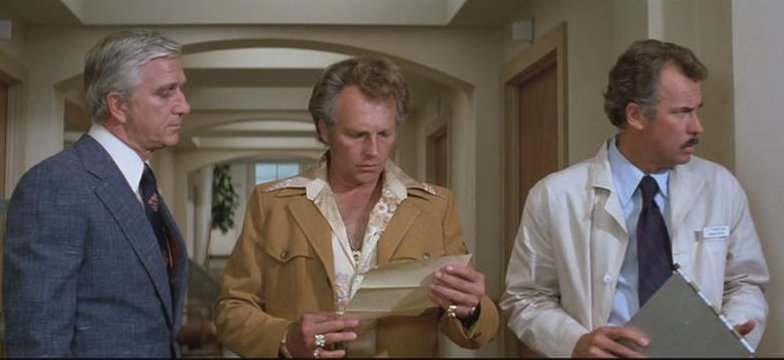
Sen. Kate Lassiter (Susan Sullivan) is visiting a cave in order to determine whether it’s safe to leave it open to the public.  Giving the senator and her group the grand tour is Gene Pearson (Dennis Cole), who is not only a park ranger but who is also Kate’s ex-boyfriend.  The question as to whether or not the cave is safe for the general public is answered by a sudden cave-in, which leaves Kate, Gene, and the others trapped.  Now, Gene has to lead the group across often dangerous terrain to safety.

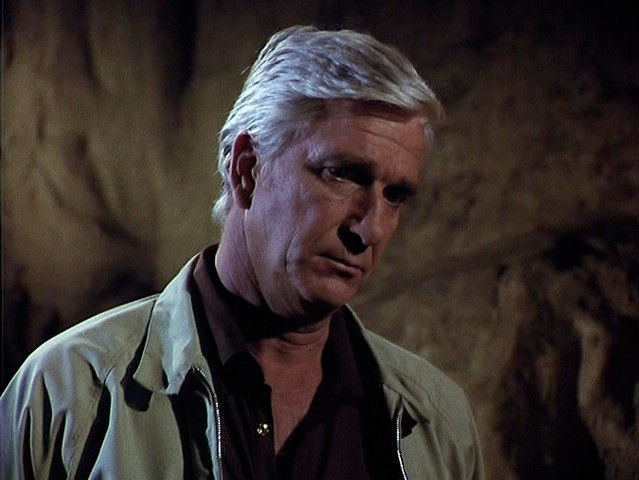
Along with Kate, the group includes a bitter cop named Joe Johnson (Leslie Nielsen!), his wife Liz (Julie Sommars), arrogant Prof. Harrison Soames (Ray Milland), and the professor’s shy daughter, Ann (Sheila Larkin).  Joe and Liz are struggling to keep their marriage together.  Prof. Soames refuses to allow his daughter to have a life of her own.  The six of them are going to have to somehow work together if they’re going to survive this cave-in!  Of course, they’re not alone.  There’s a seventh person in the cave.  Tom Arlen (James Olson) is a dangerous convict who was in the cave hiding out from the police.  Now, he’s trapped along with everyone else.

Cave-In is a pretty standard disaster movie.  Produced by Irwin Allen, it was originally filmed in 1979 but it didn’t air on NBC until 1983.  By that time, Airplane! had pretty much reduced the disaster genre to a joke.  Ironically, Leslie Nielsen himself has a starring role in Cave-In, playing exactly the type of character that he parodied in both Airplane! and Police Squad.  At the time he filmed Cave-In, Neilsen was still a dramatic actor but by the time the movie aired, his deadpan style was firmly associated with comedy.  Even when his dialogue is serious, the natural instinct is to laugh.

Cave-In gets bogged down by flashbacks.  Even though everyone should be concentrating on making their way to safety, it instead seems that they’re too busy obsessing on their backstory.  Since no one’s backstory is that interesting, the flashbacks don’t do much to liven up the film and, unfortunately, a cave-in just isn’t as compelling as a fire in skyscraper or an upside down boat.

On the plus side, every disaster movie needs an arrogant bastard who makes escape unnecessarily difficult and, in the 70s, no one played a better arrogant bastard Ray Milland.  Otherwise, Cave-In is a forgettable entry from the final days of the disaster genre.

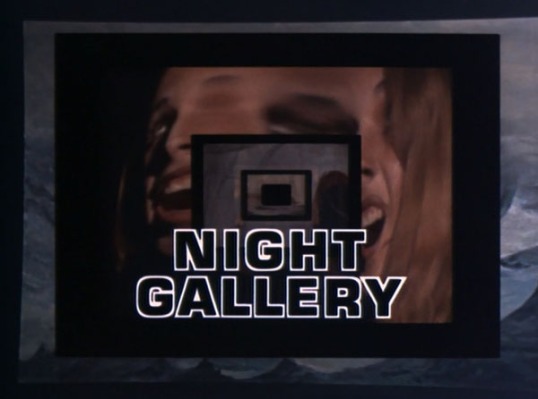
TV Review: Night Gallery 2.1 “The Boy Who Predicted Earthquakes/Miss Lovecraft Sent Me/The Hand of Borgus Weems/Phantom of What Opera?”


The second season of Night Gallery premiered on September 15th, 1971.  Once again, Rod Serling led viewers through a darkened museum, inviting them to look upon macabre paintings and imagine the story behind image.

The first episode had four — that’s right, four! — different stories!  Apparently, the show’s producers demanded that, for the 2nd season, each episode feature shorter stories along with some light-heated segments.  From what I’ve read, Rod Serling was not particularly happy with the directive and it’s perhaps significant that, after writing every story featured in Night Gallery‘s first season, he only wrote one of the stories featured in the second season premiere.

The Boy Who Predicted Earthquakes (dir by John Badham, written by Rod Serling)

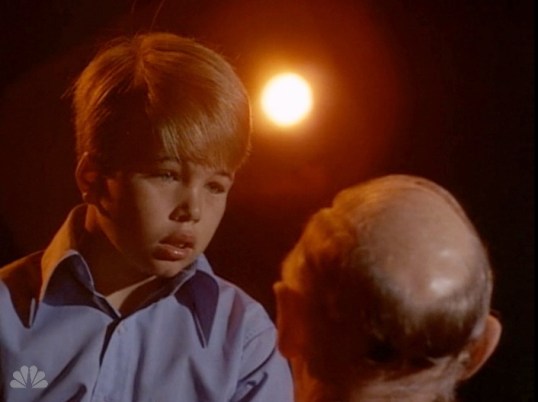
Herbie (played by 12 year-old Clint Howard, younger brother of Ron) is a little boy with a very special gift.  He can see the future.  He seems like a normal child, the type who rambles about random subjects except that, at random, he’ll suddenly stop and ominously predict the future.  After Herbie correctly predicts both the rescue of a missing girl and an earthquake, Herbie is given his own TV show.  For a year, Herbie makes predictions, all of which come true.  Then, suddenly, Herbie refuses to shares his latest prediction and says that he doesn’t want to do the show anymore.  What has Herbie seen and is it a good thing or a bad thing?

The Boy Who Predicted Earthquakes gets the second season of Night Gallery off to a good start.  Centered by a natural performance from Clint Howard, The Boy Who Predicted Earthquakes is an intelligently written and thought-provoking story.  Not only does it examine the burden of being able to see the future but it’s also a provocative look at how society exploits the gifted.  With the exception of Herbie’s grandfather (William Hansen), the people around Herbie are less concerned with what he predicts than that people keep watching.  The segment ends on an appropriately dark note, one that will keep the viewer thinking.

Miss Lovecraft Sent Me (dir by Gene Kearney, written by Jack Laird)

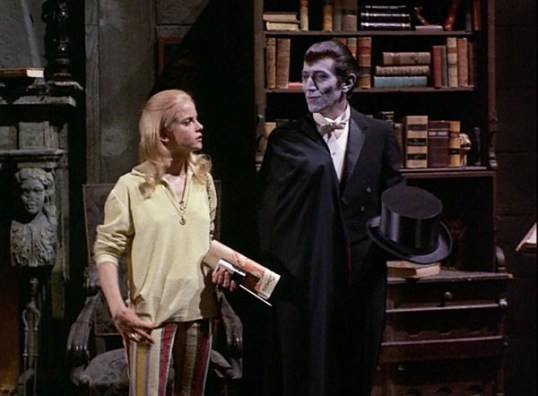
A gum-chewing babysitter (Sue Lyon) show up for her latest job.  It’s at a castle!  And the owner of the castle (played by Joseph Campanella) has gray skin, is wearing a cape, and has a Transylvanian accent!  What could it all mean?

This is a short comedic segment.  Apparently, the producer of Night Gallery, Jack Laird, had the idea to liven things up with sketches like this one.  Serling was apparently not a fan of the idea but Miss Lovecraft Sent Me isn’t that bad.  It’s silly and insubstantial because Joseph Campanella and Sue Lyon handled their roles well.  It’s impossible not to laugh when the babysitter reads aloud the names of the books that Campanella has sitting on his bookshelf.

The Hand of Borgus Weems (dir by John M. Lucas, written by Alvin Sapinsley)

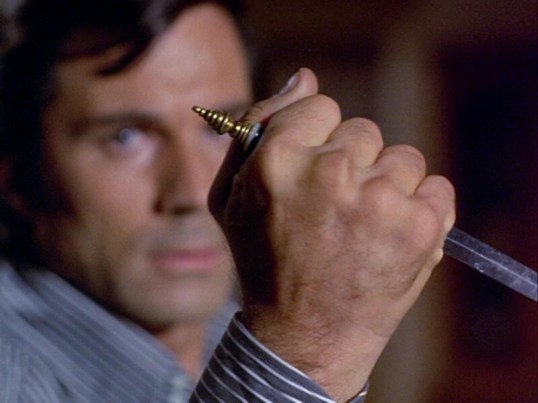
Peter Lacland (George Maharis) sits in a doctor’s office and asks Dr. Ravadon (Ray Milland) to remoe his right hand.  Peter explains that his right hand has a mind of its own and that it keeps trying to kill everyone who Peter comes into contact with.  Peter explains that his hand has been possessed!

There’s a surprisingly large number of stories out there about possessed hands.  The Hand of Borgus Weems doesn’t necessarily bring anything new to the genre and it gets a bit bogged down with its flashback structure but it’s still an enjoyably creepy little segment, featuring good performances from George Maharis and Ray Milland.  Possessed hands are also creepy, no matter what.  Like The Boy Who Predicted Earthquakes, it also has an effective ending, which is quite a contrast to the often insubstantial conclusions of Night Gallery’s first season.

Phantom Of What Opera?  (written and dir by Gene Kearney)

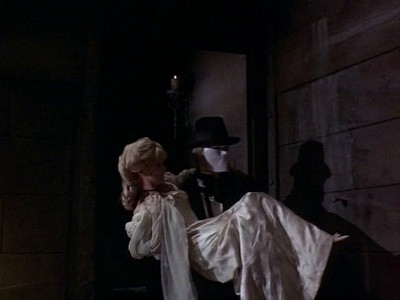
This is a short, 4-minute comedic story — a skit really — featuring Leslie Nielsen as the Phantom of the Opera and Mary Ann Beck as Christine. This version starts out like a typical Phantom segment, with the Phantom kidnapping Christine, taking her down to the dungeon, and telling her never to remove his mask.  Christine, of course, removes his mask while he’s playing the organ just for him to then discover that she’s also wearing a mask.  It all leads to love and a happy ending!  It’s kind of a sweet segment, actually.

So the 2nd season of Night Gallery got off to a pretty good start!  Would future episodes continue the trend?  We’ll find out soon as I continue to watch Night Gallery.

Previous Night Gallery Reviews:

  1. The Pilot
  2. The Dead Man/The Housekeeper
  3. Room With A View/The Little Black Bag/The Nature of the Enemy
  4. The House/Certain Shadows on the Wall
  5. Make Me Laugh/Clean Kills And Other Trophies
  6. Pamela’s Voice/Lone Survivor/The Doll
  7. They’re Tearing Down Tim Riley’s Bar/The Last Laurel

City on Fire (1979, directed by Alvin Rakoff)


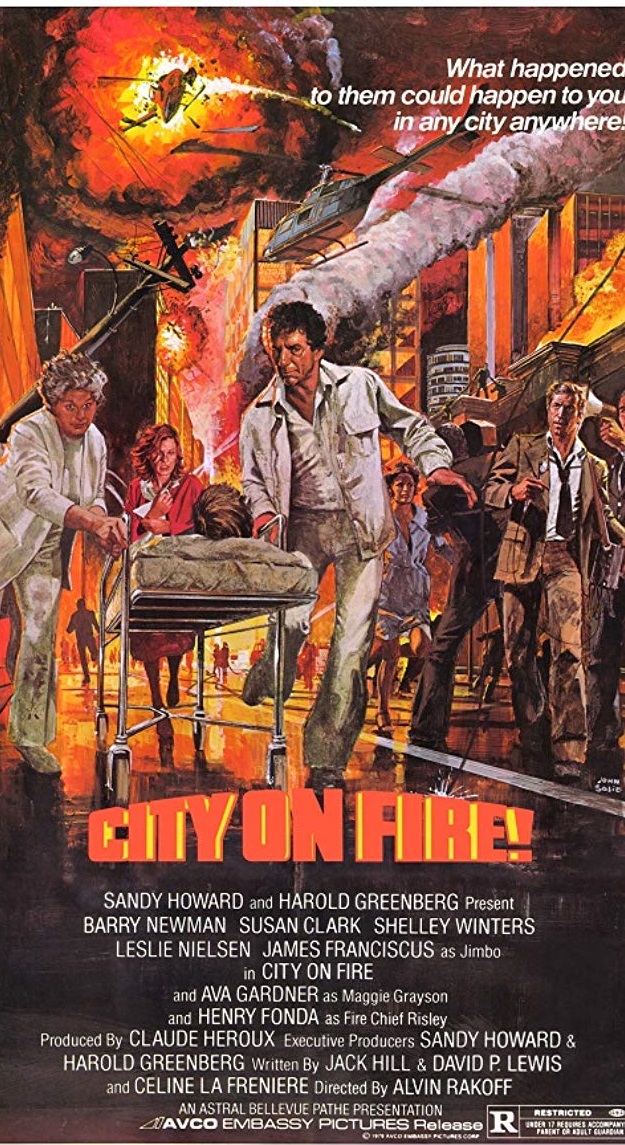
In an unnamed city somewhere in the midwest, Herman Stover (Jonathan Welsh) is fired from his job at an oil refinery.  Herman does what any disgruntled former employee would do.  He runs around the refinery and opens up all the valves and soon, the entire location is covered in a combustible mix of oil and chemicals.  One spark is all it takes for the refinery to explode and the entire city to turn into a raging inferno.

While Fire Chief Risley (Henry Fonda, getting a special “And starring” credit for doing what probably amounted to a few hours of work) sits in his office and gives orders to his subordinates, Dr. Frank Whitman (Barry Newman) cares for the injured at the city’s new hospital.  Also at the hospital is Mayor William Dudley (Leslie Nielsen) and local celebrity Diana Brockhurst-Lautrec (Susan Clark), who is having an affair with the mayor.  Diana also went to high school with Herman and he still has a crush on her.  When he shows up at the hospital to try to hit on her, he’s roped into working as a paramedic.  Also helping out at the hospital is Nurse Shelley Winters.  (The character may be named Andrea Harper but she’s played by Shelley Winters and therefore, she is Shelley Winters.)  At the local television station, news producer Jimbo (James Franciscus) tries to keep his anchorwoman, Maggie Grayson (Ava Gardner), sober enough to keep everyone up to date on how much longer the city is going to be on fire.

Mostly because it was featured on an early pre-Comedy Central episode of Mystery Science Theater 3000, City on Fire has a reputation for being a terrible movie but, as far as 70s disaster films are concerned, it’s not that bad.  The special effects are actually pretty impressive, especially during the first half of the film and there’s really not a weak link to be found in the cast.  It’s always strange to see Leslie Nielsen playing a serious role but, before Airplane! gave him a chance to display his skill for deadpan comedy, he specialized in playing stuffy and boring authority figures.  He actually does a good job as Mayor Dudley and it’s not the film’s fault that, for modern audiences, it’s impossible to look at Leslie Nielsen without instinctively laughing.  Of course, there is a scene towards the end where Leslie Nielsen picks up a fire hose and starts spraying people as they come out of the hospital and it was hard not to laugh at that because it felt like a scene straight from The Naked Gun.

What the film does suffer from is an overabundance of cliches and bad dialogue.  From the minute the movie starts, you know who is going to live and who isn’t and sometimes, City on Fire tries too hard to give everyone a connection.  It’s believable that Herman would be stupid enough to start a fire because we all know that happens in the real world.  What’s less believable is that, having started the fire, Herman would then go to the hospital and keep asking Diana if she remembers him from high school.  It’s not asking too much to believe that Diana, as wealthy local celebrity, would be invited to the opening of a new hospital.  It’s stretching things, though, to then have her deliver a baby while the hospital is in flames around her.

Coming out at the tail end of the disaster boom, City on Fire didn’t do much at the box office and would probably be forgotten if not for the MST 3K connection.  A year after City on Fire was released, Airplane! came out and, through the power of ridicule, put a temporary end to the entire disaster genre.

Viva Knievel (1977, directed by Gordon Douglas)


Last night, I watched one of the greatest movies of all time, Viva Knievel!

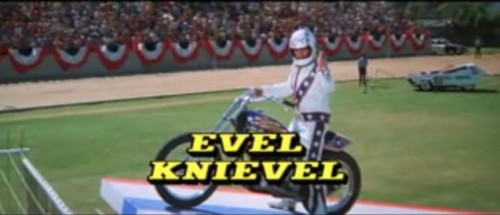
Viva Knievel! starts with the real-life, motorcycle-riding daredevil Evel Knievel breaking into an orphanage in the middle of the night, waking up all the children, and giving each of them their own Evel Knievel action figure.  When one of the kids says, “You actually came!,” Evel replies that he always keeps his word.  Another one of the orphans then throws away his crutches as he announced that he can walk again!

From there, Viva Knievel! only gets better as Evel preaches against drug use, helps his alcoholic mechanic (Gene Kelly) bond with his son, and flirts with a glamorous photojournalist (Lauren Hutton).  Evel was married at the time that Viva Knievel! was produced but his wife and family go unmentioned as Evel, Kelly, and Hutton travel through Mexico, jumping over fire pits, and battling drug dealers.

Evel’s former protegee, Jessie (former child evangelist Marjoe Gortner), has fallen in with a bad crowd and gotten messed up on the same drugs that Evel spends the entire movie preaching against.  An evil drug trafficker (Leslie Nielsen, a few years before Airplane! and The Naked Gun) pressures Jessie to convince Evel to do a dangerous stunt.  The plot is to replace Evel’s trusted mechanic with a crooked mechanic (Cameron Mitchell) who will sabotage the jump.  When Evel dies, he will be shipped back to the U.S. in a coffin and, hidden within the walls of the coffin, will be several kilos of cocaine.  Oh, the irony!  Evel Knievel, America’s number one spokesman against drugs, will be responsible for bringing them into the United States!  Can Evel thwart the nefarious plans of Leslie Nielsen while still finding time to fall in love with Lauren Hutton and break Gene Kelly out of a psychiatric ward?  If anyone can do it, Evel can.

Even Dabney Coleman’s in this movie!

From the start, Viva Knievel! is a vanity project but in the best, most loony and entertaining way possible.  There are many well-known actors in this film and all of them take a backseat to Evel Knievel, whom they all speak of as if he’s a cross between Gary Cooper and Jesus Christ.  Watching this movie, you learn three things: 1) Evel Knievel was high on life but not dope, 2) Evel Knievel always kept his word, and 3) Evel Knievel always wore his helmet.  He even makes sure that Lauren Hutton is wearing one before he takes her for a spin on his motorcycle.  You also learn that Evel Knievel liked to get paid.  He nearly beats up his manager (Red Buttons) when he thinks that he’s been cheated but they’re still friends afterwards because how could anyone turn down a chance to be in Evel’s presence?

There are plenty of stunts and jumps to be seen in Viva Knievel!, though watching Leslie Nielsen play a villain is almost as fun as watching Evel jump over a fire pit.  Judging from his performance here, Evel Knievel probably could have had a film career.  He had a natural screen presence and delivered even the worst dialogue with sincerity.   Unfortunately, three months after Viva Knievel! opened in the United States, Evel attacked a promoter with an aluminum baseball bat and ended up doing 6 months in jail.  Evel said it was because the promoter was spreading lies about him but, regardless, Evel lost most of his sponsorships and his toyline was discontinued.  Viva Knievel! sunk into an obscurity from which it has only recently reemerged.  Viva Knievel! is cheesy fun, a relic of a bygone era.  Watch it, think about whatever problems you may be dealing with in your own life, and then ask yourself, “What would Evel do?”


Dangerous Curves (1988, directed by David Lewis)


Last night, I watched Dangerous Curves.

This was a dumb, dumb film from the late 80s.  Tate Donovan and Grant Heslov star as two college students who lose a Porsche in San Diego and then have to get it back.  Fortunately, the Porsche is the grand prize in a beauty contest so Donovan and Heslov just have to hope that their friend Michelle (Danielle van Zernick) wins.  This should have been fun because it featured a hot car and several hot girls in bikinis but it also featured Tate Donovan and Grant Heslov as our “heroes.”  Donovan plays the uptight college student and comes across like one of the flunkies who helped Ted Kennedy cover-up Chappaquiddick.  Grant Heslov plays the carefree college student who constantly ruins everyone else’s life.  Neither one has the screen presence necessary to make us overlook how stupid their characters are.  On the basis of Dangerous Curves, it’s easy to see why Heslov went into producing and Tate Donovan went into doing character roles in films produced by Grant Heslov.

On the plus side, Robert Stack and Leslie Nielsen are funny in small roles.  And the car is hot and the film features as many bikinis as a typical episode of Miami Vice.  Watching the movie might remind you of the fun you had playing Grand Theft Auto: Vice City back in the day.

There’s nothing wrong with that.

Horror on the Lens: Night Slaves (dir by Ted Post)


For today’s horror on the lens, we have the 1970 made-for-TV movie, Night Slaves!

In this atmospheric film, an estranged married couple (James Franciscus and Lee Grant) find themselves in a small town.  It seems like a friendly enough place.  I mean, Leslie Nielsen is the sheriff!  How could anything go wrong in a town protected by Leslie Nielsen?

However, at night, the town changes.  Only Franciscus seems to notice all of the townspeople wandering about like zombies.  Is he going crazy or has he stumbled across something sinister?

You’ll have to watch find out!

Enjoy!

Recipe for Disaster: THE POSEIDON ADVENTURE (20th Century-Fox 1972)


gary loggins's avatarcracked rear viewer

Although 1970’s AIRPORT is generally credited as the first “disaster movie”, it was 1972’s THE POSEIDON ADVENTURE that made the biggest splash for the genre. Producer Irwin Allen loaded up his cast with five- count ’em!- Academy Award winners, including the previous year’s winner Gene Hackman (THE FRENCH CONNECTION ). The special effects laden extravaganza wound up nominated for 9 Oscars, winning 2, and was the second highest grossing film of the year, behind only THE GODFATHER!

And unlike many of the “disasters” that followed in its wake, THE POSEIDON ADVENTURE holds up surprisingly well. The story serves as an instruction manual for all disaster movies to come. First, introduce your premise: The S.S. Poseidon is sailing on its final voyage, and Captain Leslie Nielsen is ordered by the new ownership to go full steam ahead, despite the ship no longer being in ship-shape. (You won’t be able to take…

View original post 539 more words

A Horror Insomnia File #29: Day of the Animals (dir by William Girdler)


What’s an Insomnia File? You know how some times you just can’t get any sleep and, at about three in the morning, you’ll find yourself watching whatever you can find on cable? This feature is all about those insomnia-inspired discoveries!

Last night, if you were having trouble sleeping around 2:30 in the morning, you could have turned on your television, changed the station to Movies TV, and watched the 1977 nature-goes-crazy horror film, Day of the Animals!

Now, I should admit that I was not suffering from insomnia last night.  Jeff and I are currently up at beautiful Lake Texoma and we just happened to be up late last night and flipping through the stations.  I should also admit that, unlike most of the other movies reviewed for this feature, Day of the Animals was not one of “those insomnia-inspired discoveries.”

No, we had both seen Day of the Animals before.  The thing with Day of the Animals is that it’s one of those films that, if you see that it’s on TV, you simply have to stop what you’re doing and watch it.  Considering that the man had a long career in the movies and I haven’t seen every film that he made, I could be wrong on this but I am fairly certain that Day of the Animals is your only opportunity to see Leslie Nielsen wrestle a grizzly bear.

Leslie Nielsen plays Paul, a businessman who is part of a group of hikers.  Shortly before he wrestles with the bear, Paul stands, bare-chested, in the middle of a rainstorm and attempts to taunt God.  “Melville’s God, that’s the God I believe in!” Paul shouts, “You want something!?  YOU TAKE IT!”  Then he turns to one of the hikers and says, “I know what I want and I’m taking it!  I killed a man for you!”

Now, at this point, I should probably make it clear that Day of the Animals is not a comedy, though it’s always inspired a lot of laughter whenever I’ve watched it.  Day of the Animals attempts to be a very serious horror movie.  It even has an environmental message.  Because of the hole in the ozone layer, solar radiation is driving all of the mountain animals crazy.  Mountain lions attack campers.  A grizzly bear wrestles Leslie Nielsen.  A group of rats attempt to kill a policeman.  German shepherds tear a man apart.  And it’s not just the wild animals that are being affected.  Leslie Nielsen goes crazy too.

Of course, Leslie Nielsen isn’t the only hiker.  Genre vet Christopher George plays the leader of the tour and Lynda Day George is along for the ride as well.  If you’ve seen the movie Pieces, you’ll remember Christopher George as the tough cop and Lynda Day George as the tennis pro who, at one point, dramatically screams “BASTARD!” into the wind.  Susan Backlinie, who was the first victim in Jaws, also has a role in this film and that seems appropriate.  Director William Girdler found quite a bit of success in ripping off Jaws.  Before Day of the Animals, he directed Grizzly.

But good ole Leslie Nielsen is pretty much the entire show here.  He tries really, really hard to give an intense and frightening performance.  In fact, he tries so hard that you almost feel guilty for laughing at times.  But then you see that head of perfect silver hair and you hear that deadpan voice saying, “Come here, you little punk!” and you just can’t help yourself.

Anyway, Day of the Animals may be bad but I defy anyone not to watch it.

Previous Insomnia Files:

  1. Story of Mankind
  2. Stag
  3. Love Is A Gun
  4. Nina Takes A Lover
  5. Black Ice
  6. Frogs For Snakes
  7. Fair Game
  8. From The Hip
  9. Born Killers
  10. Eye For An Eye
  11. Summer Catch
  12. Beyond the Law
  13. Spring Broke
  14. Promise
  15. George Wallace
  16. Kill The Messenger
  17. The Suburbans
  18. Only The Strong
  19. Great Expectations
  20. Casual Sex?
  21. Truth
  22. Insomina
  23. Death Do Us Part
  24. A Star is Born
  25. The Winning Season
  26. Rabbit Run
  27. Remember My Name
  28. The Arrangement

A Movie A Day #128: Ransom! (1956, directed by Alex Segal)


What would you do if your child was kidnapped?

That’s the question asked in this unjustly obscure film from 1956.  Dave Stannard (Glenn Ford) is a wealthy businessman, with a beautiful wife (Donna Reed), a big suburban home, and a butler named Chapman (the great Puerto Rican actor Juano Hernandez).  One day, his son Andy (Bobby Clark) does not come home from school.  The school says that a nurse showed up to pick Andy up for a doctor’s appointment but neither Dave nor his wife know about any appointment and their family doctor says that he would never send a nurse to pick up a patient.

Andy has been kidnapped.  When the kidnappers call, they tell Dave that they want half a million dollars in ransom.  Dave gets the money together but is then told, by reporter Charlie Telfer (Leslie Nielsen), that, once the kidnappers have the money, they will have no incentive to return Andy.  Since Andy is the only person who could identity them to the police, they may very well kill Andy after getting the money.  By paying the ransom, Dave will also be encouraging other kidnappers.

The next morning, Dave goes on television and announces that he will not be paying the ransom.  Instead, he announces that if the kidnappers do not immediately return his son, the money will be given as a reward to anyone who helps to track them down.

If this sounds familiar, it’s because Ransom! was later remade by Ron Howard, with Mel Gibson as the father and Gary Sinise as the kidnapper.  (Ransom! itself was a remake of a live television drama that aired in 1954.)  As opposed to the Howard film, the original Ransom! is a low-key character piece, one that takes place almost entirely in the Stannard home and in which the kidnappers remain largely unseen.  Almost the entire movie focuses on Dave, his decision, and his struggle to come to terms with that decision.  Was Dave right or was he wrong?  Ransom! is stagey but thought-provoking with excellent performances from the entire cast.  Even Leslie Nielsen, making his film debut, does well in the type of dramatic role that defined his career until he reinvented himself as a masterful comedic actor.

They don’t make them like this anyone and that is too bad.


Horror on TV: Thriller 1.1 “The Twisted Image”


Tonight’s excursion into televised horror is the very first episode of Boris Karloff’s Thriller!

Thriller was an anthology series that lasted from 1960 to 1962.  Each episode presented a new story of horror and/or suspense.  What makes this series especially memorable is that each episode was introduced by none other than Boris Karloff!  I’ve seen a few episodes of Thriller (the entire series is on YouTube) and, to be honest, it’s kind of a hit-or-miss show.  But Karloff and that mischievous twinkle in his eye makes it all worth it!

This episode originally aired on September 13th, 1960.  It’s called The Twisted Image and stars Leslie Neilsen as a man being stalked by two mentally disturbed individuals.  This episode was well-directed by Arthur Hiller and, if it’s more of a suspense story than a horror story, it still has its creepy moments.

Enjoy!