Retro Television Review: The American Short Story #14: Rappaccini’s Daughter


Welcome to Retro Television Reviews, a feature where we review some of our favorite and least favorite shows of the past!  On Saturdays, Lisa will be reviewing The American Short Story, which ran semi-regularly on PBS in 1974 to 1981.  The entire show can be purchased on Prime and found on YouTube and Tubi.

This week, we have an anemic adaptation of a Nathaniel Hawthorne short story.

Episode #14: Rappaccini’s Daughter

(Dir by Deszo Magyar, originally aired in 1980)

This week’s episode is an adaptation of one of Nathaniel Hawthorne’s more intriguing short stories.  Giovanni (Kristoffer Tabori) is a young scholar who, in 18th Century Italy, falls in love with the beautiful and mysterious Beatrice (Kathleen Beller).  Beatrice has been raised in a garden that is full of poisonous plants that have been developed by her father, Dr. Rappaccini (Leonardo Cimino).  As a result, Beatrice is immune to the plants but she herself is poisonous.  Giovanni falls in love with her and is willing to become poisonous himself but it ultimately turns out that everything comes with a price.

Hawthorne’s short story was not only an early example of gothic literature but it was also a well-deserved parody of the nature-loving, self-righteous transcendentalists.  (The story came out at the same time as Henry David Thoreau’s Walden.)  Unfortunately, this particular adaptation really doesn’t do the story justice.  It moves extremely slowly and the performances are not particularly memorable.  Kristoffer Tabori and Kathleen Beller have very little chemistry and, in the end, the adaptation misses the satirical nature of the story altogether.  There’s a reason why Vincent Price made for an excellent Dr. Rappaccini in 1963’s Twice Told Tales.

Lisa Reviews An Oscar Nominee: Moonstruck (dir by Norman Jewison)


Nominated for Best Picture of 1987, Moonstruck is a film about love, romance, New York City, and being Italian.

Loretta Castorini (Cher) is a widow and a bookkeeper who lives with her parents, Cosmo (Vincent Gardenia) and Rose (Olympia Dukakis) in Brooklyn.  When her boyfriend, Johnny (Danny Aiello), asks Loretta to marry him, Loretta says yes even though she knows that, while she likes him, she’s not really in love with him.  After he proposes, Johnny reveals that he has to go to Sicily to see his “dying” mother.  He asks Loretta to pay a visit to his estranged brother, Ronny (Nicolas Cage), and invite him to the wedding.  Loretta, a strong believer in family and the importance of following tradition, agrees.

Loretta finds Ronny working in the bakery that he owns.  Ronny is not thrilled to learn that his brother has gotten engaged.  Ronny reveals that he has a wooden hand.  He lost his real hand when he accidentally placed it in a bread slicer while having a conversation with Johnny.  After he lost his hand, Ronny’s then-fiancée left him.  Ronny has never forgiven Johnny for the loss of his hand.  “I lost my hand!  I lost my bride!”  Ronny yells to the heavens.  Loretta, however, immediately understands that Johnny actually hurt his hand to get his fiancée to break up with him.  A conversation at Ronny’s apartment leads to the two of them impulsively sleeping with each other.  The next day, Ronny promises to never bother Loretta again if she agrees to go the opera with him.

What the guilt-stricken Loretta doesn’t know is that her father is having an affair himself and it turns out that Cosmo and Mona (Rose Gilette) enjoy the opera as well.  Meanwhile, Rose finds herself tempted by a lecherous college professor named Perry (John Mahoney).

There’s a lot of stereotypes to be found in Moonstruck.  Of course, passionate Ronny loves the opera.  Of course, the simple but well-intentioned Johnny abandons his fiancée so that he can rush to Sicily to be with his “dying” mother who, it turns out, isn’t dying at all.  Of course, Loretta slaps Ronny and tells him to snap out of it.  (I should note that I’m a fourth Italian myself so I could definitely relate to some of this film.  I’ve never liked opera, though.)  Fortunately, the film’s cast is so perfectly chosen and John Patrick Shanley’s script so adroitly maintains the balance between the broad comedy and the small dramatic moments that it doesn’t matter that all of the characters are a bit stereotypical.  The film comes to a wonderful life.  It’s impossible not love these characters, flaws and all.  Cher and Olympia Dukakis deserved the Oscars that they both won for this film.  Vincent Gardenia deserved the nomination that he received.  Nicolas Cage, Danny Aiello, and John Mahoney were not nominated but they should have been.  In particular, John Mahoney is heart-breaking in his small role, playing the type of lecherous character that most films would have just portrayed as being a cardboard buffoon.  As for Nicolas Cage, Moonstruck is a film that features both his trademark eccentricity and his ability to show the real and vulnerable human being underneath all of the bluster.  Moonstruck is a film about the search for love and the glory of finding it.  It’s a wonderfully romantic film, even if almost all of that love seems to involve infidelity.  As directed by Norman Jewison, Moonstruck not only celebrates falling in love but also celebrates being lucky enough to do so in New York City.  It’s a love letter not just to its characters but to the city as well.

Moonstruck was nominated for Best Picture but it lost to a far more epic production, The Last Emperor.


Film Review: The Man In The Glass Booth (dir by Arthur Hiller)


Who is Arthur Goldman?

That’s the question at the heart of the 1975 film, The Man In The Glass Booth.

When we first meet Arthur Goldman (Maximilian Schell), he is a wealthy businessman who lives in a Manhattan high-rise and who appears to rarely leave the safety of his penthouse.  He is waited on by two assistants, Jack (Henry Brown) and Charlie (Lawrence Pressman), both of whom he talks to and treats as if they are members of his own family.  His most frequent visitor is his psychiatrist, Dr. Weissburger (Robert H. Harris), who frequently stops by and asks Arthur if he’s been taking his medication.

Arthur Goldman is a man who loves to talk.  Indeed, the first hour of the film feels almost like a nonstop monologue on the part of Goldman, with just occasional interjections from the other characters.  Goldman was born in Germany.  He talks about how, when he was young, he and his family were sent to a concentration camp and it was there that he witnessed the murder of his father by the camp’s sadistic commandant, Dorff.  Dorff is one of the many Nazis who disappeared to South America at the end of the war.

When Goldman spots a car that always seems to be parked across the street from his building, he becomes paranoid.  He says that he’s being watched and even suggests that Dorff has come to capture him.  Instead, it turns out that Mossad come for him.  As the agents explain it to Charlie, dental records prove that Arthur Goldman is actually Commandant Dorff.  Goldman/Dorff is taken back to Israel to stand trial for his crimes.

Are Arthur Goldman and Dorff the same man?  Once in Israel, Goldman tells anyone who will listen that he is Dorff and that he feels no guilt for his actions.  He insists on being allowed to wear his SS uniform during the trial.  Because of threats to his safety, a booth made of bullet-proof glass has been placed in the courtroom.  As the trial commences, The Man in the Glass Booth continues to rant and rave and declare his guilt.  However, the prosecutor (Lois Nettleton) comes to doubt that the man is who he says he is.

The Man In The Glass Booth is based on a novel and play by Robert Shaw.  (The same year that The Man In The Glass Booth was released, Shaw played Quint in Jaws.)  The film was produced as a part of an experiment called American Film Theatre, in which well-known plays would be adapted to film and then would be shown at 500 participating movie theaters in America.  Each production would only be shown four times at each theater and subscriptions were sold for an entire “season” of films.  It sounds like an interesting experiment and the type of thing that I would have enjoyed if I had been around back then.  Today, of course, these productions would have just premiered on a streaming service.

The Man In The Glass Booth is a film that very much feels like a filmed play.  There are only three locations — Goldman’s penthouse, his cell, and the courtroom where he is put on trial.  The three act structure is very easy to spot.  Maximilian Schell’s performance is also very theatrical.  In fact, it’s so theatrical that, for the first hour or so, I found myself wishing that he would just stop talking for a few second or two.  He was so dramatic and so flamboyant and so intentionally over-the-top that he became somewhat exhausting.  But, during the second hour, I came to see that all of that “overacting” was actually setting up the film’s final act.  Schell talks so much that, when he finally does find himself unable to explain himself, it’s a shocking moment and one that perfectly captures not just the evil of the Nazis and the Holocaust but also how the legacy of that evil lives on after the fall of the Third Reich and the deaths of the majority of the Holocaust’s perpetrators.  At that moment, I realized that The Man In The Glass Booth never stopped speaking because silence would force him to confront the horrors of the past and the trauma, guilt, and uncertainty lurking in his subconscious.  Maximilian Schell was nominated for an Oscar for his performance here and, by the end of the film, I totally understood why.

The Man In The Glass Booth requires some patience.  Actually, it requires a lot of patience.  However, those who stick with it will discover an intelligent and thought-provoking film about not only the horror of the past but also how those in the present deal with and rationalize those horrors.  Though the film is a bit too stagey for its own good, it’s also one that sticks with you even after the curtain falls and the end credits roll.

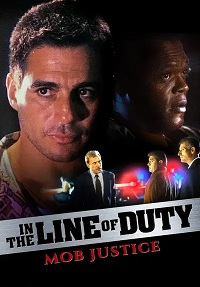
In The Line of Duty: Mob Justice (1991, directed by Peter Markle)


The fourth of NBC’s In The Line of Duty movies, Mob Justice opens with the murder of an undercover DEA agent by a low-level gangster who has just been released from prison.  While the gangster goes into hiding, the DEA mobilizes and starts to make life so difficult for all of the other mobsters in New York that soon, the Mafia is as determined to get justice as law enforcement.

This was the first In The Line Of Duty film not be directed by Dick Lowry.  Lowry’s fast-paced style is missed as Mob Justice takes forever to get going and regularly gets bogged down with scenes lifted from other mafia movies.  The old mobsters talk about the importance of family, play cards in the backroom, and eat big dinners.  Opera blares on the soundtrack when the DEA starts to harass them.  For a movie that is supposed to honor the work and the sacrifice of federal law enforcement, the DEA actually comes across as being thoroughly incompetent in Mob Justice.  A dumb mistake leads to the first murder.  A series of other misjudgments lead to the Mafia dispensing the own type of violent justice before the DEA can arrest their man.

The most interesting thing about Mob Justice is the cast.

The trigger-happy gangster is played by Tony Danza, who I guess was trying to prove himself as a dramatic actor after spending years on Taxi and Who’s The Boss but who still comes across like Tony Micelli having a bad day.  His best friend is played Nicholas Turturro, who later played a straight arrow detective on NYPD Blue.  Frank Vincent and Leonardo Cimino plays the mob bosses who knows that murdering a federal agent is bad for business.

The head of the investigation is played by Ted Levine, who has had a long career but will always be remembered as the killer from The Silence of the Lambs.  Working under him is Dan Lauria, who a generation will instantly recognize as being the long-suffering and frequently angry father from The Wonder Years.  You know that this is a big case is Buffalo Bill and Jack Arnold are working together.  (Dan Lauria actually appeared in several In The Line of Duty films, always playing different characters.)

And finally, the murdered DEA agent is played by none other than Samuel L. Jackson.  It’s never a good thing when the best actor in a movie is killed off after the first fifteen minutes.

The cast is great but Mob Justice is forgettable.  The main problem is that, after Jackson is taken out of the picture, the rest of the movie is just Danza hiding in different apartments while Levine and Lauria annoy Frank Vincent.  Danza’s murderer is never smart nor interesting enough to be a compelling antagonist and there’s never any doubt that, one way or another, he will pay for his stupidity.  There is one memorable scene where Danza freaks out while wearing a blonde wig but otherwise, Mob Justice doesn’t leave much of an impression.

Film Review: Cocaine and Blue Eyes (1983, directed by E.W. Swackhamer)


When San Francisco-based private investigator Michael Brennen (O.J. Simpson) gives a ride to Joey Crawford (John Spencer) on Christmas Eve, he doesn’t know that it’s going to lead to the biggest case of his career.  When Joey asks Michael to help him track down his ex-girlfriend, Michael assumes that Joey would never be able to pay for his investigative services.  But one week later, Michael gets something in the mail from Joey.  Inside the envelope, there’s a picture of both Joey’s ex and a thousand dollar bill.  Ever after he discovers that Joey was mysteriously killed the night before, Michael decides to take on the case.  His investigation will take him not only to Joey’s ex but it will also lead to him uncovering a drug ring that involves one of San Francisco’s most prominent families.
Simpson not only starred in this made-for-TV movie but he also served as executive producer.  Watching the movie, it’s obvious that it was meant to serve as a pilot for a Michael Brennen TV series and it’s also just as obvious why that series never happened.  O.J. Simpson was not a terrible actor but, ironically for someone who set records as an NFL player, there was nothing tough about him.  Simpson may be playing a two-fisted, cash-strapped P.I. but, in every scene, he comes across like he can’t wait to hit the golf course.  Simpson’s pleasant demeanor may have served him well in other areas of his life but it didn’t help him with this role.  Whenever Simpson has to share a scene with John Spencer, Candy Clark, Cliff Gorman, or any of the other members of this film’s surprisingly talented supporting cast, Simpson’s bland screen presence and lack of gravitas becomes all the more apparent.

Of course, when seen today, the main problem with Cocaine and Blue Eyes is that it’s impossible to watch without thinking, “Hey, didn’t the star of this movie get away with killing his wife and an innocent bystander?”  Even the most innocuous  of lines take on a double meaning when they’re uttered by O.J. Simpson.  It doesn’t help that the movie opens with Michael visiting his estranged wife and their children on Christmas Eve and getting chased around the neighborhood by a guard dog.  When the movie was made, this scene was probably included so that O.J. could show off some of the moves that made him a star at UCLA and with the Bills.  Seen today, the scene takes on a whole different meaning.

Without O.J. Simpson, Cocaine and Blue Eyes could easily pass for being an extended episode of Magnum P.I., Simon and Simon, or any other detective show from the 80s.  With Simpson, it becomes a pop cultural relic.  I don’t think it’s ever been released on DVD but it is available on YouTube, where it can be viewed by O.J. Simpson completists everywhere.

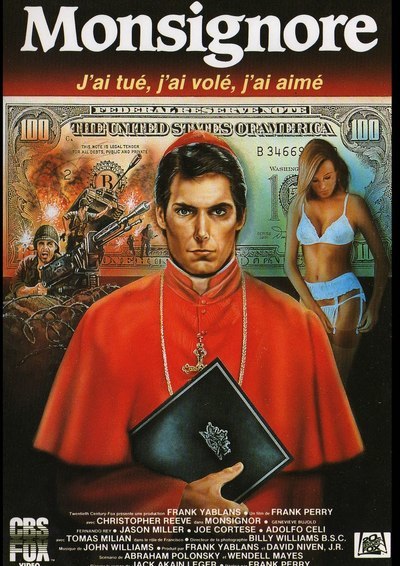
Lisa Cleans Out Her DVR: Monsignor (dir by Frank Perry)


(Lisa is currently in the process of cleaning out her DVR!  It’s taking her longer than it took Saint Malachy to transcribe The Prophecy of the Popes!  She recorded the 1982 film, Monsignor, off of Retroplex on March 8th!)

Maybe it’s because I’m a fourth Italian and I was raised Catholic but Monsignor amused the Hell out of me.

See, Monsignor is a big, sprawling epic about the Church and the Mafia.  I don’t know much about the production of this film but, having watched it, I’m going to guess that it was made by people who were neither Catholic nor Italian.  This is one of those films that is so full of clichés and inaccuracies and yet so self-important that it becomes oddly fascinating to watch.

It tells the story of Father John Flaherty (Christopher Reeve, an Episcopalian who gives a performance so wooden that one worries about getting splinters just from watching it).  When we first meet Father Flaherty, he’s just taken his orders.  He’s a good Irish kid from Brooklyn.  The neighborhood’s proud of him, because he has volunteered to serve as a chaplain in the army.  (The film opens during World War II.)  The neighborhood is even prouder when he performs a Mafia wedding.  Don Appolini (Jason Miller), who may be a mobster but who still loves the Church, is especially impressed.  He expects big things from Father Flaherty.

(The father of the bride, incidentally, is played by Joe Spinell, who played Willy Chicci in Godfathers One and Two and who achieved a certain infamy when he starred in Maniac.)

Father Flaherty goes to war and discovers that it’s not easy to be a man of God in a war zone.  Everywhere around him, soldiers are either dying or losing their faith.  (Perhaps it would help if Father Flaherty knew how to properly conduct a Requiem Mass but the movie screws that up, with Flaherty saying, “”Requiescat in pace” when he clearly should have said, “Requiescant in pace.”)   After trying, in vain, to comfort a mortally wounded man, Flaherty snaps, picks up a machine gun, and starts blowing away Germans.

Having broken the Thou Shalt Not Kill Commandment and indulged in one of the seven deadly sins, Father Flaherty apparently decides to commit every other sin as well.  Or, at least, it seems like that’s his plan.  The thing is, Christopher Reeve’s performance is bland that it’s difficult to guess what could possibly be going on inside of Flaherty’s head.  Is he disillusioned with the church or does he still have faith?  When he says that he feels guilty over his transgressions, is he being sincere or is he lying?  It’s impossible to tell because, when it comes to Father Flaherty, there’s no there there.  He’s literally an empty vessel.

That, of course, doesn’t stop him from becoming a powerful man in the Church.  Through his Mafia connections, he makes a fortune on the black market and launders money for the church.  He also has sex with a cynical, nymphomaniac postulant nun, who is something of a stock figure in films like this.  In this case, the role is played by Genevieve Bujold.  Despite the stereotypical nature of her character, Bujold comes the closest of anyone in the cast to giving a nuanced performance but her character abruptly vanishes from the film.  One can literally hear the producers in the background saying, “Okay, we’ve indulged in the sexy nun thing.  Send her home now.”

Towards the end of the film, there’s a flash forward that is so abrupt that I didn’t even realize it had happened until I noticed that Christopher Reeve and Jason Miller now had a little gray in their hair.  The flash forward doesn’t really accomplish much.  Father Flaherty has lost a lot of the Mafia’s family and the Mafia’s not happy about it.  It’s kinda like the Vatican subplot in The Godfather Part III, just with less interesting actors.

Anyway, Monsignor obviously thinks that it has something to say about both the Church and the Mafia but it’s actually remarkably empty-headed.  Strangely enough, for an epic film that cost 10 million dollars to make (that’s in 1982 money), the whole film looks remarkably cheap.  If a community theater decided to put on a production of Otto Preminger’s The Cardinal, the end result would probably end up looking a lot like Monsignor.

And yet, I really can’t hate Monsignor.  It’s so bad that, as I said earlier, it’s also oddly fascinating.  You watch and you ask yourself, How many details can one film about Catholicism get wrong?  How many Italian stereotypes can be forced into a movie with a Mafia subplot?  Now, I should point out that, at no point, does Don Appolini say, “Mama mia!” but, if he had, I wouldn’t have been surprised.  It’s just that type of film.

Anyway, Monsignor is so sordid and stupid that it becomes entertaining for all the wrong reasons.  If you’re into that, you’ll enjoy Monsignor.

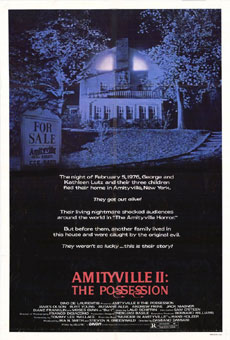
The TSL’s Daily Horror Grindhouse: Amityville II: The Possession (dir by Damiano Damiani)


amityville_ii_the_possession

Agck!

The 1982 “prequel” Amityville II: The Possession is a film that is so grimy and icky and yucky and disgusting that you’ll want to take a shower right after you watch it.  And then you’ll probably end up taking two more showers, just to be sure that you’ve washed the film away.

Seriously, this is an amazingly disturbing film.

Claiming to show how that infamous house in Amityville, New York came to be haunted in the first place, this film opens with The Montelli Family moves into a big house with quarter moon windows.  The family patriarch is Anthony (Burt Young), a former cop who walks with a cane.  Anthony is an angry monster, an abusive husband, and a terrible father.  His wife, Dolores (Rutanya Alda), lives her life in denial, insisting that a new house means a new beginning and continually praying that her family will find peace.  Anthony and Dolores have four children.  The two youngest are at the mercy of their angry father.  Teenagers Patricia (Diane Franklin) and Sonny (Jack Magner) are both looking forward to the day that they can escape their family.

As soon as the Montellis move in, strange things start to happen.  It turns out that there’s a strange tunnel in the basement, one that appears to lead to nowhere.  When obscene messages appear on the walls of the house, Anthony starts to beat the youngest children but, fortunately, Sonny grabs a rifle and points it at his father’s head.  When the local priest, Father Adamsky (James Olson), shows up to bless the house, he ends up getting so disgusted at Anthony that he leaves without finishing.

In fact, Father Adamsy is a remarkable ineffectual priest.  When he attempts to talk to Sonny, he simply assumes that Sonny isn’t talking because he’s rude.  What Adamsky doesn’t suspect is that Sonny’s being rude because he’s been possessed by a demon for the basement!  When Patricia confesses that she and Sonny have been having sex, Adamsky doesn’t do anything about it.  When Patricia tries to call him to let him know that her brother appears to be possessed, Adamsky refuses to answer the phone and instead goes skiing for the weekend.

And, of course, while Adamsky is gone, Sonny grabs that rifle and, in a nightmare-inducing series of scenes, kills everyone in the house…

Of course, when Father Adamsky returns, he feels guilty and he decides to perform an exorcism.  MAYBE HE SHOULD HAVE DONE THAT EARLIER!  But no … he had to go skiing…

Anyway, Amityville II: The Possession is a deeply icky film.  It’s undeniably effective and has a lot of scary moments but it’s not an easy film to sit through.  Between Anthony beating his family and Sonny walking into Patricia’s room and asking her to “play a game,” this is a film that really gets under your skin.  You’ll never forget it but, at the same time, you’ll also never want to watch it again.

Interestingly enough, Amityville II was directed by Damiano Damiani, an Italian director who is probably best known for movies like A Bullet For The General and Confessions of a Police Captain, genre films that often featured a subversive political subtext.  Though Amityvile II is not overly political, the film’s portrait of the suburban Montelli family as a ticking time bomb does definitely fit in with Damiani’s other work.  Damiani reportedly set out to make the most disturbing film that he possibly could and he succeeded.

Back to School Part II #6: Jeremy (dir by Arthur Barron)


Jeremy

After I finally finished working out my thoughts concerning A Clockwork Orange, I continued my back to school reviews by watching a 1973 teen romance called Jeremy.  I have to admit that it was kind of a shock going from Stanley Kubrick’s confrontational masterpiece to this rather gentle and sweet-natured film about two nice kids who fall in love.  But that’s one of the things that I love about reviewing movies.  You get to see all sorts of things.

As for Jeremy — it’s a film that tells a familiar story but it doesn’t quite go in the direction that you’re expecting.  15 year-old Jeremy (played by Robby Benson, who was apparently the Justin Bieber of his day) is a 15 year-old student at a private high school in New York City.  He’s a brilliant but painfully shy student.  He’s very serious about learning the cello, even though his teacher (Leonardo Cimino) tells him that he’s good but he’ll probably never be great.  He’s also really into horse racing, though he never bets himself.  Instead, he just likes to pick the winner and is content with the knowledge that he was right.  Jeremy is largely ignored by his parents and has only one friend but he seems to be okay with his largely solitary life.

That is, of course, until he spots Susan (Glynnis O’Connor) practicing ballet in a classroom.  Jeremy is instantly attracted to her and it’s obvious that she likes him as well but, because of his pathological shyness, Jeremy cannot bring himself to ask her out.  (In fact, he even forgets to ask her name the first time that they meet.)  It’s not until Susan compliments him on his cello playing that Jeremy is able to work up the courage to ask her out.  It’s not that Jeremy is arrogant or stand-offish or any of the other stuff that people regularly say about shy people.  It’s just that talking about his cello gives Jeremy the courage to be himself.  It’s rather sweet, actually.

Jeremy and Susan go out for three weeks and, in a tastefully handled scene, even end up making love for the first time.  However, Susan’s father has been transferred to another city and Susan is about to move away.  Even when Susan and Jeremy say that they’re in love, all of the adults ignore them.

At this point, I was expecting Susan and Jeremy to enter into a suicide pact but it didn’t happen.  That’s not the type of film that Jeremy is.  Jeremy is a very sweet but ultimately realistic film about first love and first heartbreak.

As for the two lead performers, they apparently dated for a while after making Jeremy and they both display a very real chemistry in the film.  Admittedly, there’s a few scenes where Benson goes a little bit overboard but, watching him, I could tell why he was a teen idol in the 70s.  There’s not a threatening or dangerous thing about him and when he’s insecure or sad, you just want give him a big hug.  Glynnis O’Connor brings a bit of an edge to Susan (there always seems to be a poignant sadness right under the surface when it comes to Susan) and it contrasts nicely with Benson’s performance.

In the end, it may not add up too much but it’s heartfelt and nicely done and I’m glad that I watched it.

http://www.youtube.com/watch?v=jLi-oAbkEHQ