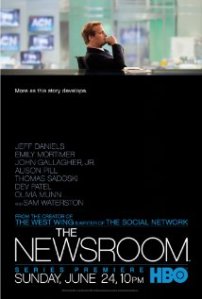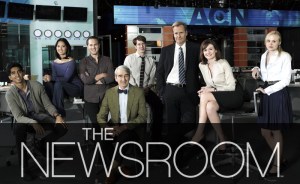
Review: The Newsroom S1:E3 – “The 112th Congress”


Though I’m a registered Democrat (which I did before realizing I could be Independent) and my family’s mostly Republican, Politics tend to make my eyes glaze over and a lot of it goes over my head. My reasoning is that no matter who you have in office, neither side has everything right and you’ll find corruption and/or underhanded deals no matter what side is chosen. It’s because of this that makes The Newsroom a little difficult for me to write about from a political standpoint, but on an entertainment standpoint, I’m having fun. This show is getting a little tighter with every episode.

This episode, titled “The 112th Congress”, opens with a statement taken from the 9/11 Commission back in 2004. Will makes an apology to the American viewing public on the way News Night has been, stating that they failed to give the right news – “A leader in an industry that miscalled election results, miscalled hyped up terror scares, ginned up controversy, and failed to report on tectonic shifts in our country”. Will stresses that they will be concentrating on giving the news, and opinions that also contrast his own. I liked the way this scene moved, jumping back and forth through the events of writing out the speech, getting everyone up for their morning meeting, cleaning it all up and providing it to Charlie before the actual broadcast. This is all while the speech is given. The opening editorial lays down the template to the News Night viewers on where it’s headed.

The following scene is a conference room with Charlie, Reese, another associate and Leona (Jane Fonda) in a debriefing meeting on the News Night changes. This takes place on November 3rd, 2010. The show moves to this location, the Bigwig Conference, a number of times as we go over the months since NN2.0’s inception. I have to admit I really liked the movement of the scenes back and forth here. Don approaches Jim and gives him a little flak on why he wasn’t in the loop on Will’s speech, given that his own show that comes afterward is also trying to be the one to move up to that treasured 8pm slot. Don also has something of an issue with Maggie on this as well, but it only lasts for a moment.

Reese goes on to mention that since the News Night change, Will’s lost about a good 7% of his audience. Though they’re doing what they feel is the right thing, it is costing them from a viewer’s standpoint. I liked how Leona really doesn’t speak up until the middle of the episode, her character just kind of taking in all of the information that’s given.

There’s a very interesting conversation between Will and Charlie, talking about the changes in the Tea Party’s progression. Granted, this all requires first level research for stronger opinions & statements to be formed, but from the way The Newsroom presents it (and my interpretation of it), the Tea Party kind of swooped in and changed the Republican landscape (or was at least trying to at the time) for their own pursuits. That Will, being a Republican himself, decides to make this the top story felt like it added to the “all the facts” angle the NN2.0 was shooting for. For the record, were he a Democrat, I’m pretty sure that they could have done the same thing for that party, using a story on gun control or something like that.

Getting back to the story, it’s revealed in the Bigwig conference that Will is treating his interview subjects like members in a courtroom and that at one point in his life, he was a prosecutor. I liked this, but the information seemed sudden to me, as if Sorkin and crew were in their writing room and the question came of “Well, how is Will so good at this?”, and they came up with the lawyer angle. Then again, to counter that, we learned 4 episodes into Mad Men that Don Draper’s name wasn’t his and his past wasn’t his either. I suppose it makes sense here too.

Mac meets one of Will’s new dates and overreacts a little with the compliments, inquiring on who she is. Turns out that the lady works for the New York Jets as a choreographer. Mac and Will move to Will’s office, where she berates him on his dating choice for the evening. There’s a bit of cute back and forth banter before she nearly storms out and Charlie catches her, telling them both the keep up what they’re doing with the Tea Party pressure. Will asks how the 44th floor (The Bigwig Conference) is handling this, and Charlie lies to him about it. Undoubtedly, this will end up being a problem later on in the season. The relationship angles still appear a little blurry. We learn that Maggie’s issues are attributed to Panic Attacks, which opens a nice scene between she and Jim on the terrace of the building. I already touched on the Sorkin Girls in the last episode. I’ll let it go here, but it does kind of show why she’s been the way she’s been. The problem here is that with the forward momentum the scene made, it takes two steps back in having her with Don still by the end of the episode. I’m not saying they should be in each other arms by now, but I wouldn’t mind seeing thing forward just a little more.

The story moves ahead to June 18, 2010, where Will goes after a senator regarding statements made on AIDS and it’s spread. The Bigwigs are not pleased at all on this. After the broadcast, Mac finds another date waiting for Will, who Will points out is an actual brain surgeon. That was actually worth a chuckle, indeed.

At the Bigwig Conference, Reese points out that there was a party every year he and his mother were invited to at Telluride that they didn’t receive an invite for this time around. Reese points out that Will’s broadcasts has cost them Koch Industries, which happens to be close to the Lansing’s (Reese and Leona).

Near the end of the Bigwig Meeting, Leona finally speaks up, letting Charlie know that Will needs to back off as the parent company, AWM has special interests with of the parties that Will has been attacking. Leona threatens to fire Will, which of course would be a problem due to a special clause in his contact that prevents him from working for 3 years. That was kind of cool, reminding me of what happened with Conan O’Brien when he left NBC. So now, the stakes are raised. Do they continue doing what they’ve planned and face being fired or revert back to the old format?

While I still have the same complaints as before (Sharpen up the girls, etc.), the episode ramped up things with some of the actual broadcasts that were done. The Bigwig Conference scenes were some of the strongest parts there, I felt. We’ll see where this all goes.

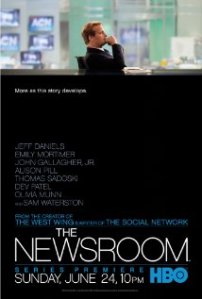
Video Game Quick Review: The Amazing Spider Man


Rocksteady changed things with 2009’s Batman: Arkham Asylum. As a brand new IP, it’s starting to become the template for a few popular games. Beenox has noted that the game was an influence on their “The Amazing Spider Man” game, and it really shows. Eidos’ Hitman:Absolution will also be working off the same engine (if not a similar one).

Before playing Activision and Beenox’s “The Amazing Spider-Man”, you should first know that it takes place after the events of the Marc Webb’s film that opened recently. Playing the game will give away major plot points from the film, but visually, it’s quite a treat. Unlike the other Spider-Man related tie in’s, this game doesn’t feature the voices of the movie cast. I was kind of hoping that it would, really.

Activision, along with Treyarch, created all of the movie related Spider-Man games (which I’ve owned), and by far, I’ve always thought of Spider-Man 2 as the best game in the franchise. The control in that game, which allowed you to shoot separate weblines from each hand, was amazing. It allowed you to pull off some incredible turns mid-swing and if timed just right, you could pull off sideways swinging. Beenox decided to change the style of the game, focusing on more of a Parkour-style swinging dynamic. This adds two great touches:

The “Web-Rush” system allows you to pick predesignated places for Spider-Man to go at any time. Once chosen, the game will take the quickest route to that target, even if it means Spider-Man has to bounce from Building A, hop off the fire escape of Building B and flip over some cars to get there. The Web Rush system also works similar to Batman’s Detective Mode in the Arkham games, allowing you to lock onto targets of attack, object to grab and use against your enemies. In flight (or fall, however you choose to look at it), it slows down time to allow you to select your destination. It makes it all look very beautiful and stylish, but also manages to take away the effort required to make it happen. It’s not a terrible thing at all, but I suppose it could be compared to Assassin’s Creed vs. Mirror’s Edge. Both games have you climb a building. Assassin’s Creed uses one button to get you to the top. Mirror’s Edge requires a number of calculated button presses to do the same thing. The reward is different, and I tend to prefer the latter. Still, it’s very fun to use, especially in close quarter interior battles. You can leap backwards to the ceiling and then advance right back to the enemy with a button press.

The controls are incredibly easy to access. Climbing a wall is as simple as pushing against it, and you can alternate between climbing and “perching” against any sideways wall. This turns the camera back to it’s original state to give you an idea of where you are as you move.

The camera is closer to Spider-Man overall, so you get a better sense of vertigo during swinging. You aren’t able to do any acrobatics while swinging, but that free fall experience is still there. It’s definitely beautiful. You can literally spend your time swinging all across the city all day. Note that the map is condensed, compared to Spider Man 2, which also contained part of Queens. Considering all of the graphical data that had to be generated, I can understand shrinking the map.

Collector Fiends will love that there are almost 700 comic book pages floating around the city, similar to the feathers in the Assassin’s Creed games. Collecting enough of these will unlock actual viewable versions of classic Spider-Man comics. XP gained from collecting these, along with taking out bad guys via the main storyline or the random crimes that occur in Manhattan will allow to unlock new moves and stealth actions for the old webhead. At one point, you’ll also obtain a camera that will allow you to take pictures around the city. It would have been nice if there was a way to capture screenshots of yourself swinging, but I’ll take it.

Stealth is a new factor in this game, a carryover from the Batman games. Spider-Man has the ability to now climb above and behind bad guys to web them up and get them out-of-the-way. It works to some degree, though some bad guys move in such tight nit groups that it’s hard to get them away from each other to take them out. You’ll be able to stealth eliminate two at a time (with an upgrade), but the rest of the group sees this, you’ll be under attack. Bad guys range from normal thugs to some monsters to even giant robots, which are pretty fun.

The problem with The Amazing Spider-Man is the same problem that plagued all of the other free roaming versions of the game. The mini crimes are so predictable and monotonous that you’ll probably end up getting bored doing them. They literally are all the same ones from the original Spider-Man game, though cleaned up a bit.The web swinging and comic page collecting will make up for it, but I’m not sure if any game developer can find a better way to make the city defending elements better than what they are.

Overall, The Amazing Spider-Man is a fun game to try out, and the reply value is okay in the sense that you can just pick it up and go, but like every other game in the series, it still requires a few tweaks. The game is available for all the console systems.

Scenes I Love: “The Orange Man” from Unbreakable.


There’s a part of me that really wants to see M. Night Shyamalan come back into his own again. I think somewhere between The Village and Lady in the Water, he started this strange descent. But back in 2000, he had “Unbreakable” which wasn’t bad at all. The story of a man who discovers he has abilities far beyond normal people, Unbreakable could be considered one of the first ‘every person superhero’ films. As with some origin stories, Unbreakable’s David Dunn has to come to terms with what he can do. Once he’s put on the path by a Comic Book aficionado (played by Samuel L. Jackson), he heads off to do some good.

The above is David Dunn taking down a home invader with a simple choke hold. Enjoy.

The first time I saw this scene was on DVD, with my little brother. This part in particular left us with smiles. It’s not so much what takes place, but the music behind it. James Newton Howard’s score takes what would normally be a quick action theme (for a story like this) and uses a dramatic piece to cover the scene. I thought it worked really well here. It also reminds me that as he wasn’t working on The Dark Knight Rises score with Hans Zimmer, you might not find a lot of those softer themes. Then again, with Gotham in turmoil, maybe that’s not the kind of music it needs right now.

Review: The Newsroom S1:E2 – “News Night 2.0”


After seeing the second episode of The Newsroom, which is my first Aaron Sorkin show experience, I’ve learned four things:

1.) In the Sorkin Universe, guys may be asses, but girls seem to make all the huge mistakes.

2.) Everyone is just one moment away from emotionally exploding.

3.) The “Walk and Talk” gets things done.

4.) There are very few moments of silence.

Okay, here we are with the second episode for The Newsroom. This one appears to be tighter compared to the pilot episode and an overall improvement from that, though it still has it’s problems. The episode overall is about the construction of News Night 2.0, the revised version of the broadcast that will concentrate on giving the news and not letting the ratings control the content. It’s a great plan, but issues do arise. Charlie (Sam Waterston) has to warn one of Will’s colleagues, Reese (Chris Messina) about giving Will the numbers on the ratings. As Will is a big fan of the ratings, Charlie fears that this will sway him from following the new broadcast process. Reese explains that he’s not the bad guy, but is only giving Will what he wants. Despite the warning, he still speaks with Will in a later scene.

That I liked, the notion that Will is still laboring under the belief that he should shoot for the news that people want to hear versus the news they should. This episode was partially supposed to show how going against that process didn’t work out for him and should ground him going forward. In some ways, I think it succeeded. The News Night Team is trying something different, but in order for that to work, everyone has to be on board. By the end of the episode, you come to find out who’s with Mac on this, and who’s against it. I’m loving where the show is going on that front.

We now have our antagonists in Reese, who wants Will to keep the old format going and we have Don. Don is staying with the NewsNigh Team to make sure the transition goes well, but at the same time, is rooting for Will to fail because it puts his new show in that prized time slot. I’m under the impression that later on, we’ll see both of these individuals trying to sabotage things.

Here’s what worked for me:

The Introduction of both Reese and Sloan. Both Chris Messina and Olivia Munn had some good scenes in the episode. They both appeared to be even keeled for the most part. Reese’s “walk and talk” with Will was nice, though in doing a bit of research, I’ve discovered it’s bit of a Sorkin staple.  Olivia Munn’s character, Sloan Sabbith is introduced when Mackenzie hires her to perform the Financial News segment to start before Will’s broadcast. I’m hoping her character gets some more time in. Of course, I’ve been a fan of Olivia’s for years, so there’s some bias there, admittedly. It’s cool seeing how far she’s come. Sabbith also happens to be one of the only girls who hasn’t had some kind of serious emotional crash, yet (and that’s still questionable).

More pop and zip. Overall the episode moved very well. I didn’t get the feeling of slowdown from the pilot, with it’s empty areas and all the time spent trying to figure out who was what. It was basically, “What’s our show?”, “Who do we need to get it going?”, “Oh damn, we messed up!”, “The Broadcast”, “The Aftermath”. I wouldn’t mind seeing that template keep going. By the time we reached Will’s actual broadcast, I was all smiles. It’s quick, to the point and there’s just never a quiet moment. Everyone has something to say to fill in the space, all the time. I wish I could write the dialog in my fiction like that.

And then there’s the one glaring problem:

Women are Always the Source of the Issue in a World Where Men Seemingly Do No Wrong. During last year’s Oscars, Lisa Marie and I got into a debate over her hatred of Sorkin and my love for The Social Network. We agreed to disagree that he can do dialog and that he kinda, sorta, maybe has a problem with writing women. I was pretty sure I won that argument when Sorkin accepted his Oscar – I was rooting for him to win. This episode, however had me face palming myself, like a PR agent watching their star client mess up with everyone watching.

Again, where Sorkin excels in dialog and moving that forward, the girls get the short end of the stick. Every mistake and problem that occurs in this episode is the direct result of something a girl should have done or didn’t do or blew out of proportion. The flow moves in this pattern:

1.) Girl makes big mistake. As her Superior Male supervisor is going to blow up because of it, she loses her mind in a theatrical fashion. (Both Maggie and Mac do this to great effect, it’s like they haven’t had tea or something.).

2.) Girl gets verbally chewed out by Superior Male. This also seems to happen publicly where people can see it.

3.) Girl apologizes, kowtows and hopes the Male she works for doesn’t look bad because of her actions.

It may sound a little exaggerated, but it’s there. Now you may say, “Len, that’s not right. The girls are on equal footing with the guys. And you’re a guy, it shouldn’t matter, should it?” Perhaps it shouldn’t, but as someone who prefers seeing women in media that don’t complain about broken fingernails, The Newsroom still needs improvement on this level. I can’t claim to understand women in the slightest, but I’ve seen and have known tons of them that just aren’t this…submissive, for want of a better word. Case in point – It’s stated that Mackenzie McHale was a journalist in war-torn areas for a long time. Yet, in the Newsroom, she comes across as being particularly clumsy and high-strung. I would have expected a calmer person, kind of a like a Kathryn Bigelow. Could you imagine Mac, the way she is in the Newsroom, being as effective in a warlike environment? That bothered me a bit, honestly. If Sorkin could fix that one part, he’d be downright perfect. It has me wondering what the first show he doesn’t write will be like. That this has become the only problem for me says a lot for how much better the show’s done in these two episodes.

So basically, I’m loving where the show is going, but it needs to up the girl factor. I’m hoping Sloan may be that factor. For the next episode, I’ll try not to be issue like a dead horse, but if they keep giving me the ammo, I’m be tempted to fire off a round or two.

Quick Review: The Newsroom (S1:E1) – “We Just Decided To.”


Quick story before the review. If you’d like to skip this, just scroll down a bit.

About a month before The Social Network came out, I was able to catch a special sneak preview of the film in Manhattan. The preview was special because after the film, Sony planned to have a Q&A session with some of the stars. While waiting on line and listening to some of the conversations, one person pointed out that they were waiting to see Aaron Sorkin.

“Excuse me, who?” I asked. The name didn’t ring any kind of bells with me. No Ratattouille – light in front of my eyes or anything.

“Sorkin. The West Wing.” She said.

“Ah, I’ve heard of that, but never saw it.” I said.

“A Few Good Men?” she added.

“Ah, I see!” I exclaimed, smiling. My sister and I loved that movie.  She actually memorized the “You can’t Handle the Truth” speech, we liked it so much. Okay, I had a handle who this was.

When the movie ended, we were presented with Armie Hammer, Andrew Garfield, Jesse Eisenberg, Olivia Munn, and Aaron Sorkin, seated in front of the audience. Being in the third row, they were all in hitting distance of my soda. The Q&A lasted for about a half hour or so. Walking out of there, my thoughts were that Aaron Sorkin was just a writer. By the time I got home and hit the internet, I found out that opinions on him, however, were polarized. It’s kind of interesting when all you have to do is throw out a person’s last name to start anyone talking. His work was either really revered or spat upon like a leper. I hadn’t seen anything like it since Joss Whedon, who’s writing I never knew of during the Roseanne years, absolutely could not stand during the Buffy years, and who finally won me over after seeing early morning episodes of Angel on TNT as the show was ending its main run.

So, that’s where I stand with Sorkin. He’s not a “Writer That Can Do No Wrong”, but I’ll admit that I like the conversational style he uses for characters. It’s almost similar to David E. Kelley’s work in a way. It’s not always required and can sometimes hinder things – Matthew Weiner is a good example of someone who does just fine without the tommy gun speeches – but it does work when it needs to.

My Thoughts (Where the Review actually begins…): 

The Newsroom starts out with a televised interview where a number of people are arguing politics back and forth. Seated between them is Will McAvoy (Jeff Daniels), who doesn’t have much to say, but listens. As he does so, he has a moment where he kind of zones out when he notices a woman up in the stands. This gives us a hint to the vertigo issues he supposedly has. When asked why he thinks that America is the greatest country in the world, he notices the same girl who holds up a notepad reading “It’s not, but it could be.” Will chooses to give an even keel answer, but when forced to give ‘a human reaction’, he admits to not feeling that America’s all that. He loses it, stating that even though we proclaim ourselves to be the only free country in the world, there are tons out there. “Canada has freedom! Japan has Freedom. Belgium has freedom!”, he rattles off. He points out that the only thing America really is good at is having a high incarceration rate, for the most part. He then goes on to add the good things the country did over the years. Once the interview ends and he leaves, he turns to his colleagues and asks “What did I say out there?!”

And that was all before the opening credits. I thought that was a good way to start. Definitely a hook, though the responses overall to the scene could be interesting.

Will returns into work the following morning to find most of his staff missing. After a conversation with Maggie (Allison Pill), he finds out he needs to speak with his superior, Charlie (Sam Waterston). I like Allison Pill as an actress. She was great in The Pillars of the Earth, but here is where Sorkin kind of stumbles. Granted, her character is handling being newly promoted to a position she isn’t ready for, but she’s almost too jittery. She’s almost a ball of nerves. It’s the Winifred Burkle / Lexi Grey / Ally McBeal archetype of the “New Girl with a Lot on her Plate”. Before you start in on me, take a look at the first season of Weiner’s Mad Men and you’ll see an example in Elizabeth Moss that’s handled stronger than Pill’s character is here. It’s almost the same situation, but where Moss’ character finds small ways to stand on her own, Maggie’s just a little lost. I’m hoping that in future episodes, she’s able to shake that and come into her own.

We’re also introduced to some of the other characters that run the Newsroom. You have Don (Thomas Sadoski), Will’s former Associate Producer and Neal (Dev Patel), who is the resident tech analyst. We find that Charlie has brought on Mackenzie MacHale (Emily Mortimer) on as the Executive Producer, who Will has a serious problem with. Most of the episode is spent in Will’s office, arguing over how we can do better, and how he has the opportunity to make the news show stronger than what it was. Personally, I felt there were more interesting things going on outside of Will’s office then in it. At one point, a news blip comes in (courtesy of an iNews like program, which was nice), which touches on the start of the oil spill in Louisiana in 2010. It’s then that we’re told this is the time period we’re in. The show begins to accelerate and by the time that Will is actually on air, we get the notion of what the show could be if they rubbed out a little of conversations in between. That was very cool, like watching a submarine crew at work. The newscast scene is actually the strongest part of the episode overall, and Sorkin’s machine gun style dialogue helps there a lot, I felt. Dialog, he can do.

The only problem is for me is that we’re locked to this one location. It’s like watching a play unfold.  You’re in one location, and all of this information comes in. It’s discussed and action’s taken, but I didn’t get the feeling that the characters were growing or had room to. Let me put it this way. The star of the show isn’t any one person. It’s the News desk. The most important part of the show happened at the News desk, and while that was great, I’m thinking that for the characters involved, where are the subtle changes?

Here’s the thing (and I go to back to Mad Men, which I’ve also started watching from the beginning). By the end of the first episode of that show, you come to find that it’s main character, Don Draper, changes. You’re shown details that shape his attitude and come to find that he’s not the picture perfect fellow you may have thought he was. I didn’t get any of that with this episode of The Newsroom. I’m eager to see where it goes, because I like what’s being said, but I haven’t hit a point where any one of these people – even Will – is someone I feel I could hook on to. There’s always at least one character that stands out in a show for me – whether it’s Aaron Paul’s Jesse Pinkman in Breaking Bad or Andrew Lincoln’s Rick Grimes in The Walking Dead. I’m hoping that something changes here to help me find that. The only hint of growth or personal reflection seemed to come at the last few minutes between Mac and Will, when he discusses the conversation he had with her father. That, I would love to see more of.

Overall, the Newsroom isn’t a bad show. It kind of moves like a pilot should, a one shot that has to hit the audience with it’s strongest punch to make sure they’re hooked, while at the same time trying to plant seeds for future episodes. It does what it tries to – give the news – but I walked away feeling like I visited this business, watched what went on and then promptly left with only the mildest of introductions to the staff. I don’t really know anyone here.

It can definitely be improved upon, and it’s all the start of something. I’m just not exactly sure I know what that is.

Quick Review: Brave (dir. by Mark Andrews & Brenda Chapman)


Brave already has a great review by Lisa Marie, check it out to get another insight into the film. One of the great things about the Shattered Lens is that even if a movie’s been reviewed once, another review can create a review as well.

Before Brave starts, Pixar presents their Oscar Nominated short film, La Luna, directed by Enrico Casarosa. La Luna is a simple piece about a little boy (Bambino) on a tiny boat who is taking on the Family Business. Sitting with his father and grandfather, they watch as a full moon rises high in the sky above them. Setting up a ladder, Bambino heads up to the moon, to find it littered with tiny glowing stars. The trio act as cleaners of the Moon. It’s a cute little story that for me, anyway, makes me smile when I look up at the Moon. I’m hoping Pixar maybe considers making a best of video with all their mini stories.

Brave is the story of Merida (brilliantly voiced by Boardwalk Empire’s Kelly MacDonald), a young princess in what appears to be Scotland, who is due to be married off to one of the children of her area’s neighboring lands. Granted, this isn’t something she’s looking forward to, as the wedding plans are being set up by her mother. Honestly, in watching Brave, I got the feeling that Merida really wasn’t into any of the Princess things she was supposed to be following (“No weapons on the table.”, “A princess is proper”, etc.), she seemed to just enjoy her freedom of being a young woman, of just living her life.

Brave marks the second film that wasn’t directed by one of the Pixar Majors (Pete Doctor of Monsters Inc., John Lassiter of Toy Story and Cars, Andrew Stanton of Wall-E, Finding Nemo and John Carter, and newcomer Brad Bird  of Ratatouille and The Incredibles), the first being Toy Story 3. With all of the staff that Pixar has, it makes sense that eventually, the Pixar Babies would have to step up and try their hand at feature films – even if this means that Pixar breaks their streak of great animation and filmmaking.

If Brave is any indication, Pixar is in very good hands. Directors Brenda Chapman and Mark Andrews carry Chapman’s story far better than Lassiter did with Cars 2. It’s the story of a daughter, her mother and the connection between them. It’s of wanting to follow your own path vs. the paths that others want us to follow, and it manages to do all of this effortlessly. Like Tangled, our heroine takes charge of her own path, even if it means stumbling here and there. What makes Brave even better (and what my Mom would personally enjoy) is that Merida, much like Drew Barrymore’s character in Ever After, doesn’t need any guys rescuing her from her situation, save for perhaps one key moment that doesn’t count only because it’s family oriented anyway. There’s a great sense of strength in the character.

When Merida decides to fight for herself in an Archery test to ward off the would be suitors,  she gets into a huge argument with her mother (Emma Thompson), that ends up with some harsh things being said. Merida eventually finds her way to a witch who lets her change her fate. Like Disney’s Brother Bear, the change in question is that her mother is turned into a bear. With Merida’s father (voiced by The Boondock Saints’ Billy Connolly) swearing vengeance against the black bear that took of his leg, Merida and her mother have to both keep away from him as well as fix the relationship between them or else the mother will stay a bear, forever.

This is where Brave shines. Between the communications between the Mama Bear and Merida and the gravity of their situation, Chapman creates some great emotional opportunities for them. An added touch was the notion that the longer the mother stays a bear, the more she loses her humanity and becomes a real bear. I took this to be similar to someone suffering from dementia or Alzheimer’s in a way, and that was where Pixar really got me on this one.

If there’s anything about Brave that I would change, it would be that there could have been a bit more back story on the legend that the mother told Merida (on the villain). I would have liked to know more about all of that, but in hindsight, the movie tells you all you really need to know, because the focus is still just on Merida and her Mother. There’s also just a hint of nudity, nothing terrible at all, but it’s a different route than other Pixar films have went. Additionally, kids may also find that the bear attack sequences may be a little too scary (at least the younger viewers might).

Overall, Brave’s a wonderful film and I’m ready to pick up the Blu-Ray the moment it comes out.

Quick Review: Chernobyl Diaries (dir. by Bradley Parker)


ImageThe Short of It:

While it’s not the greatest story in the world, The Chernobyl Diaries uses one of the best possible locations for a horror setting.  The cliches are a dime a dozen and you’ll pretty much forget the characters by the time you walk out of the theatre. The film contains a number of jump scenes, but when you ultimately find out what’s going on, you may be disappointed. It felt like they could have done a little more with it.

The Long Story:

Oren Peli, creator of the Paranormal Activity films, had a hand in writing the story for Chernobyl Diaries, which is interesting when considering that most of his movies so far have been of the found footage variety. While the film starts off looking like it may be entirely found footage, it conveniently changes over to a standard filming setup, which helps the way everything is presented. I’m thankful they went this route, personally. After Chronicle, I’m not sure I could deal with another found footage film.

Chernobyl Diaries centers around six tourists in Russia, who get the divine notion to take an extreme tour through the town of Pripryat, just near the site of the Chernobyl nuclear disaster from the 1980’s. Once they arrive, however, they find that that an armed roadblock keeps them from the city. Undaunted, they locate a back road into town and make their way through, setting up camp for the day. The spend their time walking around the area to  take photos and have discussions about what happened here. I’m not sure if the movie was actually filmed in the city, but the landscape did look very good. That may be one of the things that I can take away from this movie that was worth it. The settings definitely worked, even if the actual gore didn’t. After their mode of transport is damaged, they’re left stranded in the area and searching for a way out. That is the entire plot of the film. The characters don’t count (save that two are related), and the mystery behind what happened there is non-existant. It’s simply 6 people dropping themselves in a hellish situation and trying to find their way out.

Again, this is one of the coolest places to stage a horror film. Imagine with the fallout that occurred, something or someone had to be left behind during the evacuations, waiting to attack others. The problem with this is the audience already knows this. After so many of these types of films, you expect something out there. I thought they could have made what existed a bit extreme, but the effects were such standard fare that one might say they’ve seen better in any episode of The Walking Dead. There’s low budget, and then there’s The Blair Witch Project, then your typical Sci-Fi channel weekend flick and then you have Chernobyl Diaries. For a first time director, Bradley Parker does okay with what he has, but it’s nothing terribly awe-inspiring.

That isn’t to say that the movie doesn’t scare. Trying to escape a town in the dark can’t be easy, and there are a few jump moments that had the audience screaming, but by the time the film ended, some complained about wanting to get their money back. Truthfully, I myself had to cover my ears a few times in certain moments, but this really needed more overall.

Watch it if it happens to come on late at night, but really, the film just isn’t worth paying for.

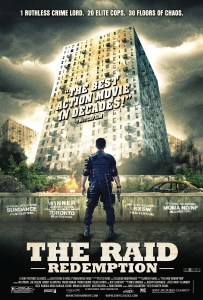
Quick Review: The Raid: Redemption (dir. by Gareth Evans)


I have to admit, Gareth Evans’ “The Raid: Redemption” wasn’t on my collective radar. It was by way of two friends on Twitter that I was even aware of it, but damn was it worth it. I can easily recommend The Raid as the movie to catch this weekend if you can find it playing near you (and if you happen to like action films). It’s been a while since I’ve run to the theatre twice in one week for the same film. It’s not perfect, and won’t win any kind of dramatic awards, but it’ll probably have you coming back for a second dose of the action.

The film has three things going for it:

1.) The action is intense, when it happens. The breaks between action moments are small.

2.) The film is short. At about 100 minutes, you almost won’t even realize when the film’s done.

3.) The music really moves it.

Evans and The Raid’s main star, Iko Uwais worked together back in 2009’s Merantau, which I’m looking to see now. The premise of The Raid: Redemption is a simple one. Rama (Uwais), along with 20 other SWAT team (or SWAT Team like) members perform a raid on a building owned by a criminal lord. Once the team gets in, they find the tables turned on them, with everyone in the building becoming their enemy.  This forces the team to try to stay alive and find a way to either escape, or get the Boss. That’s all it is, and honestly, that’s all The Raid would need to be as an action film. It’s as simple a story as Fist of Fury, Hard Boiled, and quite possibly The Expendables. There’s a side element in the film that I won’t go into detail on, which adds to things a little, but all the audience needs to know is that in The Raid, you’re getting pure action. If you’re walking into this expecting something more thought invoking (and that’s not a detriment to the film), you may want to look elsewhere.

Another high point of the film is its soundtrack, performed by  Mike Shinoda (of Linkin Park) and Joe Trapanese has a number of kinetic tracks in it that help to fuel the battles. It comes together very well, though part of me wishes that the main theme had a larger instrumental piece to it.

The pacing for The Raid is pretty good. Again, the time between fights are minimal, and most of it is used to showcase some of the situations the team and the members that live in the complex are in. While a few of these can be tense, they don’t really relax to the point where you’d hope to see more action.

If The Raid suffers from any drawbacks, it’s that that the fights themselves can end up being a little on the repetitive side. Mind you, this could be just a side effect of having seen the film twice already but you’ll find that by the time you get to the second to last fight, some of the moves seem to be repeated. Still, you won’t see anything better than this if you’re looking for a straight laced action film. An easily recommended pick.

1500 and Counting…


It’s hard to believe it but the little entertainment site that begun one quiet morning the day before Christmas 2009 has reached another milestone.

1500 articles posted is no small feat considering that this was originally a site dedicated to just it’s creator’s random thoughts on entertainment with little or no focus. As the months went by more people joined wanting to contribute and each and every one contributed in their own way. Many have begun to follow the thoughts, opinions and ramblings of the crew that made up the this chaotic ship called Through the Shattered Lens.

Once again I say thanks to those who have become my blog nakama and who continue to stay on board this ship to destinations unknown. My biggest thanks has to go to the one I consider this site’s heart and soul and one who continues to make running this little piece of the entertainment blogosphere quite an adventurous and unpredictable experience: Lisa Marie Bowman.

Fair winds and following seas to the crew of Through the Shattered Lens both new and old!

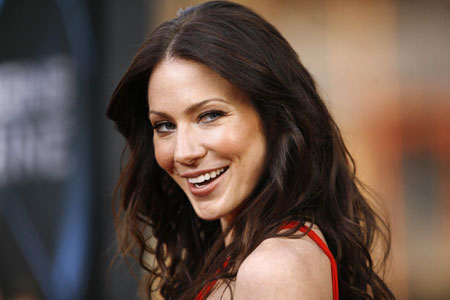
Hottie of the Day: Lynn Collins


I’ll admit that I’m not very experienced in writing about The Hottie of the Day. The things that move me about women may not be what moves everyone else. Along with that, you have to find something really cool and interesting to say about the subject, when in fact, you’re taking the phrase “Wow, she’s hot.” and expanding on that. Maybe if I get better, I’ll do more.

This may be a tough one, though.

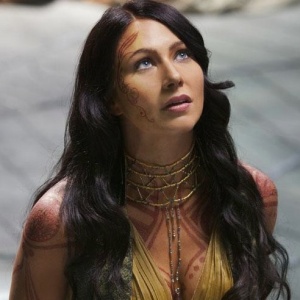
My last entry in this part of the Shattered Lens was Olive Oyl. On seeing John Carter this past Friday, though, I couldn’t take my eyes off of Lynn Collins on the scenes she was in. Playing a princess with a warriors spirit (and an awesome tan), Collins quit smoking and went through a bit of training for the fight sequences. For this, and a number of other example, she becomes the Shattered Lens’ Hottie of the Day for March 11, 2012.

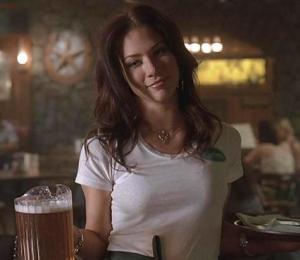
If she looks at all familiar, it’s probably because she’s had a number of films under her belt. Although she had a small part in Joel Schumacher’s “The Number 23” some years ago, Collins may be remembered best as Wolverine’s former love in X-Men Origins: Wolverine. In that film, she played Kayla Silverfox, a mutant with the ability to sway people’s minds via touch. She was later featured in Alan Ball’s Towelhead, as the girlfriend of the protagonist’s father. Ball would later go on to feature Collins in the first few episodes of HBO’s True Blood as Dawn, one of the barmaids at Merlotte’s who had a tryst with Jason Stackhouse. Though her character didn’t last through too many episodes, she made her short stay a memorable one.

Lynn has been in a number of independent films, such as Numb with Matthew Perry, where she had to deal with Perry’s penchant for Kleptomania. She also starred in Uncertainty with Joseph Gordon-Levitt. Collins, a mix of Irish and Native American backgrounds, is married to fellow actor Steven Strait, who was in The Covenant (also with John Carter’s Taylor Kitsch) and Roland Emmerich’s 10,000 B.C.

Here’s hoping that we see a lot more of Collins in the years to come.

On a side note, I wouldn’t mind if it’s her face behind Tali’Zorah’s Quarian mask in Mass Effect 3. That’s just me. 🙂