Lenny Montana started out as a boxer and a wrestler. He eventually ended up working as a bouncer and a bodyguard for the leadership of the Colombo Crime Family. However, Montana achieved his immortality as a result of veteran tough guy actor Timothy Carey turning down the role of Luca Brasi in The Godfather. Brasi was the Corleone Family’s most feared enforcer and Carey, who had made a career out of playing psychos, was one of the most feared men in Hollywood, one who was rumored to have pulled a gun on more than a few directors. (For the record, Stanley Kubrick loved him.) When Carey turned down the role in favor of doing a television series, Francis Ford Coppola offered the role to Lenny Montana. Montana may not have had Carey’s screen acting experience but he brought real-life authenticity to the role. When Michael says that Luca Brasi is a “very scary man,” one look at Lenny Montana confirms it. Unfailingly loyal to the family and willing to do anything for the Don, Luca Brasi represents the Family’s strength. When Luca Brasi is killed, you know that the old era of the Corleones is ending as well. Without Luca, the Corleones are in deep trouble.
My favorite Luca Brasi scene comes at the beginning of the film. Surprised to be invited to Connie’s wedding, Luca wants to thank the Don personally. Nervous about acting opposite Marlon Brando, Montana flubbed his lines. The scene, with the flub, was kept in the film and it served to humanize both Luca and Don Corleone. (The Don’s smile was due to the fact that Marlon Brando was having trouble not laughing.) It’s a nice little scene, one that reminds us that even gangsters are human.
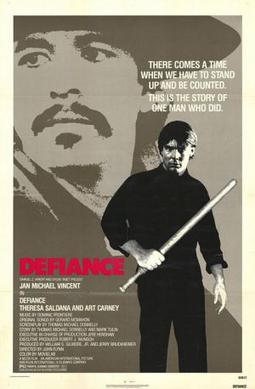
Serving out a six-month suspension, Merchant Seaman Tommy Campbell (Jan-Michael Vincent) rents an apartment on New York’s Lower East Side and passes the time painting and trying to learn Spanish in hope of getting assigned to a ship that is heading to Panama.
Tommy just wants to be left alone but he finds himself being drawn into the close-knit neighborhood. He becomes friends with Carmine (Danny Aiello) and more than friends with his upstairs neighbor (Theresa Saldana). He becomes a mentor to a street kid (Fernando Lopez) who lives with a punch-drunk boxer named called Whacko (Lenny Montana). Abe (Art Carney), who owns the local bodega, agrees to let Tommy use his phone.
Tommy also finds himself drawing the attention of Angel Cruz (Rudy Ramos), head of the local street gang. Tommy doesn’t want to get involved in any trouble. He just wants to serve his suspension and sail to Panama. But with Angel and his gang terrorizing the neighborhood and even robbing a church bingo game, Tommy and his friends finally stand up to the gang.
Defiance is more intelligent and realistic than many of the other urban vigilante movies that came out in the 70s and 80s. Tommy never becomes a cold-blooded killer, like Charles Bronson did in the Death Wish films. Instead, he spends most of the film trying to stay out of trouble and, when he does stand up for himself and the neighborhood, he does so realistically. He fights the gang members but he doesn’t set out to the kill them. About as deliberately destructive as he and Carmine get is that they destroy Angel’s car. Rather than being a typical vigilante movie, Defiance is a portrait of a neighborhood where everyone takes care of everyone else. Angel and his gang mistake the neighborhood’s kindness for weakness. The neighborhood proves them wrong.
Defiance stars two actors who never quite got their due. Theresa Saldana’s promising career was derailed when she was attacked and nearly killed by a deranged stalker in 1982. Though she recovered and went on to do a lot of television, she never became the star that she should have. Jan-Michael Vincent did become a star in the 70s and 80s but he later became better-known for his struggles with drugs and alcohol. Both of them are very good in Defiance and leave you thinking about the careers that they could have had if things had just gone differently.
97 years ago, on this date, Lenny Montana was born in Brooklyn, New York.
Montana started out as a boxer and a wrestler. He eventually ended up working as a bouncer and a bodyguard for the leadership of the Colombo Crime Family. However, Montana achieved his immortality as a result of veteran tough guy actor Timothy Carey turning down the role of Luca Brasi in The Godfather. Brasi was the Corleone Family’s most feared enforcer and Carey, who had made a career out of playing psychos, was one of the most feared men in Hollywood, one who was rumored to have pulled a gun on more than a few directors. (For the record, Stanley Kubrick loved him.) When Carey turned down the role in favor of doing a television series, Francis Ford Coppola offered the role to Lenny Montana. Montana may not have had Carey’s screen acting experience but he brought real-life authenticity to the role. When Michael says that Luca Brasi is a “very scary man,” one look at Lenny Montana confirms it. Unfailingly loyal to the family and willing to do anything for the Don, Luca Brasi represents the Family’s strength. When Luca Brasi is killed, you know that the old era of the Corleones is ending as well. Without Luca, the Corleones are in deep trouble.
My favorite Luca Brasi scene comes at the beginning of the film. Surprised to be invited to Connie’s wedding, Luca wants to thank the Don personally. Nervous about acting opposite Marlon Brando, Montana flubbed his lines. The scene, with the flub, was kept in the film and it served to humanize both Luca and Don Corleone. (The Don’s smile was due to the fact that Marlon Brando was having trouble not laughing.) It’s a nice little scene, one that reminds us that even gangsters are human.
(Lisa is currently in the process of cleaning out her DVR! How long is it going to take? Some would say forever but, here at the Shattered Lens, we’re hoping that she might have it all done by August. Anyway, she recorded the 1969 film Change of Habit off of Starz on March 20th!)
It’s Elvis vs. God for the heart of Mary Tyler Moore!
(Okay, so that may be a little bit glib on my part but, seriously, that pretty much sums up Change of Habit.)
Change of Habit opens with three nuns walking through New York City. There’s the forgettable nun, Sister Barbara (Jane Elliott). There’s the black, streetwise nun, Sister Irene (Barbara McNair). And then there’s the idealistic and wholesome nun, Sister Michelle (Mary Tyler Moore). Because they’re nuns, even notoriously rude New Yorkers are nice to them. They walk across a busy intersection and all of the cars stop for them. A cop sees them jaywalking and just smiles and nods at them. In case you were ever wondering why someone would become a nun, it’s because nuns always have the right-of-way and they don’t have to obey arbitrary laws. It’s a good life.
The sisters are shopping and, as the opening credits roll, the three of them duck into a dressing room and change into contemporary civilian clothing. Obsessively, the camera keeps zooming in on everyone’s bare legs. You can literally hear the film’s producers telling all the boys in the audience, “This may be a G-rated Elvis film but that’s not going to stop us from implying nun nudity!”
It’s Sister Michelle’s idea that the nuns should wear contemporary clothing, the better to relate to the Godless youth of the 1960s. Unfortunately, now that they’re dressed like everyone else, they have to actually obey traffic laws. When they attempt to cross the street for a second time, cars honk at them and the cop yells at them for jaywalking.
Michelle, Irene, and Barbara get jobs working at a free clinic. The clinic is run by John Carpenter (Elvis Presley). Carpenter is looking for aspiring actresses to appear in a movie about a babysitter being stalked by a masked murderer on Halloween and … oh sorry. Wrong John Carpenter. This John Carpenter is a no-nonsense doctor who will stop at nothing to bring peace and good health to the most poverty-stricken neighborhoods in New York!
That’s right. It’s an Elvis film with a social conscience!
And that probably sounds like a joke but Change of Habit‘s heart is in the right place. It’s intentions are good. At least a few of the people involved in the film were probably trying to make the world a better place. There’s a subplot involving an autistic child that, when you consider this film was made in 1969, is handled with unusual sensitivity. Of course, that doesn’t mean that the rest of Change of Habit doesn’t feel totally and completely out-of-touch. The entire film feels so dated that I imagine it probably even felt dated when it was initially released. This is one of those films where the local black militants give Sister Irene a hard time about being a sell-out, just to eventually admit, during a block party, that maybe white folks aren’t so bad after all. By the end of the movie, they’re even joking with the cops. All that was needed was for Elvis to sing a song or two. To be honest, there are times when Change of Habit feels like the 1969 version of Kendall Jenner’s Pepsi commercial.
Of course, the majority of the film deals with Elvis falling in love with Mary Tyler Moore. He doesn’t know that she’s a nun and, as she falls in love with him, she’s forced to make a difficult choice. Does she follow God or does she follow Elvis? Actually, the film ends before she officially makes that choice but there’s little doubt as to what she’s going to eventually do. In his final non-concert film appearance, Elvis is totally miscast as a serious-minded doctor and, it must be said, he looked miserable throughout the entire film. You get the feeling he’d rather be doing anything than starring in Change of Habit. (Maybe he was already thinking about how much he wanted a special FBI badge.) Mary Tyler Moore is a bit more believable as a nun. Fortunately, both Moore and Elvis were likable performers and their likability makes Change of Habit, as ludicrous as it often is, far more watchable than it has any right to be.
In the end, Elvis may not have saved society but he did get to sing a gospel song or two.
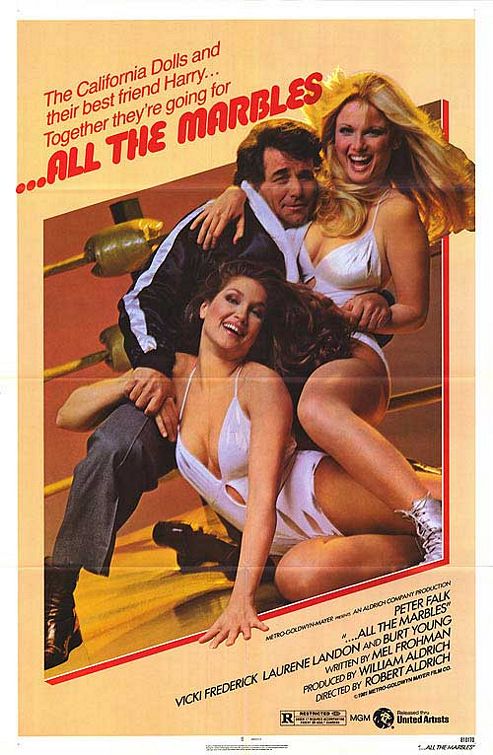
Before Dwayne “The Rock” Johnson, before Hulk Hogan and Roddy Piper , the worlds of professional wrestling and the movies had long been entwined. After all, they’re both show biz! Grapplers like Nat Pendleton , Mike Mazurki, Tor Johnson , Harold Sakata (GOLDFINGER’s Oddjob), and Lenny Montana (Luca Brasi in THE GODFATHER) made the successful transition from the squared circle to Hollywood, not to mention Mexican luchadores like El Santo and Mil Mascaras, who starred in the ring and in their own series of movies south of the border. Even early TV wrestling phenom Gorgeous George had his own feature film, 1949’s ALIAS THE CHAMP.
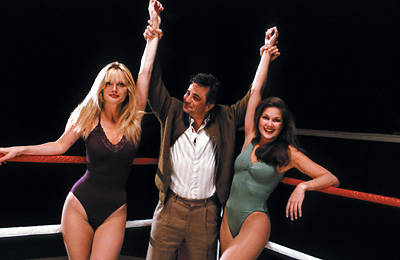
1981’s …ALL THE MARBLES was made just before the Hulkamania craze started a boom in pro wrestling’s popularity. It’s a serio-comic character study centering on small time manager Harry Sears and his two young charges Iris and Molly, better known as tag team The California Dolls. Harry and Iris…
“I got something for your mother and Sonny and a tie for Freddy and Tom Hagen got the Reynolds Pen…” — Kay Adams (Diane Keaton) in The Godfather (1972)
It probably seems strange that when talking about The Godfather, a film that it is generally acknowledged as being one of the best and most influential of all time, I would start with an innocuous quote about getting Tom Hagen a pen.
(And it better have been a hell of a pen because, judging from the scene where Sollozzo stops him in the street, it looked like Tom was going all out as far as gifts were concerned…)
After all, The Godfather is a film that is full of memorable quotes. “Leave the gun. Take the cannoli.” “I’m going to make him an offer he can’t refuse.” “It’s strictly business.” “I believe in America….” “That’s my family, Kay. That’s not me.”
But I went with the quote about the Reynolds pen because, quite frankly, I find an excuse to repeat it every Christmas. Every holiday season, whenever I hear friends or family talking about presents, I remind them that Tom Hagen is getting the Reynolds pen. Doubt me? Check out these tweets from the past!
But all that love also makes The Godfather a difficult film to review. What do you say about a film that everyone already knows is great?
Do you praise it by saying that Al Pacino, Robert Duvall, James Caan, Diane Keaton, Marlon Brando, John Cazale, Richard Castellano, Abe Vigoda, Alex Rocco, and Talia Shire all gave excellent performances? You can do that but everyone already knows that.
Do you talk about how well director Francis Ford Coppola told this operatic, sprawling story of crime, family, and politics? You can do that but everyone already knows that.
Maybe you can talk about how beautiful Gordon Willis’s dark and shadowy cinematography looks, regardless of whether you’re seeing it in a theater or on TV. Because it certainly does but everyone knows that.
Maybe you can mention the haunting beauty of Nina Rota’s score but again…
Well, you get the idea.
Now, if you somehow have never seen the film before, allow me to try to tell you what happens in The Godfather. I say try because The Godfather is a true epic. Because it’s also an intimate family drama and features such a dominating lead performance from Al Pacino, it’s sometimes to easy to forget just how much is actually going on in The Godfather.
The Godfather tells the story of the Corleone Family. Patriarch Vito Corleone (Marlon Brando) has done very well for himself in America, making himself into a rich and influential man. Of course, Vito is also known as both Don Corleone and the Godfather and he’s made his fortune through less-than-legal means. He may be rich and he may be influential but when his daughter gets married, the FBI shows up outside the reception and takes pictures of all the cars in the parking lot. Vito Corleone knows judges and congressmen but none of them are willing to be seen in public with him. Vito is the establishment that nobody wants to acknowledge and sometimes, this very powerful man wonders if there will ever be a “Governor Corleone” or a “Senator Corleone.”
Vito is the proud father of three children and the adopted father of one more. His oldest son, and probable successor, is Sonny (James Caan). Sonny, however, has a temper and absolutely no impulse control. While his wife is bragging about him to the other women at the wedding, Sonny is upstairs screwing a bridesmaid. When the enemies of the Corleone Family declare war, Sonny declares war back and forgets the first rule of organized crime: “It’s not personal. It’s strictly business.”
After Sonny, there’s Fredo (John Cazale). Poor, pathetic Fredo. In many ways, it’s impossible not to feel sorry for Fredo. He’s the one who ends up getting exiled to Vegas, where he lives under the protection of the crude Moe Greene (Alex Rocco). One of the film’s best moments is when a bejeweled Fredo shows up at a Vegas hotel with an entourage of prostitutes and other hangers-on. In these scenes, Fred is trying so hard but when you take one look at his shifty eyes, it’s obvious that he’s still the same guy who we first saw stumbling around drunk at his sister’s wedding.
(And, of course, it’s impossible to watch Fredo in this film without thinking about both what will happen to the character in the Godfather, Part II and how John Cazale, who brought the character to such vibrant life, would die just 6 years later.)
As a female, daughter Connie (Talia Shire) is — for the first film, at least — excluded from the family business. Instead, she marries Sonny’s friend Carlo Rizzi (Gianni Russo). And, to put it gently, it’s not a match made in heaven.
And finally, there’s Michael (Al Pacino). Michael is the son who, at the start of the film, declares that he wants nothing to do with the family business. He’s the one who wants to break with family tradition by marrying Kay Adams (Diane Keaton), who is most definitely not Italian. He’s the one who was decorated in World War II and who comes to his sister’s wedding still dressed in his uniform. (In the second Godfather film, we learn that Vito thought Michael was foolish to join the army, which makes it all the more clear that, by wearing the uniform to the wedding, Michael is attempting to declare his own identity outside of the family.) To paraphrase the third Godfather film, Michael is the one who says he wants to get out but who keeps getting dragged back in.
And finally, the adopted son is Tom Hagen (Robert Duvall). Tom is the Don’s lawyer and one reason why Tom is one of my favorite characters is because, behind his usual stone-faced facade, Tom is actually very snarky. He just hides it well.
Early on, we get a hint that Tom is more amused than he lets on when he has dinner with the crude Jack Woltz (John Marley), a film producer who doesn’t want to use Johnny Fontane (Al Martino) in a movie When Woltz shouts insults at him, Tom calmly finishes his dinner and thanks him for a lovely evening. And he does it with just the hint of a little smirk and you can practically see him thinking, “Somebody’s going to wake up with a horse tomorrow….”
However, my favorite Tom Hagen moment comes when Kay, who is searching for Michael, drops by the family compound. Tom greets her at the gate. When Kay spots a car that’s riddled with bullet holes, she asks what happened. Tom smiles and says, “Oh, that was an accident. But luckily no one was hurt!” Duvall delivers the line with just the right attitude of “That’s my story and I’m sticking to it!” How can you not kind of love Tom after that?
And, of course, the film is full of other memorable characters, all of whom are scheming and plotting. There’s Clemenza (Richard S. Catellano) and Tessio (Abe Vigoda), the two Corleone lieutenants who may or may not be plotting to betray the Don. There’s fearsome Luca Brasi (Lenny Montana), who spends an eternity practicing what he wants to say at Connie’s wedding and yet still manages to screw it up. And, of course, there’s Sollozzo (Al Lettieri, playing a role originally offered to Franco Nero), the drug dealer who reacts angrily to Vito’s refusal to help him out. Meanwhile, Capt. McCluskey (Sterling Hayden) is busy beating up young punks and Al Neri (Richard Bright) is gunning people down in front of the courthouse. And, of course, there’s poor, innocent, ill-fated Appollonia (Simonetta Stefanelli)…
The Godfather is a great Italian-American epic, one that works as both a gangster film and a family drama. Perhaps the genius of the Godfather trilogy is that the Corleone family serves as an ink blot in a cinematic rorschach test. Audiences can look at them and see whatever they want. If you want them and their crimes to serve as a metaphor for capitalism, you need only listen to Tom and Michael repeatedly state that it’s only business. If you want to see them as heroic businessmen, just consider that their enemies essentially want to regulate the Corleones out of existence. If you want the Corleones to serve as symbols of the patriarchy, you need only watch as the door to Michael’s office is shut in Kay’s face. If you want to see the Corleones as heroes, you need only consider that they — and they alone — seem to operate with any sort of honorable criminal code. (This, of course, would change over the course of the two sequels.)
And, if you’re trying to fit a review of The Godfather into a series about political films, you only have to consider that Vito is regularly spoken of as being a man who carries politicians around in his pocket. We may not see any elected officials in the first Godfather film but their presence is felt. Above all else, it’s Vito’s political influence that sets in motion all of the events that unfold over the course of the film.
The Godfather, of course, won the Oscar for best picture of 1972. And while it’s rare that I openly agree with the Academy, I’m proud to say that this one time is a definite exception.



 Through the Shattered Lens