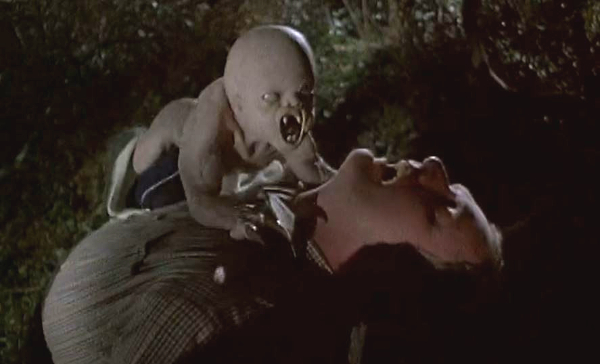
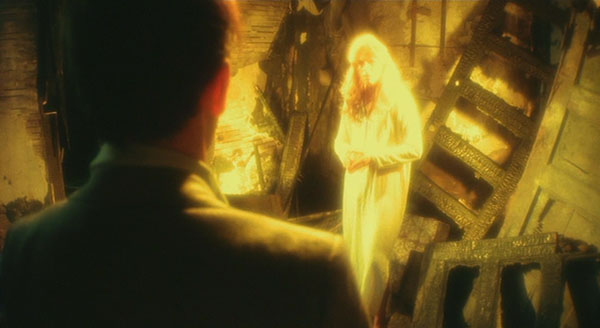
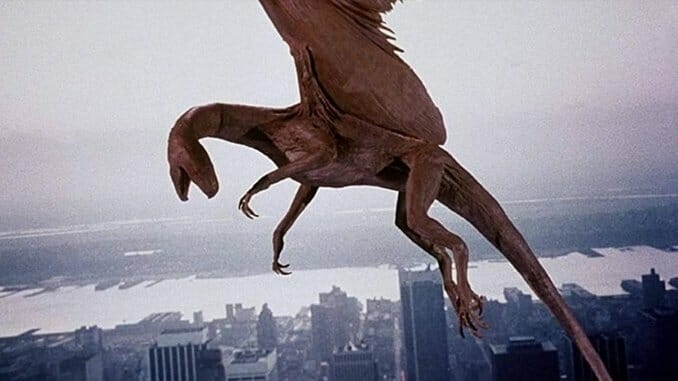
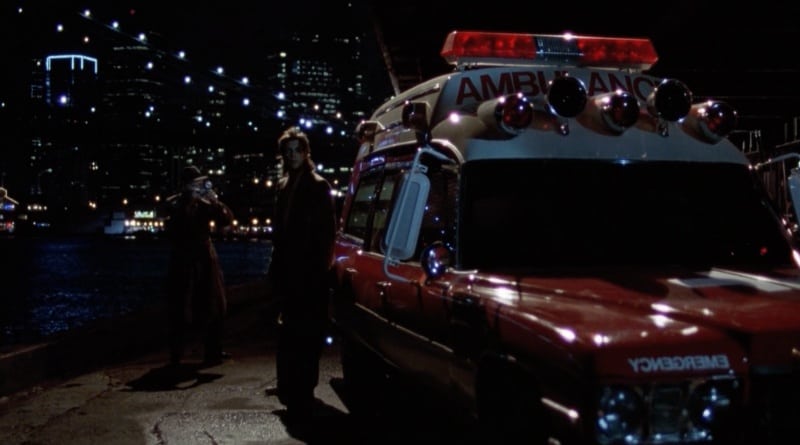
4 Shots From 4 Films is just what it says it is, 4 shots from 4 of our favorite films. As opposed to the reviews and recaps that we usually post, 4 Shots From 4 Films lets the visuals do the talking.
Today would have been the 89th birthday of the pioneering indie film director, Larry Cohen. It’s time for….
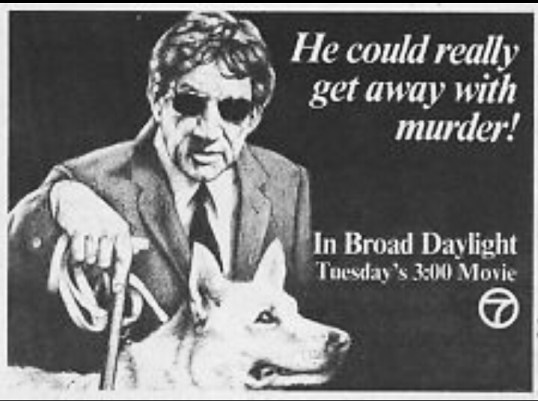
Welcome to Retro Television Reviews, a feature where we review some of our favorite and least favorite shows of the past! On Sundays, I will be reviewing the made-for-television movies that used to be a primetime mainstay. Today’s film is 1971’s In Broad Daylight! It can be viewed on YouTube.
Tony Chappel (Richard Boone) is an actor who has just recently lost his sight as a result of an accident. Released from the hospital, Tony struggles to adjust to living in a world without his vision. When one cab driver says to him, “Didn’t you used to be Tony Chappel?,” he flinches as he realizes that his career as a famous actor is now considered to be over. One day, he comes home early and overhears his wife (Stella Stevens) fooling around with his lawyer and “best friend” (Fred Beir). Tony promptly decides to murder his wife and frame his friend for the crime.
Tony decides to use his acting skills to his advantage. He memorizes the the area around him so that he can make his way through it by memory. He puts on a fake beard, speaks with Greek accent, and makes a point of carrying a camera with him. He starts taking public transportation and going out of his way to be talkative and social Everyone that he meets, he tells them about how he’s been taking pictures of the city and how he can’t wait to see how they come out. When his wife is eventually murdered, the police receive a reports of a mysterious Greek man, one who was definitely not blind, in the area. However, Lt. Bergman (John Marley) has his doubts and comes to suspect that Tony is the killer.
In Broad Daylight was made from an early script written by Larry Cohen, who would later go on to direct films like God Told Me To. It’s a clever script, one that sets up an intriguing premise and which ends on a properly twisty and satisfactory note. The film works because it is as much of a character study as a thriller. Tony’s wife not only cheats on him but also betrays him at the moment when he needs her and his friends the most. Tony has gone from being a movie star to being a man who can barely walk from one room to another. He’s already angry. Discovering that his wife is laughing at him behind his back is the last straw.
Larry Cohen reportedly felt that Richard Boone was miscast as Tony. I felt that Boone did a pretty good job, even if he did overact a bit while Tony was trying to convince everyone that he was a Greek tourist. Stella Stevens is perfectly cast as his wife and Suzanne Pleshette is sympathetic as his nurse. Godfather fans will be happy to see John Marley not having to deal with a horse’s head but instead playing the clever detective who attempts to solve the murder.
In Broad Daylight is a clever and entertaining thriller and character study.
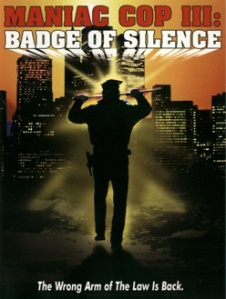
Despite finally getting his burial with honors at the end of Maniac Cop 2, Matt Cordell (Robert Z’Dar) returns for one last outing. Raised from the dead by a voodoo houngan (Julius Harris), Cordell invades a hospital to seek vengeance for a comatose policewoman named Katie Sullivan (Gretchen Baker). In a coma due to the wounds she received while thwarting a convenience store robbery, Katie is being framed by unscrupulous reporters and attorneys who claim that Katie was a bad cop who killed a clerk in cold blood. Cordell sees Katie as being a fellow victim of anti-cop bias and he is not going to let anyone treat her with disrespect, which is something that two doctors (Robert Forster and Doug Savant) are unfortunate enough to discover. Sean McKinney (Robert Davi) and Dr. Susan Lowery (Caitlin Dulany) try to figure out how to bring peace to the souls of both Cordell and Katie.
As opposed to the first two films, Maniac Cop III had a troubled production. Lustig and screenwriter Larry Cohen wanted to set the film in a Harlem hospital and bring in an African-American detective to investigate Cordell’s activities. The film’s Japanese producers insisted that Robert Davi return as the lead, even though the script’s lead character had little in common with the way Sean McKinney was portrayed in Maniac Cop 2. Larry Cohen then refused to do any rewrites on the script unless he was paid more. William Lustig filmed what he could and ended up with a 51-minute movie. Extra scenes were directed by one of the film’s producers and the film was also padded out with outtakes from Maniac Cop 2.
The film is disjointed and there’s too much time devoted to Jackie Earle Haley playing a character who has much in common Leo Rossi’s serial killer from the second film. (Haley’s performance is fine but the character feels superfluous). But the movie’s hospital setting leads to some interesting kill scenes and Z’Dar and Davi both give good performances as two different types of maniac cops. The supporting cast is full of good character actors like Haley, Forster, Savant, Julius Harris, Bobby Di Cicco, and Paul Gleason. Despite the film’s flaws, Maniac Cop III is a solid ending for the trilogy.
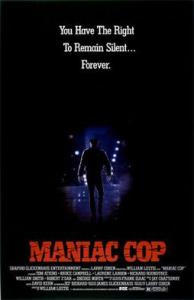
In New York City, murders are being committed by a hulking man dressed in a policeman’s uniform. The NYPD brass (led by William Smith and Richard Roundtree) want to cover up the fact that the murders are being committed by an apparent maniac cop but Lt. Frank McRae (Tom Atkins) leaks the news to the press. With the citizens taking up arms against cops, the brass is eager to frame adulterous cop Jack Forrest (Bruce Campbell) for not only murdering his wife but also committing all of the murders. Lt. McRae believes that Jack is innocent.
Why is the brass so eager to frame Jack? Maybe it’s because they know that the Maniac Cop is actually Matt Cordell (Robert Z’Dar), a formerly good cop who was sent to Sing Sing on trumped up brutality charges. Cordell was killed in prison but he has now come back to life and is seeking revenge on the police force that he feels betrayed him.
Written by Larry Cohen and directed by William Lustig, Maniac Cop is the first of three Maniac Cop films. While the other two Maniac Cop movies largely work and hold up well, the first Maniac Cop is undoubtedly the worst of the trilogy, with most of the kills occurring offscreen and the action moving very slowly. The film is full of genre vets and Tom Atkins gives another one of this good tough guy performances. Bruce Campbell disappointingly plays his role straight and Robert Z’Dar, as intimidating as he is, is actually underused in this film.
As with most films written by Cohen, Maniac Cop has an interesting political subtext. It focuses on cop brutality and corruption with Cordell becoming a symbol of most people’s mixed feelings about the police. But the Maniac Cop trilogy wouldn’t really come to life until the second film. The first spends a lot of time setting Cordell up as a relentless avenger but there’s not much of pay-off.
The 1989 film, Wicked Stepmother, was Bette Davis’s final film. She was cast as Miranda, an enigmatic woman who meets and marries a man named Sam (Lionel Stander). Sam’s daughter, Jenny (Colleen Camp) and her husband, Steve (David Rasche), are stunned to come home from a vacation just to discover Miranda living in their house. Miranda chain-smokes, despite Jenny and Steve asking her not to. Miranda cooks and eats meat, despite Jenny being a vegetarian. Miranda brags about her sex life which freaks Jenny out even though I suppose really old people do occasionally have sex. When it becomes apparent that Miranda is a witch who seduces and shrinks her victims, Jenny decides that something must be done.
Wicked Stepmother was not only Bette Davis’s last starring role but it was also the last production that she ever walked out on. Early on in filming, she announced that she didn’t like the script, she didn’t like the way she was being filmed, and that she didn’t like the director, venerable B-move maestro Larry Cohen. For his part, Cohen said that Davis left the movie because she was in bad health but she didn’t want to announce that to the world. In Cohen’s defense, Davis does appear to be rather frail in the movie and often seems to be having trouble speaking. (Davis has a stroke a few years before appearing in Wicked Stepmother.) Davis died just a few months after Wicker Stepmother was released so I tend to assume that Cohen was correct when he said that the main reason Davis left the film was because of her health. That doesn’t mean the script wasn’t bad, of course. But, in the latter part of her career, Davis appeared in a lot of badly written movies. She did Burnt Offerings, afterall.
Regardless of why she left, Davis’s absence did require that Wicked Stepmother work around her character. But how do you do that when Bette Davis was literally the title character? This film’s solution was to bring in Barbara Carrerra as Priscilla, Miranda’s daughter. It turns out that Miranda and Priscilla both inhabit the body of a cat but only one of them can use the body at a time. So, when Priscilla is in the cat, Miranda is among the humans. When Miranda is in the cat, Priscilla is …. well, you get the idea. In the film, Priscilla leaves the body of the cat and then refuses to reeneter it because “I’m having too much fun.” So, whenever we see the cat glaring in the background, we’re meant to assume that we’re actually seeing Miranda in the background.
Got it?
Now, believe it or not, the whole thing with the cat is probably the least confusing thing about Wicked Stepmother. Jenny can’t convince Steve that Miranda and Priscilla are actually witches. Steve actually has sex with Pricilla and is shocked when Priscilla starts to turn into a cat but the whole incident is never mentioned again and Steve quickly goes from being an adulterous jerk to a loyal husband. Sam goes on a game show and, with Priscilla’s help, wins a lot of money even though the questions that he answered were so simple that he shouldn’t have needed the help of a witch’s spell. (“Who won the election of 1876?” is one question. The correct answer, by the way, is Rutherford B. Hayes. Screw you, Samuel Tilden.) Jenny gets some help from a cop, a private detective, and a priestess of some sort. The whole thing ends with a big magical battle that involves Barbara Carrera mouthing pre-recorded Bette Davis dialogue.
None of it makes any sense. The special effects are incredibly cut-rate. It’s hard not to regret that Bette Davis didn’t go out on a better film. And yet, when taken on its own terms, Wicked Stepmother itself is oddly likable. Colleen Camp is sympathetic as Jenny, which is saying something when you consider that Jenny is written to be a humorless vegetarian. Lionel Stander appears to be having fun as Sam. Larry Cohen was a good-enough director that, even though he couldn’t save the film from its own bad script and miniscule budget, the movie itself is never boring. It’s cheap and stupid but its watchable in the same way that Michael Scott’s Threat Level Midnight was watchable. It may not be particularly good but you just can’t look away.
We are rapidly reaching the halfway mark of our October horrorthon here at the Shattered Lens. By the time we reach the end of the first half at midnight on Saturday, we will have published over 200 posts. During the second half, we’ll publish …. well, let’s not speculate. You never know. The world could end tomorrow and, as a result, we might never post again. What’s important is that I’m proud of what we’ve accomplished so far and I look forward to seeing what we accomplish during the rest of the month!
(That said, I’m hoping for another 250 to 300 or so posts. 500 FOR OCTOBER! It seems like a reasonable go. We’ll see!)
Anyway, today seems like a good time for another edition of Lisa Marie’s Favorite Grindhouse Trailers! And, since today is Jack Arnold’s birthday, it only seems appropriate that today’s edition deals with giant creature features!
Q: The Winged Serpent (1982)
From director Larry Cohen, it’s Q The Winged Serpent! I’ve seen this movie and it’s undeniably entertaining. On the one hand, you’ve got the serpent flying around and looking all dangerous. Then you’ve got David Carradine and Richard Roundtree kind of sleepwalking through their roles. And then, suddenly, Michael Moriarty shows up and gives this brilliant, method-influenced performance. It’s an odd film but it’s hard not to like that Claymation flying serpent.
2. The Giant Spider Invasion (1975)
From Wisconsin’s own Bill Rebane, here’s the trailer for The Giant Spider Invasion! This is probably Rebane’s best film. If you’re trying to frighten your audience, you can’t go wrong with a giant spider.
3. Empire of the Ants (1977)
What’s the only thing scarier than a giant spider? A giant ant, of course! This film is from Bert I. Gordon, a director so obsessed with films about giant monsters that he was actually nicknamed Mr. BIG. (Of course, it also helped that those were his initials.)
4. Food of the Gods (1976)
Speaking of Bert I. Gordon, he was also responsible for this film, Food of the Gods. Like Empire of the Ants, it was based (however loosely) on a novel by H.G. Wells. Two old farmers feed the food of the Gods to the local animals and things do not go well. For some reason, a football player played by Marjoe Gortner decides to investigate. Shouldn’t he be practicing for the big game? Gordon missed an opportunity here by not having a giant-sized Marjoe Gortner.
5. Night of the Lepus (1972)
As frightening as those previous trailers were, can anything prepare you for the terror of killer rabbits!? This movie is proof positive that rabbits look cute no matter who they’re killing.
6. Village of the Giants (1965)
In the end, though, the greatest monster will always be man. By the way, this is another Bert I. Gordon film. Beau Bridges turns into a giant and plots to conquer the world. Only a young Ron Howard can stop him.
I hope you’re having a wonderful October! Never stop watching the shadows!
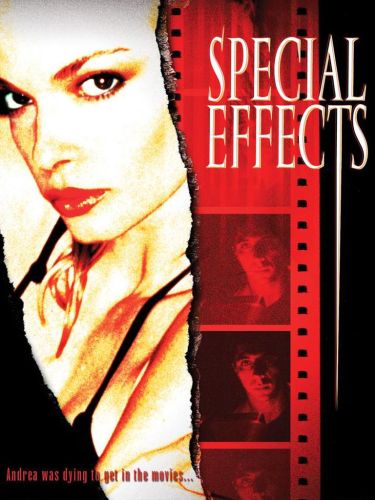
In this rather odd horror film from 1984, dumb-as-mud Keefe Wateran (Brad Rijn) travels from Dallas to New York City, hoping to bring his wife back home. Andrea (Zoe Tamerlis, the star of Abel Ferrara’s Ms. 45) abandoned both Keefe and their son because she wants to be a star. When the film opens, she’s posing topless in a replica of the Oval Office. Keefe is not too happy when he discovers that his wife is apparently appearing in politically-themed nude photo shoots.
And the thing is, you feel like you should feel sorry for Keefe, seeing as how his wife abandoned not only him but also their child. But Keefe is just such a self-righteous know-it-all that you really can’t blame Andrea for leaving him. As soon he starts going on and on about how she’s abandoned her family just to be a tramp in New York, you’re pretty much automatically on Andrea’s side.
Unfortunately, when Andrea turns up dead at Coney Island, the police automatically suspect that Keefe’s responsible. When they show up to arrest Keefe for the murder, he’s only wearing his boxer shorts. One of the detectives comments that, if he was going to commit murder, he would at least wear interesting underwear. And, again, you may want to sympathize with Keefe but the detective has a point. You need to dress for the job you want, not the one you have. I have an entire drawer full of murder thongs, just in case I ever decide to go for a career change.
Keefe is bailed out of jail and provided a high-priced attorney by Christopher Neville (Eric Bogosian). Neville is a big-time Hollywood director …. or, at least, he was until he directed a huge flop. (Apparently, the film had over $30,000 worth of special effects, which I guess was a lot back in 1984.) Neville, whom Andrea was supposed to have a meeting with on the night that she died, says that he’s fascinated by Keefe and Andrea’s story. In fact, he wants to turn it into a movie and he wants to hire Keefe as a special consultant.
However, what we know (but what Keefe doesn’t know, though he’d be able to figure it out if he wasn’t such a total and complete freaking moron), is that Neville murdered Andrea! He strangled her when she objected to him filming them while they were having sex. Now, Neville wants to make a movie about the murder. He even hires Elaine Bernstein (Zoe Tamerlis, again) to play Andrea in the film, despite the fact that Elaine has no acting experience. What’s important is that Elaine looks like Andrea. Neville also manages to manipulate the rather stupid Keefe into playing himself in the film. Soon, Neville is suggesting that perhaps they need to film a scene of Keefe and Andrea having rough sex and maybe Keefe should choke her during the scene….
And it just gets stranger from there. Special Effects is Hitchcock-style thriller from director Larry Cohen, one that’s got a bit more on its mind than just murder and a few heavy-handed jokes about the film industry. Neville may be smooth and manipulative while Keefe may be loud and a bit on the dumb side but, ultimately, they’re both obsessed with turning Elaine into Andrea. Neville wants to transform Elaine into the Andrea that he victimized while Keefe wants to turn Elaine into his idealized version of Andrea, the version that never wanted anything more than to be his wife and the mother of his children. In the end, they’re both creeps. (Admittedly, only one of them is murderer.)
Adding to the film’s strange tone are the three memorably eccentric lead performances. All three of the actors do unexpected things with their characters. Bogosian is wonderfully smug and smoothly manipulative as Neville while Brad Rijin goes all out in making Keefe one of the stupidest characters ever to appear in a leading role in a motion picture. (He’s like Bruce Campbell, without the comedic timing.) And finally, Zoe Tamerlis does a great job playing four different characters — Andrea, Neville’s version of Andrea, Keefe’s version of Andrea, and finally Esther.
Special Effects is an intriguing mix of thrills, horror, and satire with an undercurrent of anger. One gets the feeling that Neville is a stand-in for many of the soulless directors who had the type of career that Cohen felt he deserved. Track it down and check it out.
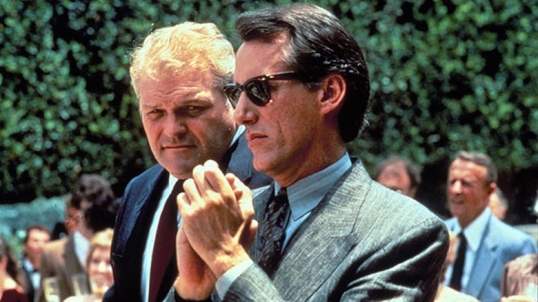
The 1987 film, Best Seller, tells the story of two men, both equally capable of violence but with two very different moral codes.
Dennis Meechum (Brian Dennehy) is a cop who also writes true crime. In the early 70s, he was the one of several cops who were attacked by a group of gunmen who were all wearing Richard Nixon masks. Though he was shot, Meechum survived and he even managed to stab one his assailants. 15 years later, Meechum is still haunted by the incident. Meechum is a brawler who doesn’t have much time for nonsense but he also has a strong moral code (or so he thinks).
Cleve (James Woods) talks fast and always seems like he’s a little bit nervous. He has a quick smile and a joke for almost every occasion. He’s also a professional assassin, a sociopath who is very interested in Dennis. Cleve has spent the majority of his life working for a powerful businessman named David Madlock (Paul Shenar) but he’s recently been laid off. Cleve wants revenge and he thinks that Dennis can help him get it.
Together …. THEY FIGHT CRIME!
Well, actually, they kind of do. Madlock’s done a lot of illegal stuff and Cleve and Dennis are exposing him, his crooked corporation, and all of his powerful connections. However, what Cleve really wants is for Dennis to write a best seller about his life. Cleve wants Dennis to write his story and most importantly, he wants Dennis to make him the hero. Dennis is still a cop and says that once all this is over, he’s going to have to arrest Cleve. Of course, eventually, he discovers that Cleve was the man who shot him 15 years earlier. At that point, Dennis says that he’s going to have to kill Cleve once all of this is over.
As a crime thriller, Best Seller hits all of the expected beats. As soon as we find out that Dennis is a widower and that he has a teenage daughter, we know that she’s eventually going to be taken prisoner by the bad guys. For that matter, we can also guess that there will be a few scenes where Cleve insists that Dennis is just like him. When Cleve starts telling people that Dennis is his brother, it’s a fun scene because it’s well-acted by both Woods and Dennehy but it’s not exactly surprising.
But no matter! Though the the overall plot may be predictable, there’s enough clever little twists and details that the film holds your interest. For instance, there’s an extended sequence where Dennis insists that Cleve introduce him to his family. For the next few minutes, the film stops being an action thriller and instead becomes a bit of a domestic comedy as Dennis meets Cleve’s friendly family, none of whom are aware that Cleve is a ruthless killer. The stuff with Cleve’s family doesn’t move the plot forward but your happy it’s there because 1) James Woods gives a great performance in those scenes and 2) it suggests that the film (which was written by Larry Cohen and directed by John Flynn, who was previously responsible for the brilliant Rolling Thunder) has more on its mind than just shooting people.
The main reason why Best Seller works so well is because the two leads are perfectly cast. Brian Dennehy was born to play tough cops while James Woods gives one of his best performances as the unstable but likable Cleve. I’ve actually had people get made at me for saying that James Woods is a good actor, simply because they disagree with his politics. But, when it comes to art and talent, I don’t care about anyone’s politics. (I mean, if I only watched movies starring people whose politics where approved by Film Twitter, I would end up spending the entire pandemic watching romantic comedies starring Alec Baldwin and Rosie O’Donnell and why should I suffer like that?) James Woods is a good actor and he’s great in Best Seller.
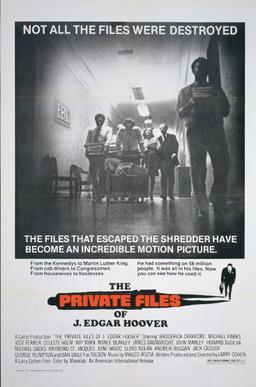
The 1977 film, The Private Files of J. Edgar Hoover, opens in 1972.
J. Edgar Hoover, the much-feared and long-serving director of the FBI, has just been found dead at his home and it seems like the entire city of Washington, D.C. is scrambling. Not only are people jockeying for Hoover’s job but they’re also wondering what might be found in his secret files. As quickly becomes apparent, Hoover had a file on everyone. While Presidents lauded him and the press portrayed him as hero, Hoover spent nearly 50 years building up a surveillance state. Hoover said it was to fight criminals and subversives but mostly, it was just to hold onto his own power. Even President Nixon is heard, in the Oval Office, ordering his men to get those files.
Hoover may have known everyone’s secrets but, the film suggests, very few people knew his. The film is narrated by a former FBI agent named Dwight Webb (Rip Torn). Dwight talks about how he was kicked out of the FBI because it was discovered that he not only smoked but that he was having an adulterous affair with a secretary. “You know how Hoover was about that sex stuff,” he says, his tone suggesting that there’s more to the story than just Hoover being a bit of a puritan.
We flash back to the 1920s. We see a young Hoover (James Wainwright) as a part of the infamous Palmer Raids, an early effort by the Justice Department to track down and deport communist subversives. Though Hoover disagrees with the legality of the Palmer Raids, he still plays his part and that loyalty is enough to eventually get him appointed, at the age of 29, to be the head of the agency that would eventually become the FBI. Hoover may start out as a relatively idealistic man but it doesn’t take long for the fame and the power to go to his head.
Hoover (now played by Broderick Crawford) serves a number of Presidents, each one worse the one who proceeded him. Franklin Delano Roosevelt (Howard Da Silva) is an avuncular despot while the Kennedy brothers (William Jordan as John and Michael Parks as Bobby) are two rich brats who think that they can control Hoover but who soon discover that Hoover is far more clever than they realize. Hoover finds himself a man out-of-place in the 60s and the 70s, Suddenly, he’s no longer everyone’s hero and people are starting to view the FBI as being not a force for law enforcement but instead an instrument of oppression.
Through it all, Hoover remains an enigma. He demands a lot of from his agents but he resents them if they’re too successful. Melvin Purvis (Michael Sacks) might find fame for leading the manhunt that took down Dillinger but he’s driven to suicide by Hoover’s cruel treatment. Unlike Clint Eastwood’s film about Hoover, The Private Files of J. Edgar Hoover suggests that Hoover was not gay but that instead, that he was so repressed that he was essentially asexual. When one woman throws herself at him, he accuses her of being a subversive and demands to know how anyone could find him attractive. He’s closest to his mother and when she dies, he shuts off his emotions. His own power, for better and worse, becomes the one thing that he loves. He’s married to the FBI and he often behaves like an abusive spouse.
The Private Files of J. Edgar Hoover is an interesting film. It’s an attempt to do a huge American epic on a less than epic budget. At the start of the film, the low budget is undeniably distracting. The 1920s are essentially represented by a back lot and two old cars. The scenes of the FBI dealing with gangsters like Dillinger and Creepy Karpis feel awkward and slapdash. But, as the film’s timeline gets closer to what was then the modern era, the film’s story tightens up and so does Larry Cohen’s direction. (One get the feeling that Cohen was, perhaps understandably, more interested in the Hoover of the 60s and the 70s than the Hoover of the 20s and 30s. There’s a sharpness to the second half of the movie that is just missing from the first half.) Broderick Crawford gives a chilling performance as a man who is determined to hold onto his power, just for the sake of having it. The scenes were Hoover and Bobby Kennedy snap at each other have a charge that’s missing from the first half of the film. Michael Parks does a great job portraying RFK as basically being a spoiled jerk while Crawford seems to relish the chance to play up the resentful, bitter old man aspects of Hoover’s personality. The film ultimately suggests that whether the audience previously admired RFK or whether they previously admired Hoover, they were all essentially duped.
Though the film never quite overcomes the limits of its low budget, it works well as a secret history of the United States. In 1977, it undoubtedly took guts to make a film that portrayed Roosevelt and Kennedy as being as bad as Nixon and Johnson. (It would probably even take guts today. One need only rewatch something like The Butleror Hyde Park on Hudson to see the ludicrous lengths Hollywood will go to idealize presidents like Kennedy and dictators like FDR.) While this film certainly doesn’t defend J. Edgar Hoover’s excesses, it often suggests that the president he served under were just as bad, if not even worse. In the end, it becomes a portrait of not only how power corrupts but also why things don’t change, regardless of who is nominally in charge. In the end the film’s villain is not J. Edgar Hoover. Instead, the film’s villain is the system that created and then enabled him. The man may be dead but the system remains.
Original Gangstas opens with shots of the deserted streets and burned-out store fronts of Gary, Indiana and narration telling us how a once great American city came to be in such disrepair. The steel plant closed and put much of the city out of work. While the politicians and the police looked the other way, violent street gangs rose up and took over entire neighborhoods. Now, Gary is a shell of its former self. Even the local movie theater has closed down. The narrators tells us that the last movie to play at the theater was Star Wars.
Led by Spyro (Christoper B. Duncan) and Damien (Eddie Bo Smith, Jr.), the Rebels are the most feared and powerful gang in Gary. They rule through violence and intimidation. Talk to the police and your business is liable to get torched and you’re likely to get shot. However, Spyro and Damien have finally gone too far and now, two men who previously escaped from Gary are returning to town to dish out some justice.
John Bookman (Fred Williamson) is a former football player who wants to avenge the shooting of his father. Jake Trevor (Jim Brown) is a boxer who once killed a man in the ring and who wants revenge for the death of his son. When they were young men, John and Jake were the original Rebels and now they’re getting the old gang back together again. With the help of Laurie (Pam Grier), Bubba (Ron O’Neal), and Slick (Richard Roundtree), the original gangstas are going to take back the streets of Gary.
Original Gangstas was released at a time when, largely thanks to the influence of Quentin Tarantino, people were just starting to feel nostalgic for the old blaxploitation movies. The main appeal of the film, not surprisingly, is that it brings together so many of the great blaxploitation stars and sets them loose in what was then the modern era. (Jim Kelly is missed.) When John and Jake talk about how they’re responsible for the Rebels, they could just as easily be talking about how they’re responsible for both all of the independent crime films that came out in the wake of Reservoir Dogs and Pulp Fiction.
Original Gangstas is a tribute to both the Blaxploitation genre and the oversized personalities that made that era so memorable. Neither Fred Williamson, Jim Brown, nor Richard Roundtree were particularly good actors but they all had so much screen presence and such an innate sense of cool that it didn’t matter whether they could convincingly show emotion or not. (Original Gangstas gives all of the big dramatic scenes to Pam Grier, who was not only naturally cool but a damn good actress to boot.) The minute Fred Williamson lights his cigar, he control the entire movie. He and Jim Brown make a good team and Original Gangstas is an entertaining and violent trip down memory lane.



 Through the Shattered Lens