Film Review: The FBI Story (dir by Mervyn LeRoy)


In 1959’s The FBI Story, veteran FBI agent Chip Hardesty (James Stewart) delivers a lecture to a group of new FBI recruits.  He tells them the story of both the FBI and his time as a member of the agency.  Somewhat implausibly, it turns out that Chip was involved with nearly every major FBI operation, as we discover while watching this flashback-filled, episodic film.

Battling the Ku Klux Klan in the Deep South?  Chip was there.

Investigating the Oklahoma Indian murders?  Chip was not only there but he was also the one who solved them through handwriting analysis!  (Decades later, the crimes and the investigation would serve as the basis of Martin Scorsese’s Killers of the Flower Moon.)

During the public enemy era, Chip was there.  He was there when Baby Face Nelson killed several unarmed FBI agents, including Chip’s best friend (Murray Hamilton).  He was there when John Dillinger was gunned down in Chicago.  He was there when my distant ancestor “Pretty Boy” Floyd was killed in Ohio.  He wasn’t there when J. Edgar Hoover personally arrested Alvin Karpis or when “Machine Gun” Kelly said, “Don’t shoot, G-Man!” but Chip still makes sure to tell the recruits about it.  He also talks about the gunfight that killed Ma Barker, presented her as being a machine gun-toting madwoman.

Chip investigates subversives during World War II and helped to round up Americans of German and Japanese descent during the internment era.  (Chip insists that they weren’t rounded up because of their ancestry but because the FBI had gotten reports that they might be disloyal.)   When the war wraps up, Chip turns his attention to fighting the international communist conspiracy and good for him.  (Communism sucks!)

Strangely enough, it appears that Chip also tells the recruits a good deal about his personal life because we certainly do see a lot of it.  Chip marries a librarian named Lucy (Vera Miles), who struggles with the demands of being an FBI agent’s wife but who ultimately accepts that Chip has to do his duty.  Sometimes, Lucy wants Chip to quit and sometimes, Chip is tempted to get out.  But they always remember that Chip and the FBI have a job to do.  They raise a family.  They lose a son at Iwo Jima.  Their faith in God and country remains undiminished.

The FBI Story was made with the full cooperation of the FBI, with J. Edgar Hoover personally approving the script and making suggestions.  Hoover even appeared as himself in the film, accepting a report about an airplane bombing with a grim look on his face.  At one point, Chip is prepared to quit the FBI until he hears a speech from Hoover and he’s so inspired that he keeps his resignation letter tucked away in his suit pocket.  Since this film came out in 1959, there’s no details of the FBI tapping the phones of Martin Luther King or Hoover collecting dirt on his political opponents.  Instead, The FBI Story is pure propaganda, your reminder that law enforcement never makes mistakes and civil liberties can be always be sacrificed for the greater good.

It’s simplistic propaganda and it’s overlong and it promotes a few falsehoods as facts.  (Despite what the film says, Pretty Boy Floyd had nothing to do with the Kansas City Massacre and most historians agree that Ma Barker was not the criminal mastermind that Hoover made her out to be after she was caught in the crossfire between her sons and law enforcement.)  The film rather casually dismisses the concern over the World War II internments of American citizens.  To me, something like that is a big deal but the film insists to us that it was all blown out of proportion.  That’s the one moment when not even the film itself seems to be totally sold on what it’s selling.

Fortunately, the film stars the ever-reliable James Stewart, who brings his natural mix of charm and gravity to the role of Chip Hardesty.  Stewart was a bit too old to play Chip as a bumbling young man in the early part of the film but, as the character grows up, so does Stewart’s performance.  The scene where he and Vera Miles learn that his son has been killed in combat feels like it’s from a different and far better movie.  I guess my point here is that James Stewart was one of those actors who could make even questionable material watchable and that’s certainly what he does with The FBI Story.  The FBI, at a time when Hoover was aging and the excesses of the McCarthy era had left many Americans uneasy about the government, decides to borrow James Stewart’s credibility to boost their own.  You may not like the FBI but how can you not love Jimmy Stewart?

The FBI Story came out the same year as one of Stewart’s best films, Anatomy of a Murder, a film that was a complicated as The FBI Story was simplistic.  Stewart gives one of his best performances in Anatomy of a Murder, playing the type of character that Chip Hardesty probably wouldn’t want to have much to do with.  With these two films, Stewart showed us both sides of the American justice system, the men who are tasked with enforcing the law and, even more importantly, the men who are tasked with making sure that law was enforced fairly.  Whichever side your on, you have to be happy to have Jimmy Stewart there.

Retro Television Reviews: Fantasy Island 2.23 “Cornelius and Alphonse/The Choice”


Welcome to Retro Television Reviews, a feature where we review some of our favorite and least favorite shows of the past!  On Tuesdays, I will be reviewing the original Fantasy Island, which ran on ABC from 1977 to 1986.  The entire show is currently streaming on Tubi!

Smiles, everyone, smiles!  This week, we visit the other side of the Island.

Episode 2.23 “Cornelius and Alphonse/The Choice”

(Dir by Earl Bellamy, originally aired on May 6th, 1979)

This was a bit of an odd episode.

First off, the official title of the show, for this episode, was Fantasy Island Sunday Special.  Usually, Fantasy Island aired on Saturdays.  This episode, as you can guess by the title, aired on a Sunday.  Secondly, this episode does away with both the plane and Tattoo’s signature cry of “Da Plane Da Plane,” and instead has the guests arrive on the island in a hot air balloon.  Tattoo (who is once again seen driving his little car, so I guess he finally recovered it after it was stolen earlier in the season) and Mr. Roarke are joined by a second assistant, Cindy (Kimberly Beck, who readers of this site will probably recognize as the likable lead in films like Massacre at Central High and Friday The 13th: The Final Chapter).  At one point, Roarke says that “Cindy helps me on this side of the Island.”  If nothing else, this episode confirms that Roarke has multiple assistants and the Island is really, really big.

Actually, it’s a good thing that Cindy is there because Cornelius (Red Buttons) and Alphonse (Billy Barty) have kidnapped Tattoo!  Cornelius is a former employee of the Island but he was fired for stealing.  When he returns to the Island, he says that his fantasy is to just have a pleasant holiday with his friend Alphonse.  However, Cornelius’s real fantasy is to get revenge on Mr. Roarke by abducting Tattoo and holding him for ransom!

Of course, anyone who has been paying attention to the show up to this point knows that Cornelius and Alphonse have made a mistake.  Mr. Roarke and Tattoo obviously loathe each other.  When Mr. Roarke finds out that Tattoo is being held captive in a conveniently deserted castle, he doesn’t really seem that concerned about it.  And Tattoo turns out to be such a disruptive presence that Cornelius is soon begging Roarke to take him back.  In the end, Roarke demands money to take Tattoo off of their hands and Cornelius and Alphone end up paying off their debt by working in Fantasy Island’s kitchen.  Tattoo is amused by the whole thing, despite the fact that Mr, Roarke was essentially willing to let him die.

Meanwhile, two orphans (Kyle Richards and Michael Anderson, Jr.) are given a chance to pick their new parents.  They spend time with two sets of prospective parents.  (One of the potential fathers is a magician played by a youngish Regis Philbin.)  From the start of the fantasy, it’s pretty obvious that they’re going to ask to be adopted by Ruth (Juliet Mills), the head of the adoption agency.  And that’s exactly what happens.  The episode ends with Ruth and the children boarding a hot air balloon and flying all the way back to America.

As I said, this was a bit of a weird episode, with a new assistant and a hot air balloon.  “The other side of the Island” looks a like a theme park.  This episode was obviously designed to appeal to children and, for what it’s worth, the IMDb trivia section states that this episode was meant to be a “backdoor pilot” for a version of Fantasy Island that would appeal to children.  (I assume Cindy would have been the main character.)  Unfortunately, the kidnapping humor is a bit too broad and the adoption storyline is a bit too predictable.  Hopefully, next week’s episode will take place on the adult side of the Island.

Back to School #18: Massacre At Central High (dir by Rene Daalder)


http://www.youtube.com/watch?v=YzX2RNGGM7U

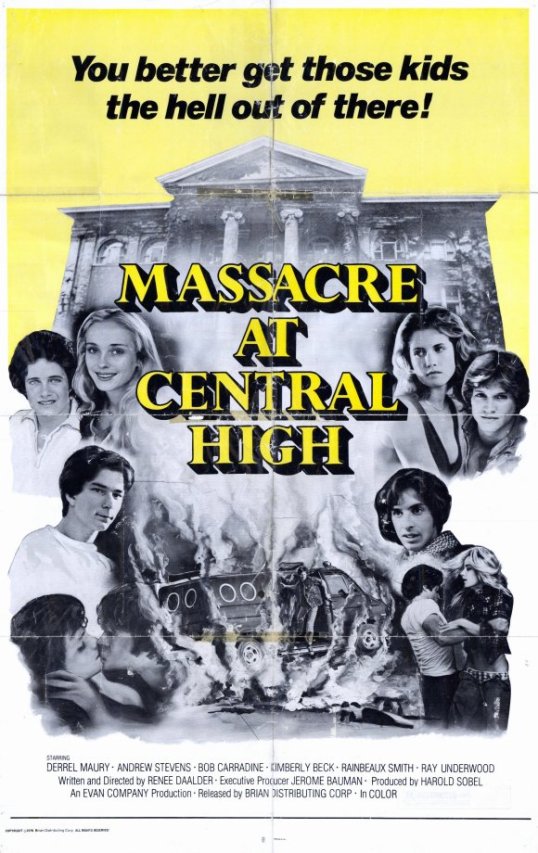
With a title like Massacre at Central High, you probably think that this 1976 film is a low-budget slasher film.  However, you’re totally wrong.  Instead of being a low-budget slasher film, Massacre at Central High is a low-budget political allegory and it’s a pretty good one at that.  It’s also not exactly an easy film to see (I had to watch it off of a scratchy, old VHS tape), which is unfortunate because it’s probably one of the best exploitation films of the 1970s.

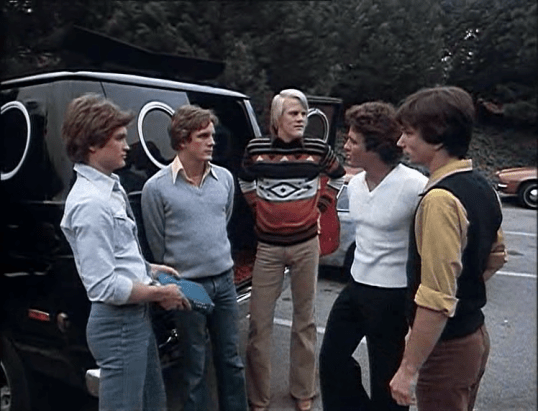
Massacre at Central High takes place at a high school in Southern California.  The first thing that you notice about Central High is that there aren’t any adults around.  The students don’t ever appear to go to class.  Instead, they spend their time roaming the halls.  The school is run by four wealthy jocks who enforce order, repress independent thought, and spend most of their time hanging out in an exclusive lounge.  Of the four ruling jocks, Mark (Andrew Stevens) is the most sensitive, an overall nice guy who doesn’t approve of the excesses of the others but, at the same time, isn’t willing to stand up to them either.

The Ruling Clique

The Ruling Clique

As for the other students, they spend their time being alternatively harassed and cared for by the jocks.  They’re told, of course, that everything is for their own good and that their survival depends on the survival of Central High.  Spoony (Robert Carradine) is caught and punished for spraying political graffiti on the lockers.  Oscar (Jeffrey Winner) is regularly bullied by the jocks on account of his weight.  School librarian Arthur (Dennis Kort) is attacked for being an intellectual.  When Rodney (Rex Steven Sikes) makes the mistake of parking his car in one of the jock’s space, they react by stealing and wrecking his car.

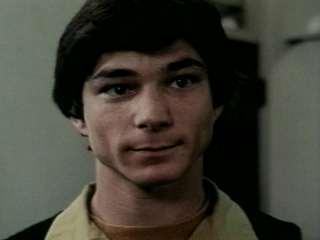
Things start to change when track star David (Derrel Maury) transfers to Central High.  David is an old friend of Mark’s and, at first, Mark attempts to get him to join the ruling clique.  However, David is disgusted by the other jocks and starts to stand up for the oppressed students.  The jocks (with the exception of Mark) respond by lowering a car down on David’s leg, crushing it.

No longer able to run track and now moving with a permanent limp, David refuses to tell anyone the truth about how he injured his leg.  Instead, he returns to school and gets his revenge, methodically murdering all of the jocks except for Mark.  Mark and his girlfriend Theresa (Kimberly Beck) now find themselves transformed into societal pariahs within the halls of Central High.  Meanwhile, the formerly oppressed students step up to fill the power vacuum and, to David’s disgust, they quickly turn out to be just as bad as their now deceased oppressors.

David Is Disappointed

David Is Disappointed

Now realizing that most revolutions are waged by the lower class against the upper class for the sole benefit of the middle class and that there’s absolutely no way to bring any real change to Central High, David instead makes plans to destroy the entire high school…

Surreal and dream-like, Massacre at Central High is a potent allegory that takes the concept of absolute power corrupting absolutely to its logical extreme.  It’s a film that celebrates revolution while, at the same time, asking, “What’s the point?”  It’s a film that looks at politics, society, and culture and actually has the courage to suggest that it might be better just to give up on all of it.  Featuring excellent performances from Maury, Beck, and Stevens and wonderfully off-center direction from Rene Daalder, Massacre at Central High is not an easy film to track down but it’s definitely one worth seeing.

Massacre At Central High