Horror Film Review: The Devil’s Rain (dir by Robert Fuest)


https://www.youtube.com/watch?v=HAfio1Qht3c

Was I the only one who was relieved that William Shatner didn’t die this week?

Seriously, when I heard that the 90 year-old Shatner was going to be taking a trip on one of the Amazon rockets, I was really worried.  First off, you’re taking a 90 year-old into space.  Secondly, you’re doing it with a rocket that people don’t really know that much about.  And third, that 90 year-old is a cultural icon and one who probably played no small role in causing people like Jeff Bezos and Elon Musk to become obsessed with conquering space in the first place.  With the exception of George Takei, everyone loves William Shatner.  (And, at this point, Takei’s constant sniping about Shatner is coming across as being just a little bit petty.  Move on, George!  People love you, too.)

As I watched Shatner land back on Earth, I found myself thinking about The Devil’s Rain, a film from 1975 that starred William Shatner as a man whose exploration of the unknown led to a far less triumphant result.   

In this film, Shatner plays Mark Preston, a youngish man who lives on ranch with his father (George Sawaya) and his mother (Ida Lupino).  For some reason, the Preston family owns a book that is full of evil magic.  Satanic high priest Jonathan Corbis (Ernest Borgnine) wants the book and when the Prestons refuse to hand it over, he makes it his mission to destroy them.  He gets things started by turning Mark’s father into a weird, waxy zombie who melts in the rain.  Not wanting the same fate to befall the rest of the family, Mark grabs the book and heads to a desert ghost town that has been taken over by Corbis and his followers.  Mark never returns.

Mark’s older brother, Tom (Tom Skerritt) then shows up in town, searching for Mark.  Accompanying him are his wife (Joan Prather) and a paranormal researcher (Eddie Albert).  Tom discovers that Corbis is transforming his followers into zombies who have no memories and who exist only to …. well, I’m not sure what the point of it all is but I guess it basically comes down to Corbis needing something evil to do.  Not only has Mark become one of his Corbis’s followers but, if you keep an eye out, you might spot a very young John Travolta in the background.  This was Travolta’s film debut.  According to the end credits, the character he plays is named Danny.  Danny Zuko, perhaps?  That would serve him right for making Sandy doubt herself.

The Devil’s Rain is one of the many low-budget movies that William Shatner did between the end of the Star Trek TV show and the start of the Star Trek movies.  It’s a bit of an disjointed film, as I think any film starring William Shatner and Tom Skerritt as brothers would have to be.  Skerritt gives a very laconic performance, playing his character as if he was the star of a Western.  Shatner, meanwhile, does that thing where he randomly emphasizes his words and gets the full drama out of every sentence and facial expression.  But, as much as Shatner overacts, you can’t help but enjoy his performance because he’s William Shatner and that’s what he does.  The same is true of Ernest Borgnine, who overacts in his role just as much as you would expect Ernest Borgnine to overact when cast as an evil cult leader.  For that matter, Eddie Albert isn’t exactly subtle as the paranormal researcher.  Don’t even get me started on Keenan Wynn, playing yet another small town sheriff.  Let’s just say that, with the exception of Tom Skerritt, the cast of The Devil’s Rain is not necessarily full of actors noted for their restraint.  That said, there’s something rather charming about everyone’s attempts to steal every scene in which they appear.

The Devil’s Rain is a deeply silly film but that doesn’t make any sense but it’s hard not to get caught up in it.  Even if the fact that this film is perhaps your only opportunity to see John Travolta melt on screen isn’t enough to make you watch, Shatner vs. Borgnine with Skerritt approaching in the distance is just too entertaining to resist!  Thankfully, Shatner survived appearing in this film and revitalized his career through a combination of Star Trek movies and Canadian tax shelter flicks.  He’s a survivor.  In fact, I guess I shouldn’t have been surprised that, even at the age of 90, Shatner has no trouble going into space.  William Shatner’s going to be around forever.

Horror Film Review: Piranha (1978, dir by Joe Dante)


At the height of the Vietnam War, the U.S. Government came up with a plan that could have changed the course of the war.

What if the government developed gigantic, super-fast, occasionally jumpy piranha?  And what if they set those killer fish loose in the rivers of Vietnam?  Would those fish swim through North Vietnam and take out the VC?  Sadly, the war ended before the government got a chance to test out Operation Razorteeth.  With the war over, the government was stuck with a bunch of killer fish.  Scientist Robert Hoak (Kevin McCarthy) ignored all orders to destroy his mutant fish because they were his life’s work.  (Awwwwwwwww!)  He kept an eye on them and did everything he could to prevent them from getting into the nearby river.

Unfortunately, Dr. Hoak’s best wasn’t good enough.  Because the piranha have gotten loose and now they’re making their way down to the river!  They start out eating skinny dipping teenagers, fisherman, and Keenan Wynn.  (They’re good enough not to eat Wynn’s adorable dog, which I appreciated.)  Further down the river, there’s a summer camp and a water park!  It’s definitely not safe to get back in the water but sadly, that’s what several people insist on doing throughout this film.  Even when the water is full of blood, people will jump in.  (It’s easy to be judgmental but it is a pretty river.  I don’t swim but I honestly wouldn’t mind living near a river that looked that nice.  Instead, I have to make due with a creek.)

Floating down the river on a raft and trying to warn everyone is the unlikely team of Maggie (Heather Menzies) and Paul (Bradford Dillman).  Maggie is a detective who has come to town to track down the two teenage skinny dippers who were eaten at the start of the film.  Paul is a drunk.  Well, technically, Paul is a wilderness guide and he does spend the entire movie wearing the type of plaid shirt that would only be worn by someone who goes camping every weekend but really, Paul’s main personality trait seems to be that he enjoys his booze.  Paul’s daughter is away at the summer camp.  Yes, that’s the same summer camp that’s about to be visited by a school of piranha.  AGCK!

Produced by Roger Corman and obviously designed to capitalize on the monster success of Jaws, Piranha was an early directorial credit for Joe Dante.  Dante would later go on to direct films like The Howling and GremlinsPiranha was also an early screenwriting credit for the novelist John Sayles, who would use his paycheck to launch his own directing career.  As a director, Sayles specializes in politically-themed ensemble pieces, which is something you might not guess while watching Piranha.  (Piranha does have an anti-military subplot but then again, it’s a film from the 70s so of course it does.)  Like the best of Corman’s film, Piranha works because it sticks to the basics and it delivers exactly what it promises.  Piranha promises killer fish biting away at anyone dumb enough to get in the water and that’s what it gives us.  As an added bonus, we also get some occasionally witty dialogue and Joe Dante’s energetic, self-aware direction.

As is typical with the films of both Corman and Dante, the cast is full of familiar faces.  Along with Kevin McCarthy as the mad scientist and Keenan Wynn as the eccentric fisherman, Dick Miller shows up as the waterpark owner.  Richard Deacon, who made a career of playing bosses and neighbors on various sitcoms in the 50s and 60s, plays the father of a missing teenager.  Director Paul Bartel plays the head of the summer camp, who may be a jerk but who still heroically jumps in the water to save several campers.  (Bartel’s moment of heroism is one of Piranha’s best scenes and, significantly, it’s played without irony.  You’ll want to cheer for the guy.)  Finally, the great Barbara Steele plays the government scientist who shows up to clean up Operation Razorteeth.

Piranha is simple but entertaining.   Dante’s direction is energetic and, despite the film’s self-referential tone, the killer fish are just savage enough to be scary.  It’s a film that tell us not to get back in the water but which understands that the temptation might just be too strong.

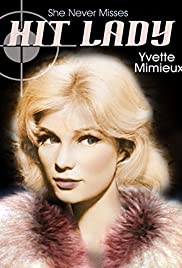
Hit Lady (1974, directed by Tracy Keenan Wynn)


Beautiful blonde Angela de Vries (Yvette Mimieux) shows up at a Texas barbecue and starts to chat up over-the-hill but very wealthy cowboy Buddy McCormick (Keenan Wynn).  Buddy thinks that he has hit the jackpot and when Angela suggests that they go off together for some alone time, he doesn’t turn her down.  Unfortunately for Buddy, the only reason Angela was talking to him was so she could get him alone and kill him with no witnesses!

(Buddy is played by Keenan Wynn because his son, screenwriter Tracy Keenan Wynn, directed this made-for-TV movie.  Angela is played by Yvette Mimieux because she got tired of only being cast in bland roles so she wrote a script with a juicy lead role for herself.)

Angela is a contract killer but she wants to get out of the business so that she can settle down with her seemingly oblivious boyfriend, a photographer named Doug (Dack Rambo).  Angela’s boss, Roarke (Clu Gulager), insists that Angela carry out one last hit.  He wants her to take down labor leader Jeffrey Baine (Joseph Campanella).  Angela really needs the money so she eventually accepts the job.  Roarke wants Baine’s death to look like an accident so that means Angela is going to have to learn everything that she can about Baine and his life.  When she learns that Baine loves Mozart, she decides to arrange an “accidental” meeting with him at a concert.  Is Angela the only contract killer in Los Angeles?  Couldn’t Roarke have found someone willing to do the job without so many preconditions?

Angela does meet Baine and, of course, the two of them start to fall in love.  Is Angela willing to both betray her boss and her boyfriend or will she carry out the hit?

Hit Lady is very much a product of the 70s, with one scene actually taking place at a disco.  Mimieux gives a good performance in a part that she wrote for herself and I’m sure many viewers will appreciate the lengthy amount of time she spends wearing just a bikini.  Mimieux gets to do most of the action movie things that, at the time, only men were usually allowed to do and she looks both good and convincing doing them.  Unfortunately, the love story with Jeffrey Baine does not work because the rough-hewn Campanella is not convincing as a Mozart-loving romantic lead and he and Mimieux never seem as if they really have any deep feelings for each other.  It’s easier to understand why Campanella would be attracted to Mimieux but than why she would be attracted to him.  That storyline probably would have worked better if Campanella had switched roles with Clu Gulager.  Hit Lady ends with an obvious twist but fans of 70s cheese and Yvette Mimieux should enjoy it.

An Offer You Can’t Refuse #6: King of the Roaring 20s: The Story of Arnold Rothstein (dir by Joseph M. Newman)


The 1961 gangster biopic, King of the Roaring ’20s: The Story of Arnold Rothstein, tells the story of two men.

David Janssen is Arnold Rothstein, the gambler-turned-millionaire crime lord who, in the early years of the 20th Century, was one of the dominant figures in American organized crime.  Though he may be best-remembered for his alleged role in fixing the 1918 World Series, Rothstein also served as a mentor to men like Lucky Luciano, Meyer Lansky, and Bugsy Siegel.  Rothstein was perhaps the first gangster to to treat crime like a business.

Mickey Rooney is Johnny Burke, Arnold’s best friend from childhood who grows up to be a low-level hood and notoriously unsuccessful gambler.  Whereas Arnold is intelligent, cunning, and always calm, Johnny always seems to be a desperate.  Whereas Arnold’s success is due to his ability to keep a secret, Johnny simply can’t stop talking.

Together …. THEY SOLVE CRIMES!

No, actually, they don’t.  They both commit crimes, sometimes together and sometimes apart.  Perhaps not surprisingly, Arnold turns out to be a better criminal than Johnny.  In fact, Johnny is always in over his head.  He often has to go to his friend Arnold and beg him for his help.  Johnny does this even though Arnold continually tells him, “I only care about myself and money.”

The friendship between Arnold and Johnny is at the heart of King of the Roaring 20s, though it’s not much of a heart since every conversation they have begins with Johnny begging Arnold for help and ends with Arnold declaring that he only cares about money.  At a certain point, it’s hard not to feel that Johnny is bringing a lot of this trouble on himself by consistently seeking help from someone who brags about not helping anyone.  From the minute that the film begins, Arnold Rothstein’s mantra is that he only cares about money, gambling, and winning a poker game with a royal flush.  Everything else — from his friendship to Johnny to his marriage to former showgirl Carolyn Green (Dianne Foster) to even his violent rivalry with crooked cop Phil Butler (Dan O’Herlihy) — comes second to his own greed.  The film’s portrayal of Rothstein as being a single-minded and heartless sociopath may be a convincing portrait of the type of mindset necessary to be a successful crime lord but it hardly makes for a compelling protagonist.

Oddly enough, the film leaves out a lot of the things that the real-life Arnold Rothstein was best known for.  There’s no real mention of Rothstein fixing the World Series. His mentorship to Luciano, Lansky, and Seigel is not depicted.  The fact that Rothstein was reportedly the first gangster to realize how much money could be made off of bootlegging goes unacknowledged.  By most reports, Arnold Rothstein was a flamboyant figure.  (Meyer Wolfsheim, the uncouth gangster from The Great Gatsby, was reportedly based on him.)   There’s nothing flamboyant about David Janssen’s performance in this film.  He plays Rothstein as being a tightly-wound and rather unemotional businessman.  It’s not a bad performance as much as it just doesn’t feel right for a character who, according to the film’s title, was the King of the Roaring 20s.

That said, there are still enough pleasures to be found in this film to make it worth watching.  As if to make up for Janssen’s subdued performance, everyone else in the cast attacks the scenery with gusto.  Mickey Rooney does a good job acting desperate and Dan O’Herlihy is effectively villainous as the crooked cop.  Jack Carson has a few good scenes as a corrupt political fixer and Dianne Foster does the best that she can with the somewhat thankless role of Rothstein’s wife.  The film moves quickly and, even if it’s not as violent as the typical gangster film, it does make a relevant point about how organized crime became a big business.

It’s not a great gangster film by any stretch of the imagination and the lead role is miscast but there’s still enough about this film that works to make it worth a watch for gangster movie fans.

Previous Offers You Can’t (or Can) Refuse:

  1. The Public Enemy
  2. Scarface
  3. The Purple Gang
  4. The Gang That Could’t Shoot Straight
  5. The Happening

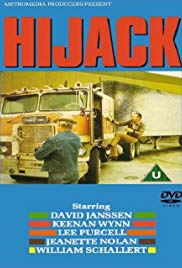
Hijack! (1973, directed by Leonard Horn)


Jake (David Janssen) is a down-on-his-luck trucker who is offered job by a mysterious man named Kleiner (WIlliam Schallert).  If Jake agrees to transport a cargo across the country, he will get not only $6,000 but Kleiner will also pull some strings get Jake back in the good graces of the trucking company.  If Jake takes the job, he will be given a slip of paper with a phone number on it and, according to Kleiner, that piece of paper will get him out of any trouble that he runs into along the way.  The only condition is that Jake is not allowed to know what he’ll be transporting.  Jake agrees and soon, he and his partner Donny (Keenan Wynn) are driving the truck through the desert.  They are also being followed by a group of men who will stop at nothing to steal the cargo.

This made-for-TV movie is called Hijack! but no one ever gets hijacked.  Instead, with the exception of a brief romantic interlude between Jake and a truck stop waitress (Lee Purcell), this is a nonstop chase movie but the chase itself is never exciting enough to justify that exclamation mark in the title.  It was probably made to capitalize on the success of Steven Spielberg’s made-for-TV classic, Duel, but it never come close to capturing the nerve or intensity of that film.  There’s one good scene where the bad guys come after the truck in a helicopter but otherwise, this is a pretty anemic stuff.  Even the eventual reveal of what Jake and Donny are hauling across the desert is a let down.

David Janssen specialized in playing grizzled loners and Keenan Wynn specialized in playing eccentric old coots so both of them are adequate in the main roles.  The bad guys are largely forgettable and, as she did in so many other TV movies in the 70s, Lee Purcell brings what life that she can to an underwritten role.

Horror on TV: Kolchak 1.16 “Demon In Lace” (dir by Don Weis)


Tonight, on Kolchak….

Young college students are dying of heart attacks and Carl Kolchak is on the case!  Could it be just a coincidence?  Could it be drugs?  Could it be anything other than a Sumerian demon?  Well, if you know Kolchak, you already know the answer to that question!

This episode originally aired on February 7th, 1975.

Enjoy!

Horror On TV: Kolchak: The Night Stalker 1.9 “The Spanish Moss Murders” (dir by Gordon Hessler)


Tonight, on Kolchak….

People are turning up dead.  Well, what else is new?  That’s pretty much been the plot of every Kolchak episode so far.  However, this time, they’re turning up dead while covered with Spanish moss!

Oh my God, could it be the Cajuns?

Well, as a matter of fact, it is.  As Kolchak discovers when he investigates, all of the dead people were somehow connected to a comatose Cajun….

Richard Kiel, who played the monster in the previous episode of Kolchak, returns here to play yet another monster.

The episode originally aired on December 6th, 1974!

http://www.youtube.com/watch?v=WcvJMqWRsVs

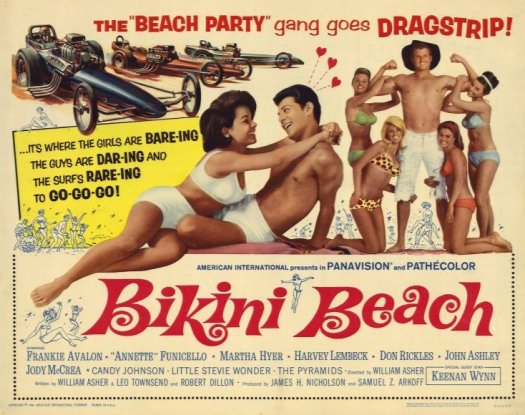
Drive-In Saturday Night 2: BIKINI BEACH (AIP 1964) & PAJAMA PARTY (AIP 1964)


gary loggins's avatarcracked rear viewer

Welcome back to Drive-In Saturday Night! Summer’s here, and the time is right for a double dose of American-International teen flicks, so pull in, pull up a speaker to hang on your car window, and enjoy our first feature, 1964’s BIKINI BEACH, starring Frankie Avalon and Annette Funicello:

BIKINI BEACH is the third of AIP’s ‘Beach Party’ movies, and this one’s a typical hodgepodge of music, comedy, and the usual teenage shenanigans. The gang’s all here, heading to the beach on spring break for surfing and swinging. This time around, there’s a newcomer on the sand, British rock star The Potato Bug, with Frankie playing a dual role. Potato Bug is an obvious spoof of the big Beatlemania fever sweeping the country, with all the beach chicks (or “birds”, as he calls ’em) screaming whenever PB starts singing one of his songs, complete with Lennon/McCartney-esque “Wooos” and “Yeah, yeah, yeahs”…

View original post 808 more words

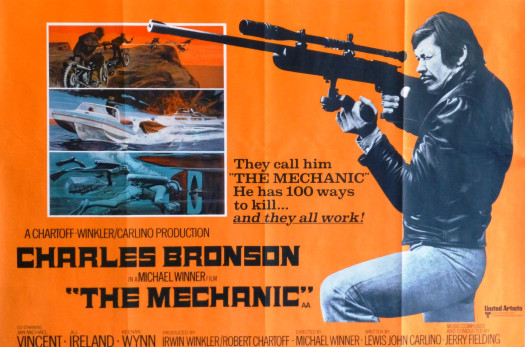
Stone Cold: Charles Bronson in THE MECHANIC (United Artists 1972)


gary loggins's avatarcracked rear viewer

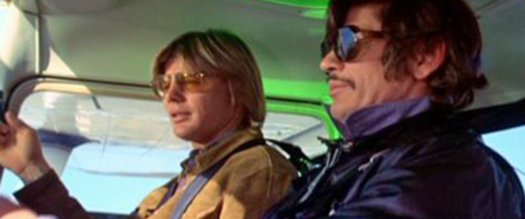
Stone-faced Charles Bronson is perfect as an ice-cold, classical music loving hit man who mentors young Jan-Michael Vincent in 1972’s THE MECHANIC. I’d say this is one of Charlie’s best 70’s actioners, but let’s be serious – they’re ALL damn entertaining!

Arthur Bishop (Bronson) takes his work seriously, meticulously planning every assignment he receives from his Mafia boss (Frank De Kova ). Given a job to kill family friend Big Harry McKenna (Keenan Wynn), Bishop does the deed with chilling precision. McKenna’s son Steve (Vincent) is a stone-cold sociopath himself, and soon worms his way into becoming Bishop’s apprentice. Their first caper together goes sour, bringing Bishop’s boss much displeasure. Bishop’s next hit takes the two overseas to Naples, where they’re set up to be killed themselves, resulting in a violent conclusion and a deliciously deadly twist ending.

Bronson, after over twenty years and 50 plus movie roles, became…

View original post 376 more words

The TSL’s Daily Horror Grindhouse: The Dark (dir by John “Bud” Cardos)


Some of y’all may have noticed that, whenever I don’t have much to say about a movie, I’ll usually start things about be praising either the film’s title or its poster art.

With that in mind, the 1979 film The Dark has got a great title.  I mean, what self-respecting horror film could actually resist a movie called The Dark?  It’s a title that promises horror and blood and no holds barred morbidity!  And really, the title is so brilliant that it almost doesn’t matter that the film itself come no where close to delivering.

And finally, just check out the poster art!

the-dark

Seriously, that’s a great poster!  If I had been alive in 1979, I totally would have wanted to see this movie just because of the poster.  Not only is the film called The Dark but the poster literally promises that this movie is going to be — and I quote — “A chilling tale of alien terror!”

Woo hoo!

Of course, The Dark didn’t start out as a chilling tale of alien terror.  The Dark is one of those films where what happened behind the camera is far more interesting than what was actually filmed.  The story behind The Dark is a classic tale of low-budget, exploitation filmmaking:

Originally, The Dark was going to be a story about a zombie decapitating people in Los Angeles.  The zombie had once been a Confederate soldier who ended up resorting to cannibalism.  As originally envisioned, the Dark would feature numerous scenes of that dead Confederate wandering around with a big axe that it would use to chop off heads.

Tobe Hooper, who was hot as a result of having directed The Texas Chainsaw Massacre, was brought in to direct.  However, after just a few days of shooting, he was replaced.  Depending on which version you read, Hooper was either fired or he walked off the set.  Either way, all accounts seem to agree that Hooper didn’t see eye-to-eye with the film’s producers.  (One of those producers was Dick Clark, the same guy who always used to host ABC’s New Year’s special.)

With Hooper gone, a new director was brought in.  That director was John “Bud” Cardos, who had previously had a drive-in hit with Kingdom of the Spiders.  Cardos finished the film but he had no emotional investment in it and that’s obvious when you watch The Dark today.  Visually, The Dark looks and feels like an old cop show, the type that you might expect to turn up on a cable station that is specifically programmed to appeal to the elderly.

The film that Cardos completed featured a Confederate zombie with an axe.  However, the producers showed that film to a preview audience and quickly discovered that nobody cared about a Confederate with an axe.

So, they made some changes.

At the time, Alien was the most popular film at the box office so the producers thought, “Why not add some special effects, redub some dialogue, and make our Confederate zombie into an alien?”  Sure, why not?

Hastily, The Dark was reedited.  All shots featuring the zombie with an axe were removed from the film.  Instead, whenever the monster attacked, the film now featured a freeze frame of the monster’s face with some hastily added laser beams shooting out of his eyes.  This would be followed by a freeze frame of the victim and stock footage of an explosion….

(That said, there’s still plenty of references to the alien removing people’s heads…)

Interestingly, there’s still a scene in the film in which a police detective suggests that the creature might be a zombie.  “Zom-bies!?” his superior yells, “I don’t want to hear those two words again!”  Well, don’t worry.  It’s not a zombie!  It’s an alien!

(You do have to wonder why an alien would be wearing jeans and flannel shirt but, then again, why would a Confederate zombie be wearing jeans and a flannel shirt?  It’s a strange world.)

As you’ve probably already guessed, The Dark is a bit of a mess.  The alien is going around Los Angeles and blowing people up.  (Though a few times, he also rips off their heads because … well, we already went into that.)  The father of one of the victims is a burned out writer and he’s played by William Devane.  (This is the same William Devane who has played the President in nearly every movie and TV show ever made.  Words cannot begin to express how bored Devane appears to be in this movie.  Oddly, with his hair long and graying, Devane bears an uncanny resemblance to Law & Order SVU‘s Richard Belzer.)  The father is investigating, even though the lead detective (played by Richard Jaeckel) tells him not to.  A reporter (Cathy Lee Crosby) is also investigating.  And then there’s a psychic (Jacquelyne Hyde) and the psychic somehow knows what the monster is and who is going to die next.

The characters do eventually cross paths.  When the detective meets the reporter, the detective announces that he’s going to kill the killer.  “38 caliber justice?” the reporter replies.  “If he’s dead, he can’t kill again!” the detective explains and he kind of has a point.

(Making it even stranger is that, while the detective and the reporter talk, there’s a political protest gong on behind them.  The protest consists of people jumping up and down.)

It’s all really messy because, while watching the movie, you get the feeling that none of the actors knew what anyone else was filming.  It’s like six different films with six different tones and they’ve all been smashed together.  It’s also not particularly scary because ultimately, the zombie alien is just a freeze frame with some hastily added laser beams.  (It doesn’t help that the lasers occasionally go “pew pew” when they’re fired.)

But still, The Dark is a great title for a movie.