Trailer: Sin City: A Dame to Kill For (Official Teaser)


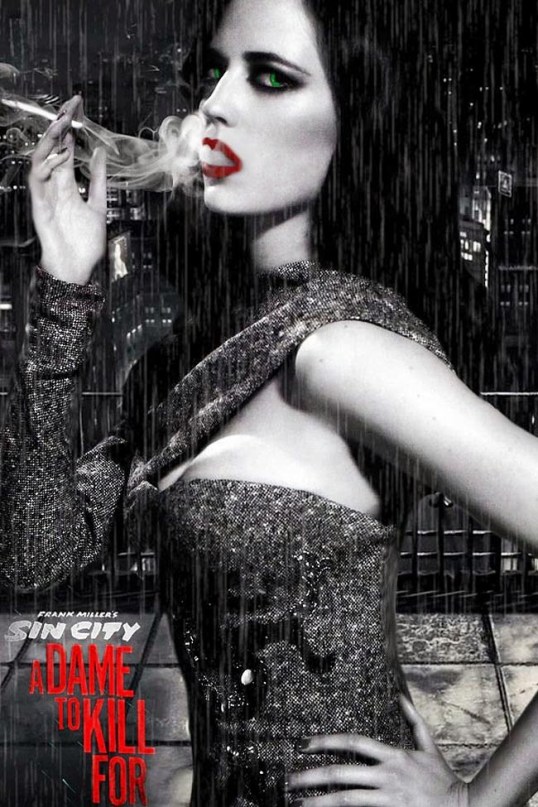
Sin City A Dame to Kill For

Hard to imagine it’s been 9 years since the original Sin City hit the big screen. It was a comic book adaptation that many thought wouldn’t work, especially how Rodriguez envisioned it to be slavishly loyal to not just Miller’s dialogue but also his unique art style.

The original film’s success quickly ramped up rumors that a sequel was already being planned using the second graphic novel in the Sin City series. Rodriguez himself stated he wanted Angelina Jolie for the role of Ava Lord, the titular “Dame to Kill For”, but after years and years of delay the role finally landed on Eva Green‘s lap (not a bad choice and one I fully support).

So, we’re now going back to Basin City for more tales of booze, broads and bullets in this hyper-noir film that should be loved or hated in equal measures by those who have followed Frank Miller’s career. Once again the directing duties have been split between Rodriguez and Miller. Here’s to hoping that Miller has learned how to be a much better directer after his last film, The Spirit, tanked.

Sin City: A Dame to Kill For is set for an August 22, 2014 release date.

Film Review: Gangster Squad (dir by Ruben Fleischer)


Gangster Squad

Do you remember Gangster Squad?

This film, which tells the story of hard-boiled cops and psychotic gangsters in 1940s Los Angeles, was originally meant to be released in September of 2012 but the release date was moved back because the film originally featured a gun battle in a movie theater.  After the real-life movie theater shooting in Aurora, Colorado, that scene was reshot and the release of Gangster Squad was delayed until January of this year.  The critics absolutely hated it, audiences stayed away, and Gangster Squad was the first high-profile flop of 2013.

I was among those who ignored the film when it was first playing at theaters.  After all, it was January and I was more interested in following the Oscar race than going to see a film that, by all accounts, was somewhat terrible.  However, now that Gangster Squad is showing up on a nearly nightly basis on Cinemax, I recently got a chance to see the movie and you know what?

The critics were wrong.

Gangster Squad tells a familiar story.  In fact, the film features not a single character or plot twist that hasn’t shown up in another movie.  The setting is Los Angeles in the 1940s.  Ruthless gangster Mickey Cohen (a totally over-the-top Sean Penn) is the king of the city’s underworld.  How crazy is Mickey Cohen?  He’s so crazy that, when we first see him, he’s watching as another gangster is literally ripped in half.  He’s so crazy that, in the middle of a gun battle, he yells, “Here comes Santy Claus!” as he fires his machine gun.  That’s how crazy Mickey Cohen is.

Sean Penn in Gangster Squad

Seriously crazy.

Fortunately, righteous police chief William H. Parker (Nick Nolte) refuses to allow a little thing like due process to keep him from pursuing Mickey.  Parker calls Sgt. John O’Mara (Josh Brolin) to his office and, after delivering a long and flowery monologue that verges on incoherence, he finally explains that O’Mara’s mission is to put together an elite squad of cops and to take Mickey out by any means necessary!  (Usually, I try to exercise some restraint when it comes to punctuation but Gangster Squad is one of those films that demands exclamation points.)

This is followed by a series of properly colorful scenes in which O’Mara recruits his gangster squad.

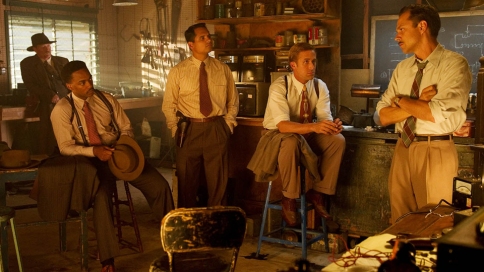
Jerry Wooters (Ryan Gosling) is a cynical World War II veteran who is, at first, skeptical of O’Mara and his squad.  Wooters, however, changes his mind after a saintly shoeshine boy is gunned down in front of him.  Wooters is also having an affair with Grace Faraday (Emma Stone), who happens to also be Cohen’s girlfriend.

Coleman Harris (Anthony Mackie) is a black cop who is good with a knife and who lost his cousin to the heroin distributed by Cohen’s mob.  Watching the friendly and playful interaction between Harris and all of the film’s white characters provides us with one of our first clues that Gangster Squad is not necessarily aiming to be a historically accurate portrait of America in the 1940s.

Conway Keeler (Giovanni Ribisi) is a wiretapper and a family man.  Keeler’s fate is pretty much sealed the minute that he tells O’Mara that he’s willing to risk death just to make the world a better place for his son.

Max Kennard (Robert Patrick) is a former old west gunslinger who now spends his time killing gangsters.  Max, we’re told, may be old but he’s also personally shot over a 100 gangsters.  Max also has a younger partner, an honest cop named Navidad Ramirez (Michael Pena).
GANGSTER SQUAD

The Gangster Squad

As you can probably guess at this point, there’s not a single cliché that is not employed by Gangster Squad.  However, and this is what I think several critics missed, the film deliberately takes its clichés to such an extreme that they go from being flaws to being strengths.  By so enthusiastically going overboard in its embrace of the conventions of the gangster film genre and, at the same time, acknowledging the fact that the audience is also familiar with those clichés, Gangster Squad creates its own vibrant and compulsively watchable fantasy world.  The world of Gangster Squad has little to do with any sort of historical reality.  Instead, it’s a  world constructed solely out of other gangster movies.

Taking all of this (and the fact that the film is directed by Ruben Fleischer of Zomieland and 30 Minutes or Less fame) into consideration, it’s pretty obvious that Gangster Squad is not a film that’s meant to be taken seriously.  And yet, that’s what so many critics did when the film was first released in January.  Instead of appreciating the film for paying over-the-top homage to the gangster films of the past, critics attacked it for being an example of style over substance.

And, to give the critics their due, they were exactly right.  There is no substance to Gangster Squad.  Instead, the film is a total celebration of style.

And what style!  In Fleischer’s hands, 1940s Los Angeles is a colorful wonderland of pure excess, a vibrant landscape of dark alleys and swanky nightclubs that literally glow on-screen and are populated by tough men and sultry women in clothing that might not have been found hanging in every closet in the 40s but should have been.  (Seriously, when Emma Stone first appears on-screen, she’s wearing a red gown that is simply to die for.)

This Christmas, I want both Ryan Gosling and the dress.

This Christmas, I want both Ryan Gosling and the dress.

For the viewer who is willing to give themselves over to the film’s over-the-top aesthetic and are willing to appreciate it for what it is (as opposed to condemning it for what it isn’t), Gangster Squad is a watchable, entertaining, and fun movie.  And what’s so bad about that?

I’m glad that I finally got a chance to see Gangster Squad.  Is it one of the great gangster films?  No.  The great gangster films have both style and substance but, quite frankly, if I can only have one than I would prefer something stylish and fun like Gangster Squad to something like Killing Them Softly.

(Then again, I would prefer just about anything to sitting through Killing Them Softly for a second time.)

So, enjoy Gangster Squad.  Watch it for the style.  Have fun.  And most importantly, remember that critics are as often wrong as they are right.

Emma Stone in Gangster Squad

Trailer: Oldboy (Red Band)


OldboyRemake

Today saw the release of the red band trailer for the remake of Park Chan-wook’s classic neo-noir Oldboy. This remake by Spike Lee already looks to pay homage (or imitate) the look and feel of Park’s adaptation of the Japanese manga of the same name by Garon Tsuchiya and Nobuaki Mineshigi. We see quick glimpses of the hallway fight scene and a montage of the main character’s 20 years spent locked up in an unknown hotel room.

There’s a great chance for Spike Lee to make this remake his very own by using the Park film as a template but not as gospel. The Park adaptation itself took some liberties with the story told in the manga. Lee and the screenplay by Protosevich could do same to allow this Oldboy a chance to stand on its own instead of becoming another Gus Van Sant Psycho.

Though I wouldn’t mind to see what Lee has in mind as Josh Brolin’s character’s first choice of a meal once getting out.

Trash Film Guru Vs. The Summer Blockbusters : “Men In Black 3”


Right out of the gate, Men In Black 3 feels dated. Not like something out of the 1960s, which is when most of this film’s story is set, but like something out of the late 90s/early 2000s. Director Barry Sonnenfeld —- who’s had a hell of a time getting other projects off the ground in Hollywood despite helming up two incredibly successful “blockbuster” franchises (MIB and The Addams Family — just in case, like apparently most studio execs, you’d forgotten) — jumps into this thing with so much gusto that you’ll forget within minutes that it’s actually been 10 years since Will Smith’s Agent J and Tommy Lee Jones’ Agent K ran around chasing men from Mars (and even further afield) across the silver screen.

Oh, sure, a lot’s happened in that decade as far as the principals here are concerned — Smith’s been pretty quiet the last few years, for one thing, and Jones has aged pretty visibly and is more or less consigned to supporting roles these days (including here, given that his younger 1960s alter ego, played with impeccable precision by Josh Brolin, actually gets far more screen time than Jones’ present-day version), but it’s pretty clear that when it comes to carrying the load in big-budget brainless summer fare, neither of them has left a step — nor has Sonnenfeld, who puts his foot down on the gas immediately and never once lets up long enough to allow us to do the one thing that’s guaranteed to pulverize the credibility of any glitzy megamiilion-dollar Hollywood FX extravaganza : think.

And ya know what? I wouldn’t have it any other way. Sure, there’s some sappy “bromance”-type crap shoehorned in here, and a love-interest subplot involving the Agent Ks of both the swingin’ Sixties and the present day, but that’s all fine and good too in the limited doses tha Sonnenfeld serves them up. By and large, though, to the shock of absolutely no one, this flick is all about big, flashy, lighthearted, comedic fun, and that’s something that’s sorely been lacking in the midst of all these dour summer movies this year, like Prometheus, for instance, that take themselves just sooooooo seriously.

Men In Black 3, quite clearly, doesn’t, and that’s perhaps its greatest virtue.The plot’s pretty basic time travel stuff — J goes back in time to prevent K from being killed, various hijinks ensue — but this is one of those films that isn’t so much concerned with doing anything new as it is just doing what everybody and their brother (or sister, or cousin) knows it’s there to do and doing it well. Give us a likable cast, some cool eye-candy effects, a couple little nifty quirks like Andy Warhol actually being a “Man In Black” himself, and you know what? You’ve got the recipe for a very familiar, but nonetheless pleasant, little serving of celluloid. It’s not at all filling on an intellectual, or frankly even artistic, level, but come one — does everything absolutely need to be? Sometimes you just want to go out to the movies, shut your brain off, and have a good time. If that’s the kind of mood you’re in, there’s nothing else out there this summer that will satisfy you quite like Men In Black 3.

A Quickie With Lisa Marie: Men In Black 3 (dir. by Barry Sonnenfeld)


Men In Black 3, which was released into theaters last month, is an unexpected surprise, a genuinely entertaining film that breathes some new life into an old franchise. 

If you’ve seen the trailer then you pretty much know the plot of Men In Black 3.  An alien war criminal named Boris (played, in wonderfully over-the-top fashion, by Jermaine Clement) escapes from imprisonment on the moon.  He goes back to the year 1969 and kills the man who originally imprisoned him, Agent K.  In the present day, Agent K (played, of course, by Tommy Lee Jones) vanishes from existence.  The only person who remembers him is his longtime partner, Agent J (Will Smith).  Agent J and Agent O (played by Emma Thompson) quickly figure out what has happened (one of the best things about Men In Black 3 is that everything happens quickly — there’s very little padding) and J is sent back to 1969 where he ends up teaming up with the young Agent K (now played by Josh Brolin).  Together, J and K attempt to prevent Boris from changing history.

As I hinted at earlier, I wasn’t really expecting much from Men In Black 3.  Yes, the trailer was cute and I was looking forward to seeing Josh Brolin’s impersonation of Tommy Lee Jones but otherwise, I had no reason to suspect that this film would be anything more than a somewhat disheartening collection of CGI and superstar egos.

But you know what?

Men In Black 3 isn’t half-bad. 

Now, don’t get me wrong.  Men In Black 3 doesn’t rewrite the rules of a familiar genre (like Cabin In The Woods).  And it’s certainly not an idiosyncratic expression of one man’s personal artistic vision (like Moonrise Kingdom).  No, Men In Black 3 is pure Hollywood entertainment but, at the very least, it’s a well-made example of pure Hollywood entertainment.  This is the type of film that could easily have been made (and watched) on autopilot but director Barry Sonnenfeld and his talented cast have actually made the effort to make an entertaining film and they’ve succeeded.

Both Will Smith and Tommy Lee Jones have reached a point where they could play their roles in their sleep (and, in other movies, that’s what they both often seem to be doing) but both of them seem to be having fun in Men in Black 3 and they’ve got such a strong chemistry that they’re enjoyable to watch.  Jones even brings a sense of reality to his character’s world-weary resignation and, if Will Smith’s main talent seems to be the fact that he’s likable, he still does likeable pretty well.  The new additions to the cast — Emma Thompson, Jermaine Clement, Alice Eve, and especially Michael Stuhlbarg and Bill Hader — are all fun and interesting to watch.  The film, however, is truly stolen by Josh Brolin, who not only perfectly captures Tommy Lee Jones’ voice and mannerisms but also manages to hint at his sense of gravitas as well.  Sonnenfeld keeps the story moving quickly and, for once, the impressive CGI is used in the service of the story as opposed to just providing an excuse for that story to exist.

As usually seems to happen with franchise films, the whole thing ends on a sentimental note and, I have to admit, it actually brought tears to my eyes.

Then again, I’ve been told that I cry at anything.

Regardless of whether my tears were honestly earned or if they were just a Pavlovian response, Men In Black 3 is an entertaining film and I’m glad I saw it.

A Belated Trailer: Men in Black 3


Yes, this trailer has been out there for a while and quite frankly, I’m not expecting this film to be that good (I get the feeling that the best moments are probably in the trailer) but still, I always smile whenever I see the trailer for Men in Black 3.  Why?  Well, there’s really only one reason and it’s not Will Smith being all Will Smith-like.  And, no, it’s not Tommy Lee Jones because, even in the trailer, Jones looks absolutely miserable and ennui-stricken.  And it’s not Jermaine Clement because, while he’s apparently in the film, he’s not in the trailer.

No, for me, this trailer — and probably the entire film — is all about Josh Brolin’s next-to-perfect imitation of Tommy Lee Jones.

A Quickie With Lisa Marie: True Grit (directed by Joel and Ethan Coen)


True Grit is probably the most straight-forward film that has ever come from the irony-laced imaginations of Joel and Ethan Coen.  Perhaps that’s appropriate since the movie is essentially an homage to that most All-American of all movie genres, the western.

Taking place in 1878, True Grit tells the story of Mattie Ross, a 14 year-old girl (Hailee Stienfeld) whose father is killed by a drifter named Tom Chaney (Josh Brolin).  Tom flees into Oklahoma so Mattie goes to Ft. Smith, Arkansas and hires alcoholic, one-eyed U.S. Marshal Rooster Cogburn (Jeff Bridges) to track Chaney down.  Cogburn agrees and teams up with a Texas ranger named LeBouef (Matt Damon) who is also looking to capture Chaney for an unrelated crime (and to pick an equally unrelated reward).  The three of them form an unlikely and uneasy alliance as they search the harsh wilderness for Chaney, who has hooked up with outlaw Ned Pepper (Barry Pepper).  Along the way, reality proves itself to be far less prosaic and ideal and justice turns out to be far less straight forward than Mattie had originally assumed.

As you might expect from a Coen Brothers film, there’s a lot of moral ambiguity on display.  Cogburn is a former outlaw who is mainly motivated by his own greed while LeBouef is an arrogant blowhard.  Meanwhile, the nominal villains often show more humanity than our “heroes.”  Even Tom Chaney appears to be more overwhelmed than evil.  This is a western where the “good guys” ambush their enemies and shoot them in the back.  Throughout the film, the Coens contrast the beautiful cinematography of Roger Deakins and Carter Burwell’s traditional score with the brutality and violence on-screen.

True Grit is a remake of a 1969 film and Jeff Bridges is getting a lot of attention for taking on a role that was originally played by John Wayne.  I haven’t seen the original film so I can’t say if Bridges gives a better performance than Wayne.  However, to be honest, Bridges probably gives the least interesting performance in the entire film.  I know that a lot of people are raving about his work here but I think those raves are more about the actor and less about the performance itself.  When people look back on this movie, they won’t remember Rooster Cogburn as much as they’ll remember Jeff Bridges wearing an eyepatch and slurring his words like your alcoholic cousin on the 4th of July.  Bridges gives a good enough performance but there’s nothing here that couldn’t have been done just as well (or better) by either Tommy Lee Jones or Joe Don Baker.

If anything, the movie belongs to Steinfeld who gives a wonderfully focused performance as Mattie and who serves as the perfect audience surrogate.  As the two main villains, Brolin and Pepper both give excellent performances and the fact that both of them are almost likable only serves to make them all the more effective as “bad” guys.

True Grit is a good movie because the Coen Brothers aren’t capable of doing any less.  Technically, it’s probably one of the best films of 2010.  Still, the movie left me vaguely disappointed.  For what it is — a straight genre piece — it’s a superior work of craftsmanship.  However, from the Coens, I’ve come to expect a bit more. 


A Quickie with Lisa Marie: Wall Street: Money Never Sleeps (Dir. by Oliver Stone)


Sometimes, words escape even me. 

I’ve been trying for about three days now to figure out how to explain why Wall Street: Money Never Sleeps is one of the most disappointing films of 2010.  Notice I didn’t use the term “worst film.”  There’s enough in the movie that works (Michael Douglas is fun to watch as Gordon Gekko and there’s a handful of scenes that perfectly capture the modern atmosphere of financial panic) to keep it from being a truly awful movie.  But just because the movie isn’t awful, that  doesn’t necessarily mean that it’s any good.

Oh, Wall Street — how did you fail?  Let me count the ways.

1) Michael Douglas gives a great performance but he actually has less screen time here than he did in the original Wall Street.  Yes, it’s fun to watch Gekko claw his way back up to the top but, once you take those scenes out of the equation, you still have about 1oo minutes of non-Gekko material to slog through.

2) Instead most of the screen time goes to Shia LeBouf.  Let me repeat that — most of the screen time goes to Shia LeBouf.  In this film, Shia plays a cocky young financial genius.  Let me repeat that.  In this film, Shia LeBouf plays a genius.  Back before Shia became the human face of the Transformers franchise, I’ll admit that I thought he was kinda cute in his geeky, awkward way.  However, in Wall Street, his character isn’t supposed to be geeky or awkward.  He’s supposed to be some sort of financial genius.

3) We’re also supposed to automatically sympathize with Shia LeBouf’s character because, while he’s a part of the system that created the recession, he’s also dedicated to funding some sort of green energy project.  Much like James Cameron in Avatar, Oliver Stone trots out a simplistic environmental theme here and expects to be praised just for mentioning it.  The message is: “Love my film or Mother Earth gets it.”

4) The film’s plot: Shia LeBouf’s mentor and boss — played by Frank Langella — commits suicide after being run out of business by evil millionaire Josh Brolin.  So, Shia takes a job working with Brolin.  Meanwhile, Shia is also engaged to the daughter of Gordon Gekko.  This leads to him taking Gekko on as a mentor.  Shia apparently wants to take Brolin down.  Or does he?  Unfortunately, LeBouf doesn’t seem to know for sure and that comes across in his performance.  As a result, the majority of the film is about as exciting as watching anyone else go to work.

5) Josh Brolin’s the villain here.  We know he’s a villain because everyone else in the film keeps insisting he’s the villain and Brolin plays the role as if he’s auditioning for a role in the next James Cameron film.  Which is to say, Brolin gives a dull and lifeless performance.

6) The little guy who is creating this alternate source of energy that Shia is so obsessed with?  The little guy is played by Austin Pendleton who, I swear to God, is one of the most annoying character actors ever.  Seriously, Pendleton, stop fucking smiling all the time! 

7) Having seen both this and the original Wall Street, I can now say that I have no idea how the stock market works and I really don’t care to learn.  I just want everyone to stop yelling and throwing paper all over the place.  Seriously, Stone tries to make the “market” scenes exciting here but, once you get over the fact that Stone knows how to use a zoom lens, they’re pretty dull.  Lucio Fulci and Jean Rollin — they would have found a cool way to film those scenes.  Stone just resorts to the same old tricks.

8) That little smiley face looks so cute with his sunglasses on.

9) As with the original Wall Street, this is yet another film about little boys and their daddy issues.  Which father figure will Shia choose?  Meanwhile, Shia’s mother (a grating performance from Susan Sarandon) and his girlfriend (Carey Mulligan) are portrayed as total fools.  Mulligan, after her performance in An Education, especially deserve better than to be stuck playing some sexist fantasy of a human being.  Sarandon is blamed for the housing collapse while Mulligan’s character is cheated out of a fortune towards the end of the film.  The message here, I guess, is don’t let women have money because we’ll just fuck everything up.  I love how I can always count on “progressive” filmmakers to prove themselves to be a bunch of pigs at heart.

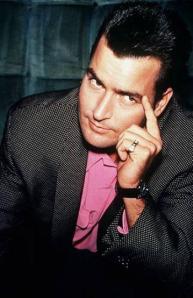
10) Charlie Sheen shows up for a really awkward cameo.  He’s supposed to be playing his Bud Fox character from the original film but, watching his performance, you get the feeling that Charlie doesn’t remember being in the original film.  Showing up at a charity dinner with a separate date on either ar, Bud Fox is presented as being just as corrupt as Gordon Gekko.  Michael Douglas, quite frankly, looked somewhat embarrassed by the whole scene.  However, as awkward as the scene was, it did manage to perfectly capture the theme of this movie:

Eventually, even Bud Fox will grow up to be Charlie Sheen.

Review: Grindhouse (dir. by Robert Rodriguez and Quentin Tarantino)


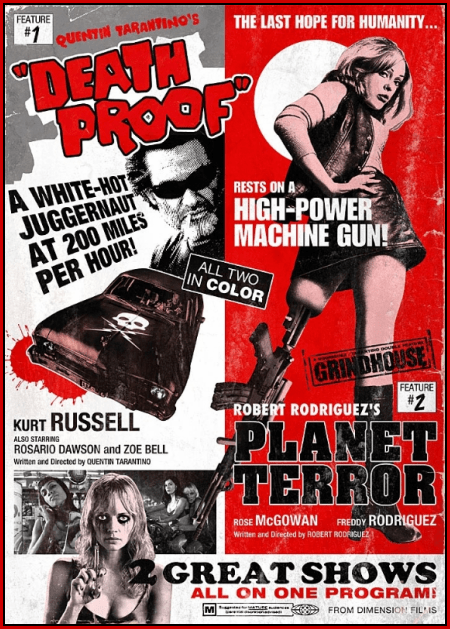
Robert Rodriguez and Quentin Tarantino have always professed to anyone within hearing distance their extreme and fanboyish love for the grindhouse days of filmmaking. Both directors’ resume of work look like a modern grindhouse films but with better writing, effects and directing. Anyone who grew up watching grindhouse film’s of the 70’s and 80’s can see it’s heavy influence on films such as From Dusk Til Dawn, Desperado, Pulp Fiction and Kill Bill. With 2007’s Grindhouse, both Rodriguez and Tarantino take their fanboy love for all things grindhouse and exploitation to a whole new level with personal take on the cheap John Carpenter-knock offs, zombie gorefests, slasher film and revenge-driven flicks that made being a young kid during the 70’s and 80’s quite enjoyable.

For those who do not know what grindhouse films are they’re the ultra-cheap and, most of the time, very bad, shlocky horror, revenge, softcore porn, badly-dubbed kung fu flicks and a myriad of other B- to Z-grade movies. These movies were shown in dingy, decrepit (usually former burlesque stagehouses) movie houses which showed double to triple-bills of titles for a low, cheap price all day long (where the popcorn and concession snacks were as stale as week-old coffee). These places and their films were book-ended by the cheap drive-in theaters which grew out of the suburban sprawl boom era of the 60’s and 70’s. One could not avoid the fact that the projector equipment were in bad shape and in desperate need of maintenance while the films played out. Then there’s the film reels themselves with their washed out sequences, out of focus scenes, burnt-in spots and missing film reels where the sex scenes would’ve been. This was the grindhouse experience and with the rise of Hollywood as a corporate entity even moreso than it’s been in the past and urban renewal projects by big city leaders, the grindhouse experience has pretty much faded away and kept alive only in the memories of its fans worldwide.

What Robert Rodriguez and Quentin Tarantino have cranked out with their three-hour long opus to those grindhouse days has been both a literal and thematic homage to an era long since gone. Grindhouse also has allowed Rodriguez and Tarantino to pull out all the stops in filming their respective halves of the film. Rodriguez went all-out in paying literal homage to the zombie gore-fests of George A. Romero, Lucio Fulci and Umberto Lenzi. Planet Terror plays like a hodgepodge of all the zombie movies from these masters of the walking dead but Rodriguez has the use of digital effects to match the over-the-top feel of the past zombie-fests without making the effects look too cheap.

The story for Planet Terror is quite simple yet full of so many incoherent subplots that trying to keep track with whats going on would just confuse a viewer even more. Rodriguez gets the grindhouse feel with such a ludicrous storyline. Whether it was done on purpose or not, the feeling of confusion in addition to the non-stop zombie action was only compounded even more by the digitally-added film stock scratches, burns to the edges of the reel and when the movie was about to get all hot and sexy, missing reel footage. Anyone who watched movies in grindhouse theaters would recognize the look quite well. Rodriguez goes all out in letting his zombie fanboy out. The violence in Planet Terror begins strong and just gets stronger and even more over-the-top right up to the final frame. Zombie’s getting their heads blown apart is shown in scratchy, loving detail with an impossible amount of blood, bone and brain for people to gawk at. The female characters are hot and sexy. Rose McGowan as Cherry Darling holds Planet Terror together with her spunky go-go dancer dreaming to be a stand-up comedienne turning into Ellen Ripley minus a leg but gaining an M16A3 w/ M203 grenade launcher as a leg prosthetic. Freddy Rodriguez as El Wray, her wayward and mysterious lover, almost seem to be channeling a hilariously bad version of Snake Plissken. These two make for quite the explosive couple as they must try and save their small Texas town from the infected townspeople turned pus-oozing, boil-ridden zombies.

Planet Terror sports a nice collection of current B-list actors like Josh Brolin (making like a Nick Nolte at his growliest) and Marley Shelton as a pair of married doctors with marital problems compounded by the increasing amount of zombies their hospital seem to be bringing in for medical help. There’s also genre veterans Michael Biehn, Jeff Fahey and Tom Savini to give Planet Terror the appropriate grindhouse look and feel to it. Ever the good friend and buddy collaborator, Rodriguez even gives Quentin Tarantino a role in his half of the film. He’s shown in the credits for Planet Terror as The Rapist. If any director seem destined to be one, if their love for movies didn’t steer them on the right path, Tarantino seem to look just like one to be called “Tha Rapist”.

There’s explosion and gore galore in Rodriguez’s ode to the zombie genre. Some who sees it might say there’s too much and they would be right if the title of the whole film wasn’t Grindhouse. I, for one, am glad Rodriguez decided to not hold back with what he threw onto the screen. I’m sure that when the dvd finally comes out and the unedited full version of Planet Terror is shown it’ll even surpass the 85-minute running time in the film. I think I can forgive Rodriguez for his gore excess and at times I actually wished for more, but then that would mean taking even more time before I get to Tarantino’s half of the movie. Planet Terror truly got the look of a grindhouse flick, but it’s Tarantino’s Death Proof half which got the spirit of grindhouse down to near-perfect.

Before Tarantino’s Death Proof half of Grindhouse begins the audience gets treated to a sort of intermission involving three fake trailers for movies which celebrate just how ridiculously fun grindhouse movies really were during the 70’s and 80’s. There’s Rob Zombie’s Werewolf Women of the SS which was this weird mish-mash of the women-in-prison flicks with that of the infamous Ilsa: She-Wolf of the SS films that brought about the exploitation in grindhouse. This trailer was great just for the inspired casting of Nicolas Cage as Fu Manchu and Sybil Danning as one of the so-called SS women werewolves. There’s also Edgar Wright’s fake trailer for Don’t (director of Shaun of the Dead and Hot Fuzz) which parodies the trailers for all the gothic, European haunted and horror movies where none of the actors in the trailer speak a word to make sure the film doesn’t get labeled as a “foreign film”. But it’s the third trailer in that intermission trio which had everyone in the audience reacting wildly.

Eli Roth’s Thanksgiving is a throwback to the seasonal-themed slasher flicks like Black Christmas but this time turns the yearly, turkey day and Pilgrim celebration into a trailer with some of the most disturbingly inventive scenes for a fake slasher movie. I don’t know what the Pilgrim serial killer was doing with that turkey at the end of the trailer but I’m sure it will have many people talking about it afterwards. It’s this Eli Roth trailer which fully captures the gritty and gratuitious nature of what makes a grindhouse horror movie. It’s also the one fake trailer I hope Roth would re-visit and turn into a full-length movie.

Now, with the trailers out of the way, Tarantino’s half of Grindhouse begins and we’re treated to a different take on the grindhouse experience. Death Proof begins as if it will continue Rodriguez’s literal examination and homage to the grindhouse experience, but after messing with the film’s focus, adding a few film scratches to the celluloid and even adding a missing reel gag, Tarantino suddenly slows all those grindhouse trickeries and actually ends up making a rip-roaring slasher-revenge-carchase flick. Tarantino takes one part slasher movie adds in a heavy dose of his own Reservoir Dogs (the talking between the female characters in Death Proof are as foul-mouthed and trivial as the diner scene in Reservoir Dogs) then mixes in equal amounts of Vanishing Point, Faster Pussycat! Kill! Kill! and I Spit On Your Grave. Instead of just mimicking these particular grindhouse classics, Tarantino uses his own flair for extended dialogue to slow down the pace of the film thus lulling the audience for the two pay-offs which happen in the middle and the end of Death Proof. Tarantino’s half of Grindhouse could’ve went nowhere with all its estrogen-laced talkies, but Kurt “I AM SNAKE PLISSKEN” Russell really saves the day once he makes his appearance as the automotive-themed serial killer, Stuntman Mike. Where Jason uses farming and bladed implements as his tool of the serial killing trade, Stuntman Mike uses both a 1971 Chevy Nova SS and a 1970 Dodge Charger R/T 440 as his weapons of choice. Both vehicles have been made death proof for filming violent car stunt sequences, but in order to appreciate it’s unique life-saving properties then one has to sit where Mike sits.

Kurt Russell can now add Stuntman Mike to his classic list of badass roles. Mike would feel quite welcome amongst the like of Snake Plissken, John J. MacReady, and Jack Burton to name a few of Russell’s classic characters. Mike comes across as cooly and slickly dangerous, yet not psychotic. His charm is quite disarming until it turns deadly. He really takes the slasher-character stereotype and turns it on its ear. Death Proof once again shows that when Tarantino gets to work with one of his boyhood idols he really gives them a role that they could sink their teeth into.

Death Proof captures the spirit of what makes a grindhouse exploitation film. Even with the heavy references to Vanishing Point, especially with a white 70’s Dodge Challenger used just like in that movie, Tarantino still injects his own brand of craziness to the whole movie. I know many who have complained that Death Proof was too much talk with only the car chase in the end being the saving grace. I politely disagree and say that it’s that very long periods of dialogue between the women in Death Proof that brings some of the spirit of grindhouse to the story. Many forget or don’t remember that most grindhouse cheapies had so much extraneous dialogue to hide the fact that the budget was low to none when the movies were being made so they had to fill-up the movie’s running time with as much nonsensical dialogue before the big effect shots payoff.

The final chase-scene between the Russell’s Stuntman Mike and the female-trio of Rosario Dawson, Tracie Thoms (channeling Jules from Pulp Fiction) and real-life stuntwoman Zoe Bell (she doubled as Uma Thurman in the more dangerous stunts in Kill Bill) has to go down as one of the craziest, whiteknuckling, barnburning car chase sequences of the modern times. No CGI-effects trickery and fancy MTV-style editing was used. George Miller, John Frankenheimer and Richard Sarafian would be proud of what Tarantino was able to accomplish with Death Proof‘s 20-minute long car chase. By the time Death Proof ends the audience have bee put through the wringer and one was hard-pressed not to cheer and root for Stuntman Mike even though we know we shouldn’t. Death Proof proves that “hell hath no fury like a woman scorned” or at least a trio of women endangered.

Grindhouse is a film not for everyone. There’s going to be quite a few people who won’t “get” the film homages and references by both Robert Rodriguez and Quentin Tarantino. Some would say that the movie was too over-the-top, badly made and just out there, but then they would be missing the point of the whole project altogether. For those who grew up watching these kind of films as kids and teenagers, it’s a belated Valentine’s gift from two fanboy filmmakers who finally were able to do the films they grew up idolizing and enjoying. For the rest who are not as well-versed in the grindhouse cinema, this is a good enough starter before they move on to try the classic ones which are now on video (I would suggest they find a worn-out VHS copy of it instead of the cleaned up DVD version). The film is over three-hours long, but one who goes in really can’t say that they didn’t get their money’s worth when they went in to watch Grindhouse.