4 Shots From 4 Films is just what it says it is, 4 shots from 4 of our favorite films. As opposed to the reviews and recaps that we usually post, 4 Shots From 4 Films lets the visuals do the talking!
Today is the birthday of one of the greatest films stars ever, Elizabeth Taylor! And you know what that means. It’s time for….
4 Shots From 4 Elizabeth Taylor Films
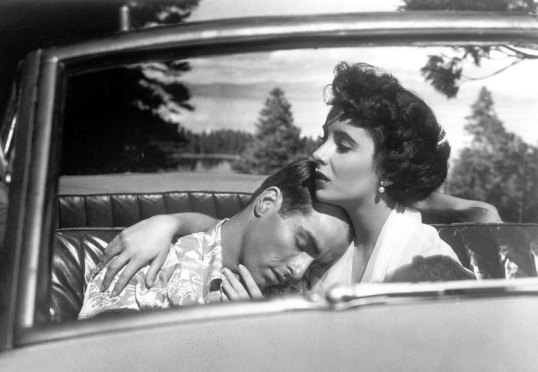
A Place in the Sun (1951, dir by George Stevens, DP: William C. Mellor)
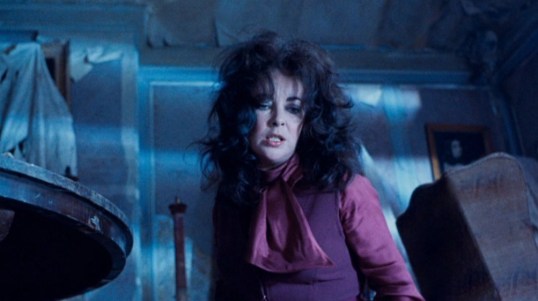
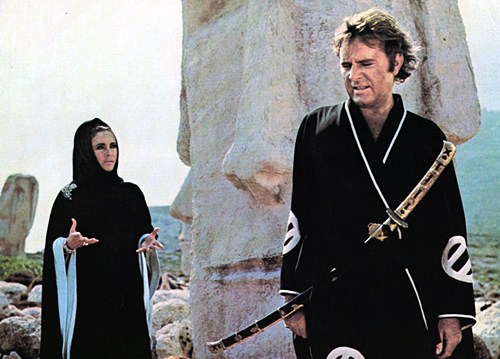
Boom! (1968, dir by Joseph Losey, DP: Douglas Slocombe)
Night Watch (1973, dir by Brian G. Hutton, DP: Billy Williams)
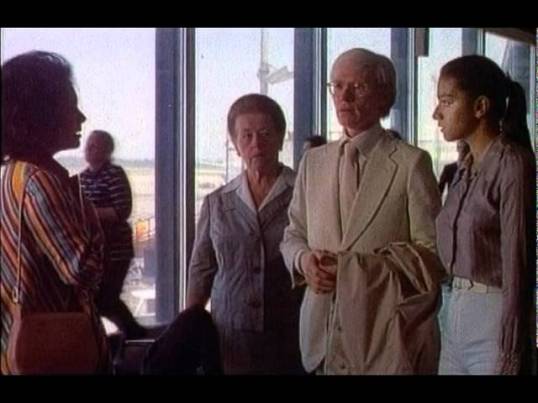
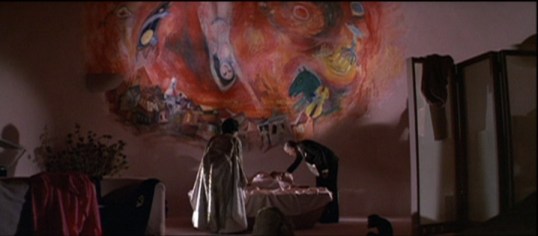
The Driver’s Seat (1974, dir by Giuseppe Patroni Griffi, DP: Vittorio Storaro)
4 Or More Shots From 4 Or More Films is just what it says it is, 4 shots from 4 of our favorite films. As opposed to the reviews and recaps that we usually post, 4 Shots From 4 Films lets the visuals do the talking!
Today would have been Tennessee Williams’s 114th birthday! It’s time for….
4 Shots From 4 Tennessee Williams Films
A Streetcar Named Desire (1951, dir by Elia Kazan, DP: Harry Stradling)
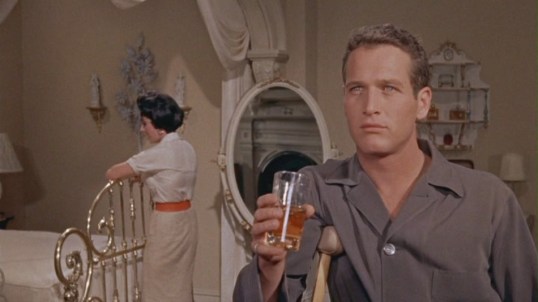
Cat On A Hot Tin Roof (1958, dir by Richard Brooks, DP: William Daniels)
Suddenly, Last Summer (1959, dir by Joseph L. Mankiewicz, DP: Jack Hildyard)
4 Shots From 4 Films is just what it says it is, 4 shots from 4 of our favorite films. As opposed to the reviews and recaps that we usually post, 4 Shots From 4 Films lets the visuals do the talking!
Today is the birthday of one of the greatest films stars ever, Elizabeth Taylor! And you know what that means. It’s time for….
4 Shots From 4 Elizabeth Taylor Films
A Place in the Sun (1951, dir by George Stevens, DP: William C. Mellor)
Suddenly, Last Summer (1959, dir by Joseph L. Mankiewicz, DP: Jack Hildyard)
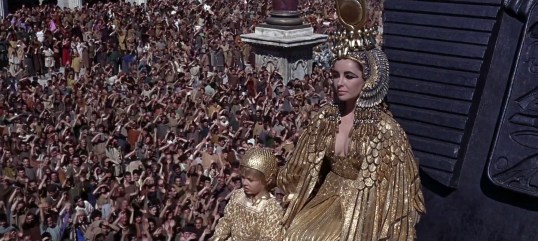
Cleopatra (1963, dir by Joseph L. Mankiewicz, DP: Leon Shamroy )
Boom! (1968, dir by Joseph Losey, DP: Douglas Slocombe)
If you study the history of the International Left in the years immediately following the death of Lenin, it quickly becomes apparent that the era was defined by the rivalry between Joseph Stalin and Leon Trotsky.
Trotsky, the self-styled intellectual who was credited with forming the Red Army and who many felt was Lenin’s favorite, believed that he should succeed Lenin as the leader of Communist Russia. Stalin, the ruthless nationalist who made up in brutality what he lacked in intelligence, disagreed. Stalin outmaneuvered Trotsky, succeeding Lenin as the leader of the USSR and eventually kicking Trotsky out of the country. Trotsky would spend the rests of his life in exile, a hero to some and a pariah to others. While Stalin starved his people and signed non-aggression pacts with Hitler, Trotsky called for worldwide revolution. To Stalin, Trotsky was a nuisance whose continued existence ran the risk of making Stalin look weak. When Trotsky was assassinated in Mexico in 1940, there was little doubt who had given the order. After Totsky’s death, the American Communist Party, which had already been weakened by the signing of the non-aggression pact between Hitler and Stalin, was further divided into Stalinist and Trotskyite factions.
Ideologically, was there a huge difference between Stalin and Trotsky? Many historians have suggested that Trotsky probably would have taken many of the same actions that Stalin took had Trotsky succeeded Lenin. Indeed, the idea that Trotsky was somehow a force of benevolence has more to do with the circumstances of his assassination than anything that Trotsky either said or did. In the end, the main difference between Stalin and Trotsky seemed to be Trotsky was a good deal more charismatic than Stalin. Unlike Trotsky, Stalin couldn’t tell a joke. However, Stalin could order his enemies killed whenever he felt like it and some people definitely found that type of power to be appealing. Trotsky could write essays. Stalin could kill Trotsky.
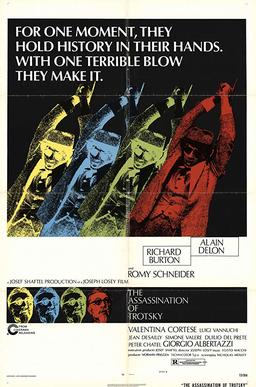
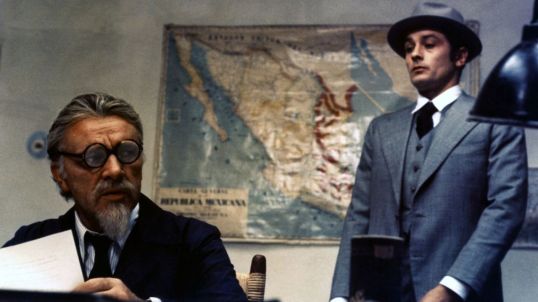
First released in 1972, The Assassination of Trotsky is a cinematic recreation of the events leading to the death of Leon Trotsky in Mexico. French actor Alain Delon plays Frank Jacson, the Spanish communist who was tasked with infiltrating Trotsky’s inner circle and assassinating him with a pickaxe. Welsh actor Richard Burton plays the Russian Trotsky, giving long-winded monologues about world revolution. Italian Valentina Cortese also plays a Russian, in this case Trotsky’s wife, Natalia. And finally, French actress Romy Schneider plays Gita Samuels, who is based on Jacson’s American girlfriend. This international cast was directed by Joseph Losey, an American director who joined the Communist Party in 1946 and who moved to Europe during the McCarthy era.
Losey was an interesting director. Though his first American feature film was the anti-war The Boy With Green Hair, the majority of his American films were on the pulpy side. Not surprisingly, his European films were far more open in their politics. Losey directed his share of undeniable masterpieces, like The Servant, Accident, and The Go-Between. At the same time, he also directed his share of misfires, the majority of which were bad in the way that only a bad film directed by a good director can be. The same director who gave the world The Go-Between was also responsible for Boom!
And then there’s The Assassination of Trotsky. It’s a bit of an odd and rather uneven film. Alain Delon’s performance as the neurotic assassin holds up well and some of his scenes of Romy Schneider have a true erotic charge to them. The scenes of Delon wandering around Mexico with his eyes hidden behind his dark glasses may not add up too much but they do serve as a reminder that Delon was an actor who could make almost any scene feel stylish.
But then we have Richard Burton, looking like Colonel Sanders and not even bothering to disguise his Welsh accent while playing one of the most prominent Russians of the early 20th Century. The film features many lengthy monologues from Trotsky, all of which Burton delivers in a style that is very theatrical but also devoid of any real meaning. As played by Burton, Trotsky comes across as being a pompous phony, a man who loudly calls for world revolution while hiding out in his secure Mexican villa. Now, for all I know, Trotsky could have been a pompous phony. He certainly would not have been the first or last communist to demand the proletariat fight while he remained secure in a gated community. The problem is that the film wants us to admire Trotsky and to feel that the world was robbed of a great man when Jacson drove that pickaxe into his head. That’s not the impression that one gets from watching Burton’s performance. If anything, Burton’s overacting during the assassination scene will likely inspire more laughs than tears.
The Assassination of Trotsky is one of those films that regularly appears on lists of the worst ever made. I feel that’s a bit extreme. The film doesn’t work but Alain Delon was always an intriguing screen presence. (Interestingly enough, Delon himself was very much not a supporter of communism or the Left in general.) The film fails as a tribute to Trotsky but it does make one appreciate Alain Delon.
4 Shots From 4 Films is just what it says it is, 4 shots from 4 of our favorite films. As opposed to the reviews and recaps that we usually post, 4 Shots From 4 Films is all about letting the visuals do the talking.
115 years ago, on this date, director Joseph Losey was born in Wisconsin. Losey began his film career in the United States before exiling himself to Europe during the McCarthy era. Losey was a director who worked in all genres, usually bringing a political subtext to most of his films. Today, Losey is perhaps best remembered for his collaborations with playwright and screenwriter Harold Pinter.
In honor of Joseph Losey, here are….
4 Shots From 4 Joseph Losey Films
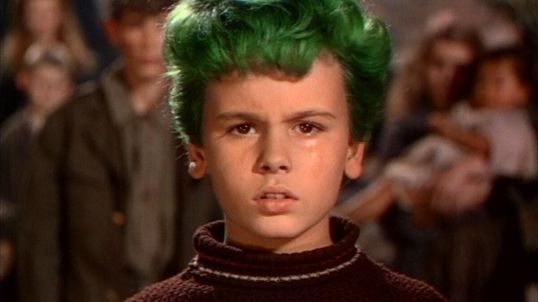
The Boy With Green Hair (1948, dir by Joseph Losey, DP: George Barnes)
The Servant (1963, dir by Joseph Losey, DP: Douglas Slocombe)
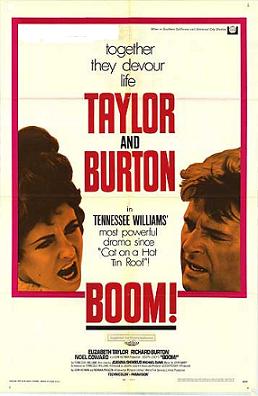
Boom! (1968, dir by Joseph Losey, DP: Douglas Slocombe)
The Assassination of Trotsky (1972, dir by Joseph Losey, DP: Pasqualino De Santis)
“Boom!” says poet Chris Flanders (Richard Burton) in the 1968 film of the same name. Boom, he goes on the explain, is the sound of life being lived. Every minute that we’re reminded that we’re still alive is a “Boom!” It’s the type of thing that 18 year-old artists say to get laid, though the film treats Chris’s comment with an almost supernatural reverence.
Chris has just shown up on an island that’s owned by Flora Goforth (Elizabeth Taylor), who is the richest woman in the world and who is apparently dying of one of those diseases that makes you lie in bed and yell a lot. Flora lives on the island with an entourage that includes a secretary named Miss Black (Joanna Shimkus) and a head of security named Rudi (Michael Dunn). Rudi is a dwarf and he dresses like a Nazi and often does a stiff-armed salute, just in case we missed the fact that he’s supposed to be a fascist. Why exactly Flora, who were supposed to sympathize with, would employ a Nazi, we never really find out. The film seems to think that there’s something extremely daring about casting a person of short statue as the head of Flora’s security though, ultimately, it’s about as profound as uttering “Boom!” every few minutes.
Anyway, Flora is dying but she’s also dictating her autobiography. It turns out that she’s rich because she married a lot of wealthy men, all of whom died and left her all of their money. Flora’s always in a bad mood but things improve a little when Chris mysteriously shows up on the island and starts saying, “Boom!” all the time. Flora and Chris have several conversations about life and the meaning of it all, the majority of which are full of obscure statements and half-baked attempts at being profound. The dialogue is pretentious but it’s also not very memorable, which is a shame. One can survive being pretentious but being forgettable is simply unforgivable.
Eventually, a friend of Flora’s shows up. Famed playwright Noel Coward plays The Witch of Capri, a flamboyant friend to the rich and famous. He loves to gossip and has a bitchy comment for every occasion. One could argue that Coward is merely playing himself, though one imagines that the real-life Coward could have also come up with a few genuinely witty lines. The Witch informs Flora that Chris has a habit of showing up at the bedside of rich women right before they die. Some people think that Chris is a gigolo while others believe Chris to be …. THE ANGEL OF DEATH!
(Dramatic music)
Which is it? Don’t worry, the answer is revealed by the end of the movie. Of course, it takes a while to get to the end. Boom! is two hours long but it feels much longer. Storywise, Boom! feels like it would be ideal as a 30-minute episode of some old anthology show but director Joseph Losey keeps the story moving at a very slow pace and there are so many dramatic pauses and unnecessary zoom shots that the film itself becomes a bit of an endurance test. Just when you think the movie is finally going to get moving, Chris says, “Boom!” or there’s an extreme close-up of Flora’s ring and everything slows down again.
Boom! is one of the many films that Richard Burton and Elizabeth Taylor made together in the 60s. Unfortunately, both actors are miscast in the lead roles. Flora is described as being old and sickly. Elizabeth Taylor was in her 30s and appeared to be in robust health during the shooting of the film. Chris Flanders is supposed to be in his 20s and a seeker of truth and enlightenment. Burton was in his 40s and looked like he was in his 60s. He spends most of the film looking and sounding as if he’s just come off a weekend bender, which makes him look all the more ludicrous when he hears the ocean and says, “Boom!”
On the plus side, the film is lovely to look at. Flora’s house is big and beautiful. The island scenery is gorgeous. Flora’s costumes are ludicrously ornate but still, they are what you would want to see an international movie star wearing in 1968. As such, the film is always nice to look at. In fact, perhaps the best way to watch Boom! is to turn down the sound so you don’t have to listen to any of the dialogue.
Boom! was based on a Tennessee Williams’s play called The Milk Train Doesn’t Stop Here Anymore. The filmmakers decided to change the name to Boom! and I really can’t blame them for that. This was Elizabeth Taylor’s third film to be based on a Tennessee Williams play. Unfortunately, it matched neither the critical nor the commercial success of Cat On A Hot Tin Roof or Suddenly, Last Summer.
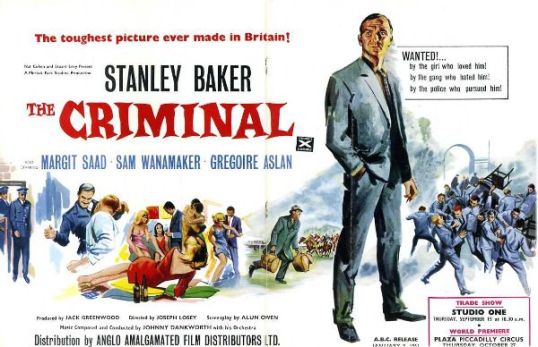
Johnny Bannion (Stanley Baker) is a career criminal, one who divides his time between long stretches in prison and short visits to the real world. He’s handsome, he’s charming, he’s clever, and he’s totally trapped. Baker moves through the film like a natural-born predator, waiting for the moment to strike. When he’s in prison, he’s as defiant as a caged tiger. When he’s out of prison, he’s always stalking the next prize.
Johnny has a hard time staying out of prison. When we first meet him, he’s in prison and it quickly becomes clear that he’s quite a respected figure behind bars. When he gets out, the first thing that he does is team up with his old associate, Mike Carter (Sam Wanamaker), and make plans to rob a racetrack. Mike and Johnny have an interesting relationship. On the one hand, Mike kept Johnny’s apartment for him while he was locked away and Johnny obviously has enough faith in Mike to work him. On the other hand, neither man seems to truly trust the other. That’s the world of criminals, I suppose. Never trust anyone.
Of course, it quickly turns out that there’s actually a good reason to never trust anyone when you’re living a life of crime. As soon as Johnny, Mike, and the gang pull of the racetrack robbery, Johnny’s betrayed. Johnny ends up locked away once again, all thanks to Mike. However, it turns out that Mike may have acted too soon because Johnny hid all the money before he was sent back to prison. Now, Mike has to figure out a way to pressure Johnny into revealing where the money’s buried while Johnny has to try to survive in a world of ruthless prisoners and guards who are ineffectual at best and crooked at worst. Mike’s not the only one who is interested in where Johnny put all that cash….
I have to admit that I’m probably a bit biased when it come to The Criminal because it’s a British crime film that I actually saw while in the UK. It’s one thing to watch a tough British crime film from the safety of Texas. It’s another thing to watch it at 2 in the morning while in a hotel room with a nice view of the Thames. As opposed to the watered down British-American co-productions that we tend to get used to here in the United States, The Criminal was British through-and-through, from the tough working class accents to the harsh urban landscape to the stylish suits that were worn even inside the prison.
It’s a dense movie. Though Stanley Baker is undoubtedly the star, director Joseph Losey is just as interested in the other people who come within Johnny’s orbit and, as a result, we get to know not just Mike but also the guards and the other prisoners. Partrick Magee, who was a favorite of Kubrick’s, makes a strong impression as Barrows, the prison guard who may be a manipulative sadist or who may just be a man who is doing what he has to do to maintain some sort of order in the prison. The film’s portrayal of Barrows is ambiguous but the same can be said for almost everyone in the movie. In classic noir fashion, there are no traditional heroes. Johnny’s bad but he’s a little bit less bad than the men who betrayed him and who are willing to go to extreme lengths to discover where Johnny hid that money.
Directed by Joseph Losey, The Criminal alternates between scenes of hard-edged reality and scenes that feel as if they could have been lifted from some sort of Boschian nightmare. The scenes outside the prison are harshly realistic while the inside of the prison feels almost like some sort of surrealistic dreamscape where demons take human form. The Criminal is an effective and violent British noir, one that will encourage you to keep your eyes on the shadows.
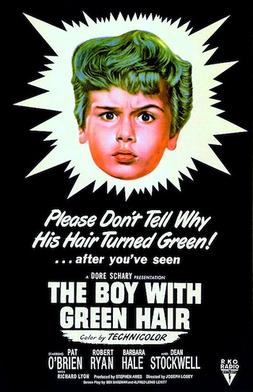
Who is Peter Fry (played by a 12 year-old Dean Stockwell), the young boy at the center of the 1948 film, The Boy With Green Hair?
When we first meet him, Peter is a nearly mute child who has had all of his hair shaved off and who refuses to talk about either one of his parents. He’s mysteriously shown up in a small town and it’s only after a kindly psychologist (played by Robert Ryan) speaks with him that we discover that Peter is an orphan. Both of his parents are dead, victims of the Second World War. Fortunately, a retired actor named Gramps (Pat O’Brien) is willing to adopt Peter and raise him as his own. Gramps has all sorts of stories about the times that he performed in Europe. The film hints that Gramps might be a damn liar but he’s well-meaning, nonetheless.
Peter starts to attend school and slowly, but surely, he comes out of his shell. Soon, he appears to be just another carefree child and his hair even grows back. But then, one day, he sees a poster featuring other war orphans, children like him who have lost their families to war. When Peter overhears adults talking about how the world may go to war again and how there are now even bigger and more destructive bombs that can be dropped on America’s enemies, Peter start to get upset. What’s the point of going to school and preparing for the future if there’s not going to be any future?
One night, Peter goes to sleep. When he wakes up in the morning, he discovers that his hair has turned green!
Why has Peter’s hair turned green? It’s hard to say but the town is remarkably unsympathetic. It’s perhaps understandable that Peter’s classmates would make fun of him because they’re children and children are the worst about not being able to handle change. But not even the adults seem to be able to handle Peter having green hair! They want to shave his head again!
With even kindly old Gramps prepared to take away Peter’s green hair, Peter flees into the woods. There’s where he runs into the spirits of all the children who have either died or been orphaned by war. They have a message for Peter….
The Boy With Green Hair is both an antiwar parable and a plea for tolerance. There’s not a subtle moment to be found in the entire film but, considering that it was made at a time when the world was still in ruins and people were still getting used to living in the shadow of the atomic bomb, it’s perhaps understandable that the film would be a bit heavy-handed. It was, after all, made during a heavy-handed time. That said, the film actually works better as a parable about racism than as a pacifist statement. It’s kind of hard to see how Peter having green hair could convince people to pursue world peace but the way that Peter is ostracized for being different from everyone else is something to which many viewers could undoubtedly relate.
There’s some weird padding in the film. For instance, there’s a weird musical number involving Gramps that comes out of nowhere. Still, one can see why the film made an impression on some viewers. Dean Stockwell gives a sympathetic and, most importantly, naturalistic performance as Peter and the film’s message is a sincere one. One could easily imagine and also easily dread the prospect of this film being remade with Peter’s hair turning green over climate change. I’m a little surprised that hasn’t happened yet, especially considering the amount of coverage that was once given to Greta Thunberg, whose pronouncements and fame have made her a somewhat angrier version of the boy with green hair. Hopefully, a remake won’t ever happen, as the original film works just fine as it is. Not everything has to be remade.
4 Shots From 4 Films is just what it says it is, 4 shots from 4 of our favorite films. As opposed to the reviews and recaps that we usually post, 4 Shots From 4 Films lets the visuals do the talking!
Today is the birthday of one of the greatest films stars ever, Elizabeth Taylor! And you know what that means. It’s time for….
4 Shots From 4 Elizabeth Taylor Films
A Place in the Sun (1951, dir by George Stevens)
Suddenly, Last Summer (1959, dir by Joseph L. Mankiewicz
To take my mind off the sciatic nerve pain I was suffering last week, I immersed myself on the dark world of film noir. The following quartet of films represent some of the genre’s best, filled with murder, femme fatales, psychopaths, and sleazy living. Good times!!
I’ll begin chronologically with BOOMERANG (20th Century-Fox 1947), director Elia Kazan’s true-life tale of a drifter (an excellent Arthur Kennedy ) falsely accused of murdering a priest in cold blood, and the doubting DA (Dana Andrews ) who fights an uphill battle against political corruption to exonerate him. Filmed on location in Stamford, CT and using many local residents as extras and bit parts, the literate script by Richard Murphy (CRY OF THE CITY, PANIC IN THE STREETS, COMPULSION) takes a realistic look behind the scenes at an American mid-sized city, shedding light into it’s darker corners.







 Through the Shattered Lens