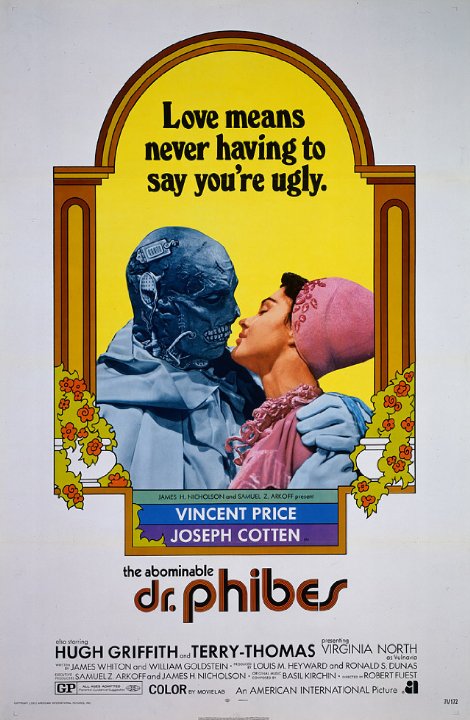
It’s really not October until you’ve watched at least one Vincent Price film and, for today’s horror on the lens, we have one of his most popular films, 1971’s The Abominable Dr. Phibes!
In Montana, four men have infiltrated and taken over a top-secret ICBM complex. Three of the men, Hoxey (William Smith), Garvas (Burt Young), and Powell (Paul Winfield) are considered to be common criminals but their leader is something much different. Until he was court-martialed and sentenced to a military prison, Lawrence Dell (Burt Lancaster) was a respected Air Force general. He even designed the complex that he has now taken over. Dell calls the White House and makes his demands known: he wants ten million dollars and for the President (Charles Durning) to go on television and read the contents of top secret dossier, one that reveals the real reason behind the war in Vietnam. Dell also demands that the President surrender himself so that he can be used as a human shield while Dell and his men make their escape.
Until Dell made his demands known, the President did not even know of the dossier’s existence. His cabinet (made up of distinguished and venerable character actors like Joseph Cotten and Melvyn Douglas) did and some of them are willing to sacrifice the President to keep that information from getting out.
Robert Aldrich specialized in insightful genre films and Twilight’s Last Gleaming is a typical example: aggressive, violent, sometimes crass, and unexpectedly intelligent. At two hours and 30 minutes, Twilight’s Last Gleaming is overlong and Aldrich’s frequent use of split screens is sometimes distracting but Twilight’s Last Gleaming is still a thought-provoking film. The large cast does a good job, with Lancaster and Durning as clear stand-outs. I also liked Richard Widmark as a general with his own agenda and, of course, any movie that features Joseph Cotten is good in my book! Best of all, Twilight’s Last Gleaming‘s theory about the reason why America stayed in Vietnam is entirely credible.
The Vietnam angle may be one of the reasons why Twilight’s Last Gleaming was one of the biggest flops of Aldrich’s career. In 1977, audiences had a choice of thrilling to Star Wars, falling in love with Annie Hall, or watching a two and a half hour history lesson about Vietnam. Not surprisingly, a nation that yearned for escape did just that and Twilight’s Last Gleaming flopped in America but found success in Europe. Box office success or not, Twilight’s Last Gleaming is an intelligent political thriller that is ripe for rediscovery.
Johnny Moon (William Shatner) is a half-breed. His father was white and his mother was a Comanche. Johnny was raised Comanche but he now lives as a white man. He is a good and law-abiding citizen but he has a problem. Johnny has a twin brother named Notah (played, of course, by William Shatner) and, hooked on peyote, Notah keeps holding up stagecoaches, killing white men, and raping white women. Sick and tired of people constantly trying to lynch him, Johnny contacts Notah and demands a final showdown. At the same time, Johnny refuses to tell anyone about Notah’s existence so everyone still wants to kill Johnny. The only person who realizes that Johnny and Notah are not the same is one of Notah’s victims, a showgirl named Kelly (Rosanna Yanni). She sees that good Johnny has blue eyes while bad Notah has black eyes.
William Shatner has described White Comanche as being his worst film, which is saying something when you consider some of the movies that Shatner made between the cancellation of Star Trek and the release of Star Trek: The Motion Picture. Still: William Shatner as twins, one of whom spends the entire movie tripping on peyote. That sounds like it should be fun and it would be except that, for the first and only time in his career, Shatner actually gives a low-key performance. When Shatner is playing Notah, he is the Shatner that we all know and love. But when Shatner plays Johnny Moon, he tries to give a subtle and restrained performance and, unfortunately, the movie is about 75% Johnny. That’s not what we pay money to see when we watch a William Shatner movie!
(I am currently in the process of cleaning out my DVR! I recorded the 1953 film noir, A Blueprint for Murder, off of FXM on February 21st.)
Much like Alfred Hitchcock’s Shadow of a Doubt, A Blueprint for Murder stars Joseph Cotten in a story about a seemingly wonderful person who might actually be a murderer. Actually, now that I think about it, it seems like Joseph Cotten appeared in quite a few films that centered around that idea. What distinguished A Blueprint For Murder is that, for once, Joseph Cotten is not the murderer. Instead, he’s the one who is forced to deal with the overwhelming evidence that someone in his life might be a sociopath.
Cotten plays Cam Cameron, who is shocked when his niece, Polly, suddenly takes ill and dies. Cam’s immediate response is to comfort his sister-in-law, Lynne (Jean Peters). And yet, Lynne doesn’t seem to be too upset over Polly’s death. Could it be because Polly was only her stepdaughter? Or maybe Lynne is no longer surprised by sudden death, seeing as how her husband also died after a sudden and mysterious illness.
Or could it be that Lynne murdered both Polly and her husband? That’s the theory put forward by Maggie (Catherine McLeod), the wife of Cam’s friend, Fred (Gary Merrill). Maggie thinks that it sounds like both Polly and her father were poisoned with strychnine! As the initially skeptical Fred points out, when Lynne’s husband died, he put all of his money in a trust for his children. If his children die, Lynne stands to inherit the fortune. Polly’s already dead. The only remaining obstacle would be Cam’s nephew, Doug.
Much like Don’t Bother To Knock, A Blueprint for Murder barely clocks in at a little over 70 minutes. It’s a briskly told melodrama and, seen today, it’s easier to imagine it as an episode of a television series than as an actual movie. As I watched it, I kept thinking that it felt like an old episode of CSI Miami, with Joseph Cotten in the role that would have been played by David Caruso. (“Two deaths in one family? It sounds like something’s in the water and it’s not fluoride.” YEEEEEEEEEEAHHHHHH! DON’T GET FOOLED AGAIN!! NO NO!) For that matter, it was also easy for me to imagine A Blueprint For Murder being remade for Lifetime, with Josie Davis in the Joseph Cotten role and maybe AnnaLynne McCord replacing Jean Peters.
A Blueprint For Murder is actually pretty predictable up until the final 15 minutes. It’s during the final 15 minutes that Cam, Lynne, and Doug all end up on a cruise ship together and, in an effort to prove his suspicions, Cam does something that has so much potential for backfiring that it kind of makes you reconsider everything that you previously assumed about him. To be honest, it doesn’t make much sense. It’s hard to believe, despite what Cam insists, that what he did was his only possible option. Then again, it is the 1950s. In an era before DNA testing, maybe the only way to solve a crime was by doing something crazy.
That said, I enjoyed A Blueprint for Murder. It’s a real time capsule film and you know how much I love those. I may never be able to find a time machine but I can always experience the past by watching something like A Blueprint for Murder. Joseph Cotten is, as always, a sturdy lead. In real life, Jean Peters’s acting career was somewhat derailed when she married legendary weird guy Howard Hughes. In this film, she gives a great performance as the potentially murderous sister-in-law.
If you’re a fan of 50s noir or either of the two leads, keep an eye out for A Blueprint For Murder.
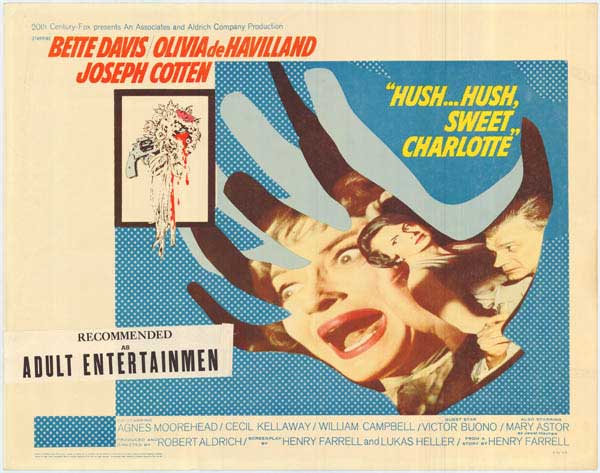
Today marks the 100th birthday of one of the last true Golden Age greats, Olivia de Havilland. Film fans across the globe are celebrating the life and career of this fine actress, who fought the Hollywood system and won. Olivia is the last surviving cast member of GONE WITH THE WIND (Melanie Wilkes), won two Academy Awards (TO EACH HIS OWN, THE HEIRESS), headlined classics like THE SNAKE PIT and THE DARK MIRROR, and costarred with dashing Errol Flynn in eight exciting films, including CAPTAIN BLOOD , THE ADVENTURES OF ROBIN HOOD, SANTA FE TRAIL, and THEY DIED WITH THEIR BOOTS ON.
Olivia moved to Paris with her husband in the 1950’s and was semi-retired, acting in a handful of films. In 1962 director Robert Aldrich scored a huge hit, a psychological horror thriller called WHATEVER HAPPENED TO BABY JANE?, starring screen veterans Bette Davis and Joan Crawford. A new genre was…
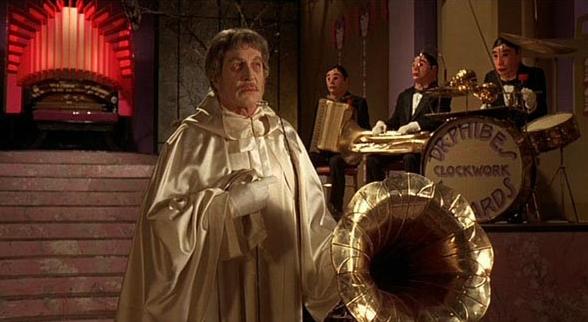
For a 13-year-old monster-crazed kid in 1971, attending the latest Vincent Price movie at the local theater on Saturday afternoon was a major event. Price was THE horror star of the time, having assumed the mantle when King Karloff passed away a few years before. Not to take anything away from Mr. Cushing and Mr. Lee, but “Vincent Price Movies” had become, like “John Wayne Movies “, a sort of genre unto themselves. AIP had squeezed about every nickel they could out of the Edgar Allan Poe name so, with the release of THE ABOMINABLE DR. PHIBES, a new character was created for the horror star, the avenging evil genius Dr. Anton Phibes.
Phibes is a concert organist, theologian, scientist, and master of acoustics who uses his knowledge and vast wealth to gain revenge on the nine surgeons who (to his mind) botched an operation that killed his wife. We first see…
I feel no shame in admitting that I love horror movies. I don’t think that’s any secret to anyone who has ever read my reviews on this site. When I’m feeling so restless that I can’t sit still or focus, all you have to do is give me a horror film (especially if it’s one that I’ve never never seen before) and I’ll be quiet for at least 90 minutes.
That’s why I’m always on the look out for horror movies that I haven’t seen before. If it’s a horror movie, I’ll watch it regardless of obscurity, age, or critical disdain. At its best, this habit has led to me discovering neglected cinematic gems like Sole Survivor.
And it’s worst, it’s led me to me sitting through films like 1980′s The Hearse.
The Hearse is one of those public domain film that turns up in every other Mill Creek Box Set and it tells a very familiar story. A recently divorced woman named Jane (played by Tish Van Devere, who was married to George C. Scott at the time) leaves the big city to seek peace and solace in a creepy small town that’s full of rednecks who stare at her with a combination of lust and total disdain. Jane moves into a house that once belonged to her aunt and, pretty soon, she’s hearing strange sounds and having nightmares. On some nights, she sees a hearse (which, earlier, had attempted to run her off of the road) pull up in front of her house.
Jane attempts to tell the local sheirff about the strange happenings at her house but he responds by suggesting that maybe she should move. The local townspeople respond to her concerns by telling her that her aunt made a pact with Satan. The local priest comes by and tells Jane that the necklace her aunt gave her is a symbol of Satan.
None of this really makes much of an impression on Jane, mostly because she’s busy dating this creepy guy named Tom. Tom rarely ever shows any emotion and, on those rare occasions that he does smile, his face looks like a leering skull.
Again, Jane doesn’t seem to notice any of this…
Obviously, horror requires a certain suspension of disbelief but, seriously, it’s hard not to watch The Hearse and feel as if the scariest thing about the movie is the idea that anyone could be as stupid as Jane.
That said, The Hearse isn’t a total waste of time. The nightmare sequence is genuinely effective and the film itself features a few creepy visuals but, then again, there’s no way the sight of a hearse pulling up in front of a house in the middle of the night couldn’t be creepy. Trish Van Devere does okay as Jane, though she was far better in both The Changeling and One Is A Lonely Number. (The film also features a few too many less-than-credible scenes where the town’s teenage boys talk about how “hot and sexy” they find the aristocratic and rather uptight Jane to be.) If, like me, you’re into film history, you’ll enjoy this film as a relic of the past, an example of what horror movies were like in a less ironic age.
Some movies are merely good. Some movies are undeniably great. And then, a handful movies are so amazingly brilliant that, every time you watch, you’re reminded why you fell in love with cinema in the first place.
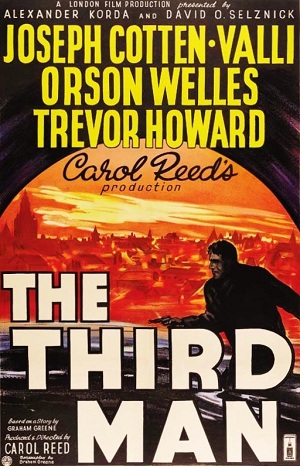
The Third Man is one of those brilliant films.
Directed by Carol Reed and scripted by novelist Graham Greene, The Third Man takes place in the years immediately following the end of World War II. Pulp novelist Holly Martins (Joseph Cotten) comes to Vienna to search for his old friend Harry Lime (Orson Welles). Upon arriving, Holly is shocked to learn that Harry makes his living selling diluted penicillin on the black market.
In the classic scene below, Harry and Holly have a clandestine meeting in a Ferris wheel and Harry justifies both his actions and the lives that have been lost as a result of them.
While Orson Welles’ performance is (rightfully) celebrated, I’ve always felt that Joseph Cotten’s work was even more important to the film’s success. While Welles made Harry Lime into a charismatic and compelling villain, it was Cotten who provided the film with a heart.
I stayed up way too late last night but it was totally worth it because I was watching a film from 1966, The Oscar.
Among those of us who love bad and campy movies from the 50s and 60s, The Oscar is a legendary film. It has a reputation for being one of best so bad-its-good-films ever made. The Oscar is a film that I’ve read about in several books but, until last night, I had never gotten a chance to actually see it. When I saw that the film was going to be on last night, I said “Sleep be damned!” and I stayed up and watched. What other choice did I have?
The Oscar takes place in a world where women are “dames” and men are “fellas” and everyone acts as if they’re a character in a Rat Pack-themed fanfic. One look at Frankie Fane (played by Stephen Boyd) and you know he’s the type of guy who snaps his fingers when he walks and probably uses pig Latin when he flirts. He’s one cool cat and as the film begins, he’s been nominated for an Academy Award for Best Actor.
The film begins at the Oscars. Frankie sits out in the audience, surrounded by Hollywood royalty and nervously waiting for the envelope to be opened. The camera pans over to Frankie’s personal manager, Hymie Kelley. Hymie stares bitterly at his former friend and suddenly, we hear his thoughts and do they ever let us know what type of movie we’re about to see.
As Hymie himself puts it:
“You finally made it, Frankie! Oscar night! And here you sit, on top of a glass mountain called “success.” You’re one of the chosen five, and the whole town’s holding its breath to see who won it. It’s been quite a climb, hasn’t it, Frankie? Down at the bottom, scuffling for dimes in those smokers, all the way to the top. Magic Hollywood! Ever think about it? I do, friend Frankie, I do…”
Hymie, incidentally, is played by the singer Tony Bennett. This was Bennett’s first dramatic film role and it was also his last. Whatever talent or magnetism Bennett may have had as a singer, it didn’t translate into screen presence. Bennett goes through the entire film looking embarrassed but who can blame him when the script calls for him to constantly tell Frankie that, “You lie down with pigs, you stand up smelling like garbage…”
As we discover through the use of flashback, Frankie has had to lay down with a lot of pigs to get his chance at winning an Oscar. After starting out his career working at sleazy clubs, Frankie, Hymie, and Frankie’s stripper girlfriend (Jill St. John) find themselves in New York. Frankie dumps his girlfriend (unaware that she’s pregnant with his child) after he meets artist Elke Sommer at a “swinging party.”
“Are you a tourist or a native?” Frankie asks her.
“Take one from column A and one from column B. You get an egg roll either way,” Sommer replies.
No wonder Frankie tells her, “You make my head hurt with all that poetry.”
Eventually, Frankie is discovered by a talent agent who takes him to see studio mogul Joseph Cotten (who went from Citizen Kane, The Magnificent Ambersons, and Third Man to this). Cotten is so impressed with Frankie that he says, “Once in a while, you bring me meat like this. It all has different names: prime rib of Gloria, shoulder cut of Johnny. MEAT!”
With the help of savvy talent agent Milton Berle, Frankie becomes a film star but he’s still a total heel who cheats on Sommer and takes advantage of Hymie’s loyalty. When Frankie gets nominated for an Oscar, he hires a sleazy private investigator (Ernest Borgnine, of course) to leak a story about Frankie’s criminal past. Frankie assumes that one of his fellow nominees will be blamed for the leak and that he’ll be able to ride a wave of sympathy to victory.
And who are Frankie’s fellow nominees? We only learn the identity of three of them – Frank Sinatra, Richard Burton, and Burt Lancaster. We never find out what movie Sinatra was nominated for but we’re told that Burton was nominated for The Grapes of Winter (which, I’m going to assume, was a film version of a Shakespeare play about Tom Joad) while Lancaster was nominated for his amazing performance in The Spanish Armada. Doesn’t that sound like an amazing film?
Oh, how to describe the delirious experience of watching The Oscar? In many ways, it is a truly terrible movie but it’s fun in the way that only a “racy” film from the mid-60s can be. Nobody plays his or her role with anything resembling subtleness. Instead, everyone spends the entire film yelling, screaming, and gritting their teeth while flaring their nostrils. Everyone, that is, except for Tony Bennett who gives a performance that has a definite community theater feel to it. Even better is the dialogue. People in this film don’t just say their lines – they exclaim them. If you’ve ever wanted to spend two hours in a world where every sentence ends with an exclamation point, watch The Oscar.
For a film that was apparently meant to be something of a love letter to the Academy, The Oscar was only nominated for two Oscars. It received nominations for Best Art Design and Best Costume Design. While I had a hard time seeing what was so impressive about the film’s art design (in the world of The Oscar, Hollywood has a definite Ikea feel to it), the costumes were fairly impressive in a tacky, 1966 type of way.
Finally, I think it’s time that somebody remake The Oscar. David Fincher can direct it, Aaron Sorkin can write the script, Jessie Eisenberg can play Frankie Fane, and Justin Timberlake would make for an adorable Hymie Kelley. For the supporting roles, I think Billy Crystal would be a natural for Milton Berle’s role and perhaps Philip Baker Hall could step into the shoes of Joseph Cotten. Perhaps veteran film blogger and self-described very important person Sasha Stone could make her film debut in Ernest Borgnine’s role.
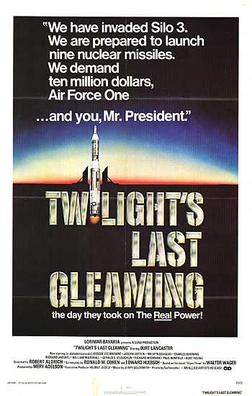 In Montana, four men have infiltrated and taken over a top-secret ICBM complex. Three of the men, Hoxey (William Smith), Garvas (Burt Young), and Powell (Paul Winfield) are considered to be common criminals but their leader is something much different. Until he was court-martialed and sentenced to a military prison, Lawrence Dell (Burt Lancaster) was a respected Air Force general. He even designed the complex that he has now taken over. Dell calls the White House and makes his demands known: he wants ten million dollars and for the President (Charles Durning) to go on television and read the contents of top secret dossier, one that reveals the real reason behind the war in Vietnam. Dell also demands that the President surrender himself so that he can be used as a human shield while Dell and his men make their escape.
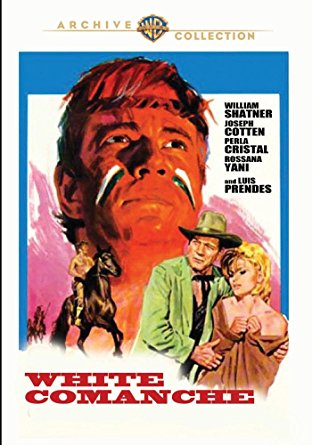 Johnny Moon (William Shatner) is a half-breed. His father was white and his mother was a Comanche. Johnny was raised Comanche but he now lives as a white man. He is a good and law-abiding citizen but he has a problem. Johnny has a twin brother named Notah (played, of course, by William Shatner) and, hooked on peyote, Notah keeps holding up stagecoaches, killing white men, and raping white women. Sick and tired of people constantly trying to lynch him, Johnny contacts Notah and demands a final showdown. At the same time, Johnny refuses to tell anyone about Notah’s existence so everyone still wants to kill Johnny. The only person who realizes that Johnny and Notah are not the same is one of Notah’s victims, a showgirl named Kelly (Rosanna Yanni). She sees that good Johnny has blue eyes while bad Notah has black eyes.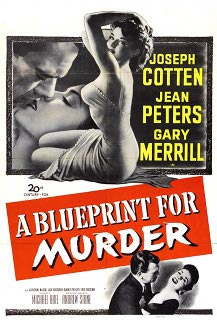



 Through the Shattered Lens