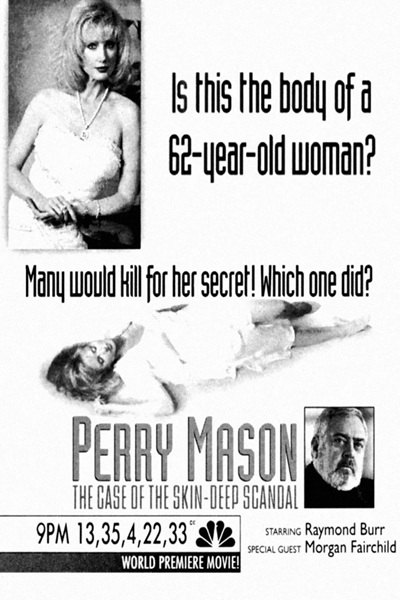
Alana Westbrook (Morgan Fairchild), the ruthless owner of a cosmetics company, is murdered after she announces that she is actually 60 years old and owes her youthful appearance to a miracle skin cream. Her husband (Patrick O’Neal) is charged with the crime but he’s lucky enough to have Perry Mason (Raymond Burr) as his attorney. Perry thinks that the murderer is an eccentric gigolo (David Warner) but, for once, Perry might be wrong. Meanwhile, Ken Malansky (William R. Moses) gets involved with a corporate spy (Lauren Lane) who might know more than she says.
Lisa and I watched this one earlier today. We really enjoyed it! It’s the most soapy of all the Perry Mason films that I’ve watched so far. Morgan Fairchild was great as the murder victim and all of the suspects were enjoyably weird. What I really enjoyed about this movie was that it featured people who appeared, in different roles, in other Perry Mason films. Patrick O’Neal went from being the victim in Perry Mason Returns to being the accused here. David Warner went from being the victim in The Case of the Poisoned Pento being a suspect here. This was also a second Perry Mason film for Jonathan Banks but instead of being a tough guy like he was the first time, he was a skin cream creator this time. This movie understood that people will kill for clear skin.
This was one of the last of Raymond Burr’s Perry Mason films (it aired the same year that he died) and, with the returning actors, it feels like a tribute to Burr and the role that he made his own.
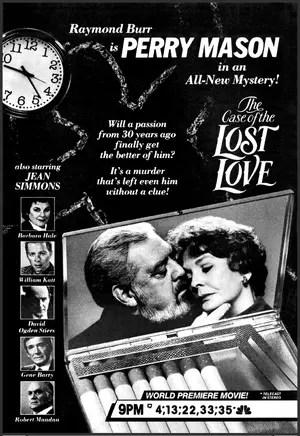
Perry Mason’s ex-girlfriend, Laura Robertson (Jean Simmons), is about to be appointed to the Senate when blackmailer Pete Dixon (Jonathan Banks) threatens to reveal that she once underwent shock treatment after having a nervous breakdown. When Dixon is murdered, Laura’s husband (Gene Barry) is arrested. Laura hires Perry (Raymond Burr) to serve as his attorney.
At first, this movie felt weird to me because it didn’t seem right for Perry to have an ex-girlfriend when we all know that he and Della (Barbara Hale) were in love. When Laura is at the office waiting to see Perry, she and Della have a conversation and it’s obvious that each is jealous of the other. When Laura asks, “What about you and Perry?,” Perry shows up before Della can answer. We all know what the answer was though. Della loves Perry and, probably because she was so upset over Perry dating Laura, she threw herself at Paul Drake, Sr. and that’s how we got Paul Drake, Jr.
As for Paul Drake, Jr. (William Katt), he flirts with two different women in this movie but he doesn’t get to do as much investigating as he did in the first few films. This movie is almost all Perry Mason interrogating people. Raymond Burr uses a cane in this movie and there’s a few scenes where it’s obvious that he was in pain but he still gives a very good performance. The movie is very talky but it also has the best courtroom confession scene yet and Raymond Burr really sells Perry’s ambivalent feelings. The identity of the killer actually took me by surprise!
It was weird to see Perry in love with someone oter than Della but this was still an excellent entry in the series.
“This ain’t no god damn way to start a partnership.” – Reggie Hammond
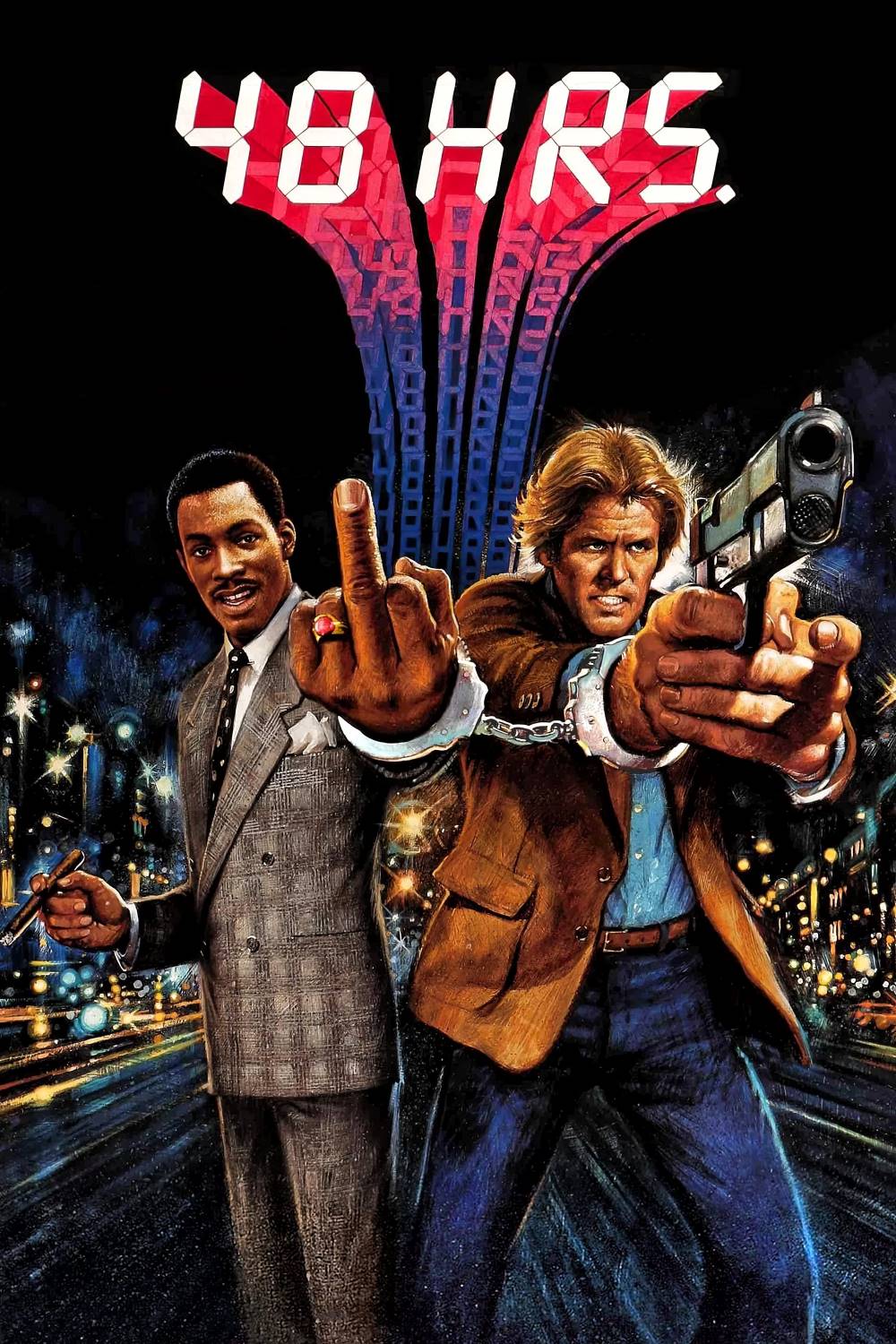
48 Hrs. bursts onto the screen with a gritty prison breakout that sets the stage for chaos in the foggy streets of San Francisco, where a pair of ruthless killers slip away after gunning down a cop’s partner in cold blood. Jack Cates, the surviving detective, is left battered and furious, piecing together a case that points to a slick convict named Reggie Hammond holding the key to the crooks’ whereabouts—and a stash of stolen cash. With time ticking down, Jack pulls strings to get Reggie out on a 48-hour pass, thrusting these two polar opposites into a reluctant alliance that turns the city into their personal battlefield of bullets, banter, and bad blood.
From the jump, Jack comes across as the ultimate rough-around-the-edges cop, nursing a flask under his trench coat, snapping at colleagues, and charging headfirst into danger like a man who’s got nothing left to lose. His apartment is a mess of empty bottles and regret, and his rocky relationship with his girlfriend underscores how the job has chewed him up and spit him out, leaving him more beast than man. Reggie, by contrast, rolls in with street-honed swagger, his prison jumpsuit barely containing the energy of a guy who’s survived by being quicker on his feet and sharper with his mouth than anyone around him. He’s got a girlfriend waiting with that hidden money, and no intention of playing nice with a cop who’s eyeing him like fresh meat.
The beauty of their pairing lies in how the film lets their friction spark from the very first shared car ride, where Jack’s growled commands clash against Reggie’s nonstop ribbing, turning a simple stakeout into a verbal demolition derby. Picture them peeling out after a lead goes south, tires screeching through narrow alleys while Reggie gripes about the beat-up car and Jack slams the dash in frustration—it’s these raw, unscripted-feeling moments that make the movie breathe. As they hit up seedy bars, chase informants through strip joints, and dodge ambushes, the script peels back layers: Jack’s not just a bully, he’s haunted by close calls; Reggie’s bravado masks real fear of ending up dead or broke.
One standout sequence drops them into a hillbilly roadhouse packed with hostile locals, where Reggie grabs the mic for an impromptu takedown that flips the room from menace to mayhem, buying them time while Jack backs him up with sheer firepower. It’s tense, hilarious, and perfectly timed, showing how their skills complement each other—Jack’s brute force meeting Reggie’s silver tongue—in ways neither saw coming. The villains, led by a stone-cold Luther and his trigger-happy sidekick, keep the heat cranked high, popping up for savage hits that leave bodies in the gutter and force the duo to improvise on the fly, like hot-wiring rides or shaking down lowlifes for scraps of intel.
Walter Hill’s direction keeps it all taut and visceral, with handheld cameras capturing the sweat and grime of every punch thrown or shot fired, no glossy filters to soften the blows. The San Francisco backdrop shines through rain-slicked hills, neon-lit dives, and shadowy piers, giving the action a grounded, almost documentary edge that amps up the stakes. Sound design punches too—the roar of engines, the crack of gunfire, the thud of fists—layered over a pulsing ’80s score that shifts from funky grooves during chases to ominous drones in quieter beats, mirroring the push-pull between comedy and threat.
Diving deeper into the characters, Jack’s arc feels earned through small touches: a hesitant phone call to his ex, a flicker of respect when Reggie saves his skin, moments that humanize the hardass without forcing redemption. Reggie evolves too, his initial scam-artist vibe giving way to flashes of loyalty, like when he risks his neck to protect that cash not just for himself, but to build something real outside the walls. Supporting roles flesh out the world—the precinct captain barking orders, the sultry singer tangled with the bad guys, Reggie’s tough-as-nails woman who won’t take guff—but they never overshadow the core duo, serving as sparks for conflict or comic relief.
Pacing-wise, the film rarely pauses for breath, clocking in under two hours yet packing in a full meal of twists, from double-crosses at motels to a frantic foot chase across rooftops that leaves you winded. The 48-hour ticking clock adds urgency without gimmicks, every dead end ramping tension as dawn breaks on their deadline. Humor lands organically too, not from slapstick but from character-driven zingers—Reggie calling out Jack’s outdated tough-guy schtick, Jack grumbling about Reggie’s flashy clothes—keeping the tone light even as blood spills.
Of course, watching through modern eyes, the dialogue packs some era-specific punches, with raw language around race, cops, and crooks that reflects ’80s attitudes head-on, for better or worse. It’s unapologetic, mirroring the film’s macho pulse, but adds texture to the time capsule feel, making replays fascinating for how boldly it leaned into taboos. The women, while fierce in spots, often play second fiddle to the bromance brewing, a hallmark of the genre that 48 Hrs. helped cement before it evolved.
What elevates this beyond standard action fare is how it nails the buddy dynamic’s slow burn: no instant high-fives, just gradual thaw from shared survival, culminating in a dockside finale where alliances solidify amid explosions and last stands. The editing zips between high-octane set pieces and downtime breather scenes, like a roadside diner heart-to-heart that reveals backstories without halting momentum. Cinematography plays with shadows and neon to heighten paranoia, turning everyday spots into pressure cookers.
Influence-wise, you can trace lines straight to later hits—the grizzled vet and smooth-talking newbie formula got refined here, blending Lethal Weapon grit with Beverly Hills Cop wit years ahead of schedule. Performances anchor it all: the leads’ chemistry crackles, carrying weaker beats on sheer charisma, while Hill’s lean style ensures every frame earns its keep. Runtime flies because it’s efficient, no fat, just muscle.
Final stretch ramps to operatic violence on those windswept docks, bullets flying as personal scores settle, leaving our heroes bloodied but bonded in a way that feels hard-won. 48 Hrs. endures as a rowdy blueprint for the genre, blending laughs, thrills, and toughness into a package that’s addictive on first watch and rewarding on revisit. It’s got heart under the bruises, edge in the jokes, and a vibe that’s pure ’80s adrenaline—grab it for a night of no-holds-barred entertainment that still packs a wallop over four decades later.
2002’s Dark Blue opens in 1992, with a decorated Los Angeles cop named Eldon Perry (Kurt Russell) holed in a hotel room with a shotgun and a pistol. Perry, who were learn comes from a long line of cops, should be happy. He’s about to finally get promoted. While Los Angeles is in the grip of the riots that followed the Rodney King verdict, Perry’s lifelong dream is about to come true. But, instead of celebrating, he’s a nervous wreck. Dark Blue shows us why.
Perry is the protegee of Commander Jack Van Meter (Brendan Gleeson), a corrupt cop who regularly encourages his men to harass, arrest, and even kill anyone who is suspected of having committed a crime. Van Meter and Perry claim that they’re doing what they need to do in order to keep the city safe. They look at a reformer like Assistant Chief Arthur Holland (Ving Rhames) and they see someone who has no idea what it’s actually like on the streets and who is more concerned with his own ambitions than anything else. However, Van Meter has a side operation going. Two of his informants (played by Korupt and Dash Mihok) regularly commit robberies that he sets up and helps them get away with. When their latest robbery leaves four people dead and one wounded, Van Meter assigns Perry and Perry’s young partner, Bobby Keough (Scott Speedman), to the case. Bobby is young and maybe not as cynical as Perry. But he’s also Van Meter’s nephew so the assumption is that he’ll play ball.
And, at first, Bobby does go along with whatever Van Meter and Perry say. When Perry unknowingly gets too close to the truth about what happened at the robbery, Van Meter orders Perry and Bobby to go after someone else. When Perry orders Bobby to execute an innocent man, Bobby does so and Perry takes the blame. (In one of the film’s best scenes, Bobby gives his statement about the shooting to Internal Affairs, just for the detectives to shut off the tape recorder and give Bobby a chance to make a better statement.) But when Bobby has a crisis of conscience and Van Meter reveals that depths that he’ll go to protect himself, Eldon Perry is forced to reconsider the life that he’s built for himself as a cop. With Los Angeles descending into chaos, Perry has to finally decide whether or not to play the game or to do the right thing.
There’s a lot going on in Dark Blue. Actually, there’s too much going on. The film is based on a story by James Ellroy and it has Ellroy’s traditionally dense plotting, full of duplicitous characters and macho dialogue. Not only is Perry dealing with the investigation, he’s also dealing with his frayed marriage to Sally (Lolita Davidovich). Not only is Bobby struggling with his ethics but he’s also struggling with his love for Sgt. Beth Williamson (Michael Michele), who is also Holland’s assistant and who also once had a one-night stand with Holland, pictures of which have gotten into Van Meter’s hands and which Van Meter plans to use to blackmail Holland into taking a job in Cleveland. It’s a lot to keep track of and, visually, director Ron Shelton struggles to capture Ellroy’s trademark prose. As a writer, Ellroy’s jittery style can get readers to accept almost anything, no matter how complex or potentially disturbing. Ellroy has no fear of alienating the reader. Shelton, on the other hand, has a much more gentle style and it’s not a good match for Ellroy’s vision of a world gone mad. The film mixes Ellroy’s moral ambiguity with Shelton’s rather predictable liberal piety and the end result never really comes together. Shelton doesn’t seem to be sure what he wants to say with Dark Blue.
That said, this film does feature an excellent performance from Kurt Russell. Russell plays a character who is both good and bad. Perry cares about his partner. He cares about his family. He’s loyal to the police department. His methods may be extreme but he’s also taking criminals off the street. But Perry is also thoroughly mired in Van Meter’s corruption. Perry trusts Van Meter because Perry considers the police force to be his family. His shock at being betrayed is one of the more poignant things about the film and Russell captures the moment perfectly.
Dark Blue has a lot that it wants to say, about morality, policing, and race relations. It doesn’t really work because Ron Shelton was the wrong director to bring James Ellroy’s pulp sensibility to life. But it does provide Kurt Russell a chance to show us that he’s one of our most underrated actors.
We all know the story. Eddie Murphy is Axel Foley, a streetsmart detective in Detroit whose childhood friend, Mickey (James Russo), is murdered because of something that he saw while working as a security guard in Beverly Hills. Axel plays by his own rules and gets results even as he gives his boss, Inspector Todd (Gil Hill), heartburn. Todd refuses to allow Foley to investigate Mickey’s death so Axel puts in for some vacation time and catches the first plane to Beverly Hills.
In Beverly Hills, he meets up with another childhood friend, Jenny (Lisa Eilbacher). Axel thinks that Mickey’s murder was ordered by a shady businessman named Victor Maitland (Steven Berkoff). The Beverly Hills Police Department orders Axel to leave Maitland alone and to return to Detroit. Axel won’t go until he gets justice for Mickey. Lt. Bogomil (Ronny Cox) assigns Taggart (John Ashton) and Rosewood (Judge Reinhold) to follow Axel in Beverly Hills.
Like 48 Hrs., the story is serious but the comedy comes from how the well-drawn characters interact with each other and from seeing how Axel reacts to the strange and wealthy world of Beverly Hills. Axel has the same reactions that we would have but, because he’s played by Eddie Murphy, he always has the perfect response to everything that he sees, whether it’s dealing with a snooty hotel clerk or with someone like Serge (Bronson Pichot), Jenny’s co-worker who speaks with an unidentifiable accent. Even more so than in 48 Hrs or Trading Places, Murphy reveals himself to be a natural star here. One reason why we like Axel is because he’s not just funny but he’s also the type of confident hero that we all wish we could be. He’s not intimidated by Beverly Hills for a second.
It’s now impossible to picture anyone else in the role of Axel Foley but, when the film’s script was first being shopped around, it was originally offered to Sylvester Stallone, who said the story had potential but was missing something. He rewrote the script and took out all of the humor, turning it into a grim and serious action film. (It is rumored that Stallone later turned his version of the script into Cobra.) Fortunately, Stallone eventually dropped out of Beverly Hills Cop so that he could co-star with Dolly Parton in Rhinestone. Producers Don Simpson and Jerry Bruckheimer, then at the start of their producing careers, then offered the role to Eddie Murphy, who took Stallone’s script and added back all of the humor. Murphy also ended up ad-libbing several of the film’s best one-liners, improvising the hotel lobby scene and the meeting with Serge on the spot.
Beverly Hills Cop was a huge success, cementing Murphy’s status as a star and proving that Murphy could carry a movie on his own. The film still holds up, certainly better than any of the sequels that followed. Even though Murphy was clearly the main attraction, the movie also gave actors like John Ashton, Judge Reinhold, Ronny Cox, Bronson Pinchot, and even Paul Reiser a chance to shine. The villainous performances of Steven Berkoff and Jonathan Banks would serve as a model for countless bad guys through the 80s and 90s. Beverly Hills Cop is a movie that makes you happy that Sylvester Stallone didn’t have a better sense of humor.
48 Hrs. begins with a violent and bloody jailbreak. The fearsome Billy Bear (Sonny Landham) helps his criminal associate, Albert Ganz (James Remar), escape from a chain gang and kills several guards in the process. Billy and Ganz then head to San Francisco, where they start killing their former associates while searching for Luther (David Patrick Kelly). Another bloody shootout leaves several detectives dead and SFPD Detective Jack Cates (Nick Nolte) looking for revenge.
That’s not the way you might expect one of the most famous comedies of the 80s to begin. It’s not until Jack arranges for another associate of of Ganz’s to be released from prison for 48 hours that anything humorous happens in the film. However, because Reggie Hammond is played by Eddie Murphy, 48 Hrs. quickly becomes very funny.
Murphy was appearing on Saturday Night Live when he was cast in 48 Hrs, in a role that was written with Richard Pryor in mind. One of the first things that Murphy requested was that the character’s name be changed from Willie Biggs to Reggie Hammond. Murphy made the role his own and watching him, it’s hard to believe that he was only 21 and also that 48 Hrs was his first film. Murphy performs with the confidence of a natural movie star. He’s good in the film’s most famous scene, where he pretends to be a cop and talks down an entire bar full of rednecks. (I can’t repeat his most famous line but everyone knows it.) But Murphy is even better in the scenes where he’s just reacting to Nolte’s slovenly cop.
The comedy in 48 Hrs comes from the mismatched partnership and initially hostile chemistry of Jack Cates and Reggie Hammond. Cates has a job to do while Reggie, understandably, wants to enjoy as much freedom as he can before he gets sent back to prison. The humor is so effective because it’s almost entirely character-based. There are no gags but there are two well-written characters with differing ways of looking at the world who have to learn how to work with each other. The two of them start out disliking and distrusting each other but ultimately become best friends, even if Jack does punch Reggie and Reggie does keep trying to steal Jack’s lighter. Because this is a Walter Hill movie, there’s still a lot of action. Nolte and Murphy may make you laugh but there’s nothing funny about full-on psycho performances of James Remar and Sonny Landham. 48 Hrs. not only allows Murphy and Nolte to show off their comedic ability but it also allows them to be true action heroes.
Popular with critics and audiences, 48 Hrs. was the most commercially successful film of 1982. It set the standard for most buddy-cop movies to this day and it introduced the world to Eddie Murphy.
Airplane!, which may be the funniest movie ever made, has made me laugh every time that I’ve watched it. And I’ve watched it a lot!
Whenever I’m getting ready to travel for my day job, I watch Airplane! Whenever I’m going to Baltimore or West Virginia for the holidays, I watch Airplane! Whenever I’m in a bad mood and I need something lighten me up, I watch Airplane! Whenever I’m in a good mood and I want to be in an even better mood, I watch Airplane!
I can’t remember how old I was when I first saw Airplane! but I know I wasn’t yet ten. While a lot of the humor went over my head at that young age, it did not matter because I laughed at all the sight gags, like the heart hopping around on the doctor’s desk and the line of passengers waiting to “calm down” the hysterical woman. I laughed when Ted Stryker (Robert Hays) and Elaine (Julie Haggerty) got covered in seaweed while making out on the beach. I laughed at the people dying while listening to Ted’s story, even though I didn’t fully understand that it was because of Ted boring them to death. I loved it when Kareem Abdul-Jabbar got annoyed with the kid in the cockpit, even though young me really didn’t know who Kareem was other than he was a basketball player. Otto the autopilot was the coolest character around. Stephen Stucker’s Johnny made me laugh with his nonstop energy. “Excuse me, stewardess, I speak Jive.” “And don’t call me Shirley.” “It looks like I picked the wrong time to stop sniffing glue.” Every time I heard them, I laughed at all of those lines. I didn’t have to understand why Lloyd Bridges was suddenly upside down. I just knew it was funny.
As I got older and rewatched the film, I started to pick up on the humor that earlier went over my head. I traveled to Turkey when I was twelve and our tour guide spent an hour telling us that Midnight Express was not a fair representation of her country. After that, I suddenly understood why Captain Oveur (Peter Graves) wanted to know if Joey had ever been to a Turkish prison. I came to appreciate Julie Hagerty and Lorna Patterson as the two flight attendants. Airplane! still made me laugh but I came to understand that it was also a love story. What adolescent boy watching Airplane! didn’t want to be Robert Hays, not only landing the plane but also getting kiss Julie Hagerty at the end of the movie?
And then, as I learned more about the movies, I realized that Airplane! was a pitch perfect parody of the disaster genre and I came to understand the brilliance of casting actors like Lloyd Bridges, Robert Stack, Peter Graves, and especially Leslie Nielsen in this film. From the first time I saw the movie, Nielsen always made me laugh because he had the best lines and he delivered them with deadpan perfection. But, as I got older, I came to understand that Nielsen was doing more than just saying funny things. He was sending up his entire career. I’m a part of the generation who grew up laughing at Leslie Nielsen the comedy superstar and it’s always strange for me to see him in one of his older, serious roles. I have Airplane! to thank for that.
There’s so much to say about Airplane! I could write a thousand words just talking about my favorite jokes and one-liners or how much I enjoyed Stryker’s flashbacks. It’s my favorite movie and one that still makes me laugh even though I know all of the jokes by heart. (I’ve always thought Howard Jarvis waiting for Stryker to return to the taxi was one of the best, though underrated, jokes in the movie.) Airplane! is close to 50 years old and it’s still just as funny today as when I first saw it.
Frances Farmer is one of the more tragic figures to come out of Hollywood’s Golden Age.
A talented and beautiful actress, Frances Farmer came out to Hollywood in the 30s and quickly developed a reputation for being difficult. She was politically outspoken at a time when stars were expected to either be apolitical or unquestioningly patriotic. She criticized scripts. She argued with directors and studio heads. She had a well-publicized affair with communist playwright Clifford Odets and she also had numerous run-ins with the police. Some say that she was alcoholic. Some say that she was bipolar. Some say that she had a mental collapse as the result of the pressure that her mother put on her to succeed. Frances Farmer ended up in mental institution, where she was subjected to shock therapy. After she was released, her film career was basically over, though she did end up hosting a local television program. She died in 1970, reportedly alone and struggling to make ends meet. In a posthumously published autobiography called Will There Ever Be A Morning?, she wrote that she was beaten, sexually abused, and eventually given a lobotomy while she was institutionalized. Over the years, there’s been a lot of doubt about whether or not Farmer was actually lobotomized but there is no doubt that Farmer was a woman who was ultimately punished for being ahead of her time. Frances Farmer refused to conform to the safe manufactured image that Hollywood prepared for her and, for that, she was nearly destroyed.
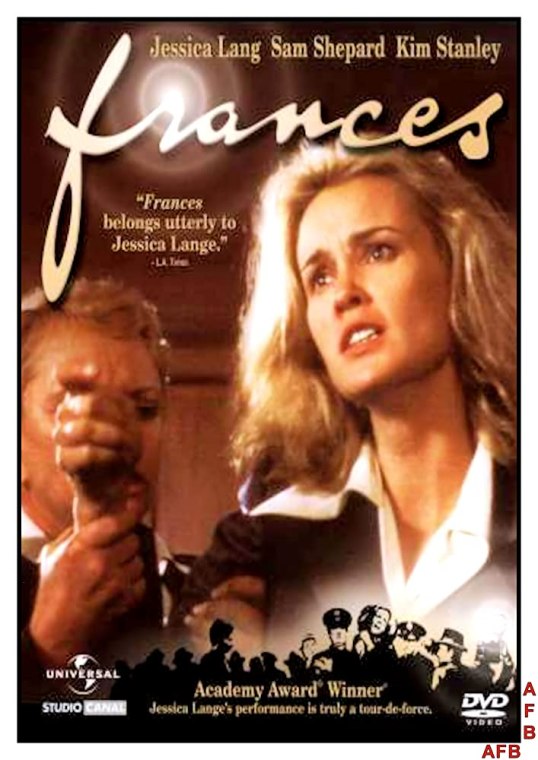
The 1983 film, Frances, is a biopic of Frances Farmer, starring Jessica Lange as Frances and Kim Stanley as her domineering mother. It opens with Frances writing a school essay about why she’s an atheist and it ends with her smiling blankly at a television camera, her independent spirit broken by a lobotomy. In between, we watch as Frances goes to Hollywood and has a self-destructive affair with Clifford Odets (played by Jeffrey DeMunn). The infamous moment when Frances was dragged out of a courtroom while screaming at the judge is recreated and Frances’s time in the institution is depicted in Hellish detail.
We also learn about Frances’s relationship with a communist writer named Alvin York (Sam Shepard). It seems like whenever Frances needs to be rescued or just needs someone to talk to, Alvin York pops up. In fact, you could almost argue that York pops up too often. Alvin York was a fictional character, one who was apparently created in order for audiences to have someone to relate to. It’s unfortunate that the film felt that the audience would only be able to relate to Frances if it viewed her life through the eyes of a fictional character because York’s character is a bit of a distraction. Sam Shepard does a good job of playing him and I certainly wasn’t shocked to learn that Sam Shepard and Jessica Lange were romantically involved during the filming of Frances (and for a long time afterwards) because Lange and Shepard do have a very real chemistry. However, from a narrative point of view, Alvin York only works as a character if one accepts that he’s a figment of Frances’s imagination. The film’s insistence that York is an actual person who just happens to show up at every important moment of Frances’s life just doesn’t work.
What does work is Jessica Lange’s performance. Lange is amazing in the role of Frances, whether she’s playing Frances as a hopeful idealist, an out-of-control rebel, or, tragically, as a glass-eyed zombie who has been reduced to appearing on television and assuring audiences that her rebellious days are over. Lange was nominated for Best Actress for Frances. She lost to Meryl Streep for Sophie’s Choice. I’ve seen Sophie’s Choice and Meryl was good but Jessica was better.
Frances was originally offered to David Lynch. He turned the film down so he could work on Dune and instead, the film was directed by Graeme Clifford, who takes a far more straight-forward approach to the material than Lynch would have. Still, Lynch’s interest in Frances Farmer would later lead to him working on stories that centered around a “woman in trouble.” One of those stories became Twin Peaks. Another would become Mulholland Drive.
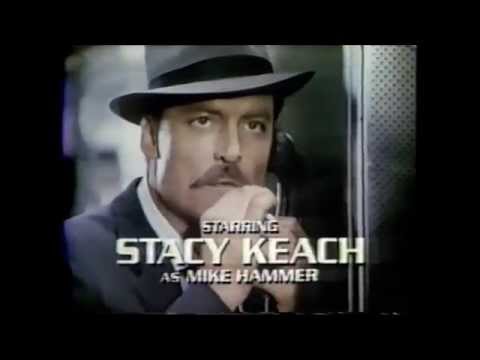
When two employees of an all-female courier service are murdered, Private Investigator Mike Hammer (Stacy Keach) is on the case. The service was owned by his ex-girlfriend, Chris (Michelle Phillips), and she wants him to protect her while she testifies in front of a grand jury. It turns out that her courier service has gotten involved in some shady business, transporting deliveries between a helicopter company and a South American dictator. Chris fears that she’ll be murdered to keep her from testifying. Hammer agrees to protect her and she tells him that he has a 19 year-old daughter who he’s never met.
While Chris is testifying, she suddenly dies on the stand. The doctors say that it was a heart attack but Hammer knows that it was murder. Hammer sets out to not only get revenge for Chris but also to find his daughter, who has disappeared into the world of underground pornography. It’s all connected though, as is traditional with Mike Hammer, it can sometimes be difficult to keep up with how.
Murder Me, Murder You was a pilot film for a brief-lived but fondly-remembered Mike Hammer TV series that aired in the 80s. Murder Me, Murder You takes Mickey Spillane’s famous detective into what was then the modern age but it allows him to remain a man of the hard-boiled noir era. Hammer’s narration is tougher than leather, he’s more interested in listening to swing music than new wave, and he still dresses like an old-fashioned private eye, complete with a fedora on his head. As played by Stacy Keach, he’s also just as dangerous and quick to kill as Hammer was in Spillane’s original novels. In the novels, Hammer was an unapologetic brute who often bragged about how much he enjoyed killing criminals and communist spies and whose closest associate was his gun, which he nicknamed Betsy. When Spillane’s novels were filmed, the violence of Hammer’s character was often downplayed. (A notable exception was Robert Aldrich’s Kiss Me Deadly, which suggested that Hammer was such a fascist that he would eventually be responsible for the end of the world. The Mike Hammer of Spillane’s novels would probably dismiss Kiss Me Deadly as being red propaganda and set out to deliver American justice to the Hollywood communists who wrote it.) In Murder Me, Murder You, Mike Hammer is just as brutal an avenger as Spillane originally imagined him to be. With his hulking frame, grim eyes, and his surly manner, Stacy Keach is the perfect Mike Hammer.
Murder Me, Murder You is a convoluted and often difficult-to-follow murder mystery but with Keach’s bravura lead performance, a strong supporting cast (including notable tough guys Tom Atkins and Jonathan Banks) and good direction from TV movie vet Gary Nelson, this movie comes about as close as any to capturing the feel of Mickey Spillane’s original novels. Murder Me, Murder You was released on DVD fourteen years ago. Though it is now out-of-print, copies are still available on Amazon.
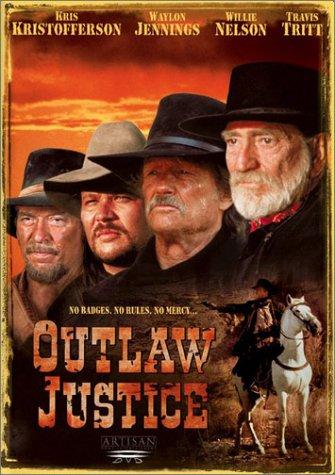
During the closing days of the old west, the evil Holden (Sancho Garcia) guns down retired outlaw, Tobey Naylor (Waylon Jennings). Tobey’s son, Bryce (Chad Willett), is determined to get revenge so he teams up with three members of Tobey’s old gang, Lee Walker (Willie Nelson), Jesse Ray Torrance (Kris Kristofferson), and Sheriff Dalton (Travis Tritt). They ride into Mexico, searching for one final shootout. Along the way, they befriend the locals, find time to rebuild a burned-out church, and bicker like aging gunslingers in a Larry McMurtry novel. Chad Willett and Willie Nelson also find time to fall in love with local women because, obviously, the entire film can’t just be gunfights and church-building.
Outlaw Justice is a standard western, which is distinguished only by the casting of the pioneers of outlaw country music as actual outlaws. Since this was made during the Lonesome Dove-Unforgiven era of westerns, there’s some talk about how Lee and Jesse Ray are past their prime but otherwise, it’s an angle that largely left unexplored. Of the singers, Kris Kristoffeson and Travis Tritt are probably the best actors but Willie Nelson seems to be having the most fun. (Nelson has enough natural charisma that he can get away with a lot.) If you’re a fan of westerns who doesn’t demand too much from the movie you’re watching, Outlaw Justice will probably be entertaining enough. Otherwise, it’s pretty forgettable.


 Through the Shattered Lens