Yor (Reb Brown, wearing a loin-cloth and blonde wig) is a hunter who makes his way through the desert, fighting dinosaurs and cavemen and drinking the blood of his enemeis. Yor finds a village and, after saving Kalaa (Corrine Clery) and Pag (Luciano Pigozzi) from a dinosaur, he becomes a valued member of the community. Yor does not know much about his past and he is searching for the meaning behind an amulet that he wears. With Kalaa and Pag, he goes on a quest for answers and instead finds himself being attacked by flying saucers, robots, and laser beams. Despite the dinosaurs and the cavemen, it turns out that this film is taking place in the future, after a nuclear apocalypse.
That’s a great twist and it’s too bad that the film’s title gives it away. When I first saw this movie as a kid, I loved it. What kid wouldn’t love a movie the mixed dinosaurs with flying saucers? Rewatching it as an adult, I still love this film even though I now know better than to take it seriously. It’s a cheap production and the special effects are so ineptly done that, when the killer robots shoots their laser guns, the beams don’t even appear to be coming out of the barrel. But I still appreciate the way the film combined two genres, caveman fantasy and post-apocalyptic science fiction and the cast’s commitment to bringing this mix of styles to life. Director Antonio Margheriti knew that the best way to deal with an incoherent plot was just to toss in a lot of action. No matter what else you might say about Yor, it’s not boring.
Reb Brown plays Yor and, despite the fight wig, gives one of his better performances. It helps that, for once, he doesn’t scream like a girl during the action scenes. John Steiner plays the evil Overlord gives another one of his trademark evil performances. Yor even gets a Flash Gordon-style theme song!
The movie ends with a cliffhanger and the narrator asking, “Will he succeed?” Tragically, there was never a Yor 2.
Caligula is a film with a long and storied history. In the mid-1970s, Penthouse publisher Bob Guccione wanted to follow the lead of his rival, Hugh Hefner, and get into the movie business. His plan was to make an explicit adult film with high production values, one that could be sold as a mainstream feature film. He decided that the infamously decadent Roman Emperor Caligula would be the subject of his film. In order to give the project some gravitas, he accepted scripts from both Lina Wertmuller and Gore Vidal. Ultimately, he chose to go with Vidal’s script because Vidal’s name had more cultural cachet than Wertmuller’s. It certainly wasn’t because he liked Vidal’s script, which Vidal later said featured a lot of gay sex but only one scene of heterosexual coupling.
With the promise that Caligula would be a classy production that would push the boundaries of cinematic sex without actually being pornographic, Guccione was able to bring together a truly impressive cast of actors. Malcolm McDowell agreed to play Caligula. Helen Mirren was cast as Caligula’s wife, Caesonia. John Gielgud took on the role of Nerva the philosopher while Peter O’Toole was cast as the diseased Emperor Tiberius. Guccione offered directing duties to John Huston and Lina Wertmuller. In the end, no matter how much money he was willing to spend or how distinguished a cast he had assembled, Guccione could not find a prominent, mainstream director who was willing to work with him. Guccione ended up hiring a director he knew little about, an Italian arthouse filmmaker named Tinto Brass.
Brass proceeded to rewrite Vidal’s script. Brass’s version of the film featured more sex and less politics. Guccione was happy about that until he discovered that Brass’s plan was to direct the sex scenes to be grotesque and disturbing. To his horror, Guccione discovered that Brass was essentially parodying the type of film that Guccione wanted him to direct. Even when Guccione insisted that the latest “Penthouse pets” be cast in the film, Brass tried to keep them in the background. As Guccione’s demands grew, Brass responded by refusing to emphasize the ornate and very expensive sets that Guccione had paid to have created. A working ship was built but Brass reportedly chose to put it in a small warehouse so that there would never be room to get a full shot of it. Guccione responded by taking the film away in post-production and inserting several hardcore sex scenes, which upset the members of the cast who did not sign on to appear in a pornographic film.
As for the film itself, it must be said that Caligula is probably one of the most historically accurate portrayals of ancient Rome. The city was said to be a mix of dirty streets and ornate palaces and Caligula certainly captured the mix of beauty and sordid decadence that was the Roman Empire. The film’s plot actually sticks very closely to what was written about Caligula by Roman historians like Suetonius. Helen Mirren and Malcolm McDowell both give strong performances, even if McDowell later claimed the film ruined his career by typecasting him as a perverse villain. Peter O’Toole is memorably grotesque as Tiberius. Exploitation vets John Steiner and Teresa Ann Savoy also make an impression in their roles and one gets the feeling that they both understood what type of film they were appearing in, even if the bigger names in the cast did not. There are moments of shocking grandeur and visual beauty to be found in Caligula and also moments of such total ugliness that they are difficult to watch. In many ways, Caligula is what Guccione wanted. It’s a big, expensive film that tests boundaries and features explicit sex.
But, Good God, is it ever boring! Seriously, the scene where Caligula visits Tiberius in Capri goes on forever. Despite McDowell’s strong performance, Caligula is not a particularly compelling character. He becomes emperor and then he goes mad. For over two hours, Caligula does one terrible thing after another and there’s only so long that you can watch it before you just want someone to hurry up and kill him. The film suggests that Caligula was rebelling against the Roman establishment but, in the end, who cares? He kills his friends. He has sex with his sister. In the film’s most disturbing scene, he rapes a bride and then fists the groom. It just goes on and on and it gets old pretty quickly.
Still, there’s always been a lot of debate over whether or not it would be possible to make Caligula into a good film. Bob Guccione claimed that he saved the film. Tinto Brass disagreed and his director’s cut, which takes out Guccione’s hardcore inserts, is considerably better-paced than the Guccione version but the nonstop ugliness still gets rather boring.
That brings us to the latest version of Caligula, the Ultimate Cut. Assembled without the input of Tinto Brass or the deceased Bob Guccione, Caligula: The Ultimate Cut played at Cannes in 2023 and was given a limited release by Drafthouse Films in 2024. It was largely assembled out of unused footage and alternate takes. I’ve read that not a single fame from the original version of Caligula is in The Ultimate Cut but I don’t think that’s quite true. (The scene with the giant beheading machine appears to be the same footage that appeared in the original version.) Caligula: The Ultimate Cut removes all of Guccione’s hardcore footage but it also downplays a lot of Brass’s directorial flourishes as well. Instead, The Ultimate Cut is said to much more closely follow Gore Vidal’s vision of the film.
Is the Ultimate Cut any good? It definitely looks better than the previous version of Caligula. The restoration makes Rome into a very colorful city. There’s a bit more humor to McDowell’s performance in the Ultimate Cut. While his version of Caligula still becomes a monster (and the wedding rape is still included in the film), he starts out as a clown whose mission is to humiliate the Roman establishment in much the same way that Tiberius used to humiliate him. In The Ultimate Cut, Caligula is much more of an anarchist. At the same time, the Ultimate Cut features a bit less of John Steiner as the duplicitous Longinus and that’s a shame because Steiner’s performance was one of the best in the original version. As well, Helen Mirren’s performance is stronger in the original version than in The Ultimate Cut. The alternate takes that were used in The Ultimate Cut often seem to favor McDowell over Mirren.
That said, The Ultimate Cut is still a bit of an endurance test. Caligula’s meeting with Tiberius still goes on forever and the nonstop evil of his reign still gets a bit dull after a while. It turns out that Caligula the Anarchist is no more compelling than Caligula the Madman. Brass and even Guccione may have had a point with the original version of Caligula. Caligula is a film that requires a truly sordid and shameless sensibility to be interesting.
In the end, it’s hard not to feel that all of this could have been avoided if Gemellus had been named emperor.
A few Octobers ago, I got the bright idea to try to review all of Dario Argento’s films over the course of TSL’s annual horrorthon. Unfortunately, I got that idea on September 29th, two days before the start of Horrorthon. I managed to make my way through Inferno until I had to temporarily abandon the project to focus on everything else that was going on that month. However, since I’m not the type to fully give up on anything, I figured this would be the great year to finish up my Argento reviews.
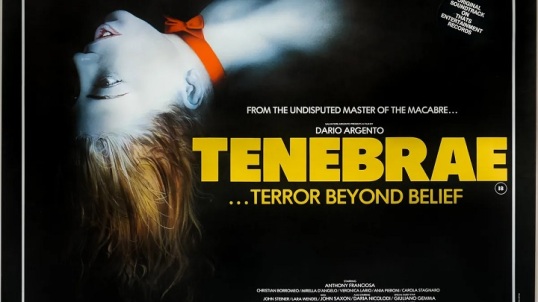
Following the commercial failure of Inferno, a disillusioned Dario Argento returned to Rome. His bad experience with 20th Century Fox had soured Argento on continuing to work with Hollywood and his struggles to film Inferno (as well as his increasingly strained relationship with girlfriend Daria Nicolodi) left him with little desire to continue The Three Mothers trilogy. Instead, he focused on a new idea, one that was inspired by his own experience with an obsessed fan who had left vaguely threatening messages for him when he was in New York. Released in 1982, Tenebrae was Argento’s return to the giallo genre and it would turn out to be a very triumphant return, even if in, typical Argento fashion, it would take a few years for many people to realize just how triumphant.
Argento himself claimed that, while the film was certainly a giallo, it was also his first stab at science fiction. In an interview that appeared in Cinefantastique, Argento said that the film was meant to take place a few years in the future, after some sort of calamity had occurred that has greatly reduced the world’s population. Interestingly, Argento said that the survivors were largely from the upper class and that none of them wanted to talk about or remember what had happened.
Is the science fiction element actually present in this film? I think it is, though perhaps only because I’ve specifically looked for it. Rome, as portrayed in Tenebrae, is a city that is full of sleek but impersonal buildings, the type that would have been recently built by a wealthy society that was unsure of what it believed. Argento specifically avoids filming any scene near any historical landmarks, suggesting all of the evidence of Rome’s former greatness has been wiped out.
Perhaps the most futuristic element of the film (and the most prophetic) is that no one really seems to have a connection with anyone else. The crowd scenes in Tenebrae aren’t really that crowded, even the ones that take place in what should be a busy airport. (In many ways, the film’s portrayal of a Rome that is both busy but strangely empty brings to mind Jean Rollin’s portrayal of Paris in The Night of the Hunted.) Even when we see people socialize, there seems to be an invisible barrier between them, as if they don’t want to run the risk of getting too close to each other. When one character is fatally stabbed while out in public, perhaps the most disturbing aspect of the murder is that so many people just walk away, as if they’ve been conditioned to ignore anything unpleasant. The only thing that prevents this scene from feeling like a vision of 2023 is that there aren’t a bunch of people filming the victim’s final moments on their phone.
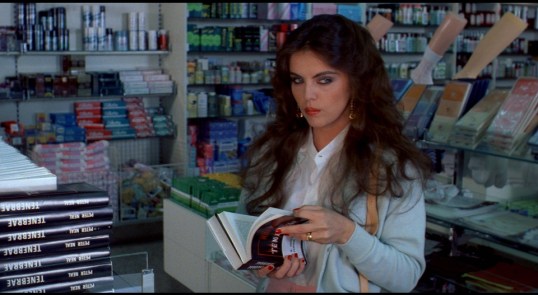
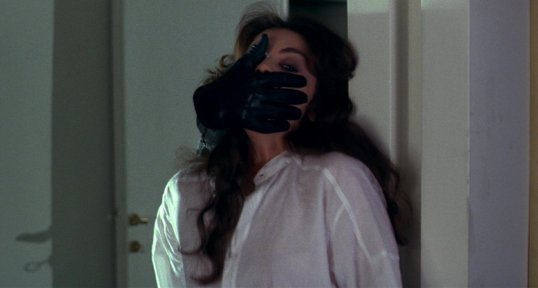
The film opens with a sequence that, as a former teen shoplifter, left me feeling disturbed. Elisa Manni (Ania Pieroni, who played The Mother of Tears in Inferno and the enigmatic housekeeper in Fulci’s The House By The Cemetery) is a shoplifter who gets caught trying to steal the latest book by thriller novelist Peter Neal. After being released, the carefree Elisa walks back to her home and, after being menaced by both a barking dog and a pervy old man, Elisa arrives in the safety of her house, starts to undress, and is promptly attacked by a black-gloved killer who slashes her neck and stuffs pages of Neal’s book into her mouth. It’s not just the murder that makes this scene disturbing but also the fact that the killer was somehow waiting for Elisa in her house, establishing that this is a world where the safety of even a locked door is an illusion.
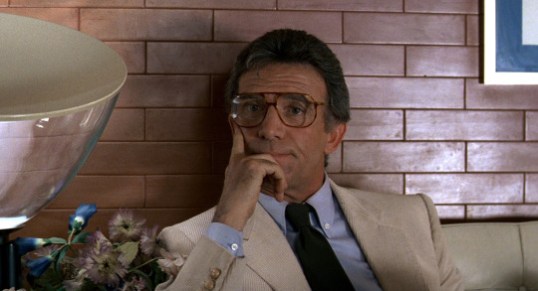
Peter Neal (Anthony Franciosa), who we first see riding his bicycle in New York, has come to Italy to promote his latest book, Tenebrae. He arrives in Rome with his manager, Bullmer (John Saxon, giving a likable performance) and his assistant, Anne (Daria Nicolodi). Confident to the point of arrogance, Peter is a pro at dismissing claims that his books are violent and misogynistic but even he is taken aback when an old friend of his, the journalist Tilde (Mirella D’Angelo), suggests that Tenebrae might inspire violence.
Peter Neal is a celebrity and a pretty obvious stand-in for Argento and everyone in the film is obsessed with him. His ex-fiancée, Jane (Victoria Lario), has followed Peter to Rome, intent on getting some sort of revenge for the way that he treated her while they were together. (Daria Nicolodi felt the vindictive and unstable Jane was based on her, which was another thing that strained her notoriously volatile relationship with Dario.) Peter’ young assistant, Gianni (Christian Borromeo, of Deodato’s The House on the Edge of the Park and Fulci’s Murderrock) hero worships him. The puritanical talk show host, Christiano Berti (John Steiner), wants to interview Peter about the morality of his books. And the killer, whoever they may be, is leaving letters for Peter, informing him that his book have inspired the killer’s crimes. Detective Germani (Spaghetti western star Giuliano Gemma) is investigating the letters and he is an admitted fan of Peter Neal’s novels but, somewhat alarmingly, he mentions that he’s never able to guess the killer’s identity.
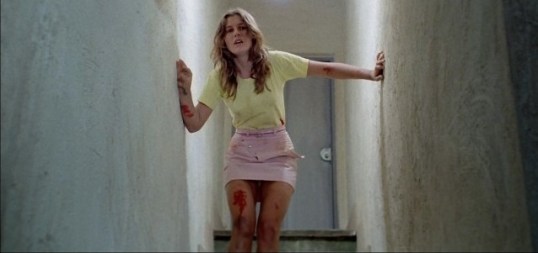
Argento’s camera restlessly prowls his futuristic Rome while Goblin’s music booms on the soundtrack as the people in Peter Neal’s life are murdered by a killer wearing black gloves and carrying a straight razor. The murder scenes feature some of Argento’s best work, directed in such a ruthless and relentless manner that we understand the killer’s determination without having to see their face. This is a film of elaborate set pieces and, as if in direct response to 20th Century Fox’s attempts to control his work on Inferno, Argento is eager to show what he can do when left alone. The film is remembered for the sequence where the camera glides over the exterior of an apartment building while the killer stalks the inhabitants but, for me, the scariest scene is when poor Maria (Lara Wendel), the daughter of Neal’s landlord, finds herself being chased straight into the killer’s lair by a very viscous Doberman.
When the film does slow down, it’s for flashbacks to a beach and acts of sexual violence performed by and against an enigmatic woman (who is played by transgender performer, Eva Robbins). The beach flashbacks unfold in a hazy, dream-like manner and they leave us to wonder if what we’re watching is real or if it’s just a fantasy. If the “modern” scenes feature Argento at his most energetic, the beach scenes feature Argento at his most enigmatic.
Daria Nicolodi often said that she considered her final scene in this film to be Argento’s greatest act of cruelty to her. Coming across the killer’s final tableaux and discovering the truth about who the killer is, Anne stands in the rain and screams over and over again. Nicolodi apparently felt that Argento required her to stand there soaked and screaming in order to punish her for having worked (with Tenebrae co-star John Steiner) on Mario Bava’s Shock, instead of having accepted a supporting role in Suspiria.
Whatever personal motives may have been involved in the decision, I think Nicolodi’s screaming is one of the most powerful moments to be found in Tenebrae. It’s certainly the most human moment because I think anyone with a soul would scream upon learning the truth of what has been happening in Rome. Every assumption that Anne had has been overturned. Who wouldn’t scream? Continuing with Argento’s claim that the film was about a world where people no longer discuss the terrible things that have happened, Anne’s screams are the most human part of the movie.
Tenebrae is the last of Agento’s truly great and flawless films. Of course, in usual Argento fashion, it was not treated well in the States, where it was initially released in a heavily edited version and with a terrible title (Unsane, under which it can still be found in certain Mill Creek box sets). But Tenebrae has since been rediscovered and today stands as one of Argento’s greatest triumphs.
Sitting in the middle of the forest, there’s a camp ground. Rumor has it that the camp was built on the site of an ancient Native American burial ground and that’s why grouchy Robert Ritchie (David Hess) and his wife Julia (Mismy Farmer) were able to afford it as such as reasonable price. I guess that could be true and maybe the part about the curse is true, too…. Well, no matter! People love to camp and the forest is lovely and there’s no way that this camp ground won’t be a success!
In fact, the only thing that could stop it from being a popular vacation location would be if two teenagers were mysteriously murdered one night….
Which, of course, is exactly what happens! The daughter of a local doctor (played by John Steiner, of all people) goes off with her boyfriend and both of them are murdered! (Though we’re told that the two of them are high school students and, when we first see them, they’re at basketball practice, both victims appear to be in their early 30s. When the actress playing the doctor’s daughter first approached him, I immediately assumed that she was playing his wife. I was actually a little bit stunned when she said, “Bye, Daddy.”)
Anyway, the unsolved murder pretty much ruins any hope of the camp ground being successful. 15 years later, Robert is paranoid and convinced that a Native shaman is sneaking around the forest and looking for campers to kill. Meanwhile, Julia is so frustrated with her increasingly unstable husband that she’s having an affair with the sheriff (Charles Napier). The sheriff is so busy shtupping Julia that it often falls upon Deputy Ted (Ivan Rassimov, who had the best hair of all the Italian horror actors) to actually enforce the law. Meanwhile, the doctor is still mourning the death of his daughter and wandering around the forest.
Eventually, a bunch of obnoxious 30-something teenagers arrive, looking for a place to park their camper and ride their dirt bikes. Despite the history of murder and the general grouchiness of Robert Ritchie, they decide to say at the campground. Soon, a masked killer is carving people up. Is it the spirit of the Native shaman or is it something else? Who will survive and what will be left of them?
This 1986 Italian film was directed by none other than Ruggero Deodato, the man behind films like Cannibal Holocaust and The House On The Edge of the Park (which starred Body Count’s David Hess). As one might expect from a Deodato film, the emphasis is on blood and atmosphere. Deodato, who always had a good eye for properly ominous locations, gets a lot of mileage out of that spooky forest, which really does look like exactly the place where a masked killer would chose to hang out. While the kills are tame by Deodato standards, they’re still icky enough to make you cringe. I’m sorry but if the scene involving the body hanging from the hook doesn’t freak you out, then you’ve obviously become dangerously desensitized and you probably should probably take a break from watching movies like this.
Of course, the main appeal of Body Count is to see a cast of Italian horror and exploitation veterans going through the motions of starring in an American-style slasher film. David Hess, Ivan Rassimov, John Steiner, Charles Napier, and Mimsy Farmer are all such wonderfully eccentric performers that they’re worth watching even when they’re stuck in one-dimensional roles. David Hess, especially, does a good job as the unhinged Robert Ritchie and the film makes good use of Hess’s image. The film understand that we’re so used to watching David Hess kill people on screen that our natural instinct is to suspect the worst when we see him in Body Count. I also liked the performance of John Steiner, largely because Steiner always came across like he couldn’t believe that, after a distinguished theatrical education, he somehow ended up an Italian horror mainstay. And, of course, Ivan Rassimov had the best hair in the Italian horror genre.
Body Count is on Prime. The story’s not great but it’s worth watching just for the horror vets in attendance.
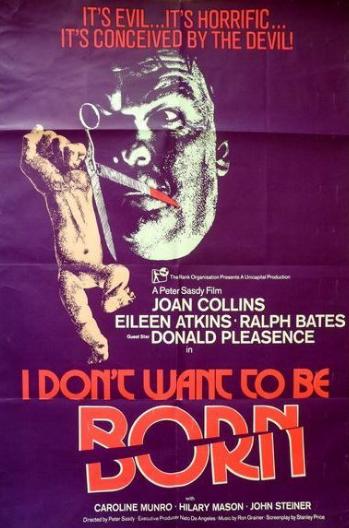
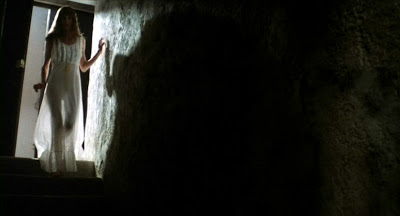
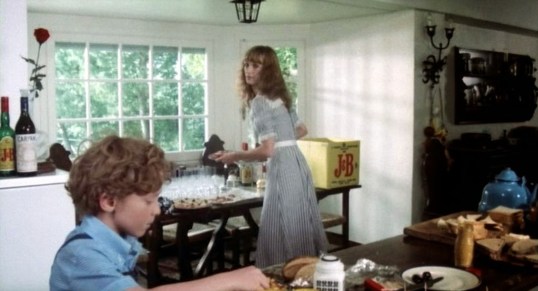
Now, admittedly, that dialogue is never heard in the 1975 British horror film, I Don’t Want To Be Born. However, if I had heard that particularly exchange in this film, I would not have been surprised. That’s just the type of movie that I Don’t Want To Be Born is. It’s a thoroughly ludicrous, totally ridiculous movie and what makes it all the more memorable is that it doesn’t seem to realize how silly it all is. This is a batshit crazy movie that tells its story in the most serious way possible. This damn film is almost somber, it’s so serious.
Lucy (played by Joan Collins) is a stripper who performs her act with a perverted dwarf named Hercules (George Claydon). When Hercules tries to force himself on Lucy, he is tossed out of the club by Tommy (who is played by John Steiner, a good actor who somehow always turned up in movies like this one.) After she and Tommy make love, Lucy is confronted by Hercules who curses her, telling her that she will have a baby “as big as I am small and possessed by the devil himself!”
Oh, Hercules, you weirdo.
9 months later, Lucy’s life has somehow completely changed. She’s no longer a dancer. Now, she’s married to a rich Italian named Gino (played by Ralph Bates, speaking in a bizarre accent). When Lucy has her baby, it’s a long and difficult delivery. The baby is huge! Not only is he huge, but he also has a bad temper and unnaturally sharp nails. The first time that Lucy holds him, he attacks her. Whenever the baby is introduced to anyone new, he responds by biting them. When Tommy drops by to take a look at the baby that might be his son, he ends up with a bloody nose!
But that’s not all this baby can do! Anytime he’s left alone in a room, the room ends up getting destroyed. Eventually, he apparently figures out how to climb trees and how efficiently slip a noose around the neck of anyone who walks underneath him. And don’t think that you can escape this baby simply because you’re taller and faster. One unfortunate person is decapitated, even though he’s standing at the time. How did the baby reach his neck? Who knows?
Does this baby need an exorcism? Lucy’s sister-in-law, Sister Albana (Eileen Atkins), certainly believes that it does! As Lucy thinks about whether the baby’s behavior is in any way odd, she glances over at the baby and — OH MY GOD! The baby has Hercules’s face!
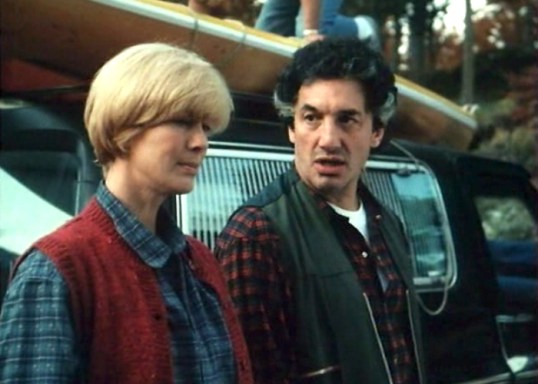
And it just keeps going from there. Again, I feel the need to repeat that this film is meant to be taken very seriously. The script may be full of awkward and clichéd dialogue but most of the cast attempts to act the Hell out of it. Speaking of the cast, there’s a lot of familiar horror people in this one. Along with John Steiner, there’s also Caroline Munro and Donald Pleasence. Those three give performances that somehow manage to remain credible, perhaps because they had the experience necessary to understand what type of movie they were in. But the rest of the cast … you feel bad for them because they’re just trying so hard.
It’s a terrible movie but it’s so weird that I have to recommend that everyone see it once. If for nothing else, see it for the scene where Hercules responds to an attempt to exorcise the baby by swaying drunkenly on the stage. It’s weird and it’s hard for mere words to do it justice.
“No wonder this baby didn’t want to be born!”
That line is also nowhere to be found in this movie. It’d be nice if it was, though.
Fortunately, I’ve got my dates correct this weekend!
Anyway, without further ado, here are 6 action-filled trailers for Memorial Day!
Inglorious Bastards (1978)
No, not the Quentin Tarantino Oscar winner! This is the film that gave its name to Tarantino’s later work. The 1978 version of Inglorious Bastards was directed by Enzo G. Castellari and stars Bo Svenson and Fred Williamson.
From Hell To Victory (1979)
This World War II film was directed by Umberto Lenzi and features a surprisingly impressive cast for a Lenzi epic. (Surprisingly, for a Lenzi film of this period, it does not appear that Mel Ferrer is anywhere to be found in From Hell To Victory.)
The Last Hunter (1980)
This is actually one of the best Italian war films ever made. It was directed by Antonio Margheriti (who was given a shout out in Tarantino’s Inglourious Basterds) and stars David Warbeck, Tony King, John Steiner, and Mia Farrow’s sister, Tisa. Tisa also starred in Lucio Fulci’s Zombi 2.
Tiger Joe (1982)
Margheriti followed up The Last Hunter with Tiger Joe. Also returning (though in different roles from The Last Hunter): David Warbeck and Tony King. The female lead was played by Annie Belle, who is probably best remembered for her co-starring role in Ruggero Deodato’s The House On The Edge of the Park.
Tornado (1983)
Tiger Joe was enough of a success that Margheriti made one more Vietnam-set film, Tornado.
Last Platoon (1988)
I’ve never seen this movie but the title was probably meant to fool audiences into thinking that it was a sequel to Oliver Stone’s Platoon. I will say that, having watched the trailer, it’s interesting to see Donald Pleasence playing an American army officer. This Italian film was directed by Ignazio Dolce.
To all of our readers in the U.S: Have a safe Memorial Day weekend!
Though it seems that he’ll never get the credit that he truly deserves, Italian director Mario Bava was truly one of the most influential and important filmmakers of all time. While he spent most of his long career making genre films, Bava was also an artist who put his own unique stamp on the horror film and whose influence continues to be felt in film today. With Blood and Black Lace, Bava helped to launch the entire giallo genre and every slasher film that has ever been made owes a debt to Bava’s Bay of Blood. While Bava’s final work as a director, 1977′s Shock, may not be as well-known as some of his other films, it’s one of his best works and it’s certainly worthy to be listed with the rest of Bava’s oeuvre.
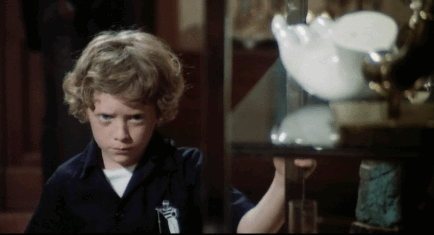
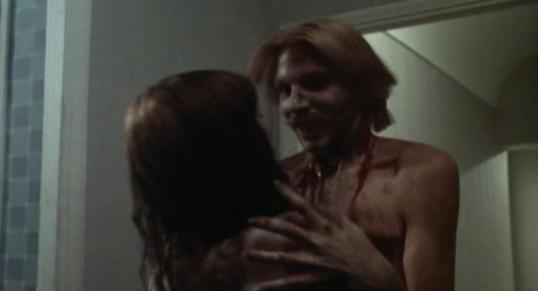
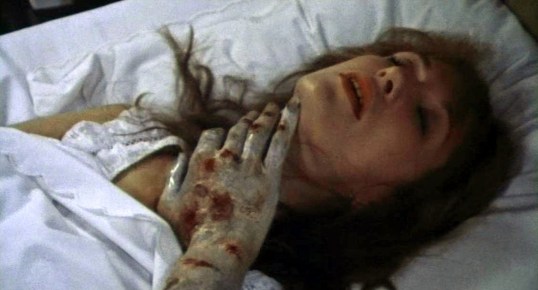
Shockis a haunted house film. Dora (played by the great Daria Nicolodi) is a mentally fragile woman who is still in the process of recovering emotionally from the suicide of her first husband. When Dora marries Bruno, an apparently well-meaning airline pilot (but he’s played by John Steiner and anyone who loves Italian exploitation knows that it’s always dangerous when Steiner shows up as a sympathetic character), it briefly appears that Dora’s life might be getting back on the right track.
Except, of course, for the fact that, whenever Bruno leaves the house, Dora gets the feeling that she’s not alone. Things fall off of shelves. A razor blade suddenly shows up hidden between the keys of a piano. Worst of all, her young son Marco (David Collin, Jr.) starts to act differently. When he’s not sneaking into the master bedroom and using a kitchen knife to chop up Dora’s underwear, Marco is doing things like aggressively wrestling with his mother and cutting Bruno out of all the family pictures.
Dora quickly becomes convinced that the spirit of her first husband is both haunting the house and possessing young Marco. Bruno, meanwhile, worries that Dora may be having another nervous breakdown. As for Marco, he’s busy spying on Bruno and Dora while they’re sleeping and calling them dirty names under his breath…
The plot of Shock will probably not shock anyone who has seen a haunted house film but one doesn’t really watch a Bava film for its plot. With a Bava film, the story is never quite as important as the way that Bava tells it. Working in the years before CGI, Bava was a master at creating special effects that were cheap, simple, and ultimately very effective and that’s what Bava does here. In perhaps the film’s most effective (and famous) moment, Marco seems to transform into Carlo right before our eyes. It’s pretty easy to figure out how Bava achieved the effect but that doesn’t make it any less of a frightening moment.
However, the main reason that this film works is because of Daria Nicolodi. Bava was never known for being a great director of actors but, for this film, he managed to capture one of the best performances in the history of horror cinema. In the role of Dora, Nicolodi is like an exposed nerve. It’s impossible not to sympathize with her, even if you’re never quite sure just how sane or insane that she may actually be. Watching Nicolodi’s performance in this film, it’s hard not to regret that, in the years to come, her talent would be so overshadowed by both her former boyfriend Dario Argento and their daughter, Asia.
By all accounts, Mario Bava was in failing health during the making of Shock (and perhaps that’s why he showed so much empathy for the similarly frail Dora) and he was aided, in the making of the film, by his son Lamberto Bava (who would later become a well-known horror director himself). Sadly, Mario Bava died three years after completing Shock and the film has never quite gotten the amount of attention that it deserves. Shock is a worthy end to a brilliant career.
Last year, I gave up control to the reader of the site and you know what? I kinda liked it in a sneaky, dirty little way. So I figured, why not do it again?
Here’s how it works. Earlier today, I put on a blindfold and then I randomly groped through my DVD collection until I had managed to pull out ten movies. I then promptly stubbed my big toe on the coffee table, fell down to the floor, and spent about 15 minutes cursing and crying. Because, seriously, it hurt! Anyway, I then took off the blindfold and looked over the 10 movies I had randomly selected. Two of them — Dracula A.D. 1972 and A Blade in the Dark — were movies that I had already reviewed on this site. So I put them back and I replaced them with two movies of my own choosing — in this case, Eternal Sunshine of the Spotless Mind and The Unbearable Lightness of Being.
Between now and next Sunday (March 27th), people will hopefully vote in this poll. On Sunday, I will watch and review whichever movie has received the most votes. Even if that movie turns out to be Incubus. *shudder* (Have I mentioned how much I love Eternal Sunshine of the Spotless Mind?)
Now, of course, there’s always the possibility that no one will vote in this poll and I’ll end up looking silly. Those are the risks you take when you set up an online poll. However, I have a backup plan. If nobody votes, I will just spend every day next week shopping for purses at Northpark Mall and then blogging about it. And by that, I mean blogging every single little detail. So, it’s a win-win for me.
Anyway, here’s the list of the 10 films:
1) Barbarella— From 1968, Jane Fonda plays Barbarella who flies around space while getting molested by …. well, everyone. Directed by Roger Vadim.
2) Barry Lyndon — From 1975, this best picture nominee is director Stanley Kubrick’s legendary recreation of 18th-century Europe and the rogues who live there.
3) Caligula — Yes, that Caligula. From 1979, it’s time for decadence, blood, and nudity in the Roman Empire. Starring Malcolm McDowell, Helen Mirren, Peter O’Toole, John Gielgud, John Steiner, and Theresa Ann Savoy.
4) Eternal Sunshine of the Spotless Mind — Oh my God, I love this movie. Jim Carrey breaks up with Kate Winslet and deals with the pain by getting his mind erased by Tom Wilkinson, Mark Ruffalo, Kirsten Dunst, and an amazingly creepy Elijah Wood.
5) Incubus — From 1969, this low-budget supernatural thriller not only stars a young William Shatner but it also features the entire cast speaking in Esperanto. For. The. Entire. Movie.
6) Inland Empire — If you want to give Lisa nightmares, you can vote for David Lynch’s disturbing 3-hour film about lost identity, sexual repression, human trafficking, and talking rabbits.
7) Kiss Me Deadly — From 1955, this Robert Aldrich-directed cult classic features hard-boiled P.I. Mike Hammer and a host of others chasing after a mysterious glowing box and accidentally destroying the world in the process.
8 ) Mandingo — From 1975, this infamous little film is a look at slavery, incest, and rheumatism in the pre-Civil War South. Starring James Mason, Ken Norton, Perry King, and Susan George. Supposedly a really offensive movie, one I haven’t sat down and watched yet.
9) Sunset Boulevard — From 1950, hack screenwriter William Holden ends up the kept man of psychotic former screen goddess Gloria Swanson. Directed by Billy Wilder.
10) The Unbearable Lightness of Being — From 1988, Philip L. Kaufman’s adaptation of Milan Kundera’s classic novel (one of my favorite books, by the way) features Daniel Day-Lewis, Juliette Binoche, and Lena Olin having sex and dealing with ennui. After I first saw this movie, I insisted on wearing a hat just like Lena Olin did.
Everyone, except for me, is eligible to vote. Vote as often as you want. The poll is now open until Sunday, March 27th.
(Edit: Voting is now closed but check below for the results! — Lisa)
 Yor (Reb Brown, wearing a loin-cloth and blonde wig) is a hunter who makes his way through the desert, fighting dinosaurs and cavemen and drinking the blood of his enemeis. Yor finds a village and, after saving Kalaa (Corrine Clery) and Pag (Luciano Pigozzi) from a dinosaur, he becomes a valued member of the community. Yor does not know much about his past and he is searching for the meaning behind an amulet that he wears. With Kalaa and Pag, he goes on a quest for answers and instead finds himself being attacked by flying saucers, robots, and laser beams. Despite the dinosaurs and the cavemen, it turns out that this film is taking place in the future, after a nuclear apocalypse.







 Through the Shattered Lens