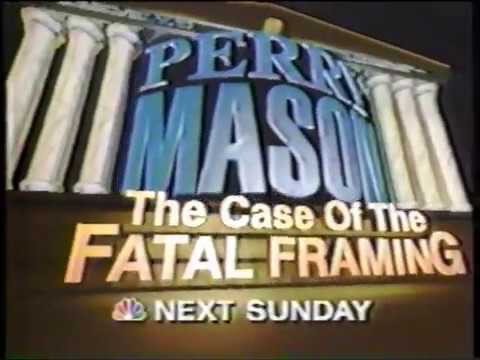
Truman York (David Soul), a painter who faked his death in a motorcycle accident five years earlier, reemerges because someone is selling forgeries of his work. When York turns up dead, a photographer (Mark Moses) is arrested for the crime. Luckily, the photographer went to college with Ken Malansky (William R. Moses) and Ken is able to convince Perry Mason (Raymond Burr) to take the case. (If you’re going to get arrested for murder, it helps to be a friend of Ken or Perry’s.)
I was disappointed with this entry in the Perry Mason series. It had potential but it never really reached it. I was more interested in how the artist faked his death for five years instead of figuring out who killed him. Raymond Burr was obviously unwell when he shot this movie and there were times when it was painful to watch him as he had to learn against a wall just to be able to stay standing while delivering his lines. I felt bad for Burr watching this because, even though he was great in the role of Perry Mason, it was obvious that he was in pain.
Maybe because Raymond Burr couldn’t do as much as usual, Ken got to do more than usual in this installment. What’s strange is that the accused photographer was also interrogating people and looking for clues. He had just been released on bail and he was on trial for murder. He should have been laying low instead of tracking down witnesses.
I love the Perry Mason films and I have so many good memories of watching them with my aunt. This one didn’t do it for me.
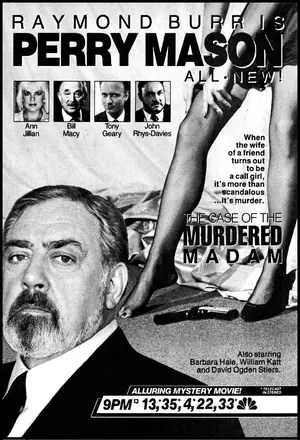
Former madam Suzanne Domenico (Ann Jillian) attempts to blackmail four rich men who are planning on embezzling money from a bank and is found dead by her husband, Tony, shortly afterwards. Tony (Vincent Baggetta) is arrested and charged with murdering his wife. Tony’s older brother used to run around with Della Street (Barbara Hale) and Della is able to get Perry Mason (Raymond Burr) to defend him in court. Paul Drake, Jr. (William Katt) is brought in to do the investigative legwork. Once again, Paul falls for a younger woman (Daphne Ashbrook) who will probably never be mentioned again in any of the other movies.
This movie was a little sad because it was obvious that Raymond Burr was not in good health. He spends most of the movie sitting or moving with crutches. In the movie, they say that Perry is using crutches because of a skiing accident but looking at Raymond Burr, there’s no way to imagine him skiing. Burr is still as sharp as ever when asking questions in the courtroom but it’s still clear that he was in pain when he did this movie. Perry being sidelined does mean that Barbara Hale and William Katt get to do more than usual. After spending the last few movies constantly getting outrun and smacked around, Katt finally gets to beat someone up in the movie.
The mystery isn’t bad, even though I guessed who the murderer was long before the trial started. The entire embezzlement scheme comes down to embezzling a few cents a day so that no one will notice. That’s the same thing they tried to do in Office Space! Luckily, no one got murdered that time.
Overall, this was a good entry in the Parry Mason movies, especially for those of us who like watching Paul Drake, Jr. I’m starting to wonder if all of Perry and Della’s friends are going to end up getting accused of murder at some point. My aunt and I always used to joke about how often Jessica Fletcher’s nephew was accused of murdering someone. It might be just as dangerous to be a friend of Perry Mason’s!
On Mount Olympus, “ages ago” according to a title card, Zeus (John Rhys Davies) is displeased with his daughter Aphrodite (Wheel of Fortune letter turner Vanna White). Aphrodite, who insists on being called Venus, has refused to marry every man or God that Zeus has found for her and she even started the Trojan War. Zeus says that Venus must learn what love means before she can rejoin the Gods. He then turns her into a statue (!) and sends her down to Earth.
How is she going to learn what love means as a statue? It’s obviously a pertinent question because, thousands of years later, she’s still set in marble and standing in a museum. Two thieves wheel her out to a courtyard and leave her there so they can pick her up later. Before the thieves return, Ted Beckman (David Naughton) and his womanizing friend, Jimmy (David Leisure), wander by. For some reason, Ted slides an engagement ring on Venus’s finger. Venus comes to life. She and Ted must now fall in love for real in order for Venus to return to Mount Olympus. The only problem is that Ted is a hairdresser and he’s already engaged to marry Cathy (Amanda Bearse).
A made-for-TV movie that unsuccessfully tried to revive the acting career that Vanna White abandoned for Wheel of Fortune, Goddess of Love is a spectacularly stupid movie that attempts to disguises its threadbare plot by being extremely busy. Not only do Ted and Venus have to overcome a lack of romantic chemistry and fall in love but the two thieves are also still looking for Venus and even Little Richard shows up as one of Ted’s employees. Venus not only accidentally burns down Ted’s business but also maxes out his credit cards. Philip Baker Hall plays the detective investigating the theft of the statue and gives a performance reminiscent of his classic Bookman turn from Seinfeld. It’s dumb but Vanna herself gives a far more engaging performance than the material requires or deserves. Some of her line deliveries are a little wooden but she still radiates the natural likability that made her an unlikely celebrity in the 80s. Goddess of Love should have cast Pat Sajak as Ted. Then it would have been a classic.
2012’s Escape tells the story of two men who meet in Thailand.
Paul Jordan (C. Thomas Howell) is a doctor who came to Thailand with his wife, Kim (Anora Lyn). Paul and Kim are both working in a clinic, trying to bring healthcare to the poor and the downtrodden. They specifically left America because of the death of their newborn. Paul says that they need to make a clean break and start new lives for themselves. Paul is an atheist, both because of the death of his child and all of the misery that he sees around him. Kim is secretly religious. Though she doesn’t discuss it with Paul, she brings a bible with her and she regularly asks the people back home to pray for them.
Malcolm Andrews (John Rhys-Davies) is a former tech boss who has retired and has been exploring the world with his wife (Puttaya Chaimongkolepetc). Malcolm is extremely wealthy but also very humble, a kind man who always tries to treat people with decency. Unlike Paul, he is very religious and has no problem with accepting the idea the God can exist even when the world itself is a complete mess.
When Paul and Malcolm first meet, Paul initially distrusts Malcolm but that soon changes due to the circumstances of their meeting. They’ve both been kidnapped by outlaws and they’re being held in a bamboo cage in the middle of an island jungle. Paul has been kidnapped because one of the outlaws has been wounded and is dying. Paul is expected to keep the man alive, with the understanding being that if the man dies, Paul dies as well. Malcolm has been kidnapped because the outlaws are hoping to get a huge ransom for him. Despite their differing views of the world, Paul and Malcolm become friends because, when you’re stuck in a bamboo cage with someone, you really don’t have much of a choice but to become friends. In a situation like that, there’s only so long someone can go without making eye contact.
While Paul and Malcolm debate theology and wait for an opportunity to make their escape, their wives try to get the authorities to search for their husbands. Unfortunately, it turns out that the authorities are almost as incompetent as the outlaws.
Lately, there have been a lot of faith-based films that have attempted to duplicate Hollywood gerne films. Escape has a religious message but it’s also a thriller about two men trapped in the middle of the jungle. It’s fairly well-done, though the action does occasionally drag. (There’s only so many ways that you can film two men talking in a cage.) The film makes good use of C. Thomas Howell’s bland niceness and the jungle scenery is both beautiful and ominous. That said, John Rhys-Davies is the main attraction here and he gives a strong and compelling performance as Malcolm. Regardless of whether you agree with his beliefs or not, you really do want to see him make it back to his wife.
Escape ends on a bit of an abrupt note but it’s still an effective thriller.
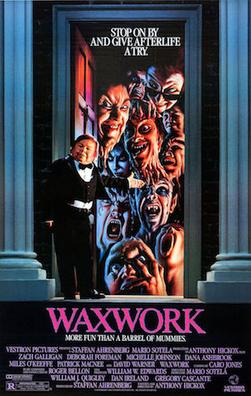
First released in 1988, Waxwork asks the audience with a very important question.
Let’s say that you and your best friend were walking to school one day when you suddenly noticed a gigantic mansion that you had never seen before, sitting in the middle of your neighborhood. And what if a tall, somewhat sinister Englishman (played by David Warner, none the less) suddenly appeared out of nowhere and told you that the mansion was actually a waxwork. And what if that Englishman than invited you to come to the waxwork at midnight and specifically asked you to come in a group of 6. Would you do it?
Now, I know that your first instinct is to say, “Of course, I wouldn’t!” That’s the type of answer that we’ve been conditioned to give because no one wants to admit that they can be as dumb as a character in a horror movie. But really, I would go. Especially if, like the characters in Waxwork, I was a teenager. (Actually, most of the characters in Waxwork are described as being college students but they all act like high school students and their college appears to be a high school so draw your own conclusions.) When you’re a certain age, you feel like you’re immortal and an invitation to hang out in a creepy building with a bunch of strangers at midnight feels totally reasonable.
Anyway, four rich kids — Mark (Zach Galligan), China (Michelle Johnson), Sarah (Deborah Foreman), and Tony (Dana Ashbrook, a year before he was cast as Laura Palmer’s boyfriend in Twin Peaks) — visit the waxwork at midnight. What they discover is that the building is full of macabre exhibits that recreate various moments from horror history. There’s werewolves, vampires, and Jack the Ripper. There’s also the Marquis de Sade, a figure that the seemingly innocent Sarah becomes fascinated with. And, as two of the visitors discover, stepping past the red rope and entering an exhibit transports them into an alternate world where they become the victim of the star of each display.
Not surprisingly, the film is at its best when imagining the world inside each exhibit. Each exhibit has its own backstory and its own set of guest stars. John Rhys-Davies shows up as a werewolf. Miles O’Keeffe is a properly urbane Count Dracula. J. Kenneth Campbell plays the Marquis de Sade, who the film imagines as a swashbuckling sadist. That said, I think the most effectively frightening exhibit was one that featured no special guest stars but a very determined and very strong mummy.
What’s going on at the waxwork!? As explained by Sir Wilfred (Patrick Macnee, bringing some welcome wit and style to the film), it’s all a part of a scheme to bring the most evil beings ever back into existence so that they can conquer the world. It’s important that none of the waxworks be allowed to enter the real world and soon, Sir Wilfred and his ragtag army are laying siege to the waxwork and bringing things to an apocalyptic conclusion. The final battle is a bit haphazardly edited and it’s impossible to really keep track of who is fighting on which side. (Indeed, I’m still not sure where Sir Wilfred even found his army.) But it does feature plenty of in-jokes for horror fans, including a cameo appearance by the carnivorous plant from Little Shop of Horrors.
Waxwork is entertaining film. It doesn’t take itself particularly seriously and, indeed, Mark, China, Sarah, Tony, and all of their friends feel as if they could just as easily have been found in the pages of a Bret Easton Ellis novel about pretty but vapid alcoholics. Mark is the type who gets his maid to write his term papers. Tony just wants to drink (but, because he’s played by the adorable Dana Ashbrook, he’s still the most likable character in the film). China says, “I do what I want, when I want,” when confronted about cheating on her boyfriend. Sarah is the “innocent” one but just seeing the words “Marquis de Sade” causes her to swoon. Dropping these four idiots into a situation where the fate of the world is at stake feels like a wonderfully sardonic cosmic joke.
In the end, the true pleasure of Waxwork is watching old pros like David Warner, Patrick Macnee, and the exhibit guest stars hamming it up. Macnee, in particular, seems to enjoy leading the final charge against the forces of evil and, indeed, it’s hard not to wish that he had even more screen time than he did. David Warner, meanwhile, rolls his eyes at just how difficult it can be to bring the 18 most evil figure in history back to life. It’s hard work but I guess someone has to do it!
In this 1993 film, John Rhys-Davies plays Professor Kissel. The professor is a mad scientist with a German accent who has taken over a small island in the Caribbean. From his compound, he has developed a process by which he can turn anyone into a cyborg! The cyborgs follow his orders and …. well, it’s never quite clear what exactly Professor Kissel plans to do with the cyborgs. I guess he just wants to keep them around so that they can do random evil things.
DEA agent Philip Ryan is captured by Kissel and transformed into one of those cyborgs! However, Philip has a brother named Jack (played by martial artist David Bradley). Jack used to work for the government until he was disillusioned when one of his investigations went terribly wrong. However, Jack is willing to come out of retirement to save his brother. Teaming up with a journalist named Cathy (Alonna Shaw), Jack infiltrates Kissel’s compound and battles the cyborgs. Along the way, Cathy falls in love with Jack. I’m not sure why that happens as Jack tends to be a bit surly and self-absorbed. Indeed, he and Cathy somehow manage to have not just zero but less than zero romantic chemistry.
Does this movie sound dumb? Well, that’s because it was pretty dumb. It was directed by Sam Firstenberg, who directed the first two American Ninja films. And it stars David Bradley, who starred in the last three American Ninja films. The American Ninjas were fun but Cyborg Cop just kind of drags. A huge part of the problem is that David Bradley was a good martial artist but he was a less than impressive actor. Seeing as how Jack is trying to save his brother from being turned into an emotionless robot, Cyborg Cop calls for a bit more acting than the American Ninja films did. Unfortunately, it’s hard to make a film about human emotions when your lead actor isn’t capable of showing them. It doesn’t help that Jack is written as being someone who is always in a rather foul mood. Also, from the minute he lands in the islands, he wears a fanny pack around his waist and it just looks so utterly ridiculous. It’s hard to take a fight seriously when one of the combatants is wearing a leather fanny pack. The other big issue is that it takes forever to actually get to the cyborg action. For some reason, the film tries to generate some suspense about what Kissel’s plan is, despite the fact that the word “cyborg” is right there in the title!
On the plus side, the film does feature John Rhys-Davies playing a mad scientist and he’s just the type of cheerfully theatrical actor who can do justice to the role of someone who spends most of his time ranting about how much smarter he is than everyone else in the world. Rhys-Davies, who is best known for playing Indiana Jones’s friend Sallah and for playing both Gimili and the talking tree in The Lord of the Rings, appears to have had a lot of fun as Prof. Kissel and it’s fun to watch him in the role. This is a case where most people watching the film will proudly cheer for the bad guy because the bad guy is so much more entertaining than the good guy.
Cyborg Cop somehow led to two sequels. The work is never done.
As some of our regular readers undoubtedly know, I am involved in hosting a few weekly live tweets on twitter. I host #FridayNightFlix every Friday, I co-host #ScarySocial on Saturday, and I am one of the five hosts of #MondayActionMovie! Every week, we get together. We watch a movie. We tweet our way through it.
Tonight, for #MondayActionMovie, the film will be 1993’s Cyborg Cop! Selected and hosted by BunnyHero, Cyborg Cop stars David Bradley and John Rhys-Davies. It’s a film about a cyborg who is a cop! The movie starts at 8 pm et and it is available on YouTube.
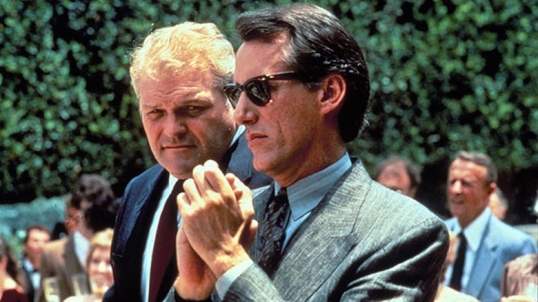
Following #MondayActionMovie, Brad and Sierra will be hosting the #MondayMuggers live tweet. We will be watching 1987’s Best Seller, a classic thriller starring James Woods as an assassin and Brian Dennehy as the cop-turned-author who Woods wants to tell his story. Both Dennehy and Woods give excellent performances in this conspiracy-themed thriller. It is available on both Prime and Tubi and it starts at 10 pm et.
It should make for a night of intense viewing and I invite all of you to join in. If you want to join the live tweets, just hop onto twitter, start Cyborg Cop at 8 pm et, and use the #MondayActionMovie hashtag! Then, at 10 pm et, start Best Seller and use the #MondayMuggers hashtag! The live tweet community is a friendly group and welcoming of newcomers so don’t be shy. And reviews of these films will probably end up on this site at some point over the next few weeks.
Still on the run and hoping to find a cure for the condition that causes him to transform into the Incredible Hulk, David Banner (Bill Bixby) is now in New York and using the name David Belson. He’s grown a beard to keep himself from being recognized. I guess it’s like when Superman used to put on his glasses. When David sees a woman being harassed on the subway by two thugs, it’s too much stress for him and he transforms into the Hulk (Lou Ferrigno). When the Hulk turns back into David, he is arrested and charged with being a mugger. (No one believes the witness’s account of seeing a huge green man on the subway.)
Despite the title, the Hulk never goes on trial, though there’s a dream sequence where David turns into the Hulk in a courtroom. (Stan Lee plays the jury foreman.) Just having a nightmare about turning into the Hulk is enough to cause the transformation for real. No New York jail can hold the Hulk.
David’s lawyer is blind and yes, his name is Matthew Murdock (played by Rex Smith). Murdock thinks that the attack on the subway was somehow linked to a crime lord named … yes, Wilson Fisk. Fisk (John Rhys-Davies) wants to set up a national crime syndicate, as if Lucky Luciano didn’t already do that. Using the name Daredevil, Murdock tries to prevent that. David eventually ends up helping.
The Trial of the Incredible Hulk is a huge tease. It promises the Hulk on trial but, instead, it’s just a backdoor pilot for a Daredevil TV series. Just like in The Incredible Hulk Returns, the Hulk is forced to make room for a new hero. But at least The Incredible Hulk Returns actually featured the Hulk working with Thor. In Trial of the Incredible Hulk, the Hulk is hardly present at all. Banner encourages Murdock not to give up, even after he’s badly beaten by Fisk’s men, and he works with Matt to help him prepare for a rematch. But the final battle is almost all Daredevil. Once he escape from prison, Banner doesn’t turn into the Hulk once.
Rex Smith isn’t bad as Daredevil. While he’s not as good as Charlie Cox, he’s still better than Ben Affleck. While the movie does not feature the classic Daredevil costume, it does at least get Daredevil’s origins and powers correct. John Rhys-Davies hams it up as Wilson Fisk. One of Marvel’s most intriguing villains is turned into just another generic bad guy in an office. It’s disappointing.
The Trial of the Incredible Hulk ends with Murdock pledging to protecting the city and Banner again hitchhiking away. Daredevil would have to wait for another 25 years before getting his own series. Banner would return in The Death of the Incredible Hulk.
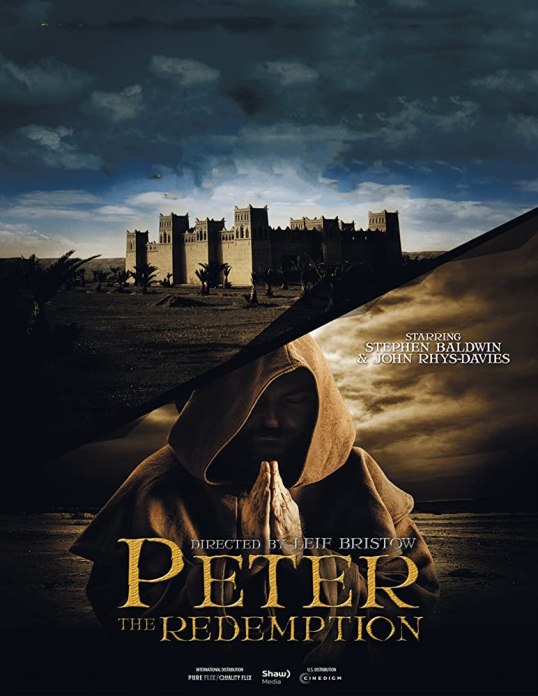
I have two main thoughts on the 2016 religious film, Peter: The Redemption.
First off, John Rhys-Davies is a treasure. The veteran actor plays the role of Peter, the rock of the Church. The film focuses on Peter’s final days, locked away in a Roman prison and suffering torture at the hand of the Romans. He’s told repeatedly that all he has to do to win his freedom (and his life) is to publicly renounce his beliefs and confess that the Christians were behind the plot to set Rome on fire. While Peter waits for death, he is haunted by memories of the night that he denied knowing Jesus. He feels that he is not worthy to be crucified. He worries if he’s done enough to atone for his mistakes. Rhys-Davies gives a powerful performance, capturing both Peter’s anguish and his inner strength. This is probably one of the best performances that you’ll ever find in a low-budget religious film.
My other thought is that you really haven’t lived until you’ve seen Stephen Baldwin plays the Emperor Nero. Baldwin plays Nero as being something of a wannabe hipster, desperately trying to convince everyone that he’s more interesting than he actually is and dreaming of rebuilding Rome in his own image. Baldwin’s Nero is a crazy conspiracy theorist, the type who often seem to be struggling to follow his own line of thought. There’s not a subtle moment to be found in Baldwin’s performance as Nero but, interestingly, his interpretation of the role is probably fairly close to being historically correct. By the account of most of the Roman historians who lived through and actually managed to survive his reign, Nero considered himself to be an artist and an intellectual and his dream was to be as acclaimed as a performer as he was an emperor. It’s been said that Nero was killed as much for his artistic pretensions as his administrative mistakes and that his final words were, “What an artist dies within me!,” and one can certainly believe that while watching Baldwin’s performance.
Unfortunately, Peter: The Redemption gets distracted by a subplot involving the blossoming relationship between a servant in Nero’s court and one of Peter’s guards. It’s the same basic story as Quo Vadis?, just told in a lot less time and on a much smaller budget. To be honest, I kind of liked the film’s low-rent version of Rome. Rome is usually presented as being this glamorous and impressive city but most historians of the era tend to emphasize the fact that the streets of Rome were often dirty and the walls were covered with frequently obscene graffiti. (In fact, graffiti was the main form of political protest in the Roman Empire.) No wonder Nero wanted to burn the place down.
Anyway, Peter: The Redemption is okay. It tells its story effectively enough and the performance of John Rhys Davies elevates every scene in which he appears. The film gets bogged down whenever it concentrates on the romance in Nero’s court but Baldwin and Rhys Davies keep things watchable.
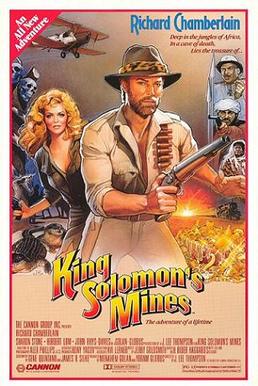
After her archaeologist father disappears while searching for the fabled mines of King Solomon, Jesse Houston (Sharon Stone) hires famed explorer Allan Quartermain (Richard Chamberlain) to help her find him. After walking around in the jungle and exploring a nearby village, Allan and Jesse discover that her father has been kidnapped by a German military expedition who want to use King Solomon’s treasure to fund their war effort. Working with the Germans is Allan’s old enemy, Dogati (John Rhys-Davies). Allan and Jesse find themselves in a race against time to find the mines before the Germans. Along the way, they steal an airplane, fight German soldiers on a train, and nearly get cooked alive in a giant cauldron.
Because this is a Cannon film and it was made at the height of Indiana Jones’s popularity and it stars John Rhys-Davies and it has a score that sounds like it was written by someone trying too hard to be John Williams, you might be tempted to think that King Solomon’s Mines is a rip-off of Raiders of the Lost Ark. However, there are some crucial differences between Raiders and King Solomon’s Mines. For instance, Raiders of the Lost Ark took place during World War II. King Solomon’s Mines takes place during World War I. Raiders of the Lost Ark had angels that melted a man’s face. King Solomon’s Mines has a lava pit that makes you explode if you fall into it. Raiders of the Lost Ark has a big fight in an airfield while King Solomon’s Mines has a big fight at an airfield …. well, wait, I guess they do have a few things in common.
Probably the biggest difference between Raiders of the Lost Ark and King Solomon’s Mines is that Raiders had Harrison Ford and Karen Allen while King Solomon’s Mines has to make due with Richard Chamberlain and Sharon Stone. (If the imdb trivia section is to be believed, Sharon Stone was cast because Menahem Golan mistook her for Kathleen Turner.) Along with generating zero romantic sparks, neither Chamberlain nor Stone come across as if they’ve ever even seen a jungle, much less explored one. The only time that the two of them are credible as anything other than actors slumming on Cannon’s dime is when they’re yelling at each other. There’s also a scene where they’re trying to steal an airplane and Chamberlain tells Stone to “reach between your legs and grab it.” That was funny, I guess.
Along with trying to be an adventure, King Solomon’s Mines also tries to be a comedy. As a general rule, Cannon films are great when they’re unintentionally funny but not so much when they actually try to be funny. The film’s idea of comedy is Richard Chamberlain having to do an impromptu jig while someone shoots at his feet. Add in a healthy dose of casual racism as Allan and Jesse run into a tribe in Africa who want to cook them in a giant stew pot and you’ve got a film so bad that you’ll hardly believe it could have been produced by the same people who gave us Delta Force, which is, of course, the greatest film ever made.
Golan and Globus had enough confidence in King Solomon’s Mines that they shot a sequel before the first film was even released. Tomorrow, I will force myself to watch and review Allan Quartermain and The Lost City of Gold. And, after that, I’ll probably go sit in a corner and think about what I’ve done.




 Through the Shattered Lens