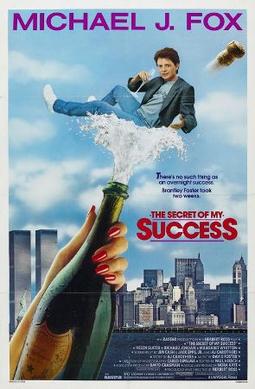
The Secret of My Success (1987, directed by Herbert Ross)


ȋ‚˜é

Brantley Foster (Michael J. Fox) heads to New York City with his business degree from the University of Kansas and the promise of an entry-level job as a financier.  He arrives to discover that the company that hired him no longer exists and that Brantley is out of a job.  New York is a harsh town for someone who is down on his luck and all of out of money.  Brantley eventually gets a job working in the mail room of a company owned by his wealthy uncle (Richard Jordan).  His uncle doesn’t even know who he is but soon, Brantley becomes just as rich and successful as he always dreamed.

What’s the secret of Brantley’s success?

Screwing his Aunt Vera (played by Margaret Whitton).

What’s the other other secret of his success?

Pretending to be named Carlton Whitfield and claiming that he’s a new executive at the corporation.

I remember when Kramer did the same thing on Seinfeld.  It didn’t work out for Kramer.  He got fired after turning in his first report.

“This is gibberish,” his boss said, “It’s almost as if you have no business training at all.  I’m afraid we have to let you go.”

“I don’t actually work here,” Kramer replied.

“That’s what makes this so hard.”

Seinfeld, never topped.

Back to The Secret of My Success, this is the most 80s film ever made, complete with montages of Brantley exploring New York and a saxophone playing on the soundtrack.  Brantley’s all about TCB, taking care of business.  He screws his aunt but falls in love with Christy Wills (Helen Slater).  Brantley doesn’t learn anything but he gets the best office and becomes a success without actually doing any real work.  It’s the ultimate fantasy and, like many fantasies, The Secret of My Success is superficially appealing.  Michael J. Fox is likable as Brantley.  Margaret Whitton is outrageously sexy as Vera.  Helen Slater is pretty and boring, traits that made her the ideal “good” girlfriend for Brantley’s story.

The Secret of My Success is your ticket to the 80s.

April Noir: To Live And Die In L.A. (dir by William Friedkin)


Some people love money so much that they make their own.

In 1985’s To Live And Die In L.A., Williem DaFoe is magnetically evil as Rick Masters, a genius at counterfeiting who has gotten rich by selling other people fake money.  The film features a lengthy sequence showing how Masters makes his money and the viewer really is left feeling as if they’ve just watched an artist at work.  Masters has a talent and he’s a professional.  He’s good at what he does.  Unfortunately, he’s also a sociopath who is willing to kill just about anyone who he comes across.  There have been a lot of movies made about sympathetic counterfeiters.  They’re often portrayed as being quirky and rather likable individuals.  This is not one of those films.  DaFoe’s charisma makes it impossible to look away from Rick but he’s still not someone you would ever want to have to deal with for a prolonged period of time.  One gets the feeling that Rick eventually kills everyone that he does business with.

Secret Service agents Richard Chance (William Petersen) and John Vukovich (John Pankow) are investigating Masters.  They’re a classic crime movie partnership.  Vukovich is youngish and, when we first meet him, goes by-the-book.  Chance is a veteran member of the Secret Service, an impulsive loose cannon whose last partner was killed by Masters.  Chance is now obsessed with taking Masters down and he’s willing to do whatever it takes.  If that means threatening his lover and informant, the recently paroled Ruth (Darlanne Fluegel), so be it.  If that means defying the lawyers (represented by Dean Stockwell), so be it.  If that means committing crimes himself and nearly getting Vukovich killed in the process, so be it.  At first, Vukovich is horrified by Chance’s techniques but, as the film progresses, Vukovich comes to embrace Chance’s philosophy of doing whatever it takes.

What sets To Live and Die in L.A. apart from some other films is that, even as it concludes, it leaves us uncertain as to whether or not Chance and Vukovich’s actions were really worth it.  This is not a standard cops-vs-robbers film.  This is a William Friedkin film and he brings the same moral ambiguity that distinguished The French Connection to this film’s portrait of the Secret Service.  (When Chance isn’t chasing after a counterfeiter, he’s foiling an assassination attempt against the president.)

Like The French Connection, To Live and Die In L.A. features an pulse-pounding car chase, one that occurs as Chance and Vukovich make an escape from robbing a man who they believe to be a criminal.  (The man turns out to have been an FBI agent.)  This chase involves Chance and Vukovich driving the wrong way down a crowded freeway, desperately tying not to crash into any of the cars that are swerving out of the way.  It’s such an exciting scene that it’s easy to forget that Chance and Vukovich are actually escaping from committing a crime.  In The French Connection, Gene Hackman was chasing the man who tried to assassinate him.  In To Love and Die In L.A., Chance is fleeing the consequences of his own actions.

To Live and Die In L.A. holds up well.  DaFoe and Petersen both give charismatic performance but, for me, it really is John Pankow who carries the film.  Vukovich’s transformation from being a straight-laced member of law enforcement to being a doppelganger of his partner is both exciting and a little disturbing,  To Live and Die In L.A. is a crime film that leaves you wondering how far one can go battling the bad guys before becoming one of them.

Retro Television Reviews: Miami Vice 1.10 “Glades”


Welcome to Retro Television Reviews, a feature where we review some of our favorite and least favorite shows of the past!  On Mondays, I will be reviewing Miami Vice, which ran on NBC from 1984 to 1989.  The entire show is currently streaming on Tubi!

This week, Crockett and Tubbs leave Miami!

Episode 1.10 “Glades”

(Dir by Stan Lathan, originally aired on November 30th, 1984)

Episode ten opens with the Animals’s “We’ve Got To Get Out Of This Place” playing on the soundtrack and the camera tracking down some of the less glamorous sections of Miami.  This is a far different part of the city than the viewer is used to seeing on Miami Vice.  The sleek art deco architecture has been replaced by vacant lots, run-down apartments, and torn-up streets.  It serves as a reminder that, while some people in Miami are getting very rich, others are still trapped in the cycle of poverty.

Joey Bramlette (Keith Szarabajka) is staying in a  cheap motel room, courtesy of the Vice Squad.  Joey is due to testify in court against his former boss, a Colombian drug lord named Ruiz.  Joey’s testimony is the key to the entire case but, when he receives a mysterious letter, he escapes the safehouse and flees back to his home in the Everglades.  Though it was Zito and Switek who allowed him to escape, Crockett and Tubbs are the ones who head down to the Everglades to find him.

That’s right …. Crockett and Tubbs aren’t in Miami anymore!

As Crockett and Tubbs soon discover, the Everglades is full of rednecks, smugglers, and enforcers.  Safely hidden away from civilization, it’s a place where there is no law.  After a group of rednecks (led by John Pankow) trick Sonny and Tubbs into getting lost in the wilderness (“Moss grows on the north side of a tree!” Crockett announces as he tries to figure out how to return to civilization), the two cops are found by Joey and his wife, Cassie (Margaret Whitton).  Joey reveals that he still wants to testify but that Ruiz’s men have kidnapped his daughter.  Working together with Joey and his family, Crockett and Tubbs have to figure out how to storm Ruiz’s heavily guarded compound and rescue Joey’s daughter.

This episode was a bit of a change of pace but I enjoyed it.  Some of that is because, when I was growing up, I spent a lot of time in the country and I’ve still got a lot of family out there, working on their farms and living in communities much like the one that Crockett and Tubbs visited in this episode.  I may now be a city girl but I’ve still got my country side.  I can still remember what it was like, walking around the tall grass while wearing short shorts and a tank top.  Though I cringed a bit when it first appeared that this episode was going to portray rural Florida as being the equivalent of Deliverance, I was happy to see that it was ultimately a celebration of the resilience of country people.

There was an interesting subtext to this episode as everyone that Sonny and Tubbs met was a smuggler, either working for Ruiz or independently running marijuana into Florida.  Later, one of the older smugglers mentioned that he used to run moonshine, therefore suggesting that there wasn’t much difference between the War on Drugs of the 1980s and the doomed effort at prohibition of the 1920s.  Miami Vice is a cop show that often suggests that it’s sometimes best not to get too hung up on rigidly enforcing the law.  That’s quite a contrast to most other cop shows that I’ve seen.  Even modern cop shows tend to take the attitude that anyone who violates the law has to be punished in some way, whether by incarceration or death.  Miami Vice may have been about law enforcement but its heart belonged to the libertarians.

Next week’s episode of Miami Vice guest stars Burt Young, Michael Madsen, Lenny Von Dohlen, and Terry O’Quinn!

Horror Film Review: The Hunger (dir by Tony Scott)


“Bela Lugosi’s dead….” Peter Murphy sings at the start of 1983’s The Hunger and, in the case of this film, it’s as much of a challenge as a tribute.

Bela Lugosi and Dracula are gone, the film announces, and so is the old-fashioned vampire movie.  Here’s a new look at an old favorite….

Of course, seen today, The Hunger doesn’t seem new.  Since The Hunger‘s release, there’s been  a countless number of films in which vampires have been decadent and chic aristocrats, hanging out in dark nightclubs and looking at the world with ennui-stricken eyes.  By today’s standards, the stylish decadence of The Hunger can seem almost quaint.  Much like Paul Schrader’s remake of Cat People, The Hunger is such a film of the 80s that you half-expect someone to offer you a line coke while you’re watching it.  Also, like Cat People, it’s such a glorious tribute to excess that there’s no way you can’t watch it once it starts.  It’s hypnotic in its excess.

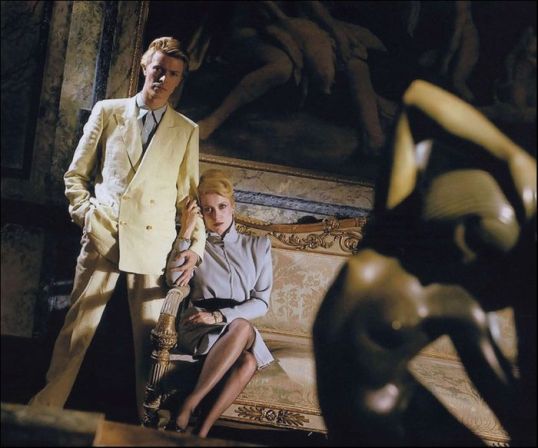
In The Hunger, our vampires are Miriam Blaylock (Catherine Deneuve) and her lover, John (David Bowie).  Miriam has been a vampire since at least the time of the ancient Egyptians.  Rather than sinking her fangs into the necks of her victims, Miriam uses an Ankh pendant to slit their throats.  John was once a cellist in 18th century France.  Now, they live in an expensive New York townhouse, where they teach classical music and occasionally murder anyone that they can convince to come up to see them.

When they first met, Miriam promised John that he would have eternal life but she didn’t promise him eternal youth.  Unfortunately, it takes 200 years for John to notice.  When he starts to rapidly age, he seeks out aging expert Dr. Sarah Roberts (Susan Sarandon) for help.  Though Dr. Roberts is originally dismissive of his claims, she is shocked to see John age several years in just an hour.

When an angry and desperate John kills the music student (Beth Ehlers) that Miriam was hoping to transform into her next lover, Miriam is forced to search elsewhere.  When Sarah shows up, searching for the man who aged years in an hour, Miriam feels that her search may be over.

As one might expect from a film directed by Tony Scott, The Hunger is an extremely stylish film, to the extent that the film’s story is often secondary to the way that Scott chooses to tell it.  The set design is so ornate and every scene is so precisely lit and shot and that, at times, the movie feels a bit like a commercial for vampirism.  It’s easy to imagine Britney Spears singing “Work Bitch” in the background of some of the scenes.  (“You want a hot body?  You want a Bugatti?  You Want a Maserati?  You better work vamp.”)  Throughout the film, New York glows like a neon wonderland while John and Miriam coolly look out over the world like 18th century French aristocrats who have no idea that they have a future date with the guillotine.  At times, it’s a film that becomes almost ludicrous in its celebration of grandeur and style.  One could imagine Jean Rollin telling the same story just as effectively while spending a lot less money.

And yet, it’s that very embrace of the over-the-top ludicrousness of it all that makes The Hunger a memorable film.  The film’s a tribute to excess, with an ending that falters precisely because it attempts to reject precisely what it’s spent the past hour and a half celebrating.  The Hunger doesn’t add up too much but its hypnotically stylish and well-acted by a cast who does their best to keep up with Tony Scott’s camera.


A Movie A Day #228: Johnny Be Good (1988, directed by Bud Smith)


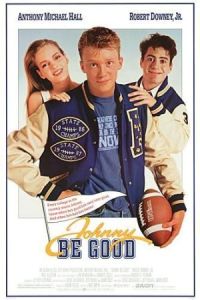
Johnny Walker (Anthony Michael Hall) may be the best high school quarterback in the country but he has a difficult choice to make.  He promised his girlfriend, Georgia (Uma Thurman), that he would go to the local state college with her but every other university in the country wants him.  (Even legendary sportscaster Howard Cosell calls Johnny and advises him to go to an Ivy League college.)  As Johnny tours universities across the country, he faces every temptation.  By the time he makes his decision, will Johnny still be good?

The main problem with Johnny Be Good can be found in the first sentence of the above synopsis.  Anthony Michael Hall plays the best high school quarterback in the country.  By taking on the role of Johnny Walker, Hall was obviously attempting to prove that he was capable of more than just playing nerds for John Hughes.  But Hall is never convincing as a quarterback, much less the best in the country.  Though he bulked up for the role, it is impossible to imagine Hall in a huddle, coming up with the big play that wins the game.  It’s easier to imagine Johnny getting shoved in a locker and left there until the school year ends.  Hall seems to be lost in the role and the movie never seems to be sure who Johnny Walker is supposed to be.  (Two years later, Hall would again play a jock and give a far better performance in Edward Scissorhands.)

As for the rest of the cast, Robert Downey, Jr., who plays Johnny’s teammate and best friend, is even less convincing as a football player than Hall.  In the 1980s, Downey could play a quirky sidekick in his sleep but not a wide receiver.  Paul Gleason also shows up in the movie, basically playing the same role that he played in The Breakfast Club.  Uma Thurman is sweet and pretty in her film debut but it’s a nothing role.  Fans of Cannon Picture will want to keep an eye out for Steve James, in a small role as a coach.

Poorly written and slackly directed with few laughs, Johnny Be Good fails to take its own advice.