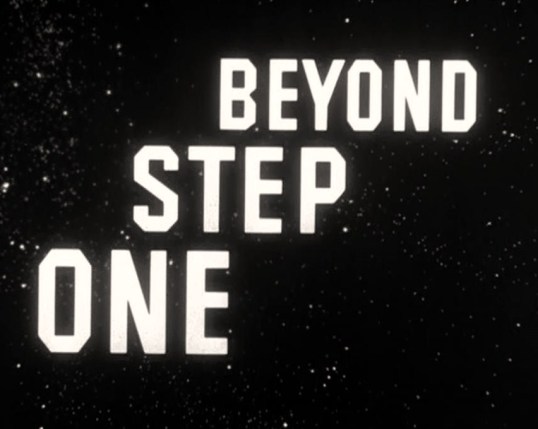
When young Davey Morris tells his parents that he’s been hanging out with a friendly Bigfoot-type creature, all of the adults in town react in the worst way possible.
This episode, from the second season of One Step Beyond, was one of the first to deal with the legend of Bigfoot. Needless to say, it’s the adults who turn out to be the true monsters in this scenario.
This episode originally aired on October 20th, 1959.
Welcome to Retro Television Reviews, a feature where we review some of our favorite and least favorite shows of the past! On Sundays, I will be reviewing the made-for-television movies that used to be a primetime mainstay. Today’s film is 1971’s In Broad Daylight! It can be viewed on YouTube.
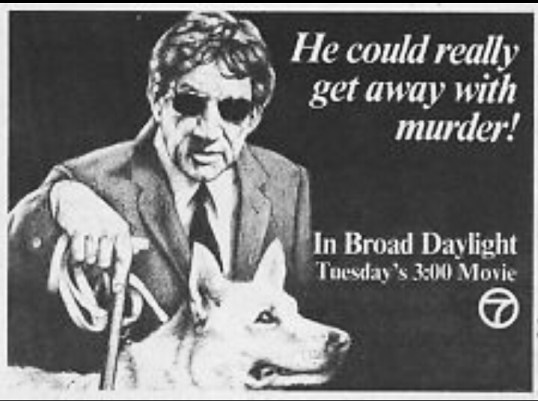
Tony Chappel (Richard Boone) is an actor who has just recently lost his sight as a result of an accident. Released from the hospital, Tony struggles to adjust to living in a world without his vision. When one cab driver says to him, “Didn’t you used to be Tony Chappel?,” he flinches as he realizes that his career as a famous actor is now considered to be over. One day, he comes home early and overhears his wife (Stella Stevens) fooling around with his lawyer and “best friend” (Fred Beir). Tony promptly decides to murder his wife and frame his friend for the crime.
Tony decides to use his acting skills to his advantage. He memorizes the the area around him so that he can make his way through it by memory. He puts on a fake beard, speaks with Greek accent, and makes a point of carrying a camera with him. He starts taking public transportation and going out of his way to be talkative and social Everyone that he meets, he tells them about how he’s been taking pictures of the city and how he can’t wait to see how they come out. When his wife is eventually murdered, the police receive a reports of a mysterious Greek man, one who was definitely not blind, in the area. However, Lt. Bergman (John Marley) has his doubts and comes to suspect that Tony is the killer.
In Broad Daylight was made from an early script written by Larry Cohen, who would later go on to direct films like God Told Me To. It’s a clever script, one that sets up an intriguing premise and which ends on a properly twisty and satisfactory note. The film works because it is as much of a character study as a thriller. Tony’s wife not only cheats on him but also betrays him at the moment when he needs her and his friends the most. Tony has gone from being a movie star to being a man who can barely walk from one room to another. He’s already angry. Discovering that his wife is laughing at him behind his back is the last straw.
Larry Cohen reportedly felt that Richard Boone was miscast as Tony. I felt that Boone did a pretty good job, even if he did overact a bit while Tony was trying to convince everyone that he was a Greek tourist. Stella Stevens is perfectly cast as his wife and Suzanne Pleshette is sympathetic as his nurse. Godfather fans will be happy to see John Marley not having to deal with a horse’s head but instead playing the clever detective who attempts to solve the murder.
In Broad Daylight is a clever and entertaining thriller and character study.
Welcome to Retro Television Reviews, a feature where we review some of our favorite and least favorite shows of the past! On Sundays, I will be reviewing the made-for-television movies that used to be a primetime mainstay. Today’s film is 1973’s The Alpha Caper! It can be viewed on YouTube!
After years of faithful service and hard work, parole officer Mark Forbes (Henry Fonda) is on the verge of mandatory retirement. He’s spent his entire career playing by the rules and taking orders and helping recently released criminals go straight. For all of his service, all he’s gets is a small party and a cheap retirement gift.
Still, Mark is on the job when he gets a call that one of his parolees, Harry (Noah Beery, Jr.), is currently in the middle of a stand-off with the cops. Mark goes to the crime scene, where he discovers that Harry was trying to rob a warehouse full of weapons. He also discovers that Harry is dying, as the result of being shot by the police. Before Harry passes, he tells Mark that he and three other ex-cons were plotting to steal a shipment of gold bars.
Mark decides to carry out Harry’s plan. Working with Mitch (Leonard Nimoy), Tudor (Larry Hagman), and Scat (James McEachin), Mark comes up with a plan to rob the armored cars that are going to be transporting the gold. While Tudor and Scat are quick to join up with Mark, Mitch is a bit more hesitant. In the end, though, they all decide to work together. The plan they come up with is a clever one but its main strength is that it’s being spearheaded by Mark, a man who no one would ever expect to commit a crime. No one but his colleague and friend, Lee (John Marley), that is.
I watched The Alpha Caper last night, with my friend Phil, Janeen, and Spiro. To be honest, I selected the film because the title led me to suspect that it would be a science fiction film of some sort. I was a little surprised when it turned out to be a crime thriller but I was even more surprised by just how good the film itself turned out to be. Cleverly plotted and well-acted by the entire cast (and featuring a scruffy Leonard Nimoy playing a role that’s about as far from the coldly logical Mr. Spock as one can get), The Alpha Caper is an entertaining crime film but it’s also surprisingly poignant. Mark is someone who feels that he’s lived his entire life without taking a single risk and, as a result, he has nothing to show for it. He compares his situation to the mythical Kilroy of “Kilroy was Here” graffiti fame. Kilroy will always be remembered, even though no one is really sure who he was. Mark fears that he’s destined to be forgotten. The robbery is Mark’s way of announcing that “Mark Forbes was here.” The film ends on a surprisingly touching, if rather bittersweet, note.
The Alpha Caper originally aired on ABC on October 6th, 1973. It was apparently meant to be a pilot for an anthology show that would be called Crime. The series wasn’t picked up but, two years later, The Alpha Caper was theatrically released in Italy. Today, it can be seen on YouTube. Like Mark Forbes and Kilroy, the film has not been forgotten.
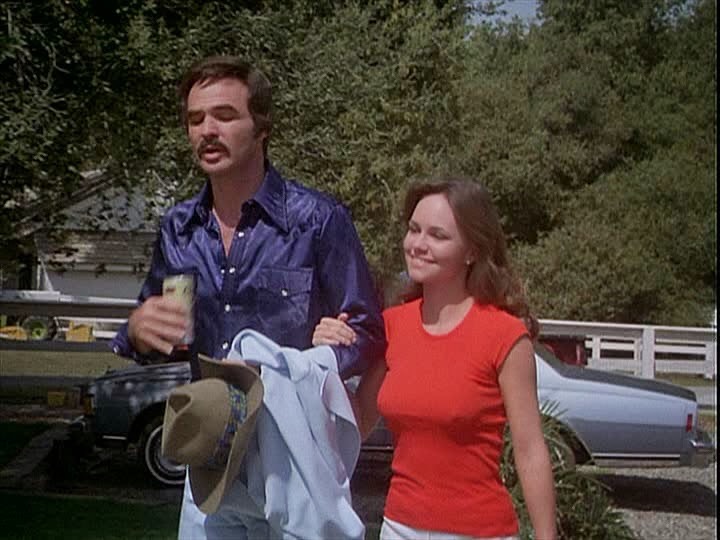
Reuniting the Smokey and the Bandit team of director Hal Needham and stars Burt Reynolds and Sally Field, Hooper is a film that pays tribute to stuntmen.
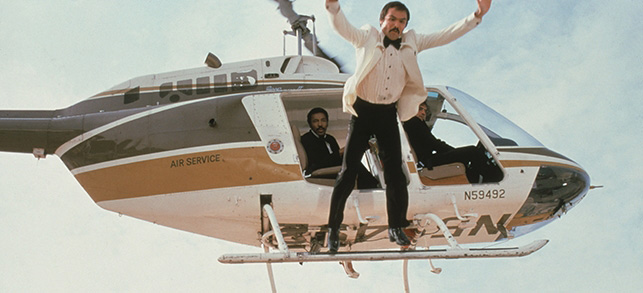
Hooper (Burt Reynolds) is a respected but aging stunt coordinator who is currently working on an overblown action film called The Spy Who Laughed At Danger. (The spy is played by Adam West, who appears as himself.) Hooper knows that he’s getting too old to keep putting his life at risk but he’s addicted to thrill of doing what he calls “gags.” Every morning, Hooper wakes up, pops pills, has a beer, and then falls off a building or crashes a car. When he’s not doing movies, he’s getting into bar brawls. As demonstrated during a visit to Dodge City, Hooper and his friends are modern day cowboys but time is catching up to them. Hooper’s girlfriend, Gwen (Sally Field), wants Hooper to settle down and retire from the business before he ends up a physical wreck like her father (Brian Keith). Hooper feels that he has to do one last, record-setting stunt before he passes the torch over to younger stuntmen like Ski Shidski (Jan-Michael Vincent).
Hooper is a classic Burt Reynolds film, with everything that you expect from late 70s Burt. As always, Burt is deceptively laid back. Sally Field is cute as a button. Old hands like Brian Keith and James Best provide strong support while Robert Klein plays the type of pompous Hollywood director who is just begging to get slugged at the end of the movie. (He does.) The plot of Hooper is even simpler than the plot of Smokey and the Bandit but Hooper is a more heartfelt film. Hal Needham was a stuntman before he became a director and this film was his tribute to the underappreciated people who risked their physical well-being to make movie magic. Needham knew men like Hooper and his friends. They were his people. Needham’s love for the stunt players comes through in every scene.
As for the stunts, they’re real and they’re spectacular.
Hal Needham, of course, will always be associated with Burt Reynolds. Before moving into directing, Needham frequently served as Reynolds’s stunt double and the two were such close friends that Needham spent 12 years living in Reynolds’s guest house. Quentin Tarantino’s Once Upon A Time In Hollywood was partially inspired by the friendship of Burt Reynolds and Hal Needham, with Leonardo Di Caprio and Brad Pitt playing characters who were based on the two men. (Reynolds was even originally cast in Once Upon A Time In Hollywood as George Spahn but he died before he could shoot his scenes. The role was taken over by Bruce Dern.) Needham was responsible for directing some of Burt’s best films (Cannonball Run, Smokey and the Bandit and this one) and some of his worst (Stroker Ace and Cannonball Run II). Needham also directed Megaforce, which didn’t feature Burt but which is still, in its own way, unforgettable.
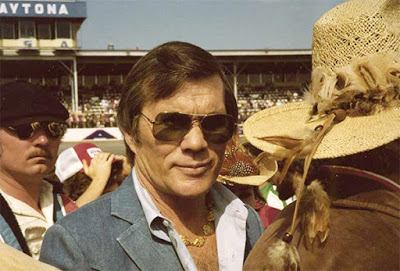
Hal Needham (1931 — 2013)
The critics may not have loved the movies that Hal and Burt made together but audiences did. Needham’s best films are just as entertaining today as they were when they were originally released. They don’t demand much but they deliver everything you could possibly want. Whenever the real world is getting to be overwhelming, I’m thankful that I can turn on a Hal Needham film and return to a world where the only thing that matters is driving fast, loving hard, and having a good laugh while you’re doing it. Today, more than ever, the legacy of Hal Needham is just what we need.
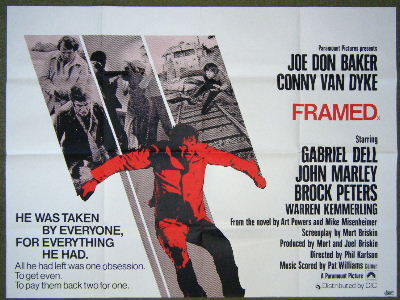
Revenge can be brutal, especially when you’ve been framed.
Joe Don Baker plays Ron Lewis, a surly nightclub owner and gambler who wins a small fortune, witnesses a crime, and nearly gets shot all in the same night. When he reaches his house, he’s planning on calling the police but he’s confronted in his own garage by a sheriff’s deputy who tries to kill him! In a lengthy and brutal scene, Ron beats the deputy to death and gouges out his eyes. Even though Ron was only acting in self-defense, he’s charged with murder. Told that there is no way that he’ll be able to win an acquittal, Ron pleads guilty to a lesser charge and is sent to prison for four years.
While he’s in prison, Ron befriends a mob boss (John Marley, who famously woke up with a horse’s head in his bed in The Godfather) and the boss’s number one hitman, Vince (Gabriel Dell). While Ron is in prison, a group of men assault his girlfriend (country singer Conny Van Dyke) and tell her not to ask any questions about the events that led to Ron being framed.
After serving his sentence and getting into numerous fights with the guards, Ron is finally released. When Vince shows up and tells Ron that he’s been hired to kill him, the two of them team up with an honest deputy (Brock Peters) and set out to find out why Ron was set up and to get revenge.
Framed is a brutal movie, Ron and his friends hold nothing back in their quest to get revenge. Whether he’s shooting a man in cold blood or hooking someone up to a car battery in order to get information out of him, there’s little that Ron won’t do and the movie lingers over every act of violence. Several pounds overweight and snarling out of his lines, Joe Don Baker may not be a conventional action hero but he’s believable in his rage. He’s the ultimate country boy who has been pushed too far and now he doesn’t care how much blood he has to get on his hands. However, because Baker does seem more like an ordinary person than a Clint Eastwood or a Charles Bronson-type, he retains the audience’s sympathy even as he splashes blood all over the screen. As violent as his action may be, they always feel justified.
Baker’s performance and the believable violence are the film’s biggest strengths. It’s biggest weakness is a plot that revolves around an elaborate conspiracy that doesn’t always make sense and some notably weak supporting performances. Ron’s revenge may be brutal but it takes a while to get there and the first hour gets bogged down with Ron’s struggle to adjust to life in prison. John Marley does a good job as Ron’s prison mentor but then he abruptly disappears from the movie.
Before making Framed, Baker and director Phil Karlson previously collaborated on Walking Tall. Framed is far more violent than that film was but its plot doesn’t hold together as well. However, if you’re just looking for a violent action film that features Joe Don Baker doing what he does best, Framed delivers.
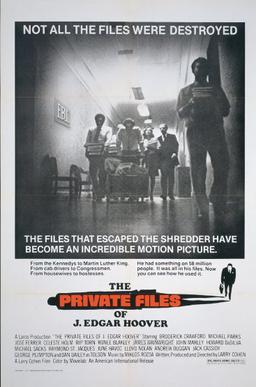
The 1977 film, The Private Files of J. Edgar Hoover, opens in 1972.
J. Edgar Hoover, the much-feared and long-serving director of the FBI, has just been found dead at his home and it seems like the entire city of Washington, D.C. is scrambling. Not only are people jockeying for Hoover’s job but they’re also wondering what might be found in his secret files. As quickly becomes apparent, Hoover had a file on everyone. While Presidents lauded him and the press portrayed him as hero, Hoover spent nearly 50 years building up a surveillance state. Hoover said it was to fight criminals and subversives but mostly, it was just to hold onto his own power. Even President Nixon is heard, in the Oval Office, ordering his men to get those files.
Hoover may have known everyone’s secrets but, the film suggests, very few people knew his. The film is narrated by a former FBI agent named Dwight Webb (Rip Torn). Dwight talks about how he was kicked out of the FBI because it was discovered that he not only smoked but that he was having an adulterous affair with a secretary. “You know how Hoover was about that sex stuff,” he says, his tone suggesting that there’s more to the story than just Hoover being a bit of a puritan.
We flash back to the 1920s. We see a young Hoover (James Wainwright) as a part of the infamous Palmer Raids, an early effort by the Justice Department to track down and deport communist subversives. Though Hoover disagrees with the legality of the Palmer Raids, he still plays his part and that loyalty is enough to eventually get him appointed, at the age of 29, to be the head of the agency that would eventually become the FBI. Hoover may start out as a relatively idealistic man but it doesn’t take long for the fame and the power to go to his head.
Hoover (now played by Broderick Crawford) serves a number of Presidents, each one worse the one who proceeded him. Franklin Delano Roosevelt (Howard Da Silva) is an avuncular despot while the Kennedy brothers (William Jordan as John and Michael Parks as Bobby) are two rich brats who think that they can control Hoover but who soon discover that Hoover is far more clever than they realize. Hoover finds himself a man out-of-place in the 60s and the 70s, Suddenly, he’s no longer everyone’s hero and people are starting to view the FBI as being not a force for law enforcement but instead an instrument of oppression.
Through it all, Hoover remains an enigma. He demands a lot of from his agents but he resents them if they’re too successful. Melvin Purvis (Michael Sacks) might find fame for leading the manhunt that took down Dillinger but he’s driven to suicide by Hoover’s cruel treatment. Unlike Clint Eastwood’s film about Hoover, The Private Files of J. Edgar Hoover suggests that Hoover was not gay but that instead, that he was so repressed that he was essentially asexual. When one woman throws herself at him, he accuses her of being a subversive and demands to know how anyone could find him attractive. He’s closest to his mother and when she dies, he shuts off his emotions. His own power, for better and worse, becomes the one thing that he loves. He’s married to the FBI and he often behaves like an abusive spouse.
The Private Files of J. Edgar Hoover is an interesting film. It’s an attempt to do a huge American epic on a less than epic budget. At the start of the film, the low budget is undeniably distracting. The 1920s are essentially represented by a back lot and two old cars. The scenes of the FBI dealing with gangsters like Dillinger and Creepy Karpis feel awkward and slapdash. But, as the film’s timeline gets closer to what was then the modern era, the film’s story tightens up and so does Larry Cohen’s direction. (One get the feeling that Cohen was, perhaps understandably, more interested in the Hoover of the 60s and the 70s than the Hoover of the 20s and 30s. There’s a sharpness to the second half of the movie that is just missing from the first half.) Broderick Crawford gives a chilling performance as a man who is determined to hold onto his power, just for the sake of having it. The scenes were Hoover and Bobby Kennedy snap at each other have a charge that’s missing from the first half of the film. Michael Parks does a great job portraying RFK as basically being a spoiled jerk while Crawford seems to relish the chance to play up the resentful, bitter old man aspects of Hoover’s personality. The film ultimately suggests that whether the audience previously admired RFK or whether they previously admired Hoover, they were all essentially duped.
Though the film never quite overcomes the limits of its low budget, it works well as a secret history of the United States. In 1977, it undoubtedly took guts to make a film that portrayed Roosevelt and Kennedy as being as bad as Nixon and Johnson. (It would probably even take guts today. One need only rewatch something like The Butleror Hyde Park on Hudson to see the ludicrous lengths Hollywood will go to idealize presidents like Kennedy and dictators like FDR.) While this film certainly doesn’t defend J. Edgar Hoover’s excesses, it often suggests that the president he served under were just as bad, if not even worse. In the end, it becomes a portrait of not only how power corrupts but also why things don’t change, regardless of who is nominally in charge. In the end the film’s villain is not J. Edgar Hoover. Instead, the film’s villain is the system that created and then enabled him. The man may be dead but the system remains.
When young Davey Morris tells his parents that he’s been hanging out with a friendly Bigfoot-type creature, all of the adults in town react in the worst way possible.
This episode, from the second season of One Step Beyond, was one of the first to deal with the legend of Bigfoot. Needless to say, it’s the adults who turn out to be the true monsters in this scenario.
This episode originally aired on October 20th, 1959.
Like many good crime films, this 1956 film noir opens on a train.
A passenger has suddenly been taken ill and his wife, Linda (Felecia Farr), wants to know if there’s a doctor on board! Fortunately, there is! Dr. Paul Bucker (Wesley Addy) just happens to be on the train and it only takes him a few minutes to figure out that the man is suffering from polio. Paul arranges for the train to make an unscheduled stop in the next town so that the man can be taken to the hospital. Paul also asks to be allowed to go to the baggage car, so that he can retrieve his doctor’s bag. Of course, he can! Who is going to say no to doctor, especially in a situation this serious?
Paul goes back to the baggage area to claim his little black bag and that’s when something unexpected happens. He opens up his bag and pulls out a gun. It turns out that Paul is not only a doctor but he’s a thief as well. After tying up everyone in the car and knocking them out with a sleeping drug, Paul proceeds to blow open a safe and steal all the money within.
When the train makes it unscheduled stop, Paul, the man, and Linda (who is actually Paul’s wife), disembark. They get into an ambulance driven by the shady Frankie Page (Jack Klugman) and they head off. It’s only after Paul’s escaped that the robbery is discovered.
With authorities baffled by the crime, insurance investigator Charlie Norman (Mark Stevens) is assigned to investigate the robbery with railroad policeman, Joe Armstrong (King Calder). Despite the fact that Charlie has been promising to take a vacation with his wife (Marianne Stewart), Charlie takes the case. Everyone knows that Charlie is one of the best in the business. If anyone’s going to catch these criminals, it’s going to be Charlie!
Of course, Charlie has another reason for taking the case. It turns out that Charlie’s the one who masterminded the entire robbery! He’s the one who first met Paul while the alcoholic doctor was attempting to file a false claim. It also turns out that Charlie has been having an affair with Linda and that Charlie’s planning on running off with her as soon as they take care of Paul.
Mark Stevens both directed and starred in Time Table and the end result is a well-made and genuinely exciting film noir, one that features all of the hard-boiled dialogue, shadowy interiors, and twisty complications that one could hope for from a good heist film. Stevens not only keeps the action moving at a steady pace but he also keeps you guessing about whether our band of criminals are going to make it to Mexico or if they’re going to all fall victim to one betrayal too many. The film is full of nice character turns, though the strongest performance comes from Wesley Addy, who brings a wounded dignity to his duplicitous character.
For fans of film noir, this is definitely one to watch.
What happens when an oil company discovers new, undefined organic matter in the arctic circle?
Well, first off, they mishandle it and it ends up turning into a prehistoric, killer ape-man.
Secondly, it’s time for a corporate cover-up!
Fortunately, the world’s greatest (if unluckiest) journalist, Carl Kolchak, is on the case!
Anyway, this is an okay episode of Kolchak. If I don’t seem as enthused about it as I’ve been about some of the previous episodes, it’s because a killer, prehistoric ape-man just isn’t as much fun as a Cajun demon or a killer robot. Still, this episode has a nicely done, underground tunnel-set climax. Seriously, you can’t go wrong with an underground tunnel.
This episode originally aired on January 17th, 1975.
Joe Louis, also known as the Brown Bomber, is generally agreed to have been one of the greatest heavyweight boxers of all time. Despite the barriers put up by both poverty and racism, Louis held the world heavyweight championship from 1937 to 1949 and successfully defended his title in 26 fights (ranking him second to only Julio Cesar Chavez, who had 27 title defenses). In 1938, he defeated German Max Schmelling, disproving Nazi claims that a black man could not defeat an Aryan and making Louis, along with Jesse Owens, one of the first African-American athletes to achieve nationwide hero status in America.
The Joe Louis Story, which was made and released shortly after Louis lost his final fight to Rocky Marciano and announced his retirement from boxing, tells an effective but sanitized version of Louis’s life story. Made on an obviously low budget, The Joe Louis Story hits all the highlights — Joe’s relationship with trainer Jack Blackburn (James Edwards), Joe’s marriage to Marva Trotter (Hilda Simms), Joe’s two fights against Max Schmelling, and Joe’s time in the army — while ignoring most of the lowlights. No mention is made of Joe’s financial troubles, Joe’s initial struggle to even get a match against the white heavyweights of the day, or the infidelity that led to Joe and Marva’s divorce. The Joe Louis Story does briefly touch on racism when Joe is told that, as a black man, he already has a strike against him as far as the boxing establishment is concerned.
The best thing about The Joe Louis Story is that it features footage from Louis’s actual fights. Coley Wallace, the boxer who was hired to play the title role, bore a remarkable resemblance to Joe and the footage of the real Joe Louis boxing is easily mixed in with scene of Wallace as Joe. Wallace was not much of an actor but, as a real-life boxer, he still brought enough authenticity to the role that his casting works.
One final note: In real life, Joe Louis ended his career after a brutal loss to Rocky Marciano. Before turning pro, Marciano lost four fights as an amueter. One of those losses came in 1948 when Marciano was defeated in the final round of the New York Golden Gloves tournament. The fighter who defeated Rocky Marciano? Coley Wallace.




 Joe Louis, also known as the Brown Bomber, is generally agreed to have been one of the greatest heavyweight boxers of all time. Despite the barriers put up by both poverty and racism, Louis held the world heavyweight championship from 1937 to 1949 and successfully defended his title in 26 fights (ranking him second to only Julio Cesar Chavez, who had 27 title defenses). In 1938, he defeated German Max Schmelling, disproving Nazi claims that a black man could not defeat an Aryan and making Louis, along with Jesse Owens, one of the first African-American athletes to achieve nationwide hero status in America.
 Through the Shattered Lens