Welcome to Retro Television Reviews, a feature where we review some of our favorite and least favorite shows of the past! On Thursdays, I will be reviewing Coming to America, which aired on CBS in 1989. Almost the entire show is currently streaming on YouTube!
Fresh off the success of the film Coming To America, Eddie Murphy served as executive producer of a series based on the film. How did that work out? Read on to find out!
Episode 1.1 “Pilot”
(Dir by Tony Singletary, originally aired on July 4th, 1989)
The pilot for Coming to America begins with the story already in progress. We get an overhead shot of New York while Prince Tariq (Tommy Davidson, speaking with an unconvincing accent) explains that he and his minder, Omar (Paul Bates), have been sent to America so that Tariq can attend college. (Tariq is established as being the younger brother of the character that Eddie Murphy played in the original film.) Tariq and Omar have rented a room from diner owner Carl Mackey (John Hancock). Carl is a curmudgeon. Tariq expects everyone to treat him like royalty. Carl grumbles about not getting to eat unhealthy food before a doctor’s visit. Tariq does an extended Stevie Wonder impersonation.
Uh-oh, Tariq’s out of money! In just nine months, he spends all of his money on movies and clothes. What can Tariq do? Maybe he and Omar can work in Carl’s diner! Uh-oh, Tariq’s started a dance party in the diner and he orders Omar to join the fun! Carl shows up at an inopportune time and Omar is fired. Can Tariq take responsibility for his actions?
“I’m a Beverly Hills Cop, you’re a Beverly Hills cop too and in 48 hours, we’re Trading Places.” Tariq says at one point and seriously, you have to wonder why they didn’t toss a reference to The Golden Child in there. Tariq is royalty so it certainly would have made more sense for him to refer to himself as being a GoldenChild as opposed to being a BeverlyHillsCop. That’s the type of show this is, though. The humor is heavy-handed but it also misses way too many opportunities.
My friend from Australia, Mark, sent me the link for this pilot (it’s on YouTube) and he dared me to see how much I could watch before turning it off in disgust. I managed to get through the entire thing but it wasn’t easy. To be honest, I nearly stopped this thing as soon as Tariq’s opening narration began. When that much exposition is stuffed into the opening narration, you know that you’re about watch a disjointed mess of a program. Indeed, one could argue that calling this program disjointed is a case of me being charitable. In the end, the main problem is that, after all the build-up of Tariq being a prince, the plot itself could just as easily been the plot of a thousand other mediocre sitcoms. How many times did Lisa and Kelly have to take jobs at the Max in Saved By The Bell? Both Malibu CA and One World suggested that working at a restaurant was the best — perhaps the only! — way to learn responsibility. The Coming to America diner looks almost exactly like the City Guys diner. How is this not a Peter Engel production?
ComingtoAmerica aired once. There was never a second episode. Hence, today, we’ve started and ended a series! Next week, something new will premiere in this time slot. Hopefully, it will be better than both Malibu CA and Coming to America.
In honor of Bruce Campbell’s 67th birthday, I decided to watch a movie he’s featured in that I’ve never seen before. I thought the horror-comedy SUNDOWN: THE VAMPIRE IN RETREAT looked like it might be fun so I went for it!
In the desert town of Purgatory, a colony of vampires led by Count Mardulak (David Carradine) want to live in peace, abstaining from human blood, and instead, drinking a blood substitute called “Necktarine,” which is produced in a local factory. They also use high powered sunscreen that allows them to go out in the day time as long as they wear thick sunglasses, big hats or umbrellas, and gloves. Unfortunately, the blood factory begins experiencing production issues, so Mardulak asks David Harrison (Jim Metzler), the unsuspecting human who designed the production process, to come to town and fix their problems. Harrison brings his family with him, including his wife Sarah (Morgan Brittany), and their two daughters. The Harrison family soon find themselves in the middle of an other worldly war as Jefferson (John Ireland) and Shane (Maxwell Caulfied), rebellious local vampires, plot to overthrow Mardulak so they can return to their murderous ways. Meanwhile, Robert Van Helsing (Bruce Campbell), the great grandson of the famed vampire hunter, walks into town, ready to romance the local vampire beauty Sandy (Deborah Foreman) and drive stakes into the hearts of as many bloodsucking freaks as possible!
As far as I’m concerned, SUNDOWN is a blast as a completely absurd horror-comedy that puts an interesting spin on traditional vampire legend, with its endless sunscreen slathering and a growing local weariness over “Necktarine” adding to the good times. It’s campy and silly, with purposely terrible stop motion bat effects, over-the-top family drama, and lots of cheesy one-liners, but of course that’s all part of the charm.
The B-movie dream cast is what I enjoyed the most about SUNDOWN. David Carradine plays it pretty straight as the town leader Count Mardulak, which is effective when you consider all of the craziness going on around him. Bruce Campbell, and his mustache, steals all of his scenes with his goofy charm and misguided heroics. And, of course, the inimitable M. Emmet Walsh is perfect as old man Mort, a vampire who loses his temper and beheads a disrespectful city slicker. He just can’t help himself. Throw in other veteran character actors like Bert Remsen and John Ireland and it’s easy to enjoy the movie no matter how silly it all gets.
On a personal note, I did want to point out a couple of performances in SUNDOWN that have Arkansas connections. First, Jim Metzler had a solid part a couple of years after this movie in the crime thriller ONE FALSE MOVE (1991), which was co-written by Billy Bob Thornton and partially filmed in Eastern Arkansas. It’s a great movie and Metzler is good in it. Second, Elizabeth Gracen has a small part in the film. Gracen, whose actual name is Elizabeth Ward, won the title of Miss Arkansas in 1981 and then went on to win Miss America in 1982. My uncle Billy was her hair stylist as she made her run to beauty pageant immortality. Other notable Gracen life events include her affair with Arkansas Governor Bill Clinton in 1983, her appearance in Steven Seagal’s MARKED FOR DEATH in 1990, and her Playboy spread in 1992. Interestingly, 18 years old at the time, I saw the layout when my girlfriend’s mom bought the issue and let me look at it!
Overall, SUNDOWN lets us know right off the bat the kind of absurd movie we’re dealing with, so you’ll either be into it or want to just move on. I was into it, mainly due to its strong cast. It’s not perfect, and it overstays its welcome by a good 15 minutes, but SUNDOWN is a fun watch for fans of silly horror-comedies and the excellent cast. I had a great time with it!
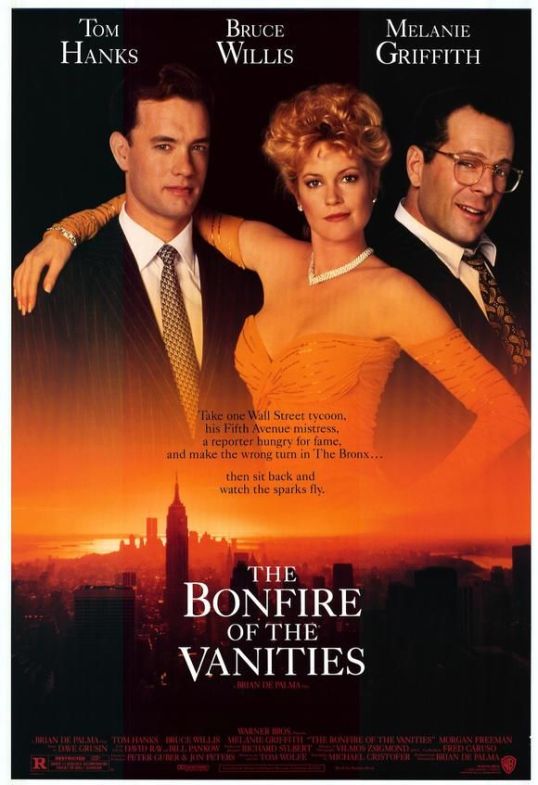
In 2021, I finally saw the infamous film, The Bonfire of the Vanities.
I saw it when it premiered on TCM. Now, I have to say that there were quite a few TCM fans who were not happy about The Bonfire of the Vanities showing up on TCM, feeling that the film had no place on a station that was supposed to be devoted to classic films. While it’s true that TCM has shown “bad” films before, they were usually films that, at the very least, had a cult reputation. And it is also true that TCM has frequently shown films that originally failed with audiences or critics or both. However, those films had almost all been subsequently rediscovered by new audiences and often reevaluated by new critics. The Bonfire of the Vanities is not a cult film. It’s not a film about which one can claim that it’s “so bad that it’s good.” As for the film being reevaluated, I’ll just say that there is no one more willing than me to embrace a film that was rejected by mainstream critics. But, as I watched The Bonfire of the Vanities, I saw that everything negative that I had previously read about the film was true.
Released in 1990 and based on a novel by Tom Wolfe, Bonfire of the Vanities stars Tom Hanks as Sherman McCoy, a superficial Wall Street trader who has the perfect penthouse and a painfully thin, status-obsessed wife (Kim Cattrall). Sherman also has a greedy mistress named Maria (Melanie Griffith). It’s while driving with Maria that Sherman takes a wrong turn and ends up in the South Bronx. When Sherman gets out of the car to move a tire that’s in the middle of the street, two black teenagers approach him. Maria panics and, after Sherman jumps back in the car, she runs over one of the teens. Maria talks Sherman into not calling the police. The police, however, figure out that Sherman’s car was the one who ran over the teen. Sherman is arrested and finds himself being prosecuted by a power-hungry district attorney (F. Murray Abraham). The trial becomes the center of all of New York City’s racial and economic strife, with Sherman becoming “the great white defendant,” upon whom blame for all of New York’s problems can be placed. Bruce Willis plays an alcoholic journalist who was British in the novel. Morgan Freeman plays the judge, who was Jewish in the novel. As well, in the novel, the judge was very much a New York character, profanely keeping order in the court and spitting at a criminal who spit at him first. In the movie, the judge delivers a speech ordering everyone to “be decent to each other” like their mothers taught them to be.
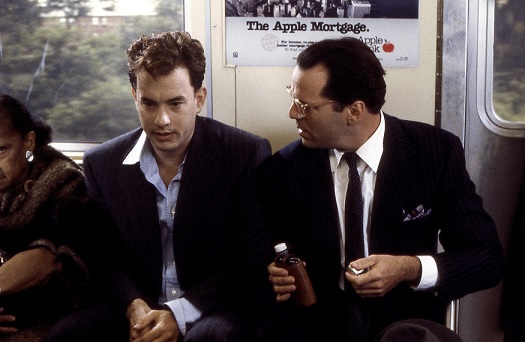
Having read Wolfe’s very novel before watching the film, I knew that there was no way that the adaptation would be able to remain a 100% faithful to Wolfe’s lacerating satire. Because the main character of Wolfe’s book was New York City, he was free to make almost all of the human characters as unlikable as possible. In the book, Peter Fallow is a perpetually soused opportunist who doesn’t worry about who he hurts with his inflammatory articles. Sherman McCoy is a haughty and out-of-touch WASP who never loses his elitist attitude. In the film, Bruce Willis smirks in his wiseguy manner and mocks the other reporters for being so eager to destroy Sherman. Hanks, meanwhile, attempts to play Sherman as an everyman who just happens to live in a luxury penthouse and spend his days on Wall Street. Hanks is so miscast and so clueless as how to play a character like this that Sherman actually comes across as if he’s suffering from some sort of brain damage. He feels less like a stockbroker and more like Forrest Gump without the Southern accent. There’s a scene, written specifically for the film, in which Fallow and Sherman ride the subway together and it literally feels like a parody of one of those sentimental buddy films where a cynic ends up having to take a road trip with someone who has been left innocent and naïve as result of spending the first half of their life locked in basement or a bomb shelter. It’s one thing to present Sherman as being wealthy and uncomfortable among those who are poor. It’s another thing to leave us wondering how he’s ever been able to successfully cross a street in New York City without getting run over by an angry cab driver.
Because the film can’t duplicate Wolfe’s unique prose, it instead resorts to mixing cartoonish comedy and overwrought melodrama. It doesn’t add up too much. At one point, Sherman ends a dinner party by firing a rifle in his apartment but, after it happens, the incident is never mentioned again. I mean, surely someone else in the apartment would have called the cops about someone firing a rifle in the building. Someone in the press would undoubtedly want to write a story about Sherman McCoy, the center of the city’s trial of the century, firing a rifle in his own apartment. If the novel ended with Sherman resigned to the fact that his legal problems are never going to end, the film ends with Sherman getting revenge on everyone who has persecuted him and he does so with a smirk that does not at all feel earned. After two hours of being an idiot, Sherman suddenly outthinks everyone else. Why? Because the film needed the happy ending that the book refused to offer up.
Of course, the film’s biggest sin is that it’s just boring. It’s a dull film, full of good actors who don’t really seem to care about the dialogue that they are reciting. Director Brian De Palma tries to give the film a certain visual flair, resorting to his usual collection of odd camera angles and split screens, none of which feel at all necessary to the story. In the end, De Palma is not at all the right director for the material. Perhaps Sidney Lumet could have done something with it, though he would have still had to deal with the less than impressive script. De Palma’s over-the-top, set piece-obsessed sensibilities just add to the film’s cartoonish feel.
The film flopped at the box office. De Palma’s career never recovered. Tom Hanks’s career as a leading man was momentarily derailed. Bruce Willis would have to wait a few more years to establish himself as a serious actor. Even the normally magnanimous Morgan Freeman has openly talked about how much he hated being involved with The Bonfire of the Vanities. That said, the film lives on because De Palma allowed journalist Julie Salomon to hang out on the set and the book she wrote about the production, The Devil’s Candy, is a classic of Hollywood non-fiction. (TCM adapted the book into a podcast, which is how The Bonfire of the Vanities came to be featured on the station.) Thanks to Salomon’s book, The Bonfire of the Vanities has gone to become the epitome of a certain type of flop, the literary adaptation that is fatally compromised by executives who don’t read.
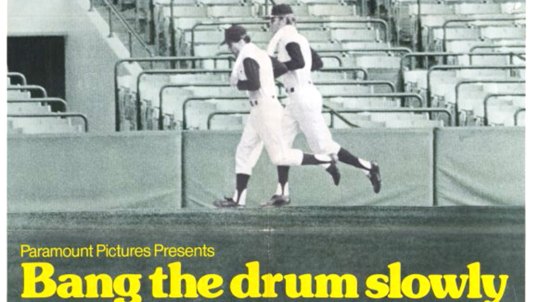
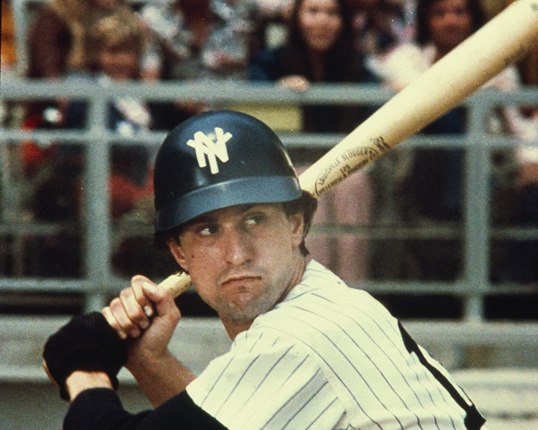
I still miss baseball! Luckily, I’ve still got plenty of baseball films to keep me busy until the MLB gets its act together and starts up again. I hope we’ll get baseball this year but if we don’t, at least I can watch a movie like Bang The Drum Slowly.
Bang The Drum Slowly is the ultimate baseball movie. It’s about a pitcher named Henry Wiggin (Michael Moriarty) who plays for the New York Mammoths and who has a side job selling insurance and writing books. When it’s time to renegotiate his contract, Henry says that he’ll re-sign with the team if the team agrees to not release or trade one of their catchers, Bruce Pearson (a really young Robert de Niro). Henry says that he and Bruce are a package deal. No one can understand why Henry cares because Bruce isn’t an outstanding player and everyone thinks that he’s slow but Henry finally gets the team’s general manager, Dutch (Vincent Gardenia), to agree to his terms. What only Henry knows is that Bruce is terminally ill and that he will be lucky to survive the entire season.
Though the Mammoth eventually make a run for the World Series and there’s a lot of great baseball footage, Bang the Drum Slowly is more about friendship than it is about winning or losing. Henry is willing to sacrifice everything to make sure that Bruce enjoys his final days and Bruce finally gets to play on a wining team. Because Bruce is so young and he appears to be so healthy for most of the film, it’s really devastating when he suddenly does get ill and he’s finally has to come to terms with his mortality. I cried a lot while I was watching Bang The Drum Slowly. You will too.
The other players eventually rally around Bruce and they become a stronger teams as a result. That’s one of the things that I love about baseball. One player, no matter how good, can’t win a game on his own. Instead, the entire team has to work together. Not everyone can go out and try to hit a home run. That’s not the way you win at baseball. Instead, you win by doing what you have to do to bring your teammates home. Bang The Drum Slowly celebrates friendship and loyalty and it perfectly captures the spirit of the game.
We may not be able to watch baseball right now. But at least we can watch movies like Bang The Drum Slowly.
Set during World War II, 1984’s A Soldier’s Story opens with a murder.
On a rural road outside of a segregated army base in Louisiana, someone has gunned down Sergeant Vernon Walters (Adolph Caesar). At the time, Walters was staggering back to the base after a night of heavy drinking. Both the local authorities and Watlers’s fellow soldiers assume that the murder was the work of the Ku Klux Klan. Captain Richard Davenport (Howard Rollins) isn’t so sure.
Captain Davenport is the officer who has been assigned to investigate the murder. From the minute that he arrives at the base, the soldiers stare at him. As Cpl. Ellis (Robert Townsend) explains it, the enlisted men are shocked because they’ve never seen a black officer before. Some of the soldiers admire Davenport while other view him with suspicion, wondering what Davenport must have done or who he must have sold out to earn his commission.
Meanwhile, the other officers (who are all white) view Davenport with a combination of condescension and hostility. Col. Nivens (Trey Wilson) only allows Davenport three days to wrap up his investigation and assigns the polite but skeptical Capt. Taylor (Dennis Lipscomb) to work with him. Taylor suspects that Walters may have been murdered by the openly racist Lt. Byrd (Wings Hauser!). Davenport, however, isn’t so sure. Even though the official story is that Walters was a tough but fair sergeant who was respected by his company, Davenport suspects that one of them may have killed him.
Davenport and Taylor start to interview the soldiers who actually had to deal with Walters on a daily basis. Through the use of flashbacks, Walters is revealed to be a far more complex man than anyone knew. We see that Walters was a man who was bitterly aware of the fact that, even after a lifetime of military service, he was destined to always be treated as a second-class citizen by the nation that he served. Unable to strike out at the men who the army and society had placed over him, Walters instead struck at the men serving underneath him. While the man in Walters’s company wait for word on whether or not they’ll be allowed to serve overseas, Davenport tries to determine if one or more of them is a murderer.
A Soldier’s Story was adapted from a play but director Norman Jewison is careful to prevent the material from becoming stagey. Effortlessly transitioning from the film’s present to flashbacks of the events that led to Walters’s murder, Jewison crafts both an incendiary look at race relations and a compelling murder mystery. He’s helped by a strong cast of predominately African-American actors. In one of his earliest roles, Denzel Washington plays Pfc. Peterson with a smoldering intensity. David Alan Grier and Robert Townsend, two actors known for their comedic skills, impress in dramatic roles. Seen primarily in flashbacks, Adolph Caesar turns Walters into a complex monster.
And yet, with all the talent on display, it is Howard Rollins who ultimately steals the movie. As a character, Captain Davenport has the potential to be a rather thankless role. He spends most of the movie listening to other people talk and, because of his status as both an officer and a black man in the rural south, he’s rarely allowed to show much anger or, for that matter, any other emotion. However, Rollins gives a performance of such quiet intelligence that Davenport becomes the most interesting character in the movie. He’s the ultimate outsider. Because of his higher rank and his role as an investigator, he can’t fraternize with the enlisted men but, as an African-American, he’s still expected to remain separate from and differential to his fellow officers. As the only black officer on a segregated base, Davenport is assigned to stay in an empty barrack. One of the best scenes in the film is Davenport standing alone and surveying the stark layout of his temporary quarters. The expression on his face tells you everything you need to know.
(Towards the end of the film, when Davenport finally gets a chance to drop his rigid facade and, if just for one line, be himself, you want to cheer for him.)
A Soldier’s Story was nominated for best picture but it lost to another theatrical adaptation, Milos Forman’s Amadeus.
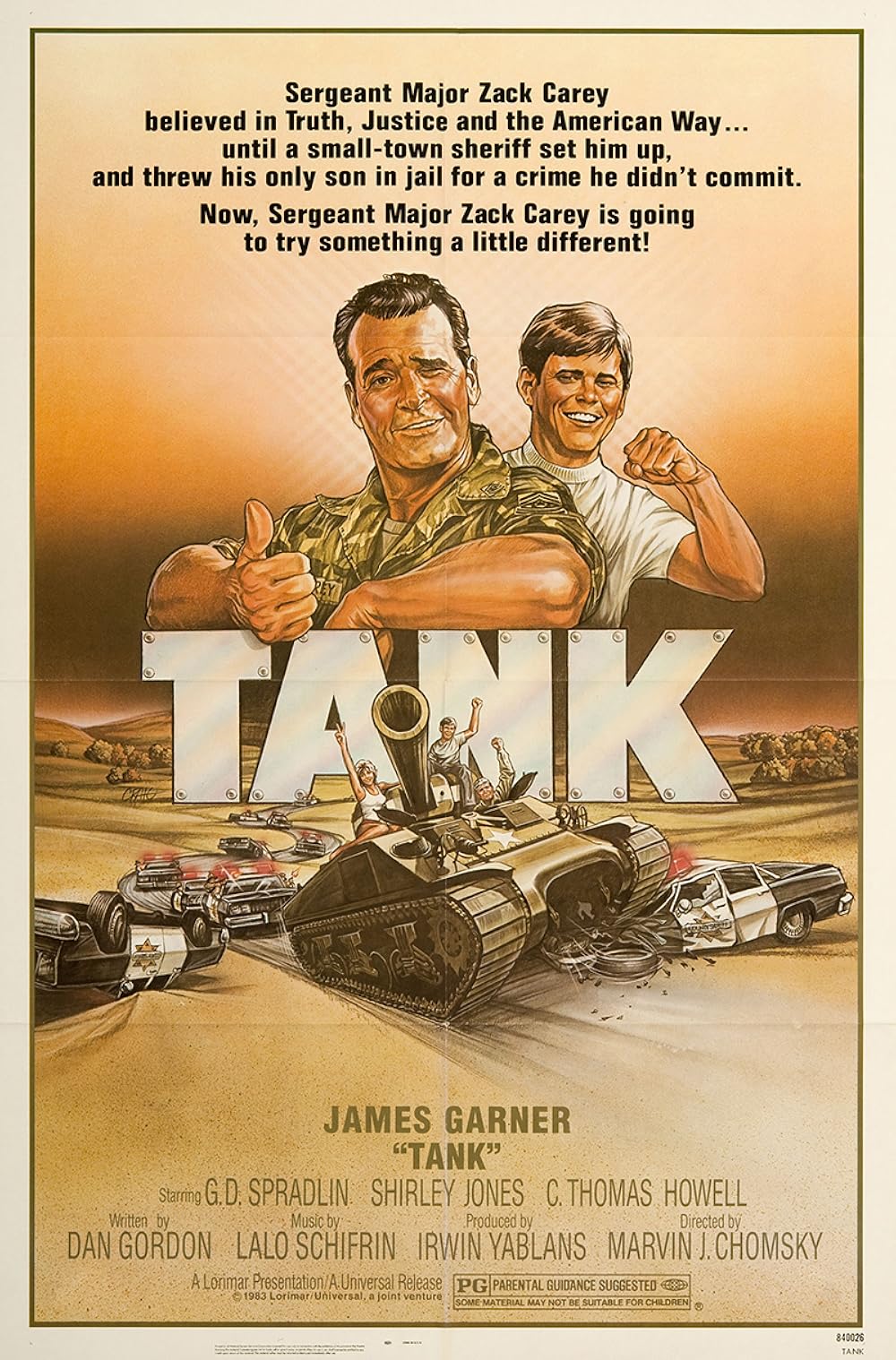
If you had just moved to a small town in Georgia and your teenage son was framed for marijuana possession and sentenced to years of hard labor, what would you do?
Would you hire a good lawyer and file appeal after appeal?
Would you go to the media and let them know that the corrupt sheriff and his evil deputy are running a prostitution ring and the only reason your son is in prison is because you dared to call them out on their corruption?
Or would you get in a World War II-era Sherman tank and drive it across Georgia, becoming a folk hero in the process?
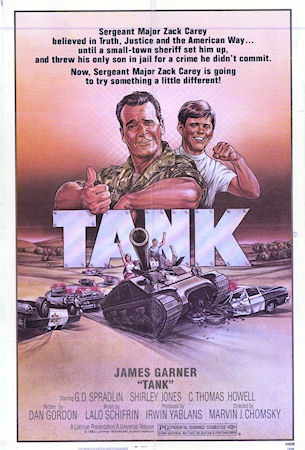
If you are Sgt. Zack Carey (James Garner), you take the third option. Sgt. Carey is only a few months from retirement but he is willing to throw that all away to break his son (C. Thomas Howell) out of prison and expose the truth about Sheriff Buelton (G.D. Spradlin) and Deputy Euclid Baker (James Cromwell, playing a redneck). Helping Sgt. Carey out are a prostitute (Jenilee Harrison), Carey’s wife (Shirley Jones), and the citizens of Georgia, who lines the road to cheer the tank as it heads for the Georgia/Kentucky border. It’s just like the O.J. Bronco chase, with James Garner in the role of A.C. Cowlings.
The main thing that Tank has going for it is that tank. Who has not fantasized about driving across the country in a tank and blowing up police cars along the way? James Garner is cool, too, even if he is playing a role that would be better suited for someone like Burt Reynolds. Tank really is Smoky and the Bandit with a tank in the place of that trans am. Personally, I would rather have the trans am but Tank is still entertaining. Dumb but entertaining.
One final note, a piece of political trivia: According to the end credits, the governor of Georgia was played by Wallace Willkinson. At first, I assumed this was the same Wallace Wilkinson who later served as governor of Kentucky. It’ not. It turns out that two men shared the same name. It’s just a coincidence that one played a governor while the other actually became a governor.
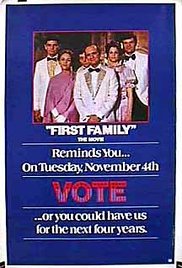
Like any newly inaugurated President, Manfred Link (Bob Newhart) faces many new challenges. The biggest challenge, though, is keeping control of his family and his White House staff. His wife (Madeline Kahn) is an alcoholic. His 28 year-old daughter (Gilda Radner) is so desperate to finally lose her virginity that she is constantly trying to sneak out of the White House. General Dumpson (Rip Torn) wants to start a war. Press Secretary Bunthorne (Richard Benjamin), Ambassador Spender (Harvey Korman), and Presidential Assistant Feebleman (Fred Willard) struggle and often fail to convince everyone that all is well.
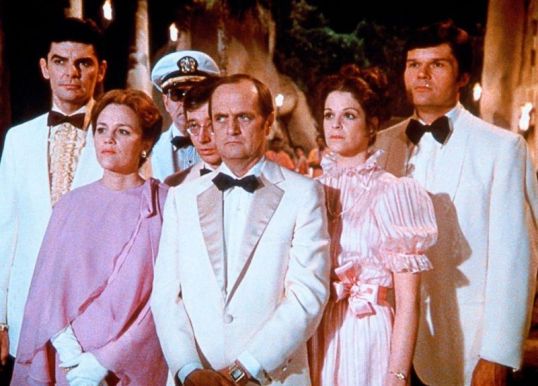
President Link needs to form an alliance with the African country of Upper Gorm, a country that speaks a language that only one man in America, Prof. Alexaner Grade (Austin Pendleton), can understand. The President of Upper Gorm (John Hancock) orders that the kidnapping of Link’s daughter. Holding her hostage, he demands that Link send him several white Americans so that the citizens of Upper Gorm can know what it is like to have a minority to oppress.
First Family not only featured a cast of comedy all-stars but it was also directed by one of the funniest men in history, Buck Henry. So, why isn’t First Family funnier? There are a few amusing scenes and Newhart can make a pause hilarious but, for the most part, First Family feels like an episode from one of Saturday Night Live‘s lesser seasons. Reportedly, Henry’s first cut of First Family tested badly and Warner Bros. demanded that certain scenes, including the ending, be reshot. Perhaps that explains why First Family feels more like a sitcom than a satire conceived by the man who wrote the script for The Graduate and whose off-center perspective made him one of the most popular hosts during Saturday Night Live‘s first five seasons. Famously, during one SNL hosting gig, Henry’s head was accidentally sliced open by John Belushi’s samurai sword. Without missing a beat, Henry finished up the sketch and performed the rest of the show with a band-aid prominently displayed on his forehead. Unfortunately, there’s little sign of that Buck Henry in First Family.