Retro Television Review: Miami Vice 3.18 “Lend Me An Ear”


Welcome to Retro Television Reviews, a feature where we review some of our favorite and least favorite shows of the past!  On Mondays, I will be reviewing Miami Vice, which ran on NBC from 1984 to 1989.  The entire show can be purchased on Prime!

This week, Crockett and Tubbs are both spectacularly bad at their jobs.

Episode 3.18 “Lend Me An Ear”

(Dir by James Quinn, originally aired on February 27th, 1987)

This week’s episode of Miami Vice centers around Steve Duddy (John Glover), an eccentric former cop-turned-surveillance expert.  When the Vice Squad has trouble bugging the home and phone lines of a mysterious Greek criminal named Alexander Dykstra (Yorgo Voyagis), Crockett and Tubbs approach Duddy for help.  Little do they know that Dubby is also on Dykstra’s payroll.  Duddy sells them the bugs that they plant in Dykstra’s home.  Then Dykstra calls Duddy and Duddy removes them.  Dykstra doesn’t know that Duddy works for the cops and the cops don’t know that Duddy works for Dykstra.

It sounds like a pretty good deal for Steve Duddy, no?  But when Duddy witnesses Dykstra commit a murder that was caused by Dykstra using one of Duddy’s voice analyzers to discover whether or not her girlfriend was lying about cheating on him, Duddy decides to try to take down Duddy.  First, he calls the homicide department and, using a device to disguise his voice, he reports that Dykstra just killed someone.  When that doesn’t work, he splices together some recordings to make it appear as if Dykstra is setting up a crime.  When that doesn’t work and Dykstra decides to take out Duddy, Duddy just kills Dykstra and his men.  Crockett and Tubbs arrest him, charging him with interfering with an investigation.  The charges are ultimately dropped but, when Duddy returns to his home, he finds a video message from Crockett.  “I’ll be watching you!” Crockett says.

This was a strange episode, if just because the main theme seemed to be that the members of the Vice Squad weren’t that smart.  Not only were they repeatedly fooled by Duddy but also Dykstra as well.  Really, anyone with as much experience as Crockett and Tubbs should have been able to figure out what Duddy was doing.  Duddy’s reaction when he heard the 9-11 call (“Sounds like someone’s altering their voice!” Duddy says) should have been a dead giveaway that Duddy knew more than he was telling.  And yet, somehow, Crockett and Tubbs didn’t figure out anything strange was happening until the episode was nearly over.

Dykstra, incidentally, was not a drug dealer.  He was a money launderer and he really didn’t make much of an effort to hide that fact.  I figure it out pretty quickly.  But, again, it took Crockett and Tubbs nearly the entire episode to figure out what Dykstra’s business actually was.  Crockett and Tubbs just had a really off-week with this episode.

On the plus, John Glover was memorably odd as Duddy.  Up until he discovers Dykstra is a murderer, Duddy is having the time of his life playing both sides against each other and it’s actually kind of entertaining to watch.  Apparently, this was Duddy’s only appearance on Miami Vice.  That’s a shame because his character definitely had potential.

Next week: Viggo Mortensen, Annette Bening, and Lou Diamond Phillips all stop by Miami!
#MondayMuggers – Why NIGHT OF THE RUNNING MAN (1995)?


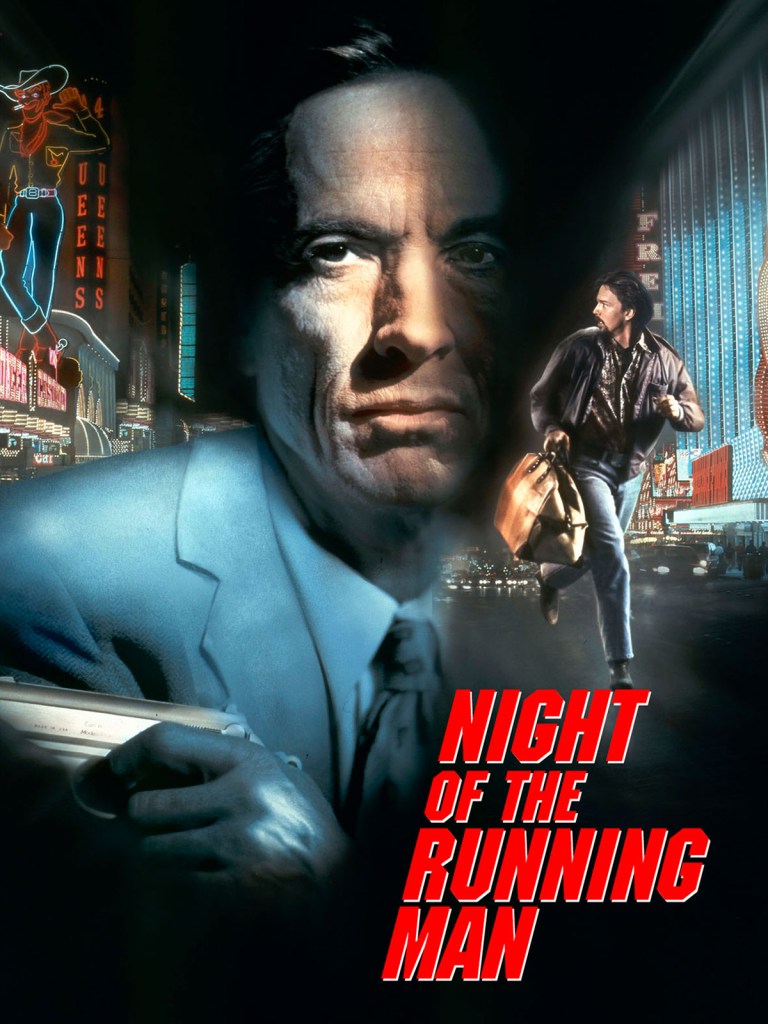
Every Monday night at 9:00 Central Time, my wife Sierra and I host a “Live Movie Tweet” event on X using the hashtag #MondayMuggers. We rotate movie picks each week, and our tastes are quite different. Tonight, Monday January 6th, we’re watching NIGHT OF THE RUNNING MAN, starring Scott Glenn, Andrew McCarthy, and John Glover.

In a nutshell, this movie is about a Las Vegas cab driver (McCarthy) who discovers a million dollars of stolen money in his cab. He is then tracked by a relentless and cold-blooded assassin (Glenn) sent to retrieve the money.

So why did Sierra pick NIGHT OF THE RUNNING MAN, you might ask? Well I asked her and she said, “I like that guy, Andrew McCarthy.” And that was it! I do remember watching the first hour or so of this movie on cable TV late one night about 25 years ago or so. I remember thinking it was pretty good prior to falling asleep. I’ve always liked Scott Glenn, even though he was a jerk in URBAN COWBOY. He’s a pretty vicious killer here so that should be fun. And John Glover is one of those guys I just enjoy seeing pop up in any movie. His bad guy in 52 PICK-UP is one of my all time favorite villains. Plus, this was directed by Mark L. Lester, the director of TRUCK STOP WOMEN, ROLLER BOOGIE, CLASS OF 1984, and COMMANDO. That’s quite a variety of flicks! And hell, it will be nice for me to see how the movie ends after all these years.

So join us tonight to for #MondayMuggers and watch NIGHT OF THE RUNNING MAN. It’s on Amazon Prime, as well as Tubi and Freevee.

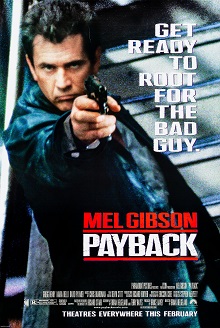
14 Days of Paranoia #5: Payback (dir by Brian Hegeland)


The 1999 film, Payback, opens with Porter (Mel Gibson) lying on a kitchen table while a grubby-looking doctor digs two bullets out of his back.  The scene takes place in almost nauseating close-up, with the emphasis being put on the amount of pain that Porter endures to get rid of those bullets.  Immediately, we know that Porter is not someone who can safely go to a regular hospital.  Porter is someone who exists in the shadows of mainstream society.

He’s also someone who spends a lot of time getting beaten up.  Even back when he was still a big star, Mel Gibson always seemed to spend a good deal of his films getting beaten up and tortured in various ways and that’s certainly the case with Payback.  Porter gets punched.  Porter gets shot.  Porter has a encounter with an over-the-top dominatrix (played by Lucy Liu).  At one point, Porter allows two of his toes to be smashed by a hammer, just so he can trick the his enemies into doing something dumb.  As played by Gibson, Porter stumbles through the film and often looks like he’s coming down from a week-long bender.  It’s interesting to think that Payback is a remake of 1967’s Point Blank, which starred Lee Marvin as Walker, an unflappable career criminal who never showed a hint of emotion or weakness.  Porter, on the other hand, is visibly unstable and spends the entire film on the verge of a complete mental collapse.  A lot of people try to kill Porter and Porter kills almost all of them without a moment’s hesitation.

(Of course, both Porter and Point Blank‘s Walker are versions of Parker, a career criminal who was at the center of several crime novels written by Donald “Richard Stark” Westlake.)

After helping to pull off a $140,000 heist from a Chinese triad, Porter was betrayed and left for dead by his former friend Val Resnick (Gregg Henry) and his wife, Lynn (Deborah Kara Unger).  Porter, who just wants the $70,000 cut that he was promised, starts his quest for the money by tracking down Val and Lynn, and then continues it by going after the three bosses (played by William Devane, James Coburn, and Kris Kristofferson) of “The Outfit,” a shadowy organization that Val had gotten involved with.  Along the way, Porter deals with a motely crew of corrupt cops, violent criminals, and sleazy middlemen.  (David Paymer has a memorable bit as a low-level functionary with atrocious taste in suits.)  Porter also hooks up with a prostitute named Rosie (Maria Bello), who might be the only person that he can actually trust.

I have mixed feelings about Payback.  (So did director Brian Hegeland, who was reportedly fired towards the end of shooting and later released a far different director’s cut.)  Though the film does a good job of capturing the visual style of a good neo-noir, the story itself is so violent and grim that it actually gets a little bit boring.  The film’s advertising encouraged audiences to “Get ready to root for the bad guy,” but there’s really no reason to root for Porter.  He’s an inarticulate and ruthless killer with no sense of humor.  If anything, the people that he kills seem to be far more reasonable and likable than he does.  In Point Blank, Lee Marvin may have been a bastard but he was good at what he did and you at least got the feeling that he wouldn’t go after any innocent bystanders.  In Payback, Porter is such a mess that his continued survival is largely due to dumb luck.  It’s hard to root for an idiot.

That said, the film does do a good job of capturing the feeling of people living on the fringes of society.  The Outfit is not a typical Mafia family but instead, a collection of businessmen who work out of nice offices and, in the case of William Devane’s Carter, come across as being more of a senior executive than a crime boss.  (James Coburn and Kris Kristofferson, meanwhile, come across as being two former hippies who made it rich on Wall Street.  They’re elderly versions of Abbie Hoffman and Jerry Rubin.)  The film does a good job of creating a world where no one trusts anyone and everyone is being watched by someone.  In one memorable scene, the three men sent to watch for Porter discover that he’s been watching them the entire time.  Never forget to look over your shoulder to see who might be following.

Flaws and all, this 1999 film does a good job of capturing the atmosphere of paranoia that, for many, would come to define the early part of the 21st Century.

14 Days of Paranoia:

  1. Fast Money (1996)
  2. Deep Throat II (1974)
  3. The Passover Plot (1976)
  4. The Believers (1987)

Ed and His Dead Mother (1993, directed by Jonathan Wacks)


After the death of his mother (Miriam Margoyles), shy Ed (Steve Buscemi) inherits the family hardware store.  Even though Ed now has his own business and maybe even a chance at having a relationship with Storm Reynolds (Sam Jenkins), Ed simply cannot leave the memory of his mother behind.  One day, he is approached by a salesman named A.J. Peddle (John Glover).  Peddle explains that he can bring Ed’s mother back to life for a thousand dollars.  Ed agrees and soon, Ed’s mother is once again living with Ed and Ed’s Uncle Benny (Ned Beatty).  Benny is upset because he doesn’t think that it’s proper to tamper in matters of morality and he never liked his sister to begin but, at first, Ed is happy to have her back.  However, Ed soon discovers that his mother has changed now that she’s come back to life.  She now has a craving for blood and soon, she’s chasing the neighborhood dogs while holding a knife.  Ed’s mom has returned as a zombie!  Can Ed finally move on and commit to sending his mother back to the grave?

This quirky comedy came out in 1993, a few years too early to take advantage of either the zombie boom or the horror comedy boom.  The movie never really find the right balance between scares and laughs.  The script is full of funny lines and Steve Buscemi and Ned Beatty are a good comedic team but the direction is as flat and as lifeless as Ed’s mom before she was resurrected.  Today, the movie is mostly interesting as a precursor for later trends in horror.  It’s also a chance to see Steve Buscemi is rare starring role.  Buscemi is ideally cast as the gentle Ed, who eventually learns the importance of letting go, accepting death, and moving on.  Buscemi is good, even in a misfire like this one.

Just two years after starring in this movie, Buscemi would appear on Homicide: Life on the Streets, playing a white supremacist murderer named Gordon Pratt.  Among the detectives assigned to arrest Pratt was Stanley Bolander, played by Ned Beatty.  As far as I know, that’s the only other pairing of Buscemi and Beatty and there wasn’t much to laugh about in that episode of Homicide.  It’s too bad because, judging from their interactions in this movie, Ned Beatty and Steve Buscemi could have been one of the great comedy teams.

Film Review: Robocop 2 (dir by Irvin Kershner)


Robocop 2, the 1990 sequel to Robocop, finds Detroit on the verge of getting nuked.

No, not nuked like that! Instead, there’s a new designer drug called Nuke and it’s tearing the city apart. Of course, Detroit has problems that go beyond just the new drug. The city is almost bankrupt. OCP, under the leadership of The Old Man (Dan O’Herlihy), is still running things behind the scenes. There’s still all sorts of petty crime to deal with. To be honest, it seems like the city has gotten even more out-of-control now that Clarence Boddiker is no longer around to oversee things.

Fortunately, Robocop (Peter Weller) is still patrolling the streets! But, for how long? There are lawyers who claim that Robocop is a huge potential liability and when you consider some of the stuff that went on during the first film, it’s hard not to see their point. His ex-wife is also suing the police department, claiming that Robocop has been harassing her. Despite being a robocop, our hero is still Murphy and he’s still haunted by memories of the family he once had. Or, at least, he is for the first few minutes of the film. That storyline kind of gets abandoned, along with a lot of other storylines.

While OCP is trying to develop a second robocop, one that can be mass produced and used to replace the human police force (the majority of whom have gone out on strike), a cult leader named Cain (Tom Noonan) is attempting to take over the city’s Nuke trade. Working with Cain is the usual gang of flamboyant malcontents. His second-in-command is a sociopathic child named Hob (Gabriel Damon). Hob may be a kid but he’ll kill anyone and he’ll enjoy himself while he’s doing it.

Robocop 2 is a bit of a mess. It apparently was rushed into production after the surprise success of the first film and filming started before there was even a completed script. As a result, there are a lot of storylines and themes that are brought up and then seem to mysteriously disappear. The film duplicates Paul Verhoeven’s satirical approach to the first film’s ultra-violence but, unfortunately, it does so in the most superficial way possible. Once again, we get the cheerful and vapid news reports about impending doom and once again, the violence is completely and totally over-the-top. But none of it carries any of the bite that was present in the first film. The first film worked because director Verhoeven actually was trying to make a larger point with all of the violence and the hints of growing fascism. He was attempting to challenge the audience and to get them wonder why they found all of the terrible thing happening in Robocop to be so entertaining. The sequel was directed by Hollywood veteran Irvin Kershner who was a good, workmanlike director but who also didn’t possess Verhoeven’s subversive sensibility. Far too often, Robocop 2 just feels like it’s going through the motions.

That’s not say that Robocop 2 isn’t occasionally an effective film. Dan O’Herlihy is wonderfully amoral as the Old Man and Tom Noonan is a worthwhile villain. Though Peter Weller has said that he wasn’t happy with how the overall film turned out, he still make for a sympathetic hero and he still manages to capture Robocop’s anguish without letting us forget that the character is still essentially a machine. I’m not really a big fan of films that use evil children for cheap shocks but Gabriel Damon is frequently chilling as Hob. Detroit is such a terrible place in the Robocop films that it’s not really a surprise when an evil child pops up and start shooting people. When compared to the first film, Robocop 2 may be a disappointment but it’s hardly a disaster.

Robocop 3 on the other hand….

4 Film Reviews: Bridge To Silence, The Chocolate War, Kiss The Bride, Wedding Daze


Last week, I watched six films on This TV.

Which TV?  No, This TV!  It’s one of my favorite channels.  It’s not just that they show a lot of movies.  It’s also that they frequently show movies that are new to me.  For instance, last week, This TV introduced me to both Prison Planet and Cherry 2000.

Here are four other films, two good and two not so good, that This TV introduced to me last week.

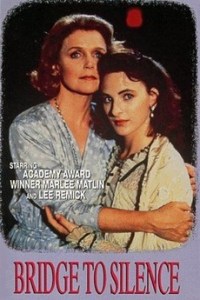
First up, we have 1989’s Bridge to Silence.

Directed by Karen Arthur, Bridge To Silence was a made-for-TV movie.  Lee Remick plays Marge Duffield, who has a strained relationship with her deaf daughter, Peggy (Marlee Matlin).  After Peggy’s husband is killed in a traffic accident, Peggy has a nervous breakdown.  Marge and her husband, Al (Josef Sommer) take care of Peggy’s daughter, Lisa, while Peggy is recovering.  However, even as Peggy gets better, Marge still doesn’t feel that she can raise her daughter so Marge files a lawsuit to be named Lisa’s legal guardian.  While all of this is going on, Peggy is starring in a college production of The Glass Menagerie and pursuing a tentative romance with the play’s director (Michael O’Keefe).

Bridge to Silence is one of those overwritten but heartfelt melodramas that just doesn’t work.  With the exception of Marlee Matlin, the cast struggles with the overwrought script.  (Michael O’Keefe, in particular, appears to be miserable.)  The film’s biggest mistake is that it relies too much on that production of The Glass Menagerie, which is Tennessee Williams’s worst play and tends to be annoying even when it’s merely used as a plot device.  There’s only so many times that you can hear the play’s director refer to Peggy as being “Blue Roses” before you just want rip your hair out.

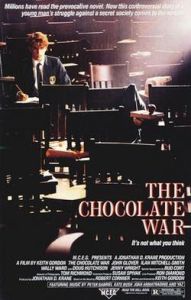
Far more enjoyable was 1988’s The Chocolate War.

Directed by Keith Gordon, The Chocolate War is a satirical look at conformity, popularity, rebellion, and chocolate at a Catholic boys school.  After the manipulative Brother Leon accidentally purchases too much chocolate for the school’s annual sale, he appeals to one of his students, Archie Costello (Wallace Langham), to help him make the money back.  Archie, who is just as manipulative as Leon, is the leader of a secret society known as the Vigils.  However, Archie and Leon’s attempt to manipulate the students runs into a roadblack when a new student, Jerry Renault (Illan Mitchell-Smith) refuses to sell any chocolates at all.  From there, things get progressively more complicated as Archie tries to break Jerry, Jerry continues to stand up for his freedom, and Leon … well, who knows what Leon is thinking?

The Chocolate War was an enjoyable and stylish film, one that featured a great soundtrack and a subtext about rebellion and conformity that still feels relevant.  John Glover and Wallace Langham both gave great performances as two master manipulators.

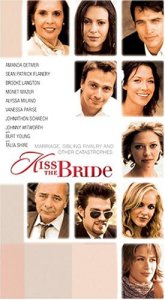
I also enjoyed the 2002 film, Kiss The Bride.

Kiss The Bride tells the story of a big Italian family, four sisters, and a wedding.  Everyone brings their own personal drama to the big day but ultimately, what matters is that family sticks together.  Directed by Vanessa Parise, Kiss The Bride featured believable and naturalistic performances from Amanda Detmer, Talia Shire, Burt Young, Brooke Langton, Monet Mazur, and Parise herself.

I have to admit that one reason why I liked this film is because it was about a big Italian family and it featured four sisters.  I’m the youngest of four sisters and, watching the film, I was reminded of my own big Irish-Italian family.  The movie just got everything right.

And then finally, there was 2006’s Wedding Daze.

Wedding Daze is a romantic “comedy.”  Anderson (Jason Biggs) asks his girlfriend to marry him, just to have her drop dead from shock.  Anderson’s best friend is afraid that Anderson will never get over his dead girlfriend and begs Anderson to not give up on love.  Anderson attempts to humor his friend by asking a complete stranger, a waitress named Katie (Isla Fisher), to marry him.  To everyone’s shock, Katie says yes.

From the get go, there are some obvious problems with this film’s problem.  Even if you accept that idea that Katie would say yes to Anderson, you also have to be willing to accept the idea that Anderson wouldn’t just say, “No, I was just joking.”  That said, the idea does have some comic potential.  You could imagine an actor like Cary Grant doing wonders with this premise in the 30s.  Unfortunately, Jason Biggs is no Cary Grant and the film’s director, comedian Michael Ian Black, is no Leo McCarey.  In the end, the entire film is such a misjudged failure that you can’t help but feel that Anderson’s ex was lucky to die before getting too involved in any of it.

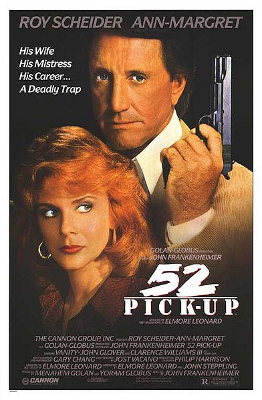
A Movie A Day #316: 52 Pick-Up (1986, directed by John Frankenheimer)


Harry Mitchell (Roy Scheider) is a businessman who has money, a beautiful wife named Barbara (Ann-Margaret), a sexy mistress named Cini (Kelly Preston), and a shitload of trouble.  He is approached by Alan Raimey (John Glover) and informed that there is a sex tape of him and his mistress.  Alan demands $105,000 to destroy the tape.  When Harry refuses to pay, Alan and his partners (Clarence Williams III and Robert Trebor) show up with a new tape, this one framing Harry for the murder of Cini.  They also make a new demand: $105,000 a year or else they will release the tape.  Can Harry beat Alan at his own game without harming his wife’s political ambitions?

Based on a novel by the great Elmore Leonard and directed by John Frankenheimer, 52 Pick-Up is one of the best films to ever come out of the Cannon Film Group.  Though it may not be as well-known as some of his other films (like The Manchurian Candidate, Seconds, Black Sunday, and Ronin), 52 Pick-Up shows why Frankenheimer was considered to be one of the masters of the thriller genre.  52 Pick-Up is a stylish, fast-paced, and violent thriller.  John Glover is memorably sleazy as the repellent Alan and the often underrated Roy Scheider does an excellent job of portraying Harry as a man who starts out smugly complacent and then becomes increasingly desperate as the story play out.

One final note: This movie was actually Cannon’s second attempt to turn Elmore Leonard’s novel to the big screen.  The first attempt was The Ambassador, which ultimately had little to do with Leonard’s original story.  Avoid The Ambassador but see 52 Pick-Up.

A Movie A Day #303: The Evil That Men Do (1984, directed by J. Lee Thompson)


Clement Molloch (Joseph Maher) is a doctor who uses his medical training to torture journalists and dissidents in an unnamed South American country.  Holland (Charles Bronson) is a former  CIA assassin, who is content with being retired.  But when Molloch kills a journalist who was also an old friend of Holland’s, it all becomes about revenge.  No one’s more dangerous than Charles Bronson seeking revenge.  Working with the dead journalist’s widow (Theresa Saldana), Holland heads down to South America.  Since Molloch is always surrounded by bodyguards, it is not going to be easy to get him.  But who can stop Charles Bronson?

Bronson was 62 years old when he made The Evil The Men Do and he was still the toughest, coolest killer in the movies.  The Evil That Men Do is a rarity, an 80s Bronson film that was not produced by Cannon.  It still feels like a Cannon production, even if it is a little more interesting than some of the other films that Bronson was making at that time.  Dr. Molloch was clearly based on the notorious Nazi Klaus Barbie and Joseph Maher plays Molloch as being a dignified sadist.  Molloch also has a strange relationship with his equally cruel sister (Antoinette Bower).  That Molloch is so extremely evil makes the film’s final scenes all the more satisfying.

The Evil That Men Do is one of the best of Bronson’s later films.  Charles Bronson, man.  No one got revenge better than Bronson.

Lifetime Film Review: The Lost Wife of Robert Durst (dir by Yves Simoneau)


Tonight’s Lifetime premiere was The Lost Wife of Robert Durst, the latest of many films to deal with the 1982 disappearance of Kathie Durst and the subsequent activities of her husband, millionaire weirdo Robert Durst.

The disappearance of Kathie Durst is an intriguing cold case.  Robert Durst was a member of one of the wealthiest and most powerful families in New York.  Many have speculated that may be why Durst was never charged with anything, despite the fact that everyone was convinced that he was responsible for her disappearance.  (Others have pointed out that most of the evidence against Durst was circumstantial and that Kathie’s body has never been found.)  Durst, himself, appears to have spent the last few decades as something of a millionaire hobo.  His best friend, Susan Berman, was murdered in 2000.  (Berman provided Durst with an alibi for the night of Kathie’s disappearance.)  Durst himself eventually turned up in Galveston, where he attempted to disguise himself as a woman and was eventually arrested for murdering his neighbor, Morris Black.  Durst was acquitted in that case.  All Good Things, a feature film starring Ryan Gosling and Kirsten Dunst, led to resurgence of interest in the case of Kathie’s disappearance.  It also led to a HBO documentary series, called The Jinx.  In an act that was either extremely cocky or extremely self-destructive, Durst agreed to be interviewed for the documentary, implicated himself in all three of the murders that he was suspected of committing, and was subsequently charged with murdering Susan Berman.

It’s one of those stories that, when you hear the details, you can hardly believe is true.  It has everything: love, greed, sex, jealousy, politics, the mafia, and several unsolved murders.  It’s not surprising that there’s been several movies and TV shows based on the Durst case.  The problem that every new film faces is what can it add to the story that we haven’t already seen.  The Lost Wife of Robert Durst is relatively well-made but there’s really nothing here that you couldn’t find in All Good Things or The Jinx.  This is like the Wikipedia version of Durst case.  It gives you all the details without going into too much depth about any of it.

Of course, one of the main questions about this case is whether Robert Durst is mentally ill or if he’s just extremely clever.  Those that claim that Durst is crazy tend to point out that he saw his mother commit suicide when he was a young boy, that he has a habit of muttering to himself, and that he lives like a hermit despite all of his money.  Those who claim that Durst is actually very clever and in total control of all of his actions point out that all of Durst’s alleged crimes required extensive planning and that, in The Jinx, he was caught saying, “What the Hell did I do?  Killed them all, of course.”  That would seem to indicate that Durst is fully aware of whatever he may have done.  The question of Durst’s sanity is not a minor one.  In some states, it would be the difference between life in prison and execution.

The Lost Wife of Robert Durst attempts to have it both ways.  As played by Daniel Gillies, Durst is obviously unstable yet clearly calculating at the same time.  In fact, I would argue that, from a purely dramatic point of view, Gillies plays Durst as being a little too obviously unstable.  You find yourself wondering why Kathie (played by Katharine McPhee) would have ever agreed to go out with him in the first place, much less marry him.  As played by McPhee, Kathie is almost as hard to read as Durst.  Even in the scenes depicting the early days of Durst marriage, the lack of chemistry between Gillies and McPhee is a problem.  I spent most of the film wishing that it would dig a little bit deeper into the case.  Then again, considering that Durst has yet to be convicted on any charges, I suppose there’s only so much that the movie could suggest.  (All Good Things changed everyone’s names, which gave it at least a little bit of freedom to speculate.)

That said, the Robert Durst story is such a strange one that, flaws and all, The Lost Wife of Robert Durst is watchable.  It’s a good enough introduction to the case, if you’re looking for one.  Ultimately, though, All Good Things remains the Durst film to watch.


Lisa Reviews An Oscar Winner: Annie Hall (dir by Woody Allen)


anniehallposterYou take a risk when you review a Woody Allen film, even an acknowledged, Best Picture-winning classic like 1977’s Annie Hall.  Do you address the accusations that have been made about him?  Do you ignore them and hope that they won’t be the Elephant in the Room, stomping through your review?  Do you try to justify reviewing (or, in some cases, even watching) Allen’s film?  Or do you just let the work speak for itself?

I love Annie Hall.  Quite frankly, I like a lot of Woody Allen’s films, even though I understand why his work is an acquired taste for quite a few other people.  I’ll address the elephant in the room in a paragraph or two but you know what?  I watched Annie Hall last night and I want to mention a few reasons why I enjoy this film.

First off, Annie Hall features one of Christopher Walken’s first (and best) performances.  He only has a few lines but he makes quite an impression.  He plays Duane, the brother of Annie Hall (Diane Keaton).  When Annie’s boyfriend, Alvy Singer (Woody Allen), is visiting the Hall family, Duane invites Alvy into his bedroom and tells him that, whenever he’s driving, he fantasizes about intentionally swerving into incoming traffoc.  In the very next scene, Duane is driving an oblivious Annie and a terrified Alvy to the airport.  It’s a wonderfully funny moment.  (If you keep your eyes open, you’ll notice that Annie’s apartment is full of pictures of Duane and his thousand yard stare.)

Secondly, this film also features an early role for Jeff Goldblum.  He only has one line — “I forgot my mantra” but my God, he does amazing things with that line.

Third, when Alvy and his agent, Rob (Tony Roberts), are driving through Los Angeles, they pass a theater.  According to the marquee, the theater is showing House of Exorcism, a Mario Bava film.  That’s right: Italian horror in a Woody Allen film.  How glorious is that?

Fourth, Annie Hall is an extremely dated film.  It was made in 1977 and, as to be expected about a film directed and written by a stand up comedian, it’s full of references that were probably hilariously on target then but rather obscure now.  As well, like almost all Woody Allen films, it’s a very New York film.  Alvy is an intellectual, left-wing Jew who suspects that everyone he sees is an anti-Semite and who is dating an aspiring actress and singer who hails from middle America.  (During the scene where Alvy meets her family, he immediately pegs Grammy Hall as a “classic Jew hater.”)  The film is very much told from Alvy’s point of view, which means jokes about New York periodicals and a flashback to an Adlai Stevenson rally.  That being said, I’m a Texas girl who was born long after Annie Hall was first released and I still enjoy the film because it’s a film that captures some universal truths about human relationships.

The first time I watched Annie Hall, I was 17 and I saw a lot of myself in Annie.  While I wouldn’t be caught dead wearing some of her outfits, I knew what it was like to be insecure.  I knew what it was like to be nervous.  I know what it was like to worry about being smart enough.  And, like Annie, I eventually learned that independence was the key to happiness.  Annie Hall has stood the test of time because both Annie and Alvy are relatable while still remaining wonderfully unique and neurotic individuals.

(If ever a film has been a ode to the joy of being neurotic, it’s Annie Hall.)

Fifth, I love the scene where Alvy asks a random couple of the street how they make their relationship work.  “I’m totally shallow and have no original thoughts,” the woman replies.  “And I’m the exact same way,” her husband cheerfully adds.

Sixth, I’m going to assume that Paul Simon was primarily playing himself.

Seventh, there are just so many great scenes.  Like when Alvy deals with a rude cop by ripping up his license.  And then, there’s that lobster scene.  And that moment when Alvy comes over to Annie’s apartment to kill a “spider the size of a buick.”  (Judging by the number of times Alvy has to hit the spider with that tennis racket, I assume buick’s are pretty big.)  There’s the two scenes of Annie singing, one when she’s still insecure and can’t compete with the sound of plates smashing around here and the other when she’s developed the confidence to dominate and control both the stage and the audience.  There’s the scenes where Alvy breaks the fourth wall and get advise from random people on the streets of New York.  And what about when Annie starts laughing while telling the horrible story of how her uncle died at the post office?  Or what about when Alvy tries to avoid having sex with his first wife by discussing the JFK assassination?  Or when we literally see Annie mentally check out of making love to Alvy?  Or how about the split-screen therapy sessions?  Or the sudden moment when Annie and Alvy become cartoon characters?  Or the scene with the pretentious blowhard at the movies?

(As a Southern girl, I have to admit that it’s always strange to me to hear Alvy and Annie talking about “waiting on line” at the movies.  Down here, we say “in line,” which makes a lot more sense.  Since a line is just a crowd of people standing in a certain order, saying that you’re “on line,” is the same as saying your standing on someone’s head.  You get in a crowd, not on them.  Whenever I hear someone from up north talking about “waiting on line,” I assume they must be bidding for something on Ebay.)

I like Annie Hall and I always will.  As for the accusations against Woody Allen, they don’t keep me from enjoying his better films because:

  1. I’ve always been a big believer that art can and should be judged separately from the artist.
  2. Having read what both sides have said about Woody Allen and the accusations that have been made against him, I don’t think he did it.

Obviously, some are going to disagree with me on both those points.  So be it.  Everyone has to make their own choice.  For me, though, what’s important is that Annie Hall is a film that I’ve loved since the first time I saw it and I’ll continue to love it.