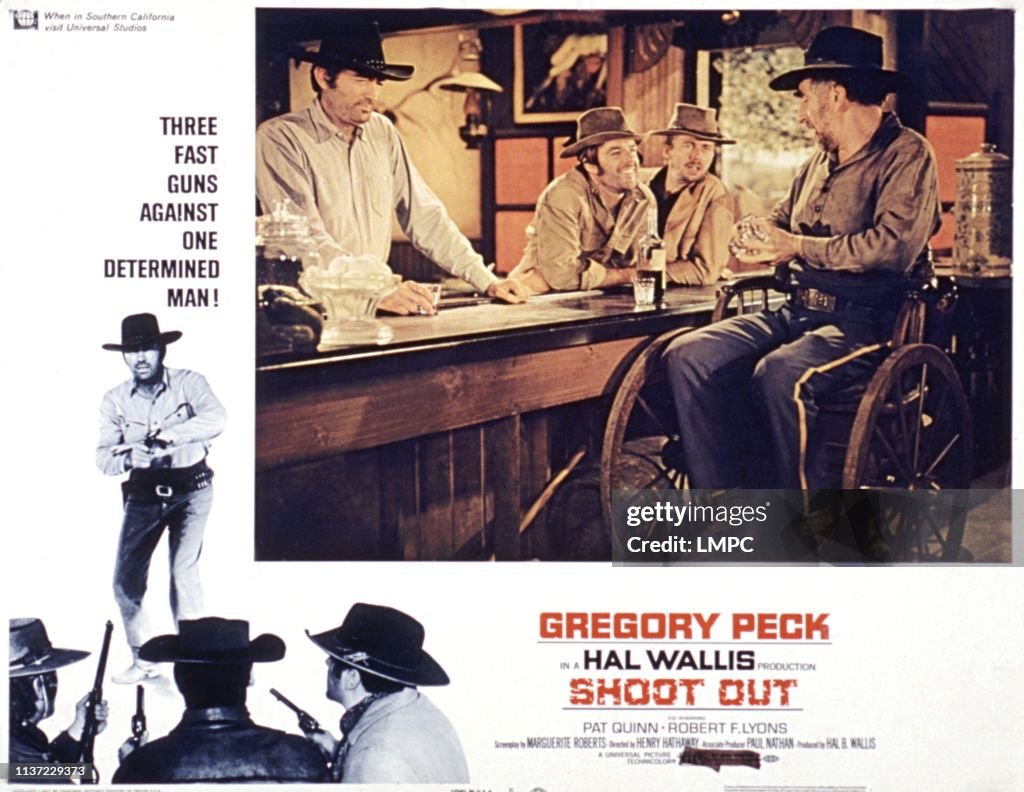
Brad reviews SHOOT OUT (1971), starring Gregory Peck & Robert F. Lyons! 


After serving a stretch at the Canon City penitentiary, Clay Lomax (Gregory Peck) gets out with only one thing on his mind… revenge on his former partner Sam Foley (James Gregory), who shot him in the back during a bank robbery, leaving him to take the rap. Foley isn’t a fool, though, so he’s hired a trio of young punks, Bobby Jay (Robert F. Lyons), Skeeter (John Davis Chandler), and Pepe (Pepe Serna) to surveil Lomax and let him know if he’s heading to his home in Gun Hill with payback on his mind. These guys are about as crazy as it gets, and they make two major mistakes. First, they kill Lomax’s friend Trooper (Jeff Corey) who lets him know where Foley is with his dying breath. Second, they kidnap the prostitute Alma (Susan Tyrell) just because they want to treat her like crap and have fun with her, which turns out to be a dumb move. Interrupting Lomax’s quest for revenge, he finds himself being forced to care for a young child named Decky (Dawn Lyn), who just may be his daughter with a lady back in Kansas City who used to be his “friend.” Looking after Decky, and then meeting and falling for the widow Juliana Farrell (Patricia Quinn), Lomax is soon facing off against his most dangerous foe, the crazed Bobby Joe, as he attempts to protect all these new people that he loves so he can move on with his life. But is it all too late?!!

I love westerns, but I must admit that I’m not the biggest fan of director Henry Hathaway’s SHOOT OUT. Hathaway has directed some of my favorite actors and movies, like Charles Bronson’s debut film with Gary Cooper, YOU’RE IN THE NAVY NOW (1951), along with the Jimmy Stewart film CALL NORTHSIDE 777 (1948) and John Wayne’s Oscar winning TRUE GRIT (1969). Unfortunately, it seems his best years are behind him, and he would only direct one more film after this, the less than excellent black action film HANGUP (1974). This isn’t exactly Gregory Peck’s best work either. Coming nine years after his Oscar winning performance in TO KILL A MOCKINGBIRD (1962), this is definitely not even close to that kind of level. Don’t get me wrong, I do enjoy his turn as Lomax when he’s the wronged outlaw looking for revenge, but I don’t really care at all for his part as the reluctant father figure trying to deal with the six-year-old Decky. I found Dawn Lyn to be more annoying than cute in the role, and this storyline distracted me from the revenge plot that I actually enjoyed. As a co-host of the “This Week in Charles Bronson Podcast,” we had the opportunity to interview Robert F. Lyons, who plays the bad guy, Bobby Jay Jones. I specifically asked him about this film and what it was like working with Gregory Peck. While he enjoyed working with Peck, his response about the film itself was telling…. “The work in there is not my work.” If you’ve watched much of the excellent actor’s work before, you can immediately understand what he means. Lyons goes so over-the-top as the spying outlaw Bobby Jay Jones, that his performance is inconsistent with the bulk of his career. Lyons told us that his performance was orchestrated by Hathaway in a way that he disagreed with, and he essentially disowns his work in the film. You can see a similar vibe with his “gang” that includes the actors John Davis Chandler and Pepe Serna. 

While I’m not a huge fan of the overall direction of the storyline or the focus of some of the main performances in SHOOT OUT, I am appreciative of the genre and the classic western stars that Hathaway cast in supporting roles. I especially enjoy seeing Jeff Corey in the small but pivotal role as the wheelchair bound Trooper, Paul Fix as the train brakeman who delivers Decky and a stack of cash to Lomax, and Arthur Hunnicutt as the ranch owner who barters with Lomax over the price of a pony. Hunnicutt is a particular favorite of mine although his role here is very small. Nominated for an Oscar for his performance in Howard Hawks’ THE BIG SKY (1952), Hunnicutt is from the small town of Gravelly, Arkansas, which is not far from where my own family is from. He even attended the same college that I graduated from, the University of Central Arkansas, which was known as the Arkansas State Teachers College when he (and my dad) went there. And then there is the setup of the revenge scenario at the beginning and the final showdown at the end, classic staples of the western genre. These are enjoyable and satisfying moments as Lomax settles his scores and the bad guys get their comeuppance.

Overall, SHOOT OUT is best enjoyed by fans of old school westerns and star Gregory Peck. It veers aways from the best storylines of the genre and wastes a lot of time with uninteresting melodrama, but it does offer us another chance to see some of our great character actors doing what they do. That means something to me. 

I’ve included our podcast episode with Robert F. Lyons below. He discusses SHOOT OUT at around the 1:00:30 mark.
Retro Television Review: Fantasy Island 6.3 “The Perfect Gentleman/Legend”


Welcome to Retro Television Reviews, a feature where we review some of our favorite and least favorite shows of the past!  On Tuesdays, I will be reviewing the original Fantasy Island, which ran on ABC from 1977 to 1984.  Unfortunately, the show has been removed from most streaming sites.  Fortunately, I’ve got nearly every episode on my DVR.

Smiles, everyone!

Episode 6.3 “The Perfect Gentleman/Legend”

(Dir by Philip Leacock, originally aired on October 30th, 1982)

Jimmy Jordan (Paul Williams, who appeared on a lot of these type of shows) is a rock star who witnessed a mob hit at one of his concerts.  Jimmy did what anyone would do.  He called the police.  They offered to protect him if he testified but then they told him that they probably wouldn’t be able to continue to protect him afterwards.  (Uhmm …. hello?  Witness Protection Program?)  Jimmy decided to fake his own death and then go to Fantasy Island.  His fantasy?  To not get caught by the two mobsters who have been sent to make sure that he’s actually dead.

Uhmmm …. that’s weird.  Like all of that was going on Jimmy just decided to go to Fantasy Island?  And then he shows up on Fantasy Island wearing a trenchcoat over his rock star jump suit?  Weird.

Fortunately, Michelle (Leslie Easterbrook) is on the island and her fantasy is apparently to have a new butler!  Soon, Jimmy is calling himself Godfrey and helping Michelle and her family save their business while Tracer (John Davis Chandler) and Killer (Joseph Ruskin) search for him.  Needless to say, Jimmy and Michelle fall in love and leave the island together and, unless I missed something, it appears that Jimmy is planning on just being Godfrey for the rest of his life.  He even drives Michelle and her daughter to the docks so that they can all fly off to the mainland.  I guess the world is going to go on believing that Jimmy’s dead and….

This fantasy raised way too many unanswered questions and Paul Williams was convincing neither as a rock star or a butler.  This is a fantasy that called out for someone like …. oh, I don’t know.  Sonny Bono, maybe.

The other fantasy was a bit of an improvement, just because it featured the unlikely but surprisingly likable pairing of Michelle Phillips and Andy Griffith.  Phillips plays Andrea Barclay, who has a beautiful singing voice but who suffers from crippling stage fright.  Her fantasy is to successfully perform in front of the toughest crowd ever.

Really?  Roarke says, The toughest crowd?

By now, guests should realize that whenever Roarke says something like that, it means your fantasy is going to be interpreted in a bizarre way that you never expected.  Considering that, the last time that Michelle Phillips was on the show, her fantasy to be the most famous woman in the world somehow led to her becoming Lady Godiva, Andrea really should have known better.  Instead, Andrea is shocked when she finds herself in the Old West, where Judge Roy Bean (Andy Griffith) has promised the citizens of Langtry, Texas that his favorite actress and singer, Lillie Langtry (Madlyn Rhue), will be performing for them.  When Lillie leaves without singing, it’s time for Andrea to put on a mask and pretend to be Lillie as she performs in Judge Bean’s saloon.  Yeah, it’s a silly fantasy but Andy Griffith and Michelle Phillips both put their heart into their performances.  Andy Griffith does his folksy-but-intelligent routine while Michelle Phillips especially deserves a lot of credit for taking things seriously.

This episode had the same problem as last week’s.  Everything felt very familiar.  Last week, we had what seemed like the show’s hundredth boxing and dancing fantasy.  This week, we have what feels like the hundredth singing fantasy.  After five seasons, it’s obvious that the show’s writers had started to run out of ideas.

Next week …. Roddy McDowall returns to Fantasy Island!  Yay!


Retro Television Review: Fantasy Island 5.22 “The Ghost’s Story/The Spoilers”


Welcome to Retro Television Reviews, a feature where we review some of our favorite and least favorite shows of the past!  On Tuesdays, I will be reviewing the original Fantasy Island, which ran on ABC from 1977 to 1984.  Unfortunately, the show has been removed from most streaming sites.  Fortunately, I’ve got nearly every episode on my DVR.

This week, season 5 comes to an end.

Episode 5.22 “The Ghost’s Story/The Spoilers”

(Dir by Don Chaffey, originally aired on May 8th, 1982)

The latest batch of guests are arriving and Julie is nowhere to be seen!  Perhaps that’s because, as Mr. Roarke explains to Tattoo, Julie is helping out a guest who has an invisibility fantasy.  Tattoo and Roarke watch as the guest walks by.  His body may be invisible but his pants are not.

This is the final episode of the fifth season and it’s also the final episode in which Wendy Schaal will be credited as a part of the cast.  I wasn’t a huge fan of the Julie character but it still seems like a bit of a shame that she didn’t get to do anything in the finale.  Then again, this episode doesn’t really feel like a finale.  I don’t know what was going on behind the scenes during the fifth season but it’s hard not to feel, with the way that Julie and Tattoo have randomly shown up in different stories, that the season’s episodes were not shown in the order in which they were filmed.  Maybe all the Julie episodes were filmed at one time, while Herve Villechazie was off doing something else.  Who knows?  It’s just been a strange season.

That’s all wonderful and interesting, Lisa …. But what about this week’s fantasies!? you may be asking.

They both feel a bit familiar.  That’s not always a bad thing, of course.  Fantasy Island is a comfort show and a part of the comfort is knowing that things are always going to play out in a certain way.  But, with this episode, both fantasies felt as if they had been done better in the past.

Harry (Bo Hopkins) is a bounty hunter who comes to the Island to track down fugitive Nick Tanner (Robert Fuller).  Nick has been accused of robbing a bank and is hiding out on a nearby island.  Harry goes to the island but he soon discovers that Nick is innocent and that the real bank robbers have also come to the island in search of Nick.  Luckily, there’s a widow named Juliet (Jo Ann Pflug) who is also living on the island.  Harry and Nick hide out at her place before they all team up to defeat the real bank robbers.  Nick and Juliet fall in love and Mr. Roarke performs one of his trademark wedding ceremonies.  Nick and Juliet then board the plane back to America and …. wait a minute, what about Harry?  It was his fantasy!  We don’t ever see Harry leave Fantasy Island.  Maybe he’s still living there.

(Personally, I think he married Julie and that’s why she was no longer working there once season six began.  I like that.  Consider it to be canon.)

The other fantasy is a haunted house story.  Amanda Parsons (Tanya Roberts) comes all the way from Baltimore to spend 24 hours in one of Fantasy Island’s many haunted houses.  Two other paranormal investigators attempt to do it before Amanda but they end up fleeing after two minutes.  I’m not sure why.  The manor looks creepy but it turns out that the ghost is a rather wimpy and not at all frightening guy named Timothy Black (Dack Rambo).  Cursed by his own father after Timothy refused to fight a duel with Captain Fitzhugh Ross (John McCook), Timothy has spent two hundred years haunting the old manor.  Amanda takes sympathy on him.  It turns out that Ross’s descendant is also on the Island.  Timothy challenges him to a duel, causing the latest Ross to run in fear.  Timothy and his ghost dad (John Myhers) realize it’s okay to be scared of getting shot.  Ghost Dad asks Roarke to bring Timothy back to life so that he can pursue his romance with Amanda.  Roarke does just that, despite the fact that, in many previous episodes, Roarke has specifically said that he cannot bring the dead back to life.

Usually, I enjoy Fantasy Island‘s haunted house fantasies but this one didn’t do much for me.  I think it’s because the ghost was just too wimpy.  There’s nothing more annoying than a whiny a dead guy,

And so ends this very odd season.  Next week, we being season 6!

Retro Television Review: Fantasy Island 5.7 “The Perfect Husband/Volcano”


Welcome to Retro Television Reviews, a feature where we review some of our favorite and least favorite shows of the past!  On Tuesdays, I will be reviewing the original Fantasy Island, which ran on ABC from 1977 to 1984.  Unfortunately, the show has been removed from most streaming sites.  Fortunately, I’ve got nearly every episode on my DVR.

Yay!  It’s finally time to return to the Island.

Episode 5.7 “The Perfect Husband/Volcano”

(Dir by Philip Leacock, originally aired on November 21st, 1981)

This week, it’s Tattoo’s turn to serve as Roarke’s sidekick while Julie is sent off to deal with two weddings and a tour for “the seniors.”

On the one hand, it’s incredibly awkward for Roarke to have two sidekicks and it’s pretty obvious that Julie was only hired to serve as insurance in case Herve Villechaize walked off the set.

On the other hand, it is kind of nice to be reminded of the fact that there’s a lot happening on Fantasy Island.  Fantasy Island is not just a mystical nation that is ruled over by the enigmatic Mr. Roarke.  It’s also a resort that hosts vacations and retirement homes.  Apparently, you don’t have to have a fantasy in order to spend some time on Fantasy Island.  Instead, you can just come to Fantasy Island for a nice tropical vacation.  That’s kind of nice.

But, that said, the fantasies are why we’re here.  We’ve got two good ones this week.

Dorothy Nicholson (Susan Sullivan) is a newspaper publisher who has been feeling unfulfilled ever since her husband was killed by a drunk driver.  She want to find the perfect husband, a man without any flaws whatsoever.  After giving her his customary “You may not like what you find,” warning, Roarke sends her to Paradise Cove.  Operated by the sinister Anton Jagger (Rossano Brazzi), Paradise Cover is a resort where wealthy women are assigned the perfect companion.  Dorothy’s perfect man is Gilbert (Lyle Waggoner).  Gilbert is handsome, suave, charming, and attentive.  Unfortunately, like all of the perfect men at Paradise Cove, he’s also a robot and a part of Jagger’s scheme to cheat women out of their money!  Dorothy figures out the truth after Gilbert doesn’t even flinch after his hand catches on fire.  Can she defeat Jagger’s plans and rescue the real Gilbert?

(Of course, she can.  It’s Fantasy Island!)

Dr. Hal Workman (George Maharis) thinks that he’s figured out a way to detect when a volcano is going to erupt.  He wants to go to Fantasy Island’s own active volcano to test out his methods.  Roarke agrees, even though he worries that Dr. Workman only cares about science and not about people.  (Honestly, who cares?  A volcano detection system sounds like it would be a good thing, regardless of the motives of the man who created it.)  Workman is led to the volcano by a disillusioned former priest named Lauria (Richard Romanus).  However, Workman and Lauria are not the only people at the volcano.  There’s also a shady tycoon, Joseph Butler (Norman Alden), and his girlfriend, Terri (Misty Rowe).  You can probably guess what happens.  Workman falls in love with Terri.  Lauria finds his faith.  And Butler presumably dies when the volcano erupts and a deluge of what appears to be very thin tomato sauce comes pouring down the mountain.

Both of these fantasies were cheerfully ridiculous, which made them a lot of fun.  You may wonder why Roarke would send one of his guests to a resort that’s being run by a madman and that’s a legitimate question.  But the important thing is that the viewer gets a montage of all of the robots malfunctioning at once.  And you may wonder at the wisdom of allowing someone to go to an active volcano but the important thing is that we get a scene of George Maharis and Richard Romanus running away from the least realistic lava flow ever caught on film.  Fantasy Island is a lot of fun when it goes over the top and embraces its beautiful absurdity and that’s exactly what this episode did.

What a wonderful trip to the Island!

Retro Television Review: Fantasy Island 4.22 “Hard Knocks/Lady Godiva”


Welcome to Retro Television Reviews, a feature where we review some of our favorite and least favorite shows of the past!  On Tuesdays, I will be reviewing the original Fantasy Island, which ran on ABC from 1977 to 1984.  Almost the entire show is currently streaming on Daily Motion.

Welcome to Fantasy Island, where Mr. Roarke does whatever he wants.

Episode 4.22 “Hard Knocks/Lady Godiva”

(Dir by Don Weis, originally aired on May 9th, 1981)

Sheila Godfrey (Michelle Phillips) comes to Fantasy Island with a simple fantasy, one that Mr. Roarke manages to totally screw up.

Sheila grew up in Montana and loves horses.  Because she was often ill while she was growing up, she was often not allowed to ride as much as she would have liked.  Now, she wants to be the world’s most famous female equestrian.  To me, this seems like a pretty simple and straight-forward request.  Sheila is asking to be famous for riding a horse.

Roarke, however, decides that Sheila’s fantasy is that she wants to be the most famous female equestrian in history.  And, in Roarke’s opinion, that means that Sheila wants to be Lady Godiva.  Now, setting aside the idea that Mr. Roarke is suddenly such a stickler for detail that he’s forcing Sheila to go with a literal translation of her fantasy (which is something that no other guest has ever had to deal with), is Lady Godiva truly the most famous female equestrian ever?  Katharine Hepburn used to ride horses.  Belle Starr used to ride horses.  Joan of Arc rode a horse on occasion.  What about Annie Oakley?

But let’s accept that Sheila’s fantasy is to become Lady Godiva.  Roarke doesn’t even do that!  Instead, he gives her a magic horse named Lancelot, which Sheila rides into medieval England.  And, in the past, Lancelot turns into a donkey and Sheila is promptly arrested for poaching on a nobleman’s land.  Sheila ends up a servant to Lady Godiva (Gunilla Hutton), who is being imprisoned in her own castle for criticizing the taxes that her husband, Leo (Ken Berry, who is very much not British), has placed on the people living on his land.  When Leo says that he’ll release his wife and lower the taxes but only if she’ll agree to humiliate herself by riding her horse naked, Godiva agrees.  However, before the ride, she is given a magic potion that knocks her out.

It falls to Sheila to disguise herself as Godiva and take the famous ride.  The servants respect her decision and turn their back as she rides by on a horse.  Well, one guy does take a look and gets yelled at as a result.  “You’ll always be known as Peeping Tom!”

Sheila returns to the present and is somehow not upset about the fact that she really didn’t get her fantasy.  (Not only did she not get the fantasy she asked for but she didn’t even get the fantasy that Roarke claimed she was asking for.  I mean, even if we accept that Sheila’s fantasy was to be Lady Godiva, that didn’t happen.  Instead, she became a servant who pretended to be Lady Godiva.)  Roarke agrees to send her Lancelot and also informs her that handsome Sir John Apensdale (Patrick Wayne), who Sheila fell in love with while in the past, was actually a Montana rancher who was having a fantasy of his own.  And he’ll be happy to teach Sheila how to ride!

Meanwhile, Steve Pryor (Philip Levian) comes to the Island with the fantasy of being a hard-boiled detective.  Roarke gives Steve his fantasy and even provides him with a mentor to offer him advice.  Who is that mentor?  The ghost of Humphrey Bogart (played by Robert Sacchi)!  Only Steve can see Bogart, which leads to a lot of scenes of people wondering why Steve is talking to himself.

The case involves delivering a package, picking up a key to a safety deposit box, and dealing with a femme fatale (Martha Smith).  It’s a pretty simple case, to be honest.  But at least Steve gets to hang out with Bogart.  And, to give credit where credit is due, Robert Sacchi’s Bogart impersonation was spot-on.

This episode was silly enough to be likable.  That said, I do think Sheila could probably sue Mr. Roarke for not actually granting her fantasy.  Seriously, I wonder how many lawyers Mr. Roarke kept on retainer.

The Take (1974, directed by Robert Hartford-Davis)


Lt. Terrence Sneed (Billy Dee Williams), a tough and suave cop from San Francisco, is sent to New Mexico to help Police Chief Berrigan (Eddie Albert) take down the local crime syndicate.  No sooner has Sneed arrived in town than he’s helping to prevent a prison break and killing gangsters.  Berrigan is impressed and explains to Sneed that the local crime boss is Victor Manso (Vic Morrow).  Even though everyone knows that Manso is crooked, the police haven’t ever been able to put together a case that will stand up in court.  Maybe Sneed is the man who can do it.

What Berrigan doesn’t know is that Sneed is a crooked cop, himself.  As soon as Sneed leaves his meeting with Berrigan, he goes over to Manso’s office and collects his money.  Manso assigns Sneed to work with another crooked cop, Captain Dollek (Albert Salmi).  However, it turns out that Sneed has plans of his own.  While still on Manso’s payroll, Sneed starts to put together a case that might finally take Manso down.

The Take is full of good actors in small roles.  If you have ever wanted to see Billy Dee Williams share a scene with Frankie Avalon, The Take is the film for you.  Avalon plays Danny James, a small-time hood who is arrested and interrogated by Sneed.  At first, Danny is cocky and arrogant but, as soon as Sneed removes his jacket and his watch and makes a fist, Danny starts crying and begging Sneed not to beat him.  Danny is soon turned into an informant and then disappears from the movie.  The beautiful model Kathirine Baumann plays Danny’s girlfriend.  While only wearing a towel, she gives Capt. Dollek the finger and looks amazing doing it.  Sorrell Brooke, who later found fame as Boss Hogg on The Dukes of Hazzard, also has a few good scenes as Sneed’s deceptively respectable money launderer.

The Take can be a confusing film to watch because it’s never firmly established just how corrupt Sneed actually is.  Sometimes, Sneed just seems like he’s trying to make a little extra money and then, other times, he comes across as being a full-blown gangster.  Despite being on Manso’s payroll, Sneed seems to be determined to take him down and the film never makes clear why.  Billy Dee Williams is his usual supremely cool self but he seems almost too cool to play a morally ambivalent cop.  More impressive are Vic Morrow and Eddie Albert, who both shamelessly chew the scenery as two leaders on opposite sides of the law.

The Take is often mistakenly referred to as being a blaxploitation film but it’s really just a cop film with a lead actor who happens to be black.  Unlike the best blaxploitation films, there’s no political subtext to be found in the movie.  Sneed could just as easily be a corrupt white detective and, with the exception of one throwaway line, race is never mentioned.  While this is a minor cop film, it features a few good action scenes and, again, it’s your only chance to see two very different pop cultural icons, Billy Dee Williams and Frankie Avalon, acting opposite of each other.  That’s not a bad pay-off for 91 minutes of your life.

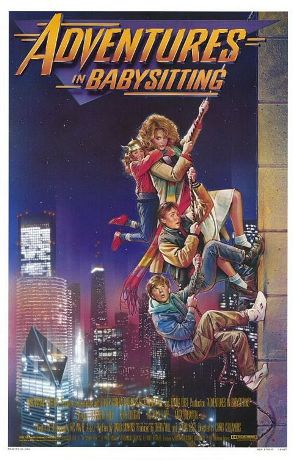
Back to School Part II #23: Adventures in Babysitting (dir by Chris Columbus)


adventures_in_babysitting

One unfortunate thing about both being the youngest of four and having a teenage reputation for being a little out of control is that I never got a chance to be a babysitter.  Whenever my mom wasn’t around, my older sisters were in charge.  When I was technically old enough to look after other children, nobody was willing to trust me with them.  So, I missed out on babysitting and…

Well, to be honest, that never really bothered me.  I was too busy either having too much fun or no fun at all to worry about any of that.  But maybe I should have because, whenever I watch the 1987 film Adventures in Babysitting, I’m always left convinced that I could have been a kickass babysitter.  Seriously, if Elisabeth Shue could still get babysitting jobs even after taking the kids into downtown Chicago and nearly getting them killed, then anyone could do it!

In Adventures in Babysitting, Chris Parker (Elisabeth Shue) is a responsible 17 year-old who lives in the suburbs of Chicago.  (As anyone who seen The Breakfast Club, Sixteen Candles, and Ferris Bueller’s Day Off can tell you, being a teenager in 1980s meant living in Illinois.)  When we first meet Chris, she’s getting ready for her anniversary date with her boyfriend, Mike Todwell (Bradley Whitford, years before achieving fame by playing assorted pompous jerks in assorted Aaron Sorkin productions) and she’s dancing around her bedroom.  There’s an important lesson to be learned from the opening of Adventures in Babysitting: if you want me to relate to a character, introduce her while she’s dancing in her bedroom.  Seriously, though, the whole film succeeds because of that opening bedroom dance.  Chris is instantly likable and relatable.  You want to see her succeed and achieve what she wants.

So, of course, we’re all disappointed when Mike shows up and breaks his date with Chris.  That said, as upset as Chris may be, she’s still willing to take the time to try to talk her friend Brenda (Penelope Ann Miller) out of trying to poison her stepmother with Drano.  That’s a true friend.

With nothing else to do, Chris ends up taking a babysitting job.  She has been tasked to look after 8 year-old Sara Anderson (Maia Brewton) and Sara’s brother, 15 year-old Brad (Keith Coogan).  Sara is a bit of a brat, though she’s also generally well-meaning and is obsessed with comic books (Thor, in particular).  Brad is likable but dorky.  He has a huge crush on Chris and even turns down a chance to spend the night at a friend’s, just so he can be around her.

Brad’s friend, incidentally, is Daryl (Anthony Rapp, who would later play Tony in Dazed and Confused and who starred in the original Broadway production of Rent).  Daryl is a hyperactive perv who is obsessed with Chris because she resembles the centerfold in one of his dad’s Playboys.  Daryl decides that, if his friend Brad can’t visit him, then maybe he should visit Brad!

However, Chris has more to worry about than just looking after Sara, Brad, and Daryl.  Brenda has attempted to run away from home and now she’s stuck in a downtown bus station!  Her glasses have been stolen and, as a result, Brenda is doing things like picking up a giant rat and calling it a kitten.  Brenda uses her last bit of money to call Chris and beg her to come pick her up.

(Of course, none of this would happen today.  Brenda wouldn’t have to use a pay phone to call Chris and she could just call Uber to get a ride home.)

So, Chris and the kids drive into Chicago and, needless to say, things quickly fall apart.  They get a flat tire on the expressway.  Chris panics when she discovers that not only does she not have a spare tire but she also left her purse back at the house.  They are briefly helped by a one-handed truck driver named Handsome John Pruitt (John Ford Noonan) but then Pruitt discovers that his wife is cheating on him and takes a detour so he can catch her in the act and, of course, this leads to Chris and the kids being kidnapped by a helpful car thief.  Soon, they’re being chased through Chicago by the Mafia and…

Well, it gets rather complicated but that’s kind of the appeal of the film.  The film starts out as a fairly realistic, John Hughes-style teen comedy and then it gets progressively crazier and crazier.  Downtown Chicago turns out to be a rather cartoonish place, one where one disaster follows after another.  (To be honest, if Adventures in Babysitting was released today, it would probably inspire a hundred increasingly tedious Salon think pieces on white privilege.  Bleh!)  But, regardless of how silly some of the adventures may get, Adventures in Babysitting remains grounded because of the good and likable performances and a script that is full of witty and quotable dialogue.

It’s an entertaining movie and it’s one of those films that always seems to be either on Showtime or Encore.  If you’re sad, watch it and be prepared to be massively cheered up!

(Avoid the Disney Channel remake.)


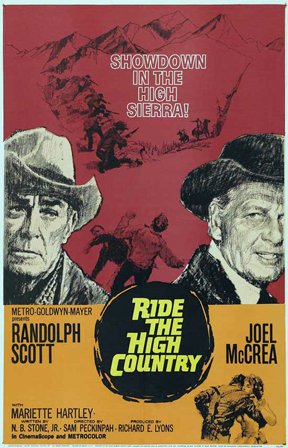
Thank You, Mr. Peckinpah: Ride the High Country (1962, directed by Sam Peckinpah)


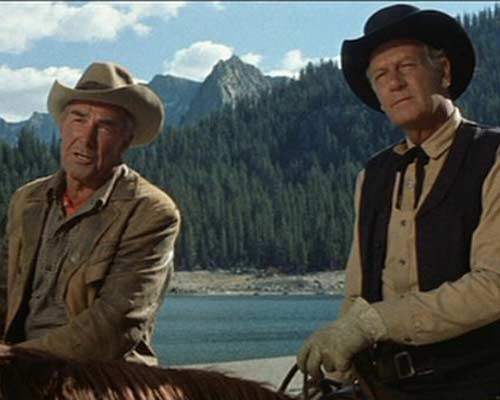
rideIt’s the turn of the 20th century and the Old West is fading into legend.  When they were younger, Steve Judd (Joel McCrea) and Gil Westrum (Randolph Scott) were tough and respect lawmen but now, time has passed them by.  Judd now provides security for shady mining companies while Gil performs at county fairs under the name The Oregon Kid.  When Judd is hired to guard a shipment of gold, he enlists his former partner, Gil, to help.  Gil brings along his current protegé, Heck Longtree (Ron Starr).
On their way to the mining camp, they spend the night at the farm of Joshua Knudsen (R.G. Armstrong) and his daughter, Elsa (Mariette Hartley).  Elsa is eager to escape her domineering father and flirts with Heck.  When they leave the next morning, Elsa accompanies them, planning on meeting her fiancée, Billy Hammond (James Drury), at the mining camp.

When they reach the camp, they meet Bill and his four brothers (John Anderson, L.Q. Jones, John Davis Chandler, and the great Warren Oates).  Billy is a drunk who is planning on “sharing” Elsa with his brothers.  Gil, Judd, and Heck rescue Elsa and prepare for a final confrontation with the Hammond Brothers.  At the same time, Gil and Heck are planning on stealing the gold, with or without Judd’s help.

Ride the High Country was actually Sam Peckinpah’s second film but it’s the first of his films to truly feel like a Sam Peckinpah film.  (For his first film, The Deadly Companions, Peckinpah was largely a director-for-hire and had no say over the script or the final edit.)  Peckinpah rewrote N.B. Stone’s original script and reportedly based the noble Steve Judd on his own father.  All of Peckinpah’s usual themes are present in Ride the High Country, with Judd and, eventually, Gil representing the dying nobility of the old west and the Hammond brothers and the greedy mining companies representing the coming of the “modern” age.  Ride The High Country‘s final shoot-out and bittersweet ending even serve as a template for Peckinpah’s later work in The Wild Bunch.

Much like the characters they were playing, Randolph Scott and Joel McCrea were two aging veterans on the verge of retirement.  For these two aging stars, who had starred in countless westerns before this one, Ride The High Country would provide both fitting farewell and moving tribute.  This would be the last chance that either of them would have to appear in a great movie and both of them obviously relish the opportunity.  The best moments in the film are the ones where Judd and Gil just talk with the majestic mountains of California in the background.

Among the supporting cast, Ron Starr and Mariette Hartley are well-cast as the young lovers but are never as compelling as Gil or Judd.  Future Peckinpah regulars R.G. Armstrong, L.Q. Jones, and Warren Oates all make early appearances.  Seven years after playing brothers in Ride the High Country, L.Q. Jones and Warren Oates would both appear in Peckinpah’s most celebrated film, The Wild Bunch.

The elegiac and beautifully-shot Ride The High Country was Sam Peckinpah’s first great film and it might be his best.

Randolph Scott and Joel McCrea in Ride The High Country

Randolph Scott and Joel McCrea in Ride The High Country

Film Review: Barquero (1970, directed by Gordon Douglas)


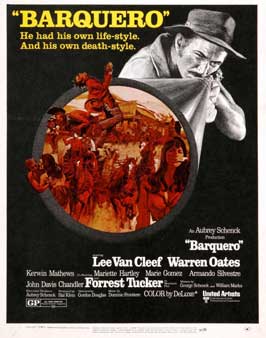
barquero-movie-poster-1970-1010695655Travis (Lee Van Cleef) is a former gunslinger who now makes his living taking settlers across a river on his small barge.  When we first meet him, he is telling a child to shut up and stop bothering him while he is guiding the barge.  He depends on the settlers on the other side of the river for his livelihood and they depend on him for transportation but he doesn’t like them and they don’t like him.  Travis only cares about two people, his Mexican lover, Nola (Maria Gomez) and an eccentric hunter named Mountain Phil (Forrest Tucker).

After stealing a shipment of silver, outlaw Jake Remy (Warren Oates) and his army of mercenaries need to cross the river to escape into Mexico.  To prevent anyone from following, they plan to destroy the barge afterward.  However, Travis and Phil find out that Remy is on the way and take the barge to the other side of the river.  When Jake and his gang arrive, a tense stand-off ensues, with the outlaws on one side of the river and Travis and the settlers trapped on the other.

Though Barquero was directed by the veteran American director Gordon Douglas (Douglas’s best known film is the 1950s giant ant film, Them!),  it was heavily influenced by contemporary Spaghetti Westerns and Sam Peckinpah’s The Wild Bunch.  This can be seen in both its graphic violence and in the casting of Lee Van Cleef and Warren Oates in the leading roles.

Travis was a perfect role for Van Cleef, a talented actor who was ignored by Hollywood until he found fame playing ruthless villains in European westerns.  Surly and unsmiling, Travis may seem like an unlikely hero but, like many of the best Spaghetti westerns, there are no traditional good guys in Barquero.  Travis is more interested in saving his boat than protecting the settlers.  He is a hero of circumstance.

As Jake, Warren Oates is a great villain.  In his very first scene, he and a prostitute watch as his gang massacre the citizens of a small town.  When the prostitute asks if she can come with them, Jake calmly replies, “I don’t think so” and shoots her dead.  Stuck on his side of the river, Jake smokes the local weed and starts to have violent hallucinations.  Soon, he is shooting bullets into the river.

Also doing good work are Forest Tucker as Mountain Phil and Kerwin Mathews.  Mathews, who is best remembered for starring in The 7th Voyage of Sinbad, plays the Marquette, a disgraced French nobleman who has started a second life as Jake Remy’s right-hand man.

Barquero starts with a bang but it struggles to keep up the momentum over its entire running time.  The opening shoot out is exciting but things slow down almost too much during the stand-off at the river.  It is an interesting but flawed western that deserves to be better known than it is and worth watching to see Lee Van Cleef and Warren Oates at their best.

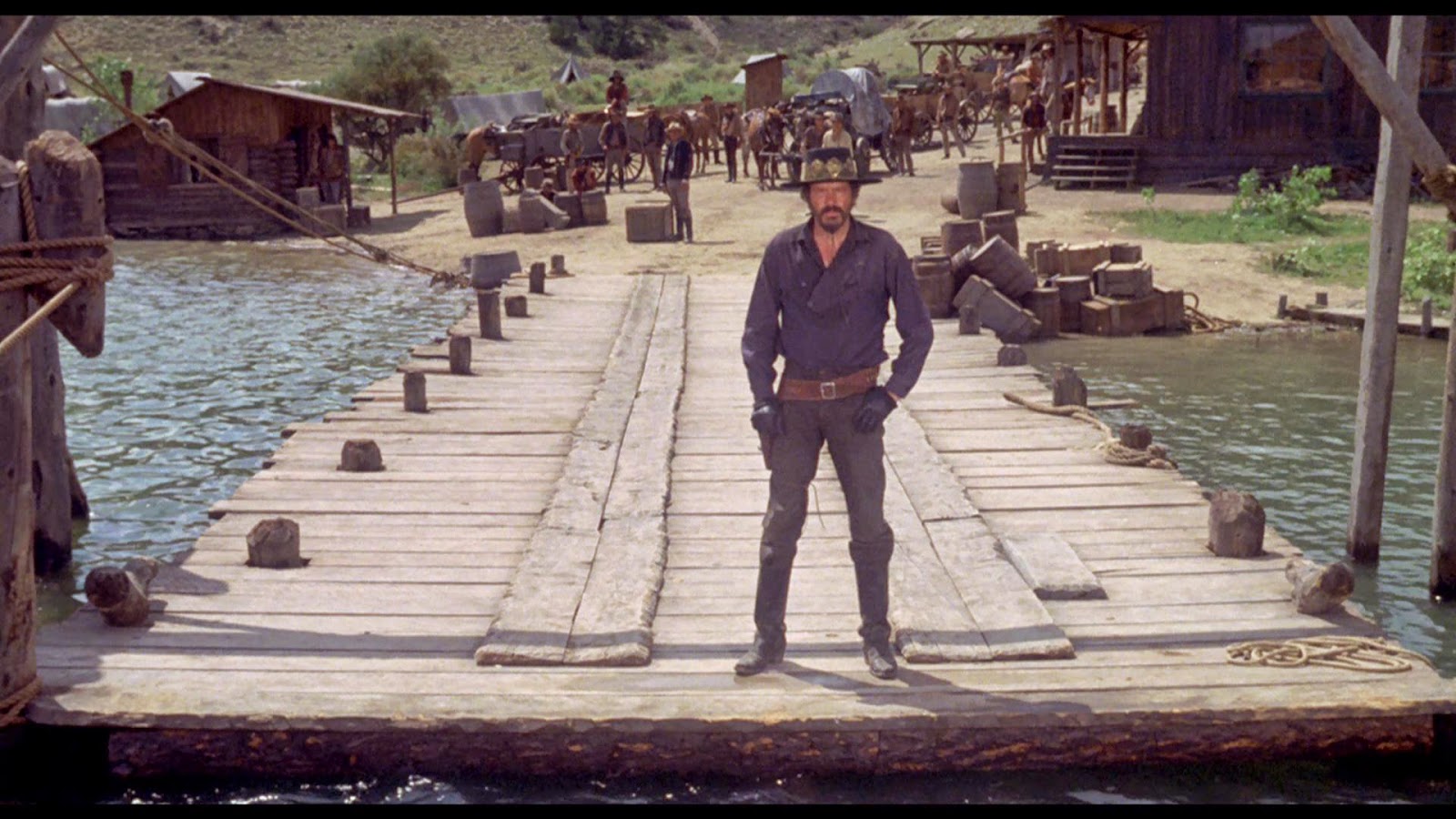
Barquero-Oates-on-dock

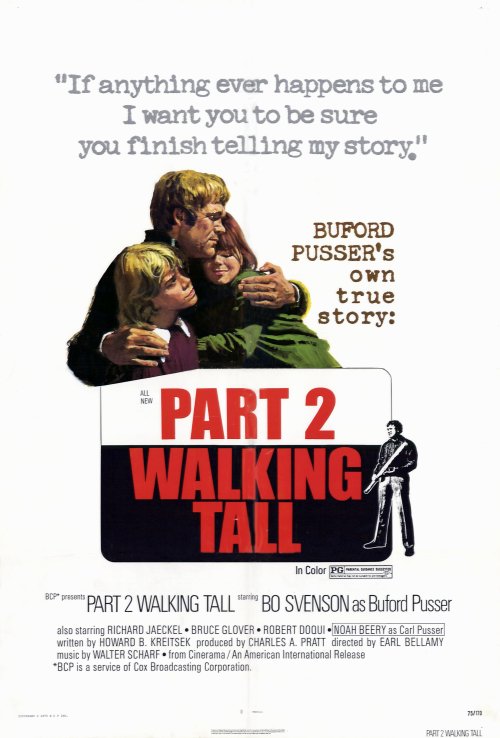
Embracing the Melodrama Part II #51: Walking Tall Part 2 (dir by Earl Bellamy)


Film_Poster_for_Walking_Tall_Part_2The 1975 southern melodrama Walking Tall Part 2 opens with a voice over telling us that we’re about to see more of the true of story Sheriff Buford Pusser, the Tennessee lawman who carried a big stick, battled the Dixie Mafia, and whose wife was killed in an ambush.  Pusser, we learn, died under suspicious circumstances shortly after the release of the film Walking Tall.

Mere hours before he died, Pusser had signed a contract to play himself in Walking Tall Part 2.  As a result of Pusser’s car “accident,” the film’s producers were forced to cast an actor as the lawman.  Now, it would have made sense to, once again, give the role to Joe Don Baker.  After all, he played the role in Walking Tall and I imagine that to most audiences at that time, he was Buford Pusser.  However, for whatever reason, Baker was not given the role for a second time.  Instead, the role was given to Bo Svenson and, while Svenson does not necessarily do a bad job in the role, he’s still no Joe Don Baker.  The difference between Baker and Svenson is the difference between someone being a redneck and someone just pretending.

The film opens almost immediately where Walking Tall ended.  Terribly wounded in the ambush that took his wife’s life, Buford is in the hospital and his face is covered in bandages.  Townspeople gather outside both his room and his farm and they wonder whether he’ll run for reelection as sheriff.  Someone else mentions that Buford has had massive facial reconstructive surgery.

Finally, the bandages are removed and we discover that Buford has turned into Bo Svenson.  Now, Svenson and Baker do have enough facial similarities that you can force yourself to believe that surgery could lead to Baker having Svenson’s features.  I mean, this isn’t like Mark Ruffalo taking over the role of Bruce Banner from Edward Norton.  At the same time, it’s hard not to wonder how reconstructive surgery could have led to Buford Pusser becoming a blonde or, for that matter, apparently growing by 5 inches between Walking Tall and Walking Tall Part 2.

Anyway, Buford’s out of the hospital and, of course, he’s reelected as sheriff.  One thing that quickly becomes apparent is that everyone in the world totally loves Buford Pusser.  I lost track of how many characters specifically walked up to Buford to tell him that he was a great man and a great sheriff.  Nobody complains about Buford’s habit of ignoring civil liberties while enforcing the law.  Instead, everyone cheers for him.

(And, just in case the viewer is uncomfortable with the sight of the very white Buford taunting the mostly black moonshiners that he spends the film arresting, Buford’s black deputy constantly says stuff like, “Buford, you’re my kind of sheriff!”)

The only people who don’t like Buford are the local crime lords.  They still want Buford dead so they hire a race car driver (Richard Jaeckel) to kill him.  The race car driver’s girlfriend (Angel Tompkins) attempts to hit on Buford but Buford has no interest in her.  Buford’s about enforcing the law and avenging his wife…

Walking Tall Part 2 is a pretty standard film.  Whereas the original Walking Tall had a raw and unpredictable vibe to it, the sequel is predictable and boring.  On the plus side, the film was made on location in rural Tennesee and some of the countryside is nice to look at.

As for Buford Pusser, he died before Part Two was released but the character would return in Walking Tall — The Final Chapter.