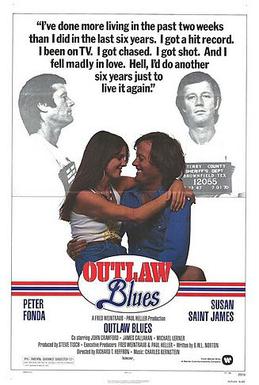
Cleaning Out The DVR: Outlaw Blues (dir by Richard T. Heffron)


The 1977 film, Outlaw Blues, opens in Huntsville State Prison. An arrogant country music star named Garland Dupree (James T. Callahan) is about to perform for the prisoners. He’s hoping his Huntsville concert will do for him what playing at Folsom did for Johnny Cash. The warden insists that Garland listen to a song written and performed by a soft-spoken prisoner named Bobby Ogden (Peter Fonda). A visibly annoyed Garland agrees but he doesn’t actually listen while Bobby performs. Instead, Garland is too busy arguing with the manager of his record label, Hatch (Michael Lerner). However, the members of Garland’s backup band record Bobby as he sings.

Several months later, Bobby is about to be released from prison when he learns that Garland is performing his song. Not only has Garland made it a hit but he’s also taking credit for writing it! Garland and Hatch even copyrighted the song, something that Bobby was never able to do because he was in prison.

Released from prison, Bobby ends up in Austin. He wants to stay out of prison and get his life straightened out. He wants to pursue a career as a singer. And he wants Garland to admit that he stole Bobby’s song. Unfortunately, when Bobby confronts Garland, things escalate and Garland ends up accidentally getting shot. Garland survives but now Bobby has the police after him. With the help of one of Garland’s former backup singers, Tina Waters (Susan Saint James), Bobby tries to become a star while staying one step ahead of the cops. Like the outlaws of old, Bobby and Tina sneak around Texas, performing where they can. (Knowing that any publicity is good publicity, Tina often calls the cop just as Bobby finishes his show, all the better for her and Bobby to make a dramatic escape.) Hatch is eager to record and release a Bobby Ogden record but both Bobby and Tina know that he can’t be trusted. But with the cops closing in, what choice do they have?

For a film about criminals on the run, Outlaw Blues is a surprisingly loose and laid back movie. It’s definitely a product of the 70s. It celebrates rebellion and doing your own thing, it mixes drama and comedy and, because it was made in the 70s, you know there’s always a good chance that, regardless of how pleasant the majority of the film may be, everyone’s going to die at the end of the movie. That definitely adds some tension to the film’s story that might not otherwise be there. For the most part, though, this is an enjoyable little lark of a drive-in movie. It celebrates individualism while also finding time for a few songs and a car chase or two.

A good deal of the film’s charm is the result of the chemistry between the two stars. Peter Fonda and Susan Saint James just seem as if they belong together and they both play characters who are written with slightly more depth than you might otherwise expect from what was obviously meant to be a cheap, drive-in film. Tina may appear to be a hippie but, as played by Saint James, she eventually turns out to be a clever businesswoman and promoter. As for Peter Fonda, he definitely had his acting limitations but he also had a nice smile and a far more likable screen presence than you might suspect if you only know him from his remote performance in Easy Rider. In Outlaw Blues, Fonda’s inexpressive manner feels right for someone who has spent most of his life in prison and who is still adjusting to being on the outside. Fonda wins you over and, once his character falls in love with Saint James, Fonda starts to relax and you get the feeling that both he and Bobby Ogden are having fun.

Outlaw Blues may be a minor 70s film but it’s likable. It has an amiable spirit which makes it worth watching.
Cleaning Out The DVR: The 300 Spartans (dir by Rudolph Mate)


King Xerxes (David Farrar), the ruler of Persia, is leading his armies across the ancient world, conquering every nation that he comes to. Xerxes is quick to proclaim that his vision is to have “one world ruled by one master” but really, he’s mostly just trying to prove that he’s as fearsome a conqueror as his father was. Like most authoritarians, he’s really just dealing with his own psychological issues.

When Xerxes sets his eyes on Greece, he assumes that he’ll easily be able to conquer the country. Greece, after all, is divided into several city states and everyone knows that the cities are rarely willing to work together. However, 300 Spartan warriors — led by King Leonidis (Richard Egan) — are willing to stand their ground and hold off Xerxes’s forces for as long as possible. Despite the fact that they’re outnumbered and have no way of knowing if reinforcements will ever arrive, the 300 Spartans are willing to do whatever it takes to protect their freedom. They know that they probably won’t survive the battle but none of them are going to surrender. Better to die than be enslaved.

If the plot of 1962’s The 300 Spartans sounds familiar, that’s probably because it’s based on the same historical events that inspired 300. The 300 Spartans essentially tells the same story and even has many of the same themes as Zack Snyder’s later film. The main difference, of course, is that The 300 Spartans tells it story in a much less stylized manner. Indeed, while 300 tended to kind of take place in a dream-world, one that was designed to highlight the legendary elements of the story, The 300 Spartans very much takes place in the real world, with the actors playing the ancient warrions standing on the same ground that Leonidis and his 300 Spartans once stood upon. It’s a choice that works well, giving The 300 Spartans a far more authentic feel than a lot of the other historical epics that came out in the 50s and 60s.

The 300 Spartans has everything that you might expect from a film like this: dancing, harems, swords, armor, a lot of talk of omens and honor, and of course several speeches about the importance of freedom. That said, even if some elements of the story are predictable, the film is well-acted with Richard Egan giving a strong performance as Leonidis while David Farrar turns Xerxes into a villain who you’ll enjoy rooting against. Anne Wakefield is also well-cast as Artemesia, Xerxes’s consort and his main advisor. Perhaps best of all is Ralph Richardson, playing the general Themistocles with the grim determination of a warrior who has learned better than to depend on omens and prophecy.

At the end of the film, the narrator grandly declares that the actions of the 300 Spartans were more than an example of Greek bravery. They were also, “a stirring example to free people throughout the world of what a few brave men can accomplish once they refuse to submit to tyranny!” Maybe a few years ago, I would have said that the narration went a bit overboard but, after the past few years, I’m now more convinced than ever that a lot of people would be fine living in an authoritarian state as long as their side was the one with all of the authority. At a time like this, any film that celebrates freedom is to be appreciated.

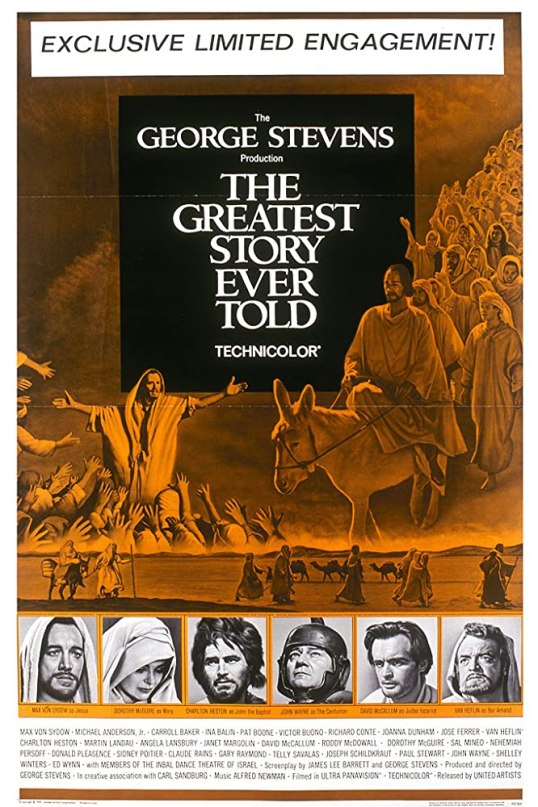
Film Review: The Greatest Story Ever Told (dir by George Stevens)


The 1965 biblical epic, The Greatest Story Ever Told, tells the story of the life of Jesus, from the Nativity to the Ascension.  It’s probably the most complete telling of the story that you’ll ever find.  It’s hard to think of a single details that’s left out and, as a result, the film has a four hour running time.  Whether you’re a believer or not, that’s a really long time to watch a reverent film that doesn’t even feature the campy excesses of something like The Ten Commandments.

(There’s actually several different version of The Greatest Story Ever Told floating around.  There’s a version that’s a little over two hours.  There’s a version that’s close to four hours.  Reportedly, the uncut version of the film ran for four hour and 20 minutes.)

Max von Sydow plays Jesus.  On the one hand, that seems like that should work because Max von Sydow was a great actor who gave off an otherworldly air.  On the other hand, it totally doesn’t work because von Sydow gives an oddly detached performance.  The Greatest Story Ever Told was von Sydow’s first American film and, at no point, does he seem particularly happy about being involved with it.  von Sydow is a very cerebral and rather reserved Jesus, one who makes his points without a hint of passion or charisma.  When he’s being friendly, he offers up a half-smile.  When he has to rebuke his disciples for their doubt, he sounds more annoyed than anything else.  He’s Jesus if Jesus was a community college philosophy professor.

The rest of the huge cast is populated with familiar faces.  The Greatest Story Ever Told takes the all-star approach to heart and, as a result, even the minor roles are played by actors who will be familiar to anyone who has spent more than a few hours watching TCM.  Many of them are on screen for only a few seconds, which makes their presence all the more distracting.  Sidney Poitier shows up as Simon of Cyrene.  Pat Boone is an angel.  Roddy McDowall is Matthew and Sal Mineo is Uriah and John Wayne shows up as a centurion and delivers his one line in his trademark drawl.

A few of the actors do manage to stand out and make a good impression.  Telly Savalas is a credible Pilate, playing him as being neither smug nor overly sympathetic but instead as a bureaucrat who can’t understand why he’s being forced to deal with all of this.  Charlton Heston has just the right intensity for the role of John the Baptist while Jose Ferrer is properly sleazy as Herod.  In the role Judas, David McCallum looks at the world through suspicious eyes and does little to disguise his irritation with the rest of the world.  The Greatest Story Ever Told does not sentimentalize Judas or his role in Jesus’s arrest.  For the most part, he’s just a jerk.  Finally, it’s not exactly surprising when Donald Pleasence shows up as Satan but Pleasence still gives a properly evil performance, giving all of his lines a mocking and often sarcastic bite.

The Greatest Story Ever Told was directed by George Stevens, a legitimately great director who struggles to maintain any sort of narrative momentum in this film.  Watching The Greatest Story Ever Told, it occurred to me that the best biblical films are the ones like Ben-Hur and The Robe, which both largely keep Jesus off-screen and instead focus on how his life and teachings and the reports of his resurrection effected other people.  Stevens approaches the film’s subject with such reverence that the film becomes boring and that’s something that should never happen when you’re making a film set in Judea during the Roman era.

I do have to admit that, despite all of my criticism of the film, I do actually kind of like The Greatest Story Ever Told.  It’s just such a big production that it’s hard not to be a little awed by it all.  That huge cast may be distracting but it’s still a little bit fun to sit there and go, “There’s Shelley Winters!  There’s John Wayne!  There’s Robert Blake and Martin Landau!”  That said, as far as biblical films are concerned, you’re still better off sticking with Jesus Christ Superstar.

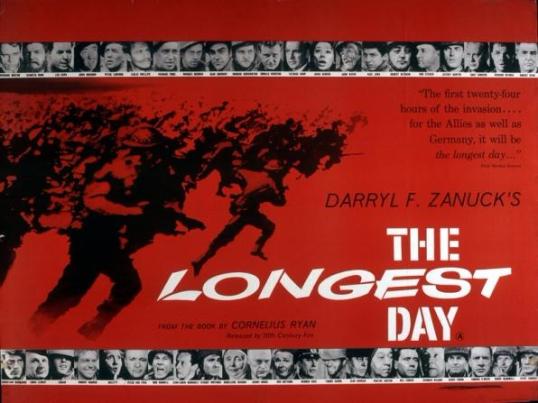
Lisa Reviews An Oscar Nominee: The Longest Day (dir by Ken Annakin, Andrew Marton, Bernhard Wicki, Gerd Oswald, and Darryl F. Zanuck)


As my sister has already pointed out, today is the 73rd anniversary of D-Day.  With that in mind, and as a part of my ongoing mission to see and review every single film ever nominated for best picture, I decided to watch the 1962 film, The Longest Day!

The Longest Day is a pain-staking and meticulous recreation of invasion of Normandy, much of it filmed on location.  It was reportedly something of a dream project for the head of the 20th Century Fox, Darryl F. Zanuck.  Zanuck set out to make both the ultimate tribute to the Allied forces and the greatest war movie ever.  Based on a best seller, The Longest Day has five credited screenwriters and three credited directors.  (Ken Annakin was credited with “British and French exteriors,” Andrew Marton did “American exteriors,” and the German scenes were credited to Bernhard Wicki.  Oddly, Gerd Oswald was not credited for his work on the parachuting scenes, even though those were some of the strongest scenes in the film.)  Even though he was not credited as either a screenwriter or a director, it is generally agreed that the film ultimately reflected the vision of Darryl F. Zanuck.  Zanuck not only rewrote the script but he also directed a few scenes as well.  The film had a budget of 7.75 million dollars, which was a huge amount in 1962.  (Until Steven Spielberg’s Schindler’s List, The Longest Day was the most expensive black-and-white film ever made.)  Not only did the film tell an epic story, but it also had an epic length.  Clocking in at 3 hours, The Longest Day was also one of the longest movies to ever be nominated for best picture.

The Longest Day also had an epic cast.  Zanuck assembled an all-star cast for his recreation of D-Day.  If you’re like me and you love watching old movies on TCM, you’ll see a lot of familiar faces go rushing by during the course of The Longest Day.  American generals were played by actors like Robert Mitchum, Robert Ryan, Henry Fonda, and John Wayne.  Peter Lawford, then the brother-in-law of the President of the United States, had a memorable role as the Scottish Lord Lovat, who marched through D-Day to the sounds of bagpipes.  When the Allied troops storm the beach, everyone from Roddy McDowall to Sal Mineo to Robert Wagner to singer Paul Anka can be seen dodging bullets.  Sean Connery pops up, speaking in his Scottish accent and providing comic relief.  When a group of paratroopers parachute into an occupied village, comedian Red Buttons ends up hanging from the steeple of a church.  When Richard Beymer (who is currently playing Ben Horne on Twin Peaks) gets separated from his squad, he stumbles across Richard Burton.  Among those representing the French are Arletty and Christian Marquand.  (Ironically, after World War II, Arletty was convicted of collaborating with the Germans and spent 18 months under house arrest.  Her crime was having a romantic relationship with a German soldier.  It is said that, in response to the charges, Arletty said, “My heart is French but my ass is international.”)  Meanwhile, among the Germans, one can find three future Bond villains: Gert Frobe, Curt Jurgens, and Walter Gotell.

It’s a big film and, to be honest, it’s too big.  It’s hard to keep track of everyone and, even though the battle scenes are probably about an intense as one could get away with in 1962 (though it’s nowhere near as effective as the famous opening of Saving Private Ryan, I still felt bad when Jeffrey Hunter and Eddie Albert were gunned down), their effectiveness is compromised by the film’s all-star approach.  Often times, the action threatens to come to a halt so that everyone can get their close-up.  Unfortunately, most of those famous faces don’t really get much of a chance to make an impression.  Even as the battle rages, you keep getting distracted by questions like, “Was that guy famous or was he just an extra?”

Among the big stars, most of them play to their personas.  John Wayne, for instance, may have been cast as General Benjamin Vandervoort but there’s never any doubt that he’s playing John Wayne.  When he tells his troops to “send them to Hell,” it’s not Vandervoort giving orders.  It’s John Wayne representing America.  Henry Fonda may be identified as being General Theodore Roosevelt II but, ultimately, you react to him because he’s Henry Fonda, a symbol of middle-American decency.  Neither Wayne nor Fonda gives a bad performance but you never forget that you’re watching Fonda and Wayne.

Throughout this huge film, there are bits and pieces that work so well that you wish the film had just concentrated on them as opposed to trying to tell every single story that occurred during D-Day.  I liked Robert Mitchum as a tough but caring general who, in the midst of battle, gives a speech that inspires his troops to keep fighting.  The scenes of Peter Lawford marching with a bagpiper at his side were nicely surreal.  Finally, there’s Richard Beymer, wandering around the French countryside and going through the entire day without firing his gun once.  Beymer gets the best line of the film when he says, “I wonder if we won.”  It’s such a modest line but it’s probably the most powerful line in the film.  I wish The Longest Day had more scenes like that.

The Longest Day was nominated for best picture of 1962 but it lost to an even longer film, Lawrence of Arabia.

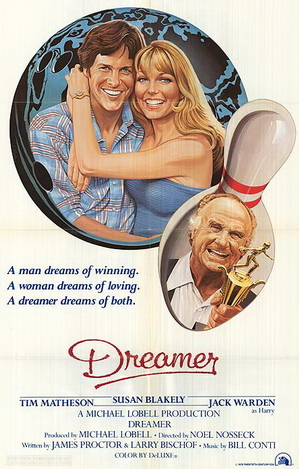
Lisa Cleans Out Her DVR: Dreamer (dir by Noel Nosseck)


(I am currently trying to clean out my DVR!  I recorded this 1979 sports film off of FXM on February 1st!)

In Dreamer, Tim Matheson plays a character named Harold Nuttingham.  His nickname is Dreamer.  Do you think it’s possible that Harold has a dream!?  Well, it would probably be a really cruel nickname if he didn’t!

Dreamer lives in small town Illinois.  He loves to bowl.  He spends all of his time down at the local bowling alley, where everyone knows him and they all love him and his dreams of becoming a professional bowler.  His mentor is named Harry White (Jack Warden) and runs the pro shop.  Harry dreamed of being a famous, champion bowler but his dreams didn’t come true.  But now he can help Dreamer’s dreams work out.  Everyone loves the fact that Harry is helping Dreamer.  Dreamer’s girlfriend is named Karen Lee (Susan Blakely).  She loves that Dreamer loves bowling but she is frustrated because everyone keeps telling Dreamer that it would be a mistake to take her to his games.  Karen might bring bad luck.

Everyone in his hometown loves Dreamer but the Professional Bowling Association (which apparently is an actual thing) doesn’t love Dreamer.  They don’t want to let Dreamer compete on a professional level.  Or, at least, they don’t until Dreamer meets with them personally and shows off his amazing bowling skills.  Then they love Dreamer.

Even though Dreamer is the new guy on the professional circuit, the audiences love him.  And all the other professional bowlers love him, even when they lose to him.  Everyone loves Dreamer, perhaps because everyone loves a dreamer…

Are you getting the impression that Dreamer might be one of the most positive movies ever made?  Well, it is.  Hardly anyone says a bad word about anyone in Dreamer.  Nobody tells Dreamer to give up.  Dreamer never really suffers from any self-doubt, though he does injure his thumb at one point.  There is a moment of tragedy towards the end of the movie but it’s one of those tragedies that leads to better things.  You can’t have light without a little darkness, though Dreamer seems to suggest that you can come awfully close.

Normally, films get on my nerves when they’re overwhelmingly positive but I can’t really complain about a movie like Dreamer.  It’s just so earnest and sincere.  There’s no real conflict and there’s no real drama but everyone in the movie is just so damn likable that you almost feel guilty for wishing something unexpected would happen.  Dreamer struggles and fails to make bowling cinematic but Dreamer’s a nice guy so you wish him the best.

Perhaps the most interesting thing about Dreamer is that it was directed by Noel Nosseck, who also directed an incredibly odd little grindhouse film called Best Friends.  Best Friends, which I recommend tracking down, is almost the anti-Dreamer.  Watch Best Friends to have your faith in humanity destroyed and then follow it up with Dreamer so your faith can be restored.

Or don’t.  It’s really up to you.

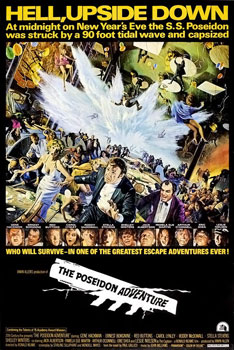
Embracing the Melodrama Part II #44: The Poseidon Adventure (dir by Ronald Neame)


PoseidonAdventure

A few years ago, when I first told Arleigh that I had recently watched the 1972 film The Poseidon Adventure, I remember him as being a bit shocked and amazed that I had made it through the entire film.  This was because Arleigh knows that I have a morbid obsession with drowning and that the mere sight of someone struggling underwater is enough to send me into a panic attack.

And The Poseidon Adventure is a film that is totally about drowning.  The majority of the cast drowns over the course of the film.  The few who survive spend all of their time trying not to drown.  The main villain in The Poseidon Adventure is the ocean.  The Poseidon Adventure is a film specifically designed to terrify aquaphobes like me.

And there are certain parts of The Poseidon Adventure that freaked me out when I first watched it and which continue to freak me out whenever I rewatch it.

For instance, just the film’s plot freaks me out.  On New Year’s Day, an ocean liner is capsized by a huge tidal wave.  With the boat upside down, a small group of survivors struggle to make their way up to the hull where, hopefully, they might be rescued.  That involves a lot of fighting, arguing, climbing, and drowning.

It freaks me out whenever I see the huge tidal wave crash into the bridge and drown Captain Leslie Nielsen.  That’s largely because it’s impossible for me to look at Leslie Nielsen without smiling.  (I’ve already written about my reaction to seeing him in the original Prom Night.)  When he suddenly drowns, it’s not funny at all.

It freaks me out when the boat turns over and hundred of extras are tossed around the ballroom.  I always feel especially bad for the people who vainly try to hold onto the upside down tables before eventually plunging to their deaths.  (Did I mention that I’m scared of heights as well?)

It freaks me out when Roddy McDowall plunges to his death because who wants to see Roddy McDowall die?  Whenever I see him in an old movie, he always come across as being such a super nice guy.  (Except in Cleopatra, of course…)  Plus, Roddy had an absolutely chilling death scream.  They need to replace the Wilhelm Scream with the Roddy Scream.

It freaks me out when survivor Shelley Winters has a heart attack right after swimming from one part of the ship to another.  Because seriously, Shelley totally deserved the Oscar nomination that she got for this film.

And it really freaks me out when Stella Stevens plunges to her death because I related to Stella’s character.  Stella was tough, she didn’t take any crap from anyone, and she still didn’t make it.  If Stella Stevens can’t make it, what hope would there be for me?

And yet, at the same time, The Poseidon Adventure is such an entertaining film that I’m willing to be freaked out.  The Poseidon Adventure was one of the first of the classic disaster films and it’s so well done that even the parts of the film that don’t work somehow do work.

For instance, Gene Hackman plays the Rev. Frank Scott, the leader of the group of survivors.  And Hackman, who can legitimately be called one of the best actors ever, gives an absolutely terrible performance.  His performance is amazingly shrill and totally lacking in nuance.  When, toward the end of the film, he starts to angrily yell at God, you actually feel sorry for God.  And yet, Hackman’s terrible performance somehow works perfectly for the film.  It’s such an over-the-top performance that it sets the tone for the whole film.  The Poseidon Adventure is an over-the-top film and, if Hackman had invested his character with any sort of nuance, the film would not have worked as well as it did.

And then there’s Ernest Borgnine, who plays Stella Stevens’s husband.  Borgnine spends the entire film arguing with Gene Hackman.  Whenever something bad happens, Borgnine starts acting like Edward G. Robinson in The Ten Commandments.  He never actually says, “Where is your God now!?” but it wouldn’t have been inappropriate if he had.  And yet, again, it’s exactly the type of performance that a film like this needs.

And finally, there’s that theme song.  “There has to be a morning after…”  It won an Oscar, defeating Strange Are The Ways Of Love from The Stepmother.  And is it a good song?  No, not really.  It’s incredibly vapid and, while it does get stuck in your head, you don’t necessarily want it there.  But you know what?  It’s the perfect song for this film.

The Poseidon Adventure is not a deep film, regardless of how many times Hackman and Borgnine argue about the role of God in the disaster.  It’s an amazingly shallow film about people drowning.  But it’s so well-made and so perfectly manipulative that you can’t help but be entertained.

The Poseidon Adventure totally freaks me out.  But I will probably always be willing to find time to watch it.

Embracing the Melodrama #28: The Towering Inferno (dir by John Guillermin)


The_Towering_Inferno_1974-500x300

I have a weakness for the old, all-star disaster movies of the 1970s.  It could be because those movies remind me of how fragile life really is and encourage me to make the most of every minute.  Or maybe it’s because I have my phobias and, by watching those movies, I can confront my fears without having to deal with a real-life tornado, hurricane, tidal wave, avalanche, or fire.

Or maybe I just have a weakness of glitz, glamour, and melodrama — especially when it involves a huge cast of stars and character actors.  Yes that’s probably the reason right there.

Case in point: the 1974 best picture nominee, The Towering Inferno. 

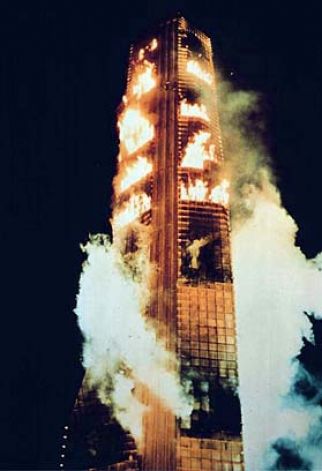
As is the case with most of the classic disaster films, The Towering Inferno is a long and big movie but it has a very simple plot.  The world’s tallest building — known as the Glass Tower — has been built in San Francisco.  On the night of the grand opening, a fire breaks out, trapping all the rich and famous guests on the 135th floor.  Now, it’s up to the fire department to put out the fire while the trapped guests simply try to survive long enough to be rescued.  Some will live, some will die but one thing is certain — every member of the all-star cast will get at least 15 minutes of screen time and at least one chance to scream in the face of the film’s still effective special effects.

628x471

As for the people trapped by the towering inferno, we don’t really get to know them or their motivations.  (Add to that, once the fire breaks out, everyone pretty much only has one motivation and that’s to not die.)  As a result, we don’t so much react to them as characters as we do to personas of the actors who are playing them.

Steve-McQueen-in-The-Towe-001

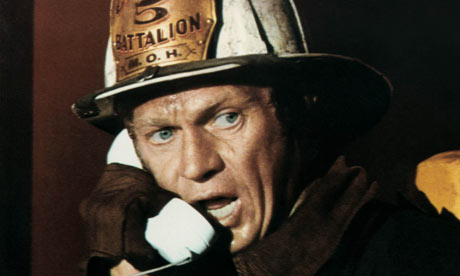
For instance, we know that Fire Chief O’Halloran is a fearless badass and a natural leader because he’s played by Steve McQueen.  McQueen brings a certain blue collar arrogance to this role and it’s a lot of fun to watch as he gets progressively more and more annoyed with the rich people that he’s been tasked with rescuing.

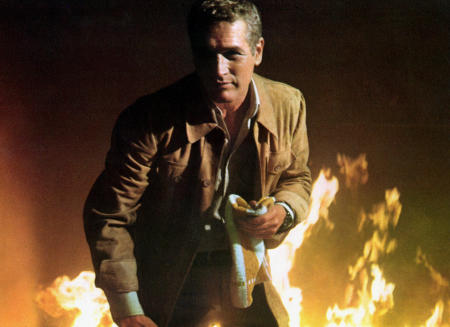
We know that architect Doug Roberts is a good guy because he’s played by Paul Newman.  Reportedly, Newman and McQueen were very competitive and, in this movie, we literally get to see them go-head-to-head.  And, as charismatic as Newman is, McQueen pretty much wins the movie.  That’s because there’s never a moment that O’Halloran isn’t in charge.  Doug, meanwhile, spends most of the movie begging everyone else in the tower to exercise the common sense necessary to not die.  (Unfortunately, despite the fact that he looks and sounds just like Paul Newman, nobody in the tower feels like listening to Doug.  If Towering Inferno proves anything, it’s that most people are too stupid to survive a disaster.)

paul-newman-inferno1

The tower’s owner, James Duncan, is played by William Holden so we know that Duncan may be a ruthless businessman but that ultimately he’s one of the good guys.  Holden gets one of the best scenes in the film when, after being told that people in the building are catching on fire, he replies, “I think you’re overreacting.”

Roger Simmons is Duncan’s son-in-law and we know that he’s ultimately to blame for the fire because he’s played by Richard Chamberlain.  Roger might as well have a sign on his back that reads “Doomed.”  The same can be said of publicity executive Dan (Robert Wagner) and his girlfriend, Lorrie (Susan Flannery).

The_Towering_Inferno_1974_Faye_Dunaway_Mike_Lookinland

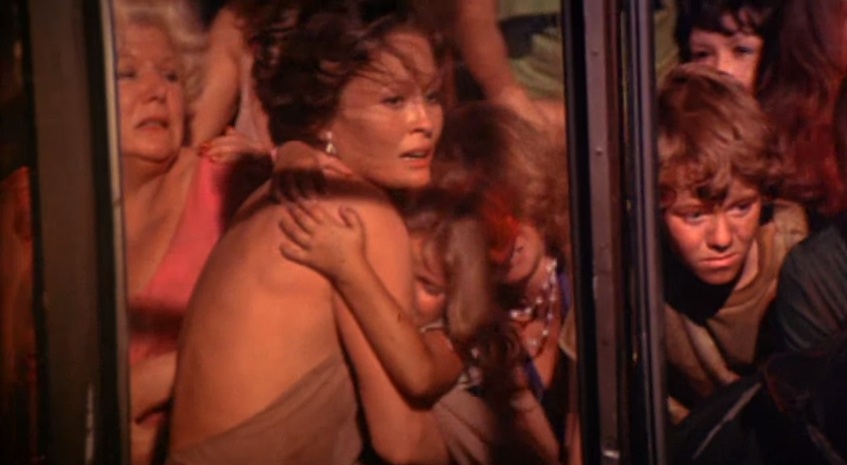
Faye Dunway is Susan.  She is Doug’s fiancée and she really doesn’t do much but she does get to wear a really pretty dress.  The same can be said of Susan Blakely, who plays Roger’s dissatisfied wife, and Jennifer Jones, who plays a recluse.  And good for them because if you’re going to be stuck in an inferno without much to do, you can at least take some comfort in looking good.

Then there’s Fred Astaire, who does not dance in this film.  Instead, he plays a kind-hearted con artist who ends up falling in love with Jennifer Jones.  Fred Astaire received his only Oscar nomination for his brief but likable performance in The Towering Inferno.

And finally, there’s the building’s head of security, Jernigan.  We know that he’s a murderer because he’s played by O.J. Simpson and … oh wait.  Jernigan is actually probably the second nicest guy in the whole film.  The only person nicer than Jernigan is Carlos, the bartender played by Gregory Sierra.

OJ

The real star of the film, of course, is the fire.  In the 40 years since The Towering Inferno was produced, there’s been a lot of advances in CGI and I imagine that if the film was made today, we’d be watching the fire in 3D and it would be so realistic that we’d probably feel the heat in the theater.  That said, the fire effects in The Towering Inferno are still pretty effective.  Now, I have to admit that I have a phobia (and frequent nightmares) about being trapped in a fire so, obviously, this is a film that’s specifically designed to work itself into my subconscious.  But that said, the scenes with various extras thrashing about in the flames are still difficult to watch.  There’s a scene where Robert Wagner and Susan Flannery find themselves trapped in a blazing reception area and it is pure nightmare fuel.

The Towering Inferno 9

The Towering Inferno is an undeniably effective disaster film.  At the same time, when one looks at the 1974 Oscar nominees, it’s odd to see The Towering Inferno nominated for best picture along with The Godfather Part II, Chinatown, and The Conversation.  Unlike those three, The Towering Inferno is hardly a great film.

But it is definitely an entertaining one.

toweringinferno2