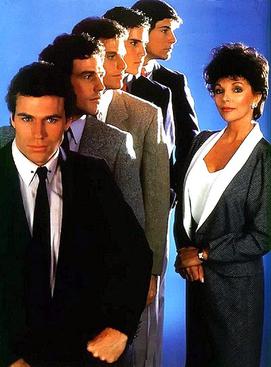
Retro Television Reviews: The Love Boat 6.21 “The Captain’s Crush/Out Of My Hair/Off-Course Romance”


Welcome to Retro Television Reviews, a feature where we review some of our favorite and least favorite shows of the past!  On Wednesdays, I will be reviewing the original Love Boat, which aired on ABC from 1977 to 1986!  The series can be streamed on Paramount Plus!
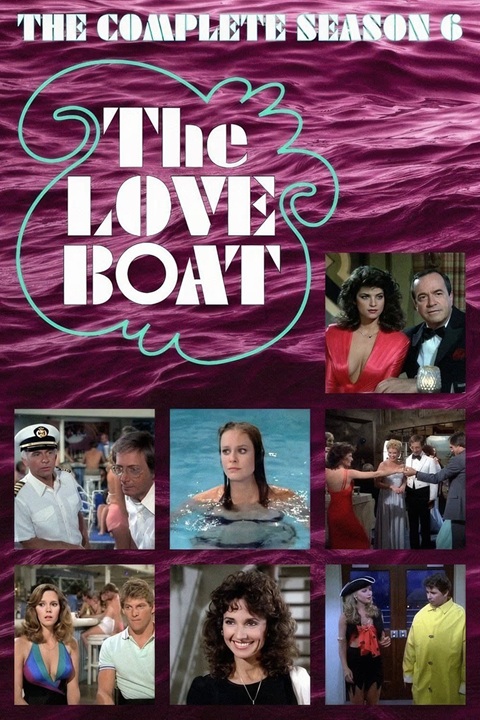
Welcome aboard, it’s love!

Episode 6.21 “The Captain’s Crush/Out Of My Hair/Off-Course Romance”

(Dir by Ted Lange, originally aired on February 19th, 1983)

Kathy Costello (Stella Stevens) is looking forward to taking a cruise with her husband, Joe (Monte Markham).  However, at the last minute, Joe decides that he would rather go to a golf tournament than take a vacation with his wife.  The angry Kathy boards the boat and immediately runs into her ex-boyfriend, Ted Cole (Ron Ely).  Kathy enjoys spending time with Ted but then suddenly, Joe shows up on the cruise.  He’s not happy to discover his wife is spending time with her ex.  The main problem with this story is that there’s no one to root for.  Kathy is cheating but her husband is being a jerk.  It’s rare that I ever watch an episode of The Love Boat and say, “This should end with divorce,” but this episode inspired me.

Meanwhile, Lydia (Delta Burke) boards the boat with her wealthy fiancé (Jeffrey Tambor).  Lydia’s ex-boyfriend (Richard Gilliland) also boards the boat, hoping to break up their engagement.  This storyline felt oddly similar to the other storyline and it suffered from the same problem.  There was no one to root for.  None of these people deserved to get married.

Finally, movie star Janine Adams (Joan Collins) boarded the boat and ate dinner with the Captain.  The next day, the tabloid news wires are full of speculation that the Captain is going to become Jane’s tenth husband and the Captain starts to think that maybe he’d like to be Jane’s tenth husband.  Go for it, I say!  Seriously, Janine and the Captain are as close to a likable couple as this episode has so they might as well get married.  Of course, they don’t get married.  I guess that’s a good thing.  It’s hard to imagine The Love Boat without Captain Stubing at the helm.

This episode was directed by Ted Lange and, as usual, he gets good performances from the cast.  Unfortunately, this cruise is let down by two weakly-written stories.
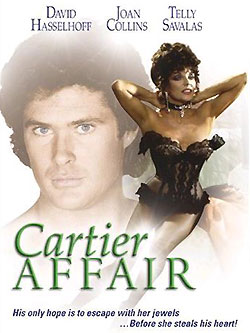
Made-For-TV Movie Review: The Cartier Affair (dir by Rod Holcomb)


In 1984’s The Cartier Affair, David Hasselhoff plays Curt Taylor.  He has spent the last few years in prison, having been convicted of selling deeds to fake oil wells.  He has passed the time by watching a soap opera that stars actress Cartier Rand (Joan Collins).  He has also managed to get in debt to the local prison mob boss, Phil Drexler (Telly Savalas).

When Curt learns that he’s being released from prison, Drexler informs him that he’s still expected to find a way to pay off his debt.  On the outside, Curt discovers that even his parole officer (Ed Lauter) works for Drexler!  Curt is assigned to become the private secretary of Cartier Rand and to steal her jewelry.  In order to get the job, Curt has to pretend to be gay.  That’s the only way that Cartier’s boyfriend (Charles Napier) would be willing to accept the idea of a male private secretary.

(Wouldn’t it just be simpler for Curt to rob a bank or something?)

Once he’s a part of the household staff, Curt discovers that Cartier is more than just the star of his favorite soap opera.  She’s someone who is tired of reciting melodramatic dialogue and kissing her co-stars.  She has serious ambitions.  Curt is immediately attracted to her and soon, Cartier is attracted to Curt.  But, of course, Curt is pretending to be gay and, to his horror, Cartier sets Curt up with one of her gay friends.

Meanwhile, the bad guys want their money….

The first half of the film is taken up by scenes of people mistaking Curt for being gay and there are more than a few moments and jokes that a film wouldn’t be allowed to get away with today.  A scene where Curt finds himself in a gay bar is cringey because, rather than asking us to laugh at Curt for panicking about finding himself in the rather innocuous location, the film asks us to instead laugh at the sight of men slow-dancing with other men.  Early on in the film, there’s a few scene where Hasselhoff overplays his attempts to come across as being gay.  Fortunately, Hasselhoff soon stops doing that and his performance improves as the film goes on.

The film gets slightly better during the second half, when Cartier learns the truth about Curt and the two of them somewhat implausibly go on the run from the bad guys.  They end up getting chased out to the desert, trading one-liners all the way, and I do have to admit that Collins and Hasselhoff displayed a surprising amount of chemistry during those scenes.

The film is tonal mishmash that doesn’t really work.  It tries to parody the type of soap operas that made Cartier Rand a star and it also tries to be a relatively exciting chase film but it keeps getting bogged down in plot points that ultimately feel rather superfluous.  My main issue that, if Drexler really wanted to get him money from Curt, it seems like he would have come up with a less complicated scheme, like robbing a bank or fencing stolen goods or something like that.  Instead, Curt is supposed to go undercover, pretend to be gay, and rob one of the most famous women on the planet.  I mean, Hell, he could have just broken into a jewelry store and gotten it all done in one night.  That said, Hasselhoff and Collins have a bit of charm to them.  It’s a shame they didn’t co-star in a better film.

May Noir: The Big Sleep (dir by Michael Winner)


Raymond Chandler’s detective classic, The Big Sleep, has twice been adapted for film.

The first version came out in 1946, just seven years after the book’s publication.  That version starred Humphrey Bogart as detective Philip Marlowe and Lauren Bacall as Vivian, the daughter of a man who has hired Marlowe to discover who is trying to blackmail him.  Directed by Howard Hawks and co-written by William Faulkner, this version of The Big Sleep is considered to be a classic noir, one that was cited as being a major influence on director Akira Kurosawa.

The 1978 version was directed by Michael Winner, takes place in London in the 1970s, and features Robert Mitchum as Marlowe.  Despite a strong ensemble cast and an excellent lead performance from Mitchum, this version of The Big Sleep still features one of the worst performances ever put on film.

Sarah Miles plays the role of Charlotte Sternwood Regan, the eldest daughter of General Sternwood (James Stewart).  Miles is playing the role that Lauren Bacall played in the first film and, despite the fact that they both earlier co-starred to a certain amount of acclaim in Ryan’s Daughter, Miles and Mitchum do not have a hint of chemistry in this film.  Actually, Miles doesn’t have chemistry with anyone in this film.  She seems detached from the action and her frequent half-smiles come across as being not mysterious but instead somewhat flakey, as if she doesn’t quite understand that she’s in a noir.  Sarah Miles is not a bad actress (as anyone who has seen Hope and Glory can tell you) but her performance here is incredibly dull.  That said, she is not the one who gives the worst performance in the film.

Instead, that honor goes to Candy Clark, playing General Sternwood’s youngest daughter, Camilla.  Camilla is meant to be mentally unstable and potentially dangerous.  Clark plays the role like a giggly teenager, constantly fidgeting and literally hissing in more than a few scenes, as if she’s been possessed by a cat.  Clark overacts to such an extent that you’ll be more likely to laugh at than be disturbed by her antics.  It doesn’t help that she shares nearly all of her scenes with Robert Mitchum, a man who was a master when it came to underacting.  If you’re going to give a bad performance, you don’t want to do it opposite someone who will make you look even worse by comparison.

The mystery of who is blackmailing General Sternwood is twisty and full of disreputable people.  At times, the film feels like a a parade of character actors.  Edward Fox, Joan Collins, Richard Boone, Oliver Reed, Harry Andrews, Richard Todd, and John Mills all show up throughout the film and, as a viewer, I was happy to see most of them.  They all brought their own sense of style to the film, especially the menacing Oliver Reed.  That said, director Michael Winner was never known for being a particularly subtle director and the film gets so mired in its own sordidness that it becomes be a bit of a slog to sit through.  As a filmmaker, Winner was a shameless.  That sometimes worked to a film’s advantage, as with the original Death Wish.  That film needed a director who would dive into its Hellish portrayal of New York City without a moment’s hesitation and that’s what it got with Michael Winner.  With Winner’s adaptation of The Big Sleep, however, the film gets so caught up in trying to shock and titillate that it’s hard not to miss the wit that made the first adaptation so special.

That said, The Big Sleep does feature the truly special opportunity to see Robert Mitchum and James Stewart acting opposite each other.  Both give good and heartfelt performances, with Mitchum plays Marlowe as a cynic with a heart and Stewart capturing the pain of knowing that your children don’t deserve all that you do for them.  Stewart and Mitchum bring a lot of emotion and sincerity to their scenes and, for at least a few minutes, The Big Sleep becomes about something more than just bloody murders and revealing photographs.  It becomes about two aging men trying to find their place in a changing world.  The Big Sleep was one of Stewart’s final feature films and he shows that, even late into his career, he was always one of the best.


Love On The Shattered Lens: The Bitch (dir by Gerry O’Hara)


“Joan Collins is THE BITCH” announced the opening credits of the 1979 film, The Bitch.  Seriously, how can you not love a film that opens that way?

Joan Collins returns of Fonatine Khaled, the character that she previously played in The Stud.  Once again based on a novel by Jackie Collins, The Bitch follow Fontaine as she adjusts to life as a freshly divorced woman.  Though she received a good deal of money in the divorce and she has her own personal fortune as well, Fontaine is struggling to maintain her extravagant lifestyle.  A new disco has opened and is taking away the crowds that used to populate her club.  She’s running out of cash and soon, she might not even be able to fly first class!

It’s on an airplane that she meets Nico (Michael Colby, who is not particularly charismatic but still isn’t quite as dull as Oliver Tobias was in The Stud).  In an amusing in-joke, the movie that they watch on the plane is The Stud.  Nico says that he can’t decide if the movie is funnier with the sound or without.  “It’s not meant to by funny,” Fontaine replies.  Nico claims to be a wealthy Italian businessman, which immediately gets Fontaine’s attention.  Of course, Nico’s lying.  He’s actually a con artist and a jewel thief.  Fontaine figures that out when Nico tries to use her to smuggle a diamond through customs.  Fontaine is angered but she’s intrigued.

Nico is in debt to the Mafia.  The head of the British mob is a man named … and I’m not making this up …. Thrush Feathers (Ian Hendry).  Thrush Feathers demands that Nico cause a horse to lose an upcoming race.  The horse belongs to Fontaine’s friends from the first film, Vanessa (Sue Lloyd) and Mark Grant (Mark Burns).  Thrush Feathers also offers to help Fontaine keep her club open but his help comes with a price.  Whatever the price is, could it possibly be worse than being named Thrush Feathers?  Seriously, in what world is someone with that name going to take over a London crime syndicate?  How do you go from the Kray Brothers to Thrush Feathers?

Anyway, the plot really isn’t that important.  There’s a lot of double crosses and manipulation as Fontaine lives up to the title of the film.  The plot is really just an excuse to tease the viewer with visions of the decadent rich.  The clothes are expensive.  The mansions are ornate.  The conversations are always arch and full of double entendres.  This film is less about how the rich live and more about how middle class like to imagine the rich live.  It’s also about sex, though none of it quite reaches the lunatic abandon of The Stud’s swimming pool orgy scene.  The important thing is that whole thing is scored to a disco beat.

As with The Stud, it’s Joan Collins who holds the film together, giving a fierce and uninhibited performance in which she gleefully embraces the melodrama and delivers her lines with just enough attitude to let the viewer know that she’s in on the joke.  “Bitch” may have been meant as an insult but, as played by Joan Collins, Fontaine wears the title as a badge of honor.  She understands what had to be done to survive in a male-dominated world and she makes no apologies for it.  Even more importantly, she knows that once you fly first class, you can never go back.

The Bitch is not necessarily good but it is definitely fun in its sordid way.

Love On The Shattered Lens: The Stud (dir by Quentin Masters)


Oliver Tobias is …. THE STUD!

It is true that Oliver Tobias does play the title character of this 1978 British film, which was itself based on a novel by Jackie Collins.  Tobias is cast as Tony Blake, a youngish Englishman who runs the hottest discotheque in the UK.  He runs it on behalf of its actual owner, the decadent Fontaine Khaled (Joan Collins).  Fontaine is married to the fabulously wealthy Benjamin Khaled (played by Walter Gotell, who also had a recurring role in the James Bond films as the head of the KGB) but she seeks her carnal pleasure elsewhere.  Tony’s job and all the glamour that goes with it is dependent upon being Fontaine’s personal plaything.  If Fontaine wants to do it in the elevator while the security cameras film, that is what’s going to happen.  If Fontaine wants Tony to take part in a swimming pool orgy while she swings back and forth over the festivities, that’s what is going to happen.  Tony Blake is the stud, after all.

Tony, however, tires of all the nonstop decadence.  He’s not as empty-headed as Fontaine assumes him to be.  Tony’s complicated.  Tony has feelings.  At least, that’s what the films wants us to believe.  To be honest, Tony is kind of boring but we’ll get to that later.  Tony allows himself to be used by Fontaine but he finds himself truly falling in love with Fontaine’s stepdaughter, Alexandra (Emma Jacobs).  But does Alexandra feel the same way towards Tony or is she just using Tony to get revenge on her hated stepmother?

Let’s start with something positive about this film.  The Stud is one of the most 70s movies ever made.  Everything from the fashion to the slang to the cinematography to the wah wah soundtrack simply screams 70s.  There’s several scenes that take place in the discotheque.  Very few of them actually move the story forward in any meaningful way but they do give you a chance to look at the clothes and the haircuts and to listen for the sound of people snorting cocaine in the background.  If you’re a student pop culture or if you’re just fascinated by the tacky and the trashy, the film is very enjoyable on that level.  There’s also a lot of sex, all of it filmed in vibrant color and featuring a camera that will not stop moving as The Stud tries to convince us that it’s actually high art.

Unfortunately, the stud of the title is a bit of dud.  (And they say I’m not a poet!)  Oliver Tobias is handsome and has a superficially charming screen presence.  But, whenever he has to deliver dialogue or show any hint of emotion, the film falls flat.  As played by Tobias, Tony just comes across as a bland gigolo, enjoyable to look at but impossible to really care about.  The film is so dominated by Joan Collins’s cheerfully over-the-top performance as Fontaine that Tobias seems to spend a lot of the movie disappearing into the background.  Indeed, Collins’s performance is the best thing about the film.  She fully understand what type of movie she’s appearing in and she fully embraces the melodrama, delivering her arch dialogue with just the right amount of self-awareness to suggest that she’s in on the joke.

The Stud is a love story featuring people who are only capable of loving themselves.  At its worst, it gets bogged down in Tobias’s dull lead performance.  At its best, its trashy fun with a disco beat.  I like trashy fun so I can excuse the boring leading man.  A good beat that you can dance to can make up for a lot.

Retro Television Reviews: Fantasy Island 3.22 “My Fair Pharaoh/The Power”


Welcome to Retro Television Reviews, a feature where we review some of our favorite and least favorite shows of the past!  On Tuesdays, I will be reviewing the original Fantasy Island, which ran on ABC from 1977 to 1986.  Almost the entire show is currently streaming is on Youtube!

This week, Fantasy Island goes to ancient Egypt!

Episode 3.22 “My Fair Pharaoh/The Power”

(Dir by George McCowan, originally aired on May 10th, 1980)

This week, Mr. Roarke welcomes two people with two very different fantasies.  Neither one of their fantasies really make much sense but you know Mr. Roarke.  He’s going to give the people what they want, unless he takes some sort of personal dislike to them.  Then, they’re totally going to get screwed.

Lucy Atwell (Joan Collins), for instance, has always fantasized about going back to ancient Egypt and living the life of Cleopatra.  Now, you may wonder why that is, seeing as how Cleopatra lost every man that she ever loved and was eventually killed by an asp.  But no matter!  Mr. Roarke sends Lucy into the past and Lucy quickly discovers that …. wait a minute!  She’s not Cleopatra!  Instead, she’s a part of the harem of Ptolemy (Michael Ansara)!  What the Hell, Mr. Roarke!?  What part of “I want to be Queen of Egypt” sounds like “I want to be a part of some old guy’s harem?”

However, Lucy does look exactly like the real Cleopatra and that might be useful, seeing as how the real Cleopatra is currently being held prisoner.  After a proper amount of royal training, Lucy fills in for Cleopatra and gets to meet and fall in love with Marc Anthony (Ron Ely).  When the real Cleopatra is killed by an asp, the fake Cleopatra gets to rule Egypt and it all works out nicely until …. the fantasy ends.

Oh well, it was a nice weekend.  Time for Lucy to go home except …. who is that waiting for the airplane?  Why, it’s Marc Anthony!  Except his real name is Eric Williams and apparently, he was just a guy living out a fantasy of his own.  He always wanted to know what it would be like to be Marc Anthony because who hasn’t fantasized about briefly ruling Rome and then being exiled and hounded to death by the forces of Augustus?  Anyway, Lucy finds her love and Joan Collins finally gets to play Cleopatra, the role that she was nearly awarded in 1960 before Elizabeth Taylor was selected instead.

Meanwhile, in the episode’s comedic fantasy, dorky Fred Webster (Larry Linville) wants to impress his girlfriend, Laura (Julie Sommars) by being telekinetic.  What?  Seriously, that’s how he wants to impress her?  I mean, it’s Fantasy Island!  Ask for a better job or a nicer car or something.  Anyway, Fred gets his power of telekinesis and uses it to cheat at gambling.  This brings him to the attention of Stephanie (Carol Lynley) and her goons.  When Fred realizes that Stephanie is evil, Stephanie has Laura kidnapped but she’s forgotten that Fred has telekinesis and can just mentally cause a fishing net to wrap up her and her men.  This was an extremely silly fantasy.  In fact, it was too silly for its own good, right down to the scenes where Fred’s eyes take on a green glow while he uses his powers.

This was a pretty forgettable episode but at least there were some nice costumes in the Egyptian fantasy.  Next week, season 3 comes to an end.

Horror Film Review: Empire of the Ants (dir by Bert I. Gordon)


Ants are interesting creatures.  On the one hand, they work hard and they can design and build a complex home in just a matter of hours.  They’re loyal to the other members of their tribe and they all happily do whatever needs to be done to keep their community healthy and moving forward.  They’re family-orientated.  They take care of their children.  They eat earth worms.  They fight other ants.  They can carry several pounds over their own weight.  They like to move in a single-file line.  These are all things that people, in general, admire.  If you had to hire someone to do some yardwork, you would want someone who had the attitude of an ant.

At the same time, ants also have no respect for privacy, they tend to get everywhere, and they bite you and leave behind those ugly red marks that take forever to go away and that can itch like heck.  I was once outside barefoot, helping someone wash his car, when I suddenly felt a really intense pain in my foot.  I looked down and saw that I had stepped straight into an ant hill.  It was not only an ant hill but it was a FIRE ANT HILL!  I grabbed a hose and I washed all of the ants off my foot but it was still one of the most painful experiences of my life.  Ants are hard-working and industrious but they’re also kind of mean and they really don’t like humans.  (Maybe they would like us more if people stopped kicking ant hills and using magnifying glasses to set them on fire.)  Ants will break into your house and then bite you when you tell them to go away.  My point is that you might like ants but ants do not like you and you better remember that!

The 1977 film, Empire of the Ants, is all about humanity’s mixed feelings towards ants.  Joan Collins plays a shady real estate agent who leads a group of potential home buyers into the bayou because she wants to trick them into buying some worthless property on a nearby island.   What Collins and her clients don’t know is that a barrel of radioactive waste was recently dumped off of a nearby boat and when the waste washed on shore, a bunch of ants got into it and it caused them to become giant ants!  The giant ants are industriously creating their own sugar-based society but they’re also attacking and brainwashing humans!

Needless to say, this is a Bert I. Gordon film.  Gordon took his “Mr. Big” nickname quite literally and, as a result, he spent almost his entire career making movies about animals and occasionally humans who were turned into giants by radiation.  Apparently, radiation can do anything!  Empire of the Ants is a typical Gordon film, in that the special effects are just bad enough to be kind of charming.  The ants are either awkwardly super-imposed into the scene or they are clearly made out of plastic.  There’s a scene where an ant grabs a man by his neck and it would be really terrifying if not for the fact that the ant’s head appears to have been made from Styrofoam.  Unfortunately, even though the special effects are bad in an amusing way, Empire of the Ants is still a pretty boring film.  Gordon devotes way too much time to the people heading out to look at Joan Collins’s beachfront property.  No one is watching a film like this for human drama.

This movie is based on a short story by H.G. Wells.  Wells, reportedly, considered it to be the worst thing he had ever written.

Horror On The Lens: Tales From The Crypt (dir by Freddie Francis)


For today’s Horror on the Lens, we have 1972’s Tales From The Crypt, a British anthology film which features The Crypt Keeper (Ralph Richardson) informing five strangers of how they will die.  This classic, all-star film was based on stories that originally appeared in the Tales From The Crypt comic book.

In general, I’m not a huge fan of anthology films but Tales From The Crypt is an exception to that role.  It’s an entertaining collection of macabre stories and the cast is to die for …. maybe literally!

This Amicus-produced movie is probably best remembered for the segment in which Joan Collins is menaced by an evil Santa but the whole thing is good.

Retro Television Reviews: Making of a Male Model (dir by Irving J. Moore)


Welcome to Retro Television Reviews, a feature where we review some of our favorite and least favorite shows of the past!  On Sundays, I will be reviewing the made-for-television movies that used to be a primetime mainstay.  Today’s film is 1983’s Making of a Male Model!  It  can be viewed on YouTube!

While visiting the set of an outdoor shoot in Nevada, high-powered modeling agent Kay Dillon (Joan Collins) spots a ranch hand named Tyler Burnett (Jon-Erik Hexum).  Tyler is tall, athletic, handsome, and polite.  When Kay asks Tyler if he’s ever modeled, Tyler scoffs at the idea.  Him?  A model?  He’d rather stay in Nevada and work on the ranch.  However, when the girl he likes turns him down because he doesn’t have any money, Tyler reconsiders Kay’s offer.

Before you can say Midnight Cowboy, Tyler is walking around Times Square while dressed like a cowboy.  At first, Tyler is resistant to Kay’s suggestions on how to improve his look.  He doesn’t want anyone messing with her ear or trimming his eyebrows.  But, after a humiliating meeting with a photographer who tells him that he just doesn’t have the right look, Tyler agrees to let Kay turn him into a male model.  Not only does she fix his look but she also takes him to bed.

Soon, Tyler is one of the country’s most well-known faces.  He branches out into commercials, using his sex appeal to sell products to the men who want be him.  And yet, Tyler still feels lost.  He’s not sure if Kay actually loves him or if she’s just using him.  Meanwhile, his roommate, Chuck Lanyard (Jeff Conaway), is a former model who is now hooked on drugs and who constantly warns Tyler that all models are washed up by the time they hit 35.  Tyler becomes disillusioned with his life as a model but is he capable of giving up the fame and the money and returning to Nevada?  Or is he destined to follow in Chuck’s footsteps and head down a path of drugs and self-destruction?

Welcome to the world of decadence, 80s style!  Making of a Male Model is one of those films where the synthesizer-heavy soundtrack plays through every scene and the only thing more dramatic than the line readings is the hair and the shoulder pads.  It’s all a bit silly, none more so that when Tyler and Kay go to a costume party.  Kay dressed up like Cleopatra.  Tyler wears a cowboy hat.  One random extra wears an oversized headpiece with two gigantic eyes painted at either end.  It’s not so much Studio 54 as much as it’s Studio 54 as imagined by someone who has heard of the place but never visited.  It’s decadent but it’s never quite authentic.  The film captures the joy of not only looking good but also knowing that you look good but it never captures the tedium that can go into being on a shoot.  It’s a film about the reality of modeling that never bothers to get that real but so what?  You don’t watch a film called Making of a Male Model because you’re looking for reality.

Joan Collins appears to be having fun in the role of Kay.  John-Erik Hexum, who was a real-life model, gives a rather stiff performance in the role of Tyler.  He looks good but he struggles whenever he has to show any emotion beyond being slightly annoyed.  If anyone really stands out in the cast, it’s Jeff Conaway.  Conaway brings a bit of genuine sadness to his role but you’ll guess what’s going to happen to Chuck long before it actually does.  Finally, Kevin McCarthy (the actor, not the Congressman) plays one of Kay’s business rivals.  He doesn’t get to do much but it’s always nice to see Kevin McCarthy playing yet another sophisticated but ruthless businessman.

In the end, the film doesn’t have anything surprising to say about the world of modeling and Tyler is never that interesting of a protagonist.  However, there’s just enough 80s melodrama and 80s fashion to keep things watchable.

Film Review: Esther and the King (dir by Raoul Walsh)


The 1960 Italian-American co-production, Esther and the King, opens in ancient Persia.  King Ahasuerus (Richard Egan) has just returned from conquering Egypt and he is angered to discover that his wife, Vashti (Daneila Rocca), has been cheating on him with not just his main advisor, Haman (Sergio Fantoni), but also with the entire palace guard as well.  After the Queen shows her further displeasure with the King by doing a topless dance in front of the entire royal court, the King banishes her from his life.

Since the king now needs a new wife, every attractive woman in the land is dragged off to the palace so that she can audition for the role.  Among those forcibly recruited is the strong-willed Esther (Joan Collins), who was previously engaged to a rebel named Simon (Rick Battaglia).  What the king doesn’t know is that Esther is both Jewish and the cousin of Mordecai (Denis O’Dea), who has recently offended Haman by refusing to bow down before him.  Haman and his wife (Rosalba Neri) are now plotting to execute all of the Jews is Persia.  Despite her love for Simon, Esther remains in the competition to become the Queen so that she can save her people….

There are a few things that you immediately notice about Esther and the King.

First off, it’s an extremely loose adaptation of the story of Esther, one that is designed to make the King out to be a far more sympathetic figure than he actually was.  Whereas the King actually banished his wife after refused to attend a banquet where the drunken King wanted her to pose naked, Esther and the King presents the King as being the wronged party as his wife is literally cheating with every available man in the kingdom.  (Ironically, the film actually presents the King as being forced to banish his wife after she removes her top during a banquet whereas, in actuality, it was her refusal to do so that led to be her being exiled.)  The film also adds in considerably more battles and a lot more court intrigue as all of the king’s potential wives compete for his attention.  And, of course, then there’s Esther’s fiancee, Simon, who does not appear anywhere in the original text.

The other thing that you immediately notice about Esther and the King is that ancient Persia apparently looked a lot like ancient Rome.  That’s not surprising when you consider that this was an Italian co-production and that Esther and the King is as much of an old school peplum film as a biblical adaptation.  This is a biblical adaptation that is as concerned with sword fights and banquets as it is with prayer and religion.

Regardless of whether it’s historically accurate or not, it’s an entertaining film.  Admittedly, Richard Egan is a bit of a stiff as the King and Joan Collins really doesn’t bring much beyond beauty to the role of Esther.  But the sets are properly ornate and the costume are to die for.  Mario Bava was the film’s cinematographer (and some sites credit him as being the film’s co-director as well) and Esther and the King is gorgeous to look at.  This is one of those historical epics where almost everything feels appropriately big, from the palaces to the emotions to the melodrama.  The supporting cast is largely made up of Italian actors who all appear to be having a great time playing up the drama of it all.  Sergio Fantoni is wonderfully hissable as the evil Haman.  (Boo!  Haman!  Boo!)  Rosabla Neri also has some memorably manipulative moments as Zeresh, the wife of Haman (boo!)  For those of us who like big and not necessarily historical accurate epics about the ancient world, Esther and the King is a lot of fun.