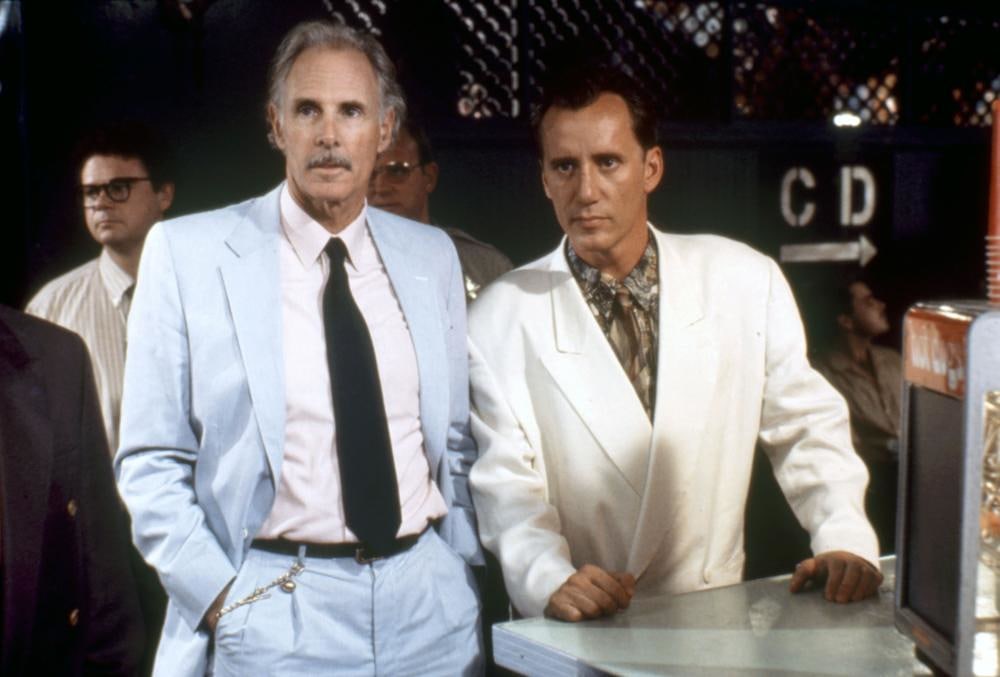
Brad reviews DIGGSTOWN (1992), starring James Woods, Lou Gossett Jr. and Bruce Dern!


Gabriel Caine (James Woods) is a fast-talking con man fresh out of prison who’s already set up his next big scam. Along with his partner Fitz (Oliver Platt), Caine is targeting Diggstown, a small, boxing-obsessed community ruled over by the corrupt John Gillon (Bruce Dern). Gillon controls the town because he rigged a fight that left local boxing legend Charles Macum Diggs (Wilhelm von Homburg) completely brain-damaged. The scam involves getting Gillon to take a $100,000 bet that 48 year old “Honey” Roy Palmer (Louis Gossett Jr.) can defeat any ten Diggstown fighters in one 24-hour period. Once the fights start, you can bet that both sides will have lots of surprises up their sleeves, but the question is who will be standing when the final bell rings?!! 

Since today is Bruce Dern’s 89th birthday, I decided to watch DIGGSTOWN, one of my favorite movies featuring the birthday boy. A box office flop when it was released in 1992, making less than $5 million at the box office, the reputation for the film seems to have gotten stronger over the years. The film has an excellent cast! James Woods exudes cockiness and intelligence as conman, Gabriel Caine. He somehow pulls off the feat of being both sleazy and very likable, which is a testament to Woods’ skills as an actor. Louis Gossett Jr. is great as “Honey” Roy Palmer. I remember when I first saw the trailer for DIGGSTOWN, I thought he was too old for the role. After watching it though, he’s able to make the boxing scenes work, especially when you consider some of the help he’s given as part of the con. With the huge personalities of Woods and Bruce Dern surrounding him, Gossett’s more grounded performance anchors the film. Bruce Dern is perfectly cast as the villainous scuzzbucket, Gillon. He’s the type of guy you really want to see get his comeuppance at the end. Now that I think about it, Gillon is such an A-hole, Caine can’t help but seem likable in comparison! Finally, I did want to give a shout out to Oliver Platt, who’s extremely funny in his role as Caine’s partner in con. It’s one of the first movies I remember seeing Platt in, and he’s great!

For DIGGSTOWN to really work though, the boxing scenes need to work and the con needs to be smart. Director Michael Ritchie (THE BAD NEWS BEARS) does a good job setting up both. The boxing sequences are well choreographed by Benny “The Jet” Urquidez, and you can’t help but root for the old guy as his opponents keep on coming. Of the 10 fights, some are funny, some are quick, and some are very intense depending on the situation. Ritchie is able to keep the stakes high enough during the boxing scenes to make sure we remain invested in the story. It’s a nice balancing act as the con plays out in the background of each fight. And what a con it is! I won’t spoil it for you, but it’s a stroke of genius that resulted in a massive amount of satisfaction for this audience member! 

Overall, DIGGSTOWN is one of those movies I’m sure to watch every few years. With its great cast, punchy sense of humor, and genius triple-twist of an ending, I can’t imagine anyone leaving disappointed. I highly recommend it! 

The trailer is included below:
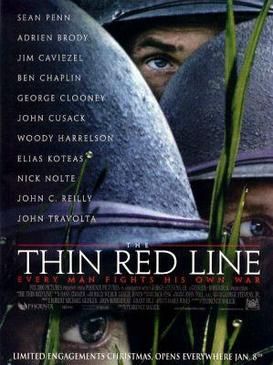
Lisa Marie Reviews An Oscar Nominee: The Thin Red Line (dir by Terrence Malick)


Based on a novel by James Jones (and technically, a sequel of sorts to From Here To Eternity), 1998’s The Thin Red Line is one of those Best Picture nominees that people seem to either love or hate.

Those who love it point out that the film is visually stunning and that director Terrence Malick takes a unique approach to portraying both the Battle of Guadalcanal and war in general.  Whereas Steven Spielberg’s Saving Private Ryan told a rather traditional story about the tragedy of war (albeit with much more blood than previous World War II films), The Thin Red Line used the war as a way to consider the innocence of nature and the corrupting influence of mankind.  “It’s all about property,” one shell-shocked soldier shouts in the middle of a battle and later, as soldiers die in the tall green grass of the film’s island setting, a baby bird hatches out of an egg.  Malick’s film may have been an adaptation of James Jones’s novel but its concerns were all pure Malick, right down to the philosophical voice-overs that were heard throughout the film.

Those who dislike the film point out that it moves at a very deliberate pace and that we don’t really learn much about the characters that the film follows.  In fact, with everyone wearing helmets and running through the overgrown grass, it’s often difficult to tell who is who.  (One gets the feeling that deliberate on Malick’s point.)  They complain that the story is difficult to follow.  They point out that the parade of star cameos can be distracting.  And they also complain that infantrymen who are constantly having to look out for enemy snipers would not necessarily be having an inner debate about the spirituality of nature.

I will agree that the cameos can be distracting.  John Cusack, for example, pops up out of nowhere, plays a major role for a few minutes, and then vanishes from the film.  The sight of John Travolta playing an admiral is also a bit distracting, if just because Travolta’s mustache makes him look a bit goofy.  George Clooney appears towards the end of the film and delivers a somewhat patronizing lecture to the men under his command.  Though his role was apparently meant to be much larger, Adrien Brody ends up two lines of dialogue and eleven minutes of screentime in the film’s final cut.

That said, The Thin Red Line works for me.  The film is not meant to be a traditional war film and it’s not necessarily meant to be a realistic recreation of the Battle of Guadalcanal.  Instead, it’s a film that plays out like a dream and, when viewed a dream, the philosophical voice overs and the scenes of eerie beauty all make sense.  Like the majority of Malick’s films, The Thin Red Line is ultimately a visual poem.  The plot is far less important than how the film is put together.  It’s a film that immerses you in its world.  Even the seeming randomness of the film’s battles and deaths fits together in a definite patten.  It’s a Malick film.  It’s not for everyone but those who are attuned to Malick’s wavelength will appreciate it even if they don’t understand it.

And while Malick does definitely put an emphasis on the visuals, he still gets some good performances out of his cast.  Nick Nolte is chilling as the frustrated officer who has no hesitation about ordering his men to go on a suicide mission.  Elias Koteas is genuinely moving as the captain whose military career is ultimately sabotaged by his kind nature.  Sean Penn is surprisingly convincing as a cynical sergeant while Jim Caviezel (playing the closest thing the film has to a main character) gets a head start on humanizing messianic characters by playing the most philosophical of the soldiers.  Ben Chaplin spends most of his time worrying about his wife back home and his fantasies give us a glimpse of what’s going on in America while its soldiers fight and die overseas.

The Thin Red Line was the first of Terrence Malick’s films to be nominated for Best Picture and it was one of three World War II films to be nominated that year.  However, it lost to Shakespeare In Love.

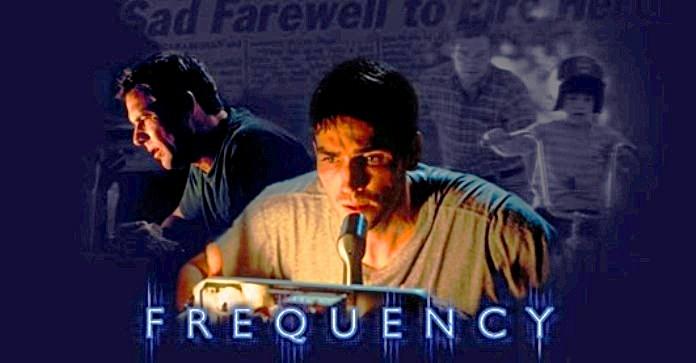
FREQUENCY (2000) – What would you give to talk to your dad or mom one more time?


I find it difficult to write about my favorite movies, because it can be hard to put into words why I love them so much. It seems that nothing I can say will do the movie justice. FREQUENCY is one of those movies that I abolutely love, and I’ll tell any person who will listen that it’s one of my all-time favorites. Sadly, I run into quite a few people who aren’t even aware of the almost 25 year old film at this point. That just doesn’t set right with me, so I’m here today to sing the praises of FREQUENCY!

FREQUENCY stars Jim Caviezel as homicide detective John Sullivan, a guy who lives in the same house he’s lived in his entire life. John is still dealing with emotional scars related to the death of his firefighter father Frank (Dennis Quaid), who died fighting a fire 30 years earlier. One night John’s hanging out with his buddy Gordo (Noah Emmerich), when they come across his dad’s old Ham radio. Some of John’s fondest memories of his dad include him speaking with people around the world on that old radio. They hook it up not even sure if it even works anymore. Sometime later that night when he’s there alone, a man’s voice comes across the airwaves. John starts talking back, and that’s when the greatness of this movie starts for me. The two guys start talking about baseball, and the voice on the other end of the line wants to know what John thinks about New York’s Amazin’ Mets chances to win the 1969 World Series. It seems that somehow through movie magic and the “mother sunspot of all time,” John is talking to his own father at the same location, separated by 30 years of space and time. John tells his dad about the specific fire that he dies in on that fateful day 30 years earlier. With John’s warning, Frank is able to survive the fire, and John gets a bunch of new memories that show him growing up with his dad in his life. Unfortunately, the changing of the past has real world consequences in the present. Now, John’s mom Julia (Elizabeth Mitchell) is gone, killed by a serial killer whose “Nightingale murders” had ended with 3 nurses in 1969, but has now ballooned to 10 in 1999. Separated by those 30 years, and not knowing when their connection on the radio might end, John and Frank work together to try to stop the Nightingale killer and save Julia, not knowing what other things they might change in the process.

FREQUENCY is a cross-genre concoction. It’s a fantasy film in the way that it brings people together from two different timeframes. The exact way this is done is never spelled out and shouldn’t be thought about too much. We just know that the phenomenon known as the aurora borealis, which is a natural light show that occurs when charged particles from the sun interact with Earth’s magnetic field, is going on in both 1969 and 1999. This natural phenomenon is somehow allowing John and Frank to talk to each other. It’s also a solid dramatic thriller as John is able to first save Frank’s life from the fire, and then as the two work together to catch a serial killer (Shawn Doyle) before he takes out Julia. This is put together extremely well by director Gregory Hoblit, who gets solid performances from Jim Caviezel, Dennis Quaid, and Elizabeth Mitchell as the Sullivan family. I also want to shout out Andre Braugher, who plays Frank’s best friend Satch in the 1969 timeframe, and who’s John’s cop partner in 1999. He’s so good in FREQUENCY. Despite winning two primetime Emmy awards, I still believe that Andre Braugher was an amazing actor who was underused during his lifetime. Sadly, he passed away in 2023 at just 61 years of age.

But the reason that I love FREQUENCY is the fantastic notion that a son who’s lost his father would somehow have the chance to talk to him again. Father-son relationships in movies affect me more than anything else, and I’m all in for the way it is addressed here. I cry like a baby every time I watch FIELD OF DREAMS with Kevin Costner, and I also cry like a baby every time I watch FREQUENCY. I mentioned earlier that John is dealing with emotional scars from not having his dad growing up. In this film, we get to hear their conversations and put ourselves in that same position. The film really leans into the joy of this unique opportunity to change the past and erase much of the pain that came with such deep emotional wounds. This shared desire to right past wrongs and erase past pain elevates the film even when logic fails. FREQUENCY got on my radar back at the turn of the century when I read articles about grown men crying in theaters as they watched. I remember telling a friend of mine, a friend whose father had died when he was young, about this film. He told me later of his own emotional experience watching it. There really is something universal about wanting to connect with our parents once they are no longer with us. As of this writing, my own father is still here, yet I am still emotionally overwhelmed every time I watch FREQUENCY. I can’t even begin to imagine what it will feel like if there’s a time that I’m still here, and he’s gone.     

Weekly Trailer Round-Up: El Angel, UFO, Breaking and Exiting, The School, Running For Grace, The Immortal, White Fang


Here are some of the trailers that dropped last week.

First up, we have El Angel.  This fact-based Argentine film is about Carlos Robledo Puch, a youthful criminal whose crime spree both stunned Argentina and turned him into a celebrity in 1971.  El Angel premiered at this year’s Cannes Film Festival and does not yet have an American release date.

Gilliam Anderson may be leaving The X-Files but, judging from this trailer for UFO, she’s not leaving the world of extraterrestrial conspiracy theories.  UFO was filmed in Cincinnati last December and is scheduled to be released sometime this year.

Breaking and Exiting is a comedy about a thief (Milo Gibson) who breaks into the home of a suicidal woman (Jordan Hinson) and who, according to the film’s imdb page, “decides to save her from herself.  Breaking and Exiting will be released on August 17th.

Am I the only one who can’t watch the trailer for The School without thinking of Silent Hill?  The School will be released, in Australia, on July 27th.

Co-starring Ryan Potter, Matt Dillon, and Jim Caviezel, Running For Grace is set in Hawaii in the 1920s and is about a forbidden love affair between a mixed race orphan and the daughter of a plantation owner.  Running For Grace will be released on August 1st.

As far as what’s happening in this trailer for The Immortal, your guess is as good as mine.  This is a Vietnamese film that does not appear to have a release date yet,

Finally, we have the latest version of Jack London’s classic novel, White Fang.  This animated adaptation is now streaming on Netflix.

A Movie A Day #217: Wyatt Earp (1994, directed by Lawrence Kasdan)


Once upon a time, there were two movies about the legendary Western lawman (or outlaw, depending on who is telling the story) Wyatt Earp.  One came out in 1993 and the other came out in 1994.
The 1993 movie was called Tombstone.  That is the one that starred Kurt Russell was Wyatt, with Sam Elliott and Bill Paxton in the roles of his brothers and Val Kilmer playing Doc Holliday.  Tombstone deals with the circumstances that led to the Gunfight at the O.K. Corral.  “I’m your huckleberry,” Doc Holliday says right before his gunfight with Michael Biehn’s Johnny Ringo.  Tombstone is the movie that everyone remembers.

The 1994 movies was called Wyatt Earp.  This was a big budget extravaganza that was directed by Lawrence Kasdan and starred Kevin Costner as Wyatt.  Dennis Quaid played Doc Holliday and supporting roles were played by almost everyone who was an active SAG member in 1994.  If they were not in Tombstone, they were probably in Wyatt Earp.  Gene Hackman, Michael Madsen, Tom Sizemore, Jeff Fahey, Mark Harmon, Annabeth Gish, Gene Hackman, Bill Pullman, Isabella Rossellini, JoBeth Williams, Mare Winningham, and many others all appeared as supporting characters in the (very) long story of Wyatt Earp’s life.

Of course, Wyatt Earp features the famous Gunfight at the O.K. Corral but it also deals with every other chapter of Earp’s life, including his multiple marriages, his career as a buffalo hunter, and his time as a gold prospector.  With a three-hour running time, there is little about Wyatt Earp’s life that is not included.  Unfortunately, with the exception of his time in Tomstone, Wyatt Earp’s life was not that interesting.  Neither was Kevin Costner’s performance.  Costner tried to channel Gary Cooper in his performance but Cooper would have known better than to have starred in a slowly paced, three-hour movie.  The film is so centered around Costner and his all-American persona that, with the exception of Dennis Quaid, the impressive cast is wasted in glorified cameos.  Wyatt Earp the movie tries to be an elegy for the old west but neither Wyatt Earp as a character nor Kevin Costner’s performance was strong enough to carry such heavy symbolism.  A good western should never be boring and that is a rule that Wyatt Earp breaks from the minute that Costner delivers his first line.

Costner was originally cast in Tombstone, just to leave the project so he could produce his own Wyatt Earp film.  As a big, Oscar-winnng star, Costner went as far as to try to have production of Tombstone canceled.  Ironically, Tombstone turned out to be the film that everyone remember while Wyatt Earp is the film that most people want to forget.

Embracing the Melodrama Part II #99: Pay It Forward (dir by Mimi Leder)


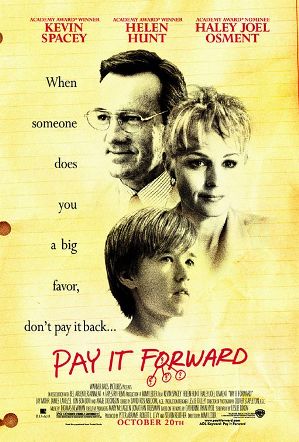
Pay_it_forward_ver1Speaking of crappy films…

Listen, I’m not going to say too much about the 2000 film Pay It Forward because it’s such a terrible movie that I feel like writing too much about it would be like the equivalent of having sex in It Follows.  Seriously, you talk too much about Pay It Forward and you’ll end up with some sort of shape-shifting demon following you around, doing you favors and demanding that you do three more favors for three other people and then those people have to do three more favors and pretty soon, everyone in the world is doing favors for everyone and…

AGCK!

Okay, okay — I know that probably doesn’t sound too bad to some people.  “People being nice to each other!?  What could be wrong about that?”  Well, watch the damn film and find out.

In Pay it Forward, Haley Joel Osment plays a creepy little kid who basically “saves” the world.  At the end of the film, he’s violently murdered and the entire population of Las Vegas gathers outside of his house with candles.  His mother Helen Hunt is truly touched that everyone was so moved by Haley’s mission.  That said, if Haley had never decided that everyone should pay it forward, he probably wouldn’t be dead.  I mean, let’s just be honest here.

Before he died, Haley was challenged by his social studies teacher, Kevin Spacey.  Mr. Spacey challenged an entire class of 7th graders to come up with an idea that will change the world.  (Honestly, don’t 7th graders already have enough to deal with?)  Haley’s idea is that he’ll do a favor for three random people and then those three people will do three nice things for three people and then…

BLEH!  God, I hate this movie!

Anyway, Haley gives money to a homeless man and then that homeless man keeps a woman from committing suicide and then that woman does something nice for Angie Dickinson and then somehow, this all eventually leads to some rich guy giving Jay Mohr a car and telling him to “pay it foward.”

And Jay’s a reporter!

So, naturally, he starts to work his way backwards on the chain of good deeds.  Along the way, he meets a prison inmate who has been converted to Pay It Forwardism.  “This is going to change the world!” he tells Jay.  “I’m even getting the brothers in here in on it!”

By the way, there’s exactly one person of color in Pay It Forward and he’s a prison inmate who thinks that other inmates will want to do random favors for each other.

Oh, but Haley has to do two other favors!  So, he sets Helen Hunt up with Kevin Spacey and when he catches his teacher coming out his mom’s bedroom, Haley gets really, really excited and … well, it’s pretty creepy.

At first, Helen thinks that Kevin thinks that she’s not smart enough to date him.  When Helen asks him point blank if he thinks that she’s dumb, he responds by giving a really long monologue about the time that his father set him on fire.  Kevin does not mention what his father was attempting to pay forward…

And then Jay shows up in town and interviews Haley and oh my God, Haley’s going to change the world!  Yay!  But then Haley spends his third favor trying to protect a kid (played by Degrassi‘s Marc Donato) from some bullies and ends up getting stabbed to death.

But fear not!  Along with that candlelight vigil, we also hear an anchorwoman breathlessly reporting that there have been reports of “Pay it Forwardism” across the country.

Now, there’s a lot of negative things that I could say about Pay It Forward but … well, I kinda already did.  Pay It Forward pops up on TV a lot and there’s a lot of idiots who always get excited about it.

https://twitter.com/_sierraalynn/status/606195871949156353

https://twitter.com/TreyClark56/status/605372272690356225

https://twitter.com/KelliOtto_/status/605370371248951296

Here’s my fear concerning the whole Pay It Forward idea.  It seems like anybody can just do anything and then go, “Pay it forward,” and suddenly, you are obligated to go do three favors.  You may be running late.  You may have other things you need to do.  But no, you’ve been told to pay it forward and now, you have to!  Because of one creepy little kid who wanted his social studies teacher to have sex with his mom, you have now been inconvenienced.

There doesn’t seem to be any rule about how big of a favor anyone actually has to do before they can smugly order you to “Pay it forward.”  Think about this.  You’re trying to get a Coke from a vending machine but all of your dollars are all crumbled up and the machine won’t accept them.  You’re about to give up and go home when suddenly, a stranger walks up and deposits three quarters in the machine and punches a button.

He tosses you a grape drink.  You wanted a Coke but, because you’re nice and you think he was selflessly trying to help you out, you smile and say, “Thank you.”

“Pay it forward,” he replies before walking away.

Well, now, you’re screwed, aren’t you?

Now, suddenly, you have to go find three people who need a favor.  You didn’t want grape.  You wanted a Coke and, even if you had never gotten that Coke, it would not have been the end of the world.  But, because you were polite and said thank you, you are now obligated.

As you look for people to help, it occurs to you that stranger really didn’t care about whether you wanted a Coke.  What he cared about was completing his third favor so he could actually get on with his life.  So, no, he wasn’t trying to help you or trying to make the world a better place.  Instead, he was just trying to free himself of a nagging obligation.

So, after a long search, you’ve finally found your three strangers and you’ve done your three favors and you’re finally free of your obligation.  And then suddenly, another stranger runs up and tosses you the keys to one of those stupid looking Smart cars and yells, “Pay it forward!”

SERIOUSLY, IT NEVER ENDS!

Don’t tell me about paying it forward.

Just leave me alone and let me drink my damn Coke.

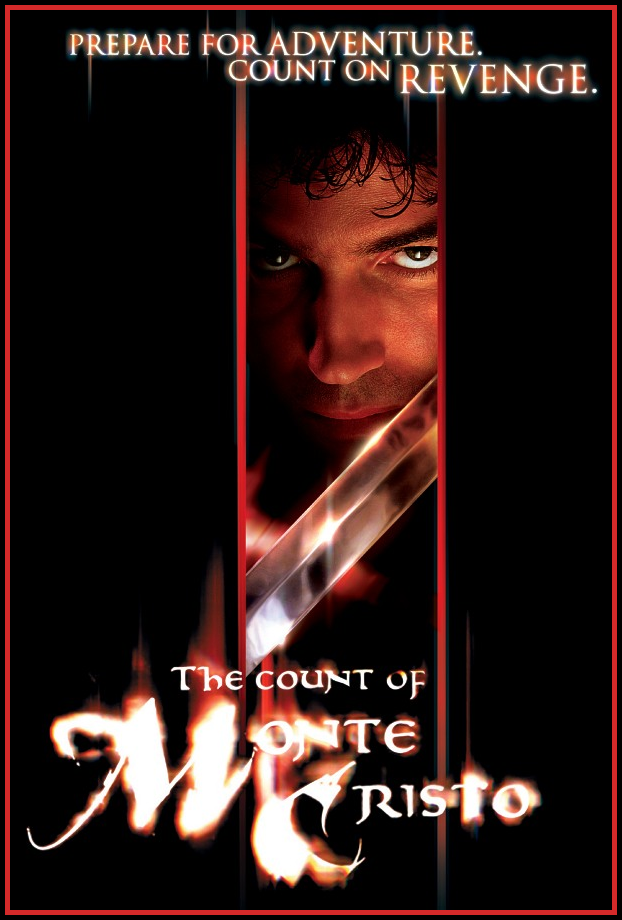
Review: The Count of Monte Cristo (dir. by Kevin Reynolds)


In what has become an unofficial ritual for myself whenever my birthday rolls around I always end up watching a film from 2002 that flew under the radar of most people. While it made modest box-office returns it wasn’t the head-turning blockbuster that some of its producers hoped it would turn out to be. It’s a romantic adventure piece by Kevin Reynolds and for readers of classic literature they’d recognize the title of the film, The Count of Monte Cristo. A film loosely based on the classic novel of adventure, revenge and redemption by French author Alexandre Dumas. The film ends up being a fun, thrilling throwback to films of an era which had marquee stars such as Errol Flynn and Basil Rathbone.

The story is one known well enough. It’s a tale of a man, Edmond Dantès wrongly accussed of a capital crime and imprisoned in the Alcatraz-like prison Chateau d’If through the machinations of three individuals: his best friend Fernand Mondego, first mate Danglars and the ambitious deputy prosecutor Villefort. Dantès spends the next several years in Chateau d’If under the cruel and sadistic eyes of it’s warden, Armand Dorleac (played by Michael Wincott with his usual flair for sadism). It’s while Dantès  has started to contemplate suicide after rejecting God for the pain and suffering he has had to endure that he has a fortuitious meeting with another guest of Chateau d’If. It’s this relationship between Dantès and Abbé Faria (Richard Harris in the mentor role he had begun to play in his later years) which take up the bulk of the first third of the film.

Dantès tells him of the circumstances which led to his imprison in Chateau d’If and the thoughts of vengeance on those responsible for his predicament. Faria tries to turn him from his dark path, but seeing how determined his young friend seems on journeying down its twisted path he agrees to teach him how to become adept at being a noble, finances and in swordcraft in exchange for help in digging themselves out of their prison. Taking several more years to complete the education Dantès needs to exact his revenge it ends at the death of Faria and his mentor’s final gift to his student. The location of a treasure so vast that Dantès could retire to a life of peace and contemplation or fund his plans of vengeance.

The middle section of the film shows Dantès finding the treasure and remaking himself through his newfound wealth as the Count of Monte Cristo to better insinuate himself amongst the wealthy and noble-born his targets mingle in. With the help of a bandit whose life spares after a duel in Jacopo (Luis Guzman) the plans Dantès has worked on for years begin to bear fruit as he manipulates and fools Fernand, Villefort and Danglars into his confidence to better see to their downfall. It’s during this time he meets his former fiancee Mercedes (played by the ridiculously beautiful Dagmara Dominczyk), now Countess Mondego after being told of Edmond’s execution earlier in the film, and Fernand’s son Albert. The circumstances of how his former love having had a child and married to one of the men who had conspired against him brings a new complication to Dantès plans.

The last third of the film shows the culmination of Dantès and his elaborate plans to bring about the downfall of all those who had wronged him. While the plans, at times, strain the bonds of disbelief at actually having fooled and worked against his enemies the way the film makes the audience root for Dantès to succeed helps. This is a Dantès who comes off as noble despite being of commoner origins who we stand behind and support in his plans of vengeance. With the amount of wealth at his disposal it’s not too difficult to put oneself in the same shoes and not think of vengeance as well to strike a balance.

It’s a testament to the direction of filmmaker Kevin Reynolds that the film and it’s story never bogs down despite a story with many elaborate plots and secondary characters introduced midway. The fact that the film only borrows some of its complexity from an even more labyrinthine novel shows how the filmmakers actually had to simplify the story as to not make it so complex that it loses the bulk of its audience.

The Count of Monte Cristo also benefit from a strong cast led by Jim Caviezel in the titular role with Guy Pearce playing his former friend and betrayer Fernand Mondego and James Frain as the prosecutor Villefort. Caviezel plays his role as Dantès and as the Count of Monte Cristo as two different people with distinct personalities. There’s Dantès the earnest sailor who just wanted to get back to his love, Mercedes and then there’s the sophisticated and ruthless Count whose machinations would lead to the destruction of lives and reputations. It’s a mystery why Caviezel hasn’t become the star he surely was in the making and this film showed that he had the talent to become one of the industry’s new leading men. I blame Mel Gibson in casting him as Jesus in The Passion of the Christ for having put a curse on Caviezel.

Guy Pierce in the role of Fernand plays the conniving and remoreless villain role to the hilt. With an overbearing and effete noble bearing to his performance it was a character written to inspire hatred not just in its main protagonist but in the audience as well. Pearce knows what his roles represent and has fun playing up the role as main heavy.

Richard Harris as the priest Faria did his usual great work as the elder mentor to a younger man. It was a role he began to be known for starting with Ridley Scott’s Gladiator right up to his final mentor role as the wizard Dumbledore in the Harry Potter film franchise. It’s hard to explain to people that Harris was not always this wise and mentoring father figure, but one who played roles where he’d play womanizers, charming cads and roguish rebel.

The Count of Monte Cristo ended up being more fun than it should be with enough complexities in its storytelling that the film doesn’t dumb down too much the story it was adapted from. To be honest the only way one could truly adapt Dumas’ novel of revenge and redemption is through a long-form tv series. It is just that complex with so many characters that a film adaptation would just be too long or just unnecessarily crowded with characters the audience would care to know. It’s a good thing that the film by Kevin Reynolds was still able to keep to the spirit of the original source while whiling away the story down to its basic core.

It’s a film that plays like a throwback to the swashbuckling films from Hollywood of the 30’s and 40’s and it wouldn’t be too difficult to see Caviezel in the roles Errol Flynn once inhabited. There’s very little special effects in the film which adds more to this sense with swordfight scenes as expertly choreographed as any of the past. The Count of Monte Cristo, for some reason still unknown to me, continues to be the one thing that keeps airing on my birthday and the fact that it’s such a fun and thrilling film that I continue to watch it everytime my day of days roll around. Can’t wait for next year.