Retro Television Review: Law and Order 6.13 “Charm City” and Homicide 4.11 “For God And Country”


Welcome to Retro Television Reviews, a feature where we review some of our favorite and least favorite shows of the past!  On Sundays, I will be reviewing Homicide: Life On The Street, which aired from 1993 to 1999, on NBC!  It  can be viewed on Peacock.
This week, Homicide crosses over with Law & Order.

Law & Order 6.13 “Charm City”

(Dir by Ed Sherin, originally aired on February 7th, 1996)

Homicide 4.11 “For God and Country”

(Dir by Ed Sherin, originally aired on February 9th, 1996)

This week, we have a two-part cross-over between Law & Order and Homicide.

On Law & Order, things start in New York City.  A chemical attack on a subway train leaves 20 people dead.  Because the train was specifically heading into Harlem and all of the victims were black, it is suspected that the attack was racially motivated.  In Baltimore, Frank Pembleton and Tim Bayliss hear about the attack and are reminded of a similar attack on a black church, which occurred five years prior.  Pembleton was the primary on the church attack.  He and Bayliss head to New York City, where they meet and quickly get on the nerves of Detectives Lennie Briscoe (Jerry Orbach) and Rey Curtis (Benjamin Bratt).

Pembleton’s investigation uncovers that a man from Baltimore, Brian Egan (Kevin Geer), not only had access to the chemicals used in both attacks but also that’s he currently in New York.  When Briscoe and Curtis arrest Egan and fail to get him to confess, Pembleton asks for permission to interrogate him.  Pembleton, being Pembleton, rather easily gets Egan to confess to having committed the church bombing.  However, before getting the confession, Pembleton pretends not to hear Egan say that he no longer wants to continue talking.  In typical Law & Order (if not Homicide) fashion, the confession is tossed out.

Jack McCoy (Sam Waterston) and Claire Kincaid (Jill Hennessy) still get their conviction.  (And Claire gets an admirer in the form of Tim Bayliss.)  However, it’s obvious that Egan was not working alone.  Egan says that he will never name names.

That changes when his wife is murdered and his teenage son goes missing.  Homicide opens with Bayliss investigating the poisoning of Egan’s wife.  He and Pembleton eventually track down Egan’s son and they get him to admit that he saw his uncle, former NSA agent Col. Alexander Rausch (J.K. Simmons), murder his mother.  Because Brian Egan has said that he’ll only reveal the truth of the conspiracy if his son is brought to New York, Briscoe and Curtis show up in Baltimore.

While Curtis, Bayliss, and Pembleton track down Colonel Rausch, Briscoe hangs out with Munch.  Their friendly banter goes south as soon as Briscoe mentions that he once knew a Gwen Munch in New York.  Gwen is John Munch’s ex-wife and John is not happy when he finds out that Briscoe slept with Gwen.  John Munch spends the rest of the episode drinking heavily.  Stanley Bolander would not approve.

As for Col. Rausch, he is captured and he turns out to be a smug snake.  (He’s played by J.K. Simmons, after all.)  Pembleton wants to see Rausch prosecuted for the church bombing and he especially wants to see racist Rausch publicly humiliated.  New York, however, wants to prosecute him for the subway attack.  Claire comes down to Baltimore and gets a judge to agree that Rausch should first be sent to New York.

Rausch doesn’t care.  He has a heart condition so he simply stops taking his heart pills and then drops dead while waiting for the train to take him to the Big Apple.  The episodes ends with Pembleton sobbing as he realizes Rausch will never be humiliated at a trial.  The New York cops shrug and say, “Sorry, Frank.”

I enjoyed this crossover quite a bit.  It was interesting to see two police dramas, each with a very different style, come together to tell one big story.  As Homicide always celebrated the lengths that Pembleton would go to get a confession in the Box, it was amusing to see what would actually happen to one of those confessions if it was brought to court.  Jack McCoy is not at all amused by Pembleton’s tactics.  Meanwhile, Briscoe, Curtis, and Claire was allowed to loosen up a bit when they went to Homicide and I enjoyed watching them shed their “just-the-facts” personas.  If the Law & Order episode was ultimately superior to the the Homicide episode, that’s just because the Law & Order episode featured an actual mystery to be solved whereas the Homicide episode occasionally felt as if it was padded out a bit.  On Homicide, it was obvious that Colonel Rausch was guilty and, from the minute he started to cough during the interrogation, it was easy to guess what his ultimate fate would be.

(I also have to say that it was interesting to compare this episode of Law & Order to watch Law & Order has become today.  How this show went from featuring McCoy confidently doing his job to Nolan Price essentially begging his co-counsel, on a weekly basis, to actually do her job is something that is worth considering.)

Overall, this was a good crossover.  For those who want to watch it, the Law & Order episode is available on Hulu and Disney+ while Homicide can be found on Peacock and Tubi.

Late Night Retro Television Review: Friday the 13th: The Series 3.17 “Jack-In-The-Box”


Welcome to Late Night Retro Television Reviews, a feature where we review some of our favorite and least favorite shows of the past! On Fridays, I will be reviewing Friday the 13th: The Series, a show which ran in syndication from 1987 to 1990. The entire series can be found on YouTube!

This week’s episode is a sad one.

Episode 3.17 “Jack-In-The-Box”

(Dir by David Winning, originally aired on April 23rd, 1990)

After her lifeguard father drowns, a young girl named Megan (Marsha Moreau) uses a cursed jack-in-the-box to get revenge of those who she blames for his death.  Seeing the jack in the box when it opens leads to people drowning.  A janitor drowns in a pool.  One guy drowns in a car wash.  The deaths are grisly but it brings back the spirit of Megan’s death father.  Or, at least, that’s what Megan thinks.  Personally, I think the spirt was a demon in disguise because some of the things he suggested were really out there.

This was a really sad episode.  In an amazing coincidence, Micki knew the lifeguard’s family and she spent most of this episode on the verge of tears.  Meanwhile, Megan’s mother dealt with her sadness by becoming an alcoholic and Megan killed  a number of people just so she could spend some time with her “father.”  This episode was well-acted and well-written and really not the right sort of thing for me to watch at a time when the one-year anniversary of my Dad’s passing is quickly approaching.  This was an episode that not only left Micki in tears but it left me in tears as well.

Okay, enough sadness!  This was a good episode.  The third season has been uneven and I still miss Ryan’s character but this episode showed that Friday the 13th was still capable of being effective even as the show came to a close.

Late Night Retro Television Review: Friday the 13th: The Series 3.11 “Year of the Monkey”


Welcome to Late Night Retro Television Reviews, a feature where we review some of our favorite and least favorite shows of the past! On Fridays, I will be reviewing Friday the 13th: The Series, a show which ran in syndication from 1987 to 1990. The entire series can be found on YouTube!

This week, Friday the 13th features an international adventure!

Episode 3.11 “Year of the Monkey”

(Dir by Rodney Charters, originally aired on January 15th, 1990)

Mushashi (John Fujioka) is a modern-day samurai who owns a cursed tea kettle.  When Jack, Micki, and Johnny come by his dojo in search of the kettle, Mushashi says that he will give it to them if they can prove that they are “honorable” by retrieving three cursed monkey statues that are currently in the possession an elderly businessman named Tanaka (Robert Ito).

Tanaka, however, has given the three wise monkey statues (“See No Evil,” “Hear No Evil,” and “Speak No Evil”) to his three children, Michiko (Tia Carrere), Koji (Leonard Chow), and Hitoshi (Von Flores).  Tanaka explains that each statue will challenge it’s owner.  Those who react in an honorable way will inherit Tanaka’s fortune.  Those who are dishonorable will get nothing.

Jack, Micki, and Johnny split up to retrieve the monkeys.  Johnny goes to New Yok to get Hear No Evil from Hitoshi.  Micki goes to Hong Kong to retrieve See No Evil from Koji.  Jack gets to stay in Canada (or Chicago or wherever this show is supposed to be taking place) so that he can retrieve Speak No Evil from Michiko.  What they don’t know is that Tanaka is several hundred years old.  Every time one of his children fails a monkey test, Tanaka gets a little bit younger.

It’s all about honor and dishonor and the code of the samurai in this week’s episode.  To be honest, it’s a bit of a mess.  First off, the title refers to the Chinese Zodiac but, other than our three regulars, all of the characters are meant to be Japanese.  Secondly, it’s never really clear how the cursed monkeys decide what is honorable and what is dishonorable.  Hitoshi uses his monkey to hear the thoughts of those around him and to take advantage of them.  That’s definitely dishonorable.  But then Koji is declared to be dishonorable even though his monkey did something on its own, without Koji telling it to.  Michiko refuses to use her monkey to her own advantage and is judged to be honorable.  She is told that it is now her duty to kill her father but instead, she commits suicide because killing her father would be dishonorable.  Then, Tanaka is eventually judged to be dishonorable because he stabs Musashi while Mushasi is not holding a weapon but that’s just because Mushashi dropped his sword at the very least minute.  It seems like Mushashi should be the dishonarable one for going out of his way to trick Tanaka.

My point is that this was a confusing episode.  The monkey were actually kind of cute but their powers made no sense.  I’m also not sure why experienced world traveler Jack decided to send Micki to Hong Kong instead of going himself.  In the end, this episode was pretty silly, despite the cool monkeys and the samurai-themed finale.

Late Night Retro Television Review: Friday the 13th: The Series 3.8 “Night Prey”


Welcome to Late Night Retro Television Reviews, a feature where we review some of our favorite and least favorite shows of the past! On Fridays, I will be reviewing Friday the 13th: The Series, a show which ran in syndication from 1987 to 1990. The entire series can be found on YouTube!

This week on Friday the 13th: The Series, Micki and Jack come across vampires in their city but the real threat comes from the man who has dedicated his life to destroying them.

Episode 3.8 “Night Prey”

(Dir by Armand Mastroianni, originally aired on November 13th, 1989)

Back in 1969, Kurt Bachman (Michael Burgess) could only watch helplessly as his wife was abducted and turned into a creature of the night by vampire Evan Van Hellier (Eric Murphy).  Kurt has spent twenty years searching for Evan and trying to kill other vampires.  (Jill Hennessy makes her second appearance on Friday the 13th, this time playing a vampire who lures an unsuspecting victim into an alley.)  However, Kurt now has a new tool at his disposal.  He has a cursed crucifix that can destroy a vampire but only after it is first used to kill an innocent person.  Kurt may be trying to do the right thing by ridding the world of vampires but, as is so often the case with this show, it’s impossible to do the right thing while using a cursed object.  Kurt gets his revenge but at the cost of his own life.  Spilling blood to destroy a bloodsucker just doesn’t work in the long term.

This is another episode in which Jack gets involved after a friend of his is killed.  Poor Jack.  He friends were always dying.  In this case, Jack’s friend was a priest who attempted to keep Kurt from stealing the crucifix.  (Kurt, for all that he’s suffered, doesn’t really seem to be too upset over killing an innocent priest.  Maybe his obsession got the better of him.  Maybe Kurt was just a jerk.)  Jack and Micki investigate the local decadent vampire scene while Johnny stays at the store and has pizza and beer.  Jack confesses that he sometimes envies the vampires but fear not, Jack does not go over to the dark side.  For that matter, neither does Micki.  They both learned their lesson the last time they had to deal with a vampire.

This was a stylish episode, though the idea of vampires being decadent, leather-clad nightclubbers is not really as shocking an idea as the show seems to think it is.  Michael Burgess gives a good performance as the obsessed Kurt.  In  the end, he destroys the vampire who abducted his wife but at the cost of his own soul as his now vampiric wife puts the bite on him and soon, Kurt is a vampire himself.  Fortunately, Jack has some holy water to take care of that.  People spend so much time on stakes and crucifixes that they overlook the power of holy water.  This episode was full of atmosphere and I always like it when Jack gets to do something more than just wait back at the store.  This was a good Friday.

Late Night Retro Television Review: Friday the 13th 2.21 “Wedding in Black”


Welcome to Late Night Retro Television Reviews, a new feature where we review some of our favorite and least favorite shows of the past! On Fridays, I will be reviewing Friday the 13th: The Series, a show which ran in syndication from 1987 to 1990. The show can be found on YouTube!

This week, the departed return!

Episode 2.21 “Wedding in Black”

(Dir by Rodney Charters, originally aired on May 8th, 1989)

In South America, a man named Calvin Collier (Stephen Meadows) is carrying around a snow globe and strangling women.  After he kills a young Jill Hennessy (credited here with playing “Spanish Hooker,”), Calvin is taken to prison.  However, an ominous voice says that it has need of Calvin’s soul.

In Africa, Brother Antonio (Guy Bannerman) is caught trying to rape a woman and is promptly set on fire.

In America (or maybe Canada), Maya Zedler (Carolyn Dunn) is released from prison and promptly kills herself.

What do all three of these people have in common?  They all know the folks at Curious Goods!  Calvin is a friend of Micki’s.  Brother Antonio is an acquaintance of Jack’s.  Maya used to be Ryan’s girlfriend.  And even though all three of them are now dead, Lucifer sent them back into the world of the living because he’s decided that he wants Micki to give birth to his child.

Calvin and Antonio show up and draw Micki and Jack out of the store and into a sudden blizzard.  Suddenly, all four of them find themselves in the castle that sits in the middle of Calvin’s snow globe.  Calvin sets about trying to seduce Micki on behalf of Lucifer.

Meanwhile, Maya shows up and tries to keep Ryan distracted so that he won’t go looking for Micki and Jack.  However, it turns out that Maya still has a conscience and eventually, she turns on Lucifer and sacrifices herself to help Ryan.

This episode was an interesting change of pace.  The snow globe may have been an antique but wasn’t one of the antiques and instead of Micki and Ryan stumbling into whatever terrible thing was happening, Lucifer instead came directly for them.  If nothing else, this episode showed that the producers of Friday the 13th: The Series understood the danger of falling into a rut and that they were capable of changing things up without losing the overall macabre atmosphere of the show.  The scenes in the castle were appropriately surreal and both Chris Wiggins and the often underused Robey gave good performances.  Of the three souls, Guy Bannerman made the strongest impression just by playing his character as being totally and unashamedly evil.

At the same time, it was hard not to feel that this episode was a bit of a missed opportunity.  While it was interesting to have Micki, Jack, and Ryan meet up with three spirits of people who they used to know, it’s hard not to feel that the episode would have worked better if the producers had reached into the past and brought back some of the show’s former guest stars.  Not an episode passed in which Micki, Jack, or Ryan doesn’t lose someone that they cared about and it would have been fun to see some of those people come back.  Imagine the emotional impact if John Stockwell or Catherine Disher or maybe one of Jack’s old war buddies had returned to life.

All in all, this was a good episode that could have been even better.

Due to the holidays, this is my final Friday the 13th review for 2024.  These reviews will return on January 3rd!

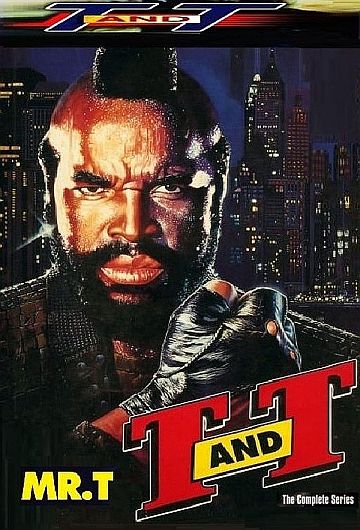
Retro Television Review: T and T 3.17 “Nightmare”


Welcome to Retro Television Reviews, a new feature where we review some of our favorite and least favorite shows of the past! On Fridays, I will be reviewing T. and T., a Canadian show which ran in syndication from 1987 to 1990.  The show can be found on Tubi!

This week, Terri is approached by a man who claims to be a political refugee.  But is he really?  It’s a good thing T.S. Turner doesn’t have anything better to do than help her out.

Episode 3.17 “Nightmare”

(Dir by Don McCutcheon, originally aired on April 28th, 1990)

While walking down the street in Canada, Terri is approached by a desperate man (William Colgate), who introduces himself as Sebastian Fuentes.  He explains that he was a newspaper editor in his native country of San Miguel.  After a left-wing death squad killed his family, Sebastian fled to North America.  Now, he needs Terri’s help to be designated a refugee.  He claims that there are people from San Miguel who want him dead and, for that reason, he cannot risk going to the authorities or even being seen in Terri’s office.  He says he has to hide, no matter what.

Terri doesn’t know anything about immigration law.  Both T.S Turner and a sleazy lawyer named Kerr (Don Allison) warn her that she shouldn’t be so quick to believe Sebastian’s story.  But something about Sebastian’s fear touches Terri’s heart and she agrees to help him.

Unfortunately, it turns out that both Turner and Kerr were correct.  Sebastian is actually a colonel who murdered the real Sebastian.  The nightmares that haunt him are not about watching his family being killed but instead about being the killer himself.  The people who are searching for him are not government agents but instead the relatives of the people who he victimized in his home country.  Eventually, Sebastian’s real identity is discovered by some fellow refugees (one of whom is played by a young Jill Hennessy) and he ends up in prison, haunted by his crimes.

This was an unusually serious episode of T and T.  Indeed, it was shot more like an episode of Monsters than a typical episode of this show.  Unfortunately, with the exception of Don Allison’s performance as the sleazy Mr. Kerr, the acting in this episode was pretty dodgy and it was easy to guess that Sebastian was going to turn out to not be who he said he was.

Probably the most interesting thing about this episode is that it aired 34 years ago but the issues that it deals with are the same issues that are going on today.  Dictators are still coming to power and abusing their citizens and, as a result, refugees are still flooding over the border.  The immigration system is still broken and it doesn’t appear that anyone is truly interested in finding a way to fix it.  This episode aired in 1990, long before men like Venezuela’s Maduro came to power.  The issues that are dealt with in this episode existed before the current crop of dictators and they will undoubtedly continue even after people like Maduro fade into history.

The Films of 2024: Madame Web (dir by S.J. Clarkson)


Cassie Webb (Dakota Johnson) is a paramedic in New York City.  Haunted by the fact that her mother died while giving birth to her while looking for a special spider in Peru (and I cannot believe that I just wrote that), Cassie struggles with showing her emotions and opening up to people.  In fact, her only friend appears to be her fellow paramedic, Ben Parker (Adam Scott).  Ben’s sister-in-law is pregnant and Cassie tells him, “You’ll be a great uncle, Ben.”

After a near-death experience, Cassie discovers that she has the ability to see into the future.  She also discovers that a strange man named Ezekiel (Tahar Rahim) wants to kill three teenage girls, Mattie (Celeste O’Connor), Anya (Isabela Merced), and Julia (Sydney Sweeney).  Cassie does what anyone would do.  She kidnaps the three girls to keep them safe and then hops on a plane to Peru to find out how Ezekiel is connected to her mother’s death.

Madame Web is the latest entry in Sony’s Spider-Man Universe.  Because Sony has the rights to Spider-Man, all of the MCU films featuring Spider-Man have been co-productions with Columbia Pictures and have been distributed by Sony.  With Spider-Man emerging as one of the few characters to remain a strong box office draw for Marvel, Columbia has produced a series of Spider-Man-adjacent films that feature characters who have appeared in Spider-Man-related media.  While Marvel and Disney have Tom Holland swinging his way through New York, Sony has to settle for Adam Scott and Dakota Johnson in an ambulance.

I always assume that the folks at Marvel and Disney probably groan a little whenever they hear that a new Sony film is coming out.  The MCU Spider-Man films have been consistently strong, with all three of them proving popular with both audiences and critics.  The Sony Spider-Man films, on the other hand, often seem like throwbacks to the bad old days of the early aughts, when most comic book films were still cheap and kind of embarrassing.  Madame Web doesn’t do much to change this perception.  In fact, the film is even set in 2003, complete with a Blockbuster Video store prominently featured in one scene, Britney Spears’s Toxic playing in a roadside diner, and a totally random reference to American Idol.  (What’s funny is that the jokey reference to American Idol would really only work if the show were no longer on the air but actually, it’s still airing on CBS.  No one ever seems to notice anymore but it’s still there.  If the movie really had any guts, it would have had Dakota Johnson says that she was going home to watch Paradise Hotel.)

Slow-paced and featuring some of the most awkward line readings this side of a community theater production of Bus Stop, Madame Web is not a particularly engaging film.  After a truly abysmal prologue set in Peru, the film spends about half-an-hour giving us a tour of Cassie’s not particularly interesting life as a tough New York paramedic before finally getting started on the main story.  And even then, the film leaves the viewer feeling cheated because none of three girls — who we are told are all destined to become super heroes — actually become super powered over the course of the film.  The film basically says, “They’re all going to be Spiderwoman …. BUT NOT TODAY!”   The problem with that approach is that it’s hard not to feel that the only interesting thing about the three girls is that they’re eventually going to have super powers.  Without the powers, they’re just kind of boring.  Cassie is the only one who has a super power but being able to see three minutes into the future isn’t that much of a power.  Dakota Johnson and the rest of the cast all seem to be bored out of their minds and who can blame them?

The main problem with Madame Web is that it’s just not much fun.  The best super hero films are fun to watch.  That goes for the Marvel films, the DC films, and even the Sony films.  (Admit it, the first Venom was kind of fun.)  Even with The Dark Knight films, Christopher Nolan understood that the villains had to be flamboyant to make up for Christian Bale’s rather dour Batman.  In this film, we’re never quite sure what Ezekiel wants or even who he is.  He’s just a random evil guy and not a particularly memorable one.  Madame Web does make some attempts at humor but the sitcom-style jokes are negated by Dakota Johnson’s flat delivery.  (Oddly enough, sitcom veteran Adam Scott is stuck playing a serious character.)  Overall, there’s an overwhelming blandness to Madame Web.  It doesn’t engage,.  It doesn’t thrill.  It doesn’t make you cheer or even jeer.  It’s just kind of there.

The film sets up a sequel but, judging from how the film did at the box office and how not even the film’s cast has pretended to be happy with how the film turned out, I’d expect to see Morbius 2 before another installment of Madame Web. 

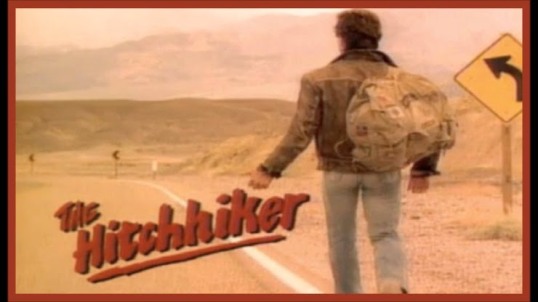
Horror on TV: The Hitchhiker 5.26 “Pawns” (dir by Leon Marr)


Poor Eddie!

Eddie (David McIlwraith) used to be a rock star but now he’s a washed up alcoholic without a cent to his name.  Needing to pay his bills, Eddie decides to make the ultimate sacrifice.  He decides to go down to a pawnshop and sell his trademark guitar.  However, a quirky woman named Elisabeth (Jill Hennessy) has another idea.  Maybe …. he could just rob the pawn shop!

Did you know that, as a name, Lisa started out as a shortened version of Elisabeth?

This episode originally aired on December 16th, 1989.

Film Review: Robocop 3 (dir by Fred Dekker)


“Oh wow, Robocop can fly!”

An odd film, Robocop 3. Released in 1993, this was the third and final film in the original Robocop franchise. While the action is still set in Detroit and Robocop is back (albeit now played by Robert John Burke) and Nancy Allen shows up long enough to get killed off, Robocop 3 feels strangely separate from the previous two Robocop films. If the first two Robocop films were dark, satirical, and over-the-top in their violence, the third film is a family friendly adventure film that reimagines Robocop as being some sort of fair housing activist.

And, on top of all that, Robocop can fly now. Admittedly, that’s because Robocop gets fitted for a jetpack that he didn’t have in the previous films but he still looks incredibly ludicrous flying through the streets of Detroit. Since the Robocop armor has always looked very bulky and very heavy, it’s hard to believe that he could fly as quickly and as smoothly as he does in this film.

There’s a new set of villains too. Rip Torn has replaced Dan O’Herilhy as the CEO. And listen, I like Rip Torn. He will always be a hero to me because he bit Norman Mailer’s ear off. But Torn is far too obviously evil in the role of the CEO. O’Herlihy smartly played the Old Man as being avuncular and amoral. You could look at him and understand how he rose to his position of prominence. Torn’s performance is a bit more cartoonish but then again, Robocop 3 is the most cartoonish of the series.

The CEO wants to tear down Old Detroit so the residents of Old Detroit are fighting back. Leading the CEO’s forces — called the Rehabbers — is Paul McDagget (John Castle), who is a complete and total madman but who, at the same time, is never quite as memorable as Kurtwood Smith or Tom Noonan. He’s really just another generic militaristic bad guy. Normally, you would expect Robocop to be on the side of the company and the police but he’s been reprogrammed by an 8 year-old hacker named Nikko (Remy Ryan). Robocop is now working with the rebels. One of the rebels is played by Stephen Root, proving once again that you never know where Stephen Root might pop up.

Robocop 3 has none of the satiric bite of the first two movies. Instead of being a symbol of authoritarianism gone beserk, Robocop becomes a generic do-gooder. The violence is toned down and, with the addition of a kid sidekick, it’s obvious that this Robocop was meant to be a safer version of the character. Unfortunately, a safe Robocop equals a boring Robocop. You watch this movie and you wonder what happened to the Robocop who shot Ronny Cox out of a window.

“My friend’s call me Murphy,” he says towards the end of the film, “You can call me Robocop.” That seemed to indicate that Robocop had quite a future ahead of him of doing the right thing and standing up to big evil corporations but Robocop 3 was such a bomb at the box office that Robocop’s further adventures would only be seen on TV. The franchise was rebooted back in 2014, in a film that my friend Mark called “Rubber Cop.” After Rubber Cop fell flat, it was announced that Robocop would be rebooted for a second time, this time with a movie that would serve as a direct sequel to the first Robocop and which would ignore the sequels and the first reboot. Personally, I think it might be time to let Robocop retire. He had a good run.

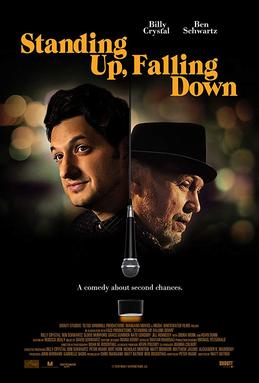
The Films of 2020: Standing Up, Falling Down (dir by Matt Ratner)


Having failed to achieve his dream of becoming a comedy superstar in Los Angeles, 34 year-old Scott (Ben Schwartz) returns home to Long Island.  How bad are things for Scott?  Consider this:

When he left for Los Angeles, he left behind Becky (Eloise Mumford), despite thinking that he was in love with her and despite her asking him to stay.  While he was in L.A., he purposefully chose to not respond to her attempts to get in contact with him because he was determined to move on with his life.  Now, he’s back and he’s wondering what could have been.  As for Becky, she’s now an acclaimed photographer and she’s married to a surfer named Owen (John Behlman).

All of his old friends are now married and have families and don’t really have time to hang out with a 34 year-old who is still struggling with adulthood.

When Scott returns home, he moves back in with his parents.  His mother (Debra Monk) spoils him while his father (Kevin Dunn) barely says a word to him.  Scott announces that, even though he knows he needs a job, there’s no way that he’s going to go to work at his father’s lumberyard.  His father says that’s not a problem because he wasn’t planning on offering Scott a job in the first place.

Scott’s sister (Grace Gummer) is also living at home and is stuck in a less than glamorous job but she’s dating Ruis (David Castaneda), an extremely charming security guard who is loved by everyone who meets him.

And, to top it all off, Scott has developed a rash of some sort in his arm!

In fact, the only positive development in Scott’s life is that he’s made a new friend.  Marty (Billy Cyrstal) is a bit older and he’s an alcoholic but he also has the best weed and he’s full of good advice.  On top of that, Marty’s also a dermatologist and is willing to just give Scott the medicine for his arm free of charge.  Marty becomes a bit of a mentor to Scott.  Of course, Marty has demons of his own.  His first wife committed suicide and his second wife died of stomach cancer.  His own son refuses to speak to him and won’t allow him to see his grandson.  Marty’s drinking isn’t the quirky character trait that it first appears to be.  Instead, it’s what he does to deal with the pain and the guilt that he carries around with him every day.

Standing Up, Falling Down is an occasionally effective and occasionally awkward mix of comedy and drama.  As a character, Scott can occasionally be a bit hard too take.  It’s one thing to have trouble accepting the fact that you’re getting older while it’s another thing to be in your mid-thirties with the maturity level of a 13 year-old.  At times, Scott seems to be so helpless that you find yourself wondering how he survived in Los Angeles for as long as he did.  Fortunately, Ben Schwartz is an appealing actor and the film doesn’t make the mistake of trying to idealize Scott’s lack of direction.  You find yourself sincerely hoping that Scott will finally manage to get his life together, even though you know he probably won’t.

The big surprise of the film is Billy Crystal, who gives a genuinely good and complex performance as Marty.  Like Crystal, Marty is a bit of an attention hog and occasionally seems a bit too satisfied with his jokes.  However, the film also explores why someone like Marty always feels the need to be “on.”  The best moments in the film are the ones where Marty quietly considers why his life has reached the point that it has.  In the film’s quieter moments, there’s a lot of sadness in Crystal’s performance.  The scene where he unsuccessfully tries to get his son to talk to him is absolutely heart-breaking, all the more so because Cyrstal downplays the scene’s potential for sentimentality.  Right when you’re expecting schmaltz, Crystal instead holds back.  With just the slightest change in his facial expression, Crystal immediately tells us everything that’s going on inside of Marty’s head.  It’s a truly good performance.

Standing Up, Falling Down is a low-key, occasionally effective dramedy.  Not all of it works (I could have done without Scott harassing his sister’s co-worker at the pretzel place) but it has a good heart and an unexpectedly great performance from Billy Crystal.