
Brad reviews the South Korean horror film, THE CALL (2020)!


There’s a movie podcast I love to listen to called the “Podcast on Fire.” Kenny B and his various co-hosts focus on Asia, especially the films of Hong Kong and South Korea. They have a large back catalogue, and I’ve been catching up on their episodes related to South Korean horror. In the middle of a show on the WHISPERING CORRIDORS series, co-host Paul Quinn mentioned THE CALL, a film that was released on Netflix during the pandemic. I’m usually not a consumer of freaky horror, but his enthusiasm for the film proved infectious, so I decided I’d check it out when I got home from work.

THE CALL centers on two 28 year old women. There’s Seo-yeon (Park Shin-hye), who’s visiting her childhood home in the country when she receives a series of phone calls from 28 year old Young-sook (Jeon Jong-seo). They soon realize that Young-sook is calling Seo-yeon from the same house… just from 20 years in the past. Both with severe mommy issues, the two ladies initially seem to form a friendship. They even use their knowledge of events in the past to help each other in ways that change the future. But as you might guess, these changes come with severe consequences, and the story eventually turns into one of bloody survival!

I wasn’t expecting it, but I kept thinking of one of my favorite movies, FREQUENCY (2000), while watching THE CALL. In FREQUENCY, an adult son is able to talk to his deceased dad from 30 years in the past on their family’s old ham radio. We may not really understand the science behind it all, but we just accept it. Their discussions start out as heartwarming, and their actions that change the future seem good at first, but then eventually bad things happen. That’s pretty much what takes place in THE CALL, with the exception that these ladies are not family and the radio has been replaced by one of those late 20th century cordless phones. The heartwarming early moments eventually devolve into a lot of crying, screaming, and gaping neck wounds.

While the concept has been done before, the filmmakers do a good job of building genuine suspense. It’s one of those movies where the stakes keep getting raised, and when you think they’re as high as they can go, they’re ramped up another notch. There are a few effective jump scares here, but the primary tension is in the growing sense of dread concerning how the actions in the past will affect the present. Let’s just say that some of the characters in the present aren’t allowed to enjoy their newfound health and well-being for very long.

I wasn’t familiar with either of the lead actresses going in, but they’re both excellent. In the present time, Park Shin-hye invests enough vulnerability in her character of Seo-yeon that you can’t help but pull for her, especially as her world is continuously turned upside down. And I can’t say enough about Jeon Jong-seo, who gets the showier role in the past timeline. Her character starts out as sympathetic, but she doesn’t stay that way. It’s an unnerving character and performance.

At the end of the day, I had a good time with THE CALL. It’s been awhile since I watched a film from South Korea, so it was fun for me to jump back in. If you enjoy a good horror-suspense-thriller, this one’s an easy recommendation!

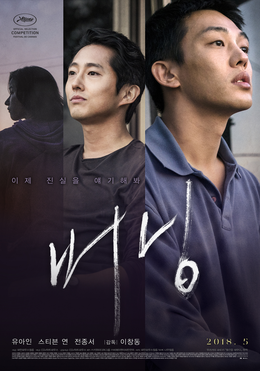
International Horror Film: Burning (dir by Lee Chang-dong)


I’ll be the fist to admit that it’s probably open for debate whether or not the 2018 South Korean film, Burning, is really a horror film.  On the one hand, it could be a murder mystery or perhaps a film about a poor farm boy who meets an upper class sociopath.  On the other hand, it could all be a big misunderstanding.  By the end of the movie, you’re not even sure that all of these characters even existed.  Though there are no ghosts nor any other paranormal monsters to be found in Burning, it’s still a deeply unsettling film.  In fact, it’s one of the most unsettling films that I’ve seen in a while.  It’s a film that sticks with you, as any good horror film should.

Lee Jong-su (Yoo Ah-in) is an aspiring writer who makes a meager living by doing odd jobs in Seoul.  His family owns a farm and his father has been accused of murder, though the details as to what happened are left deliberately opaque.  When Jong-su runs into an old classmate named Shin Hae-mi (Jeon Jong-seo) in downtown Seoul, he doesn’t recognize her at first.  She cheerfully explains that she’s had plastic surgery.  She also says that she has spent years training in the art of pantomime.  She pantomimes eating invisible food and she does such a good job at it that you’d swear she was actually holding something in her hand and chewing something in her mouth.  After they have sex, Hae-mi says that she’s going on a trip to Africa and she asks Jong-su to look after her cat.  Jong-su agrees.

And yet, we never see the cat.  After Hae-mi leaves, Lee goes to her apartment and searches for the cat but never finds it.  He finds evidence that the cat does exist.  Food is eaten.  The litter box is used.  And yet, the entire time that Jong-su is supposed to be taking care of it, the cat is never seen.  Jong-su spends so much time searching for the cat in that apartment that it’s hard not to wonder if the cat even existed.  For that matter, Hae-mi’s story about going to Africa is remarkably vague.  Why is she going to Africa?  Why has she entrusted someone she barely knows with taking care of her cat?  Are the cat and the visit to Africa just another pantomime, something that seems real yet only exists in Jong-su’s mind?

When Hae-mi finally does return from her trip, she brings with her a story about being stranded in the Nairobi Airport for three days as the result of a terrorist attack.  Returning with Hae-mi is Ben (Steven Yeun).  Ben is a handsome and rich and confident and everything that Lee is not.  Ben alternates between being superficially friendly and chillingly cold.  At one point, he suggests that he at least cared enough about Hae-mi to be jealous of her relationship with Jong-su and yet it’s hard not to notice that Ben always seems to be slightly annoyed with her whenever they’re together.  When the three of them go up to Jong-su’s farm and a stoned Hae-mi dances in the night, Jong-su watches enraptured while Ben smirks.  (It would be easy to assume that Jong-su is the good guy while Ben is the bad guy if not for a scene where Jong-soo angrily reprimands Hae-mi for her behavior around other men, showing that Ben is not only person in the film with control issues.)  At one point, Ben casually tells Jung-so about his interesting habit.  He sets fire to greenhouses.  He destroys the beauty that others have grown.  He tells Jong-su that he’s noticed a lot of greenhouses near his family’s farm….

Burning is a deeply unsettling film.  It’s not just that Steven Yeun gives a chilling performance as a man who appears to have no soul.  (The film makes very good use of Yeun’s natural likability so show how someone like Ben can not only survive in the world but also thrive in it.)  At the same time that we’re trying to figure out Ben, we’re also struggling to get a read on Jong-su as well.  We spend a lot of time with Jong-su and yet, by the end of the movie, we’re still not sure that we know him at all.  He says he wants to be a writer and speaks vaguely of Faulkner and Fitzgerald but it still seems as if he’s hiding secrets of his own.  It’s tempting to read a lot (perhaps too much) into Jong-su’s admiration of Faulkner and Fitzgerald.  Faulkner wrote novels that took place in the heads of his characters, much as how Burning, at times, seems to be taking place completely in the head of Jong-su.  Fitzgerald’s best-known novel was about a man who was obsessed with money and a woman whom he had idealized beyond reality.  Jong-su, at one point, refers to Ben as being Gatsby but we’re left to wonder if perhaps it’s the other way around.  Perhaps Jong-su is Gatsby, the poor man who is constantly trying to reinvent his reality.

It all leads to a mystery that may not be a mystery and clues that could just as easily by coincidences.  It also leads to an act of sudden violence, one that leaves you wondering whether or not we knew any of these people.  As I said, it’s a deeply unsettling film but, at the same time, it’s not one that can be ignored.  It has a 148-minute running time and it’s deliberately paced and yet, due to the strength of the performers and the intriguing enigma of the plot, you don’t get bored.  You don’t look away.  You watch this story and you search for answers that you know you’ll probably never find.

Burning is on Netflix right now so be sure to watch it before they drop it to make room for another season of American Horror Story.