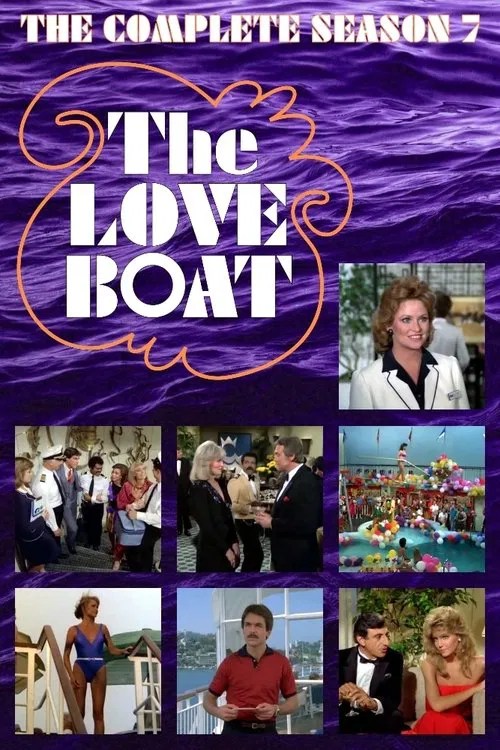
Under the Sea: Goliath Awaits (1981, directed by Kevin Connor)


1939.  War is breaking out across Europe.  The British luxury liner Goliath is torpedoed by a German U-boat.  Presumed to be lost with the ship are a swashbuckling film star, Ronald Bentley (John Carradine), and U.S. Senator Oliver Barthowlemew (John McIntire), who may have been carrying a forged letter from Hitler to Roosevelt when the boat went down.

1981.  Oceanographer Peter Cabot (Mark Harmon, with a mustache) comes across the sunken wreck of the Goliath.  When he dives to check out his discovery, he is shocked to hear big band music coming from inside the ship.  He also thinks that he can hear someone tapping out an S.O.S. signal.  When he looks into a porthole, he is stunned to discover a beautiful young woman (Emma Samms) staring back at him.

Under the command of Admiral Sloan (Eddie Albert), who wants to retrieve the forged letter before it does any damage to the NATO alliance, Cabot and Command Jeff Selkirk (Robert Forster) are assigned to head an expedition to explore Goliath.  What they discover is that, for 40 years, the passengers and crew have survived within an air bubble.  Under the leadership of Captain John McKenzie (Christopher Lee), they have created a new, apparently perfect society within the sunken ship.  Cabot discovers that the woman that he saw was McKenzie’s daughter, Lea.

McKenzie is friendly to Cabot and his crew, explaining to them the scientific developments that have allowed the passengers and crew to not only survive but thrive underwater.  The only problems are a group of outcasts — the Bow People — who refuse to follow McKenzie’s orders and Palmer’s Disease, an infection that only seems to infect people who are no longer strong enough to perform the daily tasks necessary to keep McKenzie’s utopia functioning.   Even when people on the boat die, they continue to play their part by being cremated in Goliath’s engine room and helping to power the ship.

Everything seems perfect until Cabot announces that he has come to rescue the survivors of the Goliath.  Even though Goliath is starting to decay and will soon no longer be safe, McKenzie is not ready to give up the perfect society that he’s created.  McKenzie sets out to prevent anyone from escaping the Goliath.

Goliath Awaits is a massive, 3-hour production that was made for television and originally aired over two nights.  (The entire 200-minute production has been uploaded to YouTube.  Avoid the heavily edited, 91-minute version that was released on VHS in the 90s.)  It’s surprisingly good for a made-for-TV movie.  Because a large portion of the film was shot on the RMS Queen Mary, a retired cruise ship that was moored in Long Beach, California, Goliath looks luxurious enough that you understand why some of the passengers might want to stay there instead of returning to the surface.  Beyond that, Goliath Awaits takes the time to fully explore the society that McKenzie has created and what it’s like to live on the ship.  McKenzie may not be as benevolent as he first appears to be but neither is he a one-dimensional villain.

Mark Harmon is a dull lead but Robert Forster is just as cool as always and Christopher Lee is perfect for the role of misguided Capt. McKenzie.  The movie is really stolen by Frank Gorshin, who is coldly sinister as Dan Wesker, the Goliath’s head of security.  McKenzie may by Goliath’s leader but Wesker is the one who does the dirty work necessary to keep the society running.

Goliath Awaits also features several character actors in small roles, with John Carradine, Duncan Regehr, Jean Marsh, John McIntire, Jeanette Nolan, Alex Cord, Emma Samms, and John Ratzenberger all getting to make a good impression.  (Ignore, if you can, a very young Kirk Cameron as one of the children born on the Goliath.)

Goliath Awaits is far better than your average made-for-TV movie from the 80s.  With any luck, it will someday get the home video release that it deserves.


Embracing the Melodrama Part II #26: Cleopatra (dir by Joseph L. Mankiewicz)


Cleopatra_posterWhile watching the 1963 best picture nominee, Cleopatra, I had many thoughts.  The film lasts over 4 hours so I had a lot of time to think.

For instance, I often found myself impressed by the sheer size of the production.  I marveled at the recreation of ancient Greece and Rome.  I loved looking at the ornate costumes.  I loved feeling as if I was taking a look back at what Rome may have actually looked like at the height of the Roman Empire.  Making it all the more impressive was that this film was made in the days before CGI.  When the film’s Romans walked through the streets of Rome, they weren’t just actors standing in front of a green screen.  They were walking down real streets and surrounded by real buildings.  It reminded me of the awe and wonder that I felt when I was in Italy and I was visiting the ruins of ancient Rome.

(I don’t know if any of the cast accidentally flashed everyone like I did when I visited during Pompeii on a windy day but considering how short some of the skirts on the men were, it wouldn’t surprise me if they did!)

And, as I marveled at the recreation of Rome, I also thought to myself, “How long is this freaking movie?”  Because, seriously, Cleopatra is an amazingly long movie.  It’s not just the film is over four hours long.  It’s that the film feels even longer.  Gone With The Wind, The Godfathers Part One and Part Two, Once Upon A Time In America; these are all long films but, because they’re so great, you never find yourself checking the time while watching.  Cleopatra is the opposite of that.  Cleopatra is a film that, at its slowest, will make you very much aware of how many seconds are in a minute.

I found myself marveling at the lack of chemistry between Elizabeth Taylor and Richard Burton.  If anything, this is the most shocking thing about Cleopatra.  If Cleopatra is famous for anything, it’s famous for being the film where Elizabeth Taylor (cast in the role of Cleopatra) first met Richard Burton (who was playing Mark Antony).  Their affair dominated the gossip headlines.  (If TMZ and YouTube had been around back then, there would be daily videos of Richard Burton punching out paparazzi.)  Cleopatra was the first of many big-budgeted, overproduced films that Taylor and Burton co-starred in.

(Then again, they also starred in Who’s Afraid of Virginia Woolf, a film that is almost the exact opposite of Cleopatra.)

In the role of Mark Antony, Burton spends most of the film looking absolutely miserable.  Elizabeth Taylor, meanwhile, seems to be having a lot more fun.  It’s almost as if she understood what Cleopatra was going to become so she went out of her way to give the type of over-the-top performance that the film deserved.  The same can also be said about Rex Harrison, who plays Julius Caesar and who, perhaps because he appears to have shared her attitude, actually does have some chemistry with Taylor.

Actually, if anyone gives a truly great performance in Cleopatra, it’s Roddy McDowall.  McDowall plays the future Emperor Augustus with a mesmerizing intensity.  Again, McDowall’s performance is not exactly subtle but Cleopatra is not a film that demands subtlety.

As the film finally neared its end, I found myself wondering how Joseph L. Mankiewicz went from directing two close to perfect films, A Letter To Three Wives and All About Eve, to directing this.  Even more amazing, Mankiewicz had previously directed one of the best Roman Empire films ever, 1953’s Julius Caesar.  (When compared to Cleopatra, the low-key and thoughtful Julius Caesar appears to have been filmed on an entirely different planet.)  Well, in Mankiewicz’s defense, he was not the original director.  He was brought in to replace Rouben Mamoulian, who had previously attempted to make the film with Joan Collins, Ben-Hur‘s Stephen Boyd, and Peter Finch.  When Mankiewicz was brought in, the cast was replaced with Taylor, Burton, and Harrison.  Between the expensive stars, the troubled production, and all of the offscreen romantic melodrama, Mankiewicz probably did the best that he could.

Today, Cleopatra is mostly interesting as an example of a film from the “Only Gigantic Productions Will Save Us From Television!” era of Hollywood filmmaking.  Cleopatra started out as a $2,000,000 production and ended up costing $31,000,000.  It was the number one film at the 1963 box office and it still nearly bankrupted 20th Century Fox.  While the film does have some kitsch appeal, the critics hated it and it’s easy to see why.

And yes, it was nominated for best picture of the year, a tribute to the size of the production and the determination of 20th Century Fox to get something — anything — in return for their money.

Cleopatra is a bit of a chore to sit through but it can be fun if you’re in a snarky mood.  It’ll do until the inevitable Angelina Jolie remake comes along.

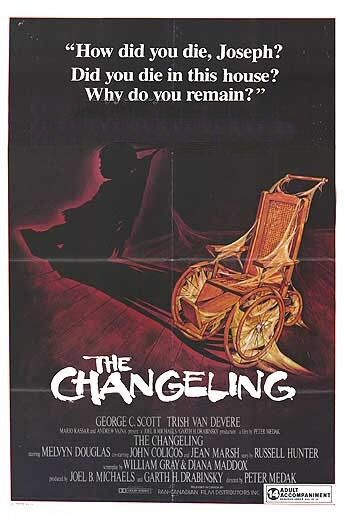
Shattered Politics #45: The Changeling (dir by Peter Medak)


Changeling_ver1If you love horror movies, you have to track down and see The Changeling.

First released in 1980, The Changeling stars George C. Scott as John Russell, a composer.  At the start of the film, he watches helplessly as both his wife and his daughter are killed in a horrific auto accident.  The grieving John leaves his New York home and relocates to Seattle, Washington.  With the help of a sympathetic realtor, Claire Norman (Trish Van Devere), John finds and rents a previously abandoned Victorian mansion.

At first, it seems that John is alone with his grief.  But, as you can probably guess, it quickly becomes apparent that John isn’t alone in his house.  Windows shatter.  Doors slam.  And, most dramatically, every night a mysterious banging sound echoes through the house.  Slowly, John comes to suspect that his house might be haunted…

And, of course, it is!  It’s no spoiler to tell you that because the film is admirably straight forward about being a ghost story.  And what a clever ghost story it is.  I don’t want to give too much away so I’ll just say that the story behind the ghost involves a powerful family, an age-old scandal, and a powerful U.S. Senator (played, with a mixture of poignant sadness and menace, by Melvyn Douglas).

The Changeling is a very well-done and effective ghost story.  For the most part, director Peter Medak emphasizes atmosphere over easy shocks, the end result being a film that maintains a steady feeling of dread and sticks with you long after the final credit rolls up the screen.  George C. Scott is well-cast as John Russell, capturing both the character’s grief and his curiosity.  (There’s actually a very interesting subtext to the film, in that investigating death actually gives John a reason to live.)  At the time the film was made, he was married to Trish Van Devere and the two of them have a very likable chemistry.  And, as previously stated, Melvyn Douglas makes for a great quasi-villain.

(It’s interesting to compare Douglas’s intimidating work here with the far more sympathetic performances that he gave, around the same time, in Being There and The Seduction of Joe Tynan.)

My favorite scene in The Changeling comes when John and Claire hold a séance in order to try to discover what the ghost wants.  The séance team is made up one woman who asks questions, one woman who channels the spirit and writes down his answers, and one man who reads the answers after they’re written.  It’s a wonderfully effective scene, dominated by the eerie sounds of questions being asked, answers being scribbled, and then being shakily read aloud.  It’s probably one of the best cinematic séances that I’ve ever seen.

The Changeling is a wonderful mix of political intrigue and paranormal horror. It was also the first film ever to win a Genie award for Best Canadian Film, which just goes to prove the 90% of all good things come from Canada.