Film Review: Air (dir by Ben Affleck)


Air opens with a montage of the 80s.  Ronald Reagan is President.  MTV is actually playing music.  Wall Street is full of millionaires.  Sylvester Stallone is singing with Dolly Parton for some reason.  Because the specific year is 1984, people are nervously giving George Orwell’s book the side-eye.  Everyone wants an expensive car.  Everyone wants a big house.  Everyone wants the world to know how rich and successful and special they are.

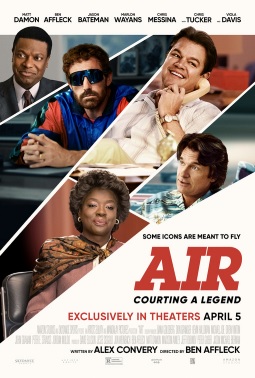
What no one wants is a pair of Nike basketball shoes.  All of the major players are wearing Adidas and Converse while Nike is viewed as being primarily a company that makes running shoes.  CEO Phil Knight (played by Ben Affleck) is considering closing down the basketball shoe division.  Sonny Vaccaro (Matt Damon), however, has a plan that he thinks will save the division.  Instead of recruiting three or four low-tier players to wear and endorse Nike shoes, Sonny wants to spend the entire division’s budget on just one player.  Sonny is convinced that a young Michael Jordan is destined to become one of the best players in the history of basketball and he wants to make a shoe that will be specifically designed for Jordan.

The problem is that Michael Jordan doesn’t want to have anything to do with Nike because Nike is not viewed as being a cool brand.  Jordan wants to sign with Adidas, though he’s considering other offers as well.  He also wants a new Mercedes.  Even though everyone tells Sonny that he’s wasting his time and that he’ll be responsible for a lot of people losing their jobs if he fails, Sonny travels to North Carolina to make his pitch personally to Jordan’s mother (Viola Davis).

For it’s first 50 minutes or so, Air feels like a typical guy film, albeit a well-directed and well-acted one.  Almost all of the characters are former jocks and the dialogue is full of the type of good-natured insults that one would expect to hear while listening to a bunch of longtime friends hanging out together.  For all the pressure that Sonny is under, the underlying message seems to be one of wish fulfilment.  “Isn’t it great,” the film seems to be saying, “that these guys get to hang out and talk about sports all day?”  When Sonny runs afoul Michael Jordan’s agent, David Falk (Chris Messina), one is reminded of the stories of temperamental film executives who spent all day yelling at each other on the telephone.  The efforts to sign Jordan feel a lot like the effort to get a major star to agree to do a movie and it’s easy to see what attracted Damon and Affleck to the material.  Even though the majority of the film takes place in the Nike corporate offices, it deals with a culture that Damon and Affleck undoubtedly know well.

But then Jason Bateman delivers a great monologue and the entire film starts to change.  Despite his reluctance to sign with Nike, Michael Jordan and his family have agreed to visit the corporate headquarters.  Sonny has a weekend to oversee the creation of the shoe that will hopefully convince Jordan to sign.  When Sonny shows up for work, he’s excited.  But then he has a conversation with Rob Strasser (Jason Bateman), the head of marketing.  Strasser talks about his divorce and how he only sees his daughter on the weekends.  Every weekend, Rob brings his daughter the latest free Nike stuff.  His daughter now his 60 pairs of Nike shoes.  Rob admits that, even if he loses his job, he’ll probably still continue to buy Nike shoes because that’s now what his daughter expects whenever she sees him.  Rob compares Sonny’s plan to the Bruce Springsteen song Born in the USA, in that the tune sounds hopeful but the lyrics are much darker.  If the plan succeeds, Nike will make a lot of money.  If it fails, Rob and everyone in the basketball division will be out of a job and that’s going to effect every aspect of their lives.  Rob points out that Sonny made his decision to pursue only Michael Jordan without thinking about what could happen to everyone else.  Sonny says that success requires risk.  Rob replies that Sonny’s words are spoken, “like a man who doesn’t have a daughter.”

It’s an honest moment and it made all the more powerful by Bateman’s calm but weary delivery of the lines.  It’s the moment when the film’s stakes finally start to feel real, even though everyone knows how the story eventually turned out.  As well, it’s in this moment that the film acknowledges that the Air Jordan legacy is a complicated one.  Rob talks about how the shoes are manufactured in overseas sweatshops.  Later, when discussing whether or not Michael Jordan should get a percentage of the sales, Jordan’s mother acknowledges that the shoes aren’t going to be cheap to purchase.  They’re going to be a status symbol, just as surely as the Mercedes that Jordan expects for signing with the company.  Air becomes much like that Springsteen song.  On the surface, it’s a likable film about a major cultural moment, full of dialogue that is quippy and sharply delivered without ever falling into the pompous self-importance of one of Aaron Sorkin’s corporate daydreams.  But, under the surface, it’s a film about how one cultural moment changed things forever, in some ways for the better and in some ways for the worse.

It’s an intelligent film, one the creates a specific moment in time without ever falling victim to cheap nostalgia.  Matt Damon gets a brilliant monologue of his own, in which he discusses how America’s celebrity culture will always attempt to tear down anyone that it has previously built up.  Ben Affleck plays Nike’s CEO as being an enigmatic grump, alternatively supportive and annoyed with whole thing.  As for Michael Jordan, he is mostly present in only archival footage.  An actor named Damian Delano Young plays him when he and his parents visit Nike’s corporate headquarters but, significantly, his face is rarely show and we only hear him speak once.  In one of the film’s best moments, he shrugs his shoulders in boredom while watching a recruitment film that Nike has produced to entice him and, because it’s the first reaction he’s shown during the entire visit, the audience immediately understands the panic of every executive in the room.

Air is a surprisingly good film.  It’s currently streaming on Prime.
Embracing the Melodrama Part II #99: Pay It Forward (dir by Mimi Leder)


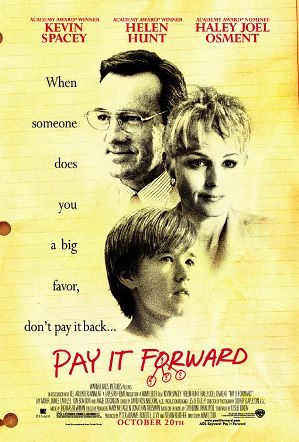
Pay_it_forward_ver1Speaking of crappy films…

Listen, I’m not going to say too much about the 2000 film Pay It Forward because it’s such a terrible movie that I feel like writing too much about it would be like the equivalent of having sex in It Follows.  Seriously, you talk too much about Pay It Forward and you’ll end up with some sort of shape-shifting demon following you around, doing you favors and demanding that you do three more favors for three other people and then those people have to do three more favors and pretty soon, everyone in the world is doing favors for everyone and…

AGCK!

Okay, okay — I know that probably doesn’t sound too bad to some people.  “People being nice to each other!?  What could be wrong about that?”  Well, watch the damn film and find out.

In Pay it Forward, Haley Joel Osment plays a creepy little kid who basically “saves” the world.  At the end of the film, he’s violently murdered and the entire population of Las Vegas gathers outside of his house with candles.  His mother Helen Hunt is truly touched that everyone was so moved by Haley’s mission.  That said, if Haley had never decided that everyone should pay it forward, he probably wouldn’t be dead.  I mean, let’s just be honest here.

Before he died, Haley was challenged by his social studies teacher, Kevin Spacey.  Mr. Spacey challenged an entire class of 7th graders to come up with an idea that will change the world.  (Honestly, don’t 7th graders already have enough to deal with?)  Haley’s idea is that he’ll do a favor for three random people and then those three people will do three nice things for three people and then…

BLEH!  God, I hate this movie!

Anyway, Haley gives money to a homeless man and then that homeless man keeps a woman from committing suicide and then that woman does something nice for Angie Dickinson and then somehow, this all eventually leads to some rich guy giving Jay Mohr a car and telling him to “pay it foward.”

And Jay’s a reporter!

So, naturally, he starts to work his way backwards on the chain of good deeds.  Along the way, he meets a prison inmate who has been converted to Pay It Forwardism.  “This is going to change the world!” he tells Jay.  “I’m even getting the brothers in here in on it!”

By the way, there’s exactly one person of color in Pay It Forward and he’s a prison inmate who thinks that other inmates will want to do random favors for each other.

Oh, but Haley has to do two other favors!  So, he sets Helen Hunt up with Kevin Spacey and when he catches his teacher coming out his mom’s bedroom, Haley gets really, really excited and … well, it’s pretty creepy.

At first, Helen thinks that Kevin thinks that she’s not smart enough to date him.  When Helen asks him point blank if he thinks that she’s dumb, he responds by giving a really long monologue about the time that his father set him on fire.  Kevin does not mention what his father was attempting to pay forward…

And then Jay shows up in town and interviews Haley and oh my God, Haley’s going to change the world!  Yay!  But then Haley spends his third favor trying to protect a kid (played by Degrassi‘s Marc Donato) from some bullies and ends up getting stabbed to death.

But fear not!  Along with that candlelight vigil, we also hear an anchorwoman breathlessly reporting that there have been reports of “Pay it Forwardism” across the country.

Now, there’s a lot of negative things that I could say about Pay It Forward but … well, I kinda already did.  Pay It Forward pops up on TV a lot and there’s a lot of idiots who always get excited about it.

https://twitter.com/_sierraalynn/status/606195871949156353

https://twitter.com/TreyClark56/status/605372272690356225

https://twitter.com/KelliOtto_/status/605370371248951296

Here’s my fear concerning the whole Pay It Forward idea.  It seems like anybody can just do anything and then go, “Pay it forward,” and suddenly, you are obligated to go do three favors.  You may be running late.  You may have other things you need to do.  But no, you’ve been told to pay it forward and now, you have to!  Because of one creepy little kid who wanted his social studies teacher to have sex with his mom, you have now been inconvenienced.

There doesn’t seem to be any rule about how big of a favor anyone actually has to do before they can smugly order you to “Pay it forward.”  Think about this.  You’re trying to get a Coke from a vending machine but all of your dollars are all crumbled up and the machine won’t accept them.  You’re about to give up and go home when suddenly, a stranger walks up and deposits three quarters in the machine and punches a button.

He tosses you a grape drink.  You wanted a Coke but, because you’re nice and you think he was selflessly trying to help you out, you smile and say, “Thank you.”

“Pay it forward,” he replies before walking away.

Well, now, you’re screwed, aren’t you?

Now, suddenly, you have to go find three people who need a favor.  You didn’t want grape.  You wanted a Coke and, even if you had never gotten that Coke, it would not have been the end of the world.  But, because you were polite and said thank you, you are now obligated.

As you look for people to help, it occurs to you that stranger really didn’t care about whether you wanted a Coke.  What he cared about was completing his third favor so he could actually get on with his life.  So, no, he wasn’t trying to help you or trying to make the world a better place.  Instead, he was just trying to free himself of a nagging obligation.

So, after a long search, you’ve finally found your three strangers and you’ve done your three favors and you’re finally free of your obligation.  And then suddenly, another stranger runs up and tosses you the keys to one of those stupid looking Smart cars and yells, “Pay it forward!”

SERIOUSLY, IT NEVER ENDS!

Don’t tell me about paying it forward.

Just leave me alone and let me drink my damn Coke.

Quick Review: The Incredible Burt Wonderstone (dir. by Don Scardino)


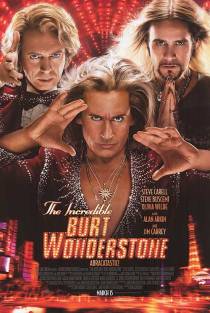
url-2I don’t have a whole lot to say about The Incredible Burt Wonderstone. It’s such a compact, little film, there’s not much I can say without telling everyone the entire story. The trailer is the movie, let’s put it that way.

When I was little, I owned this deck of magic playing cards. On the back of every card was a circular pattern that told the reader what card they were holding, the next card in the deck and the card at the bottom of the set (if they were shuffled correctly). It only lasted a few days, but the effect of doing the trick – that look of amazement when the trick actually worked – was pretty cool. Once that time passed, the trick was stale and predictable.

The Incredible Burt Wonderstone is kind of like that. It’s a film that probably won’t be very memorable in the long run, especially when you have other films about magic like Neil Burger’s The Illusionist and Christopher Nolan’s The Prestige. At the start, it seems awesome, but once the story arcs develop, you may start wondering if you need to stick around for the rest. Truth be told, it’s not a film you have to rush out to see, though there are some scenes to laugh at. On the other hand, if you’re going to the movies just to be entertained, to just laugh for a while, this may be what you’re looking for.

After receiving a magic trick set as kid and watching a training video by the great Rance Holloway (Alan Arkin), young Burt Wonderstone decides he’s going to be a magician. He and his new best friend decide to train together over the years, enjoying the tricks until they become The Incredible Burt Wonderstone and Anton Marvelton. They end up doing so well that they become the headliners for a major Casino for the next 10 years, and this strains their friendship. Anton enjoys the magic for the entertainment it is, and Burt considers himself royalty, feeling a sense of entitlement for all the perks he receives. When Steve Gray (Jim Carrey) appears on the scene with his new tricks, Burt and Anton find themselves facing some serious competition. Can the duo come up with something as amazing as Grey serves up? Can Wonderstone deflate his incredibly huge ego?

The story, written by Johnathan Goldstein (Horrible Bosses) and John Francis Daley (Freaks and Geeks) is not bad for what it’s offering. Of the last 3 films I’ve seen (Hansel & Gretel: Witch Hunters, Identity Thief, Jack & the Giant Slayer), it easily has the best pacing, but you can almost close your eyes and dictate what the next scene is going to be. There’s not a whole lot in the way of surprise, story wise…which I guess is what all the magic is for.  Not saying I could ever come up with anything better, though. For the director, Don Scardino, if this is first movie coming off of the 30 Rock episodes he’s done, he does a good job of keeping the story moving. The cast does well, but there’s nothing amazing with anyone here save for Carrey and Arkin. Carrell is basically himself in this film, which works well enough, and I felt that Buscemi was almost reenacting his role from The Big Lebowski. As a group, it seemed to make sense that Buscemi was the straight man to Carrell’s role.

Carrey’s Steve Grey is a lot like a David Blaine or Criss Angel, performing a mixture of illusion and stunt effects.  I have to admit that while I’m not a huge fan of Carrey’s recent efforts, I really don’t think this film would be as fun as it is without him in it. That the movie offers him up in small doses actually helps things. Olivia Wilde was nice as Wonderstone’s new assistant, but I would have liked her to do just a little more, or even better, she could have played a great rival. The same can be said of Alan Arkin, who had me smiling for most of the time he was in the film (though his appearance does kind of leave something of a plot hole in the story, but that’s just me).

The magic itself is more or less hit or miss. Depending on who you’re watching, the “tricks” were either worthy of a chuckle, made you simultaneously laugh and wince (Just about all of Grey’s were that way) or they showed one or two that made the audience at my showing gasp. For those moments, the movie was worth it, and the comedy is definitely there. Overall, I’d see this again if it were on cable or someone showed it to me, but it’s not a film I’d run right back to.

If only I could get that damn Abracadra song out of my head.

The 10 Worst Films of 2010


Sometime during the first week of January, I’ll post my picks for the top 25 films of 2010.  But for now, I’m going to go ahead and post the much more fun list, my picks for the 10 Worst Films of 2010.

10)  Knight and Day — Tom Cruise gets creepier with each film.

9) Robin Hood — Sorry, but that “I declare him to be an …. OUTLAWWWWWW!” line can only carry a film so far. 

8 ) Wall Street: Money Never Sleeps — Money may never sleep but Lisa Marie did.  Shia LeBouf as a financial genius?  Plus, any film that so completely wastes the talents of Carey Mulligan deserves to be on this list.  The Other Guys got across the exact same message and was actually entertaining.

7) Eat Pray Love — Finally, a film that tells us all how to find peace, enlightenment, and happiness.  First off, have a lot of money.  Secondly, be Julia Roberts.

6) Solitary Man — A superb performance from Michael Douglas can’t disguise the fact that this is yet another entry in the “Men-Just-Can’t-Help-It” genre of film. 

5) Hereafter — This is, quite frankly, one of the most boring films I’ve ever seen in my life.  And I’ve seen a lot of boring films.  This is also one of those films that attempts to convince you that it’s a quality production by making all the actors look as crappy as possible.  Seriously, did they just pump collagen into Jay Mohr’s face?

4) Clash of the Titans — Zeus must be turning over in his grave.

3) Chloe — Great director (Atom Egoyan), great cast (Julianne Moore, Liam Neeson, Amanda Seyfried), terrible movie.  I’m still trying to understand how this one came about.

2) The American — An homage to the French New Wave that fails because it is neither French nor new and there’s also a notable lack of waves.

1) Love and Other Drugs — What makes this film the worst of 2010?  The beginning, the middle, and the end.

Film Review: Hereafter (dir. by Clint Eastwood)


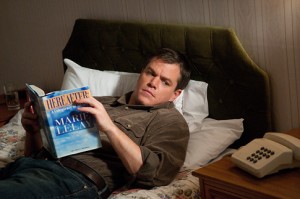
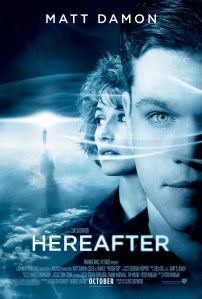
Hereafter is a very serious film about a very serious topic, death.  Following three separate but ultimately connected stories, the film attempts to explore death and the question of what happens after death from three different angles — intellectually, emotionally, and spiritually.   I really wanted Hereafter to be a great film.  So did the film’s makers, which is precisely why Hereafter fails.

The intellectual consideration of death is represented by the character of Marie (Cecile De France), a French journalist who, at the start of the film, drowns in a tsunami and is, for a few minutes, clinically dead.  Before she is eventually revived, she has a classic near-death experience: the bright light, the people waiting to greet her, the whole deal.  After this experience, Marie is compelled to investigate whether or not there truly is such a thing as an afterlife.  As she does so, Marie finds herself shunned by her resolutely secular friends and grows increasingly distant from her skeptical (and rather condescending) boyfriend.

The emotional response to death is represented in the story of twin brothers, Marcus and Jason (played by Frankie and George McLaren).  The two boys live in London with their drug-addicted mother and share a strong (and, to be honest, kinda creepy) bond.  Jason, while simply trying to return home with some drugs for his detoxing mother, is roughed up by some bullies and ends up running out into the middle of the street.  Naturally, since this is a movie, Jason is hit by a truck as soon as he steps off the curb.  Jason is killed and Marcus is taken away by social services and put into a foster home.  Marcus continues to carry Jason’s cap with him and soon starts tracking down local English psychics in an attempt to talk to his brother again.

Finally, the spiritual aspect is detailed in the film’s most interesting story.  This story features Matt Damon as George Lonegan, a psychic who can speak with the dead.  After years of being a minor celebrity, George burned out and went into a self-imposed exile.  He now works at a factory while his brother (Jay Mohr, who looks incredibly puffy in this movie) keeps trying to find ways to convince George to get back into the business of talking to dead for fun and profit.  After George reluctantly gives a reading to Richard Kind, he finds himself being dragged back into his old life.

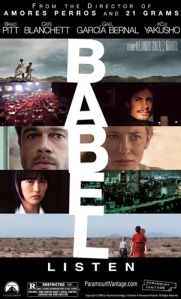
 A lot of viewers and critics have compared Hereafter to Alejandro González Iñárritu’s 2006 masterpiece, Babel.  Both films follow three separate but connecting stories and both films are concerned with the theme of death and how it connects us all.  As well, Babel featured Brad Pitt in a serious role and Hereafter features Matt Damon.  The main difference, however, is that Babel was a great film but Hereafter is basically an uneven mess.

Whereas Babel featured three strong stories, Hereafter features 1 compelling story (that would be Damon’s) which is compelling solely because Matt Damon is a talented enough actor that he can apparently perform miracles.  He’s probably about as likable as he’s ever been in the role of George but he also wisely plays the role as being just a little bit off.  Even though the film makes the mistake of never really going into the details of just what exactly caused George to give up being a psychic, Damon is so good in the role that you’re willing to take him at his word that he had a good reason.  Probably the highlight of the film (and one of the few sections to really inspire any sort of real emotional response) is an extended sequence where Damon befriends and the manages to alienate an insecure, single woman played by Bryce Dallas Howard.  Damon and Howard have a scene that involves eating while blind-folded that manages to be both powerfully erotic and wonderfully romantic at the same time.  If the entire film had been about them, Hereafter would have been a much better movie.

Unfortunately, we’ve got to slog through two other stories. 

Cecile La France gives an excellent performance as Marie and the opening tsunami scene is truly terrifying.  For someone like me, who cannot swim and risks having a panic attack if she even stands near the deep end of a swimming pool, the tsunami scene was almost impossible to watch.  I had to put my hands in front of my eyes and watch the scene through my fingers.  However, once she drowns, Marie sees a vision of the afterlife that — as a harbinger of things to come — is rather dull.  I mean, with everything that can supposedly be done in movies today, the best that Hereafter can give us is a bland white light.  Once Marie returns to Paris and starts her investigation, La France remains a sympathetic presence and the film actually does a pretty good job of showing just how condescending most supposedly “liberal” men are whenever a woman starts to stray from the established orthodoxy.  But, unfortunately, her story is just never that interesting.  Marie decides to write a book about the afterlife.  As a writer myself, I have to say that there is nothing more boring than watching someone else write.

As for Marcus, I was shocked just how little I cared about him or his attempts to contact his brother.  I come from a very close family and I have a very strong bond with all three of my sisters and, among them, I am notorious for crying at any movie that deals with that sort of sibling bonding.  Yet I sat through the saga of Marcus and Jason without shedding a tear and I felt terrible about it.  I really wanted to cry.  I really wanted to have some sort of emotional response to the story but I just never believed it.  I hate to say this but honestly, a lot of this was due to the fact that the McLaren twins are such bad actors.  Director Clint Eastwood has said that he specifically cast them because they weren’t professional actors and therefore, they wouldn’t introduce any false “sentimentality” into the mix.  But dammit, it was a sentimental story.  Sentiment is not necessarily a bad thing and just because something is sentimental, that doesn’t make it false.

So, what exactly went wrong with Hereafter?  The film opens strongly with a terrifying tsunami and the final 30 minutes are also undeniably touching (if also a bit contrived).  It’s everything that happens in between those two points that ruins Hereafter.  Director Eastwood, obviously looking to avoid that dreaded curse of being sentimental, keeps the whole film very low-key and realistic.  Other than the opening tsunami, there are no big wow moments but to be honest, isn’t that what movies are for?  If you’re going to make a movie that specifically shuns the wow moment, you better have something compelling (a perfect script or an entire cast giving a compelling performance as opposed to just a handful of them) to take its place.  Hereafter doesn’t and, as a result, the movie drags.  This, honestly, has got to be one of the slowest, most boring movies I’ve ever seen.  If director Eastwood’s westerns and actions films can all be seen as homages to Sergio Leone and Don Siegel, I think Hereafter must be an homage to some of Andy Warhol’s intentionally dull films.  Whereas Warhol, at the very least, gave us Joe Dallesandro to look at, Eastwood gives us Jay Mohr.  It’s not a fair trade.

I don’t know how much of Hereafter should be blamed on Eastwood and how much should be blamed on the script written by Peter Morgan.  Here’s a quote from Morgan that appeared in The Hollywood Reporter:

“It’s quite spiritual material, and quite romantic, too. It’s the sort of piece that’s not easy to describe and in the hands of different filmmakers could end up as wildly different films. Quite unlike some of my other material, which I think there were only certain ways that you could shoot it. It’s really not just another boring Hollywood movie with the same old boring Hollywood actors, although I see the point that the public and sick of paying $10.00 to see a movie with same old faces and the same gramma of story telling.”

And to that, all I can say is “Shut up, Peter Morgan!”

This is not spiritual material as much as it’s just a bunch of vaguely New Age platitudes being delivered by a mainstream screenwriter who apparently doesn’t have the guts to come down either firmly for or against an afterlife.  This is the type of feel-good BS that leads to thousands of people every year giving up their life savings to some fraud who claims he can deliver messages from beyond.  Morgan’s script goes out of its way not to actually define the afterlife.  Is it heaven or is it Hell?  Is there a God?  Do the worthy go to Heaven?  Are souls saved?  Or are they just ghosts who are waiting for us to be willing to let them go?  These are all questions that would have been considered by a good film but Hereafter doesn’t consider them.  Oh, don’t get me wrong.  It pretends to bring them up but only so the movie can shrug and go, “I guess nobody knows.”  And to that I say, either take a position or don’t expect everyone else to pay money just to listen to you duck the question because you’re too scared of alienating mainstream critics or audiences.

(Myself, I do believe that those who love us are always with us in some way even if I don’t believe in a literal afterlife.  And while I know that answer might seem vague, you should also consider that I’m not the one spending millions of dollars to make a movie celebrating that vagueness.)

Morgan’s script also make its a point to incorporate real-life events into his contrived narrative.  As a result, the London Subway bombings and the Thailand Tsunami are both used as convenient plot points in much the same way that The Curious Case of Benjamin Button used Hurricane Katrina.  I felt it was ghoulish when Button did it and, the more I think about it, it’s equally ghoulish in Hereafter.  It’s hard not to feel that the film’s saying, “Too bad all those real people died but what’s important is how these events impacted the lives of a bunch of fictional characters.”

Hereafter’s main problem is that it simply tries too hard to be great.  You get the feeling that every scene and line has been calculated to make you go, “Wow, what genius!”  As a result, even the scenes that work still somehow feel very dishonest.  The end result is a very insincere film about some very sincere concerns.