Retro Television Reviews: The Last Child (dir by John Llewellyn Moxey)


Welcome to Retro Television Reviews, a feature where we review some of our favorite and least favorite shows of the past!  On Sundays, I will be reviewing the made-for-television movies that used to be a primetime mainstay.  Today’s film is 1971’s The Last Child!  It  can be viewed on YouTube!

Welcome to the “near future.”

Panicked by hysterical claims about overpopulation and environmental catastrophe, Americans have sacrificed the majority of their civil liberties.  Smiling policeman stand on every corner and in every public hallway.  Of course, once their authority is challenged, those smiles quickly disappear.  Crude posters have been put up everywhere, demanding that everyone watch their consumption of natural resources.  The social engineers and the eugenicists are in charge.  Anyone over the age of 65 is ineligible for medical care and encouraged to consider euthanasia.  Couples are allowed to have only one child and the government requires that anyone who gets pregnant a second time have an abortion.  Anyone who questions the policy is told that they have no choice but to follow the law.  It’s their civic duty.  The media, meanwhile, runs headlines declaring that the one child policy has led to world peace.
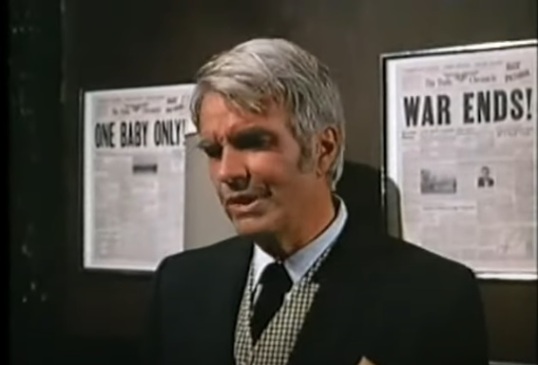
Alan and Karen Miller (played by Michael Cole and Janet Margolin) have already had their one child.  That their child died shortly after birth doesn’t matter in the eyes of Barstow (Ed Asner), the Himmleresque head of the Population Control Police.  Every couple is allowed one child and that’s it.  When Karen gets pregnant a second time, she is determined to have the baby.  She and Alan know that their only hope is to cross the border into Canada.  Helping them is a retired U.S. Senator (Van Heflin, in his final performance) who is opposed to the government’s policies.  Caught in the middle of Karen’s brother, Howard (Harry Guardino).  Howard works for the Population Control Police and he knows just how far Barstow is willing to go to keep Karen from having her baby.

The Last Child opens with a title card informing us that the film takes place in the “not-too-distant future.”  Along with all of the propaganda posters, that’s the only real sign that this film is meant to be taking place in the future.  There’s no “futuristic” technology.  Everyone dresses in the latest 1971 fashions.  Everyone drives the latest 1971 automobiles.  Though the decision may have been motivated by the film’s low-budget, the lack of the typical sci-fi trappings serves the film well.  The Last Child does not take place in a sleekly designed future and it doesn’t takes place in an apocalyptic wasteland.  Instead, it takes place in a world that is just as shabby as you would expect a world controlled and decorated by a government bureaucracy to be.  It’s a gray dystopia, populated by people who have given up their individuality.  It’s a world that’s visually boring by design and that makes it all the more disturbing.

The Last Child is an effective and well-acted film.  It probably feels more plausible today than it did when it aired back in 1971.  In many ways, with its portrait of unfeeling government officials and bland authoritarianism, it’s the perfect film for the age of COVID.  Indeed, the government’s policy of refusing to provide life-saving care for people over the age of 65 is reminiscent of what many pundits advocated for at the height of the COVID pandemic.  As for the film’s one child policy, that too is a concept that has become recently popular with many American academics.  Among many members of the so-called “elites,” there’s a definite need to try to control people and that very real need is what makes The Last Child so disturbingly plausible.  In The Last Child, sanctuary is found in Canada.  Today, of course, Canada is at the forefront of the euthanasia trend.  Of course, in 1971, the Prime Minister of Canada was Pierre Trudeau and not Justin.

Pierre Trudeau’s personal motto was “Reason before passion” and that’s certainly the philosophy that fuels the dystopian society at the center of The Last Child.  It’s a film that holds up today as both a thriller and a prophecy,
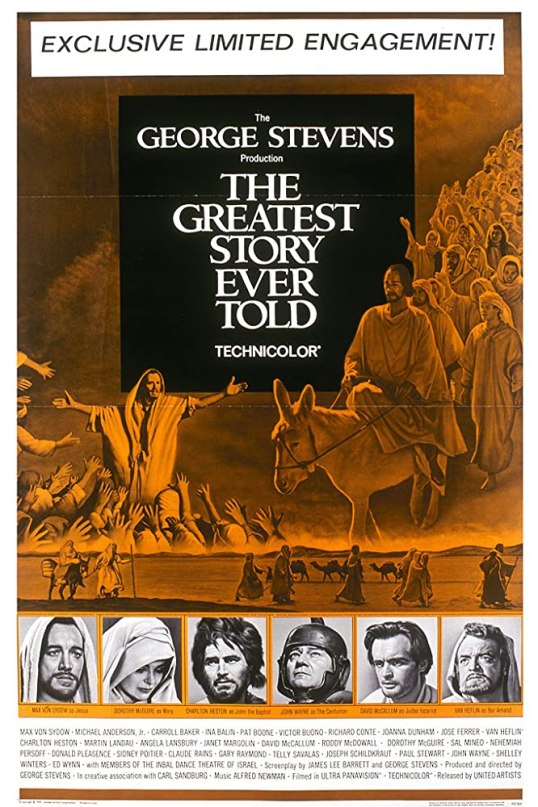
Film Review: The Greatest Story Ever Told (dir by George Stevens)


The 1965 biblical epic, The Greatest Story Ever Told, tells the story of the life of Jesus, from the Nativity to the Ascension.  It’s probably the most complete telling of the story that you’ll ever find.  It’s hard to think of a single details that’s left out and, as a result, the film has a four hour running time.  Whether you’re a believer or not, that’s a really long time to watch a reverent film that doesn’t even feature the campy excesses of something like The Ten Commandments.

(There’s actually several different version of The Greatest Story Ever Told floating around.  There’s a version that’s a little over two hours.  There’s a version that’s close to four hours.  Reportedly, the uncut version of the film ran for four hour and 20 minutes.)

Max von Sydow plays Jesus.  On the one hand, that seems like that should work because Max von Sydow was a great actor who gave off an otherworldly air.  On the other hand, it totally doesn’t work because von Sydow gives an oddly detached performance.  The Greatest Story Ever Told was von Sydow’s first American film and, at no point, does he seem particularly happy about being involved with it.  von Sydow is a very cerebral and rather reserved Jesus, one who makes his points without a hint of passion or charisma.  When he’s being friendly, he offers up a half-smile.  When he has to rebuke his disciples for their doubt, he sounds more annoyed than anything else.  He’s Jesus if Jesus was a community college philosophy professor.

The rest of the huge cast is populated with familiar faces.  The Greatest Story Ever Told takes the all-star approach to heart and, as a result, even the minor roles are played by actors who will be familiar to anyone who has spent more than a few hours watching TCM.  Many of them are on screen for only a few seconds, which makes their presence all the more distracting.  Sidney Poitier shows up as Simon of Cyrene.  Pat Boone is an angel.  Roddy McDowall is Matthew and Sal Mineo is Uriah and John Wayne shows up as a centurion and delivers his one line in his trademark drawl.

A few of the actors do manage to stand out and make a good impression.  Telly Savalas is a credible Pilate, playing him as being neither smug nor overly sympathetic but instead as a bureaucrat who can’t understand why he’s being forced to deal with all of this.  Charlton Heston has just the right intensity for the role of John the Baptist while Jose Ferrer is properly sleazy as Herod.  In the role Judas, David McCallum looks at the world through suspicious eyes and does little to disguise his irritation with the rest of the world.  The Greatest Story Ever Told does not sentimentalize Judas or his role in Jesus’s arrest.  For the most part, he’s just a jerk.  Finally, it’s not exactly surprising when Donald Pleasence shows up as Satan but Pleasence still gives a properly evil performance, giving all of his lines a mocking and often sarcastic bite.

The Greatest Story Ever Told was directed by George Stevens, a legitimately great director who struggles to maintain any sort of narrative momentum in this film.  Watching The Greatest Story Ever Told, it occurred to me that the best biblical films are the ones like Ben-Hur and The Robe, which both largely keep Jesus off-screen and instead focus on how his life and teachings and the reports of his resurrection effected other people.  Stevens approaches the film’s subject with such reverence that the film becomes boring and that’s something that should never happen when you’re making a film set in Judea during the Roman era.

I do have to admit that, despite all of my criticism of the film, I do actually kind of like The Greatest Story Ever Told.  It’s just such a big production that it’s hard not to be a little awed by it all.  That huge cast may be distracting but it’s still a little bit fun to sit there and go, “There’s Shelley Winters!  There’s John Wayne!  There’s Robert Blake and Martin Landau!”  That said, as far as biblical films are concerned, you’re still better off sticking with Jesus Christ Superstar.

Captain Kirk vs. Sheriff Taylor: Pray For The Wildcats (1974, directed by Robert Michael Lewis)


The year is 1974 and there’s nothing more dangerous than being a hippie in Baja California.  That’s because psychotic business Sam Farragutt (played by Andy Griffith!) is on the loose.  Sam likes to describe himself as being a hippie himself.  “A hippie with money,” Sam puts it as he waves a hundred dollar bill in the face of a hippie without money,

Actually, there is one thing more dangerous than being a hippie in Baja California and that’s being an ad executive.  Once again, Sam Farragutt is to blame.  He’s willing to give his business to three ad execs but first they have to agree to go down to Baja and ride around with him on their motorcycles.  The three ad execs are Terry Maxon (former child evangelist Marjoe Gortner!), Paul McIllvain (former Brady Bunch star Robert Reed!), and suicidal burn-out Warren Summerfield (William Shatner!).  Warren is having an affair with Paul’s wife (Angie Dickinson!) but he’s still planning on committing suicide in Mexico.

However, going to Mexico gives Warren a new lease on life.  After Warren discovers that Farragutt is responsible for the death of two hippies, he becomes determined to make sure that justice is served.  Soon, Andy Griffith (!) is chasing William Shatner (!) across the Mexican desert.  Someone’s going to die.  Is it going to be Sheriff Taylor or Captain Kirk?

Pray For The Wildcats was a made-for-TV movie that aired the same year as Savages.  Both movies were a part of Andy Griffith’s attempt to change his image after playing the folksy Sheriff Taylor on The Andy Griffith Show.  Griffith is a good villain but the main appeal of Pray for the Wildcats is the chance to see William Shatner doing his thing.  Shatner has a juicy role here, playing a man who is at first suicidal and then righteously indignant.  He overemotes with the self-serious intensity that was Shatner’s trademark in the years before he finally developed a sense of humor about himself.  The movie itself gets bogged down with unnecessary flashbacks and dated dialogue but the spectacle of Griffith vs. Shatner makes it all worth it.

Lisa Reviews An Oscar Winner: Annie Hall (dir by Woody Allen)


anniehallposterYou take a risk when you review a Woody Allen film, even an acknowledged, Best Picture-winning classic like 1977’s Annie Hall.  Do you address the accusations that have been made about him?  Do you ignore them and hope that they won’t be the Elephant in the Room, stomping through your review?  Do you try to justify reviewing (or, in some cases, even watching) Allen’s film?  Or do you just let the work speak for itself?

I love Annie Hall.  Quite frankly, I like a lot of Woody Allen’s films, even though I understand why his work is an acquired taste for quite a few other people.  I’ll address the elephant in the room in a paragraph or two but you know what?  I watched Annie Hall last night and I want to mention a few reasons why I enjoy this film.

First off, Annie Hall features one of Christopher Walken’s first (and best) performances.  He only has a few lines but he makes quite an impression.  He plays Duane, the brother of Annie Hall (Diane Keaton).  When Annie’s boyfriend, Alvy Singer (Woody Allen), is visiting the Hall family, Duane invites Alvy into his bedroom and tells him that, whenever he’s driving, he fantasizes about intentionally swerving into incoming traffoc.  In the very next scene, Duane is driving an oblivious Annie and a terrified Alvy to the airport.  It’s a wonderfully funny moment.  (If you keep your eyes open, you’ll notice that Annie’s apartment is full of pictures of Duane and his thousand yard stare.)

Secondly, this film also features an early role for Jeff Goldblum.  He only has one line — “I forgot my mantra” but my God, he does amazing things with that line.

Third, when Alvy and his agent, Rob (Tony Roberts), are driving through Los Angeles, they pass a theater.  According to the marquee, the theater is showing House of Exorcism, a Mario Bava film.  That’s right: Italian horror in a Woody Allen film.  How glorious is that?

Fourth, Annie Hall is an extremely dated film.  It was made in 1977 and, as to be expected about a film directed and written by a stand up comedian, it’s full of references that were probably hilariously on target then but rather obscure now.  As well, like almost all Woody Allen films, it’s a very New York film.  Alvy is an intellectual, left-wing Jew who suspects that everyone he sees is an anti-Semite and who is dating an aspiring actress and singer who hails from middle America.  (During the scene where Alvy meets her family, he immediately pegs Grammy Hall as a “classic Jew hater.”)  The film is very much told from Alvy’s point of view, which means jokes about New York periodicals and a flashback to an Adlai Stevenson rally.  That being said, I’m a Texas girl who was born long after Annie Hall was first released and I still enjoy the film because it’s a film that captures some universal truths about human relationships.

The first time I watched Annie Hall, I was 17 and I saw a lot of myself in Annie.  While I wouldn’t be caught dead wearing some of her outfits, I knew what it was like to be insecure.  I knew what it was like to be nervous.  I know what it was like to worry about being smart enough.  And, like Annie, I eventually learned that independence was the key to happiness.  Annie Hall has stood the test of time because both Annie and Alvy are relatable while still remaining wonderfully unique and neurotic individuals.

(If ever a film has been a ode to the joy of being neurotic, it’s Annie Hall.)

Fifth, I love the scene where Alvy asks a random couple of the street how they make their relationship work.  “I’m totally shallow and have no original thoughts,” the woman replies.  “And I’m the exact same way,” her husband cheerfully adds.

Sixth, I’m going to assume that Paul Simon was primarily playing himself.

Seventh, there are just so many great scenes.  Like when Alvy deals with a rude cop by ripping up his license.  And then, there’s that lobster scene.  And that moment when Alvy comes over to Annie’s apartment to kill a “spider the size of a buick.”  (Judging by the number of times Alvy has to hit the spider with that tennis racket, I assume buick’s are pretty big.)  There’s the two scenes of Annie singing, one when she’s still insecure and can’t compete with the sound of plates smashing around here and the other when she’s developed the confidence to dominate and control both the stage and the audience.  There’s the scenes where Alvy breaks the fourth wall and get advise from random people on the streets of New York.  And what about when Annie starts laughing while telling the horrible story of how her uncle died at the post office?  Or what about when Alvy tries to avoid having sex with his first wife by discussing the JFK assassination?  Or when we literally see Annie mentally check out of making love to Alvy?  Or how about the split-screen therapy sessions?  Or the sudden moment when Annie and Alvy become cartoon characters?  Or the scene with the pretentious blowhard at the movies?

(As a Southern girl, I have to admit that it’s always strange to me to hear Alvy and Annie talking about “waiting on line” at the movies.  Down here, we say “in line,” which makes a lot more sense.  Since a line is just a crowd of people standing in a certain order, saying that you’re “on line,” is the same as saying your standing on someone’s head.  You get in a crowd, not on them.  Whenever I hear someone from up north talking about “waiting on line,” I assume they must be bidding for something on Ebay.)

I like Annie Hall and I always will.  As for the accusations against Woody Allen, they don’t keep me from enjoying his better films because:

  1. I’ve always been a big believer that art can and should be judged separately from the artist.
  2. Having read what both sides have said about Woody Allen and the accusations that have been made against him, I don’t think he did it.

Obviously, some are going to disagree with me on both those points.  So be it.  Everyone has to make their own choice.  For me, though, what’s important is that Annie Hall is a film that I’ve loved since the first time I saw it and I’ll continue to love it.