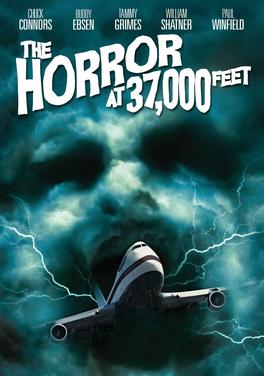
Guilty Pleasure #86: The Horror at 37,000 Feet (dir by David Lowell Rich)


I imagine that it should go without saying that, if you’re on an airplane and you’re flying high above the ground, the last thing that you want to deal with is a bunch of angry ghost druids.

And yet, that’s exactly what happens in this made-for-TV horror film from 1973.

The ghost druids are upset because two architects (played by Roy Thinnes and Jane Merrow) have traveled to England, specifically so that they can supervise the deconstruction of ancient druid altar. Now, they’re flying the pieces of the altar back over the ocean so that the altar can be reconstructed in the United States. The spirits of the ancient druids aren’t happy about being moved so they start doing everything they can to make the journey difficult.

First, they attempt to freeze the plane. When that doesn’t work, they decide to rip it in half. One of the passengers, Mrs. Pinder (Tammy Grimes), suggests that maybe the druids will settle down if they’re offered a sacrifice. When the druids reject an offer of a doll, the passengers start to wonder if maybe the spirits would be happier with a human sacrifice.

Although some of the passengers are reluctant to buy into the whole sacrifice thing, a few of them do start to come around. For instance, there’s a perpetually angry businessman who is played by Buddy Ebsen. Once he realizes that the druids aren’t going anywhere, he has no problem with the idea of a human sacrifice. There’s also a cowboy played by Will Hutchins. If sacrificing a human is what he has to do to have another chance to ride the range, that’s what he’s going to do. Paul Winfield plays a distinguished doctor who tries to keep everyone calm while Chuck Connors is stuck in the cockpit, trying to keep the plane in the air while his passengers and crew debate the ethics of human sacrifice.

And then there’s William Shatner.

Shatner plays a former priest who has lost his faith. From the minute he gets on the plane, he starts drinking and he doesn’t stop for almost the entire movie. It doesn’t matter what’s happening on the plane, Shatner always has a glass in his hand. Playing a character who never has anything positive to say, Shatner smirks through the entire film. Shatner delivers all of his lines in his standard halfting and overdramatic fashion and it’s something of a wonder to behold. Shatner has said that The Horror At 37,000 Feet may be the worst movie in which he ever appeared and just one look at his filmography will show why this is such a bold statement.

The Horror at 37,000 Feet is definitely a film of its time. The plane comes complete with a swinging cocktail lounge, William Shatner wears a turtle neck, and all of the flight attendants wear boots and miniskirts. Everything about this film screams 1973. It’s an incredibly silly but undeniably fun movie. With a running time of only 73 minutes, the pace is fast and the druids don’t waste any time getting down to business. The film’s on YouTube so check it out the next time you’ve an hour and 13 minutes to kill.

Previous Guilty Pleasures

  1. Half-Baked
  2. Save The Last Dance
  3. Every Rose Has Its Thorns
  4. The Jeremy Kyle Show
  5. Invasion USA
  6. The Golden Child
  7. Final Destination 2
  8. Paparazzi
  9. The Principal
  10. The Substitute
  11. Terror In The Family
  12. Pandorum
  13. Lambada
  14. Fear
  15. Cocktail
  16. Keep Off The Grass
  17. Girls, Girls, Girls
  18. Class
  19. Tart
  20. King Kong vs. Godzilla
  21. Hawk the Slayer
  22. Battle Beyond the Stars
  23. Meridian
  24. Walk of Shame
  25. From Justin To Kelly
  26. Project Greenlight
  27. Sex Decoy: Love Stings
  28. Swimfan
  29. On the Line
  30. Wolfen
  31. Hail Caesar!
  32. It’s So Cold In The D
  33. In the Mix
  34. Healed By Grace
  35. Valley of the Dolls
  36. The Legend of Billie Jean
  37. Death Wish
  38. Shipping Wars
  39. Ghost Whisperer
  40. Parking Wars
  41. The Dead Are After Me
  42. Harper’s Island
  43. The Resurrection of Gavin Stone
  44. Paranormal State
  45. Utopia
  46. Bar Rescue
  47. The Powers of Matthew Star
  48. Spiker
  49. Heavenly Bodies
  50. Maid in Manhattan
  51. Rage and Honor
  52. Saved By The Bell 3. 21 “No Hope With Dope”
  53. Happy Gilmore
  54. Solarbabies
  55. The Dawn of Correction
  56. Once You Understand
  57. The Voyeurs 
  58. Robot Jox
  59. Teen Wolf
  60. The Running Man
  61. Double Dragon
  62. Backtrack
  63. Julie and Jack
  64. Karate Warrior
  65. Invaders From Mars
  66. Cloverfield
  67. Aerobicide 
  68. Blood Harvest
  69. Shocking Dark
  70. Face The Truth
  71. Submerged
  72. The Canyons
  73. Days of Thunder
  74. Van Helsing
  75. The Night Comes for Us
  76. Code of Silence
  77. Captain Ron
  78. Armageddon
  79. Kate’s Secret
  80. Point Break
  81. The Replacements
  82. The Shadow
  83. Meteor
  84. Last Action Hero
  85. Attack of the Killer Tomatoes

Horror on the Lens: The Horror at 37,000 Feet (dir by David Lowell Rich)


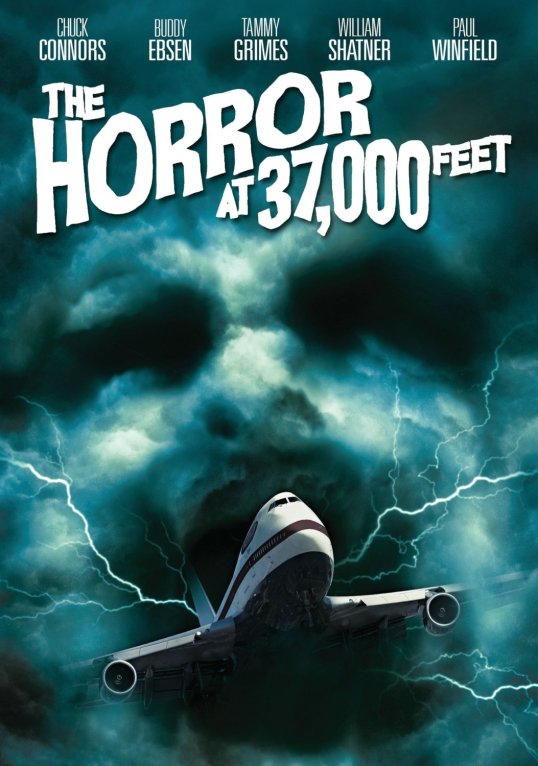
Today, we have the 1973 made-for-TV movie, The Horror at 37,000 Feet.  This film starts off like a typical disaster film, with a collection of familiar celebrities catching a flight from Heathrow Airport.    What they don’t know is that celebrity is not the only thing flying across the ocean!  There’s a sacrificial altar sitting in the baggage hold and soon, all sorts of strange things are happening!  Truly, it’s a horror at 37,000 feet!

This film is silly and perhaps even a little bit dumb but it’s also definitely a lot of fun.  To be honest, when you’ve got William Shatner playing an ex-priest who is wondering what happened to his faith, how can you go wrong?  Along with Shatner, keep an eye out for Chuck Conners, Buddy Ebsen, Roy Thinnes, Paul Winfield, Tammy Grimes, and France Nuyen.  Basically, every TV actor who needed a job in 1973 boarded The Horror at 37,000 Feet. 

Happy October and enjoy The Horror at 37,000 Feet!

Horror on the Lens: Island of the Burning Damned (dir by Terence Fisher)


Today’s horror on the lens is a British 1967 science fiction film, featuring the team of Christopher Lee and Peter Cushing and directed by Terence Fisher!

This film is based on a novel that came out in 1959.  It was originally meant to be a movie for British television but, after the script was written, it was decided to instead turn it into a theatrical film.  The film was originally called Night of the Big Heat but, when it was subsequently released in the United States, the title was changed to Island of the Burning Damned.

It’s not October without Peter Cushing and Christopher Lee!

Horror on the Lens: The Horror at 37,000 Feet (dir by David Lowell Rich)


Hi there and welcome to October! This is our favorite time of the year here at the Shattered Lens because October is our annual horrorthon! For the past several years (seriously, we’ve been doing this for a while), we have celebrated every October by reviewing and showing some of our favorite horror movies, shows, books, and music. That’s a tradition that I’m looking forward to helping to continue this year.

To start things off, we have the 1973 made-for-TV movie, The Horror at 37,000 Feet.  This film starts off like a typical disaster film, with a collection of familiar celebrities catching a flight from Heathrow Airport.    What they don’t know is that celebrity is not the only thing flying across the ocean!  There’s a sacrificial altar sitting in the baggage hold and soon, all sorts of strange things are happening!  Truly, it’s a horror at 37,000 feet!

This film is silly and perhaps even a little bit dumb but it’s also definitely a lot of fun.  To be honest, when you’ve got William Shatner playing an ex-priest who is wondering what happened to his faith, how can you go wrong?  Along with Shatner, keep an eye out for Chuck Conners, Buddy Ebsen, Roy Thinnes, Paul Winfield, Tammy Grimes, and France Nuyen.  Basically, every TV actor who needed a job in 1973 boarded The Horror at 37,000 Feet. 

Happy October and enjoy The Horror at 37,000 Feet!

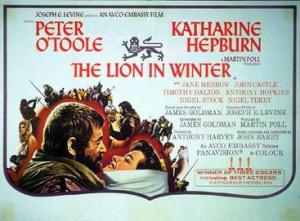
Lisa Reviews An Oscar Nominee: The Lion in Winter (dir by Anthony Harvey)


(With the Oscars scheduled to be awarded on March 4th, I have decided to review at least one Oscar-nominated film a day.  These films could be nominees or they could be winners.  They could be from this year’s Oscars or they could be a previous year’s nominee!  We’ll see how things play out.  Today, I take a look at the 1968 best picture nominee, The Lion in Winter!)

“I don’t much like our children.”

— Eleanor of Aquitaine (Katharine Hepburn)

“Oh God, but I do love being king.”

— King Henry II (Peter O’Toole)

“What family doesn’t have its up and down?”

— Eleanor of Aquitaine

To be honest, it’s tempting to just spend this entire review offering up quotes from this film.  Based on a play by James Goldman and featuring a cast of actors who all specialized in delivering the most snarky of lines with style, The Lion In Winter is a film that is in love with the English language.  As visually impressive as the film and its recreation of the 12th Century is, it’s tempting to close your eyes while watching The Lion In Winter and just listen to the dialogue.

The year is 1183.  England has a king.  His name is Henry II (Peter O’Toole) and he’s held power for a long time, through a combination of willpower and political manipulation.  He’s married to Eleanor of Aquitaine (Katharine Hepburn), though he long since had her imprisoned.  Before marrying Henry, Eleanor was the wife of Louis VII.  Now, Henry’s mistress is Alais (Jane Merrow), the daughter of Louis and his second wife.  In order to get Alais’s dowry, Henry has promised her half-brother, Philip II (Timothy Dalton), that she will be married to the next king of England.  Philip, incidentally, is the son of Louis’s third wife.  To be honest, it’s confusing as Hell to try to keep up with all of it but that’s medieval politics for you.

Of course, everyone knows that Henry II will not be king forever.  He’s already 50 years old, which is quite an advanced age for 1183.  Being king means that everyone, even his own family, is plotting against him.  It also means living in a remarkably dirty and drafty castle.  (If you’re looking for a film that celebrates the splendor of royalty, this is probably not the film to watch.)  Henry has three sons, all of whom feel that he should be the rightful heir.

For instance, there’s Richard (a young Anthony Hopkins).  Richard is Henry and Eleanor’s eldest son.  He is a fierce, outspoken, and judgemental man.  He describes himself as being a legend and a poet.  He looks and acts like a future king.  Of course, he’s also a bit of a pompous ass.  Richard is Eleanor’s pick to be king, though Richard is always quick to equally condemn both of his parents.

And then there’s John (Nigel Terry).  Early on, John is described as being “pimply and smelling of compost.”  For some reason, John is Henry’s favorite.  He’s also a sniveling weakling, the type who is never smart enough to know when his father is being honest or when his father is bluffing.  Halfway through the film, he comes close to accidentally starting a civil war.

And finally, there’s Geoffrey (John Castle).  Geoffrey is the smartest of the princes and the most manipulative.  Of the three princes, he’s the only one who is as smart as both Henry and Eleanor.  However, whereas Henry and Eleanor enjoy their complicated lives and manage to maintain a sense of (very dark) humor about it all, Geoffrey is bitter about his place as the middle child.

Christmas has arrived and Henry has temporarily released Eleanor from prison so that she can spend the holidays with him, his sons, and his mistress.  Also coming over for the holiday is King Phillip II, eager to either take back his sister’s dowry or to attend her wedding to the next King of England.  What follows is a holiday of politics, manipulation, and shouting.  In fact, there’s lots and lots of shouting.

It’s a thoroughly enjoyable film, one that expertly mixes British history with domestic drama and dark comedy.  Obviously, the film’s main appeal comes from watching two screen icons, Peter O’Toole and Katharine Hepburn, exchanging snappy dialogue.  Hepburn deservedly won an Oscar for her performance as Eleanor.  O’Toole should have won an Oscar as well but he lost to Cliff Robertson for Charly.  In fact, O’Toole and Hepburn are so good that they occasionally overshadow the rest of the very talented cast.  Anthony Hopkins and Nigel Terry both make indelible impressions as Richard and John but my favorite princely performance came from John Castle, who is a malicious wonder as Geoffrey.  As easy as it is to dislike Geoffrey, it’s hard not to feel that he does have a point.

(Of course, in real life, both Richard and John would eventually serve as king while Geoffrey would die, under mysterious circumstances, in France.  Reportedly, Philip II was so distraught over Geoffrey’s death that he attempted to jump on the coffin as it was being lowered into the ground.)

The Lion In Winter was nominated for seven Oscars and won three, for Best Actress (Katharine Hepburn), Best Adapted Screenplay (James Goldman), and Best Music Score (John Barry).  It lost best picture to Oliver!

The TSL’s Daily Horror Grindhouse: Hands of the Ripper (dir by Peter Sasdy)


MPW-27513

The 1971 Hammer film Hands of the Ripper tells the story of Anna (Angharad Rees), a woman living in Victorian England who has a few issues.

What type of issues, you may wonder?  Well, first off, she’s the daughter of the infamous serial killer known as Jack The Ripper.  When she was just a baby, her father killed her mother while Anna watched from her crib.  Now, years later, the teenage Anna is working for a fake medium named Mrs. Golding (Dora Bryan).  It’s Anna’s job to stand behind the curtain and provide the ghostly voices whenever Mrs. Golding is holding one of her fake seances.

One such séance is attended by both a sleazy member of Parliament named Dysart (Derek Godfrey) and a progressive psychiatrist named Dr. John Pritchard (Eric Porter).  When Mrs. Golding’s ruse is discovered, she decides to “give” Anna to Dysart.  However, this plan falls apart when Anna suddenly goes crazy, grabs a fireplace poker, and murders Mrs. Golding.  Dysart flees the scene, leaving Anna, who claims to have no memory of attacking anyone, with John.  Assuming that he can cure her, John takes Anna in and set her up at his house.

Well, it turns out that curing Anna will not be quite as easy as John assumed.  For one thing, Anna is extremely repressed and often refuses to open up to him.  Also, there’s the fact that Anna keeps killing people.  Whenever anyone stands to close to Anna or kisses her on the cheek, Anna goes into a trance and hears her father’s voice demanding that she kill.  John, convinced that he can save Anna, continues to cover up every murder.

I really wasn’t expecting much from Hands of the Ripper.  In fact, I have to admit that the main reason I dvred it off of TCM was because I thought this might be the film in which Klaus Kinski played Jack the Ripper.  I was wrong, of course.  The Kinski Jack the Ripper film was called Jack the Ripper and it was directed by Jess Franco.  Hands of the Ripper, on the other hand, is a Hammer film that was released in 1971, at a time when Hammer was struggling to stay relevant in an ever-changing cinematic landscape.  Perhaps that’s why the murders in Hands of the Ripper were gory, even be the bloody standards of Hammer Films.

Interestingly enough, though the film was made over 40 years ago, the murders themselves remain quite shocking.  I can only imagine how audiences in 1971 reacted to them.  The scene where Anna suddenly attacks a housekeeper made me flinch, as did a later scene in which one of Anna’s victims stumbled out onto a crowded street, minus an eye.  Angharad Rees gave a good performance as Anna, one that keeps you guessing as to whether or not she’s just crazy or if maybe she really is possessed by the spirit of her father.

Hands of the Ripper is a good Hammer film, one that combines the usual Hammer tropes with a bit more psychological depth than one might expect.  This is one to keep an eye out for.

http://www.youtube.com/watch?v=5RzWRC1uZiE