Retro Television Review: Fantasy Island 6.16 “Return To The Cotton Club/No Friends Like Old Friends”


Welcome to Retro Television Reviews, a feature where we review some of our favorite and least favorite shows of the past!  On Tuesdays, I will be reviewing the original Fantasy Island, which ran on ABC from 1977 to 1984.  Unfortunately, the show has been removed from most streaming sites.  Fortunately, I’ve got nearly every episode on my DVR.
This week, we’re traveling in time!

Episode 6.16 “Return to the Cotton Club/No Friends Like Old Friends”

(Dir by Don Weis, originally aired on February 26th, 1983)

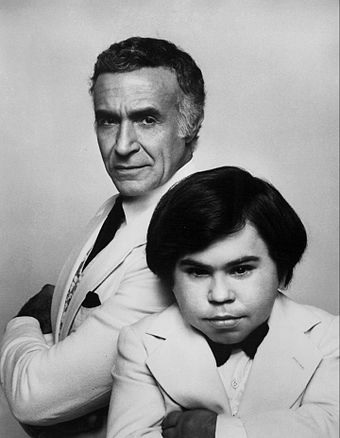
Aspiring singer Charlie Whelan (Lou Rawls) wants to go back to a time where all that mattered was talent.  As he tells Roarke and Tattoo, it’s all about image and connections now.  Charlie wants to go back to the Cotton Club, the famous New York club where blacks were allowed to perform on stage while gangsters sat in the audience.  Roarke sends Charlie back in time and soon, Charlie is at the Cotton Club.  He meets Dutch Schultz (J.D. Cannon).  He befriends the club’s manager, Gus Kelly (Yaphet Kotto).  He falls for another singer, Linda (Berlinda Tolbert).

The first thing I noticed about this fantasy is that The Cotton Club looked really cheap.  It looked like an old VIP lounge in an airport.  It was kind of tacky.  The other thing I noticed is that the fantasy wasn’t historically accurate.  The Cotton Club was not owned by Dutch Schultz.  In fact, Schultz had little to do with The Cotton Club.  The gangster who owned the Cotton Club was Owney Madden, an Irish gangster who eventually left New York City for Hot Springs, Arkansas.  In the show’s defense, the man who Charlie knew as Dutch Schultz was eventually revealed to be another guest who was having a fantasy of his own.  I’ve always had mixed feelings about Roarke’s habit of combining fantasies.  I feel like a guest should only have to pay half-price if their fantasy is going to mixed up with somebody else’s.

As for this fantasy, it was okay.  Lou Rawls certainly gave a better performance here than he ever did on Baywatch Nights.  And Yaphet Kotto was a charming as ever, even if his role was, again, not historically accurate.  (The Cotton Club may have hired black performers but otherwise, it was heavily segregated.)  I like almost anything involving 1930s gangsters.  I can’t help it.  They had style.

As for the other fantasy, Doreen Murphy (Markie Post) wants to have a reunion with her friends from college.  Doreen asks Roarke to make her rich and beautiful so that she can shame all of the people who never believed in her.  Roarke gives her a magic necklace that changes her from being a brunette to being a blonde.  That’s all it takes!  One of Doreen’s friends is Liz (Cybill Shepherd).  Liz is married to the unfaithful Al (Lyle Waggoner), who takes an interest in Doreen.  Doreen learns a lesson about true beauty being more than just an appearance.  She also learns that people don’t dislike her as much as they dislike her bitter attitude.  Doreen gives the necklace to Liz so that Liz can get her cheating husband back.  Good, I guess.

This was an uneven trip to the Island.  Neither story was particularly compelling.  The Cotton Club fantasy at least had Yaphet Kotto.  Otherwise, this was a forgettable trip.  The writers really didn’t even seem to be trying to come up with anything unexpected or surprising.  At least the Island continues to look lovely.
SHANE (The TV Series) – Episode 11: The Day the Wolf Laughed (originally aired November 19th, 1966)


Episode 11 of Shane opens with a group of outlaws making their way across the valley after pulling off a lucrative robbery. Needing a couple of days to lay low and rest their horses, they decide to take over Sam Grafton’s bar to drink and blow off some steam. They reason it’s a safe place to stay since there doesn’t appear to be any law in the area. Their leader is Reno (J.D. Cannon), with Augie (Skip Homeier) as his right-hand man, Grant (Daniel J. Travanti) as his enforcer, and a couple of others for good measure. Shane (David Carradine) and Marian (Jill Ireland) happen to be shopping in Sam’s general store when Reno and his men come into the bar. They can hear them breaking bottles and bullying Sam around in the next room. Sam comes into the general store and asks his employee Ben (Owen Bush) to ride out to Rufe Ryker’s ranch and ask him if he will come help with these guys. Soon the outlaws walk into the general store, where Shane and Reno immediately recognize each other. It seems the two gunslingers grew up together under the tutelage of an old man they called “The Wolf,” who taught them everything they know. Because Shane knows how skilled and dangerous Reno is, he asks Sam to let them stay for the next couple of days, and Reno agrees to pay Sam well for his trouble. Sam reluctantly agrees and Shane and Marian head back to the ranch. 

A little later Rufe Ryker (Bert Freed) and his men ride into town and enter Sam’s bar. Reno gets the drop on them and sends them back out with their tails between their legs. They regroup back at Ryker’s ranch and decide to go back to town and try force the outlaws out of the bar. On the way, Ryker stops off at the Starett’s ranch to try to convince Shane to help. Shane tells Ryker that the best thing he can do is leave Reno and his men alone and wait for them to leave in a couple of days. With his pride hurt, Ryker is in no mood for listening and heads to town anyway. When the shooting starts, Ryker and his men are caught in a deadly crossfire. Trying to retreat, Ryker is shot and severely injured by Reno. While Ryker tries to recover, his men decide they are going to stake out the bar so they can be in position to kill Reno and his men when they try to leave. Feeling trapped, Reno instructs a couple of his guys to go to the nearest ranch and get a hostage to help them with their escape. When the guys grab a local girl named Shirley and Marian, who was in the area looking for their cow Katrina at the same time, Shane finally decides to enter the fight against Reno. Their old mentor “The Wolf” always predicted that their relationship would end with one of them killing the other. It looks like he just may be right. 

“The Day the Wolf Laughed” is my favorite episode of the TV series SHANE so far, as it really leans into Shane’s skills as a gunfighter and pits him against a man in Reno who’s every bit as skilled. When the two men first see each other in Sam’s general store you can tell that they really do respect each other. Reno goes so far as to tell Marian that “you have a good man. He’ll fight for you.” As soon as you hear those lines, you know Shane will end up having to prove those words to be true. Even though Shane spends most of the episode trying to convince other people that they just need to leave Reno alone, he doesn’t hesitate to take matters into his own hands the moment Marian is put in danger. This is the first episode of the series where Shane really lives up to the reputation that is always being hinted at in the series, and I loved it! 

Episode 11 is also elevated by its game cast of guest stars. J.D. Cannon (DEATH WISH II) is an especially strong adversary for Shane. He can be extremely cold blooded, but he’s also respectful, somewhat likable, and you believe that his word means something. You almost hate it when the two end up squaring off at the end. Daniel J. Travanti (HILL STREET BLUES), with a thick mustache, is quite intimidating as the enforcer of the gang. He seems quiet and laid back until he’s called upon by Reno. His countenance then completely changes, and you don’t really want to be on the other side of his gun at that point in time. It was also nice seeing Skip Homeier show up as Reno’s right-hand man, Augie. Homeier appeared in the excellent 1957 Budd Boetticher/Randolph Scott western THE TALL T, and he provides good support here as well. As far as the main cast, David Carradine and Bert Freed take center stage in this episode, with both men doing a great job. Freed, in particular, has created a strong, complex character in Ryker over the course of the first 11 episodes, and I’ve actually grown to like him.

Overall, for a fan of badass western action, this episode was right down my alley. Shane and Marian may not have shared any long, lustful looks, but Shane proves his love by putting his life on the line for her against Reno’s gang. We only have 6 more episodes to go, and it will be fun to see where we go from here.  

Retro Television Reviews: The Master 1.11 “Failure to Communicate”


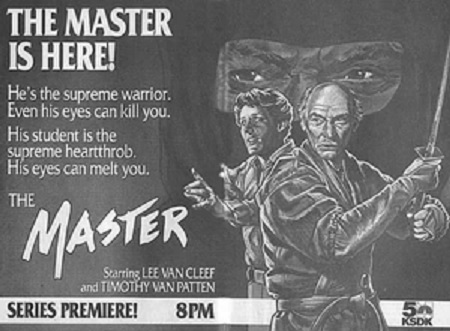
Welcome to Retro Television Reviews, a new feature where we review some of our favorite and least favorite shows of the past! On Fridays, I will be reviewing The Master, which ran on NBC from January to August of 1984.  The show can be found on Tubi!

This week, we meet Max Keller’s father!

Episode 1.11 “Failure to Communicate”

(Dir by Sidney Hayers, originally aired on May 4th, 1984)

This week’s episode of The Master opens with McAllister (Lee Van Cleef) teaching Max (Tim Van Patten) how to fight even while blindfolded.  McAllister explains that, when one’s sight is taken away, the other senses become even stronger.  Hmmm…. I wonder if this will prove to be relevant to their next adventure?

Having apparently given up on trying to find McAllister’s daughter (not that they ever seemed to be trying that hard to begin with), Max and McAllister head to Los Angeles so that Max can visit his father.  Max’s father, Patrick (Doug McClure), has been estranged from Max ever since the death of Max’s mother and older brother.  However, under McAllister’s guidance, Max has learned the importance of forgiveness.

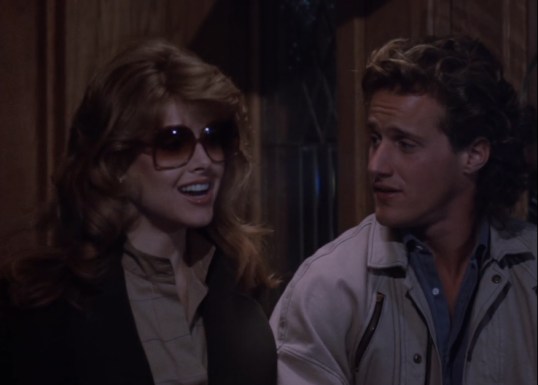
However, before Max can drop in on his father, he and McAllister have to rescue Kathy Hunter (Ashley Ferrare), who is being chased by three men in a cemetery.  McAllister is impressed when Kathy uses some martial arts skills of her own to fight off the men.  (Kathy explains that she has been in training for six years.)  McAllister takes Kathy home to her father, a wealthy bunker named Jason Hunter (J.D. Cannon).  Max, meanwhile, goes to his father’s law office.

However, Patrick is not at his office.  Instead, Max meets Patrick’s administrative assistant, Laura Crane (Rebecca Holden).  Laura is blind but, as we saw at the start of the program, that just means that all of her other senses are now superhuman.  As soon as she meets Max, she knows that he recently stopped off at a gas station and that he drives a van.  All it takes is for her to touch his face for her to realize that she is Patrick’s son.

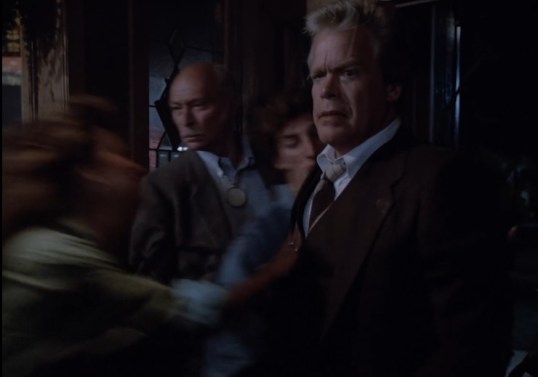
Patrick, unfortunately, is not doing too well.  He is now an alcoholic and he’s more likely to be found in the local cocktail lounge than in court.  He’s in danger of losing his license and he’s also struggling financially.  In fact, at the cocktail bar, Patrick is meeting with Straker (Marc Alaimo), one of the men who previously tried to abduct Kathy in the cemetery.  Straker is blackmailing Patrick into helping with Staker’s next attempt to kidnap Kathy.  Of course, when Max arrives at the bar looking for his father, all Hell breaks loose when Max sees the men from the cemetery.  Patrick can only watch as Max and a late-arriving McAllister chase the men out of the bar.

After the bar fight, Max and Patrick have a tense meeting at Patrick’s office.  Max accuses his father of being a bitter drunk.  Patrick says that Max is irresponsible.  Patrick tells Max to get out of his life.  Meanwhile, McAllister escorts Laura back to her apartment.  Okassa (Sho Kosugi) shows up and we get yet another fight, this time between Sho Kosugi and Lee Van Cleef’s very busy stunt double.

The next day, Patrick, Laura, McAllister, and Max all end up at a reception for Kathy.  Patrick spots the three kidnappers at the reception and, having had a change of heart, attempts to lead Kathy outside to safety.  However, this just leads to both Patrick and Kathy being kidnapped.  Straker calls Kathy’s father and demands a $3,000,000 ransom but, fortunately, Laura smelled cemetery dirt on the men who grabbed Kathy so Max and McAllister head back to the cemetery, break into a church, and manage to rescue both Kathy and Patrick!

Yay!  I guess the episode’s over, right?

Nope, not even close.

While Max and McAllister are rescuing Patrick and Kathy, Straker is busy kidnapping Laura.  Straker then calls Kathy’s father and announces that he still expects to get his 3 million or “your lawyer’s secretary gets it!”  Kathy’s father is like, “Why would I pay 3 million dollars for someone who I don’t even know?,” which is kind of a fair question even if it’s not a popular one.  McAllister, however, tells Kathy’s father that it’s important to take care of everyone, even the strangers.

Patrick finally breaks down and admits that he was a part of the plot to kidnap Kathy.  He tells Max and McAllister that the man behind the plot is actually Paul Stillwell (Mark Goddard), who is Jason Hunter’s head of security.  (This seems familiar….)  Patrick also explains that Stillwell is holding Laura prisoner on the Princess Louise, a decommissioned cruise ship that has been turned into a floating restaurant.

Accompanied by Patrick, Max and McAllister go to the ship.  Unfortunately, Okassa pops up out of nowhere and gets into another fight with Lee Van Cleef’s stunt double so it falls to Patrick and Max to rescue Laura.  (Patrick suddenly turns out to have some martial arts skills as well, which is a bit odd considering that Patrick is a middle-aged, overweight, out-of-shape, alcoholic attorney.)  The bad guys try to outsmart Max by turning out all the lights on the boat but Laura is able to use her supersenses to help Max beat up Straker’s men in the dark.  Laura is rescued and the bad guys are sent to prison!

As for Patrick, the Hunter family decides not to press charges because they understand that Patrick was being blackmailed.  Swearing that he’s going to live his life the right way from now on, Patrick pours out his last remaining liquor bottle.  Hooray!

This was one of those episodes that was a bit too busy for its own good.  Rather than have Max and McAllister fight against worthy opponents, this episode just had Max and McAllister continually defeat the same three idiots over and over again and you have to wonder why it never seemed to occur to the bad guys to change their strategy when it came to whole kidnapping thing as opposed to repeating the same thing over and over again.  With all of those kidnappings and rescues, there really wasn’t much time left for the emotional heart of the story, which should have been Max mending his relationship with his father.  Considering how much of this series has focused on Max and McAllister’s family issues, it was a bit anti-climatic that Max’s real father just turned out to be some drunk who was being blackmailed.  At least some of the fight scenes were well-choreographed and Rebecca Holden did a good job as Laura Crane, even if the character herself was occasionally too flawless and perfect to be believed.

Next week, maybe McAllister will finally remember that he’s supposed to be looking for his daughter.  We’ll see!

Cleaning Out The DVR: An American Dream (dir by Robert Gist)


Loosely based on a novel by Norman Mailer, the 1966 film, An American Dream, tells the story of Stephen Rojack (Stuart Whitman).  Rojack’s a war hero, a man who has several medals of valor to his credit.  He’s married to Deborah (Eleanor Parker), the daughter of one of the richest men in the country.  He’s an acclaimed writer.  He’s got his own television talk show in New York.  He’s been crusading against not only the Mafia but also against corruption in the police department.  He has powerful friends and powerful enemies.  You get the idea.

He’s also got a marriage that’s on the verge of collapse.  Deborah calls Rojack’s show and taunts him while he’s on the air.  When Rojack goes to her apartment to demand a divorce, the two of them get into an argument.  Deborah tells him that he’s not a hero.  She says he only married her for the money and that she only married him for the prestige.  She tells him that he’s a lousy lover.  Being a character in an adaptation of a Norman Mailer novel, the “lousy lay” crack causes Rojack to snap.  He attacks Deborah.  The two of them fight.  Deborah stumbles out to the balcony of her apartment and it appears that she’s on the verge of jumping.  Rojack follows her.  At first, he tries to save her but then he lets her fall.  She crashes down to the street, where she’s promptly run over by several cars.  The cars then all run into each other while Rojack stands on the balcony and wails.  There’s nothing subtle about the first 15 minutes of An American Dream.

Actually, there’s nothing subtle about any minute of An American Dream.  It’s a film where everything, from the acting to the melodrama, is so over-the-top and portentous that it actually gets a bit boring.  There’s no relief from the screeching and the inauthentic hard-boiled dialogue.  When a crazed Rojack starts to laugh uncontrollably, he doesn’t just laugh.  Instead, he laughs and laughs and laughs and laughs and laughs and …. well, let’s just say it goes on for a bit.  It’s like a 60s version of one of those terrible Family Guy jokes.

Anyway, the police don’t believe that Deborah committed suicide but they also can’t prove that Rojack killed her.  Meanwhile, within hours of his wife’s death, Rojack meets his ex-girlfriend, a singer named Cherry (Janet Leigh).  Rojack is still in love with Cherry but Cherry is also connected to the same mobsters who want to kill Rojack.  Meanwhile, Deborah’s superrich father (Lloyd Nolan) is also on his way to New York City, looking for answer of his own.

An American Dream is a very familiar type of mid-60s film.  It’s a trashy story and it’s obvious that the director was trying to be as risqué as the competition in Europe while also trying to not offend mainstream American audiences.  As such, the film has hints of nudity but not too much nudity.  There’s some profanity but not too much profanity.  Rojack, Deborah, and Cherry may curse more than Mary Poppins but they’re rank amateurs compared to the cast of Who’s Afraid of Virginia Woolf?  It’s an unabashedly melodramatic film but it doesn’t seem to be sure just how far it can go in embracing the melodrama with alienating its target audience so, as a result, the entire film feels somewhat off.  Some scenes go on forever.  Some scenes feel too short.  The whole thing has the washed-out look of an old cop show.

All of that perhaps wouldn’t matter if Stephen Rojack was a compelling character.  In theory, Rojack should have been compelling but, because he’s played by the reliably boring Stuart Whitman, Rojack instead just comes across as being a bit of a dullard.  He’s supposed to be a charismatic, two-fisted Norman Mailer-type but instead, as played by Whitman, Rojack comes across like an accountant who is looking forward to retirement but only if he can balance the books one last time.  There’s no spark of madness or imagination to be found in Whitman’s performance and, as a result, the viewer never really cares about Rojack or his problems.

Noman Mailer reportedly never saw An American Dream, saying that it would be too painful to a bad version of his favorite novel.  In this case, Mailer made the right decision.

Bronson’s Back!: Death Wish II (1982, directed by Michael Winner)


To quote John McClane, “How can the same shit happen to the same guy twice?”
It has been eight years since Paul Kersey (Charles Bronson) lost his wife and single-handedly cleaned up New York City.  The first Death Wish ended with Paul in Chicago, preparing to gun down a new group of criminals.  I guess Chicago didn’t take because, at the start of Death Wish II, Paul is in Los Angeles and he’s working as an architect again.  He has a new girlfriend, a bleeding heart liberal reporter named Geri (Jill Ireland, Bronson’s real-life wife) who is against the death penalty and who has no idea that Paul used to be New York’s most notorious vigilante.  Having finally been released from the mental institution, Carol (Robin Sherwood) is living with her father but is now mute.

Crime rates are soaring in Los Angeles and why not?  The legal system is more concerned with the rights of the criminals than the victims and Paul has retired from patrolling the streets.  But when a group of cartoonish thugs rape and kill his housekeeper and cause his daughter to fall out of a window while trying to escape them, Paul picks up his gun and sets out for revenge.

Death Wish II was not the first sequel to Death Wish.  Brian Garfield, the author of the novel on which Death Wish was based, never intended for Paul to be seen as a hero and was disgusted by what he saw as being the film’s glorification of violence.  As “penance,” he wrote a sequel called Death Sentence, in which Paul discovered that he had inspired an even more dangerous vigilante.  When Menahem Golan and Yoram Globus bought the rights to produce a second Death Wish film, they decided not to use Garfield’s sequel and instead went with a story that was co-written by Golan.

It’s the same basic story as the first film.  Again, Paul is a mild-mannered architect who is a liberal during the day and a gun-toting reactionary at night.  Again, it’s a home invasion and a death in the family that sets Paul off.  Again, Paul gets help from sympathetic citizens who don’t care that the police commissioner (Anthony Franciosa) wants him off the streets.  Jeff Goldblum played a rapist with a switch blade in the first film.  This time, it’s Laurence Fishburne who fills the role.  (Fishburne also carries a radio, which he eventually learns cannot be used to block bullets.)  Even Detective Ochoa (Vincent Gardenia) returns, coming down to Los Angeles to see if Paul has returned to his old ways.

The main difference between the first two Death Wish films is that Death Wish II is a Cannon film, which means that it is even less concerned with reality than the first film.  In Death Wish II, the criminals are more flamboyant, the violence is more graphic, and Paul is even more of a relentless avenger than in the first film.  In the first Death Wish, Paul threw up after fighting a mugger.  In the second Death Wish, he sees that one of the men who raped his daughter is wearing a cross, leading to the following exchange:

“Do you believe in Jesus?”

“Yes, I do.”

“Well, you’re going to meet him.”

BLAM!

Death Wish II is the best known of the Death Wish sequels.  It made the most money and, when I was a kid, it used to show on TV constantly.  The commercials always featured the “You believe in Jesus?” exchange and, every morning after we saw those commercials, all the kids at school would walk up to each other and say, “You believe in Jesus?  Well, you’re going to meet him.”  It drove the teachers crazy.

Overall, Death Wish II is a lousy film.  Michael Winner, who was always more concerned with getting people into the theaters than anything else, directs in a sledgehammer manner that makes his work on the first film look subtle.  He obscenely lingers over every rape and murder, leaving no doubt that he is more interested in titillating the audience than getting them to share Paul’s outrage.  The script is also weak, with Geri so poorly written that she actually gets more upset about Paul going out at night than she does when she learns that Paul’s daughter has died.  When Paul sets out to track down the gang, his method is to merely wander around Los Angeles until he stumbles across them.  It doesn’t take long for Paul to start taking them out but no one in the gang ever seems to be upset or worried that someone is obviously stalking and killing them.

There are a few good things about the film.  Charles Bronson was always a better actor than he was given credit for and it’s always fun to watch Paul try to balance his normal daily routine with his violent night life.  Whenever Geri demands to know if he’s been shooting people, Paul looks at her like he is personally offended that she could possibly think such a thing.  Also, the criminals themselves are all so cartoonishly evil that there’s never any question that Paul is doing the world a favor by gunning them down.  For many otherwise sensible viewers, a movie like Death Wish II may be bad but it is also cathartic.  It offers up a simple solution to a complex issue.  In real life, a city full of Paul Kerseys would lead to innocent people getting killed for no good reason.  But in the world of Death Wish II, no one out after nightfall is innocent so there’s no need to worry about shooting the wrong person.

Finally, the film’s score was written by the legendary Jimmy Page.  The studio wanted Isaac Hayes to do the score but Winner asked his neighbor, Page.  Page took the film, retreated into his studio, and returned with a bluesy score that would turn out to be the best thing about the movie.  The soundtrack was the only one of Page’s solo projects to be released on Led Zeppelin’s record label, Swan Song Records.

Tomorrow, Bronson returns with Death Wish 3!

A Movie A Day #238: Lawman (1971, directed by Michael Winner)


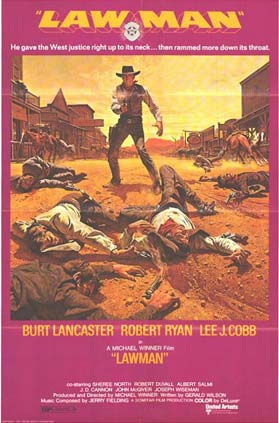
In the 1880s, Jared Maddox (Burt Lancaster) is the marshal of the town of Bannock.  After a night of drinking and carousing leads to the accidental shooting of an old man, warrants are issued for the arrest of six ranch hands.  Maddox is determined to execute the arrest warrants but the problem is that the six men live in Sabbath, another town.  They all work for a wealthy rancher (Lee J. Cobb) and the marshal of Sabbath, Cotton Ryan (Robert Ryan), does not see the point in causing trouble when all of the men are likely to be acquitted anyway.  Maddox doesn’t care.  The law is the law and he does not intend to leave Sabbath until he has the six men.

Lawman starts out like a standard western, with a stranger riding into town, but then it quickly turns the western traditions on their head by portraying Marshal Maddox as being a rigid fanatic and the wealthy rancher as a morally conflicted man who does not want to resort to violence and who continually tries and fails to convince Maddox to leave.  In the tradition of Sergio Leone and Sam Peckinpah, there are no real heroes to be found in Lawman and, even when Maddox starts to reconsider his strict adherence to the law and refusal to compromise, it is too late to prevent the movie from ending in a bloody massacre.  Since Lawman was made in 1971, I initially assumed it was meant to be an allegory about the Vietnam War but then I saw that it was directed by Michael Winner, a director who specialized in tricking audiences into believing that his violent movie were deeper than they actually were.

Even if Lawman never reaches the heights of a revisionist western classic like Pat Garrett and Billy the Kid, it is still pretty good, with old pros Lancaster, Ryan, Cobb, and Albert Salmi all giving excellent performances.  The cast is full of familiar faces, with everyone from Robert Duvall to Richard Jordan to Ralph Waite to Joseph Wiseman to John Beck showing up in small roles.  In America, Winner is best remembered for his frequent collaborations with Charles Bronson.  Chuck is not in Lawman, though it seems like he should have been and Lee J. Cobb’s rancher is named Vincent Bronson.  Winner would not make his first film with Charles Bronson until a year later, when he directed him in Chato’s Land.

Lisa Cleans Out Her DVR: Scorpio (dir by Michael Winner)


(Lisa is currently in the process of cleaning out her DVR!  Having recorded over 150 movies since last January, she understands that this might be an impossible task but she’s going to try anyway!  She recorded the 1973 spy thriller, Scorpio, off of Retroplex way back on January 24th!)

On the surface, Jean Laurier (Alain Delon) would appear to be the perfect man.

He’s handsome.  He looks really good in a suit.  He’s wealthy.  He’s French.  And — get this — he loves cats!  He’s the type of guy who, when he discovers a stray cat in his hotel room, immediately starts to pet it and then gives it a saucer of warm milk.  He and his girlfriend (Gayle Hunnicutt) spend their spare time looking at cats and talking about how cute they are.  At one point, even though he’s just killed a man, Jean pauses when he sees a stray cat watching…

Oh, did I mention that Jean kills people for a living?  Well, he does but I’m sure they’re all bad guys.  Seriously, he’s just so charming (and he really, really loves cats) that you really can’t hold it against him that he’s an independent contract killer.  Add to that, his code name is Scorpio.

I have to admit that the film’s title — Scorpio — is the main reason that I chose to record this movie.  I’m a scorpio myself.  In fact, I’m such a scorpio that if I believed in astrology, I would point to my existence as proof that the stars actually do determine our fate.  Seriously, you don’t want to mess with us scorpios.  We’re scorpions.  We sting.

But anyway, back to the movie.

When Scorpio is busted on a trumped-up narcotics charge (or maybe it was a legitimate narcotics charge, it was kind of hard to keep track), the CIA gives him a choice.  He can either go to prison or he can do a job for them.  Apparently, the CIA believes that Scorpio’s friend and mentor, Cross (Burt Lancaster), is a double agent who has been selling information to the Russians.  They want Cross eliminated.

Scorpio takes the job but it’s not going to be easy.  Cross is a veteran spy.  He has connections all across the world and he’s a ruthless killer, the type who forces a man to swallow a cyanide pill and then says, “You’ve got 30 seconds to live.”  In fact, the only person that Cross seems to care about is his wife (Joanne Linville) but he still doesn’t hesitate to abandon her when he realizes that their house is being watched

Cross taught Scorpio everything that he knows but there’s one lesson that Scorpio is still learning and that is to trust no one.  Is Cross actually a spy or is he being set up?  And, if Cross is being set up, what’s to prevent the same thing from happening to Scorpio?

Scorpio is probably one of the most cynical films that I’ve ever seen.  If Scorpio was a political protest, it would be full of people carrying cardboard signs reading, “Nothing Matters” and “All Is Darkness.”  Remember that annoying as Hell scene in SPECTRE where James Bond got drunk and demanded to know who a rodent was working for?  Well, imagine the disillusionment of that scene stretched out for two hours.

Fortunately, no one in Scorpio is as whiny as Daniel Craig was in SPECTRE.  In many ways, Scorpio is a triumph of old-fashioned movie star charisma.  Burt Lancaster is perfectly cast as the world-weary Cross while Alain Delon makes for a compelling Scorpio.  Both of them are believable killers and the film becomes as much about the competition between Lancaster’s old school Hollywood style of acting and Delon’s more refined (and very French) style of cool as it is about the competition between Scorpio and Cross.

Scorpio‘s a good little spy thriller, more than worth keeping an eye out for.