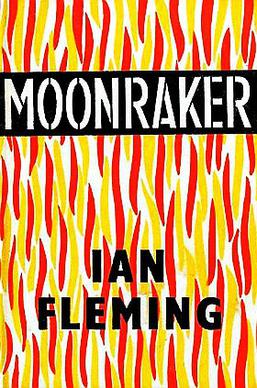
First published in 1955, Moonraker was the third of the original James Bond novels and it was also the first of the series to be totally set in Great Britain. At no point does Bond leave his home country. In fact, he spends a great deal of the book in his office. (If you’ve ever wondered what Bond’s job entails when he’s not on a mission, this is the book to check.) That said, it’s appropriate that Moonraker remains in Bond’s home country because it starts with a very British problem.
Hugo Drax is the most popular man in Britain. Drax was horribly disfigured during the Second World War but, despite all of the scars and a somewhat boorish manner, he has managed to make himself into one of the most important industrialists in the world. Drax is building an immensely powerful nuclear missile, the Moonraker. His missile will keep Britain safe from both the USSR and the USA. At the start of the novel, even Bond admires Drax. Except…
…DRAX CHEATS AT CARDS!
It turns out that M and Drax both play cards at the same club and M is sure that Drax must be cheating. Why would such a powerful man feel the need to cheat? Even more importantly, how can a man be trusted with Britain’s security when he can’t even be trusted to play bridge? Both to prevent a public scandal and to make sure that Drax really can be trusted, M bring Bond to the club so that Bond can beat Drax at his own game.
One bridge game later and suddenly, Bond has been assigned to work at Drax’s laboratory. Already on the case and working as Drax’s secretary is Special Branch officer Gala Brand. Bond being Bond, he discovers that Drax is at the head of a nefarious scheme. He also tries to figure out why Gala Brand is apparently the only woman in the world who is not won over by his manly charm…
Moonraker is one of my favorite Bond novels. Drax is an interesting villain and Fleming makes a good decision by having Bond initially admire the man. Fleming takes a lot of joy in describing both Drax’s bad manners and grotesque appearance. Drax started a tradition of Bond having to face physically unappealing bad guys. After playing a minor role in the first two books, M takes a more central role in Moonraker and we also get a chance to explore his paternal but strict relationship with 007. Gala is one of the few of the so-called Bond girls to be portrayed as being an equal to Bond and the book’s final scene between her and Bond is considerably more poignant than it has any right to be. Finally, Fleming’s love of Britain is evident on every page. If Fleming spent Casino Royale and Live and Let Die being snarky about the places that Bond visited, Moonraker finds both the author and his most famous creation in a surprisingly sentimental mood.
Moonraker came close to being the first James Bond novel to make it to the big screen. In 1955, American actor John Payne pursued the rights to the book, hoping to star as Bond in the film version. However, it would be another 24 years before Moonraker was adapted to film. Other than featuring Drax as a villain, the film version would have little do with the original novel.
Having recovered from both the horrific torture he suffered in Casino Royale and the suicide of Vesper Lynd, British secret agent James Bond is ready to return to the field. His latest mission takes him to America, where his job is to investigate Mr. Big. Mr. Big is Harlem-based gangster who is suspected of helping to finance Russian operations through his criminal enterprises.
(Specifically, Mr. Big has been selling 17th Century gold coins that are believed to be a part of a legendary pirate treasure that was buried somewhere in Jamaica. Ian Fleming knew his pirate lore and devotes a good deal of the beginning of the book to discussing Sir Henry Morgan.)
In America, Bond partners up with his old friend Felix Leiter but he soon discovers that taking down Mr. Big is not as easy as he thought it would be. Using the fear of voodoo to control his minions, Mr. Big has agents all across America. As well, Mr. Big also has the services of Solitaire, a beautiful Creole fortune teller. The case takes Bond and Felix from New York to Florida to Jamaica. It also costs one of them a leg and an arm. In order to maintain some suspense, I will refrain from revealing who gets attacked by a shark.
Reading the original James Bond novels can be enjoyable but it can also lead to a good deal of culture shock. Because Bond is constantly changing in the movies and the role is regularly recast, we tend to forget just how long the character of James Bond has been around. In the movies, Bond is forever the same age and his villains and their plots continually change to reflect whatever’s going on in the world. In SPECTRE, Blofeld was even reinvented as a bored Christoph Waltz.
The books, however, are frozen in time. They all reflect the attitudes and concerns of the time period in which they were written. That can often make for a fascinating read but it can also leave modern readers cringing. Ian Fleming was a man of his time and he shared both the strengths and the weaknesses of his time and his class. That’s a polite way of saying that, in the Bond novels, Fleming tends to treat anyone who is not British, white, and male with, at best, a patronizingly condescending attitude. (At worst, Fleming treats them with outright disdain.) That’s especially obvious in Live and Let Die, in which Mr. Big and all of his henchmen are black.
Live and Let Die was first published in 1954. Interestingly enough, Fleming doesn’t come across as being as prejudiced as some of his contemporaries. For instance, even when the action moves the American south, the n-word never appears in the book. (Then again, neither do any redneck sheriffs.) I wouldn’t call Fleming a racial progressive but, at the same time, it’s obvious that he means it to be the highest compliment when Bond describes Mr. Big as being the “first great Negro criminal.” But then Fleming introduces us to two sympathetic black characters who do nothing but happily take orders from Bond and then he starts writing dialogue in phonetic dialect and you just find yourself cringing and saying, “Oh my God, Ian, stop it!”
Here’s what does work as far as Live and Let Die is concerned: Mr. Big is a great villain, far less of a wimp than Casino Royale‘s Le Chiffre. As well, James Bond is a far more active character in this book and less whiny than he was in Casino Royale. Bond once again gets tortured but he doesn’t threaten to quit the service just because his finger gets broken. Instead, he seeks revenge.
As an American, it was interesting for me to read Fleming’s thoughts on my home country. While Bond seems quite comfortable in New York, both he and Felix are absolutely miserable in Florida. In fact, Fleming portrays Florida as being Hell on Earth, hot and full of ill-tempered old people. It’s impossible not to be amused by just how viscerally Fleming disliked Florida.
Finally, Fleming’s skills as a storyteller were even stronger in Live and Let Die than in Casino Royale. I mean, whatever else you might say about the book, who can resist that perfect one line dismissal of a opponet: “He disagreed with something that ate him.”
Earlier this year, I decided to reread all of Ian Fleming’s James Bond novels. On this site, I’ve written many times about how much I love all of the James Bond films so I thought it would be interesting, especially since a few years have passed since I originally read them, to reread the original novels.
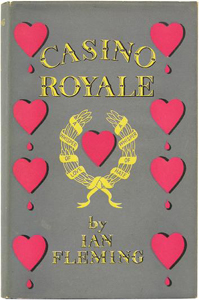
The first Bond novel was Casino Royale. First published in 1953, Casino Royale introduced the world to not only MI6’s James Bond but also to the CIA’s Felix Leiter, the sinister assassins of SMERSH, and the tragic Vesper Lynd.
The story starts with a deceptively simple mission. James Bond has been sent to the Casino Royale, with specific orders to play against and humiliate Le Chiffre, a union boss who works for the Russians. Bond succeeds at his mission but quickly discovers that Le Chiffre is not the type to accept the loss of eighty million francs gracefully. Bond ends up undergoing a truly horrific torture, one that is described in harrowing details by Fleming. While it’s not a spoiler to reveal that Bond survives (after all, Casino Royale was followed by 11 novels and 2 short story collections), it comes at the cost of a terrible scar and a terrible tragedy.
In his first appearance, Bond already possesses several of the traits for which he’s best known. He’s a meticulous eater, a frequent drinker, and a chain smoker. He’s ruthless and is described as being cruelly handsome. When Vesper Lynd first meets him, she exclaims that he looks like Hoagy Carmichael, the British musician who Fleming originally hoped would play Bond in the films.
At the same time, while rereading Casino Royale, I was surprised by how passive Bond was for the majority of the book. Beyond the scene where he plays baccarat with Le Chiffre, Bond really doesn’t take a very active role in his first novel. When he’s captured and tortured, he doesn’t escape through his wits. In fact, he doesn’t escape at all. He’s rescued by SMERSH, who have decided that they no longer need Le Chiffre to launder money for them. After being rescued, he decides to retire from intelligence work and marry Vesper Lynd. Vesper Lynd is a double agent but Bond never figures that out on his own. He only discovers this fact from Vesper’s suicide note.
(Which, of course, leads to the novel famous and bitter final line: “The bitch is dead.”)
In fact, there are times when Bond almost seems to be … well, dorky. Early on, we’re informed that he hopes to create and make a fortune off of a new drink. (Minutes after meeting Vesper, he announces that he’s going to name the drink after her.) When he’s in the hospital recovering from being beaten, he’s hardly the Bond we all know and love. Instead, he’s rather petulant. When he explains that he’s quitting the service, he comes across like an angry teenager announcing that he’s not going to go to school anymore.
As for the novel itself, it’s a quick read and, even after all these years, I can see why it caused a stir when it was originally released. It’s not just that Fleming was telling a spy story that was full of intrigue and deceit. It’s also the Fleming was giving readers a glimpse into a glamorous world that they probably would never have a chance to experience for themselves. Fleming describes the casino with such care and attention to detail that you literally feel like you’re there, watching Bond gamble.
For the record, here’s my favorite line from the book. It occurs shortly after Bond first meets Felix Leiter and discovers that Felix is from my homestate:
“Bond reflected that good Americans were fine people and that most of them seemed to come from Texas.”
And finally, here’s the ingredient for Bond’s drink, the Vesper:
“Three measures of Gordon’s, one of vodka, half a measure of Kina Lillet. Shake it very well until it’s ice-cold, then add a large thin slice of lemon peel.”
(Apparently, some of these ingredients are out-of-date. I rarely drink so I have no idea.)
Casino Royale was followed by Live and Let Die, which I’ll review tomorrow.
The picture above is Christopher Lee in the 1998 film Jinnah. In this epic biopic, Lee played Muhammad Ali Jinniah, the founder of modern Pakistan. Up until yesterday, I had never heard of Jinnah but, after news of Lee’s death broke, Jinnah was frequently cited as being Lee’s personal favorite of his many roles and films.
Consider that. Christopher Lee began his film career in the 1940s and he worked steadily up until his death. He played Dracula. He played The Man with the Golden Gun. Christopher Lee appeared, with his future best friend Peter Cushing, in Laurence Olivier’s Oscar-winning Hamlet. He played Seurat in John Huston’s Moulin Rouge. He appeared in both The Lord of the Rings and the Hobbit trilogies. He appeared in several films for Tim Burton. He even had a small role in Martin Scorsese’s Hugo. He appeared in two Star Wars prequels. He appeared in the original Wicker Man (and reportedly considered it to be his favorite of his many horror films). He appeared in Oscar winners and box office hits. And, out of all that, Christopher Lee’s personal favorite was Jinnah, a film that most people have never heard about.
Unless, of course, you live in Pakistan. When I did a google search on Christopher Lee, I came across several Pakistani news sources that announced: “Christopher Lee, star of Jinnah, has died.”
And really, that somehow seems appropriate. Christopher Lee was the epitome of an international film star. He worked for Hammer in the UK. He worked with Jess Franco in Spain and Mario Bava in Italy. He appeared in several movies in the United States. And, in Pakistan, he played Jinnah. And I haven’t seen Jinnah but I imagine he was probably as great in that role as he was in every other role that I saw him play. Over the course of his long career, Christopher Lee appeared in many good films but he also appeared in his share of bad ones. But Christopher Lee was always great.
It really is hard to know where to begin with Christopher Lee. Though his death was announced on Thursday, I haven’t gotten around to writing this tribute until Friday. Admittedly, when I first heard that Lee had passed away, I was on a romantic mini-vacation and had promised myself that I would avoid, as much as possible, getting online for two days. But, even more than for those personal reasons, I hesitated because I just did not know where to start when it came to talking about Christopher Lee. He was one of those figures who overwhelmed by his very existence.
We all know that Christopher Lee was a great and iconic actor. And I imagine that a lot of our readers know that Lee had a wonderfully idiosyncratic musical career, releasing his first heavy metal album when he was in his 80s. Did you know that Lee also served heroically during World War II and, after the war ended, helped to track down fleeing Nazi war criminals? Did you know that it has been speculated that Lee may have served as one of the role models for James Bond? (Ian Fleming was a cousin of Lee’s and even tried to convince Lee to play Dr. No in the first Bond film.) Christopher Lee lived an amazing life, both on and off the screen.
But, whenever one reads about Christopher Lee and his career or watches an interview with the man, the thing that always comes across is that, for someone who played so many evil characters, Christopher Lee appeared to be one the nicest men that you could ever hope to meet. Somehow, it was never a shock to learn that his best friend was his frequent screen nemesis, Peter Cushing.
Christopher Lee is one of those great actors who we assumed would always be here. The world of cinema will be a sadder world without him.
Legends together
Here is a list of Christopher Lee films that we’ve reviewed here on the Shattered Lens. Admittedly, not all of these reviews focus on Lee but they do provide a hint of the man’s versatility:
Sir Christopher Lee was 93 years old and he lived those 9 decades in the best way possible. As long as there are film lovers, he will never be forgotten.
For almost a month, starting in mid-October and almost two weeks into November, we here at Through the Shattered Lens have watched and shared our reviews and thoughts on the 25 James Bond films (22 official EON productions with 3 non-official ones) which preceded this week’s release of the latest James Bond entry with Skyfall. We’ve shared which were our personal favorites of the series. Some preferred the Connery-era of the Bond franchise while some were in the Moore-era. What we here have all come to realize is just how timeless this franchise has become despite it having celebrated it’s 50th anniversary just last month.
The James Bond film franchise has gone beyond what Ian Fleming had imagined when he first came up with a literary character that would become a global pop icon and remain one of cinemas most successful franchises in history. There have been low points in the franchise (usually when the actor whohas been performing the role has outlived their stay) but then there have been some great highs. In the end, there’s always been one constant and that’s the character of James Bond — British secret agent 007 with a license to kill.
A franchise which began with on Sean Connery in the title role has now seen a return to prominence with the role now in the care of British actor Daniel Craig. The Craig-era began with the critically-acclaimed Casino Royalewhich also became popular with the mass audience. The sequel to this reboot would set the franchise back a step or two, but still became the second highest grossing Bond film in the franchise. We now come to the third Bond film in the Craig-era with 2012’s Skyfall and the question of whether the James Bond franchise can still remain relevant in this age of hyper-kinetic and ultra-violent action films remain to be answered.
Skyfall begins with Bond already in the middle of a mission to recover a computer hard-drive which stores the names of hundreds of NATO agents deep undercover within the many terrorist organizations around the world. Things are not going well for Bond and his fellow MI6 agents. He finds many of them already dead or dying and it’s up to him and another agent named Eve (played by Naomie Harris) to chase after the mercenary who has taken off with the hard-drive.
One thing we’ve come to expect with the more recent James Bond films (especially the Daniel Craig ones) are the action sequences which make up the opening section of the film. Even before we get to the recognizable Bond opening credit sequence this opening of the film using a very thrilling and elaborate action sequence tend to set the tone for the rest of the film. Skyfall was no different as Bond chases the mercenary Patrice through the rooftops of Istanbul’s Grand Bazaar right up to a one-on-one fight on top of a moving train. Through an unfortunate stroke of luck and a command decision by “M” back in MI6 headquarters in London we segue ito the always popular opening credits sequence with Bond having been shot by accident and left for dead.
The plot of Skyfall was somewhat similar to Goldeneye which saw Pierce Brosnan introduced as the new James Bond. James Bond finds himself racing against time and a former MI6 agent who feels betrayed not just by the country and organization he loyally served but by “M” herself. Raoul Silva (played with a sociopathic flair and panache by Javier Bardem) knows the in’s and out’s of MI6 and this allows him to penetrate both their physical and cyber defenses which puts the entire national security of Great Britain and the Commonwealth in extreme peril. It also puts “M” on the proverbial political hot seat as civilian oversight committees look to find a scapegoat for dead MI6 agents and Silva’s continuing assault on Britain’s intelligence apparatus.
To say anymore about the plot of Skyfall would ruin the biggest joy about this film. Mendes would’ve been one of the last people I saw being picked to direct a James Bond film, but he proves himself more than just capable, but also brings his own character-driven narrative sensibilities to raise the bar for future James Bond film. His handling of the quieter moments during the film shows that particular skill of his that has made him an Academy Award-winning filmmaker. It was on the action scenes that Mendes’ skill as a filmmaker would remain in doubt, but with the help of second unit director Alexander Witt, Skyfall manages to create action scenes that weren’t created for the sake of putting action on the screen but to move the story forward.
In the past, James Bond films rarely moved into introspection on it’s main character’s personal and professional motivations. This began to change when Daniel Craig was picked to help reboot the franchise. The first two films with Craig as Bond showed a much grittier and emotionally complex 007 than in years past. We also got a Bond who was still new to the role of being a 00-agent so we saw the character grow into the role. With Casino Royale and Quantum of Solace we got a Bond who moved from newly minted secret agent then to an agent going off the reservation and following his emotions to finish a mission (both official and personal). The one thing those two films didn’t do was give us a Bond that was fully capable and confident in his abilities to get the job done through the biggest odds. But before we finally get that Bond in Skyfall we see him go through personal doubts about whether he still has the skill to be 007 in a world that sees him and his kind of espionage a relic of the Cold War. By the time the film finishes to a close we find ourselves seeing this new modern, complex Bond finally meeting the old-school traditional Bond who delighted our parents and grandparents in the past.
There’s so much more to be said about this film which brings to the table the best of 50 years this franchise has been on the silver screen. The film pays homage to it’s cinematic history, but not so much that the film becomes a “Can you spot a past Bond reference” exercise. Each and every reference seemed to flow naturally into every scene it showed up in and some even got a nice ovation and reaction (classic Aston Martin DB for example). We even got to see the film poke a bit of cheeky fun at some of the franchises more over-the-top plot devices and all of it in good fun.
Then even with a strong story, great performances from the film’s principal cast members there’s still the question that always get asked whenever a new Bond film hits the screen. That question being how were the latest new Bond Girls.
While Naomie Harris’ Eve was a nice partner to Craig’s Bond their chemistry just didn’t flare up like most of the classic pairings in the franchise. That honor goes to Bond’s short, brief time with the character Severine (played by the ridiculously beautiful Bérénice Lim Marlohe). The scenes the two share in the Macau gambling house was one of the highlights of the film with Marlohe conveying both the femme fatale and damsel in distress in the same scene with the most subtle of acting touches. There’s a good chance that whenever “best of…” lists about Bond girls get made each and every year Marlohe as Severine would be on the top of most lists.
It took two films and six years of exploring, deconstructing and analyzing the character of James Bond through the performance of Daniel Craig. Through that time we’ve gotten to see a new side to James Bond without dismissing and forgetting about the character’s suave and deadly efficiency of past Bond films. While I still lean towards Sean Connery as the gold standard of all James Bond performances after seeing Craig as Bond for the third time in Skyfall the gap has shrunk considerably and I wouldn’t argue if some have Craig matching and/or surpassing Connery in the role. It’s a title that would be well-earned and with how the film ends a chance to see how Craig moves forward as Bond not just in the updated modern sense but the traditional that has made the character one of the most iconic figures in cinema history.
A last note, we get a return to old-school James Bond songs with Adele performing the film’s song which actually has the film’s title in it. The song also harkens back to the days of Shirley Bassey and If I had a choice in the matter I would just let Adele sing all future Bond songs for as long as she wants to.
Thus end Through the Shattered Lens’ retrospective on the James Bond franchise both past and present. It’s been a great ride and all thanks to the drive and organization of co-founder Lisa Marie Bowman who styles herself as the site’s resident Bond Girl.
We’re at the home stretch in the Roger Moore-era of Ian Fleming’s James Bond film series. During his time in the role as Britain’s super spy extraordinaire we’ve seen him put his own personal stamp on the role. It was a daunting task seeing the role had been played by Sean Connery early in the film series and had done such a great job of making the character such a cultural icon that anyone following him would forever be compared. Moore doesn’t just hold his own, but has built such a loayl following in the role that many consider his portrayal of Agent 007 as the best in the series.
His Bond when compared to Connery’s portrayal was more the witty charmer who tried to use his wits and brains to solve problematic (usually dangerous ones) situations he finds himself in. Connery’s Bond was more the physical type whose charm belied a much darker personality streak that Moore’s portrayal could never pull off no matter how the writers tried.
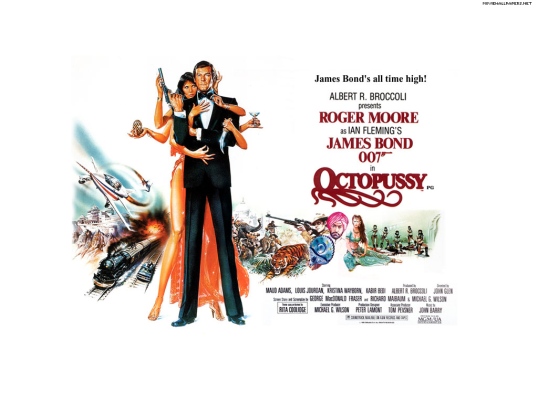
The Roger Moore-era also redefined the franchise as more more about action and less and less thriller with each new film. This culminates in Moore’s most action-packed film in the role with the 13th Bond film (produced by EON) in Octopussy.
The film begins with one of the more impressive opening sequences in the series as we find Bond in the middle of an undercover mission in Cuba. This intro’s stunt work with Bond piloting a mini-plane in and around Cuban airspace to escape and, at the same time, fulfill his mission remains a highlight in the series where each new film tries to raise the bar in terms of well-choreographed and very complicated action scenes.
Octopussy sees Bond traveling to India, East and West Germany to halt the nuclear and warmongering ambitions of a Soviet general who sees his country’s nuclear disarmament talks with the West as inviting defeat for the Soviet Union. We also have the theft of priceless Russian treasures like the Faberge Eggs being used to finance this general’s plan to complicate bond’s main mission. The plot for Octopussy is a reminder of the time it was filmed in. Reagan and Thatcher had a strong control of the West and their confrontational attitudes towards the Soviet Union and it’s satellite states made people believe that the world was on the brink of war. This public sentiment affected the fiction and entertainment of the time with Cold War thrillers becoming ascendant once more.
As much as the basic outline of the film’s plot looked to be impressive on the face of it the way the story unfolded was quite a hit-and-miss affair. I put some of this on the shoulders of it’s director John Glen who seemed more interested in moving the story from one action scene to the next while paying just the minimum of lip-service to the quieter scenes that occur in-between.
This being Moore’s sixth Bond film we pretty much know how his Bond operates. So, it falls to fleshing out his rivals and enemies to help create a much more interesting film beyond the extravagant action scenes. We learn about the agendas and personalities of Bond’s rivals through too much exposition info dumps. Even the title’ character of Octopussy (played by Maud Adams) we don’t get to learn much of other than a brief personal history dialogue she has with Bond the first time we meet. Of Bond’s two enemies in the film one is the warmongering General Orlov (played by Steven Berkoff) who comes off like an over-the-top caricature with a distinct speech pattern to match. The other is the exiled Afghan prince Kamal Khan who comes off a bit more fleshed out as Octopussy’s covetous partner-in-crime. Louis Jourdan as Kamal Khan plays the role with a sense of panache and joie de vivre that at times he’s able to match Moore’s Bond in the charisma department whenever the two share the screen together.
What should interest people about Octopussy are the very action scenes I spoke about earlier. From the opening sequence in Cuba to a thrilling race against time that traverses from East Germany to West Germany to stop a nuclear weapon from detonating it’s no wonder some people consider Octopussy as a favorite. I enjoyed the film for these very sequences despite missteps in the overall execution of the plot and inconsistencies in the performances of the cast. Yet, the film had the DNA to be much better and after repeated viewings one could see that in the hands of a different filmmaker and changes in the cast this sixth Moore-era Bond film had the potential to be one of the best.
Octopussy would mark the start of the franchise’s decline in the face of much more violent and action-packed action films of the 80’s. The film tried to keep up with this rising trend in action filmmaking during the 80’s. It was able to succeed in a fashion in making the series much more action-packed (though quite bloodless in comparison to what was about to come out of Hollywood in the coming years), but in doing so the film’s storyline and characters suffered that the film doesn’t hold up the test of time unlike some of the early Connery and Moore films.
On a side note, the film did have one of my favorite Bond song’s with Rita Coolidge singing “All Time High” in the intro sequence. A song title that was quite ironic considering that the film definitely didn’t hit an all time high.
For the past few days, the Shattered Lens has been taking a journey through the history of the James Bond film franchise. Today, we continue that journey by taking a look at 1977’s The Spy Who Loved Me. This was the 10th film in the “official” James Bond series and the 3rd to star Roger Moore as 007. It was also the first of Moore’s films to be embraced by contemporary critics and it’s still considered to be one of the best films in the entire series. It’s also one of my personal favorites.
The Spy Who Loved Me opens with one of the most of brilliant pre-credit sequences in the history of the franchise. British and Russian submarines are mysteriously vanishing. M (a returning Bernard Lee) summons James Bond (Roger Moore) to investigate. Not surprisingly, Bond is with a woman at a ski resort when the summons comes. As Bond starts to leave, the woman says, “But James, I need you.”
“So does England,” Bond replies.
Now, this was long before my time so I can’t say for sure but I always like to imagine that line got some applause when it was first heard in theaters. It is with that line (and, even more importantly, with his self-assured but humorous delivery of that line) that Roger Moore truly claims the role of James Bond as his own. No, this scene seemed to be telling us, Moore would never be Sean Connery. But he would be James Bond.
After leaving the chalet, Bond finds himself being pursued by several Russian agents. This downhill ski chase, filmed by real people who were truly putting their lives in danger in the days before CGI, is one of the most exciting of all the chases to be found in Bond films and it builds up to a perfect climax. After Bond manages to kill one of his pursuers, he skis right over the edge of a cliff. Luckily, he has a parachute in his backpack and, of course, it’s a union jack parachute. Again, I like to imagine that audiences applauded at this moment.
Bond’s escape leads to the opening credits and, even more importantly, Carly Simon singing the film’s theme song, “Nobody Does It Better.” Seriously, I love this song.
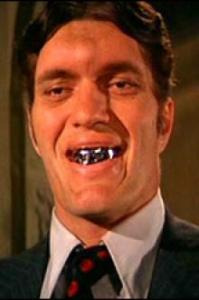
Both MI6 and the KGB discover that the plans for a submarine tracking system are being sold on the Egyptian black market. Suspecting that this is connected to the missing submarines, both James Bond and the Russian agent Anya Asamova (Barbara Bach) are sent to Egypt. Bond and Anya team up to find the plans. Along the way, they are attacked multiple times by Jaws (Richard Kiel), a hulking man with steel teeth.
Eventually, Bond and Anya discover that the man responsible for the missing submarines is Karl Stromberg (Curt Jurgens), a shipping magnate who is planning on destroying the surface world so that he can start a new society underwater. The two secret agents work together to defeat Stromberg even though Anya assures Bond that she’s going to kill him as soon as their mission is completed. Remember the man who Bond killed during that opening ski chase? It turns out that man was Anya’s lover and she’s only putting off getting her revenge so that she and Bond can save the world first.
With its confident mix of humor, intrigue, and spectacular action, The Spy Who Loved Me remains one of the most popular of the Bond films. It’s certainly one of my favorites.
Along with From Russia With Love and On Her Majesty’s Secret Service, this is the most romantic of the Bond films. Roger Moore and Barbara Bach have a very real chemistry and, as a result, you actually care about whether or not Bond and Anya will still be together after the end credits. As played by Barbara Bach, Anya is one of the strongest of the Bond girls. For once, Bond and his lover are truly equals. For anyone who doubts the importance of having a strong Bond girl, I invite them to compare this movie to The Man With The Golden Gun.
For those who are more into action than romance, The Spy Who Loved Me will not leave them disappointed. This film features some of the best set pieces in the history of the Bond franchise. Along with the ski chase at the start of the film, there’s also a genuinely exciting car chase that features Bond and Anya being pursued by a helicopter piloted by Caroline Munro.
(Speaking of cars, this film also features one of my favorite Bond gadgets — a car that doubles as a submarine.)
Karl Stromberg makes for an interesting villain. His plan makes absolutely no sense but he may be the first Bond bad guy to motivated by perverted idealism as opposed to pure greed. As you would expect from a Bond film, his secret underwater HQ is quite an impressive set. However, the best thing about Stromberg is that he employs Jaws. With his stainless steel teeth, Jaws was the best henchman since Goldfinger‘s Oddjob and he proved to be such a popular character that he actually returned in the next Bond film.
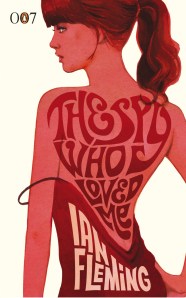
One final note: As has often been noted, The Spy Who Loved Me was the first Bond film to have absolutely nothing in common (beyond a title) with the book that it was based on. This is largely because the literary Spy Who Loved Me wasn’t really about James Bond. Instead, it told the life story of Vivienne Michel, a Canadian woman who just happens to meet Bond towards the end of the book. Fleming reportedly considered this book to be a failed experiment on his part and reportedly he only sold the film rights when he was assured that only the book’s title would be used.
That said, I recently read The Spy Who Loved Me and it’s not that bad. Vivienne Michel is a compelling character and it’s interesting to, for once, see James Bond through the eyes of a lover as opposed to the other way around. If it is a failed experiment, it’s still an experiment that’s worth reading.
As for the cinematic James Bond, he conquered the sea in The Spy Who Loved Me so it only made sense that, in his next film, he would attempt to conquer space. We’ll take a look at Moonraker tomorrow.
With the previous Bond entry, Diamonds Are Forever, we finally see Sean Connery run out of gas when it came to playing the title role of James Bond. Yet, despite the obvious boredom Connery was having in the film the producers of the series were still wanting him to come back for another Bond film. Maybe it was his experience during the production of Diamonds Are Forever or Connery finally decided it was truly time to go the series’ producers didn’t get their wish and were in a rush to find someone new to wear the mantle o Agent 007.
They finally found their new James Bond in the form of English-actor Roger Moore and production on Live and Let Die began soon after.
Roger Moore, for me, has always been the start of the less serious, but much more fun era of the James Bond franchise. His films still had the intrigue and action of the Connery-era, but the writers and producers of the series put in more one-liners and humor in the story. We begin to see the start of this in the previous Bond film (not handled as well and came off as awkward at times), but it was in Live and Let Die and in Roger Moore that this change in the series’ tone finally hit it’s stride.
The film dials back the global domination attempts by the series of villians both SPECTRE and not. This time around Bond must investigate the deaths of three MI6 agents who had been investigating one Dr. Kananga, the despot of the fictitious Caribbean island of San Monique. Kananga (played by Yaphet Kotto) also has an alter-ego in the form of Mr. Big who runs a series of soul food restaurants as a front for his drug business. Every Bond film always tries to out-elaborate the previous one with it’s villains plans. There’s no attempts by Kananga/Big to dominate the world. His plans are pretty capitalistic in a ruthless sort of way. He wants to corner the drug market in the US by flooding the illegal drug market with his own heroin which he plans to give away for free thus bankrupting the other crime lords and drug dealers.
This plan by Kananga actually looks to be very sound and it helps that he has the beautiful seer Solitaire (played by a young and beautiful Jane Seymour) to help him outwit ad stay ahead of his competitors and the law. His plan would’ve succeeded if not for the meddling of one British super-spy named James Bond.
Live and Let Die might not have been as serious about it’s story as the early Connery films, but it definitely had a much more faster pace with more action to distinguish Moore from Connery. One particular famous action sequence involves Bond escaping from Kananga’s drug farm in the Louisiana Bayou country being chased not just by Kananga’s henchmen but by the local police in the form of Sheriff J.W. Pepper who plays the role of fool and comedy relief in the film. Even the smaller action scenes in the film had more life and fun to them like Bond escaping a gator pit by timing a run across the backs of a line of gators to safety.
Where the previous bond film’s attempt at injecting humor and more action into the story were more failures than successes in this film Roger Moore Bond film they worked in due part to Moore’s playful delivery of the one-liners and bon mots the role has become known for of late. Any trepidation that audiences and producers might have had about Moore taking on the role that had been made famous by Connery soon went away as this film played out.
Live and Let Die still remains my favorite of all the Roger Moore Bond films and saw it as the highlight of his time playing the character. While the follow-up films were good in their own right it was this initial Moore entry in the series where the writers, Moore and veteran Bond filmmaker Guy Hamilton were able to find the perfect balance of thrilling action and humor that the rest of the Moore-era films couldn’t replicate.
Next up for James Bond…The Man with the Golden Gun.
I think it’s a well-known fact that the Austin Powers series was spoofing the spy film of the 60’s and 70’s with it’s main target for laughs being the iconic James Bond character and his international adventures of action and intrigue. The James Bond films with each successive entry became more and more fantastic as the megalomania of each new villain became more and more cartoonish and over-the-top and the gadgets themselves started entering the realm of science-fiction (for that time and era, at least) and back-of-the-comic-book ingenuity. I think the tipping point for the series that took James Bond from action thriller to spoofing it’s own past was with Sean Connery’s last official film as James Bond with Diamonds Are Forever.
To say that Sean Connery was truly getting tired and bored with playing the character James Bond on the big screen would be an understatement. His previous Bond entry with You Only Live Twiceshowed him pretty much disinterested with the role and one would almost think he was phoning in his performance. After that film Connery had announced his retirement from playing Bond, but after George Lazenby also retired from the role after just one film Connery was soon back for one more ride on the James Bond train.
Diamonds Are Forever once again pits James Bond against his arch-nemesis, the leader of SPECTRE and feline connoisseur, Ernst Blofeld. This time around the role of Blofeld was played by the actor Charles Gray and the film does a good job in explaining why the character has been played by so many different actors in each entry he appeared in. It is in this early sequence in the film that we begin to see that this latest James Bond entry had jumped the shark when it came to trying to keep things even remotely believable. It’s the film’s biggest flaw an, at the same time, what made it such an interesting, fun ride.
Even the plot of the film owes more to the spoofs of the Blofeld character by way of the Austin Powers films as Bond must try to stop SPECTRE from using smuggled South African diamonds from being used to create weaponized satellite with a massive “laser” that SPECTRE will use to destroy the nuclear arsenal of every superpower then auction off the rights to be the only nuclear power to the highest bidding country. It’s pretty much the the basic foundation of what would be the plot for the first Austin Powers, but with this film filmmaker Guy Hamilton still tried to treat the script as something that was of the serious Bond when it was more 60’s camp through and through.
Diamonds Are Forever may be the weakest of all the Connery Bond films, but it’s groovy sensibilities that celebrated the 60’s (despite the film having been made in 1971) psychedelic, swinging lifestyle poked fun at Bond’s predilection as a suave and charismatic womanizer that wouldn’t have looked out of place in a 60’s love-in. Even the action sequences was something that looked more humorous than thrilling whether it was Bond escaping SPECTRE henchmen on a moon buggy to the inept duo assassins Mr. Wint and Mr. Kidd looked more at home in an action comedy than a series that was known for serious action.
I would be remiss to not mention that this was the only time the Bond series had a redhead as a Bond Girl in the vivacious form of Jill St. John as Tiffany Case. I would also like to think that the other Bond Girl in the film, played by Lana Wood (Natalie Wood’s younger sister), was also a redhead but I’m not entirely sure since most audiences probably didn’t pay too close attention to Plenty O’Toole’s hair color. Either way this would be the only Bond film that would cast what fellow writer Lisa Marie calls the 2%.
Diamonds Are Forever might not have been the sort of return Sean Connery envisioned for himself when he agreed to return as James Bond after taking a film off, but then again this wouldn’t be the first time he would retire from the role only to come back again. Yet, despite all it’s flaws (there were many of them) the film does entertain though probably not in the way it’s filmmakers hoped it would. I do believe that it was this film that finally brought in Roger Moore as the next Bond, but also convinced the film’s producers to tailor the Bond films using some of the humorous aspect of Diamonds Are Forever but tempered to accompany the action in the story.
As you probably already know, we here at the Shattered Lens have been counting down the days until the American release of Skyfall by reviewing every single film in the James Bond franchise. Today, we take a look at the first non-EON Bond film, the epic, psychedelic 1967 spoof Casino Royale.
Where to begin?
When Ian Fleming’s first James Bond novel, Casino Royale, was published in 1953, veteran Hollywood producer Charles K. Feldman bought the film rights. However, Feldman didn’t buy the rights to Fleming’s subsequent novels and was forced to sit by and watch as Albert Broccoli and Harry Saltzman had unexpected success with Dr. No and the subsequent EON-produced Bond films. Much as Kevin McClory did with Thunderball, Feldman first attempted to co-produce a serious adaptation of Casino Royale with Broccoli and Saltzman. However, when Feldman, Broccoli, and Saltzman couldn’t come to an agreement on how each side would be compensated in the proposed production deal, Feldman decided to make Casino Royale on his own. He also decided that, instead of trying to compete with EON by making a “straight” James Bond film, his version of Casino Royale would be a satirical extravaganza.
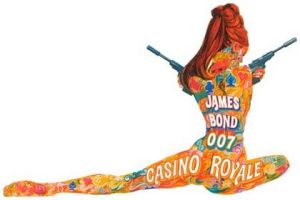
Feldman’s vision of James Bond is apparent from Casino Royale’s opening credits. While the credits are definitely based on the iconic openings of the EON Bond films, they’re also designed to play up the fact that Casino Royale — in the grand tradition of the Hollywood studios at their most excessive — is meant to be a big budget, all-star extravaganza.
Casino Royale actually starts out with a pretty clever premise. It seems that the name “James Bond,” is simply a code name that has been assigned to several British spies over the years. As M (played by John Huston, who also directed the first third of the film), explains it, the name “James Bond” strikes such fear in the hearts of Britain’s enemies that the name must be kept alive.
(Speaking for myself, this is an idea that I kinda wish that the official James Bond series would adopt. If nothing else, it would certainly explain how Pierce Brosnan and Daniel Craig could possibly be the same person.)
The original James Bond (played by David Niven) has long since retired to his stately country estate, where he spends his time playing the piano and complaining about how the agents who have inherited his name are sullying his reputation with excessive womanizing and violence. It turns out the Sir James Bond is a man renowned for his “celibate image.” At the start of the film, Bond is asked to come out of retirement by not only M but the heads of the CIA, KGB, and French secret service as well. SMERSH, an organization of female assassins that’s led by the mysterious Dr. Noah, has been eliminating agents worldwide and only the original (and very chaste) Bond can defeat them. Bond, however, refuses and M responds by ordering a mortar attack on Bond’s estate. The estate is blown up but so is M and Bond soon finds himself returning to London as the new head of MI6.
Interestingly enough, David Niven was one of the actors who was considered for the role of James Bond in Dr. No. Reportedly, Ian Fleming was quite enthusiastic for Niven to take the role but, by the time that Dr. No went into production, Niven was considered to be too old. There’s a nice bit of irony here in seeing David Niven playing a retired James Bond who spends a good deal of the film complaining about the men who have subsequently assumed his name.
Once Niven takes over MI6, he orders that, in order to confuse SMERSH, all British agents (including female agents) will be known as James Bond. The rest of the film is divided into episodes that feature these new James Bonds battling SMERSH and the mysterious Dr. Noah.
Among these agents, there’s the handsome Coop (played by Terrence Cooper) who has been trained to resist all sexual temptations.
There’s Mata Bond (Joanna Pettet), the daughter of Sir James Bond and Mata Hari.
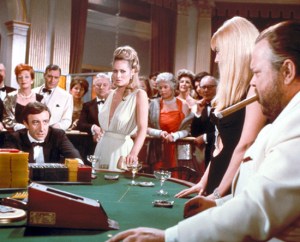
There’s Vesper Lynd (Ursula Andress) who is sent to seduce and recruit the expert gambler Evelyn Tremble (Peter Sellers) so that Tremble can beat SMERSH agent Le Chiffre (Orson Welles) at the Casino Royale.
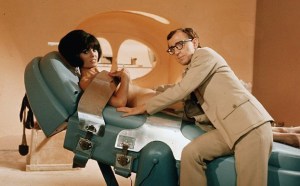
Best of all, there’s Sir James Bond’s nephew, Jimmy Bond. Jimmy Bond is played by Woody Allen and … well, let’s just take a look at Jimmy’s first scene in the film:
Casino Royale had a notoriously troubled production history and most of those troubles seemed to center on Peter Sellers. While the film was designed to be a broad, slapstick comedy, Sellers reportedly insisted on trying to play his role straight and even rewrote his lines to make his scenes more dramatic. Welles eventually grew so disgusted with Sellers that he refused to be in the same room with him. This caused quite a bit of difficulty since Sellers was in almost every scene that featured Welles. Eventually, Sellers walked off the film and the film had to be hastily (and awkwardly) rewritten to account for his sudden absence.
When one watches Casino Royale today, it’s hard to escape the conclusion that Sellers was essentially correct. While most of Casino Royale often feels disjointed and incoherent, the scenes featuring Sellers, Andress, and Welles are some of the strongest in the film. Sellers’ dramatic approach doesn’t negate the film’s comedy. If anything, it makes the comedy even stronger because Sellers actually seems to be invested in the reality his character, regardless of how ludicrous a situation that character may find himself in.
When I watched Casino Royale, I was struck by the stark contrast between the parts of the film that worked and the parts that didn’t. This is a movie that truly swings from one extreme to another. Either the film’s satire is working brilliantly (mostly in the scenes featuring Woody Allen and Peter Sellers) or it’s falling completely flat (like in an extended sequence that features Deborah Kerr as a SMERSH assassin).
I found myself laughing more at the little scenes than the big set pieces. For instance, I loved it when David Niven embraces Miss Moneypenny (Barbara Bouchet) just to be then told that she’s actually the daughter of the original Miss Moneypenny. I don’t know much about the actor Terrence Cooper (though, according to Wikipedia, he was also a contender to take the role of James Bond in the official series) but I enjoyed the brief sequence where Moneypenny “tests” him to see if he can take on the Bond identity. Unfortunately, the film doesn’t really have enough of these small, clever moments.
Ultimately, I found that Casino Royale works best when viewed as a time capsule. Casino Royale was made at a time when the established major Hollywood studios (and veteran producers like Charles K. Feldman) were struggling to remain relevant. Foreign films (including, it must be said, the James Bond films) were challenging the common assumptions of what could and what couldn’t be shown on-screen and the studio system reacted by trying to make films that would appeal to younger audiences while also reassuring older audiences that the movies hadn’t really changed that much. The end result were films like Casino Royale that featured the occasional psychedelic sequence along with cameos from old (and safe) Hollywood stars like George Raft, William Holden, and Charles Boyer. Casino Royale is the type of self-indulgent film that could only have been made in 1967 and, as such, it’s a valuable time capsule for all of us cinematic historians.
I also have to admit that, as excessive as Casino Royale may be, I happen to love excess. Casino Royale might be overlong and occasionally incoherent but the costumes are simply to die for. The film is a visual feast, if nothing else.
Casino Royale was released to scathing reviews and terrible box office but, in the years since, it has become something of a cult favorite. Our own Trash Film Guru has identified Casino Royale as his favorite Bond film. Myself, I found the film to be extremely flawed and yet oddly fascinating to watch. Casino Royale is a total mess and that is both its greatest flaw and greatest strength.
Tomorrow, we’ll return to the official James Bond series by taking a look at You Only Live Twice.







 Through the Shattered Lens