This handsy cover is from 1946.
Tag Archives: Horrorthon
Music Video of the Day: See You In Hell by Grim Reaper (1982, directed by ????)
Grim Reaper was so hardcore that they even had the Devil himself watching over their concerts!
See You In Hell is probably best remembered for Beavis and Butt-Head’s epic takedown of both the video and the singer.
Enjoy!
The Unominated #21: Southern Comfort (dir by Walter Hill)
Though the Academy of Motion Picture Arts and Sciences claim that the Oscars honor the best of the year, we all know that there are always worthy films and performances that end up getting overlooked. Sometimes, it’s because the competition too fierce. Sometimes, it’s because the film itself was too controversial. Often, it’s just a case of a film’s quality not being fully recognized until years after its initial released. This series of reviews takes a look at the films and performances that should have been nominated but were, for whatever reason, overlooked. These are the Unnominated.
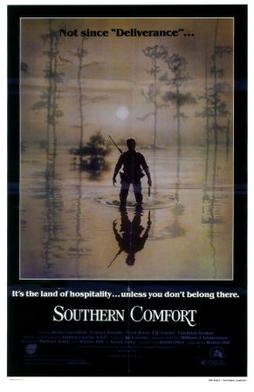
1981’s Southern Comfort takes place in 1973. While America tries to wind down its presence in Vietnam, a squad of nine National Guardsmen take part in war games in the Louisiana bayous. The squad is led by the ineffectual Sgt. Crawford Poole (Peter Coyote) while other members include the trigger-happy Lonnie Reece (Fred Ward), the weed-smoking Tyrone Cribbs (T.K. Carter), the cowardly Private Simms (Franklyn Seales), and the tightly-wound Coach Bowden (Alan Autry). Poole may be in charge but most of the members of the squad seem to look up to the laid-back and friendly Private Spencer (Keith Carradine). The newest member of the squad is Charles Hardin (Powers Boothe), a sober-minded transfer from Texas who doesn’t seem to get along with anyone but Spencer.
With the exception of Poole and Hardin, no one takes the weekend maneuvers seriously until they find themselves lost in the bayou and it becomes obvious that Poole has no idea what he’s doing. When they come across some canoes that belong to some Cajun trappers, they decide to “borrow” them. When the trappers protest, Reece fires his weapon at them. Reece’s gun is loaded with blanks but the trappers don’t know that. They fire back, killing Poole.
The national guardsmen now find themselves lost and being stalked by the trappers, a largely unseen force that always seems to attack out of nowhere. The men have no idea where they are. The trappers, on the other hand, have lived in the swamps their entire lives. The guardsmen bicker and argue over the best way to respond. Some want to fight back and some just want to get back to civilization. One-by-one, the men are picked off until only two remain.
Though the film is a somewhat heavy-handed metaphor for the Vietnam War, Southern Comfort is still a deeply affecting and suspenseful mix of horror and action. Director Walter Hill keeps the action moving at a quick pace and the film, which was shot on location and featured scenes shot during an actual Cajun celebration, perfectly captures the languid yet ominous atmosphere of the bayous. As soon as the men see those canoes unattended, we know that they’re going to steal them and that they are making the biggest mistake of their lives. Keith Carradine and Powers Boothe both give powerful performances in the lead roles and the members of the supporting cast — especially Alan Autry and Fred Ward — make a strong impression as well. I especially liked the performance of Brion James, who has a small role as a one-armed Cajun who is more crafty than he looks.
Being a mix of horror and action, it’s probably not a shock that Southern Comfort was ignored by the Academy. At the very least, I would have found room for Ry Cooder’s original score and Andrew Laszlo’s haunting cinematography.
Previous Entries In The Unnominated:
- Auto Focus
- Star 80
- Monty Python and The Holy Grail
- Johnny Got His Gun
- Saint Jack
- Office Space
- Play Misty For Me
- The Long Riders
- Mean Streets
- The Long Goodbye
- The General
- Tombstone
- Heat
- Kansas City Bomber
- Touch of Evil
- The Mortal Storm
- Honky Tonk Man
- Two-Lane Blacktop
- The Terminator
- The Ninth Configuration
Horror On TV: Hammer House Of Horror #8: Children of the Full Moon (dir by Tom Clegg)
In Children of the Full Moon, a married couple on holiday has some car trouble. They find a large house that is looked over by Ms. Ardoy (Diana Dors) and inhabited by a multitude of children, who may or may not be werewolves. This episode starts out somewhat light but the tone eventually shifts and things end on a memorably dark note. Diane Dors gives a wonderful performance as the mysterious Ms. Ardoy. Be careful about where you take your vacation.
This episode originally aired on November 1st, 1980.
October Hacks: Silent Night, Bloody Night (dir by Theodore Gershuny)
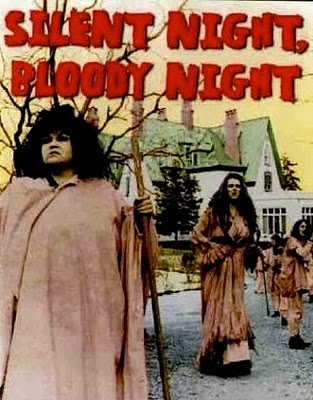
Filmed in 1972 and subsequently released in 1974, Silent Night Bloody Night is a real treat, an atmospheric thriller that has a wonderfully complicated plot that will keep you guessing.
Silent Night Bloody Night opens with attorney John Carter (Patrick O’Neal) arriving in a small town on Christmas Eve. He’s traveling with his assistant and mistress, Ingrid (Astrid Heeren). He’s been hired by Jeff Butler (James Patterson) to oversee the sell of his grandfather’s home. When Carter arrives, he finds that the town is run by a group of elderly eccentrics, including the mute Charlie Towman (John Carradine). Charlie communicates by ringing a bell and he’s the editor of the town newspaper. Carter convinces the town council to buy the Butler mansion. Then, Carter and Ingrid go to the mansion, make love, and are promptly brutally hacked to death by an unseen assailant with an axe. It’s a shocking moment because, up until their death scene, Carter and Ingrid seemed to be our main characters. Much as with Marion Crane’s shower in Psycho, their murder leaves an absence at the heart of the film.
That night, our new hero, Jeff Butler (James Patterson) comes to the isolated town to check on how the sale is going. He finds the mansion locked up and no one willing to talk about John Carter. With the help of local girl Diane (Mary Woronov), Jeff investigates his grandfather’s death and discovers that the town is full of secrets and people who are willing to kill to maintain them. As we discover through some wonderfully dream-like flashbacks, Jeff’s grandfather died nearly 40 years ago when he was set on fire in his own home. Those aren’t the only flashbacks to the film. In an extended sepia-toned flashback, we learn about the previous inhabitants of the house. They are all played by former Warhol superstars, including Candy Darling, Ondine, Tally Brown, Charlotte Fairchild, Lewis Love, Harvey Cohen, George Trakas, Susan Rothenberg, and Jack Smith. (Mary Woronov was, herself, a former member of Warhol’s entourage.)
Silent Night Bloody Night has a terrible reputation. Mary Woronov, who was married to director Theodore Gershuny at the time she made the film, later described it as being “lousy.” Personally, I think the film’s reputation has more to do with all of the grainy, bad copies of the film that have turned up in various Mill Creek box sets over the years than the quality of the film itself. (Silent Night Bloody Night is in public domain.) The film itself is atmospheric, memorably bloody, and — for those who have the patience to deal with the occasional slow spot — effectively creepy. Mary Woronov is a likable lead and the Warhol superstars definitely make an impression. The film plays out at its own deliberate pace and, at its best, it duplicates the feeling of a particularly macabre holiday dream.
Director Theodore Gershuny uses the low budget to his advantage and the sepia-toned flashbacks are truly disturbing and haunting. Ultimately, Silent Night Bloody Night feels like a dream itself and the mystery’s solution is less important than the journey taken to reach it.
The TSL Horror Grindhouse: Messiah of Evil (dir by Gloria Katz and Willard Huyck)
I can still remember the first time that I saw the 1973 film, Messiah of Evil.
It was on a Monday night, many years ago. I had recently picked up a 10-movie DVD box set called Tales of Terror and I was using the movies inside to try to deal with a bout of insomnia. I had already watched The Hatchet Murders (a.k,a. Deep Red) and The House At The Edge of the Park and, at two in the morning, I was faced with a decision. Should I try to sleep or should I watch one more movie?
Naturally, I chose to watch one more movie and the movie I picked was Messiah of Evil. So, there I was at two in the morning, sitting at the edge of my bed in my underwear and watching an obscure horror movie while rain fell outside.
And, seriously — this movie totally FREAKED me out!
Messiah of Evil opens with a man (played by future director Walter Hill) stumbling through the night, obviously trying to escape from something. A mysterious woman appears and kills him. We’re left to wonder who the man was supposed to be as the film doesn’t ever really return to his murder. In most films this would be a weakness but it feels appropriate for Messiah of Evil, a film that plays out with the visual style and fragmented logic of a particularly intense nightmare.
The rest of the story tells the story of Arletty (Marianna Hill), a neurotic woman who drives to an isolated California town in order to visit her father. Her father is an artist who specializes in painting eerie pictures of large groups of black-clad people. However, once she arrives at his home, Arletty discovers that her father has vanished and left behind a diary where he claims that a darkness has overtaken the town. Meanwhile, it sometimes appear as if the people in the paintings are moving or threatening to come out of the walls.
Meanwhile, one crazed man (Elisha Cook, Jr.) explains that “the dark stranger” is returning. An albino (Bennie Robinson) drives a truck up and down the street and talks about how he likes to listen to “Wagner.” The back of the truck is full of blank-faced people staring at the sky and the Albino eats a rat. Finally, a mysterious man named Thom (Michael Greer) is wandering about town with two groupies (played by Anitaa Ford and Joy Bang) and interviewing random townspeople. After meeting Arletty, they all end up moving into her father’s house.
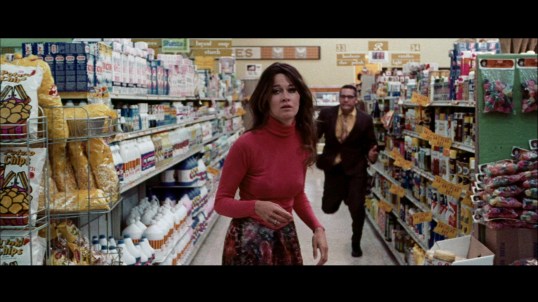
Messiah of Evil is literally one of the strangest films that I’ve ever seen. It’s shot in a dream-like fashion and the much of the film is left open to the viewer’s interpretation. Joy Bang goes to see a Sammy Davis, Jr. western and doesn’t notice as the theater slowly fills up with pale, red-eyed townspeople. Anitra Ford goes to a grocery store late at night and discovers the townspeople indulging in their appetites. If the film was only distinguished by those two scenes, it would still be worth saying. However, Messiah of Evil is a total and complete experience, a film where every scene matters and the audience is tasked with putting the puzzle together.
This film was directed by Gloria Katz and Willard Huyck, two longtime associates of George Lucas. (They wrote the screenplay for American Graffiti and Huyck directed Howard The Duck.) There’s absolutely nothing else in their filmography that is as surreal as Messiah of Evil, leading me to suspect that the film itself might be a very fortunate accident. Apparently, the production ran out of money before Katz and Huyck finished principal photography, which is what led to the film’s disjointed nature. Accident or not, Messiah of Evil is a masterpiece of surreal horror.
Aliens (1986, directed by James Cameron)
When I learned that today was Sigourney Weaver’s birthday, I flashed back to the first time I saw Aliens.
I was just a kid, probably too young for the movie. My father rented Aliens from the local Blockbuster. It had been years since the movie had first come out but my father, who went to every Star Trek movie premiere and who still knows the lore of Star Wars better than I do, had never seen it and he was planning on correcting that oversight. My family gathered in the living room. We turned out all the lights. The tape was slipped into the VCR. Play was hit. Our boxy television turned into a movie screen and Aliens began.
And it scared the Hell out of me.
Today, I think people forget just how scary both Alien and Aliens are the first time that you watch them. After the first time, you at least know when the aliens are going to jump out at people and you also know who is going to survive. Today, if I rewatch Aliens, I know not to get to attached to the any of the Colonial Marines. I also know not to trust Carter Burke, even if he is played by Paul Reiser. I watch the movie in anticipation of Bill Paxton’s “Game over, man,” instead of dreading it. When I first watched it, all I knew is that the screen suddenly went dark, the soundtrack was full of screeches and the deaths of the Marines, and that the only thing scarier then being confronted with one alien was being confronted with a hundred of them at once. When I watch today, I know Bishop (Lance Henriksen) is going to prove to be a good android. I didn’t have the assurance when I first watched the movie. For all I knew, he was going to just abandon Ripley (Weave), Newt (Carrie Henn),and Hicks (Michael Biehn) on the planet.
Sigourney Weaver was the heart of that film. She went from being angry and bitter over what happened during then first Alien to still being angry and bitter but willing to risk her life to save Newt. From the start, she alone understood the Xenomorph threat and she was ultimately victorious because she was not only as determined and ruthless as the Queen but she actually had the heart that her opponent lacked. Ripley won because she was actually fighting for something more than just conquest. She was fighting to save Newt from becoming an incubator.
I usually think of Aliens as being the last Ripley film. I don’t acknowledge the third film because I find the idea of killing Newt and Hicks to be a betrayal of what made the first Aliens more than just a scary action movie. The fourth film, I don’t acknowledge because it asks me to believe that Winona Ryder would still be acting like Winona Ryder in the 23rd century. Aliens is a scary movie but it’s also a movie that ends with the promise of hope. After all that she’s been through, Ripley finally has a chance to start again with Newt, Hicks, and Bishop. That hope is something that is too often missing from the follow-ups.
Happy birthday, Sigourney Weaver! I’m going to go watch Aliens.
Horror Scenes That I Love: Ripley’s Last Stand in Alien
Since today is Sigourney Weaver’s birthday, I think it’s probably a given that today’s scene of the day would feature her defeating an alien. In this scene from 1979’s Alien, Ripley shows why she is the last human survivor of the Nostromo.
(As cool as Ripley is, she’s still nowhere close to being as much of a badass as Jonesy the Cat. Jonesy just had to hiss and the alien knew better than to mess with the ship’s cat.)
Horror Novel Review: Teddy by John Gault
Yesterday, I wrote about a Canadian horror film called The Pit. I mentioned that it was a film about a creepy 12 year-old named Jamie who had conversations with his teddy bear, developed a not-so-innocent crush on his babysitter, and who regularly fed the people he disliked to a bunch of underground monsters who lived in a pit in the woods.
Yesterday, I also read Teddy, the 1980 novelization of The Pit.
(The Pit was originally titled Teddy.)
Teddy is even more creepy than The Pit, largely because it includes all of the disturbing details that were either cut from the finished film or perhaps dropped when the script was rewritten. Jamie is still a creepy 12 year-old who talks to his teddy bear. Unlike the film, the novel makes it clear that Teddy is actually a living force of evil and that his words are not just a figment of Jamie’s imagination. The book actually suggests that Teddy moves from child to child, corrupting each of its owners. Teddy in the book is also a hundred times more pervy than Teddy in the movie, making some rather crude comments about Jamie’s mom and later encouraging Jamie to join him in checking out some porno magazines.
The book also delves into the investigations surrounding the disappearance of Jamie’s many victims. As a result, we get to know the victims a bit better in the book than we did in the movie. Also as a result, Jamie also comes across as much more deliberately evil in the book than he does in the movie. Even if he is under the possible demonic influence of Teddy, Jamie still seems to take way too much pleasure in people dying. This is especially true of the scene where his babysitter falls into the pit. In the movie, Jamie tries to help her escape. In the book, Jamie not only pushes her but smiles afterwards as he listens to her screams.
Agck! What a creepy kid!
Teddy is a pretty effective little horror novelization. It’s also not easy to find a physical copy. However, you can read it at Open Library.
October True Crime: Murder So Sweet (dir by Larry Peerce)

1993’s Murder So Sweet, also known a Poisoned By The Love: The Kern County Murders (seriously, try to say that ten times fast), tells the story of Steven David Catlin.
Steven David Catlin lived in Bakersfield, California. Catlin was a career criminal who was married six times and who found some personal redemption for himself as a member of the pit crew for a professional race car driver in Fresno. Trust me, I’ve lived in enough small, country towns to know that people will overlook a lot as long as someone knows how to work on a car.
One thing that people noticed about Catlin is that the people around him had a habit of dying of mysterious illnesses. Multiple wives, his adoptive parents, they all died with fluid in their lungs and they left behind not only a medical mystery but also quite a bit of money for Steven David Catlin. Catlin would always insist on holding a cremation just days after his loved ones passed away. Not only did that allow Catlin to move on but also kept anyone from being able to do a thorough autopsy.
Eventually, the police figured out that Catlin was just poisoning anyone who got on his nerves or threatened to divorce him. He wasn’t even a particularly clever poisoner. He used paraquet, a highly toxic herbicide and he kept the bottle sitting in plain view in his garage. He might as well have just labeled it his “Poisoning Thermos.” Catlin was convicted of multiple murders and he was sentenced to die in 1990. Of course, this being California, Catlin is sill alive and sitting in San Quentin. This really is a case of “If you lived in Texas, you’d be dead by now.”
In Murder My Sweet, Catlin is played Harry Hamlin, who steals the film as a dumb but charming redneck who walks with a confident swagger and has no fear of hitting on his ex-wife, even after he realizes that she’s trying to convince the police that he’s a murderer. Helen Shaver played Edie Bellew, the ex who knows better than to trust Catlin. Her current husband is played by Terence Knox and there’s plenty of scenes of him telling Edie that she needs to back off and that everyone knows that Steve Catlin isn’t a murderer. In many ways, this is the ultimate Lifetime film in that Edie Bellew not only gets to put her ex-husband in prison but she also proves that her current husband doesn’t know what he’s talking about.
Murder My Sweet takes place in rural California and, as a result, everyone in the film speaks with a shrill country accent and we spend a lot of time in a really tacky beauty parlor. Indeed, the film portrayal of country eccentricity is so over-the-top that I was tempted to say that it seemed as if the director was trying to rip-off David Lynch. However, Lynch may have made films about eccentric characters but he never portrayed them as being caricatures. Lynch loved his eccentrics while this film takes a bit of a condescending attitude towards them. Still, it’s worth watching for Harry Hamlin’s sleazy turn as Steve Catlin, a guy who enjoys fast cars and making ice cream.
Just don’t eat that ice cream….