I’ve never actually seen the 1987 film Slaughterhouse Rock. I’ve just seen the trailer included in a few compilations and, thanks to YouTube, I’ve seen the scene below. The only context that I can give for this scene is what I read on Wikipedia.
Apparently, in this scene, a ghost played by the great choreographer Toni Basil does a dance that gives the main character’s spirit the ability to roam free of his physical body. And, during the dance, we see a lot of earlier scenes from the movie. Or something like that. I don’t know. I just like the scene because of the music and Toni Basil.
I’ve always felt that dancing can take you into a spiritual realm of existence. This scene proves my point.
Welcome to the latest edition of Lisa Marie’s Favorite Grindhouse and Exploitation Film trailers! Let’s see if we can scare up some frights with these 6 trailers!
Today’s Horror on the Lens comes to use from 1958. It’s entitled I Bury The Living and say whatever you want about the actual film, that’s a great title.
In I Bury The Living, Richard Boone plays Robert Kraft, the newly appointed chairman of a committee that oversees the local cemetery. Through a series of unlikely events, Kraft becomes convinced that, through the use of black and white push-pins, he can control who will live and who will die.
Does Robert really have God-like powers or is something else happening?
Watch below to find out! I Bury The Living is no Dellamorte Dellamore but it’s still an enjoyably over the top piece of cemetery mayhem.
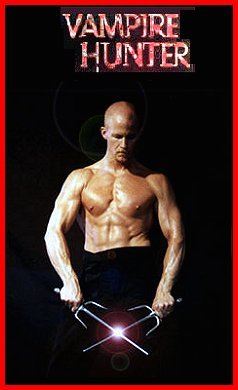
Evil vampire and art gallery owner Morgan Bane (Leonardo Milan) has lived for centuries and is suffering from a nasty case of ennui. He has grown so powerful that there simply are no more worthy opponents!
However, Morgan makes the mistake of kidnapping Heather O’Ryan (Erin Leigh). What Morgan doesn’t know is that Heather’s husband, John O’Ryan (Sean Gallimore, who also directed this film), is not just a talented animator. He’s also a super cool martial artist! John is going to get his wife back and he’s going to kick a lot of vampire ass to do it!
Helping Morgan is veteran vampire hunter, Ramone (Frank Suarez). Along with carrying a few dozen stakes, Ramone is also armed with a squirt gun full of holy water. Ramone’s religious faith is so strong that he can repel vampires just by showing them the cross that he’s tattooed on his palm. (That’s actually a pretty clever touch. Why don’t all vampire hunters do that?) John, meanwhile, is an atheist but he’s about to discover that you can’t defeat a vampire without a little faith…
Vampire Hunter was made for about $5,000 in the mid-90s but, for whatever reason, it didn’t get released until 2004. The low-budget is obvious in every frame and so is the fact that first time director Gallimore was learning how to direct as he went along. The film itself can be found in a few box sets (I found my copy in the Decrepit Crypt of Nightmares box set) and it’s obvious that the DVD was transferred over from a VHS tape.
But you know what?
I don’t care about the technical limitations. I don’t care about the low-budget. I don’t care about the less than professional acting (though I do think that Gallimore actually showed a lot of screen presence and gave a decent enough performance). I liked Vampire Hunter. It’s a fun movie, one that was made with a lot more sincerity than skill but, quite frankly, I think sincerity is underrated nowadays. Watching this movie, you get the feeling that it was a labor of love on the part of Gallimore and I’m glad that — even if it took nearly ten years — he eventually got his movie released!
And really, whatever issues you may have with the film, you cannot deny that the fight scenes are handled surprisingly well for a film with a $5,000 budget. Gallimore obviously knew what he was doing as far as the fights were concerned and, quite honestly, the fights are probably the main reason why somebody would watch a movie like Vampire Hunter in the first place.
Seriously, check out Sean Gallimore training for some vampire hunting!
Say what you will about Vampire Hunter, I hope that Sean Gallimore had fun making it and I’m happy that it was eventually released!
“A prowler has been seen around the campus and, well … he could be dangerous.”
— Miss Allison (Donna Davis) in The Prowler (1981)
Miss Allison was one of those largely ineffectual authority figures who always seems to turn up in slasher films from the early 80s. It was easy to be dismissive of her and personally, I can’t get over the fact that she would actually show up for the big graduation dance wearing pantyhose with sandals. But still, Miss Allison had a point here. There was a prowler wandering around campus and was he ever dangerous!
Of course, this all could have been avoided if they just hadn’t had a graduation dance to begin with. Eccentric old Maj. Chatham (Lawrence Tierney) understood that. He remembered what had happened at the town of Avalon Bay’s graduation dance of 1945, how Rosemary (Joy Glaccum) and her new date where both killed by a pitchfork-wielding maniac. Chatham had spent the last 35 years protesting any plans to hold another graduation dance.
However, in 1980, one feisty student named Pam (Vicky Dawson) finally convinced the town to allow them to hold a graduation dance. It probably helped the Pam’s boyfriend, Mark (Christopher Goutman) was a deputy. The morning of the dance, reports came in that someone had robbed a nearby store, murdered the store owner, and might be heading towards the town of Avalon Bay.
The sheriff (Farley Granger, who played Guy Haines in Hitchcock’s Strangers on a Train) reacted to this news by announcing that he was going fishing and leaving Mark in charge. And, before the viewer could say, “Wait a minute — how does that make any sense?,” the sheriff was gone, the dance was on, and a maniac in a combat uniform was killing people with a bayonet and a pitchfork.
Yes, Miss Allison, the prowler was quite dangerous.
Having read that plot description, you might have a suspicion as to who the prowler actually was. But you’re probably thinking to yourself, “No, that is way too obvious a solution!” Well, no — it isn’t. You will not learn the Prowler’s identity until the final few minutes of the film but you will have guessed it early on.
The Prowler is not going to win any points for originality. It’s a slasher film from the early 80s, with everything that implies. For people who know their horror history, it’s a time capsule of that brief period when slashers were still making an effort to be American gialli, before the genre became dominated by loquacious monsters like Freddy Krueger and postmodern snark. As a character, the Prowler says next to nothing and really has no personality beyond a few questionable hobbies. But he certainly does kill a lot of people and seems to truly enjoy it.
And, if you hate these type of films, you’re going to hate The Prowler. But, that being said, The Prowler is actually one of the better examples of the early 80s slasher genre. Much as he would do with both Abduction and Friday the 13th — The Final Chapter, director Joseph Zito keeps the bloody action moving and, though they may be playing stock characters, he gets above average performances from his entire cast. As opposed to a lot of slasher films of the period, you actually feel bad when these people meet their untimely end.
And finally, the Prowler himself is just scary! The combination of the Prowler’s menacing appearance and Tom Savini’s relentless gore effects sets this film apart from other contemporary slashers, like Graduation Day. Even by the standards of slasher psychos, the Prowler is cruel and sadistic. It’s not just that he kills with a bayonet. It’s that he obviously get so much enjoyment from doing it. At its best, The Prowler is pure nightmare fuel.
Finally, on a personal note, I have to admit that it kind of freaked me out that one of the Prowler’s victims was named Lisa. As I’ve said before, slasher films tend to scare me precisely because I know that there’s no way I’d survive one. We always tell ourselves that people in slasher movies die because they do unbelievably stupid things but honestly, I think we all do a lot of stupid things every day. After all, we all behave under the assumption that we’re not on the verge of being attacked by a knife-wielding maniac. Hence, it’s easy to say, “Don’t go in that room!” but why shouldn’t someone go in that room? After all, they’re not watching the movie. They don’t know there’s a killer in that room. Lisa in The Prowler certainly did some stupid things and what freaked me out was that I could easily imagine myself doing the same stupid things.
(True, unlike the film’s Lisa, I wouldn’t go out by myself in the middle of night, strip down to my underwear, and then jump in a pool but I’m planning on conquering my fear of drowning someday soon and who knows what might then happen!)
Seriously, people — be kind to the Lisas in your life.
Today’s Horror on the Lens is a classic film that really needs no introduction! Released in 1922, the German silent film Nosferatu remains one of the greatest vampire films ever made. It’s a film that we share every October and I’m happy to do so again this year!
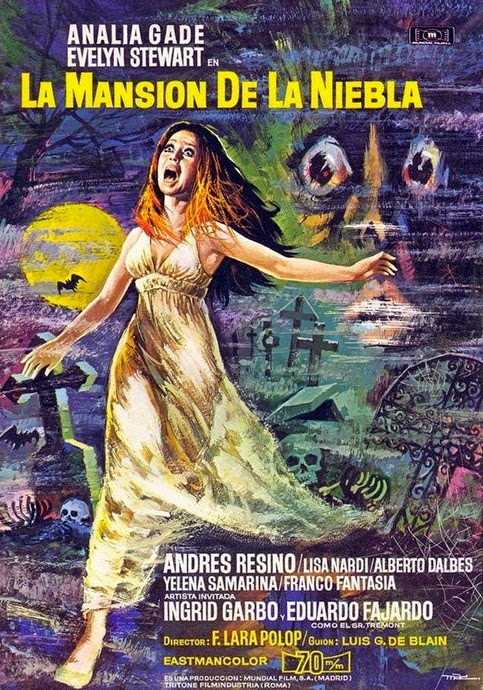
1972’s Murder Mansion (which is also known as Maniac Mansion) is an enjoyable Italian/Spanish co-production. It’s been included in a few dozen Mill Creek box sets and it’s usually advertised as being a zombie film. While I don’t want to give too much away about the film’s twisty plot, I do feel obligated to let our readers know that it is most definitely NOT a zombie film. Instead, it’s an old-fashioned gothic giallo.
Murder Mansion opens with various people separately traveling across the countryside. A few minutes is devoted to allowing us to get to know them and we quickly discover that they are all familiar giallo types. There’s the cold businessman, the lecherous man with the beard and the driving gloves, and, of course, the free-spirited young lovers who have just met. There’s also the emotionally unstable, Elsa (Analia Gade).
When a huge fog rolls in, Elsa is the first of the travelers to find herself stranded outside of a foreboding mansion. She thinks she sees two shadowy figures in the fog — a woman and a hulking man dressed like a chauffeur — pursuing her. As she runs through the fog, she runs into the young lovers, who are also similarly stranded. They decide to seek refuge inside the mansion and … guess what? It turns out that all the other travelers have decided to seek refuge there as well!
Well, it turns out that the mansion is looked after by a housekeeper named Martha (Ida Galli, a.k.a. Evelin Stewart). Martha explains that the former owner of the mansion was killed years ago in an automobile accident, along with her chauffeur. (Hmmm….) Martha also goes on to explain that the village around the mansion is deserted because the villagers became convinced that the woman and her chauffeur were vampires. Martha then invites everyone to spend the night.
As everyone prepares to turn in for the night, they can’t help but notice a few strange things. First off, why is every bedroom decorated with a disturbing painting? And why does the painting of the former, now deceased, owner of the house look so much like Martha?
As you probably already guessed, a mysterious figure soon starts to prowl around the house, killing the travelers one-by-one. Meanwhile, Elsa continues to have her nervous breakdown and soon starts to have flashbacks to some unspeakable acts that were committed by her father…
Murder Mansion is an enjoyable little giallo, one that is full of creepy atmosphere, twisty plot developments, and memorably strange characters. It’s actually a lot of fun to watch as our heroes creep around the mansion and try to put together all of the clues. (It made me want to go out and solve mysteries!) As far as blood, gore, and nudity are concerned, Murder Mansion is actually remarkably tame by the standards of Italian (and, for that matter, Spanish) thrillers, which makes it an appropriate introduction to the genre for people who may not have previously seen a lot of giallo films.
(Trust me. I tried to introduce my aunt to giallo by showing her Mario Bava’s Bay of Blood and she made me stop the movie after the double impalement. If I had been smart, I would have started with Murder Mansion and then worked my way up.)
All in all, Murder Mansion is a lot of fun and great Halloween treat!
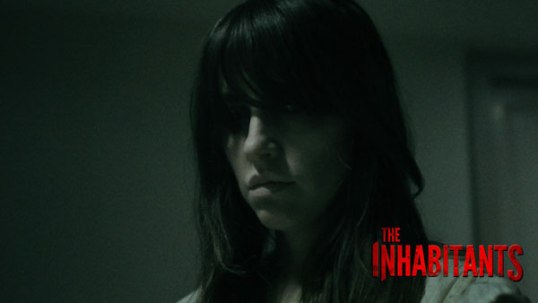
The new horror film, The Inhabitants, opens with a series of black-and-white clips of the various guests at the March Carriage Bed and Breakfast. The clips appear to have been recorded by a hidden camera and what’s disturbing is that none of these guests — as they undress, sleep, brush their teeth, make love, and do everything else that you might do while staying at a hotel for the night — are aware that they are being recorded and that they are being watched.
I have to admit that one reason why this opening got to me is that I’ve spent the night in places like the March Carriage Bed and Breakfast. In fact, I love staying in and exploring hotels whenever I’m traveling or on vacation. I think that anyone who has ever stayed at a hotel is aware of that feeling that you sometimes get, in the middle of the night, that someone might be watching you. I mean, think about it. You’re in a town where nobody knows you. You’re in a bed that’s not your own. You have no idea who slept in that bed before you and you don’t know who will sleep in that bed after you. You don’t know who is sleeping in the room next to you. And you don’t know what might or might not be happening in the rest of the hotel. At that moment, you are probably more vulnerable then you’ll ever be. Would it surprise me to learn that I had secretly been filmed while staying at a hotel? Actually, it would surprise me if I hadn’t.
But, the thing is, we force ourselves not to think about those possibilities. Because, honestly, what else can we do? Sleep in our car? Sleep on the street? Camp in the wilderness where we’ll be even more vulnerable? So, we tell ourselves that there’s nothing to worry about and we force ourselves to believe it and we hope that nothing will happen that will force us to realize how wrong we are.
I think that’s why haunted house films are so effective. We all know what it’s like to find ourselves in a new or strange place and we’ve all had that experience of wondering whether that sudden feeling of fear is legitimate or if it’s just a case of our imagination going wild. We watch a haunted house film knowing and fearing that moment when the characters (and, by extension, us) are going to be forced to realize that their fear was legitimate.
From the start, with that hidden camera footage of people at their most vulnerable, The Inhabitants is a haunted house film that works. When we first meet married couple Dan (Michael Reed) and Jessica (Elise Courture), we like them immediately. They’re young, attractive, and obviously in love. From the minute that we learn that they’re going to buy the March Carriage Bed and Breakfast, we find ourselves wanting to yell, “Don’t do it!” because we know that we are watching a haunted house film and these things never end well.
And really, it’s the likability of Dan and Jessica that make this film effective. We relate to them and we don’t want to see anything bad happen to them. The frequent complaint about characters in horror movies is that they’re always doing something stupid but neither Dan nor Jessica does anything that the viewer wouldn’t do in a similar situation. They’re just trying to move into their home and get the unpacking done. But, of course, what they don’t realize is that, way back in the 17th century, the March Carriage Bed and Breakfast was occupied by a witch. And, as quickly becomes apparent, Dan and Jessica are not alone in the house.
So, I’m not going to spoil the movie in this review by giving you too many plot details. The Inhabitants is an atmospheric throw-back to the haunted house films of the past. The fog-covered landscape, the haunted inn, and a creepy cellar all served to remind me of Lucio Fulci’s classic Beyond trilogy while the film’s dream-like atmosphere and its haunted heroine reminded me of the classic, Let’s Scare Jessica To Death. The Inhabitants, distinguished by the empathetic performances of Michael Reed and Elise Couture, is a worthy addition to the genre.
The Inhabitants will be released on VOD on October 13th!
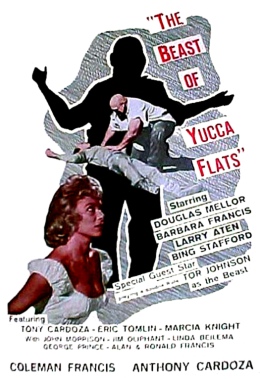
My friend, the writer Tammy Dowden, claims that 1961’s The Beast of Yucca Flats is the worst movie ever made.
Well, technically, she may be right. The Beast of Yucca Flats is a thoroughly inept film that makes next to no sense and has massive continuity errors. It’s a film that also features the legendary Tor Johnson as a Russian scientist who gets mutated by radiation and becomes a monster, but not before taking off almost all of his clothes while walking through the desert. For that matter, it’s also a film about a family that comes together though adversity — namely, being shot at by the police after the family patriarch is somehow mistaken for Tor Johnson. And finally, it’s the story of how a dying monster can find comfort from a rabbit and that’s actually kind of a sweet message.
Here’s the thing — yes, The Beast of Yucca Flats is bad but you still owe it to yourself to watch it because you will literally never see anything else like it. Plus, maybe you’ll be able to figure out what the whole point of the opening scene is.
Because I’ve watched this film a few times and I still have no idea!
In this episode of The Twilight Zone, Marsha White (played by Anne Francis) discovers some strange things happening in a department store. If you’re like me and you find mannequins to be super creepy, this episode is for you!



 Through the Shattered Lens