Horror Film Review: The Inhabitants (dir by the Rasmussen Brothers)


inhabitants1

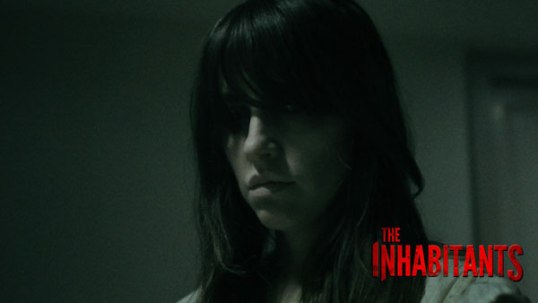
The new horror film, The Inhabitants, opens with a series of black-and-white clips of the various guests at the March Carriage Bed and Breakfast.  The clips appear to have been recorded by a hidden camera and what’s disturbing is that none of these guests — as they undress, sleep, brush their teeth, make love, and do everything else that you might do while staying at a hotel for the night — are aware that they are being recorded and that they are being watched.

I have to admit that one reason why this opening got to me is that I’ve spent the night in places like the March Carriage Bed and Breakfast.  In fact, I love staying in and exploring hotels whenever I’m traveling or on vacation.  I think that anyone who has ever stayed at a hotel is aware of that feeling that you sometimes get, in the middle of the night, that someone might be watching you.  I mean, think about it.  You’re in a town where nobody knows you.  You’re in a bed that’s not your own.  You have no idea who slept in that bed before you and you don’t know who will sleep in that bed after you.  You don’t know who is sleeping in the room next to you.  And you don’t know what might or might not be happening in the rest of the hotel.  At that moment, you are probably more vulnerable then you’ll ever be.   Would it surprise me to learn that I had secretly been filmed while staying at a hotel?  Actually, it would surprise me if I hadn’t.

But, the thing is, we force ourselves not to think about those possibilities.  Because, honestly, what else can we do?  Sleep in our car?  Sleep on the street?  Camp in the wilderness where we’ll be even more vulnerable?  So, we tell ourselves that there’s nothing to worry about and we force ourselves to believe it and we hope that nothing will happen that will force us to realize how wrong we are.

I think that’s why haunted house films are so effective.  We all know what it’s like to find ourselves in a new or strange place and we’ve all had that experience of wondering whether that sudden feeling of fear is legitimate or if it’s just a case of our imagination going wild.  We watch a haunted house film knowing and fearing that moment when the characters (and, by extension, us) are going to be forced to realize that their fear was legitimate.

From the start, with that hidden camera footage of people at their most vulnerable, The Inhabitants is a haunted house film that works.  When we first meet married couple Dan (Michael Reed) and Jessica (Elise Courture), we like them immediately.  They’re young, attractive, and obviously in love.  From the minute that we learn that they’re going to buy the March Carriage Bed and Breakfast, we find ourselves wanting to yell, “Don’t do it!” because we know that we are watching a haunted house film and these things never end well.

And really, it’s the likability of Dan and Jessica that make this film effective.  We relate to them and we don’t want to see anything bad happen to them.  The frequent complaint about characters in horror movies is that they’re always doing something stupid but neither Dan nor Jessica does anything that the viewer wouldn’t do in a similar situation.  They’re just trying to move into their home and get the unpacking done.  But, of course, what they don’t realize is that, way back in the 17th century, the March Carriage Bed and Breakfast was occupied by a witch.  And, as quickly becomes apparent, Dan and Jessica are not alone in the house.

So, I’m not going to spoil the movie in this review by giving you too many plot details.  The Inhabitants is an atmospheric throw-back to the haunted house films of the past.  The fog-covered landscape, the haunted inn, and a creepy cellar all served to remind me of Lucio Fulci’s classic Beyond trilogy while the film’s dream-like atmosphere and its haunted heroine reminded me of the classic, Let’s Scare Jessica To Death.  The Inhabitants, distinguished by the empathetic performances of Michael Reed and Elise Couture, is a worthy addition to the genre.

The Inhabitants will be released on VOD on October 13th!
Horror On The Lens: The Beast of Yucca Flats (dir by Coleman Francis)


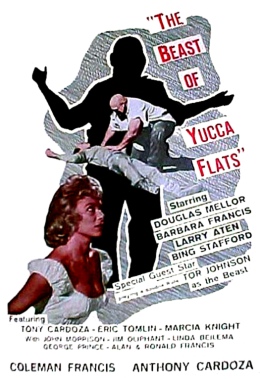
BeastyuccaflatsMy friend, the writer Tammy Dowden, claims that 1961’s The Beast of Yucca Flats is the worst movie ever made.

Well, technically, she may be right.  The Beast of Yucca Flats is a thoroughly inept film that makes next to no sense and has massive continuity errors.  It’s a film that also features the legendary Tor Johnson as a Russian scientist who gets mutated by radiation and becomes a monster, but not before taking off almost all of his clothes while walking through the desert.  For that matter, it’s also a film about a family that comes together though adversity — namely, being shot at by the police after the family patriarch is somehow mistaken for Tor Johnson.  And finally, it’s the story of how a dying monster can find comfort from a rabbit and that’s actually kind of a sweet message.

Here’s the thing — yes, The Beast of Yucca Flats is bad but you still owe it to yourself to watch it because you will literally never see anything else like it.  Plus, maybe you’ll be able to figure out what the whole point of the opening scene is.

Because I’ve watched this film a few times and I still have no idea!

Enjoy!

Horror On TV: Twilight Zone 1.34 “The After Hours”


TheTwilightZoneLogo

In this episode of The Twilight Zone, Marsha White (played by Anne Francis) discovers some strange things happening in a department store. If you’re like me and you find mannequins to be super creepy, this episode is for you!

This episode originally aired on June 10th, 1960.

The Daily Horror Grindhouse: Mama Dracula (dir by Boris Szulzinger)


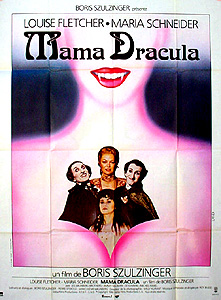
mamadraculaThis 1980 Belgian film is quite possibly the worst film that I’ve ever seen.

That’s something that I have to be careful about saying because there’s always a chance someone is going to say, “Oh my God!  If it’s really that bad, it must be a lot of fun to watch!  I have to track this movie down!”

Well, it’s not that hard to track down Mama Dracula.  It’s been included in countless Mill Creek box sets.  It’s in the public domain so you can probably find it on YouTube.  But seriously, when I say this movie is bad, I don’t mean that it’s so bad that it’s good.  This is not an Ed Wood film.  It’s not even a Herschell Gordon Lewis.  Instead, it’s just a really bad and tedious movie.  How bad is it?  It’s so bad that I originally suspected that maybe Bret Ratner had something to do with it.  That’s how bad it is.

Anyway, I guess I should tell you what the film is about so that way, I can at least say that I’ve reviewed this damn thing.  Professor Van Bloed (Jimmy Schuman) gets an invitation to attend a special conference on blood research.  The conference is being held in a small village in Transylvania and it’s being hosted by Countess Dracula.  And yes, she actually does sign the invitation “Countess Dracula” and no, Professor Van Bloed finds nothing strange about it.

Anyway, it turns out that Countess Dracula is played by Oscar-winner Louise Fletcher.  And yes, she’s a vampire.  But also, she’s the infamous Countess Bathory, who remains young by bathing in the blood of virgins.  But if she’s a vampire, wouldn’t she remain young regardless?  (And, add to that, Louise Fletcher doesn’t look particularly young in this film so you have to wonder how old she was when she first started bathing in blood.)  Countess Dracula also has twin sons and they are vampires with fangs and all that.  Apparently, they don’t have to bathe in blood to stay young.

Anyway (and you end up saying anyway a lot when you watch a film like Mama Dracula), the Dracula Twins run a clothing store called Vamp and, whenever a virgin steps into the changing room, she is promptly kidnapped and whisked away to the castle.  But everyone in the village seems to know what the twins are doing so you have to wonder why they don’t just stop going into the store.

Anyway, it turns out that there’s not many virgins left in the world and the villagers are encouraging their daughters to get laid as soon as possible.  So, Countess Dracula is willing to set Prof. Van Bloed with a special laboratory so that he can … do something.

ANYWAY, after about an hour, the film realizes that it’s going to have to end at some point so Prof. Van Bloed ends up falling in love with Nancy Hawaii (Maria Schneider), who I guess is supposed to be a virgin, though the film never seems to be quite sure…

But … yeah, this was an amazingly bad film.  Bleh on you, 1980 filmmakers!

Bleh.  On.  You.

Horror Film Review: The Devonsville Terror (dir by Ulli Lommel)


DevonsvilleTerror

Who is the world’s worst director?

That’s a question that can really lead to lot of conflict.  First off, it’s a deceptively simple question.  The more you think about it, the more you realize how fragile concepts like good and bad truly are.  Some of the greatest films ever made were critical flops.  Some of the films that have been embraced by contemporary critics will definitely be less acclaimed by future viewers.  There’s a lot to take into consideration when it comes to determining whether or not a filmmaker is good, mediocre, or one of the worst of all time.  It’s something that requires a lot of careful thought and consideration and research.

Of course, if you don’t have time for all that, you can just say that the world’s worst director is Ulli Lommel and save yourself the trouble.

This German director has been making movies for longer than I’ve been alive.  He got his start in the early 70s, as an actor who frequently collaborated with the great German filmmaker Rainer Werner Fassbinder.  With Fassbinder as his producer, Lommel made a few surrealistic (and, it should be stated, critically acclaimed) films in Germany and then, in 1977, he moved to the U.S, and became friends with Andy Warhol.  He also married Suzanna Love, an actress who was the heiress to the Standard Oil Fortune and who starred in a handful of Lommel’s early films.

Today, Lommel’s reputation for being the world’s worst director is largely the result of an endless series of low-budget, straight-to-DVD films that he’s made about various real-life serial killers.  I’ve seen quite a few of these movies (and I reviewed Lommel’s Curse of the Zodiac three years ago) and they are truly bad.  Normally, I can find something to love about almost every movie that I watch but Lommel’s serial killer films are beyond terrible.  They’re so bad that they are almost impossible to review.  I mean, how many different ways can you find to say that a movie sucks so much that it will make you question whether Eadweard Muybride should ever have filmed Sallie Gardner at a Gallop in the first place?

But here’s the thing with Ulli Lommel and this what makes it especially so frustrating to see him currently doing a thousand variations on Curse of the Zodiac.  His first two horror films — both of which were filmed in the early 80s and starred Love — are not that bad.  Don’t misunderstand me.  They’re not particularly good but they still feature enough hints of genuine talent and inspiration that you have to wonder just what the Hell happened.

The first (and best known) of Lommel’s horror films was 1980’s The Boogeyman, an incredibly stupid film that still featured some good atmosphere and a few memorable deaths.  Lommel followed The Boogeyman with 1983’s The Devonsville Terror.

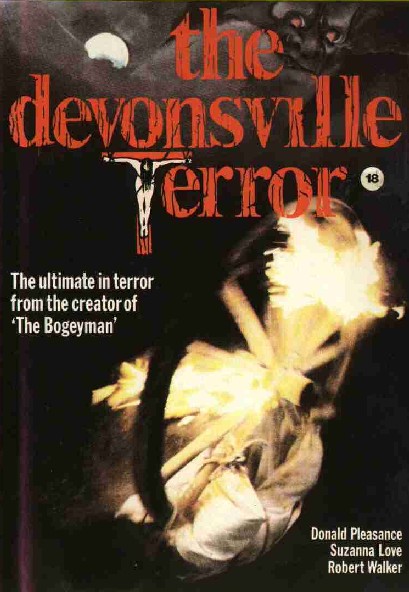
The Devonsville Terror may not have the same cult status as The Boogeyman but it’s actually a far more interesting film.  The film opens in the 17th Century.  In the Massachusetts town of Devonsville, three women are executed for being witches.  After the final witch is burned, her spirit appears in the sky and announces that the town is now cursed.

We then jump forward 300 years.  Dr. Warley is researching the Devonsville curse.  By researching, I mean that he continually invites citizens in Devonsville into his office and hypnotizes them, which leads to them having flashbacks to 1683 and those of us in the audience having to continually rewatch the first few minutes of the movie.  The spirit of the witch curses Dr. Warley and soon, he’s having to pull maggots out of his arm.  It doesn’t add up too much but Dr. Warley is played by Donald Pleasence so he’s at least entertaining.

Meanwhile, a new school teacher, Jenny (played by Suzanna Love), has moved into town and she’s teaching the kids to think for themselves and even goes as far as to suggest that God might be a woman!  The town leaders are shocked and more than a few of them start to suspect that she might be a reincarnated witch…

At the same time, a loser named Walter (Paull Wilson) has just murdered his wife and soon finds himself having nightmares where Jenny allows him to drown in a swamp.  “The legend’s true!” Walter shouts in his dream, “You are a witch!”

On top of that, two other liberated women have recently moved into town, which leads to a panic as the townfathers realize that their town — best known for executing three witches — is now home to three feminists!

Of course, it all leads to an attempt to duplicate the executions of 1683.  Heads explode.  Faces melt.  Don’t mess with the witches, y’all.  That’s all I’m saying.

The Devonsville Terror is a huge mess but, much like The Boogeyman, the film has a lot of atmosphere and features a good performance from Suzanna Love.  (As well, just as The Boogeyman features John Carradine not doing much of anything, Devonsville Terror features Donald Pleasence not doing much of anything.)  But the main thing I liked about The Devonsville Terror was its feminist subtext, which is not something you would typically expect to find in a horror film from the early 80s.

You have to ask yourself — how did the director of The Devonsville Terror ends up becoming the guy who directed Curse of the Zodiac and Mondo Americana?  One huge clue is probably found in the fact that Suzanna Love is nowhere to be found in any of Lommel’s later films.  According to the imdb, Lommel and Love divorced in 1987.

With Suzanna Love, Ulli Lommel was an occasionally interesting, if uneven, filmmaker.

Without her, he’s just the guy who directed Curse of the Zodiac.

Horror on the Lens: The Norliss Tapes (dir by Dan Curtis)


Today’s Horror on the Lens is The Norliss Tapes, a 1973 made-for-TV movie that was also a pilot for a television series that, unfortunately, was never put into productions.

Reporter David Norliss (Roy Thinnes) has disappeared.  His friend and publisher, Stanford Evans (Don Porter), listens to the tapes that Norliss recorded before vanishing.  Each tape details yet another paranormal investigation.  (Presumably, had the series been picked up, each tape would have been a different episode.)  The first tape tells how Norliss investigated the mysterious death of an artist who apparently returned from the grave.

For a made-for-TV movie, The Norliss Tapes is pretty good.  It’s full of atmosphere and features a genuinely menaching yellow-eyed zombie monster.

Enjoy!


Horror Trailer: Handjob Cabin


I don’t think anyone knew this horror film was even being made let alone being thought of being made. Well, it looks like someone thought it was a good idea and set about trying to do their own take on the “cabin in the woods” horror film.

Raimi did it with his first two Evil Dead films. Sean Cunningham took it to a campground level with the Friday the 13th series. Joss Whedon and Drew Goddard went all meta on it with the Cabin In the Woods.

Now, it’s Bennet Silverman’s turn on the seat with his interestingly titled Handjob Cabin.


The Daily Horror Grindhouse: The Devil Times Five (dir by Sean MacGregor and David Sheldon)


dt5

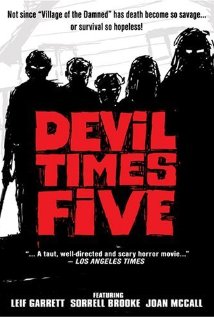
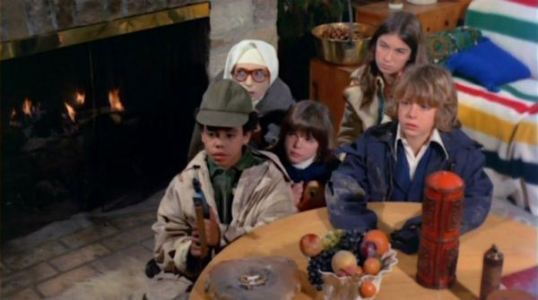
Initially released in 1974 and also known as Peopletoys, Tantrums, and The Horrible House on the Hill, Devil Times Five is one of a handful of films made about murderous children targeting and killing adults.  In the case of Devil Times Five, the children are five escapees from a mental hospital and the adults are a group of largely unlikable people who have gotten snowed in at a ski lodge.

(In a film like this, it helps that the victims are all too unlikable to really care about.)

When watching Devil Times Five, it helps to know a little something about what went on behind the scenes.  Apparently, original director Sean McGregor was fired when it turned out that, after several weeks of filming, he only had 38 minutes of usable footage.  Several weeks later, a second director, David Sheldon, was brought in to reshoot a good deal of the movie.  Unfortunately, by the time that Sheldon arrived, the majority of the cast had moved onto other projects and the main killer kid (Leif Garrett) had gotten his hair cut for another movie, meaning that he had to wear an ill-fitting wig for the reshoots.

And the end result is a truly weird movie, one that is full of odd continuity errors and strange scenes that were obviously only included to pad out the film’s running time.  Among the most obvious of the continuity errors is the insistence that the characters are snowed in despite the fact that there appears to be hardly any snow on the ground outside.  (This, of course, was largely due to the fact that the reshoots were done in sunny California.)  As for the padding, perhaps the most infamous example is the scene where the five children attack and beat to death their doctor.  This entire scene is shown in slow motion.  It lasts five minutes.

Seriously — and if you doubt me on this, be sure to read Stacie Ponder’s review of the film over on Final Girl — five minutes is a really long time.  It’s certainly a long time to watch someone get beat to death, especially when the scene is underlit and sepia-toned.  It starts out as disturbing but, after the 2nd minute or so, it just gets boring.  And then about 4 minutes in, you start to laugh because you’re just like, “How much longer can this crap go on?”  And then, at the 4:30 mark, you start to get bored again.  Around the 4:55 mark, I realized that I had forgotten who they were killing or why.  And then it was finally over.  Yay!

Incidentally, this is one of those films where, whenever one of the kids is going to kill someone, the kid suddenly starts moving in slow motion.  It was kind of like the music in Jaws.  If the kid picked up an axe but was still moving at normal speed, you knew not to worry.  But the minute that slow-mo started, you knew someone was about to die.

Of course, it takes a while to get around to the killings.  Devil Times Five clocked in at about 88 minutes.  I would guess that roughly 65 of those minutes were pure filler.  We spend a lot of time getting to know the adults at that ski lodge and, for the most part, they’re loathsome.  The oldest and grumpiest of them is even called Papa Doc, perhaps after the infamous Haitian dictator. (And let’s not even start on the film’s nominal hero, Rick, who has a pornstache, a comb over, and an extended nude scene.)  All of the adults spend a lot of time talking about their crumbling marriages and their dying dreams and it’s all very angsty for slasher film about a bunch of killer kids.  There’s even an extended cat fight between Julie (Joan McCall) and Lovely (Carolyn Staller), which involves a lot of rolling around on the floor while the 70s “wah wah” soundtrack plays in the background.

Once the killings do start, however, Devil Times Five actually starts to live up to its potential.  These are some mean little kids!  Once they start their rampage, we get axes in the back, spears to the throat, immolation, death by swing, and one really disturbing scene involving a bunch of bear traps. However, Devil Times Five is probably best known for the piranha scene.  You can legitimately wonder why someone would keep piranhas at a ski lodge but there’s still no denying that you don’t want to take a bath with them.

(Making the piranha scene all the more icky that the victim in the bathtub is played by the mother of two of the actors who played the killers.)

Devil Times Five makes for a strange viewing experience.  It starts out as nothing but filler and then suddenly, almost out of nowhere, the entire film goes batshit crazy.  Devil Times Five has slipped into the public domain, so you can watch it for free on YouTube if you want.  But I suggest tracking down the Code Red DVD, which comes with a fascinating commentary track and an entertaining and candid interview with several members of the cast.

DevilTimesFive3

Horror Film Review: Delirium (dir by Lamberto Bava)


Delirium1987

“I warn you, the hate of a woman can be very bad!” 

— Dialogue from Delirium (1987

The 1987 Italian film Delirium is an odd combination of soapy melodrama and giallo horror.  Someone is murdering models and taking pictures of their corpses.  Some other people are plotting to take over a magazine.  Obscene phone calls are received.  Recorded taunts are heard.  Oh, and one unlucky model is attacked by a swarm of bees.

That’s right — Delirium is the first and probably the only giallo to feature bees used as a deadly weapon.

Gioia (Serena Grande) is a former prostitute-turned-model-turned-men’s-magazine-publisher.  When we first meet Gioia, she’s sitting out at her pool and watching a photo shoot.  Her neighbor — a teenage boy who is confined to a wheel chair — calls her.

“You make my member hard with desire!” he tells her, “It wants to penetrate your flower and explode!”

Gioia calmly tells him to stop bothering her and then hangs up on him.  And really, this scene pretty much establishes everything that we need to know about Gioia.  She is a successful businesswoman who is just as comfortable dealing with the pervert next door as she is making high power deals.  You think Donald Trump’s ruthless?  Well, he’s got nothing on Gioia!

The other thing that you notice about Gioia is that she has an extremely voluptuous figure.  There’s not a single scene that isn’t shot to emphasize that fact and yet, the unapologetic pride that Gioia (and actress Serena Grande) took in her body was actually very empowering and one of the better aspects of the film.  Far too often, movies associate being busty with either being stupid or slutty and women are told that they have to hide their figure to be taken seriously.  (Traditionally, in horror films, it seems like the bigger an actress’s cup size, the less likely she is to survive until the end of the film.)  Speaking as someone who shares Gioia’s struggle, I was happy to see a woman with big boobs being portrayed as both an intelligent businesswoman and a tough, strong survivor.

Gioia has more than just the pervert next door to deal with.  There’s also the fact that her models are being murdered and she’s receiving photos of their dead bodies in the mail.  Who is killing Gioia’s employees?  Could it be a rival publisher (played by Capucine)?  Could it be Gioia’s neurotic assistant (played by Daria Nicolodi)?  Could it be George Eastman, who plays Gioia’s former lover?  Actually, it’s made pretty clear that it’s not George Eastman, which is odd when you consider how many movies have featured Eastman as a killer.  (Eastman and Grandi also co-starred in the infamous cannibal epic Anthropophagus, in which Eastman was the killer and Grandi was the center of one of the most infamous scenes in the history of Italian horror.)  Or could the killer by the pervert next door?

As is typical of films in the giallo genre, most of the murders are filmed from the killer’s point of view.  What’s interesting is that, when the killer looks at his victims, he literally sees them as twisted monsters.  It’s a neat little technique that leads to scenes like this:

Delirium-1

Delirium was directed by Lamberto Bava, who has never quite gotten the attention that he deserves.  Despite the fact that he directed such classics as the two Demons films and A Blade In the Dark, I’ve always felt that Lamberto is often overshadowed by the achievements of his father, Mario Bava.  However, Lamberto Bava’s films are almost always entertaining when taken on their own terms.  Delirium may not reach the heights of A Blade In The Dark or even Demons but it’s still an entertaining giallo.  It’s perhaps not the film to use to introduce a newcomer to the genre but, those of us who are familiar with giallo, Delirium is an enjoyably crazed offering.

fotodigioia7

Lisa Reviews on Oscar Nominated Horror Film: The Sixth Sense (dir by M. Night Shyamalan)


The_sixth_sense

Before I talk about the 1999 best picture nominee, The Sixth Sense, I have to ask — is it really necessary to give a spoiler warning?  I mean, everyone knows that this film has a big twist at the end and everyone’s aware of what that twist is, right?  I’m going to assume that’s the case because, quite frankly, it’s kind of pointless to talk about this film without talking about the twist.  I mean, the Sixth Sense has been around for 16 years and it’s still a film that people seem to frequently talk about.  (For instance, “Why aren’t any of M. Night Shyamalan’s other films as good as The Sixth Sense?”)  If you’re over the age of 20, you really have no excuse for not knowing the twist ending of The Sixth Sense.

But, fair is fair — THIS REVIEW CONTAINS SPOILERS!  

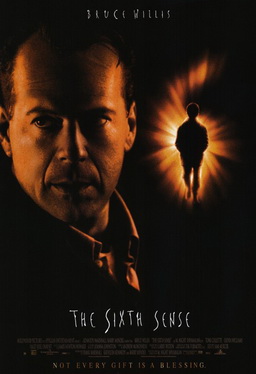
Anyway!  The Sixth Sense is the story of a 9 year-old named Cole Sear (Haley Joel Osment).  Cole lives in Philadelphia with his harried but devoted mother, Lynn (Toni Collette).  Cole is a withdrawn child, haunted by the fact that he’s constantly seeing and hearing people that nobody else can hear.  As Cole explains it to his psychologist, Dr. Malcolm Crowe (Bruce Willis), “I see dead people.”

(And you know what?  That line has been quoted and parodied a thousand times since The Sixth Sense was released but that’s because it’s a great movie moment.  Haley Joel Osment was a great child actor and did deserve the Oscar nomination that he received for his performance in this film.)

Malcolm has some issues of his own.  The previous year, one of his former patients (Donnie Wahlberg) broke into his house and shot him, while Malcolm’s terrified wife (Olivia Williams) watched.  Malcolm feels that he was shot because he failed that patient and that he can achieve some sort of redemption by helping Cole.  Of course, as Malcolm devotes more and more time to Cole, he finds it harder and harder to speak to his wife.  In one scene, Malcolm sits down across from her and tells her all about Cole.  She responds by ignoring him and then standing up and walking out of the room.

And when she does that, your natural response is to go, “What a bitch!” and feel sorry for Malcolm.  Except, of course, Cole really does see dead people.  And, as we discover in the film’s twist ending, Malcolm is one of them.  If his wife seemed distant, it was because she didn’t know he was there.  If she seemed emotionally withdrawn, it was because she was deeply mourning him.  Everyone — including Cole — knew that Malcolm was dead.  Everyone but Malcolm.

And you know what?  Film bloggers like me spend a lot of time making snarky comments about M. Night Shyamalan and his twist endings but the ending of The Sixth Sense works beautifully.  It worked when I first saw it and it has worked every time that I’ve seen it since.  Even knowing that Malcolm is dead, it’s still incredibly poignant to watch him realize it.

And that’s why I’d love to have a time machine.  I would love to be able to hop into my time machine and go back to 1999 and see what it was like for the very first audience that watched this film.  How did they react when they discovered — for the very first time — that Bruce Willis was a ghost?  I’d love to find out.

But, even without that time machine, The Sixth Sense holds up surprisingly well.  Haley Joel Osment and Bruce Willis tend to get so much attention for their excellent performances that I’m instead going to praise Toni Collette, who does great work as Cole’s loving but overwhelmed mother.  She didn’t get a great catch phrase nor was she a part of a huge twist but the heart of the film is to be found in her performance.

The Sixth Sense was nominated for best picture of 1999.  It lost to one of the worst films to ever win an Oscar, American Beauty.