Horror Scenes That I Love: Carrie Destroys The Prom


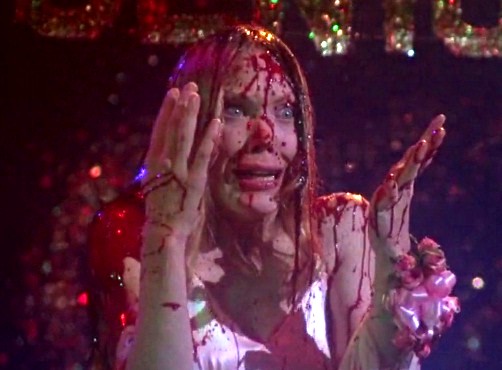
Today’s horror scene that I love comes from 1976’s Carrie.

This scene starts out on a note of happiness with Carrie (Sissy Spacek) and Tommy (William Katt) being named as Queen and King of the Prom.  Things, however, get a bit ominous when Sue (Amy Irving) notices that bucket of pig’s blood and Nancy Allen and John Travolta hanging out underneath the stage.  Things get even worse when the coach (Betty Buckley) refuses to listen to Sue and tosses her out of the gym.

And then suddenly, there’s blood everywhere and Piper Laurie’s chanting, “They’re all going to laugh at you …. they’re all going to laugh at you….”

Is everyone really laughing at Carrie?  I believe some of them are.  Norma is definitely laughing because I think the shot of the coach laughing is included to let us know that some of the laughter is strictly in Carrie’s mind.  Nothing about the character would lead us to suspect that the coach would laugh.  In fact, seeing as how the coach just threw out Sue, it’s debatable whether she would even be back among the crowd by the time the pig’s blood came down.

(Plus, would everyone be laughing even with Tommy, the most popular kid in school, lying dead on the stage?)

Anyway, regardless of whether they were all laughing or not, we all know what happens next!

Book Review: ‘Salem’s Lot by Stephen King


The town of Jerusalem’s Lot, Maine has two new arrivals.

One is Ben Mears, a successful writer who, we’re told, even has his own FBI file.  (Apparently, it only consists of a report that he once attended an anti-war rally.)  Ben spent part of his childhood is Jerusalem’s Lot and, upon returning, he discovers a small but friendly town.  Sure, there’s some drama going on behind closed doors.  There’s the sleazy real estate agent, for instance.  And then there’s the Catholic priest who, naturally, has lost his faith.  And then there’s the unhappy teenage mother and, of course, there’s the usual collection of alcoholics, adulterers, and cranky bus drivers.  Maybe Jerusalem’s Lot isn’t that friendly after all….

The other new arrival is Kurt Barlow.  Barlow’s from Austria and he’s moved into the old Marsten House.  (The Marsten House, like most old houses that you come across in Stephen King novels, used to belong to a notorious gangster.)  Barlow’s going to be opening up an antique store.  Interestingly enough, hardly anyone ever seems to see Barlow.  His business partner, Richard Straker, claims that Barlow is often away on buying trips.

Anyway, the townspeople have a lot more to worry about than what’s going on with Kurt Barlow.  For instance, a lot of people are disappearing.  And even those who aren’t vanishing are growing ill and having a bad reaction to sunlight.  Hmmm …. what could possibly be going on?

First published in 1975, ‘Salem’s Lot was Stephen King’s second published novel and it actually holds up better than most of his recent work.  It’s interesting to read ‘Salem’s Lot after Carrie, just to see how much King grew as a writer in between the two books.  Whereas King often seemed uncomfortable with the plot of his first novel and tended to hold Carrie White at a distance, he dives right into ‘Salem’s Lot.  It’s not just that King is obviously more comfortable writing about a male writer than a teenage girl.  It’s also that King creates a town that seems so real that we feel as if we could find it on a map.  King tells his story with such enthusiasm and confidence that it doesn’t matter that ‘Salem’s Lot is a fairly predictable and traditional vampire story.

Clocking in at a briskly paced 440 pages, ‘Salem’s Lot is quite a bit longer and more detailed than Carrie without, at the same time, getting bogged down in the type of stylistic self-indulgence that has come to typify a lot of King’s recent work.  (One gets the feeling that if King wrote ‘Salem’s Lot today, it would be a 1,200 page novel and that Barlow wouldn’t show up until page 900.)  King does a good job of offering up little snippets of life in Jerusalem’s Lot, just enough to make sure we have enough knowledge to mourn the eventual death of the town.  ‘Salem’s Lot takes Dracula, drops him in the middle of a small town melodrama, and the results are still entertaining to this very day.

Italian Horror Showcase: Aenigma (dir by Lucio Fulci)


If there’s anything be learned from 1988’s Aenigma …. well, actually, that might be giving the film too much credit.  There’s probably nothing to learn from Aenigma.  The film does start with a pretty cruel prank and that prank leads to some snail-related mayhem but really, you should have already learned the truth about pranks after Carrie burned down the prom.

The prank involves the cruel girls at St. Mary’s boarding school tricking their classmate, Kathy (Milijana Zirojevic), into thinking that she’s on a date with a gym teacher (Riccardo Acerbi) and then jumping out of the shadows and surprising her when Kathy and the teacher start making out in his car.  This leads to a humiliated Kathy running out into the middle of traffic, where she’s promptly hit by a car and goes into a coma.  While everyone agrees that sucks for Kathy, at least it means that no one will ever know the truth about the prank.

Then people start dying.

They die in a variety of weird ways and since only the people involved with the prank are the ones being targeted, it doesn’t take much effort to guess that the comatose Kathy is probably involved.  It also doesn’t take much effort to guess that the newest student at the school, Eva (Lara Lamberti), has been possessed by Kathy and is mostly just hanging around to make sure that everyone’s dead.

What’s weird is that, in her coma, Kathy has so many different powers that you have to wonder why exactly she needed to possess Eva.  For instance, the gym teacher is strangled when his own reflection jumps out of a mirror.  One of the girls is killed when a statue in a museum suddenly comes to life and attacks her.  Yet another girl is somehow killed by snails.

Yes, you read that right.  She wakes up to discover that she’s covered in snails and this leads to her dying.  Aenigma is regularly criticized for the scene with snails.  “Why didn’t she just get out of bed and take a shower or something?” many a commentator has asked.  I guess they have a point but, honestly, if I woke up and there were a few hundred snails on me, I would totally freak out.

Apparently, the main reason that Eva’s there is so she can try to seduce Kathy’s handsome doctor (Jared Martin) but the doctor is more interested in Jenny Clark (Ulli Reinthaler), who was involved in the prank but who, unlike everyone else, felt really bad about it afterward.  I’m sure that would lead to any complications….

There’s kind of a sad story behind this rather forgettable if occasionally entertaining horror film.  After making horror history by directing films like Zombi 2 and The Beyond, director Lucio Fulci entered into a career decline.  Struggling with ill-health and having had a falling out with some of his former collaborators, Fulci found himself working with lower budgets and less interesting premises.  That’s certainly the case with Aenigma, which was shot in Sarajevo with a largely unknown cast and which blatantly ripped off the plots of Carrie and Patrick.

Aenigma has got a terrible reputation among fans of Italian horror.  Personally, I think it’s a very flawed film but I also think that it’s not quite as bad as some have made it out to be.  I mean, the snails are ludicrous but they’re also so weird that you can’t help but kind of love it when they show up.  For that matter, the coach being killed by his own reflection and the scene where the statue come to life are clever ideas, even if their execution leaves something to be desired.  Even in his later years, Fulci still had his talent.  Unfortunately, when it came to films like Aenigma, he rarely had the resources necessary to truly make his vision come to life.

4 Shots From 4 Mind Bending Films: Carrie, The Fury, Patrick Still Lives, Scanners


4 Shots From 4 Films is just what it says it is, 4 shots from 4 of our favorite films. As opposed to the reviews and recaps that we usually post, 4 Shots From 4 Films lets the visuals do the talking.

For today’s edition of 4 Shots From 4 Films, we celebrate films that demonstrate what the human mind can do when it’s angry and there’s stuff around that can explode.  These are….

4 Shots From 4 Mind Bending Films

Carrie (1976, dir by Brian DePalma)

The Fury (1979, dir by Brian DePalma)

Patrick Lives Again (1980, dir by Mario Landi)

Scanners (1981, dir by David Cronenberg)

Horror Film Review: Wishmaster (dir by Robert Kurtzman)


Remember the Wishmaster films?

There were four of them and they all deal with this ancient Djinn (Andrew Divoff) who, during each film, would escape from his magical prison and then wander around granting people their wishes.  Of course, since the Djinn was evil, there was always a catch.  He would either interpret the wish very literally or he would manipulate people into asking for the wish in the wrong way.  As a result, people would always get their wish but they’d get in a way that would make them suffer.

For instance, a typical Wishmaster conversation would go something like this:

“I wish I was a better actor.”

“Am I to understand that you wish you were John Wilkes Booth?”

“Wait …. what?”

“As you wish.”

Sic semper tyrannis!”

The first Wishmaster was released in 1997 while the fourth (and, to date, last) installment was released in 2002.  They’ve never gotten as much attention as some of the other horror franchises from that period, largely because there was really only so much that you could do with a character like the Djinn.  Part of the problem was that almost every scene depended on someone not understanding the importance of being clear when making a wish.  There’s only so many times that you can watch the Djinn trick people into saying, “I wish I never get old,” before the whole novelty of it all wears off.

That said, the Wishmaster films did have one thing going for them and that was Andrew Divoff.  A veteran character actor (and one who you might recognize from Lost, where he played a member of the Others who was both Russian and who had only one eye), Divoff was always creepy as fug in the role of the Djinn.  Whenever someone made the mistake of making a wish, this little smile would appear on Divoff’s face and you knew that someone was about to learn an important lesson about being careful what you wish for.  Divoff was seriously frightening of the Djinn, so much so that you regretted that the films themselves could never quite keep up with his performance.

Last night, I watched the first Wishmaster film for the first time in six years and it was actually a little bit better than I remembered.  The plot itself is typical Wishmaster stuff.  The Djinn is trapped inside of a gem that eventually makes it way to the United States.  An idiot lab worker attempts to experiment on it, which leads to the gem exploding, the Djinn getting free, and an epidemic of mass wish granting.  Nobody seems to have learned the lesson that the first thing you wish for is more wishes.

Wishmaster is stupid but fun.  The first film was produced by Wes Craven and perhaps that explains why the film is full of cameos from everyone who was anyone in low-budget 90s horror.  As a result, you’ve got Kane Hodder saying that he would “love it if” the djinn “tries to go right through him,” and Robert Englund playing a businessman and Tony Todd showing up as a doorman.  It’s nice to see them all, though ultimately the main reason to watch the film is for Andrew Divoff’s wonderfully smirky turn as the Djinn.  It’s hard not to wish that he had another horror franchise to dominate.

Be care what you wish for!

(Sorry, had to do it….)


Horror on the Lens: The Cabinet of Dr. Caligari (dir by Robert Wiene)


The Cabinet of Dr. Caligari is a film that I’ve shared four times previously on the Shattered Lens.  The first time was in 2011 and then I shared it again in 2014, 2015, 2016, and 2017!  Well, you know what?  I’m sharing it again because it’s a classic, it’s Halloween, and everyone should see it!  (And let’s face it — it’s entirely possible that some of the people reading this post right now didn’t even know this site existed in 2017.  Why should they be deprived of Caligari just because they only now arrived?)

Released in 1920, the German film The Cabinet of Dr. Caligari is one of those films that we’ve all heard about but far too few of us have actually seen.  Like most silent films, it requires some patience and a willingess to adapt to the narrative convictions of an earlier time.  However, for those of us who love horror cinema, The Cabinet of Dr. Caligari remains required viewing.  Not only did it introduce the concept of the twist ending (M. Night Shyamalan owes his career to this film) but it also helped to introduce German expressionism to the cinematic world.

My initial reaction to The Cabinet of Dr. Caligari was that it simply wasn’t that scary.  It was certainly interesting to watch and I was happy that I was finally experiencing this film that I had previously only read about.  However, the film itself was obviously primitive and it was difficult for my mind (which takes CGI for granted) to adjust to watching a silent film.  I didn’t regret watching the film but I’d be lying (much like a first-year film student) if I said that I truly appreciated it after my first viewing.

But you know what?  Despite my dismissive initial reaction, the film stayed with me.  Whereas most modern films fade from the memory about 30 minutes after the end credits,The Cabinet of Dr. Caligari has stuck with me and the night after I watched it, I even had a nightmare in which Dr. Caligari was trying to break into my apartment.  Yes, Dr. Caligari looked a little bit silly staring through my bedroom window but it still caused me to wake up with my heart about to explode out of my chest.

In short, The Cabinet of Dr. Caligari passes the most important test that a horror film can pass.  It sticks with you even after it’s over.

For the curious with an open mind to watch with, here is Robert Wiene’s The Cabinet of Dr. Caligari!

Enjoy!

Horror on TV: One Step Beyond 3.26 “Signal Received” (dir by John Newland)


Starting tomorrow, we’ll be showcasing a new show here on the Shattered Lens so, for tonight, here’s the last episode of One Step Beyond that we’ll be sharing during this year’s horrorthon.

(If you’ve enjoyed these episodes, all three seasons of One Step Beyond have been uploaded to YouTube.)

Tonight’s episode tells the story of three sailors who hear an unexpected message on the radio.  Two of the sailors hear that their ship will soon sink.  The third sailor hears that he will live a long and fulfilling life.

One Step Beyond always claimed that all of its stories were “based on fact.”  This episode actually goes the extra mile by interviewing one of the real-life sailors about the message and about whether or not he believes in the supernatural.

Enjoy!

The TSL’s Horror Grindhouse: Nocturne (dir by Stephen Shimek)


Have you ever noticed how movies about teenagers always treat the rules of the “Never Have I Ever” game like they’re some sort of legally binding contract?

Seriously, I’ve seen this happen in so many movies.  Someone has a deep, dark secret that they don’t want to reveal.  They know that if they reveal the secret, a lot of bad stuff will happen as a result.  Feelings will be hurt.  Friendships will be crushed.  Lives will be lost.

But then the minute somebody says, “Never have I ever fucked my best friend’s boyfriend,” they always drink up.  Half the time, they’re the only person to take a drink.  And, during all of the drama that unfolds, it never occurs to anyone to say, “Why didn’t you just not take the drink!?  It’s just a game, after all!”

Something like this happens in the 2016 film, Nocturne.  Nocturne takes place at perhaps the saddest high school graduation party of all time.  All of the cool kids have gone to another party, which means that only seven people show up at this party.  From that humble beginning, things quickly go downhill as the graduates hang out in the hot tub, play the Never Have I Ever game, and listen to Gabe (Jake Stormeon) ramble about religion and philosophy and stuff.  Gabe also demonstrates some card tricks so yeah …. that’s definitely the way to end your high school career.

Anyway, bad parties always seem to lead to people trying to contact the dead and that’s what happens here.  Gabe sets up a makeshift séance and the graduates ask the dead a lot of questions that they probably shouldn’t have asked.  (Seriously, I’ve been to a few bad parties in my lifetime and you an always tell that the party is officially dead once people actually try to talk to the …. well, dead.)

Needless to say, this leads to someone getting possessed and just about everyone else dying.  The other party was probably a lot more fun.

So, on the plus side, Nocturne is fairly well-acted and some of the death scenes were clever.  The film’s chronology is a bit jumbled, which is one of those storytelling tricks that can be really annoying but which is justified here by the fact that demon exists beyond our conventional understanding of time and space.

On the negative side, a cat dies about halfway through the film and, as I discussed years ago in my review of Drag Me To Hell, it’s hard for me to endorse any film in which a cat is killed.  I mean, honestly, I would think most supernatural beings would appreciate the fact that a cat can sleep through just about anything.  Whereas a dog would be barking and throwing a fit over all the murders being committed, a cat would probably just relax in a corner and play with a toy mouse or something.  In this film, there was really no reason to kill the cat and it felt a bit gratuitous.  It was hard not to tell that the only reason the cat was put in the film was so it could be killed.  My point is, if you want to me to like your movie, don’t kill the cat.

Anyway, Nocturne is a rather uneven film.  If you can see past the dead cat, you might find this one interesting.  It has its creepy moments, even if it’s hard not to feel that the overall movie doesn’t really work.
Captain Kirk vs. Sheriff Taylor: Pray For The Wildcats (1974, directed by Robert Michael Lewis)


The year is 1974 and there’s nothing more dangerous than being a hippie in Baja California.  That’s because psychotic business Sam Farragutt (played by Andy Griffith!) is on the loose.  Sam likes to describe himself as being a hippie himself.  “A hippie with money,” Sam puts it as he waves a hundred dollar bill in the face of a hippie without money,

Actually, there is one thing more dangerous than being a hippie in Baja California and that’s being an ad executive.  Once again, Sam Farragutt is to blame.  He’s willing to give his business to three ad execs but first they have to agree to go down to Baja and ride around with him on their motorcycles.  The three ad execs are Terry Maxon (former child evangelist Marjoe Gortner!), Paul McIllvain (former Brady Bunch star Robert Reed!), and suicidal burn-out Warren Summerfield (William Shatner!).  Warren is having an affair with Paul’s wife (Angie Dickinson!) but he’s still planning on committing suicide in Mexico.

However, going to Mexico gives Warren a new lease on life.  After Warren discovers that Farragutt is responsible for the death of two hippies, he becomes determined to make sure that justice is served.  Soon, Andy Griffith (!) is chasing William Shatner (!) across the Mexican desert.  Someone’s going to die.  Is it going to be Sheriff Taylor or Captain Kirk?

Pray For The Wildcats was a made-for-TV movie that aired the same year as Savages.  Both movies were a part of Andy Griffith’s attempt to change his image after playing the folksy Sheriff Taylor on The Andy Griffith Show.  Griffith is a good villain but the main appeal of Pray for the Wildcats is the chance to see William Shatner doing his thing.  Shatner has a juicy role here, playing a man who is at first suicidal and then righteously indignant.  He overemotes with the self-serious intensity that was Shatner’s trademark in the years before he finally developed a sense of humor about himself.  The movie itself gets bogged down with unnecessary flashbacks and dated dialogue but the spectacle of Griffith vs. Shatner makes it all worth it.

Book Review: Baal by Robert R. McCammon


Baal begins with an act of violence.

In the late 60s, a woman is raped in an alley by a stranger whose touch burns her skin.  Nine months later, Jeffrey Harper Raines is born.  The woman’s husband fears the baby and tries to drown him, just to be stopped and murdered by Jeffrey’s mother.

Jeffrey is sent to a Catholic orphanage, where he proves himself to be an intelligent and troubled child, the type who can not only mentally control all of the other children but also inspire them to go on a rebellious and destructive rampage.

Years later, a mysterious cult leader named Baal has emerged, first in California and then eventually in Kuwait.  His followers come from all walks of life and they include some of the wealthiest men on the planet.  A researcher tries to gain access to Baal’s cult and promptly disappears.  The researcher’s mentor, an elderly theologian named Dr. Virga, goes to Kuwait in search of his protegé.

What he discovers is that Baal is not only extremely dangerous but that his followers are willing to do anything that he orders them to do.  Fortunately, Virga does find one ally out in the desert — a mysterious man named Michael….

(I guess it was Gabriel’s week off.)

Baal was first published way back in 1978 and reading it, it’s obvious that the novel was heavily influenced by films like The Omen and Rosemary’s Baby.  In fact, it’s so derivative of those films that it’s impossible not to get kinda annoyed at not only how predictable the story is but also at the fact that it takes the people in the book so much longer to figure out what the reader realizes immediately.  You really do have to wonder if a cult leader couldn’t have perhaps come up with a name other than Baal.  I mean, that’s kind of like naming yourself Lou C. Ifer or something like that.  You’re just giving the game away.

Today, Baal is best known for being the debut novel of Robert R. McCammon.  McCammon was only 25 years old when he wrote and published Baal and most of the book’s problems — the lack of focus, the occasionally clumsy plot twists– are problems that many debut novels seem to have in common.  For quite some time, McCammon refused to allow Baal to be republished, saying that he felt it was inferior to his later historical and crime novels.  For the record, McCammon’s correct about that but Baal still has enough trashy and sordid moments to be occasionally entertaining.  I guess my point here is that Baal isn’t great and, at times, it’s barely good but it’s still better than Bob Honey Who Just Do Stuff.