Horror Film Review: I Married A Monster From Outer Space (dir by Gene Fowler, Jr)


The 1958 film I Married A Monster From Outer Space tells the story of Marge (Gloria Talbott) and Bill Farrell (Tom Tryon).

Just one year ago, they seemed like the perfect couple.  They were newlyweds, looking forward to starting a family and living in a nice house in the suburbs.  Bill seemed like the perfect guy, warm, friendly, humorous, and loving.

However, things have changed.  On their one-year anniversary, Bill is cold and distant.  He certainly seems to have little interest in romance or anything like that.  When Marge gives Bill a new dog as his anniversary present, he doesn’t seem to be sure how to react to it.  When the dog later ends up dead, Bill gives her an implausible excuse.

Bill has changed but he’s not the only one.  Marge notices that all of her friend’s husbands are acting strange as well.  It’s as if something has magically turned every man into the neighborhood into a stiff, humorless jerk.

(Either that or it’s the 50s!)

One night, Marge decides to follow Bill into the forest and she sees something that challenges everything that she previously thought she knew about her husband.  What does she discover?  Well, it’s right there in the title.  Marge has married a monster from outer space!

I imagine that most people’s natural instinct with a film like this is to make fun of the title and just go on from there but actually, I Married A Monster From Outer Space is an intelligent and well-done sci-fi film.  Gloria Talbott does a great job in the lead role and Tom Tryon’s rather stiff screen presence is perfectly suited for the role of Alien-Bill.  Gene Fowler, Jr. directs the film as if it were a film noir where the usual gangsters and bank robbers have been replaced by humanoid aliens who don’t like dogs.

Since this movie is from 1958, there’s all sorts of subtext creeping around.  The most obvious, of course, is that America is being invaded from within.  You don’t think your husband could be an alien?  Well, Alger Hiss’s mother probably didn’t think her son was a communist spy!  You think it’s a silly idea that normal seeming humans would be working to conquer the world?  Have you not heard of Julius and Ethel Rosenberg?  When Bill and the other men turn cold and impersonal, it’s easy to see that they’ve embraced an ideology opposed to individual freedom and we all know what that means.

However, for me, this film works because it strikes at a very primal fear.  How well do you really know the people who you love?  Is he always going to be as perfect as he seems when you first start going out or is he going to totally change once he’s sure that you’re not going to leave him?  Like many women who have tried to escape from abusive boyfriends and spouses, Marge discovers that no one believes her.  She lives in a world controlled by men and all of the men have been taken over by the same thing that’s taken over Bill.  Even if you’ve never married a monster from outer space, you know what Marge is going through.

So, don’t dismiss this film because of the melodramatic title.  I Married A Monster From Outer Space is an intelligent sci-fi horror film, one that’s still relevant today.

Feeling the Burn: Death Spa (1989, directed by Michael Fischa)


Michael (William Bumiller) owns the hottest health club in Los Angeles but that may not stay true if he can’t do something about all the guests dying.  Members get baked alive in the sauna.  Another is killed when a malfunctioning workout machine pulls back his arms and causes a rib to burst out of one side of his body.  Shower tiles fly off the wall and panic a bunch of naked women.  A woman loses her arm in a blender and a man is somehow killed by a frozen fish.  Strangely, all of the deaths don’t seem to hurt business as people still keep coming to the gym.  Surely, there are other, safer health clubs in Los Angeles.
Michael suspects that his brother-in-law, David (Merritt Butrick), might be to blame for all of the trouble.  David is good with computers and since this movie is from 1989, that means that he can do anything.  (David is described as being a “hacker,” which may be the first time that overused term was used in a film.)  Michael feels that David has never forgiven him for the suicide of his sister.  Two useless cops show up to investigate the murders while the spa gets ready for Mardi Gras night.

This incredibly cheesy horror movie used to be a mainstay on HBO, where young viewers like me appreciated all of the gore and slightly older viewers appreciated all of the nudity.  Viewed today, Death Spa is a real nostalgia trip.  From the leg warmers to the bulky computers to the choreographed workout routines, this is a movie that could only have been made in the 80s.  The plot is beyond stupid but some of the gore effects were well-executed and that scene where the frozen fish comes to life continues to amaze.  Sadly, this was Merritt Butrick’s last film.  The actor, who was best known for playing Captain’s Kirk’s son in The Wrath of Khan and The Search for Spock, died the same year that Death Spa was released.

Horror Scenes That I Love: The Devil Is Everywhere In Haxan


Today’s scene that I love comes from the 1922 silent film, Haxan!

Haxan is a documentary, one that recreates the history of witchcraft throughout the ages.  In this scene, the film examines the belief that the devil is everywhere.  Apparently, the Devil has a lot of free time on his hands.

Directed by Benjamin Christensen, Haxan was a Swedish film that was released in its native country in 1922 but which took 7 years to make it over the United States.  Though contemporary audiences were a bit confused by it, it was popular with the surrealists and it quickly became one of the first true cult movies.  It was even re-released in 1967 with a narration provided by Beat writer William S. Burroughs.

Haxan, like many silent films, exists in many different forms.  Needless to say, the censors were not kind when this film originally made its way over to the United States.  It wasn’t until 2001 that Haxan was fully restored and released as a part of the Criterion Collection.

4 Shots From 4 Silent Horror Films: The Golem, Haxan, The Student of Prague, The Fall of the House of Usher


4 Shots From 4 Films is just what it says it is, 4 shots from 4 of our favorite films. As opposed to the reviews and recaps that we usually post, 4 Shots From 4 Films lets the visuals do the talking.

Horror is one of the oldest genres around and just to prove it, here are….

4 Shots From 4 Silent Horror Films

The Golem (1920, dir by Paul Wegener)

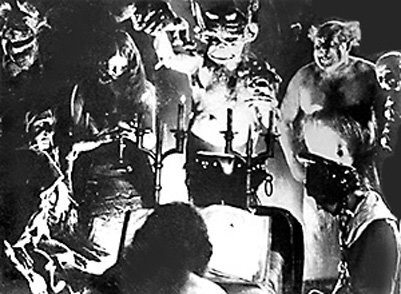
Haxan (1922, dir by Benjamin Christensen)

The Student of Prague (1926, dir by Henrik Galeen)

The Fall of the House of Usher (1928, dir by Jean Epstein)

Horror on the Lens: Nosferatu (dir by F.W. Murnau)


Today’s Horror on the Lens is a classic film that really needs no introduction!  Released in 1922, the German silent film Nosferatu remains one of the greatest vampire films ever made.  It’s a film that we share every October and I’m happy to do so again this year!

Enjoy!

Horror on TV: Kolchak: The Night Stalker 1.1 “The Ripper” (dir by Alan Baron)


For tonight’s excursion into the horrific side of television, we have the very first episode of Kolchak: The Night Stalker!

The Kolchak of the title was a reporter named Carl Kolchak (played by Darren McGavin).  Kolchak was kind of a nervous fellow because every story that he reported on seemed to involve some sort of terrible supernatural creature!  Seriously, that would make anyone anxious.

In his first episode, Kolchak investigates a series of murders and comes to suspect that Jack the Ripper might be haunting the streets of 1970s Chicago.

This episode originally aired on September 13th, 1974.

Enjoy!

The TSL’s Horror Grindhouse: Eyes of a Stranger (dir by Ken Wiederhorn)


In this 1981 slasher film, bad things are happening in the city of Miami.

There’s a serial killer on the loose.  He’s chopping off heads and leaving bodies on the beach and basically just making a huge mess of things.  Local new anchorwoman Jane (Lauren Tewes) is upset that there’s a killer roaming the streets of her hometown.  She even talks about how upset she is during a local newscast, which takes everyone at the station by surprise.  I don’t know why they’re so shocked.  Don’t they know that Jane has a younger sister named Tracy (Jennifer Jason Leigh) and that Tracy’s been blind, deaf, and mute ever since she was attacked by a maniac?

One day, Jane is returning to the apartment that she shares with her sister.  As she’s parking her car, she sees her neighbor, Stanley (John DiSanti), stuffing what appears to be a bloody shirt in a trash can.  Oh my God, could he be the murderer!?

Well, yes, he is.  The film actually makes no attempt to hide the fact that Stanley is the murderer.  Stanley is one of those movie murderers who is either hyper competent or totally oblivious, depending on what the scene demands.  For instance, despite being a rather heavyset, middle-aged man, he can still sneak up behind people without them ever hearing and chop off their head with one wave of a meat cleaver.  On the other hand, when he kills a couple on the beach, his car ends up getting stuck in the sand.

Anyway, Jane is pretty much instantly convinced that Stanley is the killer and she immediately starts doing stuff like taunting him over the telephone.  (Despite the fact that she’s on TV every night and her voice is apparently heard by everyone in Miami, she makes no effort to disguise her voice whenever she calls Stanley.)  She also breaks into his apartment to look for clues.

As I watched this film, I found myself thinking about how much more interesting it would have been if Stanley hadn’t been the killer and if Jane felt so guilty about what happened to her sister that she ended up harassing a totally innocent bystander.  But no, Stanley is the murderer so naturally all of this leads to an extended sequence where Stanley breaks into and then follows Tracy around Jane’s apartment.

So, Eyes of a Stranger is a fairly mediocre film, one that would probably be totally forgotten if not for the fact that it’s also the debut film of Jennifer Jason Leigh.  While the film is obviously meant to showcase Lauren Tewes (a TV actress who gives a rather wooden performance), Jennifer Jason Leigh steals every scene in which she appears.  Her total commitment to her character shines through and she even manages to sell a rather implausible plot twist that occurs towards the end of the film.  John DiSanti also deserves some credit for his performance as Stanley.  Again, it’s hard not to feel that the film would have worked better if it had tried to keep us guessing as to the question of Stanley’s guilt.

Eyes of a Stranger was directed by Ken Wiederhorn, who also did the far superior zombie movie, Shock Waves.  It’s interesting to note that both Lauren Tewes and Jennifer Jason Leigh would subsequently appear in Twin Peaks: The Return, though Leigh’s role was significantly larger.


Griffith Gets Serious: Winter Kill (1974, directed by Jud Taylor)


Eagle Lake, a mountain resort town in California, has a problem.  It’s almost tourist season and there is a sniper stalking through the night, using his rifle to pick off citizens and painting messages like “The First” and “The Second” in the snow.  It’s up to police chief Sam McNeill (Andy Griffith) to figure out the killer’s motives and capture him before the vacation season begins!  To catch the killer, McNeill is going to have to investigate his friends and neighbors, all of whom have secrets that they don’t want to have revealed.
1974 was a busy year for Andy Griffith.  Best-known for playing the folksy and reassuring Sheriff Taylor for over ten years on The Andy Griffith Show, Griffith tried to change his image by appearing in three unexpectedly dark made-to-TV movies.  In Pray For The Wildcats and Savages, Griffith played the villain.  In Winter Kill, he’s back in a more familiar role.  He is once again playing a lawman, though this one carries a gun and doesn’t have time to sit on his porch and play the guitar while Aunt Bea makes dinner.  Instead, he’s getting pressure from all sides to capture a psycho sniper who, at the start of the movie, shoots an old woman after throwing pebbles at her bedroom window.  Eventually, the sniper even ends up kidnapping Chief McNeill’s girlfriend!  This never happened in Mayberry!

Winter Kill is a pretty good mystery.  It’s not strictly a horror film but the sight of the masked sniper, making his way through the night and coldy gunning down unsuspecting victims is scary enough that it might as well be.  Andy Griffith was surprisingly tough and gritty as Chief McNeill.  He might be a good guy in this movie but you still know better than to mess with him.  The rest of the cast is made up of television regulars but keep an eye out for a youngish Nick Notle playing a cocky ski instructor.

Winter Kill was actually meant to be a backdoor pilot for a show where Chief McNeill would battle crime on a weekly basis.  Though that didn’t happen, the concept was later retooled and became a short-lived series called Adams of Eagle Lake.

Horror Scenes That I Love: Carrie Destroys The Prom


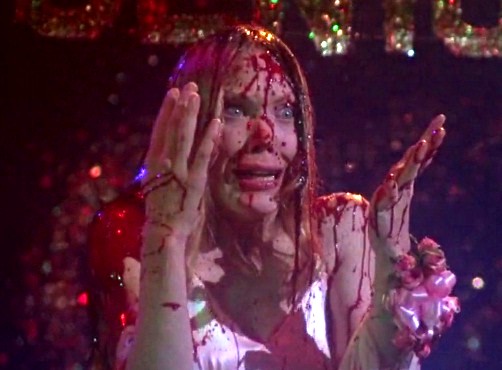
Today’s horror scene that I love comes from 1976’s Carrie.

This scene starts out on a note of happiness with Carrie (Sissy Spacek) and Tommy (William Katt) being named as Queen and King of the Prom.  Things, however, get a bit ominous when Sue (Amy Irving) notices that bucket of pig’s blood and Nancy Allen and John Travolta hanging out underneath the stage.  Things get even worse when the coach (Betty Buckley) refuses to listen to Sue and tosses her out of the gym.

And then suddenly, there’s blood everywhere and Piper Laurie’s chanting, “They’re all going to laugh at you …. they’re all going to laugh at you….”

Is everyone really laughing at Carrie?  I believe some of them are.  Norma is definitely laughing because I think the shot of the coach laughing is included to let us know that some of the laughter is strictly in Carrie’s mind.  Nothing about the character would lead us to suspect that the coach would laugh.  In fact, seeing as how the coach just threw out Sue, it’s debatable whether she would even be back among the crowd by the time the pig’s blood came down.

(Plus, would everyone be laughing even with Tommy, the most popular kid in school, lying dead on the stage?)

Anyway, regardless of whether they were all laughing or not, we all know what happens next!

Book Review: ‘Salem’s Lot by Stephen King


The town of Jerusalem’s Lot, Maine has two new arrivals.

One is Ben Mears, a successful writer who, we’re told, even has his own FBI file.  (Apparently, it only consists of a report that he once attended an anti-war rally.)  Ben spent part of his childhood is Jerusalem’s Lot and, upon returning, he discovers a small but friendly town.  Sure, there’s some drama going on behind closed doors.  There’s the sleazy real estate agent, for instance.  And then there’s the Catholic priest who, naturally, has lost his faith.  And then there’s the unhappy teenage mother and, of course, there’s the usual collection of alcoholics, adulterers, and cranky bus drivers.  Maybe Jerusalem’s Lot isn’t that friendly after all….

The other new arrival is Kurt Barlow.  Barlow’s from Austria and he’s moved into the old Marsten House.  (The Marsten House, like most old houses that you come across in Stephen King novels, used to belong to a notorious gangster.)  Barlow’s going to be opening up an antique store.  Interestingly enough, hardly anyone ever seems to see Barlow.  His business partner, Richard Straker, claims that Barlow is often away on buying trips.

Anyway, the townspeople have a lot more to worry about than what’s going on with Kurt Barlow.  For instance, a lot of people are disappearing.  And even those who aren’t vanishing are growing ill and having a bad reaction to sunlight.  Hmmm …. what could possibly be going on?

First published in 1975, ‘Salem’s Lot was Stephen King’s second published novel and it actually holds up better than most of his recent work.  It’s interesting to read ‘Salem’s Lot after Carrie, just to see how much King grew as a writer in between the two books.  Whereas King often seemed uncomfortable with the plot of his first novel and tended to hold Carrie White at a distance, he dives right into ‘Salem’s Lot.  It’s not just that King is obviously more comfortable writing about a male writer than a teenage girl.  It’s also that King creates a town that seems so real that we feel as if we could find it on a map.  King tells his story with such enthusiasm and confidence that it doesn’t matter that ‘Salem’s Lot is a fairly predictable and traditional vampire story.

Clocking in at a briskly paced 440 pages, ‘Salem’s Lot is quite a bit longer and more detailed than Carrie without, at the same time, getting bogged down in the type of stylistic self-indulgence that has come to typify a lot of King’s recent work.  (One gets the feeling that if King wrote ‘Salem’s Lot today, it would be a 1,200 page novel and that Barlow wouldn’t show up until page 900.)  King does a good job of offering up little snippets of life in Jerusalem’s Lot, just enough to make sure we have enough knowledge to mourn the eventual death of the town.  ‘Salem’s Lot takes Dracula, drops him in the middle of a small town melodrama, and the results are still entertaining to this very day.