Retro Television Review: The American Short Story #17: The Greatest Man In The World


Welcome to Retro Television Reviews, a feature where we review some of our favorite and least favorite shows of the past!  On Saturdays, I will be reviewing The American Short Story, which ran semi-regularly on PBS in 1974 to 1981.  The entire show can be purchased on Prime and found on YouTube and Tubi.
This week, The American Short Story comes to a close.

Episode #17: The Greatest Man In The World

(Dir by Ralph Rosenbaum, originally aired in 1981)

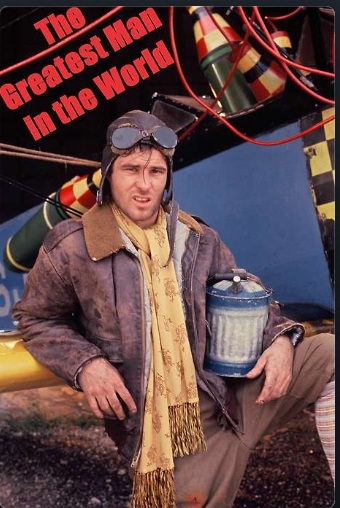
In this adaptation of a James Thurber short story, a country boy named Jack Smurch (Brad Davis) briefly becomes a celebrity when he breaks Charles Lindbergh’s record for flying nostop around the world.  Two reporters (Reed Birney and John McMartin) are assigned to write a glowing profile of him.  The U.S. Secretary of State (William Prince) wants to make him a symbol of America.  The only problem is that Smurch himself is a violent and dull-minded habitual criminal who can barely fly his plane and who almost crashes when he comes in for a landing at the end of his flight.  Before he took off in his plane, the only person who cared about Smurch was his girlfriend (Carol Kane).  Even Smurch’s own mother says that she hopes that he crashes and drowns.  But once he manages to land, Smurch becomes a hero.  As the saying goes, print the legend.

Smurch, unfortunately, isn’t smart enough to play along with the hero routine.  At a meeting with the Secretary of State and the President (who is implied to be FDR), Smurch proves to be so obnoxious that he’s tossed out of a window.  He plunges to his death but he dies an American hero.

The final episode of The American Short Story was also the best, a wonderfully dark satire on the media and our cultural need for heroes.  Brad Davis’s naturally obnoxious screen presence — the same presence that made audiences enjoy seeing him get tortured in Midnight Express — is put to good use here.  Jack Smurch is such a jerk that you really can’t blame anyone for tossing him out that window.  If nothing else, it got him to stop talking.

The American Short Story was, overall, an uneven series.  Too often, the episodes failed to really capture the tone and style that made the original stories so memorable.  That said, there were a few good episodes, like this one.  If nothing else, perhaps this series inspired people to read the original stories for themselves.  That would have been the best possible outcome.

Next week …. something new will premiere in the time slot!  What will it be?  I’ll give you a clue — it’s set on the beach but it’s not Pacific Blue.  Let’s just say that some people stand in the darkness….
Retro Television Review: The American Short Story #16 “The Jilting of Granny Weatherall”


Welcome to Retro Television Reviews, a feature where we review some of our favorite and least favorite shows of the past!  On Saturdays, I will be reviewing The American Short Story, which ran semi-regularly on PBS in 1974 to 1981.  The entire show can be purchased on Prime and found on YouTube and Tubi.

This week, The American Short Story adapts a short story by Katherine Anne Porter.

Episode #16 “The Jilting of Granny Weatherall”

(Dir by Randa Haines, originally aired 1980)

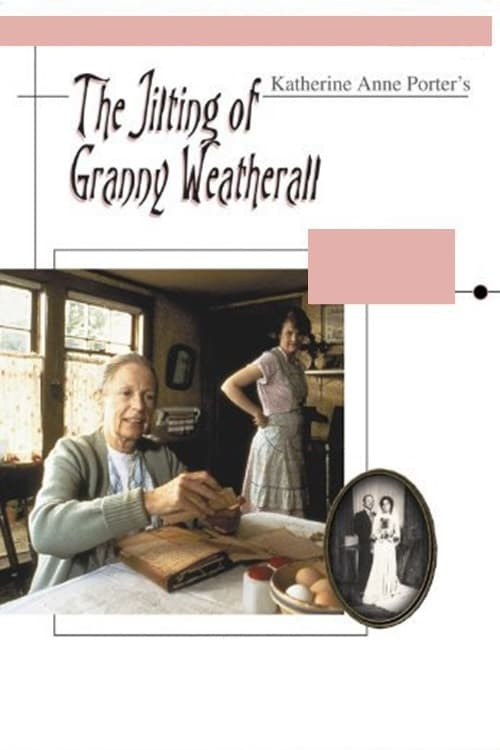
Granny Weatherall (Geraldine Fitzgerald) is dying.  While the doctor tries to comfort her and the priest tries to provide salvation, Granny obsesses on cleaning her house and getting everything in its proper place.  She thinks about how her adult daughter, Cornelia (Lois Smith), is incapable of keeping the house as clean as Granny Weatherall believes it should be.  Memories of the past and hallucinations of the present flood her mind and she remembers the time that she was jilted by a suitor and she thinks about how she has to live long enough to destroy the letters that he once wrote her.  But the coldness of death is always hovering in the background….

This episode moved a bit slowly but it was effective due to the performance of Geraldine Fitzgerald and also Randa Haines’s direction, which kept the viewer unsure of whether they were seeing reality or if they were just seeing Granny Weatherall’s dying thoughts.  The short story itself is written as a stream-of-consciousness and Haines does her best to capture that feeling in her adaptation.  One of the main problems with The American Short Story has been that most of the adaptations have struggled to capture the tone of the original stories.  The Jilting of Granny Weatherall’s visuals come very close to recreating the power of Katherine Anne Porter’s words.

Next week, The American Short Story wraps up with an adaptation of a James Thurber short story.

Retro Television Review: The American Short Story #15: The Sky Is Gray


Welcome to Retro Television Reviews, a feature where we review some of our favorite and least favorite shows of the past!  On Saturdays, Lisa will be reviewing The American Short Story, which ran semi-regularly on PBS in 1974 to 1981.  The entire show can be purchased on Prime and found on YouTube and Tubi.

This week, we have an adaptation of a 1963 short story.

Episode #15: The Sky Is Gray

(Dir by Stan Lathan, originally aired in 1980)

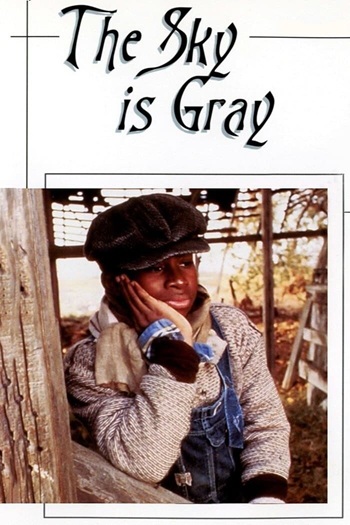
This adaptation of an Ernest Gaines short story takes place in Louisiana during the 1940s.  James (James Bond III) is a young black child who lives on a farm.  His father is overseas, serving in the Army during World War II.  His mother (Olivia Cole) is a stern but loving woman who is trying to raise the sensitive James in a world where one often has to depend on their inner strength to survive.  When James comes down with a toothache, he and his mother travel to a nearby town so he can see the dentist.  From having to stand in the back of the bus to listening to a debate between a priest and a militant in the dentist’s office, it’s an eye-opening journey for James.  When the white receptionist at the dentist’s office arbitrarily cancels James’s appointment and tells him and his mother to come back tomorrow, the two of them seek shelter.  James discovers how strong his mother is when they’re harassed by a pimp (Reuben Collins).  He also learns that there is unexpected kindness in the world when a white store owner invites him and his mother inside to give them shelter from the cold and windy day.  During one trip to the dentist, James learns that the world is far more complicated than he originally knew.

This was an okay adaptation of Gaines’s acclaimed short story.  Young James Bond III gave a good performance as James and the episode was full of scenes that visually captured the feel of being an outsider.  That said, as was often the case with this series, the adaptation was so straight-forward that it didn’t really capture the nuance of Gaines’s writing.  In the short story, Gaines put the reader right into James’s head.  The adaptation doesn’t really do that.  A heavy-handed musical score doesn’t help matters but, with all that in mind, this was still an effective coming-of-age tale.

Retro Television Review: The American Short Story #14: Rappaccini’s Daughter


Welcome to Retro Television Reviews, a feature where we review some of our favorite and least favorite shows of the past!  On Saturdays, Lisa will be reviewing The American Short Story, which ran semi-regularly on PBS in 1974 to 1981.  The entire show can be purchased on Prime and found on YouTube and Tubi.

This week, we have an anemic adaptation of a Nathaniel Hawthorne short story.

Episode #14: Rappaccini’s Daughter

(Dir by Deszo Magyar, originally aired in 1980)

This week’s episode is an adaptation of one of Nathaniel Hawthorne’s more intriguing short stories.  Giovanni (Kristoffer Tabori) is a young scholar who, in 18th Century Italy, falls in love with the beautiful and mysterious Beatrice (Kathleen Beller).  Beatrice has been raised in a garden that is full of poisonous plants that have been developed by her father, Dr. Rappaccini (Leonardo Cimino).  As a result, Beatrice is immune to the plants but she herself is poisonous.  Giovanni falls in love with her and is willing to become poisonous himself but it ultimately turns out that everything comes with a price.

Hawthorne’s short story was not only an early example of gothic literature but it was also a well-deserved parody of the nature-loving, self-righteous transcendentalists.  (The story came out at the same time as Henry David Thoreau’s Walden.)  Unfortunately, this particular adaptation really doesn’t do the story justice.  It moves extremely slowly and the performances are not particularly memorable.  Kristoffer Tabori and Kathleen Beller have very little chemistry and, in the end, the adaptation misses the satirical nature of the story altogether.  There’s a reason why Vincent Price made for an excellent Dr. Rappaccini in 1963’s Twice Told Tales.

Retro Television Review: The American Short Story #13: Barn Burning


Welcome to Retro Television Reviews, a feature where we review some of our favorite and least favorite shows of the past!  On Saturdays, Lisa will be reviewing The American Short Story, which ran semi-regularly on PBS in 1974 to 1981.  The entire show can be purchased on Prime and found on YouTube and Tubi.

This week, we have an adaptation of a William Faulkner short story.

Episode #13: Barn Burning

(Dir by Peter Werner, originally aired in 1980)

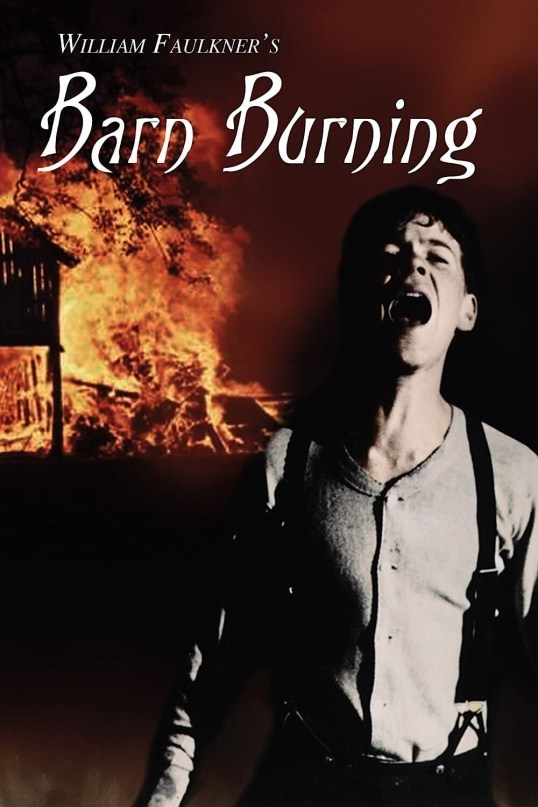
The year is 1895 and everyone in Yoknapatawpha County, Mississippi knows that Abner Snopes (Tommy Lee Jones) is no good.  The taciturn and bitter Abner is notorious for burning down the barns of those who he feels have mistreated him.  When Abner is dragged into the Justice of the Peace’s courtroom (which also happens to be a general store), he’s only acquitted because the judge and the prosecutor realize it would be unfair to force Abner’s young son, Sartoris “Sarty” Snopes (Shawn Whittington), to testify against him.  Abner and his family are ordered to move to another town but Abner avoids any legal punishment.  Despite that, Abner still accuses Sarty of thinking about betraying him.

This episode follows Sarty as he tries to understand his abusive father, a man who is offended over being told to wash a rug that he intentionally damaged that he plots to burn down another barn.  (The owner of the rug is played by Jimmy Faulkner, the grandson of William Faulkner.)  Sarty wants his father’s love but it soon becomes clear that Abner is too angry and resentful to love anyone.  The story ends with a fire and an ambiguous tragedy, leaving both the fate of Abner and the future of Sarty unclear.

With his shifting viewpoints and his internalized style of narration, William Faulkner is not an easy writer to adapt to the screen.  With Barn Burning, director Peter Werner takes a straight-forward approach to Faulkner’s short story.  While Werner’s film might lack the nuance that was brought to the tale by Faulkner’s stream-of-consciousness style, it does work as a portrait of living with an angry man who is determined to let the world know that he’s not going to be pushed around anymore.  Tommy Lee Jones gives a strong, intimidating, and ultimately charismatic performance as Abner, a tyrant who only shows emotion when he feels that he’s been treated disrespectfully.  The story takes place in the ruins of the Old South and capture the struggle between the forced gentility of the old aristocracy and the crassness of the future, represented by Abner and his family.

This was a strong episode that truly did justice to William Faulkner’s short story.

Retro Television Review: The American Short Story #12: The Man That Corrupted Hadleyburg


Welcome to Retro Television Reviews, a feature where we review some of our favorite and least favorite shows of the past!  On Saturdays, Lisa will be reviewing The American Short Story, which ran semi-regularly on PBS in 1974 to 1981.  The entire show can be purchased on Prime and found on YouTube and Tubi.

This week, we have an adaptation of a Mark Twain novella.

Episode #12: The Man That Corrupted Hadleyburg

(Dir by Ralph Rosenblum, originally aired in 1980)

In this loose adaptation of one of Mark Twain’s darkest novellas, Robert Preston stars as The Stranger.  When we first meet The Stranger, he’s looking down on the small town of Hadleyburg and it’s hard not to notice that he looks a lot like Mark Twain.  The Stranger explains that the people of Hadleyburg consider themselves to be honest and free of sin.  The town’s motto is “Lead us not into temptation!”  The Stranger has a plan to test them.

Riding into town, the Stranger stops at the home of Edward and Mary Richards (Tom Aldredge and Frances Sternhagen).  The Stranger gives them a sack that he claims is filled with $40,000 worth of gold bars.  The Stranger says that he was once a poor man and someone in Hadleyburg gave him $20 and some meaningful advice.  Now that’s he rich, he wants to pay back the person who helped him.  The Stranger explains that there is an envelope inside the sack.  In the envelope, the Stranger has written out the advice he was given by his benefactor.  The Stranger’s instruction is for the man who helped him to write out that advice and give it to Rev. Burgess (Fred Gwynne), who recently lost his church when the citizens of Hadleyburg tired of him calling them out for their hypocrisies.  The honest man who remembers the advice he gave the Stranger will be very rich as a result.  The Stranger then leaves.

News of the sack and the gold travels throughout town and eventually the rest of the nation.  The most powerful families in Hadleyburg, including the Richards family, receive a letter telling them that the advice given to the stranger was “You are far from being a bad man, go and reform.”  Burgess is soon swamped by notes, all featuring that same phrase.  At the town meeting, Burgess reads each note, revealing that everyone wrote down the same phrase and that none of the town leaders is as honest as they claim.

The Man That Corrupted Hadleyburg is one of Twain’s most stinging satires, featuring an ending that is surprisingly dark.  This adaptation takes a much lighter approach to the material, altering Twain’s ending to something much more gentle and friendly.  Unfortunately, changing the ending causes the adaptation to lack the bite of the original short story.  Twain’s portrayal of greed and guilt instead becomes a mild story about a quirky town that learns a lesson.  It’s well-acted, especially by Fred Gwynne, but this adaptation doesn’t honor Twain’s intentions.  It just doesn’t add up to much.

Retro Television Review: The American Short Story #9: Soldier’s Home


Welcome to Retro Television Reviews, a feature where we review some of our favorite and least favorite shows of the past!  On Saturdays, I will be reviewing The American Short Story, which ran semi-regularly on PBS in 1974 to 1981.  The entire show can be purchased on Prime and found on YouTube and Tubi.

This week, we have an adaptation of a short story by Ernest Hemingway.

Episode #9 “Soldier’s Home”

(Dir by Robert Young, originally aired in 1977)

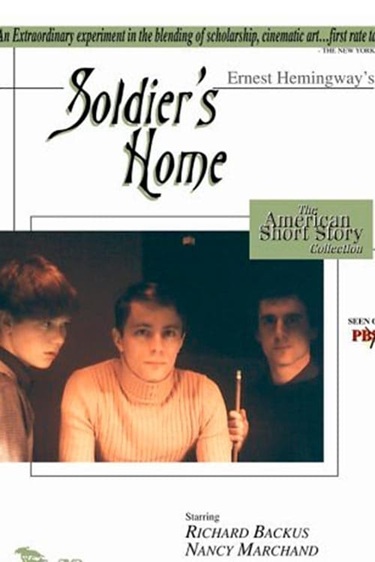
Having gone from attending college to serving in the Army during the Great War, Harold Krebs (Richard Backus) returns home to Oklahoma.  He arrives home later than most of the other soldiers who served.  (He stayed in Europe until 1919.)  As a result, there’s no big parade waiting for him.  Everyone in town seems to have moved beyond the war and they no longer have much of a desire to talk about it.

Harold, who was once a popular and optimistic member of the town’s social set, no longer feels that he fits in.  He feels detached, watching people as they go about their lives but never feeling any desire to join them.  His mother (Nancy Marchand) pushes him to go out and date and have a good time but Harold feels lost, regardless of how much she prays for him.

Ernest Hemingway’s short story was one of the first to realistically deal with the feelings of soldiers returning from combat.  Though Harold doesn’t talk much about his experiences, one can tell that he saw and experienced things that left him scarred.  After surviving the horror of The Great War, there’s no way Harold can just slip back into his normal routine.

The adaptation sticks closely to Hemingway’s story.  Unfortunately, it doesn’t really find the visual style necessary to capture the power of Hemingway’s words.  Hemingway was a deceptively simple storyteller and Robert Young’s film is a fairly straight-forward portrait of a young man who doesn’t want to do anything, one that fails to truly capture the subtext of Hemingway’s story.  Richard Backus’s blank-eyed acting style worked well when he was playing a member of the undead in Deathdream but, in this one, he just makes ennui seem boring and petulant.  Nancy Marchand, not surprisingly, is far stronger in the role of his well-meaning but clueless mother.

As was almost always the case when it came to attempts to adapt Hemingway, it’s best just to read the original.

Retro Television Review: The American Short Story Episode 8 “The Blue Hotel”


Welcome to Retro Television Reviews, a feature where we review some of our favorite and least favorite shows of the past!  On Saturdays, I will be reviewing The American Short Story, which ran semi-regularly on PBS in 1974 to 1981.  The entire show can be purchased on Prime and found on YouTube and Tubi.

This week, we have an adaptation of a Stephen Crane short story.

Episode 1.8 “The Blue Hotel”

(Dir by Jan Kadar, originally aired in 1977)

In the dying days of the Old West, a train pulls into a station in a small frontier town.  Getting off the train, a Cowboy (John Bottoms), an Easterner (Geddeth Smith), and a Swede (David Warner) head to the town’s only hotel.  A blizzard is coming and the three men are seeking shelter for the night.  The owner of the hotel, Scully (Rex Everhart), is happy to provide it.  As the men wait for dinner to be served, they play a card game with Scully’s son, Johnnie (James Keach).

At first, the game plays out without incident.  The men are all friendly, with the exception of the Swede.  The Swede remains quiet and seems distrustful.  After a few hands of the game, the Swede accuses Johnnie of cheating.  Over the next few hours, as the wind howls outside, the Swede rants and raves.  Convinced that the wild west is truly full of outlaws and that it’s all exactly like the dime-store novels that he read before boarding the train, he cannot bring himself to accept that the men mean him no harm.  It all leads to violence and tragedy.

This episode made excellent use of the shadowy Blue Hotel and the desolate wind blowing outside.  Over the course of an hour, the hotel went from being a friendly shelter to an ominous location that seemed to pulse with paranoia.  David Warner gave a strong performance as the unstable Swede and the final act of violence (which was changed slightly from the short story’s original conclusion) comes as a genuine shock as does the final twist in the tale.  The Blue Hotel becomes a look at how people unknowingly shape their own destiny, for better or worse.

Retro Television Review: The American Short Story Episode 7: The Displaced Person


Welcome to Retro Television Reviews, a feature where we review some of our favorite and least favorite shows of the past!  On Saturdays, I will be reviewing The American Short Story, which ran semi-regularly on PBS in 1974 to 1981.  The entire show can be purchased on Prime and found on YouTube and Tubi.

This week, we have an adaptation of Flannery O’Connor’s longest short story.

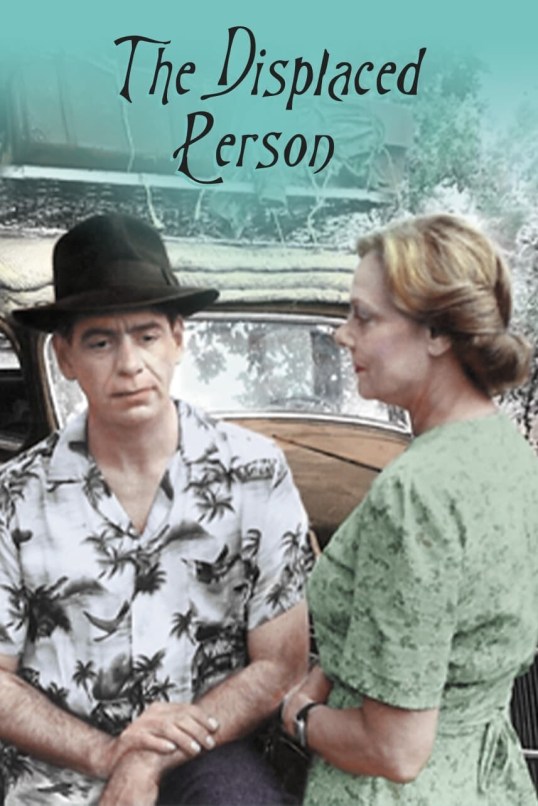
Episode #7: “The Displaced Person”

(Dir by Glenn Jordan, originally aired in 1977)

Life at a Georgia farm is thrown into turmoil when the farm’s owner, widow Mrs. McIntyre (Irene Worth), agrees to give a job to a Polish refugee named Mr. Guizac (Noam Yerushalmi).  As World War II has just ended and Father Flynn (John Houseman) has assured Mrs. McIntyre that Guizac can drive a tractor, Mrs. McIntyre is happy to give Guizac a home in America.  Less happy are the people who already work at the farm, most of whom see the hard-working Guizac as being a threat.  Mrs. Shortley (Shirley Stoler) worries that her husband (Lane Smith) is going to lose his job to Guizac.  Meanwhile, a young farmhand named Sulk (Samuel L. Jackson) enters into a business arrangement with Guizac, one that causes Mrs. McIntyre to change her opinion of Guizac.  Needless to say, it all ends in tragedy.

This adaptation is based on a short story that Flannery O’Connor wrote after her own mother hired a family of Polish refugees to work at their family farm, Andalusia.  This adaptation was actually filmed at Andalusia, only a few months after Flannery O’Connor’s death.  The furniture seen in the house was O’Connor’s own furniture.  The peacocks the drive Mrs. McIntyre crazy and which cause Father Flynn to have a religious epiphany are the same peacocks that roamed the farm when Flanney O’Connor lived there.  The cemetery that Mrs. McIntyre visits is the O’Connor family cemetery.  It brings a sense of authenticity to the film, one that is often missing from films made about the South.

The adaptation moves at a deliberate pace but it’s well-acted and it stays true to O’Connor’s aesthetic.  Those who might complain that there are only two likable characters in the film — Mr. Guizac and Father Flynn — are missing the point of O’Connor’s story.  Even Mrs. McIntyre, who initially seems to be trying to do the right thing, is blinded by the prejudices of race and class.  Father Flynn never gives up on trying to redeem both Mrs. McIntyre and the rest of the world but one gets the feeling that he might be too late.

The cast is what truly makes this adaptation stand-out.  Irene Worth, John Houseman, Lane Smith, Robert Earl Jones, they all give excellent performances.  Samuel L. Jackson was very young when he appeared in The Displaced Person but he already had the screen presence that has since made him famous.  The best performance comes from Shirley Stoler, who plays Mrs. Shortley as being a master manipulator who, unfortunately, happens to be married to a worthless man.  Mrs. Shortley does what she does to protect her husband.  Mr. Shortley does what he does because he’s a loud mouth bigot.  Everyone has their own reasons, to paraphrase Jean Renoir’s The Rules of the Game.  In this story, those reasons lead to tragedy.

Retro Television Review: The American Short Story Episode 6: “I’m A Fool”


Welcome to Retro Television Reviews, a feature where we review some of our favorite and least favorite shows of the past!  On Saturdays, I will be reviewing The American Short Story, which ran semi-regularly on PBS in 1974 to 1981.  The entire show can be purchased on Prime and found on YouTube and Tubi.

This week, after an introduction from Henry Fonda, The American Short Story presents a short film about a young man discovers that he’s a fool.

Episode 6 “I’m A Fool”

(Dir by Noel Black, originally aired in 1977)

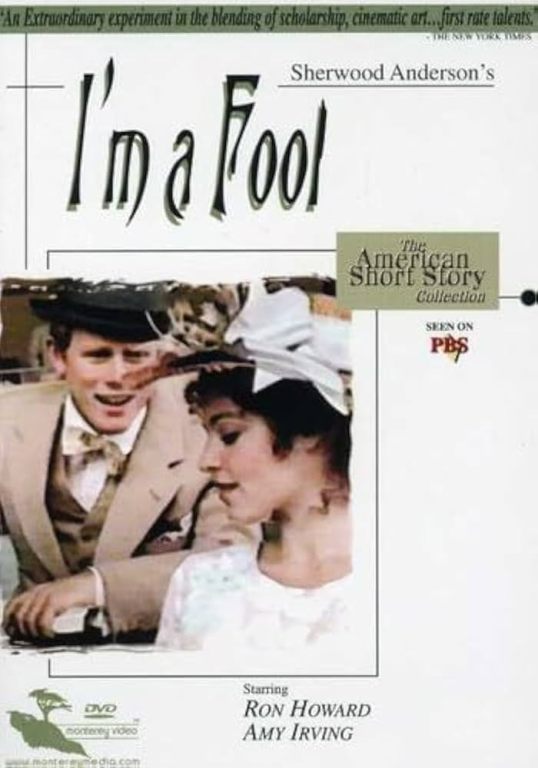
In this adaptation of a Sherwood Anderson short story, Ron Howard (back in his younger days, before he became better-known as a director) stars as Andy.  Andy is a young man who runs away from his safe and comfortable life in search of adventure.  He gets a job as a “swipe,” which was apparently what people used to call the folks who took care of the horses at a racetrack.  He and an older black man named Burt (Santiago Gonzalez) travel the racing circuit in Ohio and form a tentative friendship.  Burt can tell that, for all of his attempts to come across as being tough and worldly, Andy is a virgin who gets drunk easily and who has no idea what the real world is like.

Andy claims to be a proud member of the working class but then he meets a pretty and rich girl named Lucy (Amy Irving).  Andy introduces himself as being Walter, the son of a wealthy stable owner.  Andy and Lucy spend the day together and Andy comes to realize that he loves her and that she seems to love him as well.  But then Andy realizes that she only knows him as Walter and that it’s too late to tell her the truth.  “I’m a fool,” Andy says before leaving with Burt.

This 35-minute short film featured good performances from Ron Howard and Amy Irving and some lovely shots of the countryside, showing why a life of wandering through rural Ohio might appeal to a young person searching for meaning.  There’s a great scene in a bar where the outclassed Andy tries to prove himself to a bunch of snobs by drinking whiskey and smoking a cigar.  Unfortunately, the strength of Sherwood Anderson’s original short story is that it puts us straight into Andy’s head and allows us to see the thought process that led to him coming up with his foolish lie.  Despite featuring narration from Ron Howard, this adaptation doesn’t really accomplish that and, as a result, the viewer is always on the outside looking in.

It’s not a bad adaptation but it can’t beat sitting down and reading the original story.