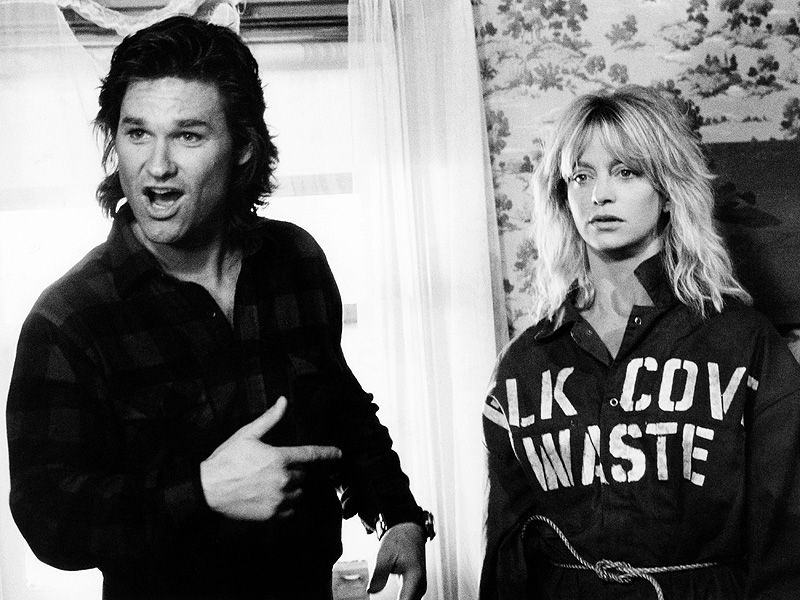
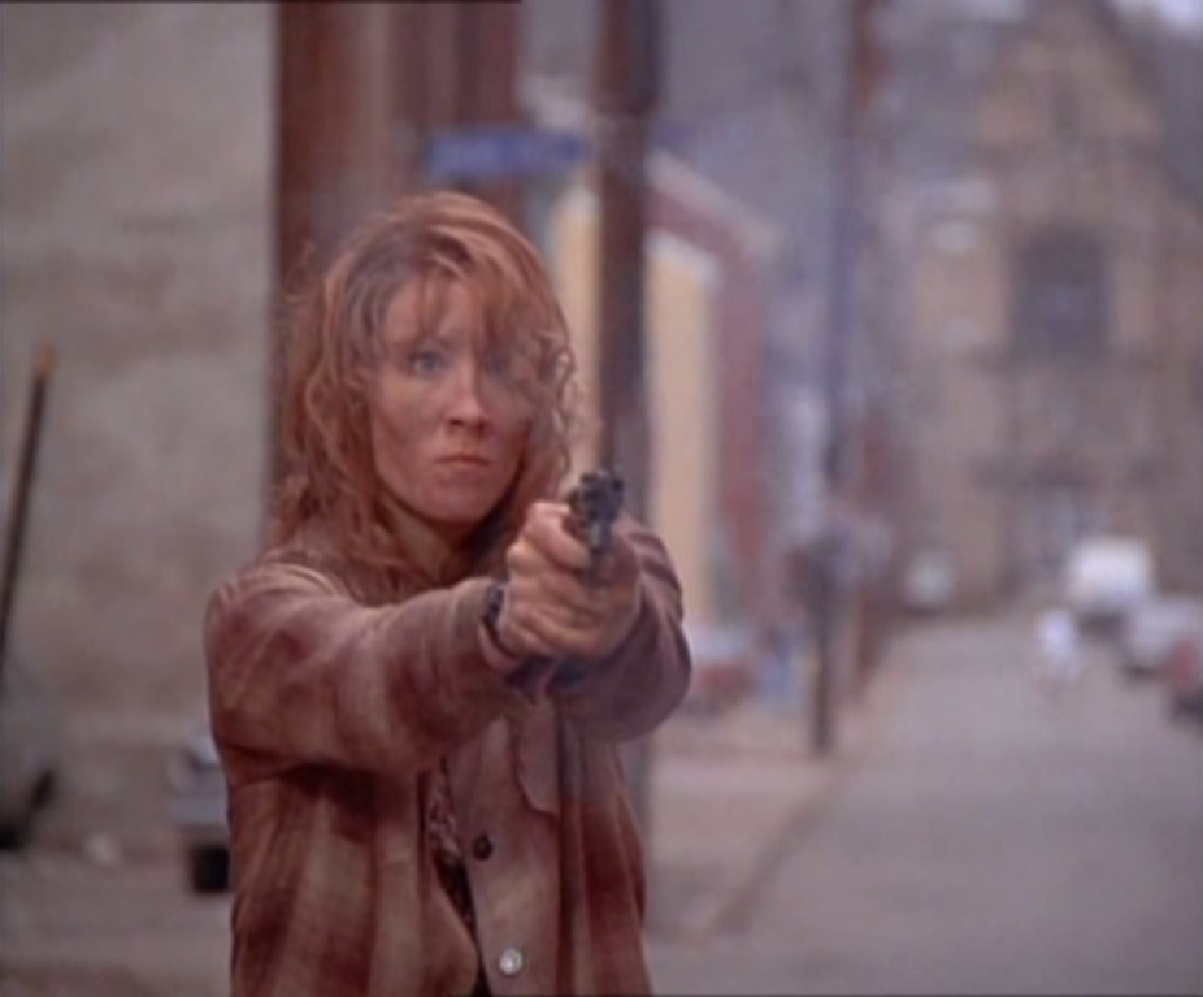
Brad reviews OVERBOARD (1987), starring Kurt Russell and Goldie Hawn!


Spoiled heiress Joanna Stayton (Goldie Hawn) hires carpenter Dean Proffitt (Kurt Russell) to remodel a closet on her yacht. Unsatisfied with his work and completely unreasonable about everything, she refuses to pay him and when he presses her for the $600, she pushes him and all of his tools overboard. Needless to say, the lady’s a “bitch” (Dean’s word) and nobody can stand her, including her husband, Grant Stayton III (Edward Herrman), and their butler Andrew (Roddy McDowell). And then something interesting happens a few days later… Joanna accidentally falls off her yacht, and when she’s fished out of the ocean, she’s still difficult to deal with, but she doesn’t have a clue who she is. Unable to identity her, the hospital puts the “amnesia lady” on the news hoping someone will recognize her. Sensing a chance to get rid of the anchor around his neck, Grant Stayton III pretends he doesn’t know her and heads out of town. This is where Dean hatches up his own plot to get revenge. He heads to the hospital and through a series of happenstances and coincidences, he’s able to convince everyone, including Joanna, now dubbed as “Annie,” that she’s his wife. He takes her home with him and makes her take care of his four wild boys, cook their food, and clean his house. Dean figures she owes it to him. But wouldn’t you know it, even though “Annie” hates it at first, over time she begins to soften towards her new life, bonds with the boys, and some sparks of love start flying between her and Dean. When she unexpectedly gets her memory back, she has to decide whether to return to her life as a spoiled heiress or stay with the man and boys she’s grown to love.

I have a soft spot in my heart for OVERBOARD, because this is a movie that my mom and I both loved, and we watched it together many times in the late 80’s and early 90’s. My mom and I didn’t often have the same taste in movies, so this was kind of “our movie.” There are a couple of other notable favorites for both me and mom, and those movies are RUTHLESS PEOPLE (1986) and LETHAL WEAPON (1987). I guarantee if I called my mom right now, interrupted her Hallmark Christmas movies, and told her I was coming over with OVERBOARD, she’d say “Come on! I’ll get something together for you to eat!” That actually sounds like a pretty good idea!

Another reason I love OVERBOARD is the fact that it stars Kurt Russell. I became a big fan of Kurt Russell during my teenage years, as I was 14 when this movie came out. A couple of years earlier, Russell starred in the films THE BEST OF TIMES (1986) and BIG TROUBLE IN LITTLE CHINA (1986), and a couple of years later he would make movies like TEQUILA SUNRISE (1988), TANGO & CASH (1989), and BACKDRAFT (1991). I wanted to watch every movie that Russell was in, and all of these films are staples of my VHS years and nostalgic favorites. In OVERBOARD, Russell starts off as a gruff, grudge-holder, but as he begins to fall for “Annie,” his natural charm and likability emerge, but so does a newfound guilt for lying to her and possibly even kidnapping her. One question for the lawyers out there, is it kidnapping when her husband had a chance to claim her and chose to abandon her instead? I’m not sure if it’s a felony or not, but I’m guessing there has to be something on the law books that doesn’t jive with what happens here. Anyway, I’ll just say that it’s best not to think of these types of pesky realities when judging this fairy tale and just go along for the ride.

Along with the Russell’s fun performance, Goldie Hawn is so perfect as the horrifically spoiled snob of an heiress who transforms into a caring substitute mother and the woman of Dean’s dreams. I know she’s great in the movie, because I can’t stand her at the beginning, but I find myself falling for her too as the movie progresses. I would not really call myself a fan of Goldie Hawn, because I haven’t spent much of my life revisiting her films, but I love her here. A couple in real life, the natural chemistry between Russell and Hawn sparkles as they fall in love on screen and only the most cold-hearted cynic isn’t pulling for them to live happily ever after as the movie closes in on its ending. As far as the supporting cast, Edward Herrmann, Katherine Helmond, Mike Hagerty, and Roddy McDowall all have good moments sprinkled throughout the film.

I do have one complaint about OVERBOARD, and that’s the “Wonders of the World Miniature Golf Course,” which is the dream business of Dean and his best friend Bad Billy Pratt (Mike Hagerty). As someone who grew up in the 70’s and 80’s playing miniature golf on the courses in Branson, MO, I would never want to play their course. Its design appears over-the-top and cheesy to me, the type of course where the scores on the holes would be determined as much by luck as by skill, which is something I find offensive. However, just like the potential kidnapping storyline, I’ve had to let my disdain for the quality of the course design go as well so I could enjoy that section of the film. I will admit this one is harder for me personally, and I still struggle with it.

Overall, OVERBOARD is not high art, and its premise is about as silly as it gets, but through a magical combination of personal 1980’s nostalgia, an appreciation for the chemistry of its stars, and a complete willingness to suspend my disbelief as we head towards an irresistibly happy ending, I still love this film. I watch it just about every year, especially if I need a pick me up as I hammer away at tax returns!

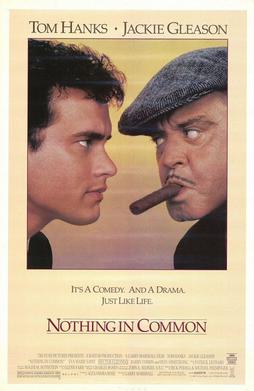
Nothing In Common (1986, directed by Garry Marshall)


Tom Hanks plays David Basner (Tom Hanks), an advertising executive whose immature lifestyle gives him insight into what sells but has also left him totally unprepared to deal with the fallout when his mother (Eva Marie Saint) leaves his father, Max (Jackie Gleason).  David, who is struggling to come up with the perfect commercial for a demanding client (Hector Elizondo), has to come to terms with both his father’s bad health and his history of infidelity.

This isn’t my favorite Tom Hanks movie.  It comes from that awkward period when Hanks was trying to make the transition from comedy to drama and its attempt to mix the two genres is not always successful.  The scenes of Hanks at the ad agency are often so cartoonish that they don’t seem like they belong in a movie where Jackie Gleason loses a foot to diabetes and realizes that he spent his entire marriage emotionally abusing his wife.  The movie, though, is worth watching for the teaming of Hanks and Gleason, two comedic actors who eventually proved themselves to equally as skilled at playing it serious.  Gleason, especially, gives a strong performance.  This was his final film and Garry Marshall convinced him to take it by asking, “Do you really want to go out on Smokey and the Bandit 3?”  Gleason would die a little over a year after the release of Nothing In Common and this film, even if it wasn’t perfect, gave the world a chance to see what a good actor he really was.

This film is often cited as the the movie that started Hanks on the way to becoming a dramatic actor.  Like Punchline, Nothing In Common played a role in Hanks becoming more than just a comedian but  I think Big was ultimately the better showcase for Hanks’s ability to mix pathos with laughs.  Nothing In Common was directed by Garry Marshall and, as was usually the case with Marshall, he often doesn’t trust the audience to figure things out for themselves.  He goes overboard trying to force an emotional response instead of just trusting the material.  Tom Hanks still does a good enough job in Nothing In Common.  Hanks is as likable as always and you can see the dramatic actor emerging in Hanks’s performance even if Hanks still wasn’t totally comfortable with it.

Nothing In Common is flawed but it was definitely a better swan song for Jackie Gleason than Smokey and the Bandit 3.

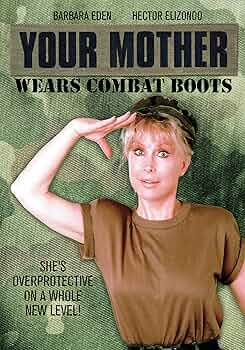
Your Mother Wears Combat Boots (1989, directed by Anson Williams)


Jimmy Anderson (David Kaufman) drops out of college and enrolls in the Army without telling his mother.  He wants to go through basic training and then do Parachute airbone training at Fort Benning, just like his father did before he died in Vietnam.  When Barbara Anderson (Barbara Eden) finds out what her son has done, she rushes down to Georgia to try to stop him.  When she discovers that Jimmy has already entered Fort Benning, Barbara assumes the identity of an AWOL trainee so that she can enter the base.  All she wants to do is track down her son and convince him to leave.  However, Sgt. Charlie Burke (Hector Elizondo) fully expects Barbara to complete her training and, in a few weeks time, to jump out of an airplane.

Probably the most interesting thing about this made-for-TV comedy is that no one seems to find it strange that a 58 year-old woman claims to have just completed basic training.  Barbara Eden looked great in this movie and she put a good deal of energy to going through all the usual Private Benjamin routines but she was still clearly too old to have ever recently enlisted in the Army and, even if she wasn’t in her 50s, the fact that she doesn’t know how to salute nor does she understand any of the basic army terminology used by Sgt. Burke should have been dead giveaways that she wasn’t who she was claiming to be.  That could have been funny if the movie had acknowledged Barbara’s age or maybe even had her act shocked that she was somehow getting away with her ruse.  Instead, the movie itself doesn’t seem to understand how strange it would be for a 58 year-old woman to show up for Parachute training.  The movie never finds the right balance between comedy and sentimentality but Barbara Eden gives it her all and the dependable Conchata Ferrell scores some laughs as a specialist who “eats recruits for breakfast.”

This film was directed Anson Williams, a.k.a. Potise from Happy Days. Ron Howard and Henry Winkler weren’t the only directors to come out of that show.

Retro Television Review: So Here’s What Happened 1.1 “Pilot”


Welcome to Retro Television Reviews, a feature where we review some of our favorite and least favorite shows of the past!  On Thursdays, I will be reviewing So Here’s What Happened, which aired on CBS in 2006.  The entire show is currently streaming on YouTube!

The first and only episode of this show has one message for all the mooks out there.  And that message is …. NEW YORK, BABY!

Episode 1.1 “Pilot”

(Dir by Michael Lembeck, aired on May 1st, 2006)

What to say about Vince Brophy (Bobby Cannavale)?  Hey, he’s a New Yorker, you know what I mean?  Hey, he starts every sentence by saying, “Hey,” y’know?  He knows the name of every single athlete who ever played for a New York sports team, y’know?  He meets a woman named Rochelle Jeter (Rashida Jones) and immediately asks her if she’s related to Derek Jeter, you know what I’m saying?  She says, “Yeah,” and she’s being sarcastic but Vince thinks that she’s being serious because who in their right mind would come into the old neighborhood and make a sarcastic joke, y’know?

Vince is such a New Yorker that he narrates the entire episode while sitting in his favorite barber chair.  His barber (Hector Elizondo) hangs on his every word, which is good since he presumably can’t see the flashbacks that the audience is forced to sit through.  Vince works at his family’s car lot and he wears solid suits and pinky rings and the pilot finds several excuses for him to say the word “Escalade.”  He’s not smart but he’s a stand-up guy, that Vince.  His co-worker asks him to be the godfather to his newborn and Vince agrees but then he nearly drowns the kid at the christening because he gets distracted when someone tells him that Derek Jeter don’t have no sister named Rochelle.  What a New Yorker!, y’know what I’m saying?

There’s a lot of talented people in this show.  Rashida Jones was months away from appearing on The Office.  Hector Elizondo is a comedy veteran.  Steve Park, a favorite of the Coen Brothers, appeared as Vince’s boss.  Mercedes Ruehl plays Vince’s mother.  And then you’ve got Bobby Cannavale in the lead role.  Cannavale is one of my favorite actors, a guy who is as good at playing sensitive as he is at playing tough.  Cannavale can play drama and he can play comedy and he’s easy on the eyes.  Unfortunately, all of these talented people were let down by a script that was written by none other than Paul Reiser.

The main problem with the show is that none of the characters have much of a personality beyond being from New York.  Obviously, New Yorkers are a unique group of people but every New Yorker I’ve met has also had their own individual personality to go along with their identity of being a citizen of America’s largest city.  The characters in this episode, on the other hand, have no identity beyond being a New Yorker in the most cliched ways possible.  Even worse, none of the jokes are particularly funny.  Vince crosses the line from being amiably dumb to being a buffoon far too quickly.

Perhaps not surprisingly, this was the only episode of this show.  The pilot did not lead to a series.  Fortunately, everyone involved went on to better things, y’know?

October True Crime: Out of the Darkness (dir by Jud Taylor)


The 1985 film, Out of the Darkness, takes place in New York City.

It begins in 1977 and it ends in 1978.  As the opening title card informs us, it’s a film about a city that was living in fear of the gunman known as the Son of Sam.  One of the first images that we see is an a handgun being fired at two people who are making out inside of a car.  We then cut to a police station where a homicide detective (played by Sam McMurray) reads aloud the letter that the Son of Sam sent to Jimmy Breslin.

That said, David Berkowitz, the killer who claimed that he was told to murder by a dog before later changing his story and claiming that he was a part of a Satanic conspiracy, spends most of the film in the shadows.  His name isn’t even mentioned until the film’s final third.  Instead, the majority of the film focuses on Ed Zigo (Martin Sheen), a New York City detective who tries to balance his desire to catch the Son of Sam with taking care of his wife (Jennifer Salt), who is due to have surgery for her heart condition.  Ed Zigo is dedicated and intelligent New York cop, the type who has no problem walking into a Mafia-controlled bar and asking the owner if his son has any connections to the family business.  He’s also a dedicated family man who freaks out when his daughter goes out on a date.  When his wife dies after surgery, Ed Zigo deals with his grief by throwing himself into his work but, as he tells his priest (Hector Elizondo), he no longer has his old confidence.  He fears that he’s going to make a mistake that’s either going to put his partner (Matt Clark) in harm’s way or allow the Son of Sam to continue to killing.

And really, it’s not a problem that the film focuses less on the killer and more on the people trying to track him down.  Martin Sheen gives a strong and sincere performance as the dedicated Ed Zigo, perfectly capturing not only his dedication but also his fear and his weariness.  (In many ways, his performance here feels like a forerunner to his performance in The Departed.)  The film captures the feel of living in a city where no one trusts anyone and it is also a good example of a “New Yorkers will be rude to anyone” film.  Even with a killer running around, no one wants to listen to a word the police have to say.  When David Berkowitz does show up, he’s played by an actor named Robert Trebor who gives an appropriately creepy performance.

Interestingly enough, Joe Spinell also appears in Out of the Darkness, playing the small but important role of an early Son of Sam suspect.  Though he only appears in two scenes, Spinell makes a memorably seedy impression.  Of course, today, Spinell is remembered for playing a character based on the Son of Sam in the infamous 1980 grindhouse shocker, Maniac.

(Trivia fans will also want to note that Charlie Sheen has a wordless cameo as a man who shuts his apartment door in the face of Martin Sheen and Matt Clark when they attempt to ask him if he witnessed the latest murder.  “Nice guy,” Martin says, in response.)

If you’re looking for a film in which Berkowitz is cursed out by a dog, Summer of Sam is probably the one to go for.  However, if you’re looking for a more low-key but realistic portrayal of Berkowitz’s reign of terror, Out of the Darkness is a good one to go with.

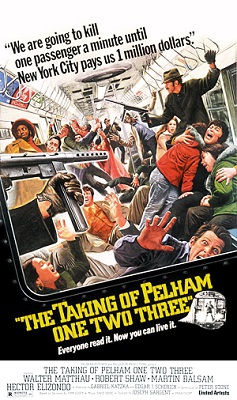
Film Review: The Taking of Pelham One Two Three (dir by Joseph Sargent)


Welcome to New York in the 1970s!  While the intellectuals flock to the latest Woody Allen movie and the wealthy throw radical chic parties in Manhattan and disturbed young men drive taxis at night and pray for a real flood to clear away all the vermin, most of the city’s citizens are just trying to make it through the day.  For many of them, that means spending an hour or two riding the subway.  In some ways, the subway is the great equalizer.  The minute that you sit down on a filthy train car, it doesn’t matter how old you are or how you vote or the color of your skin.  All that matter is finding a way to avoid making eye contact with anyone else.

Four men, all wearing obvious disguised, board the downtown Pelham 1-2-3 train.  They all look suspicious but, this being New York, no one wants to make eye contact.  Everyone just wants to reach their next stop.  The men — who are known as Mr. Blue (Robert Shaw), Mr. Green (Martin Balsam), Mr. Grey (Hector Elizondo), and Mr. Brown (Earl Hindman) — have other plans.  Revealing that they’re armed, they take the 18 passengers of the first car hostage.  Their leader, Mr. Blue, has a simple demand.  He wants a million dollars to be delivered to the car within an hour.  If the money’s late, he will kill one hostage every minute, until he receives what he wants.

While the cold-stricken mayor (Lee Wallace) tries to figure out how to 1) raise a million dollars and 2) handle the situation without losing any potential votes in his reelection campaign, Lt. Zach Garber (Walter Matthau) communicates with Mr. Blue via radio.  With Mr. Blue underground and Zach above ground, the two of them establish a cautious rapport.  Robert Shaw plays Blue as being efficient, polite, but ruthless while Walter Matthau plays Garber with his usual rumpled but intelligent style.  As embodied by Matthau, Garber is New York City in human form while Shaw is perfectly cast as the outsider who, for at least an hour or two, has managed to bring the city to its knees.

Even though the original The Taking of Pelham One Two Three is often described as being a Walter Matthau film or a Robert Shaw film, the film’s main character actually is the city of New York City.  The film portrays the city as being chaotic, angry, and unpredictable but, at the same time, also resilient and strong.  Yes, Garber may spend a lot of time bickering with his co-workers but, in the end, he and Lt. Rico Patrone (Jerry Stiller, another great New York figure) work together to do what has to be done to resolve the situation.  For all the time that’s spent on how Mr. Blue and his compatriots take that train hostage, just as much time is spent focusing on how the police, the politicians, and the Transit Authority react to what’s happened.  Not having any firsthand knowledge of the New York subway system (beyond being told not to use it when I was in NYC a few years ago), I can’t say whether or not the film is realistic but what’s important is that it feels realistic.  Even though the film is full of familiar character actors, it still seems as if you’re just watching a bunch of New Yorkers having a very long day.  Though guns are fired and there is a runway train, The Taking of Pelham One Two Three takes a refreshingly low-key approach to its story.  There’s no huge action set pieces.  The film’s classic final shot hinges not on Garber’s marksmanship but instead on his ability to remember the small details.

The Taking of Pelham One Two Three is one of my favorite heist movies.  It’s well-acted.  It’s got an interesting plot.  It’s got a few moments of unexpected humor.  Robert Shaw is a great (and, at times, almost compelling) villain while Walter Matthau and Jerry Stiller make for a great detective team.  The great Martin Balsam also turns in a wonderful turn and, even though he’s playing a bad guy, it’s hard not to sympathize him.  You need only see his apartment to understand why exactly he felt the city of New York owed him more than it had given him.  Best of all, The Taking of Pelham One Two Tree is a tribute to a great American city.  The Taking of Pelham One Two Three celebrates New York City in all of its rude, messy, and brilliant glory.

Backstreet Justice (1994, directed by Chris McIntyre)


“These straight-to-video, schlocky films I was getting were giving me an ulcer, basically because I was the only one on the set that cared about anything… Between that and my biological clock, I decided to give it all away.”

— Linda Kozlowksi, on why she retired from acting

When Linda Kozlowski talked about the “shlocky films” that soured her on acting, Backstreet Justice was probably high on the list.  Kozlowski may have found fame co-starring with her then-husband Paul Hogan in the Crocodile Dundee films but, in Backstreet Justice, there’s neither an Australian nor a sense of humor to be found.

Kozlowski plays Keri Finnegan, a tough and streetwise private investigator in Philadelphia.  Her late father was a policeman who was accused of corruption while her mentor (Hector Elizondo) is the district attorney.  Most of the cops hate Keri, especially Captain Giarusso (Paul Sorvino).  The one exception is her lover, Nick Donovan (John Shea).

The residents of Philadelphia’s worst neighborhood have hired Keri to protect them.  For the past two years, a murderer has lurked among them.  With the police showing no interest in solving the crimes, the neighborhood turns to Keri.  Keri’s investigation leads her to believe that the murders are being carried out be corrupt cops but Keri isn’t prepared for just how far up the corruption goes.

For a straight-to-video film, Backstreet Justice has a surprisingly good cast, with Paul Sorvino, Hector Elizondo, John Shea, Tammy Grimes, and Viveca Lindfors all appearing in supporting roles.  Linda Kozlowski holds her own opposite her better-known co-stars and is believable in the film’s many action scenes.  The movie has a good sense of urban squalor and captures the desperation of people living in a dying neighborhood.  The main problem with the film is that the central mystery is never that interesting and the solution is one that most people will see coming from miles away.  For all the violence and scenes of people chasing each other, Backstreet Justice is still a boring movie.

With the exception of one surprisingly explicit sex scene, Backstreet Justice could easily pass for a made-for-TV film or a pilot for a Keri Finnegan television series.  Instead, it was just another straight-to-video thriller and another reason for the talented Linda Kozlowski to leave acting behind.  Her final film appearance was in 2001’s Crocodile Dundee in Los Angeles.

“Going All Kanye On You”: New Year’s Eve (dir by Garry Marshall)


“New Year’s Eve is the worst, people who don’t drink or party all year suddenly going all Kanye on you.”

That line was delivered by Ashton Kutcher in the 2011 film, New Year’s Eve.  Seven years ago, when the film was first released, I thought it was an awkward line, partially because Ashton Kutcher sounded like he was drowning in self-loathing when he said it and partially because the sudden reference to Kanye West felt like something that would be considered clever by 60-something screenwriter who had just spent a few hours scanning twitter to see “what the kids are into nowadays.”

(Of course, hearing the line in 2018 was an even stranger experience.  People who don’t drink or party all year suddenly going all Kanye on you?  So, they’re putting on red MAGA caps and spending New Year’s Eve tweeting about prison reform?  True, that’s the way a lot of people celebrated in my part of the world but I’m not sure how exactly that would play out in Times Square.)

In New Year’s Eve, Kutcher plays a character named Randy.  Randy is a comic book artist, which means that he’s snarky and cynical and doesn’t really see the point of celebrating anything.  Fortunately, he gets trapped in an elevator with Elise (Lea Michele) and, with her help, he comes to learn that New Year’s Eve is not the worst.  Instead, it’s the most important holiday ever created and, if you don’t think so, you’re worse than the devil.

Fortunately, Hillary Swank is present to make sure that we all get the point.  Swank plays Claire Morgan, who is in charge of making sure that the ball drops at exactly the right moment at Times Square and who gets a monologue where she explains that the purpose of the ball is to make you think about both the past and the future.  As she explains it, the world comes together one night a year, all so everyone can watch that ball drop.  Apparently, if the ball doesn’t drop, the new year doesn’t actually start and everyone is trapped in a timeless limbo, kind of like Iron Man at the end of Avengers: Infinity War.

Of course, there’s more going on in New Year’s Eve than just Randy taking Kanye’s name in vain and Claire refusing the accept that Times Square is not the center of the universe.  There’s also an old man (Robert De Niro) who wants to time his death so he passes right at the start of the new year.  Sarah Jessica Parker plays the mother of frustrated teenager Abigail Breslin and gets to make a “girls gone wild” joke.  (A Kanye reference and a girls gone wild joke in the same film?  It’s like a pop culture tsunami!)  Michelle Pfeiffer tries to accomplish all of her new year’s resolutions with the help of Zac Efron.  Halle Berry worries about her husband (Common) , who is serving overseas.  Josh Duhamel searches for a woman who once told him that his heart was more important than his business.  Seth Meyers and Jessica Biel compete with Til Schweiger and Sarah Paulson to see who can be the family of the first child born in the new year.  Jon Bon Jovi thinks about the woman that he nearly married and Katherine Heigl wonders if she’s ever going to have a career again.  In other words, New Year’s Eve is an ensemble piece, one in which a bunch of slumming Oscar winners and overachieving TV actors step into small roles.  It leads to some odd pairings.  De Niro, for instance, shares scenes with Alyssa Milano while Sofia Vergara and Ludacris are both relegated to playing sidekicks.  Michael Bloomberg, New York’s then-mayor and general threat to civil liberties everywhere, also shows up, playing himself with the type of smarminess that already has many people dreading the prospect of his 2020 presidential campaign.  This is one of those films where everyone has a familiar face but no one makes much of an impression.

New Year’s Eve was directed by the late Garry Marshall and it’s the second film in his so-called holiday trilogy, sitting right between Valentine’s Day and Mother’s Day.  By most accounts, Garry Marshall was a nice guy and popular in the industry, which perhaps explains why so many familiar faces were willing to sign up to appear in New Year’s Eve.  Though the film is ruthlessly mediocre, it’s actually the best of the holiday trilogy.  For all the schmaltz and forced sentiment, one gets the feeling that the film actually is sincere in its belief in the importance of that ball dropping in Times Square.

I remember that, when New Year’s Eve was first released, a lot of people joked that Marshall was going to make an ensemble romantic comedy about every single holiday, all with the hope that at least one of them would eventually become a television perennial in the style of It’s A Wonderful Life or The Ten Commandments.  Interestingly, that’s exactly what happened with New Year’s Eve.  Yesterday, E! aired New Year’s Eve three times, back-to-back!  For better or worse, this film is probably going to outlive us all, ensuring that, in the far future, viewers will spend New Year’s Eve asking themselves, “What’s a kanye?”

Playing Catch-Up: Crisscross, The Dust Factory, Gambit, In The Arms of a Killer, Overboard, Shy People


So, this year I am making a sincere effort to review every film that I see.  I know I say that every year but this time, I really mean it.

So, in an effort to catch up, here are four quick reviews of some of the movies that I watched over the past few weeks!

  • Crisscross
  • Released: 1992
  • Directed by Chris Menges
  • Starring David Arnott, Goldie Hawn, Arliss Howard, Keith Carradine, James Gammon, Steve Buscemi

An annoying kid named Chris Cross (David Arnott) tells us the story of his life.

In the year 1969, Chris and his mother, Tracy (Goldie Hawn), are living in Key West.  While the rest of the country is excitedly watching the first moon landing, Chris and Tracy are just trying to figure out how to survive day-to-day.  Tracy tries to keep her son from learning that she’s working as a stripper but, not surprisingly, he eventually finds out.  Chris comes across some drugs that are being smuggled into Florida and, wanting to help his mother, he decides to steal them and sell them himself.  Complicating matters is the fact that the members of the drug ring (one of whom is played by Steve Buscemi) don’t want the competition.  As well, Tracy is now dating Joe (Arliss Howard), who just happens to be an undercover cop.  And, finally, making things even more difficult is the fact that Chris just isn’t that smart.

There are actually a lot of good things to be said about Crisscross.  The film was directed by the renowned cinematographer, Chris Menges, so it looks great.  Both Arliss Howard and Goldie Hawn give sympathetic performances and Keith Carradine has a great cameo as Chris’s spaced out dad.  (Traumatized by his experiences in Vietnam, Chris’s Dad left his family and joined a commune.)  But, as a character, Chris is almost too stupid to be believed and his overwrought narration doesn’t do the story any good.  Directed and written with perhaps a less heavy hand, Crisscross could have been a really good movie but, as it is, it’s merely an interesting misfire.

  • The Dust Factory 
  • Released: 2004
  • Directed by Eric Small
  • Starring Armin Mueller-Stahl, Hayden Panettiere, Ryan Kelly, Kim Myers, George de la Pena, Michael Angarano, Peter Horton

Ryan (Ryan Kelly) is a teen who stopped speaking after his father died.  One day, Ryan falls off a bridge and promptly drowns.  However, he’s not quite dead yet!  Instead, he’s in The Dust Factory, which is apparently where you go when you’re on the verge of death.  It’s a very nice place to hang out while deciding whether you want to leap into the world of the dead or return to the land of the living.  Giving Ryan a tour of the Dust Factory is his grandfather (Armin Mueller-Stahl).  Suggesting that maybe Ryan should just stay in the Dust Factory forever is a girl named Melanie (Hayden Panettiere).  Showing up randomly and acting like a jerk is a character known as The Ringmaster (George De La Pena).  Will Ryan choose death or will he return with a new zest for living life?  And, even more importantly, will the fact that Ryan’s an unlikely hockey fan somehow play into the film’s climax?

The Dust Factory is the type of unabashedly sentimental and theologically confused film that just drives me crazy.  This is one of those films that so indulges every possible cliché that I was shocked to discover that it wasn’t based on some obscure YA tome.  I’m sure there’s some people who cry while watching this film but ultimately, it’s about as deep as Facebook meme.

  • Gambit
  • Released: 2012
  • Directed by Michael Hoffman
  • Starring Colin Firth, Cameron Diaz, Alan Rickman, Tom Courtenay, Stanley Tucci, Cloris Leachman, Togo Igawa

Harry Deane (Colin Firth) is beleaguered art collector who, for the sake of petty revenge (which, as we all know, is the best type of revenge), tries to trick the snobbish Lord Shabandar (Alan Rickman) into spending a lot of money on a fake Monet.  To do this, he will have to team up with both an eccentric art forger (Tom Courtenay) and a Texas rodeo star named PJ Puznowksi (Cameron Diaz).  The plan is to claim that PJ inherited the fake Monet from her grandfather who received the painting from Hermann Goering at the end of the World War II and…

Well, listen, let’s stop talking about the plot.  This is one of those elaborate heist films where everyone has a silly name and an elaborate back story.  It’s also one of those films where everything is overly complicated but not particularly clever.  The script was written by the Coen Brothers and, if they had directed it, they would have at least brought some visual flair to the proceedings.  Instead, the film was directed by Michael Hoffman and, for the most part, it falls flat.  The film is watchable because of the cast but ultimately, it’s not surprising that Gambit never received a theatrical release in the States.

On a personal note, I saw Gambit while Jeff & I were in London last month.  So, I’ll always have good memories of watching the movie.  So I guess the best way to watch Gambit is when you’re on vacation.

  • In The Arms of a Killer
  • Released: 1992
  • Directed by Robert L. Collins
  • Starring Jaclyn Smith, John Spencer, Nina Foch, Gerald S. O’Loughlin, Sandahl Bergman, Linda Dona, Kristoffer Tabori, Michael Nouri

This is the story of two homicide detectives.  Detective Vincent Cusack (John Spencer) is tough and cynical and world-weary.  Detective Maria Quinn (Jaclyn Smith) is dedicated and still naive about how messy a murder investigation can be when it involves a bunch of Manhattan socialites.  A reputed drug dealer is found dead during a party.  Apparently, someone intentionally gave him an overdose of heroin.  Detective Cusack thinks that the culprit was Dr. Brian Venible (Michael Nouri).  Detective Quinn thinks that there has to be some other solution.  Complicating things is that Quinn and Venible are … you guessed it … lovers!  Is Quinn truly allowing herself to be held in the arms of a killer or is the murderer someone else?

This sound like it should have been a fun movie but instead, it’s all a bit dull.  Nouri and Smith have next to no chemistry so you never really care whether the doctor is the killer or not.  John Spencer was one of those actors who was pretty much born to play world-weary detectives but, other than his performance, this is pretty forgettable movie.

  • Overboard
  • Released: 1987
  • Directed by Garry Marshall
  • Starring Goldie Hawn, Kurt Russell, Edward Herrmann, Katherine Helmond, Roddy McDowall, Michael G. Hagerty, Brian Price, Jared Rushton, Hector Elizondo

When a spoiled heiress named Joanne Slayton (Goldie Hawn) falls off of her luxury yacht, no one seems to care.  Even when her husband, Grant (Edward Herrmann), discovers that Joanne was rescued by a garbage boat and that she now has amnesia, he denies knowing who she is.  Instead, he takes off with the boat and proceeds to have a good time.  The servants (led by Roddy McDowall) who Joanne spent years terrorizing are happy to be away from her.  In fact, the only person who does care about Joanne is Dean Proffitt (Kurt Russell).  When Dean sees a news report about a woman suffering from amnesia, he heads over to the hospital and declares that Joanne is his wife, Annie.

Convinced that she is Annie, Joanne returns with Dean to his messy house and his four, unruly sons.  At first, Dean says that his plan is merely to have Joanne work off some money that she owes him.  (Before getting amnesia, Joanne refused to pay Dean for some work he did on her boat.)  But soon, Joanne bonds with Dean’s children and she and Dean start to fall in love.  However, as both Grant and Dean are about to learn, neither parties nor deception can go on forever…

This is one of those films that’s pretty much saved by movie star charisma.  The plot itself is extremely problematic and just about everything that Kurt Russell does in this movie would land him in prison in real life.  However, Russell and Goldie Hawn are such a likable couple that the film come close to overcoming its rather creepy premise.  Both Russell and Hawn radiate so much charm in this movie that they can make even the stalest of jokes tolerable and it’s always enjoyable to watch Roddy McDowall get snarky.  File this one under “Kurt Russell Can Get Away With Almost Anything.”

A remake of Overboard, with the genders swapped, is set to be released in early May.

  • Shy People
  • Released: 1987
  • Directed by Andrei Konchalovsky
  • Starring Jill Clayburgh, Barbara Hershey, Martha Plimpton, Merritt Butrick, John Philbin, Don Swayze, Pruitt Taylor Vince, Mare Winningham

Diana Sullivan (Jill Clayburgh) is a writer for Cosmopolitan and she’s got a problem!  It turns out that her teenager daughter, Grace (Martha Plimpton), is skipping school and snorting cocaine!  OH MY GOD!  (And, to think, I thought I was a rebel just because I used to skip Algebra so I could go down to Target and shoplift eyeliner!)  Diana knows that she has to do something but what!?

Diana’s solution is to get Grace out of New York.  It turns out that Diana has got some distant relatives living in Louisiana bayou.  After Cosmo commissions her to write a story about them, Diana grabs Grace and the head down south!

(Because if there’s anything that the readers of Cosmo are going to be interested in, it’s white trash bayou dwellers…)

The only problem is that Ruth (Barbara Hershey) doesn’t want to be interviewed and she’s not particularly happy when Diana and Grace show up.  Ruth and her four sons live in the bayous.  Three of the sons do whatever Ruth tells them to do.  The fourth son is often disobedient so he’s been locked up in a barn.  Diana, of course, cannot understand why her relatives aren’t impressed whenever she mentions that she writes for Cosmo.  Meanwhile, Grace introduces her cousins to cocaine, which causes them to go crazy.  “She’s got some strange white powder!” one of them declares.

So, this is a weird film.  On the one hand, you have an immensely talented actress like Jill Clayburgh giving one of the worst performances in cinematic history.  (In Clayburgh’s defense, Diana is such a poorly written character that I doubt any actress could have made her in any way believable.)  On the other hand, you have Barbara Hershey giving one of the best.  As played by Hershey, Ruth is a character who viewers will both fear and admire.  Ruth has both the inner strength to survive in the bayou and the type of unsentimental personality that lets you know that you don’t want to cross her.  I think we’re supposed to feel that both Diana and Ruth have much to learn from each other but Diana is such an annoying character that you spend most of the movie wishing she would just go away and leave Ruth alone.  In the thankless role of Grace, Martha Plimpton brings more depth to the role than was probably present in the script and Don Swayze has a few memorable moments as one of Ruth’s sons.  Shy People is full of flaws and never really works as a drama but I’d still recommend watching it for Hershey and Plimpton.
A Movie A Day #287: Leviathan (1989, directed by George Pan Cosmatos)


A group of miners are sent into a dangerous environment by an evil corporation.  When they explore an abandoned ship, they unknowingly bring a hostile creature onto their own vessel.  One of the crewman is killed when the creature mutates inside of his body.  The rest of the crew includes a scientist, one strong woman, one woman who cries, and a strong, silent captain.

Sound familiar?

No, it’s not Alien.  

Instead, it’s Leviathan, which could best be described as being Alien underwater with a dash of The Thing tossed in.  The main difference between Leviathan and the films that inspired it is that people are still watching Alien and The Thing while Leviathan is one of the most forgettable films that I have ever seen.  Peter Weller is the captain.  Richard Crenna is the scientist.  Amanda Pays has the Ripley role and Ernie Hudson fills in for Yaphet Kotto.  Daniel Stern plays Sixpack, who turns into a monster after he drinks contaminated Russian vodka.  (It happens to the best of us.)  Meg Foster, with her translucent eyes, represents the corporation.

That’s a good cast and the script was written by David Peoples (who also wrote Blade Runner, Unforgiven, and 12 Monkeys) and Jeb Stuart (who wrote Die Hard and The Fugitive).  The above average special effects were designed by Stan Winston.  Why, with all of these talented people involved in the production, is Leviathan so by the numbers and forgettable?  It probably had something to do with the presence of George Pan Cosmatos in the directing chair.  Cosmatos is also credited with directing Rambo: First Blood II, Cobra, and Tombstone.  The first two films starred Sylvester Stallone, who was known for directing all of his 80s films in every way but name only and everyone knows that Kurt Russell was in charge on Tombstone.

If you want to see Alien underwater done right, watch Deepstar Six.