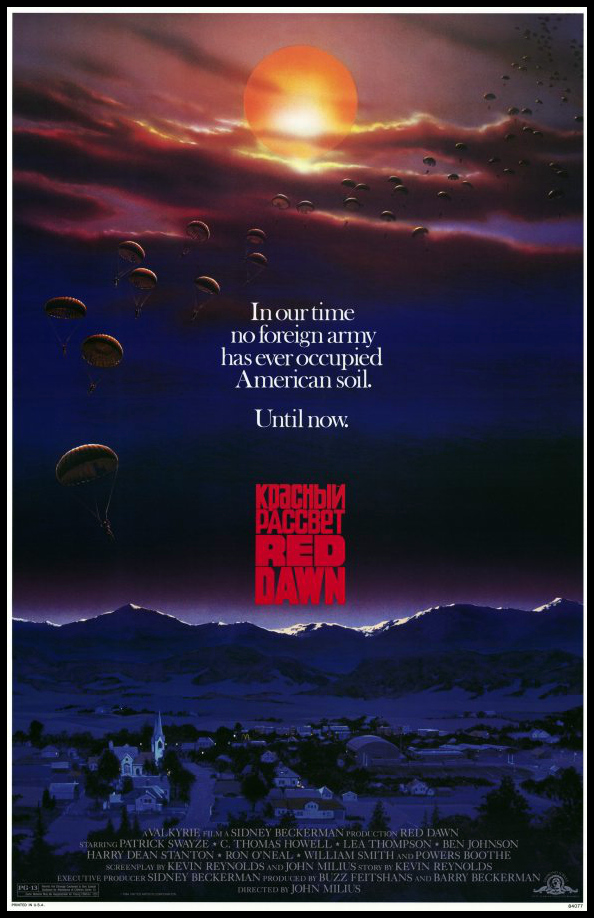
Review: Red Dawn (dir. by John Milius)


“I don’t know. Two toughest kids on the block I guess. Sooner or later they’re going to fight.”

[guilty pleasure]

Anyone who grew up during the 1980’s would say that some of the best action films were made and release during this decade. I won’t disagree with them and probably would agree to a certain point. This was the decade when action films evolved from the realism of the 70’s to the excess and ultra-violence of the 80’s. This was the decade which ushered in such action heroes as Schwarzenegger, Stallone and Willis. It was also the decade which released one of the most violent films ever released by a major motion picture studio. It’s a film that has been remembered through the prism of nostalgia. I speak of the 1984 war film by John Milius simply titled Red Dawn.

John Milius is one of those filmmakers who never conformed to the stereotype of liberal Hollywood. He was an unabashed Republican (though he considers himself more of a Zen anarchist) in a liberal studio system who happened to have written some of the most revered films of the 1970’s (Jeremiah Johnson, Apocalypse Now, Dirty Harry). He came up with a follow-up to his hugely successful Conan the Barbarian in the form of a war film set in current times (mid-80’s) America that he called Red Dawn. It was a story which takes an alternate history of the Cold War where Soviet forces and it’s allies launch a successful preemptive invasion of the United States. Before people think that this was the idea born of a conservative, warmongering mind it’s been documented that Milius’ inspiration for this film was a real Pentagon hypothetical exercise of what would happen if the Soviet Union conducted a conventional invasion of the United States and how the government and it’s population would react and resist such an occupying force. The  story would finally get it’s final treatment with major input from screenwrtier Kevin Reynolds’ own story which added a certain Lord of the Flies vibe to the group of teenagers who form the bulk of the film’s cast.

The film actually starts off with an impressive sequence of your typical Midwestern high school day with students seated in their classrooms. One moment this Rockwellian image gets a surprise from soldiers parachuting in the field outside the school. Thus we have the beginning of the Soviet invasion with one of the teachers being gunned down for trying to peacefully interact with the airborne troopers. The rest of the film is about a group of highschoolers led by senior Jed Eckert (Patrick Swayze) and his younger brother Matt (Charlie Sheen) as they flee with a handful of their classmates the massacre at their school and soon their whole town as well.

Red Dawn uses the first half of the film to show the confusion and chaos created by the sudden appearance of foreign soldiers on America soil attacking civilians and, soon enough, whatever American military response that manages to react in the area. We’re put in the shoes of Jed and his band of teenagers as they try to survive the roving bands of Soviet and Cuban soldiers patrolling the plains and countryside surrounding their hometown of Calumet, Colorado. We see American civilians packed into re-education camps and rumors of KGB secret police making certain troublemakers disappear and worst. It’s the America Cold War nightmare scenario where the Soviet Evil Empire has taken a foothold on US soil and the government and military nowhere in sight to help it’s population.

The second half of the film solves this scenario by arming the teenagers led by Jed into a sort of teen guerrila force using their school’s mascot as their rallying cry. It’s the shouts of “Wolverines!” which has become part of American pop-culture as we get to see these teenagers conduct hit-and-run strikes on enemy patrols and forward bases while at the same time arming those they free from camps. It’s during this part of the film where the violence gets ramped up to an almost ridiculous level. It’s no wonder that for almost two decades this film would be considered by Guinness World Records as the most violent film ever put on the big-screen. Milius and his filmmaking crew do not skimp on the use of blood squibs as Jed and his ragtag band of teen fighters gun down Soviets, Nicaraguans and Cuban soldiers by the score every minute during a long montage in the middle of the film.

Red Dawn in terms of storytelling is actually quite good in the grand scheme of the narrative being told, but even through the prism of nostalgia and rose-tinted glasses the characters in the film get the short-end of the stick. With the exception of Swayze’s eldest teen Jed as leader of the Wolverines the rest of the band’s teenage characters look like your typical casting call stereotypes who fill in the required roles in any ensemble cast. There’s Darren Dalton as the high school class president jealous of the group’s leader Jed, but unable to act on it. We have C. Thomas Howell as Robert the mousy one when the film begins who becomes a hardened and cold-hearted killer as the film goes on. Everyone fits in neatly to their assigned role and noen of the young actors (at the time) bring much to their characters.

This film continues to be remembered fondly by it’s fans both new and old because of the “what-if” scenario being played out on the screen. I would say that if there ever was a pure American film I would think Red Dawn manages to fit the bill. It’s a film which highlights the so-called individualism and can-do attitude Americans see for themselves. How it’s up to each individual to fight to protect their loved ones and for what is theirs. Some have called this film as a conservative’s wet-dream, but I rather think it’s a film that should appeal more to Libertarians as it focuses on individual liberties and self-preservation when the government and military tasked to protect them have failed.

John Milius has always been a maverick in Hollywood and his unpopular political beliefs have kept him from doing more work in the film industry, but one cannot deny the fact that he made one of the most iconic films of the 1980’s. Whether one agreed with the film’s politics and thought it to be a good film or not was irrelevent. Red Dawn has become part of American pop-culture and will continue to be a major example of the excess of 80’s action filmmaking for good or ill. Plus, even the most liberal people I know find the basic story of fighting to protect the nation from invaders something that feeds their innermost fantasy of playing the good guys fighting the good fight. Red Dawn is a great example of the underdog film that just happens to have teenagers kicking Soviet military ass.

Horror Scenes I Love: Alien


Lisa Marie Bowman had chosen her favorite scene from Dario Argento’s Suspiria as her latest “Scenes I Love” post and it’s quite the scene. I will match her choice with a horror scene which remains one of my favorite scenes in film history. It is also a scene from one of the best scifi-horror films ever made and, I would dare to even say, one of the best films ever created. The scene I speak of comes from Ridley Scott’s classic and iconic film Alien.

Anyone who has ever watched this classic scifi-horror will always gravitate towards talking about one particular scene. The scene is the first time the crew of the space tug Nostromo gets together to a meal as a group after the crisis which saw one of their own crew members attacked by an alien creature. This scene started off quite normal. Professionals enjoying food and good company. It’s through Ridley Scott’s direction and the exceptional performances of all involved which elevates the scene to one of the greatest. Through the scene’s depiction of normalcy we start to get a sense that something may not be right even before Kane begins to cough and have convulsions. For me it was a prolonged shot of crew member Ash during the banter around the table. His expression is all subdued smile then for just a split second we see him glance at Kane eating and being merry but he knows something is wrong and about to happen.

Even if people didn’t pick up that moment from Ash it still created a subconscious effect on the audience so that when Kane did begin to cough and convulse uncontrollably the audience was already on the razor’s edge. When the climactic event which punctuates this scene finally occurs the surprise on all the actors, especially that of actress Veronica Cartwright, has gone done as in film history as a classic. It helped that their reactions were quite genuine. Even knowing that the chestburster alien would pop out it was not being told that fake blood would squirt out that made their reaction of surprise and disgust so real. The extended version of this scene even had Cartwright slipping and falling as she screamed in horror at all the blood which had splashed on her.

One last thing which made this scene one I love and also one which I think makes it one of the greatest scenes in film history is that it was done in one take and that single take came out perfectly. This is a scene that has influenced many filmmakers since but its effect has never been fully replicated.


Horror Review: Christine (dir. by John Carpenter)


During the late 1970s and early 1980s, one could hardly step into a theater during the fall or winter movie season without seeing a trailer for the newest Stephen King adaptation. His name had become synonymous with cinematic horror, and nearly every year brought a new film promising supernatural terror or psychological unease.

Among this wave of adaptations came a 1983 film that united two masters of the genre—Stephen King, the reigning literary giant of horror, and John Carpenter, the filmmaker who had already cemented his reputation with Halloween and The Thing. Their collaboration resulted in the sleek, deadly story of a boy and his car: Christine.

The film opens on the assembly line of a Plymouth factory in 1957, immediately signaling that something is off about this particular 1958 Plymouth Fury. From the first note of the retro rock soundtrack to the gleam of that deep crimson paint, Carpenter frames the car with both nostalgia and menace. The lighting in this opening feels almost clinical—bright, sterile, mechanical—yet Christine’s red sheen cuts violently through it, a visual omen that this machine is infused with something beyond metal and chrome. Carpenter wastes no time making it clear that this car is not an inanimate prop; it’s a living entity from the moment it’s born.

We’re soon introduced to the film’s human core—Arnie Cunningham (Keith Gordon), a shy, bookish teenager tormented by bullies and smothered by his controlling parents, and his best friend Dennis Guilder (John Stockwell), the confident star athlete who often looks out for him. One afternoon, during their drive home from school, Arnie spots a rusting, decrepit Plymouth Fury in the front yard of an old man named Roland D. LeBay. Where Dennis sees a heap of junk, Arnie sees perfection. Ignoring his friend’s concerns—and later, his parents’ outrage—Arnie buys the car and names it Christine.

As Arnie begins restoring Christine to her former glory, a transformation occurs—not just in the car, but in Arnie himself. The once timid, acne-scarred teenager grows into a confident, even arrogant young man, donning slicker clothes, sharper speech, and a darker aura. Christine becomes his obsession, his refuge, and ultimately, his identity.

Carpenter crafts this metamorphosis with eerie precision, pairing the car’s physical renewal with Arnie’s psychological decay. The cinematography shifts accordingly—the lighting grows darker, drenched in neon reds and shadowy blues, mirroring Christine’s two faces: seductive allure and demonic possession. Carpenter’s score, a pulsing blend of electronic rhythm and minimalistic dread, underscores these shifts. It functions almost like Christine’s heartbeat—steady, mechanical, and ominously sensual.

Between the vintage rock tracks that accompany Arnie’s moments of infatuation and the electronic motifs that follow Christine’s predatory stalks, Carpenter manipulates sound to blur the lines between teenage romance and supernatural horror. Every rev of the engine feels rhythmic, almost musical, as if the car itself communicates through vibration and tone rather than words.

Arnie’s newfound confidence even earns him Leigh Cabot (Alexandra Paul), the most desired girl in school—a relationship that initially feels like a symbol of his triumph. But Christine is no fairy tale. When Arnie’s bullies vandalize his beloved car, the story turns from eerie to vengeful.

In a now-iconic sequence, Christine repairs herself before Arnie’s stunned eyes—the crumpled metal expands, glass re-forms, headlights ignite like eyes opening from a nightmare. Carpenter lights the scene with a soft, golden underglow that turns mechanical resurrection into a hauntingly beautiful transformation. It’s both horrifying and hypnotic—a perfectly scored ballet of vengeance set to the hum of machinery and the director’s unmistakable electronic pulse.

What follows is a furious killing spree. Christine prowls the night streets for retribution, a creature of fire and gasoline more alive than metal should ever be.

While Carpenter’s adaptation diverges from King’s novel, it remains faithful to its emotional and thematic essence. King’s book delves deeply into the idea of objects absorbing the evil of their owners, suggesting that malevolence can linger in things as much as in people. Carpenter, however, turns the focus inward.

His version becomes a tragic character study—a battle for Arnie’s soul between the cold, seductive power of obsession and the fragile warmth of human connection. In one corner stands Christine, the car that offers Arnie unconditional love but demands total possession. In the other are Dennis and Leigh, desperate to save the friend they’re rapidly losing to something they can’t fully understand.

Carpenter’s signature touches—his electronic score, minimalist framing, and cynical tone—imbue the film with a dark romanticism. Christine is less a haunted object than a femme fatale: a mechanized embodiment of jealousy and desire. The film’s atmosphere bridges two eras, combining the nostalgic vibe of 1950s Americana with the grim realism of Reagan-era suburbia.

By the end, Christine becomes both a story of supernatural obsession and a commentary on teenage identity—the hunger to shed weakness, to command respect, and to control one’s fate, even at the cost of one’s soul.

Upon its release in December 1983, Christine performed modestly at the box office but was far from a failure. Over time, it has developed a strong cult following, cherished by both Carpenter devotees and Stephen King fans. Though often overshadowed by Carpenter’s heavier-hitting works like The Thing or Escape from New York, Christine remains one of his most technically polished films. It also stands as a fascinating bridge between studio horror and Carpenter’s independent sensibilities—where the shine of a Hollywood production mingles with the grit of a B-movie heart.

If Christine teaches any lesson, it’s that love and possession are two sides of the same coin. Arnie’s tragedy lies not in falling for the wrong woman, but in falling for one that burns with literal hellfire. In Carpenter’s vision, the road to damnation isn’t paved with good intentions—it’s lined with chrome, lit by headlights, and always hungry for one more ride.

Film Review: Rango (dir. by Gore Verbinski)


Rango is something of an anomaly.

It’s an animated feature that isn’t in 3D. It caters as much to adults as it does to kids, and doesn’t seem to try toMovie Poster for the Film "Rango" lower itself to be “shiny” in that way. There are a number of scary images that I think would frighten younger kids, but overall, the film is very well done. It’s a fantastic homage to the Wild West, though it does get a little weird at times. I’ll admit that I walked in expecting something like Tangled. It reminds me more of George Miller’s Happy Feet, in how serious at times the story gets. And it does all this under the Nickelodeon banner. Wow, this is a big jump from Spongebob and Rugrats.

It ironic and feels right that Gore Verbinski – who gave us the Budweiser Frogs commercial so long ago and The Mexican – takes on an animated tale. He teams up with his Pirates of the Caribbean stars Johnny Depp and Bill Nighy again, and the results are worth it. Depp brings a spark of funny weirdness to the character of Rango, and the film has a number of pop culture references (including one for Fear and Loathing in Las Vegas). The supporting cast is okay, Isla Fisher (Confessions of a Shopaholic) makes for a quirky female lead trying to hold on to her land and Abigail Breslin (Zombieland) didn’t seem like she was used enough. Ned Beatty and Nighy in particular are the other vocal standouts here, along with Harry Dean Stanton (Big Love) as the the head of a mole family of outlaws. Timothy Olyphant (Justified) has a great cameo as well.

Rango is a chameleon who wishes to be the star of his own story. After an accident leaves him stranded in the desert, he finds is way through the blistering sun to the tiny town of Dirt. The townspeople of Dirt are a diverse lot, and it all has a real Mos Eisley in Star Wars to it. The currency of the town is water, which is pretty hard to come by these days. When he’s asked who he is, Rango takes the moment to be the character he envisioned. After he amazes the town with a display that adds fuel to the fire, the townsfolk end up making him the Sheriff of Dirt and charge him with finding a solution to their money/water issues.

Visually, Rango is a feast for the eyes despite how ugly the main character is. Fur moves, whiskers twitch and the open desert looks wonderful (especially when riding). Sunsets are colorful and Industrial Light and Magic really did some interesting work here. Honestly, I wouldn’t mind seeing this in 3D, but it’s actually nice that it isn’t in that format. Musically speaking, Hans Zimmer’s score adds a nice touch to the film, especially during one key scene involving a chase. I ended up getting the score shortly after seeing the movie.

If Rango suffers from any problems, it would be that it slows down a little in the middle, as if it’s not entirely sure of where it wants to go at one point. It quickly picks up, but the lull may be a little much for younger viewers looking for cartoon action throughout the film. I don’t believe adults will mind this, though.

But what about the Kid Factor?

It’s a Nickelodeon film. It’s designed for kids, and my audience (made up of parents and kids) appeared to really love it. The lessons to learn are that you truly are the center of your own story and growth comes through dealing with struggles. You can’t have a Protagonist without an Antagonist, and a story has to have conflict for it to go anywhere. You can take your kids to see Rango, but Parental Guidance is suggested. There’s a nude top half of a Barbie doll, no biggie there. Nighy’s Rattlesnake Jack brought up a lot of murmurs and gasps from the kids in my audience, so that might be something to be concerned about. There’s also shooting – it is the Wild West, after all – so there are characters that will die. If that doesn’t bother you, then you’ll have tons of fun with Rango. It’s definitely worth seeing.