Welcome to Retro Television Reviews, a feature where we review some of our favorite and least favorite shows of the past! On Saturdays, I will be reviewing The American Short Story, which ran semi-regularly on PBS in 1974 to 1981. The entire show can be purchased on Prime and found on YouTube and Tubi.
This week, we have an adaptation of an Ambrose Bierce short story.
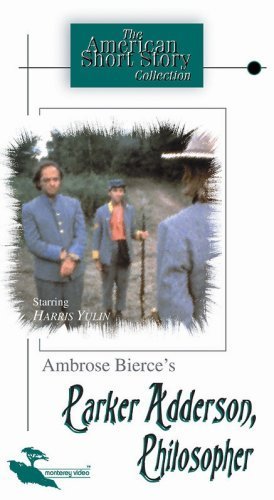
Episode 1.2 “Parker Adderson, Philosopher”
(Dir by Arthur Barron, originally aired on January 8th, 1974)
This adaptation of an Ambrose Bierce short story takes place during the Civil War. Parker Adderson (Harris Yulin) is a Union spy who is captured behind Confederate lines. Brought into the ramshackle Confederate camp, he’s put into a small cabin. He knows that, as a spy, he’s going to be executed in the morning and he seems to be at peace with that. For the most part, his captors treat him humanely. Though they may be at war, there doesn’t seem to be any real animosity between Adderson and the Confederate general (Douglass Watson) who is in charge of the camp. They are two men who have a job to do and they both seem to respect each other. At night, the General and Adderson have a conversation, talking about the war and mortality. Adderson gets a last meal. Everything seems to be strangely peaceful …. until Adderson discovers that he’s not going to be executed the way that he wants to be executed. By the time the morning sun rises, three men are dead. The formerly philosophical Adderson dies in a rage against his captors while the General dies with the peace and grace that Adderson originally envisioned for himself.
This was an effective and melancholy adaptation of Ambrose Bierce’s short story, one that captured both Bierce’s anti-war sentiments and his cynical view of the human condition. For all of his efforts to put himself above the realities of war, Adderson falls apart once the reality of his impending death becomes obvious. Meanwhile, the previously boorish general finds a certain redemption in his death, perhaps because the General, unlike Adderson, never tried to rationalize the violence of war or the cruelty of fate.
It’s a nicely-done episode, featuring good performances from both Watson and Yulin. I’ve gotten so used to seeing Yulin cast as corporate and government villains that it was really eye-opening to see him playing a complicated character for once. Clocking in at a little over 30 minutes, ParkerAdderson, Philosopher is a thought-provoking look at war and the men who fight it.
When it comes to unfortunate and dumb ways to die, getting electrocuted while standing in a puddle of spilled milk would seem to rank fairly high on the list. Unfortunately, it’s exactly what happens to the wife of Cal Jamison (Martin Sheen) during the first few minutes of 1987’s The Believers.
Traumatized by his wife’s death (and probably also by all of the people asking, “Wait a minute, she was standing in milk?”), Cal relocates from Minneapolis to New York City. Accompanying him is his young son, Chris (Harley Cross). Upon arriving in New York, Cal starts a tentative new relationship with artist Jessica Halliday (Helen Shaver) and he also gets a job working a psychologist for the NYPD.
And several members of the NYPD are going to need a good psychologist because they are investigating a series of brutal and ritualistic murders. All of the victims are children around Chris’s age and the murders are so grisly that even a hardened cop like Lt. Sean McTaggart (Robert Loggia) finds himself traumatized. When Detective Tom Lopez (Jimmy Smits, in one of his first roles) discovers one of the bodies, he has an apparent mental breakdown and starts to rant and rave about an all-powerful cult that Tom claims is committing the murders.
After Tom commits suicide, his ravings are dismissed as being the product of a mentally ill man. However, Cal is not so sure and starts to investigate on his own. What he discovers is a cult made up of a motely mix of wannabe gangsters and members of high society. While his friends and lovers either die or lose their minds around him, Cal discovers that the cult is actually closer to both him and his son than he ever realized.
An odd film, The Believers. On the one hand, there’s plenty of creepy scenes, including one in which Jessica gets a truly disturbing skin condition. The scenes in which Cal discovers that his friends have lost their minds as a result of the Cult are frequently sad and difficult to watch. Robert Loggia has scene that brought tears to my eyes. The mix of street witchery and upper class power lust is nicely handled and, as always, Harris Yulin makes for an effective villain. The Believers creates an ominous atmosphere of paranoia, one in which you really do come to feel that no one in the film is quite who they say they are.
And yet, it’s obvious that director John Schlesinger — whose previous films included Darlingand the Oscar-winning Midnight Cowboy — had more on his mind than just making an effective Omen-style horror film. He also tries to deal with Cal coming to terms with the death of his wife and Chris coming to terms with the idea of Cal dating someone new and all of those scenes of straight-forward domestic drama feel out-of-place in what should have been an energetic and grisly B-movie. In those ploddingly earnest scenes, Schlesinger seems to be trying almost too hard to remind us that he’s not really a horror filmmaker and they just feel out of place.
If there was ever a movie that called for the unapologetic and wickedly sardonic directorial vision of David Cronenberg, it was The Believers. As it is, The Believers is an intriguing but frustratingly uneven mix of paranoia, witchcraft, and domestic melodrama.
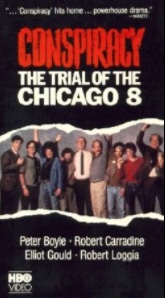
The year is 1969 and, in an Illinois courtroom, 8 political radicals stand accused of conspiring to disrupt the 1968 Democratic Convention. The prosecution is putting the entire anti-war movement on trial while the defendants are determined to disrupt the system, even if it means being convicted. The eight defendants come from all different sides of the anti-war movement. Jerry Rubin (Barry Miller) and Abbie Hoffman (Michael Lembeck) represent the intentionally absurd Yippies. Tom Hayden (Brian Benben) and Rennie Davis (Robert Carradine) are associated with the Students for a Democratic Society. Bobby Seale (Carl Lumbly) is one of the founders of the Black Panthers while David Dellinger (Peter Boyle) is a longtime peace activist. John Friones (David Kagan) and Lee Weiner (Robert Fieldsteel) represent the common activists, the people who traveled to Chicago to protest despite not being a leader of any of the various organizations. Prosecuting the Chicago 8 are Richard Schulz (David Clennon) and Tom Foran (Harris Yulin). Defending the 8 are two radical lawyers, Leonard Wienglass (Elliott Gould) and William Kunstler (Robert Loggia). Presiding over the trial is the fearsome and clearly biased Judge Julius Hoffman (David Opatoshu).
Conspiracy: The Trial of the Chicago 8 is a dramatization of the same story that inspired Aaron Sorkin’s The Trial of the Chicago 7 but, of the two films, it’s Jeremy Kagan’s The Trial of the Chicago 8 that provides a more valuable history lesson. By setting all of the action in the courtroom and recreating only what was said during the trial, director Jeremy Kagan and his cast avoid the contrived drama that marred so much of Sorkin’s film. Kagan trusts that the true story is interesting enough to stand on its own. Kagan includes documentary footage from the convention protest itself and also interviews with the people who were actually there. While Kagan may not have had the budget that Sorkin did, his film has the authenticity that Sorkin’s lacked. Kagan also has the better cast, with Michael Lembeck and Barry Miller both making Abbie Hoffman and Jerry Rubin into something more than the mere caricatures that they are often portrayed as being.
The Trial of the Chicago 8 was a film that Jeremy Kagan spent a decade trying to make. When he first tried to sell the idea behind the film to CBS in 1976, Kagan had Marlon Brando, Walter Matthau, George C. Scott, and Dustin Hoffman all willing to work for scale and take part in the production. CBS still passed on the project, saying that no one was interested in reliving the 60s. It wasn’t until 1987 that Jeremy Kagan was finally able to revive the film, this time with HBO. It actually worked out for the best because, with HBO, there was no need to try to come up with a “clean” version for the language that was used in the courtroom or in the interviews with the actual participants. The defendants could be themselves.
Though it has been overshadowed by Sorkin’s subsequent film, The Trial of the Chicago 8 is the definitive film about what happened in the aftermath of the the 1968 Democratic Convention.
The 1983 film, Scarface, is a misunderstood film. As we all know, it’s the story of Tony Montana (Al Pacino), who comes to Miami from Cuba along with his friend, Manny (Steven Bauer). In return for murdering a former member of Castro’s government, Tony is given a job working for Frank Lopez (Robert Loggia). When it becomes obvious that Tony is becoming too ambitious and might become a threat to him, Frank attempts to have Tony killed. However, the assassination attempt fails, Tony murders Frank, and then Tony becomes Miami’s richest and most powerful crime lord. Soon, Tony is burying his face in a mountain of cocaine while making deals with a sleazy Bolivian drug lord named Alejandro Sosa (Paul Shenar). Tony also marries Frank’s mistress, Elvira Hancock (Michelle Pfieffer), though it’s obvious from the start the the only person that Tony truly loves is his sister, Gina (Mary Elizabeth Mastrantonio). Anyway, it all eventually leads to a lot of violence and a lot of death. Even F. Murray Abraham ends up getting tossed out of a helicopter, which is unfortunate since his character was a lot of fun.
Scarface is a famous film, largely because of Oliver Stone’s quotable dialogue and the no holds barred direction of Brian DePalma. However, I think that people get so caught up on the fact that this is a classic gangster film that they miss the fact that Scarface is also an extremely dark comedy. It satirizes the excess of the 80s. Once Tony reaches the top of the underworld, he becomes a parody of the nouveau riche. He moves into a gigantic house and proceeds to decorate it in the most tasteless way possible and there’s something oddly charming about this crude, not particularly bright man getting excited over the fact that he can finally afford to buy a tiger. Towards the end of the film, there’s a scene where Tony rants while lounging in an indoor hot tub while Elvira languidly snorts cocaine and complains about the crudeness of his language and, at that moment, Scarface becomes a bit of a domestic comedy. Tony’s reached the top of his profession, just to discover that it takes more than a live-in tiger and a wardrobe of wide lapeled suits to achieve true happiness. So, he ends up sitting glumly in his office with a mountain of cocaine rising up in front of him. “The world is yours” may be Tony’s motto but it turns out that the world is extremely tacky. For all of his attempts to recreate himself as a wealthy and sophisticated man, Tony is still just a barely literate criminal with a nasty scar and a sour disposition. The only thing he’s gotten for all of his ruthless ambition is an order of ennui with a cocaine appetizer.
I’ve always found Brian DePalma to be an uneven director. He has a very distinct style and sometimes that style is perfectly suited to the story that he’s telling (i.e., Carrie) and sometimes, all of that style just seems to get in the way (i.e. The Fury). Scarface, however, is the ideal story for DePalma’s over-the-top aesthetic. DePalma’s style may be excessive but Scarface is a film about excess so it’s a perfect fit. For that matter, you could say the same thing about Oliver Stone’s screenplay. Stone has since stated that he was using almost as much cocaine as Tony Montana while he wrote the script. The end result of the combination of Stone’s script, DePalma’s hyperactive direction, Pacino’s overpowering lead performance, and Giorgio Moroder’s propulsive score is a film that feels as if every minute is fueled by cocaine. It’s not just a film that’s about drugs. It’s also a film that feels like a drug.
Scarface is a big movie. It runs nearly three hours, following Tony from his arrival in the United States to his final moments in his mansion, taking hundreds of bullets while grandly announcing that he’s still standing. (Even after all of the bad things that Tony has done — poor Manny! — it’s impossible not to admire his refusal to go down.) It’s also a difficult movie to review, largely because almost everyone’s seen it and already has an opinion. Personally, I think the film gets off to a strong start. I think the scenes of Tony ruthlessly taking control of Frank’s empire are perfectly handled and I love the scenes where Pacino and Steven Bauer just bounce dialogue off of each other. They’re like a comedy team who commits murder on the side. I also loved the “Take it to the limit” montage, which belongs in the 80s Cinema Hall of Fame. At the same time, I think the final third of the movie drags a bit and that Tony’s sudden crisis of conscience when he sees that a man that he’s supposed to murder has a family feels a bit forced. It also bothers me that Elvira just vanishes from the film. At the very least, the audience deserved more of an explanation as to where she disappeared to.
But no matter! Flaws and all, Scarface is a violent satire that holds up surprisingly well. Al Pacino’s unhinged performance as Tony Montana is rightly considered to be iconic. Pacino’s gives such a powerhouse performance that it’s easy to forget that the rest of the cast is pretty impressive as well. I particularly liked the wonderfully sleazy work of F. Murray Abraham and Paul Shenar. That said, my favorite character in the film remains Elvira, if just because her clothes were to die for and she just seemed so incredibly bored with all of the violent men in her life. She goes from being bored with Frank to being bored with Tony and how can you not admire someone who, even when surrounded by all Scarface’s excess, just refuse to care?
Today is Talk Like A Pirate Day which, let’s just be honest, is an extremely stupid holiday that mainly exists to remind us that “doubloon” is a deeply silly word.
Doubloons were a currency that were popular in Europe and South America back in the 18th century and pirates were always looking for doubloons. If you listen to enough pirate talk, you’ll quickly discover that there’s a lot different ways to say the word doubloon. Some people put the emphasis on the fist syllable while others emphasize the second. Some people say Due-bloon while others say Duh-bloon. Either way, it’s impossible to listen to pirates talk about doubloons without thinking that they sound very, very silly. The secret behind the success of The Pirates of the Caribbean franchise is an understanding that it’s impossible to take pirates seriously.
Unfortunately, I chose not to watch The Pirates of the Caribbean for Talk Like A Pirate Day. Instead, I watched 1995’s Cutthroat Island.
Cutthroat Island is a story of pirates, a lost treasure, and one big sea battle that literally seems to go on and on. There is occasional talk of doubloons, though not enough for my liking. Instead, most of the film deals with the efforts of Morgan (Geena Davis) to find a hidden treasure before her uncle, Dawg (Frank Langella), discovers it. Morgan has one-third of a map. It was originally tattooed on her father’s head. After he died, she scalped him and took over his boat. She also purchased a swashbuckling slave named Shaw (Matthew Modine) because Shaw is capable of reading Latin, the language in which the map is written. Needless to say, Shaw and Mogan fall in love while Dawg teams up with corrupt colonial officials to not only track down the treasure but to also capture his niece.
The film starts out as a romance with a dash of comedy before eventually transforming into a standard action movie. That means that boats get blown up and there’s a lot of scenes of people fencing. There’s also a lot of slow motion footage of bodies plunging into the ocean. The climatic battle goes on forever and it actually features Morgan hissing, “Bad dawg!” at her uncle.
(Amazingly, “Bad Dawg” isn’t the worst of the dialogue to be heard in Cutthroat Island. Morgan has a habit of saying stuff like, “I will maroon you on a rock the size of this table, instead of splattering your brains across my bulkhead” and “Since you lie so easily and since you are so shallow, I shall lie you in a shallow grave.”)
Throughout the film, there are hints of what Cutthroat Island could have been, if it hadn’t been such a by-the-numbers action flick. The fact that it was Morgan who was continually rescuing Shaw was a nice change-of-pace from the usual damsel-in-distress clichés that one finds in most pirate movies. When Morgan effortlessly breaks the neck of a soldier and sets free her crew, it’s a great moment, comparable to Angelina Jolie taking out Liev Schreiber in Salt or Milla Jovovich kicking zombie ass in a Resident Evil film. Unfortunately, director Renny Harlin (who was married to star Geena Davis, at the time) is usually too concerned with getting to the next action set piece to truly take advantage of the film’s subversive potential.
Frank Langella is smart enough to bellow his way through his villainous role while Matthew Modine appears to be so amused by the film’s terrible dialogue that it’s impossible not to like him. Geena Davis is convincing when she’s breaking necks and swinging swords but she delivers her dialogue like someone who has already figured out that the movie was a bad idea and resigned herself to the fact that her film career will never recover. She doesn’t appear to be having any fun, which kind of defeats the purpose of being a pirate.
Cutthroat Island was a huge and notorious box office flop and it’s still considered to be one of the biggest financial disasters in film history. Apparently, Hollywood was so traumatized that it would be another 8 years before there was another major pirate production. That production, of course, was Pirates of the Caribbean, a film that captured the fun that was so lacking in Cutthroat Island.
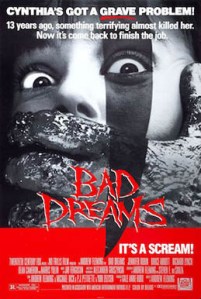
When she was a young girl, Cynthia (Jennifer Rubin) was a member of Unity Fields, a group of hippies led by the insane Franklin Harris (Richard Lynch). When Harris ordered the cult to join him in a fiery suicide pact, Cynthia was the only one to refuse. While all of the cult members when up in flames, Cynthia ended up spending 13 years in a coma. When she wakes up, she has no memory of the incident and finds herself as a patient in a psych ward. She has a support group to provide therapy. She has two doctors (Bruce Abbott and Harris Yulin) watching her every move. And she still has nightmares and visions of the long-dead Harris, appearing around the hospital, sometimes burned and sometimes not. When the members of her therapy group start to die, Cynthia is convinced that Harris has returned to claim her.
A year before starring in Bad Dreams, Jennifer Rubin made her film debut in A Nightmare on Elm Street 3: Dream Warriors. That seems appropriate because Bad Dreams would never have existed if not for A Nightmare on Elm Street. Franklin Harris is only a few bad jokes and a razor blade glove away from being Freddy Krueger’s older brother. However, if you can see past the movie’s derivative nature, Bad Dreams is not bad. Some of the deaths are inventive and Jennifer Rubin shows why she should have become a bigger star than she did. Though Franklin Harris may have been developed as stand-in for Freddy, Richard Lynch is memorably menacing and makes the role his own. Bad Dreams may have been a clone of another film but not all clones are bad.
No, this latest movie a day is not about Lisa and Erin’s cat.
Instead, Doc is yet another retelling of the famous gunfight at the O.K. Corral. Most cinematic depictions of that event present Wyatt Earp as being an upright hero, Doc Holliday as being his roguish friend, and the Clantons as being black hat-wearing villains. Doc takes the opposite approach. In this one, Wyatt (Harris Yulin) and his brother are sociopaths whose feud with the Clantons comes down to Ike Clanton’s (Mike Whitney) refusal to bow to their authority. Wyatt is a coward and a physical weakling, who gets beaten up by Ike and is only saved when his friend, Doc Holliday (Stacy Keach), steps forward to protect him.
In this film, Doc is clearly dying from the minute he first appears. Not only is Doc so thin that his bride actually carries him over the threshold, he is also constantly coughing. His misery is only relieved by opium, herbs, and the love of Katie Elder (Faye Dunaway), the prostitute that he wins in a poker game at the start of the film. Doc would rather just spend his remaining days with Katie but, because of his friendship with Wyatt, he is dragged into the Earp/Clanton fight.
Like most revisionist westerns of the early 1970s, Doc is a heavy-handed metaphor for the Vietnam War, with Wyatt Earp serving as an LBJ/Nixon stand-in and Doc Holliday standing in for all the leaders who enabled them. It sounds interesting and Stacy Keach gives a good performance but Doc is glacially paced and Harris Yulin is thoroughly miscast as Wyatt. It takes forever to get to the gunfight and the Doc is so determined to be revisionist that it forgets to be interesting. Doc is an unfortunate misfire.
The great character actor Warren Oates appeared in a lot of fairly obscure movies but none are as obscure as Prime Time.
With a running time of barely 70 minutes, Prime Time is a comedic sketch film that was meant to capitalize on the then-recent success of The Groove Tube, Tunnelvision, The Kentucky Friend Movie, and the first season of Saturday Night Live. According to the Unknown Movies Page, Prime Time was financed independently and was picked up for distribution by Warner Bros. After the Warner execs saw the finished film, they decided it was unreleasable so the film’s production team sold the film to Cannon Pictures, who were famous for being willing to release anything. The movie played in a few cities under the terrible title American Raspberry and then went straight to VHS obscurity.
Sketch comedies are usually hit-and-miss and Prime Time is definitely more miss than hit. The majority of the film is made up of commercial parodies but, since most of the commercials being parodied are no longer on the air, the humor has aged terribly. There is also a wrap-around story. The President (George Furth) and a general (Dick O’Neill) try to figure out where the commercial parodies are coming from and stop them before the broadcast leads to a riot. There are a few funny bits (including Harry Shearer as a stranded trucker looking for a ride and Kinky Friedman singing a song about “Ol’ Ben Lucas who has a lot of mucus”) but, for the most part, the film is epitomized by a skit where people literally get shit dumped on their head. The film’s opens with an incredibly racist commercial for Trans Puerto Rican Airlines and it’s all downhill from there.
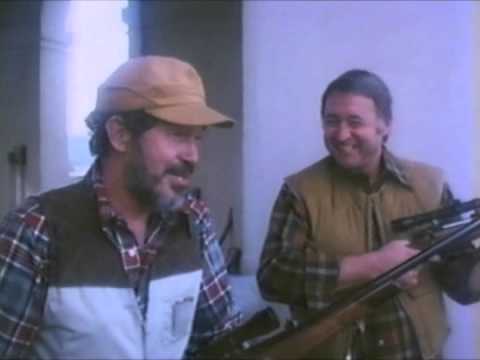
As for Warren Oates, he appears in an early skit. He and Robert Ridgely (best known for playing Col. James in Boogie Nights) play hunters who take part in the Charles Whitman Celebrity Invitational, climbing to the top of the Tower on the University of Texas campus and shooting at the people below. It’s even less funny now than it probably was in 1977.
How did Warren Oates end up in a movie like Prime Time? Even great actors have bills to pay. As for Prime Time, it is the one Warren Oates film that even the most dedicated Warren Oates fan won’t regret missing.
I have to admit that, seeing as how I was only 11 going on 12 back in 1997, I really wasn’t paying much attention to what was going on in the world at the time. But, whatever it was, it must have been something big and scary and it must have left people feeling deeply suspicious of the government. How else do you explain the fact that 1997 not only saw the release of Absolute Power, a film in which the President is a murderer, but Murder at 1600 as well.
Murder at 1600 opens with a White House maid finding the dead body of Carla Town (Mary Moore), an intern whose sole goal in life was apparently to have sex in every single room in the Executive Mansion. (And, before you judge, that happens to be my goal in life as well. So there.) Streetwise homicide detective Harlan Regis (Wesley Snipes) is on the case!
And he’s certainly got a lot of suspects. Could it be the Vice President (Chris Gillett)? Or maybe Alvin Jordan (Alan Alda), the National Security Advisor? Or how about Nick Spikings (Daniel Benzali), the bald-bef0re-bald-was-cool head of the Secret Service? Or maybe it the President’s son (Tate Donavon)? Or maybe even the President (Ronny Cox) himself!?
Fortunately, Regis is assigned a partner, Secret Service agent Nina Chance (Diane Lane). When Regis first meets her, he’s all, “Oh my God, you’re a woman!” And then Nina’s all, “I also won an Olympic medal for sharp shooting!” And then Regis is like, “I bet that will be a relevant plot point before the film ends!”
Of course, Regis already has a regular partner, as well. His name is Detective Stengel and he’s played by Dennis Miller, which just seems strange. Stengel basically looks like Dennis Miller, sounds like Dennis Miller, and acts exactly like Dennis Miller, except for the fact that he’s a cop. His jarringly out-of-place presence in this film just adds to Murder at 1600‘s general air of weirdness.
Meanwhile, it turns out that the North Koreans are up to no good and the President is being pressured to take military action. However, he’s being distracted by this whole criminal investigation thing. Will the country survive or did its future die at 1600?
(And why doesn’t the President just send in Team America to take care of the situation? Or maybe James Franco and Seth Rogen. There are way to deal with the North Koreans….)
(By the way, have you noticed how brave everyone online is when it comes to being snarky about the one country in the world that doesn’t have internet access? If Kim Jong Whatevuh ever gets a twitter account, I bet everyone will start following him and asking him for retweets.)
Murder at 1600 is an enjoyably ludicrous thriller. It’s one of those films that you’ll enjoy as long as you don’t take it seriously. Take it seriously and you’ll end up asking question like why the FBI isn’t involved in the investigation and whether or not the solution to the film’s mystery is a bit too convoluted to make any logical sense. However, if you simply decide to enjoy Murder at 1600 for what it is, an extremely pulpy thriller that’s full of nonstop melodrama, overwritten dialogue, and a healthy distrust of the government*, then you’ll find this to be an entertaining thriller.
At the very least, a White House full of potential murderers is probably a lot more realistic than anything that you might see in The American President.
If you ever find yourself on the campus of the University of North Texas and you need to kill some time, stop by the UNT Library, go up to the second floor, find the biographies, and track down a copy of Peter Manso’s Mailer: His Life and Times.
Back in December of 2007, at a time when I really should have been studying for my finals, I spent an entire afternoon in the library reading Manso’s book. I didn’t know much about Norman Mailer, the Pulitzer prize-winning writer and occasional political candidate, beyond the fact that he died that previous November and that a lot of older people who I respected apparently thought highly of his work. Though Manso’s book had been written 20 years earlier, it still provided an interesting portrait of the controversial author. It was largely an oral history, full of interviews with people who had known Mailer over the years. As I skimmed the book, it quickly became apparent that, among other things, Mailer was a larger-than-life figure.
For me, the book was at its most interesting when it dealt with Mailer’s attempts to be a filmmaker. In the 1960s, Mailer directed three movies. All three of them also starred Norman Mailer and featured his friends in supporting roles. All three of them were largely improvised. And, when released into theaters, all three of them were greeted with derision.
Maidstone, Mailer’s 3rd film, was filmed in 1970. In the film, Mailer played Norman Kingsley, an avante garde film director who is running for President. Over the course of one weekend, while also working on a movie about a brothel, Norman meets with potential supporters and debates the issues. And, of course, shadowy figures plot to assassinate Norman, not so much because they don’t want him to be President as much as they want him to be a martyr for their vaguely defined cause.
Just based on what I read in Manso’s book, it’s hard not to feel that the making of Maidstone could itself be the basis of a good movie. Mailer essentially invited all of his friends to his estate and they spent 5 days filming, with no script. It was five days of drinking, drugs, and bad feelings.
At one point, actor and painter Herve Villechaize (who would later play Knick Knack in The Man With The Golden Gun) got so drunk and obnoxious that he was picked up by actor Rip Torn and literally tossed over a fence. The unconscious Villechaize ended up floating face down in a neighbor’s pool. After fishing Villechaize out of the pool, the neighbor tossed him back over the fence and shouted, “Norman, come get your dwarf!”
Eventually, after five days, filming fell apart. Some members of the cast were okay with that. And one most definitely was not..
Fortunately, Maidstone is currently available on YouTube so I watched it last night. Unfortunately, the film itself is never as interesting as the stories about what went on behind the cameras. Maidstone is essentially scene after scene of people talking and the effectiveness of each scene depends on who is in it. For instance, Norman’s half-brother is played by Rip Torn, a professional actor with a big personality. The scenes with Torn are interesting to watch because Rip Torn is always interesting to watch. However, other scenes feature people who were clearly cast because they happened to be visiting the set on that particular day. And these scenes are boring because, quite frankly, most people are boring.
And then you’ve got Norman Mailer himself. For an acclaimed writer who was apparently quite a celebrity back in the day, it’s amazing just how little screen presence Norman Mailer had as an actor. Preening for the camera, standing around shirtless and showing off his hairy back along with his middle-aged man boobs, Mailer comes across as being more than a little pathetic. He’s at his worst whenever he tries to talk to a woman, giving off a vibe that’s somewhere between creepy uncle and super veiny soccer dad having a midlife crisis.
It’s an uneven film but, for the first half or so, it’s at least interesting as a time capsule. For those of us who want to know what rich intellectuals were like in the late 60s, Maidstone provides a service. However, during the second half of the film, it becomes obvious that Mailer got bored. Suddenly, all pretense towards telling an actual story are abandoned and the film becomes about Mailer asking his cast for their opinion about what they’ve filmed so far.
And then, during the final 15 minutes of the film, Norman Mailer decides to have the cameramen film him as he plays with his wife and children. This is apparently too much for Rip Torn who, after spending an eternity glaring at Mailer and undoubtedly thinking about everything he could have been doing during those five day if he hadn’t been filming Maidstone, walks up to Mailer, says, “You must die, Kingsley,” and then hits Mailer on the head with a hammer.
This, of course, leads to a long wrestling match between Mailer and Torn and, as the cameras roll, blood is spilled and insults are exchanged. There’s a lot of differing opinions about whether this final fight was spontaneous or staged. Having seen the footage, I get the impression that Mailer was caught off guard but that Torn probably let the cameraman know what he was going to do ahead of time.
Regardless, it’s hard to deny that the pride of Temple, Texas, Elmore “Rip” Torn, appears to be the one who came out on top. After the fight, Mailer and Torn have a lengthy argument that amounts to Rip saying that he had to do it because it was the only way that the film would make sense while Mailer replies with some of the least imaginative insults ever lobbed by a Pulitzer winner.
(So basically, Rip Torn won both the physical and the verbal rounds of the fight.)
Anyway, you can watch the entire Rip Torn/Norman Mailer confrontation below.
Now, while the fight is really the only must-see part of Maidstone, it still has considerable value as a time capsule of the time when it was made. You can watch it below!



 When she was a young girl, Cynthia (Jennifer Rubin) was a member of Unity Fields, a group of hippies led by the insane Franklin Harris (Richard Lynch). When Harris ordered the cult to join him in a fiery suicide pact, Cynthia was the only one to refuse. While all of the cult members when up in flames, Cynthia ended up spending 13 years in a coma. When she wakes up, she has no memory of the incident and finds herself as a patient in a psych ward. She has a support group to provide therapy. She has two doctors (Bruce Abbott and Harris Yulin) watching her every move. And she still has nightmares and visions of the long-dead Harris, appearing around the hospital, sometimes burned and sometimes not. When the members of her therapy group start to die, Cynthia is convinced that Harris has returned to claim her.
 No, this latest movie a day is not about Lisa and Erin’s cat.


 Through the Shattered Lens