Late Night Retro Television Reviews: Baywatch Nights 1.5 “Just A Gigolo”


Welcome to Late Night Retro Television Reviews, a feature where we review some of our favorite and least favorite shows of the past!  On Tuesdays, I will be reviewing Baywatch Nights, an detective show that ran in Syndication from 1995 to 1997.  The entire show is currently streaming on Youtube!
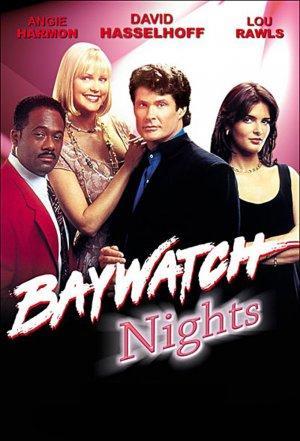
This week, Mitch and Ryan go undercover!

Episode 1.5 “Just A Gigolo”

(Dir by Martin Pasetta, originally aired on October 28th, 1995)

David Hasselhoff is a gigolo!

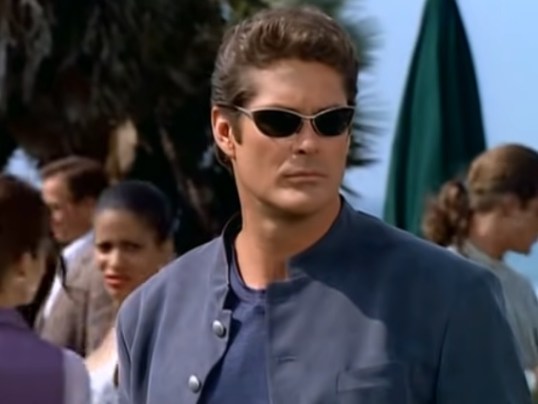
No, not really.  Mitch may be wearing sunglasses and speaking broken French but that’s just because he has gone undercover as a con artist.  He’s trying to expose the actual gigolo, a younger man named Grant Styles (Joel Beeson).  Grant swindled a good deal of money from Mitch’s friend, Julie (Candy Clark), but, because Julie voluntarily handed over the money and told Grant that he didn’t have to pay her back, no crime was committed.

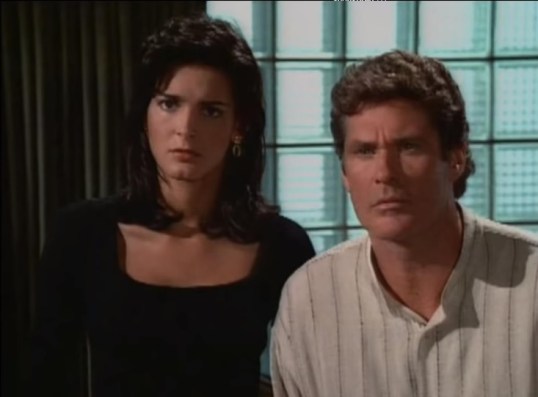
“To catch a gigolo,” Mitch tells us, “I decided to become a gigolo.”  This is followed by a lengthy exercise montage.  Finally, after a week of lifting weights and jogging on the beach, Mitch is ready to make his debut at the local country club.  Accompanying him is Ryan (Angie Harmon), who is pretending to be a wealthy divorcee.  (Mitch’s aunt agrees to allow Ryan to use her mansion.)  Grant immediately starts hitting on Ryan and Mitch can only watch as Ryan flirts back.  Mitch actually starts to feel jealous and Ryan, for her part, starts to feel jealous whenever she sees Mitch flirting with the older women at the club.  Could Mitch and Ryan be falling in love?

Actually, Mitch and Ryan do kind of make a cute couple.  I mean, seriously, they just look like they belong together.  From the first episode of this series, David Hasselhoff and Angie Harmon have had a playful chemistry and their personalities definitely compliment each other.  These two definitely need to get together.

For now, though, the important thing is exposing Grant and his “manager,” Margo Curtis (future reality star Lisa Vanderpump).  Though Mitch can’t stand the idea of Grant spending time with Ryan, he still has to do things like stand perfectly still while Grant beats him up because fighting back would apparently blow his cover.  (To be honest, I think the only reason the fight scene was included was so Hasselhoff could look directly at the camera and do a “Why me?” shrug.)  After Grant beats up Julie, Mitch and Ryan realize that Grant is far more dangerous than the average gigolo.  After Grant, while flying a paraglider, tries to shoot Mitch on the beach, Mitch and Ryan trick him into breaking into Ryan’s mansion so that he can be captured and sent away.

While all of this is going on, Garner (Gregory Alan Williams) and Destiny (Lisa Stahl) worked together to  catch a notorious bail jumped named Bobby Bahama (Jeff Dashnaw).  Most bail jumpers would probably try to leave the state but Bobby jumps bail and then decides to just keep hanging out at the beach and his favorite club.  Destiny meets Bobby at the club, invites him to her hotel room, and then handcuffs him to the bed.

“Kinky,” Bobby says.

No, Bobby, the term is “captured.”

I enjoyed this episode, not so much for the basic plot but for the chemistry between Angie Harmon and David Hasselhoff.  Like I said earlier, they’re an appealing couple and they have a fun chemistry whenever they’re acting opposite each other.  Any show that features David Hasselhoff pretending to be a gigolo is going to have a bizarre appeal to it but Mitch’s relationship with Ryan was strong enough that not even a rather silly storyline could sabotage it.

Last Night Retro Television Reviews: Baywatch Nights 1.4 “Deadly Vision”


Welcome to Late Night Retro Television Reviews, a feature where we review some of our favorite and least favorite shows of the past!  On Tuesdays, I will be reviewing Baywatch Nights, an detective show that ran in Syndication from 1995 to 1997.  The entire show is currently streaming on Youtube!

Tonight, Mitch reveals a new talent!

Episode 1.4 “Deadly Vision”

(Dir by Paul Lynch, originally aired on October 21st, 1995)

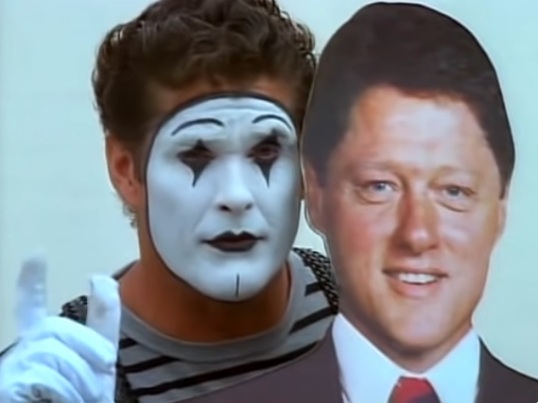
The highlight of this week’s episode is an extended sequence in which Mitch (David Hasselhoff) goes undercover.  He’s trying to protect his friend Destiny (Lisa Stahl) from a serial killer.  Because Destiny spends her days doing Tarot card readings in Malibu, Mitch decides that the best way to keep an eye on her is to dress up like a mime and perform for the crowds.

The crowds love Mitch, which leads me to wonder if maybe Mitch has some sort of previous mime experience.  I mean, either Mitch has had some professional training or pretending to be in a box is the easiest thing in the world to master because Mitch pulls it off like a pro.

At one point, Mitch poses with a cardboard cut-out of Bill Clinton.

Mitch does quite a bit as a mime.  He gets locked in an invisible box.  He juggles invisible balls.  He sings a silent song.  He even chases down and catches a thief.  What Mitch does not do is catch the serial killer.  The serial killer, who is probably not a fan of mimes, does not show up.  In fact, one could argue that Mitch doesn’t really accomplish any thing of particular importance while pretending to be a mime but the whole sequence pretty much epitomizes everything that makes Baywatch Nights so much fun.  David Hasselhoff as a mime?  It makes no sense but it’s fun!  A random cardboard cut-out of Bill Clinton?  It makes no sense but it’s fun!  Baywatch Nights is a fun show, precisely because it is so shamelessly silly.

Of course, Destiny is not having as much fun as Mitch is.  Destiny is continually having vision of people with whom she is casually acquainted being murdered.  Mitch and Garner (Gregory Alan Williams) have no problem believing that Destiny is having visions of the killer attacking people.  Ryan (Angie Harmon) is a bit more skeptical and I was happy about that, just because I’m also pretty skeptical about people who say that they can see the future.  It’s nice to have a character to whom I can relate on this show.  Mitch, Ryan and Garner think that the killer might be a con artist and a gigolo who they’re already investigating.  However, the show reveals early on that Destiny is being stalked by a crazed painter named Burt (Carl Weintraub).  Burt is obsessed with Destiny and he doesn’t like it when Destiny talks to other people, whether she’s telling their fortune or helping them investigate a crime.

In the end, the killer is thwarted and Destiny’s life is saved.  Hopefully, Mitch will continue to pursue his career as a mime because he’s got the talent!  I mean, you can’t lifeguard forever, right?

Late Night Retro Television Reviews: Baywatch Nights 1.3 “Silent Witness”


Welcome to Late Night Retro Television Reviews, a feature where we review some of our favorite and least favorite shows of the past!  On Tuesdays, I will be reviewing Baywatch Nights, an detective show that ran in Syndication from 1995 to 1997.  The entire show is currently streaming on Youtube!

This week, Mitch proves that he still has much to learn about being a private investigator.

Episode 1.3 “Silent Witness”

(Dir by Richard Friedman, originally aired on October 14th, 1995)

Have you ever wondered why Mitch’s career as a private investigator didn’t last longer than just two years?

The simple answer, of course, is that Baywatch Nights did not exactly get the best ratings and the show was canceled after two seasons.  Despite the fact that Baywatch Nights is an undeniably fun show, it was undoubtedly harmed by the fact that it didn’t feature lifeguards running in slow motion.  It was a Baywatch spin-off that had little of what attracted viewers to the original show.  Personally, I would think that the presence of David Hasselhoff would be enough but apparently, audiences in the 90s disagreed.

However, in-universe, I think Mitch’s failure to stick with the detective thing is that it doesn’t appear that he was very good at it.

Consider this episode.  Hayley Cartwright (Paige Moss) is a teenage runaway who, while walking along the beach, spots a man in the ocean being pulled under the water and drowned by someone wearing a diving outfit.  The murderer emerges from the ocean and tries to grab Haley.  Haley gets away but not before the killer shouts at her to keep quiet or she’ll be next.

Mitch, who is jogging across the beach, spots a stunned and bruised Haley collapsing on the beach.  Mitch checks out her injuries and assures her that she’s okay but Haley, who is understandably scared of everyone, runs away from him.

Later, Mitch is approached by a woman (Debby Boone) who says that her name is Lorraine and that she is Haley’s daughter.  Lorraine says that she just wants her daughter to come home and she asks Mitch to help find her.  Mitch agrees and sets out to find Haley while giving Lorraine regular updates.

Here’s what Mitch does not do.  He doesn’t bother to ask for any identification from Lorraine.  He doesn’t check out Lorraine’s story before agreeing to help her.  He doesn’t stop to consider that Haley might have a reason for acting like she’s scared for her life.  And really, it would have been good if Mitch had considered all of that because guess what?  LORRAINE IS NOT HALEY’S MOTHER!  Instead, she’s working with the killers!

Fortunately, Haley’s real mother (Janet Eilber) shows up and tells Ryan and Garner that she’s looking for her daughter.  Ryan and Garner actually ask the woman for identification and the woman reveals that she not only has her driver’s license but she also brought Haley’s birth certificate!  It’s a good thing that Haley’s real mom showed up because Mitch has found Haley hiding on a fishing boat and now, he’s having to defend her from the killers!  Now, fortunately, Mitch may not be a good detective but he’s still David Hasselhoff so he is able to beat up the killers and save Haley’s life.

It’s a fairly standard episode, in that it’s not particularly memorable but the California scenery is nice to look at and it’s a show you can relax with.  That said, the episode does have a brilliant opening, in which Mitch and Garner save Destiny from some bank robbers that are menacing her in an amusement park.  This leads to a fight on a Ferris wheel and a miracle-go-round.  Destiny is nearly run over by a miniature train!  It’s a fun and over-the-top sequence, one that has next to nothing to do with the rest of the episode but it does indicate that the people involved in the show knew better than to take any of this too seriously.

Finally, Ryan gets a minor plot, in which she buys a home in Malibu, just to discover that she’s basically purchased land in a trailer park.  It was silly but it showed off Angie Harmon and David Hasselhoff’s likable and playful chemistry.  Watching the two of them together, it’s hard not to regret that Mitch wasn’t a better detective.

Late Night Retro Television Reviews: Baywatch Nights 1.2 “Bad Blades”


Welcome to Late Night Retro Television Reviews, a feature where we review some of our favorite and least favorite shows of the past!  On Tuesdays, I will be reviewing Baywatch Nights, an detective show that ran in Syndication from 1995 to 1997.  The entire show is currently streaming on Youtube!

This week, David Hasselhoff battles John O’Hurley on Baywatch Nights!

Episode 1.2 “Bad Blades”

(Dir by George Fenady, originally aired on October 7th, 1995)

Cosmetics mogul Frances Sandreen (Lois Nettleton) has hired Mitch, Garner, and Ryan to help her track down her wayward son, Todd (Jason Hervey).  Like a lot of rich and spoiled kids, Todd has had his problems with the law.  He’s a wanderer, someone who has spent most of his short life pursuing extreme sports and who dropped out of college after just a semester or two.  Mitch and Garner think that the kid sounds like a spoiled brat but they need the money so they take the case.

(Why is Mitch so poor?  He never seemed to be struggling financially on Baywatch.)

Unfortunately, Todd has fallen in with an even worse crowd than his old prep school friends.  He’s joined a group of roller-skating burglars who rob apartments and delivery vans and then skate away into the darkness.  One reason why they’re so good at their job is because they spend hours every day practicing.  If you’ve ever wanted to spend 20 minutes of your life watching footage of people skating off of ramps in slow motion, this episode should be right up your alley.

Leading this gang of thieves is the impeccably-dressed Kemp.  Kemp is played by John O’Hurley of Dancing With Stars, Family Feud, and Seinfeld fame.  (O’Hurley also appeared in a few episodes of Baywatch, always playing a different character.)  With his perfect haircut and his resonant voice, O’Hurley makes for an entertaining villain.  There’s nothing about O’Hurley’s performance that suggests that he is in any way taking the role of Kemp particularly seriously.  O’Hurley plays him like a comic book villain and that is definitely to the episode’s benefit.

As entertaining as O’Hurley and the skating scenes are, this episode reveals a huge problem with the first season of Baywatch Nights.  Other than the fact that Hasselhoff is wearing a shirt for the entire runtime, there’s nothing about this episode to really distinguish it from a typical episode of BaywatchBaywatch has its share of episodes about spoiled rich kids and their worried parents.  Baywatch was always looking for an excuse to pad out an episode with some extreme sports footage.  Even the scene where Garner and Mitch chase the thieves across the Los Angeles river felt like it was lifted from Baywatch or any other Los Angeles-based crime show for that matter.

As well, it’s impossible not to notice that, for an a show called Baywatch Nights, most of the action takes place during the day.  I thought being a private eye was only supposed to be Mitch’s night job.  Who is watching the beach while Mitch is investigating crimes?  It really does seem like Mitch is violating some sort of lifeguard code here.

Next week: Mitch searches for the only witness to a murder!

Late Night Retro Television Reviews: Baywatch Nights 1.1 “Pursuit”


Welcome to Late Night Retro Television Reviews, a feature where we review some of our favorite and least favorite shows of the past!  On Tuesdays, I will be reviewing Baywatch Nights, an detective show that ran in Syndication from 1995 to 1997.  The entire show is currently streaming on Tubi!

The year was 1995 and Baywatch, a show about lifeguards, was the most popular in the world.  Even though the critics never cared for the show, it got monster ratings.  Having played head lifeguard Mitch Buchanan for 6 years, star David Hasselhoff was growing tired with Baywatch’s format.  He wanted to try something new and that new thing was Baywatch Nights.  During the two years that Baywatch Nights aired, Mitch would spend his days as a lifeguard and his nights as a private investigator!

Baywatch Nights ran for two seasons.  The second season is remembered for featuring Mitch battling aliens, ghosts, and vampires.  The first season featured Mitch dealing with more traditional villains.  For our latest Late Night Retro Television Review, we’ll be looking at both seasons of Baywatch Nights!

Episode 1.1 “Pursuit”

(Dir by Gus Trikonis, originally aired on September 30th, 1995)

The very first episode of Baywatch Nights opens with Mitch Buchanan (played, of course, by David Hasselhoff) speaking directly to the audience.  He’s standing at his lifeguard stand, wearing his signature red Baywatch swim trunks.

“Some people,” Mitch says straight to the camera, “think that the beach closes when the sun goes down.  Uh-uh.  That’s when it really starts to heat up.”  Mitch goes on to explain that he’s working a second job as a private investigator.  His old friend, Garner Ellerbee (Gregory Alan Williams), is a partner in a detective agency with Ryan McBride (Angie Harmon), who was born in Texas, became a detective in New York, and recently moved to California.  Mitch is working with them.  Suddenly, Mitch says that he hopes those watching will enjoy this “new show.”

This brings up an interesting question.  Are we listening to Mitch or are we listening to David Hasselhoff?  If it’s David Hasselhoff talking directly to the audience, his monologue would seem to suggest that he thinks that Baywatch is real life, even though it’s a TV show.  He talks about Garner and Ryan as if they’re real people.  If we’re listening to Mitch Buchanan, that means that he has somehow become aware that he’s a character on a television show.  Has Mitch become self-aware?  Or has he realized that he’s living in some sort of Truman Show-style situation?

These are all questions that will probably never be answered.

As for the episode, it jumps right into things.  Mitch, Garner, and Ryan have their private detective offices located right above a nightclub called — wait for it — “Nights.”  Occasionally, they are helped by Destiny Desimone (Lisa Stahl), a perky blonde who spends her days doing Tarot card readings on the beach and her nights hanging out around the office.  When Ryan can’t figure out how to use a computer, Destiny is there to help  When Mitch and Garner can’t figure out how to have multiple landlines in one office, Destiny figures it all out!  It’s all very 90s, with boxy computers and long telephone cords.

Mitch’s first case involves serving as a bodyguard for a model named Cassidy (Carol Alt).  Cassidy says that someone is stalking her and she’s especially worried because another model has recently been murdered.  (“Her name was Alexa,” Mitch muses as he looks at the murdered model’s body, “This was her last photo session.”)  Mitch protects Cassidy and, of course, he falls for her but, in the end, he realizes that Cassidy has actually been stalking herself and was responsible for the other model’s death.  Mitch is shaken by his discovery of Cassidy’s guilt, even though the exact same thing previously happened to him during the first season of Baywatch, when he fell in love with a woman who turned out to be a black widow murderer.  Mitch muses that he knows how to be a lifeguard but he’s still learning how to be a private eye.

(Mitch, seriously, just watch reruns of Baywatch!  I mean, you’re only one episode into Baywatch Nights and you’re already recycling old plots so I imagine you should just keep doing what you did the first time.)

This episode’s plot is pretty predictable but, for a pilot, it’s likable.  Angie Harmon, Gregory Alan Williams, and David Hasselhoff all have a likable chemistry and, as a Texas girl, I appreciated the fact that Angie Harmon’s accent was authentic.  Mitch narrates the episode in a hard-boiled, private eye manner and David Hasselhoff’s earnest delivery is so at odds with his words that it becomes rather charming.  As a friend of mine once said when we watched him in Starcrash, “Every country should have a Hoff!”

As far as first episodes go, Pursuit does everything it needs to do.  It introduces us to the characters and their personalities.  Ryan is supercool and has really pretty hair.  Destiny is quirky.  Garner is determined.  And Mitch …. well, Mitch is David Hasselhoff.  Wisely, the first episode didn’t spend too much time trying to rationalize the idea of Mitch working all day as a lifeguard and then all night as a private eye.  Realistically, it seems like he would end up too exhausted to be good at either job.  Instead, the first episode simply tells the audience that Mitch is now a detective and that the audience better be willing to accept it.

(Unfortunately, most of the audience didn’t accept it, which is why the second episode featured Mitch dealing with sea monsters and resurrected Vikings.  We’ll get to that in a while.)

Next week, Mitch battles a group of thieves on skates!  Seriously, you know that’s going to be fun!

October Positivity: To Hell and Back (dir by Christine Swanson)


The Book of Job is a bit of a Biblical Rorschach test.

Job is a prosperous man who always obeys and give thanks to God.  The Devil claims that Job’s faith is only due to the fact that he’s successful and has a large family.  The Devil boasts that, if he’s allowed to ruin Job’s life, Job will respond by cursing the name of God.  Instead of asking the Devil what he’s doing outside of Hell, God says, “Go ahead, just don’t kill him.”  The Devil kills Job’s family.  The Devil kills all of Job’s servants.  The Devil takes away all of Job’s wealth and afflicts Job with terrible sores.  Job’s friends tell Job that he should blame and reject God but, because Job refuses to do so, he is rewarded with a new family and even more servants.

Some people look at the story of Job and they see it as being a story about the importance of having faith, even in the most troubling of times.  Job refuses to surrender his faith and he is rewarded.  Even though Job cannot understand why bad things are happening to him, he refuses to surrender to despair and anger and puts his faith in the idea that God has a plan.

Others look at this story and see Job as a pawn in some private game between God and the Devil.  Job keeps his faith and is ultimately rewarded but his family and his servants still all die.  Job may be rewarded but why should he have to suffer just to prove a point to the Devil?  Indeed, what is the Devil doing in Heaven, debating with God in the first place.  I mean, the Devil got kicked out of that place.  He’s in Hell for a reason.

The 2015 film, To Hell and Back, is a modern-day retelling of the Book of Job.  Joe (Ernie Hudson) is a successful businessman, a man who built his company up from nothing and who now lives in a mansion with his wife (Vanessa Bell Calloway) and his five children.  Joe gives money to worthy causes and he is never without his Bible.  God and the Devil are heard in voice-over, debating the sincerity of Joe’s faith.  God agrees to allow Joe to be tested.  One tragedy after another befalls Joe and his family.  One son is killed during a burglary.  One daughter commits suicide.  A car crash leaves another daughter dead and another son in a wheelchair.  Joe’s company is driven into bankruptcy by a lawsuit while the last of Joe’s sons leaves to start his own company.  Abandoned by even his wife, Joe grows ill and soon finds himself homebound.

Even if the film leaves us wondering why God would hurt someone just to prove a point, To Hell and Back is a well-directed and well-acted film.  Ernie Hudson gives a heart-breaking performance as Joe, a man who always tries to do the right thing and is basically punished at every single turn.  Joe definitely deserves better than to just be a pawn in a cosmic waver but at least Ernie Hudson gets a chance to show off what a good actor he can truly be.

Film Review: In The Line of Fire (dir by Wolfgang Petersen)


Earlier today, it was announced that director Wolfgang Petersen had passed away.  He was 81 years old and had been suffering from pancreatic cancer.  Though Petersen started his career making films in his native Germany (and his 1981 film, Das Boot, remains the most Oscar-nominated German film of all time), Petersen eventually relocated to Los Angeles and established himself as a very successful director of thrillers and star-filled action films.

Last month, I watched one of Petersen’s films.  First released in 1993, In The Line of Fire stars Clint Eastwood as Frank Horrigan.  Frank is a veteran member of the Secret Service, still serving at a time when almost all of his colleagues have either retired or died.  When we first meet Frank, he and his new partner, Al (Dylan McDermott), are arresting a gang of counterfeiters and Frank (and the then 63 year-old Eastwood) is proving that he can still take down the bad guys.

But is Frank still up to protecting the President?  Of the agents that were with President Kennedy when he was assassinated in 1963, Frank Horrigan is the last one standing.  He’s the only active secret service agent to have lost a president and he’s haunted by what he sees as being his failure to do his job and the feeling that America has never recovered from Kennedy’s death.  Also obsessed with Frank’s history is a mysterious man who calls himself Booth.  Booth (played by John Malkovich, who received an Oscar nomination for his performance) starts to call Frank.  He informs Frank that he’s planning on assassinating the president, who is currently traveling the country as a part of his reelection bid.  Booth views Frank as being a worthy adversary and Frank, looking for redemption, requests to be returned to the Presidential Protective Division.

While Frank struggles to keep up with both the President and the younger agents, Booth slowly and methodically puts his plan in motion.  He builds his own wooden gun and tries it out on two hunters who are unfortunate enough to stumble across him.  Making a heart-breaking impression in a small role, Patrika Darbo plays the bank teller who, unfortunately, comes a bit too close to uncovering Booth’s secret identity.  Booth is friendly and sometimes apologetic and he quickly shows that he’s willing to kill anyone.  It’s a testament to both the skill of Malkovich’s performance and Petersen’s direction that the audience comes to believe that there’s a better than average chance that Booth will succeed.  He just seems to have such a strong belief in himself that the audience knows that he’s either going to kill the President or that he’s going to willingly die trying.

Meanwhile, no one believes in Frank.  The White House Chief of Staff (Fred Dalton Thompson, later to serve in the Senate and run for President himself) views Frank as being a nuisance.  The head of the detail (Gary Cole) thinks that Frank should be put out to pasture.  Only Lilly Raines (Rene Russo), another agent, seems to have much faith in Frank.  While Frank is hunting Booth, he falls in love with Lilly and she with him.  (Fortunately, even at the age of 63, Eastwood still had enough of his old Dirty Harry charisma that the film’s love story is credible, despite the age difference between him and Russo.)  The hunt for Booth reawakens something in Frank.  Just as Booth has a psychological need to be pursued and challenged, Frank needs an enemy to which he can re-direct all of his guilt and self-loathing.  Frank becomes a stand-in for everyone who fears that, because of one particular incident or tragedy, America will never regain the strength and promise that it once had.  (In Frank’s case, that strength is symbolized by his idealized memories of JFK.)  Defeating Booth is about more than just saving America.  It’s about redeeming history.

It all makes for an very exciting thriller, one in which Eastwood’s taciturn style of acting is perfectly matched with Malkovich’s more cerebral approach.  Just as the two characters are challenging each other, Eastwood and Malkovich also seem to challenge each other as actors and it leads to both men giving wonderful performances.  Wolfgang Petersen not only does a good job with the action scenes but also with generating some very real suspense.  The scene in which Malkovich attempts to assemble his gun under a table is a masterclass in directing and evidence that Petersen had not only watched Hitchcock’s films but learned from them as well.

As directed by Petersen and performed by Malkovich and Eastwood, In The Line of Fire emerges as a film that was more than just an exciting thriller.  It was also a mediation on aging, guilt, love, redemption, and the national traumas of the past.  It’s a film that stands up to multiple rewatches and as a testament to the talent of the man who directed it.

Horror on TV: Baywatch Nights 2.22 “A Thousand Words” (dir by Tracy Lynch Britton)


For tonight’s journey into the world of televised horror, we present to you the last ever episode of Baywatch Nights.  In this episode, David Hasselhoff and Angie Harmon investigate a haunted restraunt.  Then Angie disappears and the Hoff has to rescue her!

I have to say that Baywatch Nights was a silly show but I kind of liked it.  I mean, you’ve got David Hasselhoff doing the full Hoff in every episode and I think that he and Angie Harmon had kind of a fun chemistry.  I’m kind of sad that this is the last episode.  Tomorrow, we’ll start a new show.  Hopefully, I can find one.  YouTube is so weird nowadays.

But, anyway, here’s the final episode of Baywatch Nights!

Film Review: Like A Country Song (dir by Johnny Remo)


So, stop me if this sounds familiar.

You’ve got an old country boy named Bo (played by Billy Ray Cyrus) who, years ago, reacted to a family tragedy by abandoning his wife and son.  He’s spent the last decade on the road, drinking and doing drugs and basically being totally irresponsible.  Now, he’s returned home and he’s trying to be sober and he’s hoping that he might even be able to reconnect with his family.

And then you’ve got Jake (played by Joel Smallbone), who is an up-and-coming country music star.  He’s cocky.  He’s arrogant.  He’s still in love with his ex.  He’s returned home because he’s lost.  He’s also Bo’s son.  Years ago, his mother (Jennifer Taylor), told him that Bo was dead.

So, now, Bo and Jake are both wandering around the same town.  Do you think there’s a chance that Bo and Jake might meet each other?  And maybe Bo’s going to see that Jake is heading down the exact same bad road that Bo’s spent the last few years traveling?

Does that sound just like a country song?

Superficially, yes.  However, there are a few differences.  For one thing, 2014’s Like A Country Song was rated PG-13 and clearly made for a family audience.  That means there’s far less sex in this movie than you’ll find in the average country song.  This is one of those films were characters are described as being wild but they’re also rather chaste.  Jake’s ex (and perhaps future) girlfriend, Becca (Kerry Knuppe), is too busy volunteering to feed the homeless to spend much time doing anything else.

Also, since this is a faith-based film, there’s considerably less cursing to be found here than in the mildest of country music.  I may be mistaken but I don’t think I even heard a single “damn” in the film.  Trust me, I’ve spent a lot of time around country folk and even the most religious of them can turn profanity into an art form.  If you really want to attend a symposium on creative ways to use the f-word in casual conversation, go hang out with a bunch of retirees in Arkansas.

Traditionally, this would be the point of the review where I write about how, despite being from Texas, I’m not a huge fan of country music but actually the music in Like A Country Song isn’t that bad.  Say what you will about Billy Ray Cyrus, he can sing.  So can Joel Smallbone, for that matter.  Neither one is a bad actor, either.  They’re believable as father and son, except for a few instances where Smallbone’s native Australian accent breaks through.

Anyway, this is one of those films that won’t surprise you but it deserves some points for 1) being exceedingly pleasant and 2) not being as preachy as some of the other faith-based films out there.  Though the film was made on an obviously low-budget, it makes good use of its country setting and the cast does their best to bring some life to the material.  It’s a good-natured movie and sometimes, that’s enough.


Back to School Part II #33: No One Would Tell (dir by Noel Nosseck)


no_one_would_tell

Do you remember when Chris Brown performed The Man In The Mirror at the 2010 BET Awards?  It was during a tribute to Michael Jackson and Brown broke down crying while singing the song.  Afterwards, he accepted an award and he said, “I let you all down before, but I won’t do it again.  I promise you.”

This, of course, was about a year after Brown had pled guilty to physically abusing Rihanna.  I remember being on twitter during Brown’s performance and seeing literally thousands of tweets from people talking about how brave Chris Brown was and how amazing his performance had been.  Chris Brown was looking at the man in the mirror and asking him to change his ways.  Chris Brown was promising not to let anyone else down by nearly killing any future girlfriends.  A lot of people on twitter claimed this was amazing.  I thought it was disgusting and I tweeted out my opinion.  I really didn’t give a fuck if Chris Brown was asking the man in the mirror to change his ways.  The man in the mirror was (and is) an abusive asshole.  The man in the mirror beats women.  The man in the mirror is not capable of changing his ways.  “FUCK THE MAN IN THE MIRROR!” I tweeted.

And, oh my God, the reaction my little twitter rant inspired.  What was especially disturbing was that the majority of people who tweeted me in Brown’s defense were other women.  Yes, they all agreed, Chris Brown had beat Rihanna but he admitted what he had done, he was asking the man in the mirror to change his ways, and hey, Rihanna probably deserved it.

My favorite excuse — and this was used by quite a few of Brown’s defenders — was this: “Only God can judge Chris Brown.”  Well, you know what?  I asked God and he says Chris Brown’s an abusive asshole.

I’m tempted to say that it amazes me that Chris Brown still has fans but actually, it doesn’t.  Sadly, when it comes to a celebrity, people are willing to make excuses for almost anything.  If you ask most people, they’ll say that they’re against domestic abuse and they think abusers should suffer the worst punishment imaginable.  But when the abuser is someone who they know (or, in the case of a celebrity like Chris Brown, someone who they feel they know), the excuses start.  The equivocations are heard.  The blame is assigned to everyone but the abuser.  We start hearing bullshit about how people make mistakes and only God can judge.

In short, people are willing to talk but when it matters, they rarely act.

That’s also the theme of a powerful and sad movie called No One Would Tell.  No One Would Tell was originally made for television in 1996 and it still shows up fairly regularly on Lifetime.  Though the names and certain details have been changed, it’s based on a true story.  In fact, the film feels like it’s based on several true stories.  The plot of No One Would Tell is one that has occurred and continues to occur on far too regular of a basis.

Stacy Collins (played by Candace Cameron, before she added the Bure to her name) is a 16 year-old high school student.  She’s quiet, shy, and insecure.  When she first starts to date a popular jock named Bobby Tennison (Fred Savage), it seems like a dream come true.  But soon, Bobby starts to show another side.  He’s controlling and possessive.  He grabs her wrist hard enough to leave bruises.  He shoves her into a wall when they have an argument.  When she wears a skirt that he thinks is too short, he grabs her in the school hallway and demands that she change immediately.  When she isn’t home to answer his calls, he assumes that she most be cheating on him.  And, when she finally breaks up with him, he kills her.

What’s infuriating is that, throughout the film, Bobby’s abuse is witnessed by all of his and Stacy’s friends.  Everyone sees him push her.  Everyone sees the bruises.  Everyone knows that Bobby is unstable and that Stacy is afraid of him.  And yet, nobody says a word.  Nobody does a thing.  Instead, they just make excuses for Bobby’s behavior.  Some of them even blame Stacy.  No one is willing to get involved and it eventually costs Stacy her life.

For a TV movie from the mid-90s, No One Would Tell holds up surprisingly well.  Admittedly, Fred Savage overacts in the role of Bobby (and maybe it would have been better if the role had been played by Eric Balfour, who appears as Bobby’s best friend) but Candace Cameron does a perfect job as the tragic Stacy, capturing both her insecurity and her vulnerability.  Some of the film’s best moments are the ones shares by Cameron and Michelle Phillips.  In those scenes, we see how Stacy learned how to make excuses for Bobby’s behavior from watching the way that her mother made excuses for the men who similarly abused her.  No One Would Tell is a powerful film, one that offers an unflinching look at abuse and one that dares to demand that its audience take a stand.

No One Would Tell is a film that should be watched by anyone who thinks that the man in the mirror can change his ways.