Horror Film Review: Godzilla (dir by Luigi Cozzi, Inshiro Honda, and Terry Morse)


The year was 1976 and the flamboyant Italian producer, Dino de Laurentiis, was drumming up a lot of publicity for his remake of the monster classic, King Kong.  In Italy, the journalist, screenwriter, and director Luigi Cozzi assumed that the King Kong remake would be a huge hit and decided to get in on the action himself.  If Italian audiences loved a film about a big monkey, how about a film about a big radioactive lizard?

Cozzi’s original plan was to buy the distribution rights to Gojira but Toho Studios turned him down.  They did, however, agree to allow Cozzi to distribute the American cut of Gojira, Godzilla, King of the Monsters.  (That’s the version where Raymond Burr appears as American reporter Steve Martin and, through some clever editing tricks, appears to be interacting with the characters from the original Japanese version.)

Cozzi immediately ran into two huge problems when it came to distributing Godzilla, King of the Monsters.  First off, the film was in black-and-white and most Italian theater owners refused to show black-and-white films.  Cozzi’s solution was to “colorize” the film by putting translucent gel over the frame, resulting in random splotches of color that gave the entire film what could generously be called a radioactive glow.  Secondly, the American cut was considered to be too short for theatrical distribution.  Cozzi proceeded to re-cut the re-cut, adding in scenes of actual war footage and clips from other 50s monster movies.  As a result Cozzi’s film opens not with Tokyo on fire but instead stock footage of Hiroshima before the bomb was dropped.  Later, footage of actual victims of the bomb would he used as footage of victims of Godzilla.

Having re-cut the film, Cozzi then decided that the movie could use a synthesizer-heavy soundtrack, which was provided by Vince Tempera, Fabio Frizzi, and Franco Bixio.

The end result …. well, the end result is a mess but it’s a mess that fascinating for fans of Godzilla.  The colorization creates an odd effect, in which the images are all familiar but still seem different, as if being viewed in a dream.  Often times, the splashes of color are so harsh and random that it makes it difficult to actually see what’s happening in the scene.  I had to look away a few times, due to the harshness brightness of some of the yellows.  There are a few times — and by that, I mean a very few times –when the color effects oddly work.  In those rare moments, Godzilla’s atomic nature seems to be radiating through the entire movie.

As for the “new footage,” it’s thoroughly tasteless to use actual footage from Hiroshima and Nagasaki but, at the same time, it also serves to remind the viewer of the national trauma that inspired the creation of Godzilla in the first place.  The footage reminds the viewer of the horrors of war while also leaving viewers wondering they really should be watching it used in the way that it’s used in this movie.  (For his part, Cozzi said he used actual war footage because modern audiences would expect more violence and destruction than was present in the original film.  It’s reasonable to assume that any subtext was purely accidental.)

Finally, the soundtrack …. actually, I like this version’s score.  It’s wonderfully ominous, especially at the start of the film.

Nicknamed Cozilla by Cozzi himself, 1977’s Godzilla is a bizarre experiment that doesn’t quite work but I would say it’s still one that should be seen by anyone who is interested in the history of either Godzilla or exploitation films in general.  (And make no mistake, this version of Godzilla is definitely an exploitation film.)  For years, the film was impossible to see outside of Italy.  Now, of course, you can find a copy on just about every torrent site.

Previous Godzilla Reviews:

  1. Godzilla, King of the Monsters (1958)
  2. Godzilla Raids Again (1958)
  3. King Kong vs Godzilla (1962)
  4. Mothra vs. Godzilla (1964)
  5. Ghidorah: The Three-Headed Monster (1964)
  6. Invasion of the Astro-Monster (1965)
  7. Godzilla vs. The Sea Monster (1966)
  8. Son of Godzilla (1967)
  9. Destroy All Monsters (1968)
  10. All Monsters Attack (1969)
  11. Godzilla vs Hedorah (1971)
  12. Godzilla vs Gigan (1972)
  13. Godzilla vs Megalon (1973)
  14. Godzilla vs Mechagodzilla (1974)
  15. The Terror of Mechagodzilla (1975)
  16. Godzilla vs. Mothra (1992)
  17. Godzilla vs. Destoroyah (1995)
  18. Godzilla, Mothra, and King Ghidorah: Giant Monsters All-Out Attack (2001)
  19. Godzilla (2014)
  20. Godzilla: Planet of the Monsters (2017)
  21. Godzilla, King of the Monsters (2019)
  22. Godzilla vs Kong (2021)
  23. Godzilla Minus One (2023)

Horror Film Review: Terror of Mechagodzilla (dir by Ishiro Honda)


Megchagodzilla has returned!

The robot version of Godzilla, Mechagodzilla made his debut in 1974’s Godzilla vs. Mechagodzilla.  In that film, it was revealed that Mechagodzilla was built and controlled by a bunch of aliens who wanted to use him to subjugate humanity so that the aliens could take over the Earth.  The real Godzilla put an end to those plans, not only saving the world from an alien invasion but also tossing Mechagodzilla into the ocean.

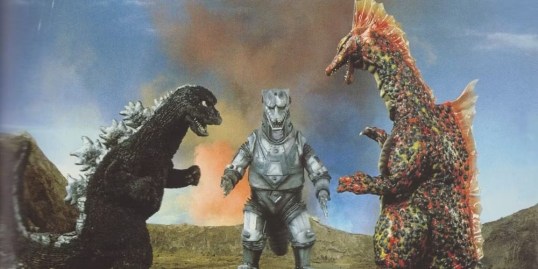
Unfortunately, it would appear that Godzilla didn’t do a good enough job taking care of his robotic counterpart because, in 1975’s Terror of Mechagodzilla, the aliens are able to resurrect Mechagodzilla and they once again sent it out to destroy humanity, starting with Japan.  Working with the aliens is a mad scientist named Dr. Mafune (Akihko Hirata).  Mafune’s daugther, Katsura (Tomoka Ai0), is a cyborg who has a mechanical and mental connection to Mechagodzilla.  Whenever her eyes glow, Mechagodizlla does something destructive.  The aliens team Mechagodzilla up with a new monster, the fearsome Titanosaurus.


Mechagodzilla and Titanosaurus work together to once again destroy Japan and it must be said that they appear to be quite capable of doing just that.  Say what you will about the special effects in these films, the scene where Mechagodzilla blows up an entire city block does pack a punch.  If Mechagodzilla is laser-focused on blowing stuff up, Titanosaurus just seems to be looking for a fight with someone.  Titanosaurus is a very enthusiastic monster, like a previously bullied kid who has just hit a growth spurt and now can’t wait to beat up everyone on the playground.  Eventually, Godzilla shows up to give Titanosaurus the fight that he’s looking for.

This film is one of the ones where Godzilla is firmly established as being humanity’s champion.  The atomic beast who once represented the trauma of the nuclear attacks on Hiroshima and Nagasaki is now a friend to all humans.  That said, it’s hard not to notice that it takes Godzilla a while to actually show up.  He allows Mechagodzilla and Titanosaurus to blow up a lot of buildings and probably kill a lot of people before he finally puts in an appearance and orders them to stop.  It’s nice that Godzilla showed up in time to save a group of children from Mechagodzilla but you have to wonder how many of those children are now orphans because Godzilla wasn’t willing to do anything while Mechagodzilla was blowing up apartment buildings.

The majority of this film centers not on Godzilla but instead on some Interpol agents who are trying to figure out what the professor and the aliens are planning on doing.  (To me, it seemed pretty obvious that the aliens were planning on using a bunch of giant monsters to destroy humanity but maybe Interpol had some information that I didn’t.)  The agents do eventually manage to track down the aliens and the professor.  There’s some sub-James Bond style action as the agents attack the evil lair.  Despite everything that Interpol does in this film, it’s obvious that Godzilla is man’s only hope.

This was the last of the original Godzilla films.  After this film came out, it would be nearly ten years before the monster was revived and returned to once again being a threat to humanity as opposed to being a friend.  Sadly, Terror of Mechagodzilla doesn’t feature enough giant monster action.  When the monsters are onscreen and fighting, this movie is a lot of fun.  Godzilla’s visible frustration with having to deal with Mechagodzilla again is very endearing.    Unfortunately, the majority of the film gets bogged down with the humans searching for the bad guys and trying to figure out their extremely simple plot.  In the end, the movie leaves the viewer thankful for Godzilla but also frustrated that he didn’t get more to do.

Previous Godzilla Reviews:

  1. Godzilla, King of the Monsters (1958)
  2. Godzilla Raids Again (1958)
  3. King Kong vs Godzilla (1962)
  4. Mothra vs. Godzilla (1964)
  5. Ghidorah: The Three-Headed Monster (1964)
  6. Invasion of the Astro-Monster (1965)
  7. Godzilla vs. The Sea Monster (1966)
  8. Son of Godzilla (1967)
  9. Destroy All Monsters (1968)
  10. All Monsters Attack (1969)
  11. Godzilla vs Hedorah (1971)
  12. Godzilla vs Gigan (1972)
  13. Godzilla vs Megalon (1973)
  14. Godzilla vs Mechagodzilla (1974)
  15. Godzilla vs. Mothra (1992)
  16. Godzilla vs. Destoroyah (1995)
  17. Godzilla, Mothra, and King Ghidorah: Giant Monsters All-Out Attack (2001)
  18. Godzilla (2014)
  19. Godzilla: Planet of the Monsters (2017)
  20. Godzilla, King of the Monsters (2019)
  21. Godzilla vs Kong (2021)
  22. Godzilla Minus One (2023)

AMV Of The Day: Godzilla (Dragonball Z)


In order to celebrate the first day of Horrorthon, how about an AMV?

Song: Godzilla – Eminem ft. Juice WRLD

Anime: Dragonball Z

Creator: Rangazee (as always, if you enjoyed this video, we encourage you to subscribe to the creator’s channel and give them lots of likes and nice comments)

Past AMVs of the Day

Horror Film Review: Godzilla Raids Again (Dir by Motoyoshi Oda)


Godzilla Raids Again begins with a plane making an emergency landing on an island near Japan.  Soon, another plane lands to help out the first plane.  The two pilots, however, are immediately stunned by the sight of Godzilla battling an armored dinosaur with a spikey back.  Rushing back to the Japan, the pilots learn that the armored dinosaur was an Ankylosaurus that has been named Anguirus.  Anguirus and Godzilla are among the many prehistoric creatures who, having once been thought extinct, have been awakened and set free by nuclear testing.  And though Godzilla and Angurius are first spotted fighting on an isolate island, there’s little doubt that they will soon make their way to Japan, where the population is still recovering from the previous Godzilla attack.

First released in Japan in 1955 and subsequently released in the United States in 1959, Godzilla Raids Again was the first sequel to Gojira and, in a nod to continuity that would become extremely rare as the series continued, it actually does provide an explanation as to how exactly Godzilla is still alive after being apparently dissolved at the end of the first film.  It’s explained that there are actually several Godzillas.  The one that previously attacked Tokyo was destroyed but now a second one is coming.  Unfortunately, the man who destroyed the first Godzilla was killed in the process and apparently, he didn’t leave behind any notes explaining how he did what he did.

Once again, Japan is attacked by a giant monster.  Once again, cites are in flames and innocent people are dying.  The main difference is that, this time, Godzilla isn’t so much trying to destroy humanity as he just doesn’t even seem to realize that humanity is there.  Godzilla is more concerned with fighting Angurius and he barely seems to notice the buildings that he’s destroying and the lives that he’s ending.  If the first Godzilla film was about the lingering trauma of the nuclear attacks on Hiroshima and Nagasaki, Godzilla Raids Again is about being a small country caught in the middle of a conflict between two nuclear superpowers.  Godzilla and Angurius are so obsessed with beating each other that they really don’t care about anyone who gets trampled underfoot.  While Godzilla Raids Again is nowhere near as dark as the nightmarish first film, it’s still considerably more sober-minded than the Godzilla films that would immediately follow.  Godzillla Raids Again may not be as powerful a film as the first one but it still has its moments.  The film is at its best when it examines how ordinary citizens react to being pawns in the middle of a war between two super-powered monsters.  Some people defy the orders to stay home and instead try to have a good time in what may be their final moments.  Others cower in fear.  Some turn to religion.  Some turn to science.  A group of criminals try to bust out of prison.  In the end, it’s the brave citizens who are willing to risk and sacrifice their lives who ultimately save the world from Godzilla’s atomic fury.

When Godzilla Raids Again was released in the United States, it was in a heavily re-edited and poorly dubbed version.  (The narrator is sure to mention that the United States is willing to help out Japan with its monster problem.)  The film was retitled Gigantis and, throughout the Americanized version, Godzilla is referred to as being “Gigantis.”  Apparently, the film’s distributor thought that audiences would stay away if they knew that this film was a sequel, despite the fact that Godzilla had been a hit with American audiences.  Since Godzilla died at the end of the first film, the distributor felt that audiences would reject the idea of the character returning from the dead.  Times certainly have changed.

Of course, Godzilla is forever.

Previous Godzilla Reviews:

  1. Godzilla, King of the Monsters (1958)
  2. King Kong vs Godzilla (1962)
  3. Mothra vs. Godzilla (1964)
  4. Ghidorah: The Three-Headed Monster (1964)
  5. Invasion of the Astro-Monster (1965)
  6. Godzilla vs. The Sea Monster (1966)
  7. Son of Godzilla (1967)
  8. Destroy All Monsters (1968)
  9. All Monsters Attack (1969)
  10. Godzilla vs Hedorah (1971)
  11. Godzilla vs Gigan (1972)
  12. Godzilla vs Megalon (1973)
  13. Godzilla vs Mechagodzilla (1974)
  14. Godzilla vs. Mothra (1992)
  15. Godzilla vs. Destoroyah (1995)
  16. Godzilla, Mothra, and King Ghidorah: Giant Monsters All-Out Attack (2001)
  17. Godzilla (2014)
  18. Godzilla: Planet of the Monsters (2017)
  19. Godzilla, King of the Monsters (2019)
  20. Godzilla vs Kong (2021)
  21. Godzilla Minus One (2023)

Live Tweet Alert: Watch Godzilla, Mothra, And King Ghidorah: Giant Monsters All-Out Attack! With #ScarySocial!


As some of our regular readers undoubtedly know, I am involved in a few weekly live tweets on twitter.  I host #FridayNightFlix every Friday, I co-host #ScarySocial on Saturday, and I am one of the five hosts of #MondayActionMovie!  Every week, we get together.  We watch a movie.  We tweet our way through it.

Tonight, for #ScarySocial, I will be hosting 2001’s Godzilla, Mothra, And King Ghidorah: Giant Monsters All-Out Attack!

If you want to join us on Saturday night, just hop onto twitter, start the film at 9 pm et, and use the #ScarySocial hashtag!  The film is available on Prime!  I’ll be there co-hosting and I imagine some other members of the TSL Crew will be there as well.  It’s a friendly group and welcoming of newcomers so don’t be shy.

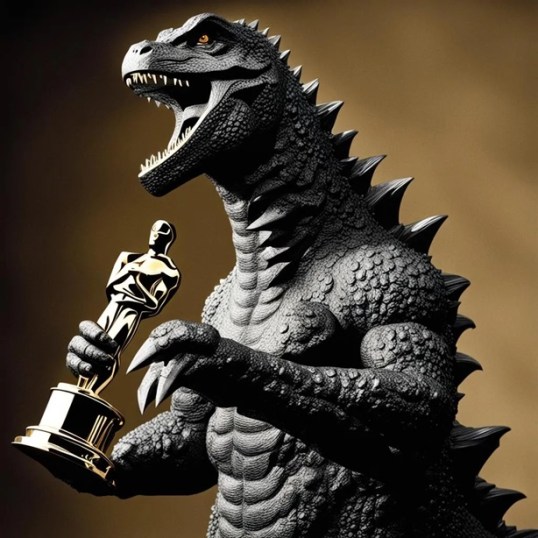
Congratulations On The Oscar, Godzilla!


Godzilla is an Oscar winner!

Seriously, can you believe that it took 70 years for Godzilla to finally not only be nominated for an Oscar but also to win one?  Godzilla Minus One was the first Godzilla film to receive an Oscar nomination and it more than deserved to win for Best Visual Effects.  Godzilla Minus One was a reminder that, when you have imagination and ingenuity, you don’t always need a huge budget.  I’m happy that, in a year dominated by expensive movies and CGI, the Academy finally gave Godzilla the attention and the respect that he deserves!

Way to go, Godzilla!  Enjoy the rest of your career!

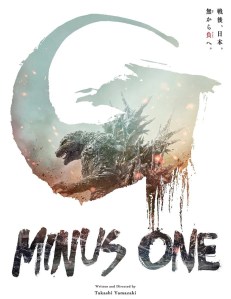
Godzilla Minus One (dir. by Takashi Yamazaki)


Although I’ve watched a number of Godzilla movies growing up, I’ve only gone to the movies for two. There was Roland Emmerich’s 1998 Godzilla, which was fun for the effects and cringe worthy for the acting. There was also Gareth Edwards 2014 Godzilla, that focused so heavily on the humans, it dodged fighting sequences until the last 30 minutes. Takashi Yamazaki’s Godzilla Minus One is an amazing piece of work that gives the audience a small group of humans to focus on versus a beast that’s a true terror to behold. I laughed, cheered, and gasped at times with this one.

Godzilla Minus One takes place over the course of a few years. When Kamikaze fighter pilot Koiji Shikishima lands on a secret refueling island, the soldiers there discover he’s been trying to dodge his responsibilities. Before anyone can react, however, a large beast arrives, laying waste to the entire base and only leaving Shikishima and head mechanic Tashibana alive.

A year later, Shikishima returns to his home villiage, which is damaged from the war. He happens upon a young woman, Noriko (Minami Hamabe, Shin Kamen Rider) and a little girl named Akiko. He takes them in and gives them shelter, but is haunted by nightmares of the beast. Can Shikishima confront his fears? Can Godzilla be stopped?

The script is one of Godzilla Minus One‘s best strengths. It does borrow from a number of different films, true. There are homages to Jaws, King Kong and even Dunkirk, but at the heart of it all are characters to cheer for (Doc was the stand out for me). Granted, there’s only so many storylines you can come up with when it comes to Kaiju stampeding through a city. Godzilla Minus One keeps things simple enough to make one wonder why their story angle wasn’t tried in any of the recent American adaptations. While I won’t say that American filmmakers don’t know how to handle Godzilla – Godzilla: King of the Monsters was enjoyable as well as Godzilla vs. Kong to a degree – Japan knows how to get the best of their creation, and it shows here.

Working off of a budget of about $15 Million (with some speculation that it’s less than that), Takashi Yamazaki also spearheaded the visual effects, along with Kiyoko Shibuya. The effects are used sparingly, and there are moments where you could think that maybe you’re looking at a guy in a suit. Still, the effects run that line between appearing practical and fully CGI. Some of it gets to be a little wild in the film’s 3rd act, but there’s so much fun involved that you might not notice any inconsistancies with the plot (“He’s just gonna stand there for all this?”, my cousin quipped as I relayed the movie to her scene by scene). From a sound and music standpoint, the film keeps all the classic Godzilla themes you know and love while varying things up a bit. The Godzilla screams are all there, as well. No real surprise there, of course.

Overall, Godzilla Minus One is a fun watch, raising the bar for what Godzilla films could be and puts Takashi Yamazaki’s name on the radar for future projects.

.

Horror Scenes That I Love: Godzilla in Godzilla vs. Megalon


For today’s Horror Scene That I Love, let’s take a minute or two to show some respect to one of the world’s greatest (and longest-lived) film stars, Godzilla!  Whether he’s attacking humanity as the literal representation of atomic age anxiety or if he’s saving Earth from a bunch of aliens, Godzilla has always been a superstar.

In this scene from 1973’s Godzilla vs. Megalon, Godzilla shows just how much of a star he is by taking a stand against bullying and saving his friend, Jet Jaguar.  In this scene, Godzilla shows that he was an anti-bullying activist even before it was cool.  Megalon and his friend thought they could just taunt poor old Jet Jaguar.  Not as long as Godzilla’s around!

Book Review: Godzilla: The Official Guide To The King Of The Monsters by Graham Skipper


Do you like Godzilla?

You better!  Seriously, for over 60 years, Godzilla has been the rightful king of the monsters and not even a few less-than-perfect films have been able to knock him off of his throne.  He started out as a symbol of the nuclear age, a prehistoric monster brought back to life by man’s arrogance and war-like nature.  He eventually became mankind’s protector but then deciding that he no longer cared for mankind. And then, like many international stars, he ended up making movies for the American studios.  It’s an epic story and it’s hard not to like the big monster at the center of it.  If, for some reason, you don’t like Godzilla, maybe Graham Skipper’s new book, Godzilla: The Official Guide To The King of the Monsters, will change your mind.

Godzilla: The Official Guide To The King of the Monsters is exactly what the title says.  It’s a guide to all of Godzilla’s adventures, from his first appearance in the 50s all the way through his animated films and the current American version.  (Perhaps not surprisingly, the 1998 version of Godzilla is only afforded a few paragraphs.)  Helpfully, Skipper divides his overview into ears, so you can see how Godzilla changed as he moved from studio to studio.  Skipper also takes a look at Godzilla’s existence outside of the movies, as a comic book mainstay and an occasional television guest star.  The book is written with a lot of obvious affection for Godzilla in all of his incarnations and reading it will remind you of why Godzilla’s films — yes, even Son of Godzilla — are so much fun to begin with.  Skipper includes a lot of trivia, some of which was new to even me.  Such as, did you know that Luigi Cozzi re-edited and colorized the original 1954 Gojira for a 1970s release in Italy?

The book is also heavily-illustrated, featuring a lot of shots from the films and behind-the-scenes pictures of Godzilla and all of his colleagues.  As I read the book, it occurred to me that, as goofy as Jet Jaguar was, it’s still nice that Godzilla had a friend.  As well, as I looked at the pictures, it occurred to me that, even in the later films when Godzilla had been transformed from a truly fearsome symbol of the nuclear age to a somewhat goofy rubber monster, there was still an undeniable majesty to him as a creation.  Even at his worse, Godzilla still looks like a king.

I picked up a copy of this book on the day after Christmas and I’m glad I did.  Not only does it celebrate Godzilla but it also provides me with a guide because, over the next 12 months, I hope to watch every Godzilla film that’s ever been made.  (I’ve seen the majority but, as this book reminded me, there’s still a few that I missed.)  For the record, I still think that Godzilla vs Destoroyah is the best of the Godzilla films but who knows?  Maybe my mind will have been changed by December.

Humanity has survived a lot over the past few years and I’m happy to say that Godzilla has survived with us.  Graham Skipper’s Godzilla helps to explain why.