The year is 1937 and “Big Boy” Caprice (Al Pacino) and his gang of flamboyant and often disfigured criminals are trying to take over the rackets. Standing in their way is ace detective Dick Tracy (Warren Beatty), the yellow trench-wearing defender of the law. Tracy is not only looking to take down Caprice but he and Tess Trueheart (Glenne Headly) are currently the guardians of The Kid (Charlie Korsmo), a young street kid who witnessed one of Caprice’s worst crimes. Tracy’s investigation leads him through a rogue’s gallery of criminals and also involves Breathless Mahoney (Madonna), who has witnessed many of Caprice’s crimes but who also wants to steal Tracy’s heart from Tess.
Based on the long-running comic strip, Dick Tracy was a labor of love on the part of Warren Beatty. Not only starring but also directing, Tracy made a film that stayed true to the look and the feel of the original comic strip (the film’s visual palette was limited to just seven colors) while also including an all-star cast the featured Madonna is an attempt to appeal to a younger audience who had probably never even heard of Dick Tracy. When Dick Tracy was released, the majority of the publicity centered around Madonna’s participation in the film and the fact that she was dating Beatty at the time. Madonna is actually probably the weakest element of the film. More of a personality than an actress, Madonna is always Madonna no matter who she is playing and, in a film full of famous actors managing to be convincing as the members of Dick Tracy’s rogue gallery, Madonna feels out of place. Michelle Pfeiffer would have been the ideal Breathless Mahoney.
It doesn’t matter, though, because the rest of the film is great. It’s one of the few comic book films of the 90s to really hold up, mostly due to Beatty’s obvious enthusiasm for the material and the performances of everyone in the supporting cast who was not named Madonna. Al Pacino received an Oscar nomination for playing Big Boy Caprice but equally good are Dustin Hoffman as Mumbles, William Forsythe as Flaptop, R.G. Armstong as Pruneface, and Henry Silva as Influence. These actors all create memorable characters, even while acting under a ton of very convincing makeup. I also liked Dick Van Dyke as the corrupt District Attorney. Beatty knew audience would be shocked to see Van Dyke not playing a hero and both he and Van Dyke play it up for all its worth. Beatty embraces the comic strip’s campiness while still remaining respectful to its style and the combination of Danny Elfman’s music and Stephen Sondheim’s songs provide just the right score for Dick Tracy’s adventures. The film can be surprisingly violent at times but the same was often said about the Dick Tracy comic strip. It wasn’t two-way wrist radios and trips to the Moon. Dick Tracy also dealt with the most ruthless and bloodthirsty gangsters his city had to offer.
Dick Tracy was considered to be a box office disappointment when it was originally released. (Again, you have to wonder if Beatty overestimated how many fans Dick Tracy had in 1990.) But it holds up well and is still more entertaining than several of the more recent comic book movies that have been released.
That was one of my main thoughts as I watched 1993’s And The Band Played On.
Directed by Roger Spottiswoode and featuring an all-star cast, And The Band Played On deals with the early days of the AIDS epidemic. It’s a film that features many different characters and storylines but holding it all together is the character of Dr. Don Francis (Matthew Modine), an epidemiologist who is haunted by what he witnessed during the Ebola epidemic in Africa and who fears that the same thing is going to happen in America unless the government gets serious about the mysterious ailment that is initially called “gay cancer” before then being known as “GRID” before finally being named AIDS. Dr. Francis is outspoken and passionate about fighting disease. He’s the type who has no fear of yelling if he feels that people aren’t taking his words seriously enough. In his office, he keeps a track of the number of HIV infections on a whiteboard. “Butchers’ Bill” is written across the top of the board.
Throughout the film, quite a few people are dismissive of Dr. Francis and his warnings. But we, the audience, know that he’s right. We know this because we know about AIDS and but the film also expects us to trust Dr. Francis because it’s specifically stated that he worked for the World Health Organization before joining the Center For Disease Control in Atlanta, Georgia. As far as the film is concerned, that’s enough to establish his credentials. Of course, today, after living through the excesses of the COVID pandemic and the attempts to censor anyone who suggested that it may have begun due to a lab leak as opposed to some random guy eating a bat, many people tend to view both the WHO and the CDC with a lot more distrust than they did when this film was made. As I said, we live in a cynical time and people are now a lot less inclined to “trust” the experts. To a large extent, the experts have only themselves to blame for that. I consider myself to be a fairly pragmatic person but even I now find myself rolling my eyes whenever a new health advisory is issued.
This new sense of automatic distrust is, in many ways, unfortunate. Because, as And The Band Played On demonstrates, the experts occasionally know what they’re talking about. Throughout the film, people refuse to listen to the warnings coming from the experts and, as a result, many lives are lost. The government refuses to take action while the search for a possible cure is hindered by a rivalry between international researchers. Alan Alda gives one of the best performances in the film, playing a biomedical researcher who throws a fit when he discovers that Dr. Francis has been sharing information with French scientists.
It’s a big, sprawling film. While Dr. Francis and his fellow researchers (played by Saul Rubinek, Glenne Headly, Richard Masur, Charles Martin Smith, Lily Tomlin, and Christian Clemenson) try to determine how exactly the disease is spread, gay activists like Bobbi Campbell (Donal Logue) and Bill Kraus (Ian McKellen) struggle to get the government and the media to take AIDS seriously. Famous faces pop up in small rolls, occasionally to the film’s detriment. Richard Gere, Steve Martin, Anjelica Huston, and even Phil Collins all give good performances but their fame also distracts the viewer from the film’s story. There’s a sense of noblesse oblige to the celebrity cameos that detracts from their effectiveness. All of them are out-acted by actor Lawrence Monoson, who may not have been a huge star (his two best-known films are The Last American Virginand Friday the 13 — The Final Chapter) but who is still heart-breakingly effective as a young man who is dying of AIDS.
Based on a 600-page, non-fiction book by Randy Shilts, And The Band Played On is a flawed film but still undeniably effective and a valuable piece of history. Director Roger Spottiswoode does a good job of bringing and holding the many different elements of the narrative together and Carter Burwell’s haunting score is appropriately mournful. The film ends on a somber but touching note. At its best, it’s a moving portrait of the end of one era and the beginning of another.
Earlier today, I got off work early and I finally saw The Circle!
The Circle is a film that I’ve been curious about for a while. It’s based on a novel by Dave Eggers, a book that I absolutely loved when I first read it. It stars Emma Watson, Tom Hanks, Patton Oswalt, and John Boyega. It’s directed by James Ponsoldt, who may not be a household name but who has previously directed such beloved films as The Spectacular Now and The End of The Tour. It sounded like a film to which everyone should have been looking forward but instead, even with Watson appearing in the blockbuster Beauty and the Beast at the same time, The Circle opened with very little fanfare.
Then the reviews came out and, with a few notable exceptions, they were all negative. I did a little research and I discovered that, though filming was initially completed in 2015, The Circle spent a year and a half sitting on the shelf. In January of this year, 16 months after shooting wrapped, a few scenes were refilmed. That’s never a good sign. One gets the feeling that, if not for John Boyega’s role in Star Wars: The Force Awakens and the excitement over Emma Watson starring in Beauty and the Beast, The Circle probably would have ended up going straight to VOD.
But here’s the thing. I loved the book. The book managed to put a new spin on the otherwise tired topic of how social media has changed our way of looking at the world. The book was an Orwellian masterpiece, an homage to 1984 by a writer who, as opposed to most people who are currently claiming to appreciate the novel’s dark vision, understood what George Orwell was actually saying.
In fact, the more I thought about it, the easier it was for me to assume that most critics probably missed the point of the movie. It was entirely possible, I decided, that the negative reaction to The Circle had to do with audiences not knowing how to deal with a movie that truly challenged their assumptions. Naively, I assumed that the story and the themes of the novel had been brought to the screen and the critics couldn’t handle it.
Well, as I said earlier, I finally saw The Circle for myself and it turns out that I was wrong. The Circle is an absolute mess. Despite being co-written by Dave Eggers, this film actually has very little in common with the novel that it’s based on. The novel was a sharply satiric portrait of a world that has become brainwashed by technology and social media. The movie is a nagging anti-internet screed that would have felt out-of-touch in 2002. The book ends with a powerful “and he loved Big Brother” moment. The movie ends on a note that feels so completely false that you just know it was studio mandated.
Emma Watson plays Mae Hubbard, a recent college grad whose degree in Art History is pretty much going to waste. (Speaking as the proud recipient of an Art History degree, I can verify that the film gets this detail absolutely right.) Through a college friend named Annie (Karen Gillian, for once not having to disguise her Scottish accent), Mae gets a job working for The Circle, an all-powerful internet company that is pretty obviously based on Google Plus. Through a series of silly events, Mae becomes the public face of The Circle. The Circle wants to use technology (cameras everywhere, social media addiction, everyone carries tablet, you must have a credit card to join The Circle, oh my!) to do away with the concept of privacy. When everyone is a member of the Circle, no one will be a stranger. No one will have any privacy. Anyone can be found. Anyone can be watched. And, of course, it’ll be easier to tell everyone what to think and who to support…
…and all of this would be shocking if The Circle had been made in a time before Twitter and Facebook.
Anyway! The Circle was founded by three men. Two of them (Tom Hanks, Patton Oswalt) are totally sinister. Oswalt glowers in the background. Hanks appears to channeling Christoph Waltz. Meanwhile, the third man (John Boyega) has become disillusioned with The Circle. He shows up occasionally, standing in the background and watching as Mae does stuff.
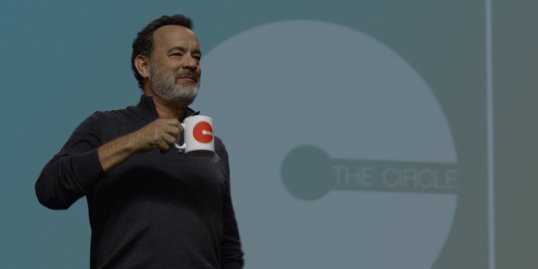
Throughout the film, Tom Hanks gives lectures to his employees. They all applaud as he introduced the latest technology from The Circle. These scenes are fun because it looks like Tom Hanks is appearing in a commercial for The Criterion Collection.
Anyway, Mae loves the brave new world but a few people don’t. Her parents (Bill Paxton and Glenne Headly) are skeptical. Though his role is small, Bill Paxton gave a good performance in this, his latest released film. I got a bit emotional watching him, especially as he was playing a character struggling with his own poor health. Ellar Coltrane, of Boyhoodfame, plays the other voice of skepticism, Mae’s childhood friend who wants to live off the grid. Coltrane is supposed to be the voice of reason but he gives such a strange and awkward performance that the main thing that comes across is that Luddites are weird.
Actually, with the exception of Bill Paxton and Karen Gillan, it’s hard to think of anyone who actually gives a good performance in The Circle. (This is especially shocking when you consider that, in the past, Ponsoldt has proven himself to be an excellent director when it comes to getting noteworthy work from his cast.) Everyone comes across like they were wishing that they were somewhere else. Emma Watson, in particular, is bad. That said, in her defense, Watson is also totally miscast. Mae is meant to be someone searching for an identity in an overly complicated world but Watson plays her as just being dourly earnest. As played by Watson, Mae’s just the boring person that you dread having to take a class with. Neither Watson nor the film, as a whole, seems to be sure who exactly Mae is. (In the novel, the character works because Mae isn’t meant to be likable. The film, however, tries to have it both ways, making her both a true believer in the Circle and a sympathetic character. It doesn’t work.)
For that matter, the film also appears to be confused as to just why exactly Hanks and Oswalt are villains. We know that we’re supposed to distrust them because Hanks is way too quick to smile and Oswalt is always standing in the background and looking like he’s just deliberately killed all of his Sims. But how evil are they actually supposed to be? What are the stakes? The film doesn’t appear to be sure.
Now, I’m not totally trashing The Circle. There were a few moments that I did like. I enjoyed the scenes that were meant to illustrate the cult-like atmosphere at the Circle. There’s a hilarious scene where two enthusiastic Circle employees interrogate Mae as to why she never told them that she enjoys kayaking. (“I enjoy kayaking! We could have kayaked together!”) And there’s another scene where Hanks and Oswalt talk about how, if countries allow The Circle to run their elections, they could then require everyone to join The Circle and then make voting mandatory. Mandatory Voting is a really terrible idea, the type that is always embraced by people who should know better. I appreciated seeing the idea exposed for being the ticket to totalitarianism that it truly is.
But, for the most part, The Circle was just a mess. Like a lot of cautionary tales (especially ones dealing with the internet), The Circle will probably eventually become a bit of a camp classic. But for now, everyone involved with the film has done better work in the past and, hopefully, will continue to do so in the future.
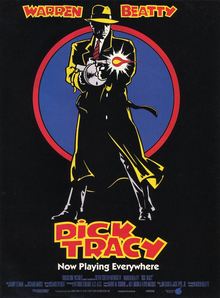 The year is 1937 and “Big Boy” Caprice (Al Pacino) and his gang of flamboyant and often disfigured criminals are trying to take over the rackets. Standing in their way is ace detective Dick Tracy (Warren Beatty), the yellow trench-wearing defender of the law. Tracy is not only looking to take down Caprice but he and Tess Trueheart (Glenne Headly) are currently the guardians of The Kid (Charlie Korsmo), a young street kid who witnessed one of Caprice’s worst crimes. Tracy’s investigation leads him through a rogue’s gallery of criminals and also involves Breathless Mahoney (Madonna), who has witnessed many of Caprice’s crimes but who also wants to steal Tracy’s heart from Tess.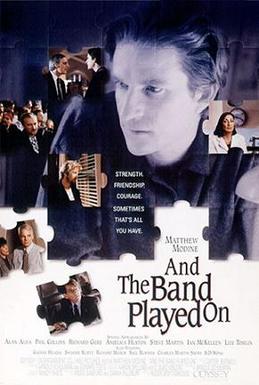
 Through the Shattered Lens