Film Review: Hud (dir by Martin Ritt)


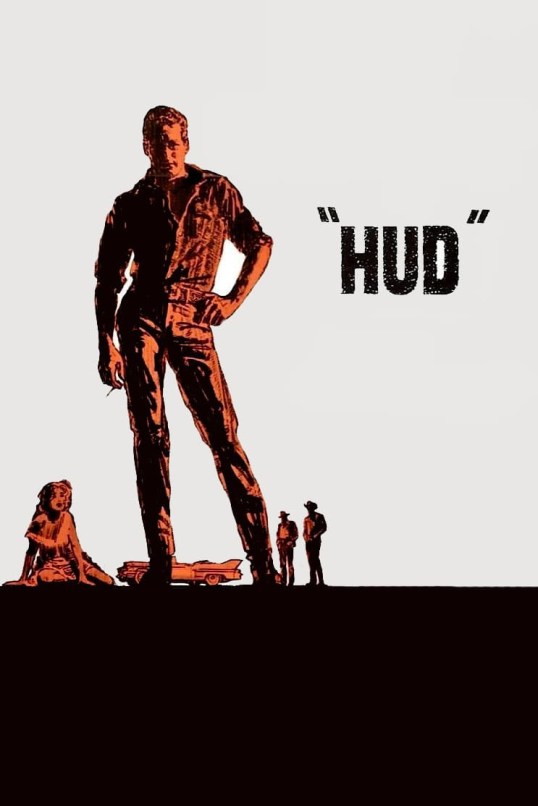
In 1963’s Hud, Paul Newman plays a monster named Hud.

Hud Bannon is the son of rancher Homer Bannon (Melvyn Douglas).  Hud lives in a small Texas town, where he’s known for his pink Cadillac, his heavy-drinking, and his womanizing.  When we first meet him, he’s leaving the home of a married woman and narrowly escaping the rage of her husband.  Throughout the film, he mentions that he’s heading into town to meet “Mrs.” So-and-So.  Hud’s father fears that Hud might be incapable of caring about anyone but himself.  Hud’s nephew, Lonnie (Brandon deWilde), at first looks up to Hud but, over the course of the film, he comes to see his uncle for who he truly is.  Though Hud is quick to defend Homer from others, he himself views Homer with contempt and even plots to have the old man declared incompetent so that he can take over the ranch.  His flirtation with the family housekeeper, Alma (Patricia Neal), soon crosses the line into something much more dangerous.  Hud is charming and handsome in the way that only a 30-something Paul Newman could be.  But he’s also a complete monster.

In Hud, Newman gave one of his best performances and director Martin Ritt and cinematographer James Wong Howe captured some haunting images of the most barren parts of the Texas panhandle.  Howe’s black-and-white imagery not only captures the harsh landscape but also the harsh outlook of the people who live there.  Hud’s ruthless personality as is much a product of the demands of the land as his own narcissism.  The characters in Hud live in a land that doesn’t allow sentimentality.  It’s a land that’s allowed Hud to become the monster that he is.

At least, that’s the way that Paul Newman saw Hud.  That was also the way that the film’s director, Martin Ritt, viewed Hud.  They viewed him as being about as villainous and unlikable as a character could be but, to Newman’s surprise, audiences actually walked out of the film embracing the character and making excuses for him.  Newman was shocked to learn that teenagers were putting posters of him as Hud on their walls.

Why did viewers embrace Hud?

Some of it is due to the fact that Brandon deWilde gives a remarkably bland performance as Lonny.  We first see Hud through Lonny’s eyes and we are meant to share Lonny’s growing disillusionment with his uncle.  But Lonny comes across as being such an empty-headed character that it’s hard to really get emotionally invested in his coming-of-age.  When Hud eventually dismisses Lonny and his concerns, Lonny really can’t defend himself because there’s not much going on inside of Lonny.  On the other hand, Paul Newman gives such a charismatic performance as Hud that we find ourselves continually making excuses for his bad behavior.  When he talks about how he was raised and his difficult relationship with his father, we have sympathy for him even though we know we shouldn’t.  The viewer makes excuses for Hud because that’s what we tend to do when it comes to charismatic bad boys who don’t follow the rules.

Indeed, Hud is proof of the power of charisma and screen presence.  As a character, Hud does some truly terrible things and yet, because he’s Paul Newman, we want to forgive him.  We want to try to figure out why someone who is so handsome and so charismatic would also be so angry.  Lonny may be the “good” character but Hud is the one who we want to get to know.  When Lonny flips through a paperback to read the sex scenes, he comes across as being creepy.  When a drunk Hud flirts with a woman who he has just met, we ask ourselves what we would do if Hud ever tried that with us.  The truth is that we all know what we would do.  That’s what makes Hud both a dangerous and an intriguing character.

In the end, Hud is an excellent film that features Paul Newman at his best and which uses the downfall of Homer’s ranch as a metaphor for a changing American society.  Though Hud was  not nominated for Best Picture, it was nominated for almost everything else.  Melvyn Douglas and Patricia Neal won acting Oscars.  James Wong Howe’s cinematography was also honored.  Paul Newman was nominated and perhaps would have won if not for the fact that Sidney Poitier was nominated for playing the exact opposite of Hud in Lilies of the FieldHud was meant to be a picture about Lonny discovering his uncle was a monster.  Instead, the film became about Hud’s refusal to compromise.  It turns out that people like good-looking rebels who do what they want.

Even if viewers missed the point, Hud was one of the best films of the early 60s and Paul Newman’s powerful performance continues to intrigue.


Retro Television Reviews: The Love Boat 2.12 “The Captain’s Cup/ The Folks From Home/ Legal Eagle”


Welcome to Retro Television Reviews, a feature where we review some of our favorite and least favorite shows of the past!  On Wednesdays, I will be reviewing the original Love Boat, which aired on ABC from 1977 to 1986!  The series can be streamed on Paramount Plus!

This week, the Love Boat departs on one weird cruise.

Episode 2.12 “The Captain’s Cup / The Folks from Home / Legal Eagle”

(Dir by Alan Rafkin, originally aired on December 2nd, 1978)

This was a strange episode.

Let’s start with the simplest of our three stories first.  Danny Holt (Bert Convy) is recently divorced and still crying over having to pay his wife alimony.  When he boards the boat, he specifically asks Gopher if there are any single men onboard who might be interested in marrying his ex-wife.  His ex isn’t even on the cruise!  Danny is one bitter passenger.  From the minute he boards the boat, he’s whining about how unfair his divorce was and how badly he was treated by his wife’s divorce lawyer, Ann Sterling (Leigh Taylor-Young).

Uh-oh, it turns out that Ann is one the cruise as well!  And she’s been assigned to be Danny’s dinner companion.  Danny isn’t happy about this but then, from out of seemingly nowhere, the two of them end of falling in love.  It’s hard to say why they suddenly fall in love.  Danny is superbitter over his divorce and Ann knows all of the details about what type of husband he was so it seems like the last thing that would ever happen would be them leaving the ship, arm-in-arm.  But somehow, that’s what happens.  It was a straight-forward story but it lacked any scenes that would have explained why the two of them fell in love.  They just did because they were characters on The Love Boat.  (It certainly wasn’t due to any noticeable romantic chemistry between Bert Convy and Leigh Taylor-Young.)  This story felt lazy and generic.

In the episode’s second storyline, Captain Stubing is excited because he’s due to receive the Captain of the Year Cup.  Diane DiMarzo (Florence Henderson, proving that former Bradys just cannot stay off The Love Boat) boards the ship with the Cup but she’s shocked to discover that 1) her boss — the guy who actually decided to give Stubing the Cup — will not be on the ship and 2) Stubing fully expects her boss to personally present him with the Cup.  Now, I’m not really sure how the logic works here but apparently, Diane could lose her job if her boss isn’t there to give Stubing the cup.  But why would that be Diane’s problem?  She did what she was supposed to do.  She boarded the ship with the Cup.  Her boss is the one who decided not to show up and he is the boss so it’s not like there was anything Diane could have done about it.

Anyway, Diane recruits one of the ship’s handymen to pretend to be her boss.  Though he works on the boat and the rest of the crew know him, it appears that the Captain himself has never met Hank Vosnik (Pat Harrington, Jr.), which kind of leads one to wonder if Stubing really deserves his award.  Anyway, Hank falls in love with Diane and is crestfallen when she turns down his marriage proposal.  (Seriously, at this point, they had only known each other for like three days so I’m not sure what Hank was expecting.)  But, despite being turned down, Hank still pretends to be Diane’s boss.  So, Diane decides that she might as well marry him.  WHAT!?

Finally, Doc Bricker is happy to meet two passengers from his hometown.  George (John McIntire) and Gloria (Jeanette Nolan) spend every moment with Doc and they even announce that, as far as they’re concerned, the 40-something Doc is a member of their family.  Doc is touched.  But then Gloria falls down a flight of stairs and Doc has to do emergency surgery on her.  Gopher calls a doctor in San Francisco and he talks Doc through the surgery.  Doc removes Gloria’s spleen and saves her life!  Yay!  Only at the end of the surgery does he get George to sign a consent form.  In real life, that would lead to Doc to losing his job and the cruise line getting sued.  But, on The Love Boat, it just leads to more laughter.

On the plus side, this storyline featured the charming performances of McIntire and Nolan, who were married in real life.  The story was also written by Fred “Gopher” Grandy and Bernie “Doc” Kopell so, not surprisingly, it actually allowed Grandy and Kopell to do something more than just leer at the passengers.  The show rarely gave Grandy or Kopell a chance to show off the fact that they were both capable of giving good dramatic performances so, whenever they got that rare chance to do so, they took advantage of it.  That said, it was still a bit awkward to see Doc suddenly performing major surgery in his tiny examination room.  It was all for the best on the show but, in real life, it would have led to a major lawsuit.  Even though Doc Bricker saved Gloria’s life, it still seems like the ship could probably be held liable for her getting injured in the first place.  I mean, the boat is in the middle of the ocean.  Shouldn’t there at least be a warning posted on the stairs?

Well, who knows?  Strange things happen at sea.  Let’s just be happy that everything worked out in the end.

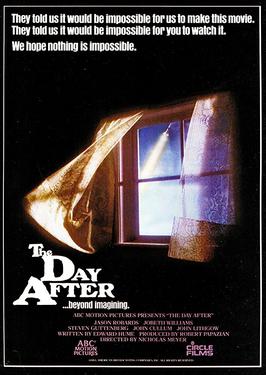
Film Review: The Day After (dir by Nicholas Meyer)


“This is Lawrence. This is Lawrence, Kansas. Is anybody there? Anybody at all?”

The words of Joe Huxley (John Lithgow) hang over the ending of The Day After, a 1983 film that imagines what the aftermath of a nuclear war would be like not on the East or the West Coasts but instead in the rural heartland of America.  Huxley is a professor at the University of Kansas and, as he explains early on in the film, Kansas would be an automatic target in any nuclear war because it houses a number of missile silos.  When he explains that, it’s in an almost joking tone, largely because the missiles haven’t been launched yet.  Instead, the only thing we’ve heard are a few barely noticed news stories about growing tensions between America and Russia.  About halfway through The Day After, the bombs go off and there are suddenly no more jokes to be made.

When the bombs drop over Kansas, we watch as cities and field and people burst into flames.  In a matter of minutes, several thousands are killed.  I’m almost ashamed to admit that I was probably more upset by the image of a horse being vaporized than I was by the death of poor Bruce Gallatin (Jeff East), the college student who was planning on marrying Denise Dahlberg (Lori Lethin).  I guess it’s because horses — really, all animals — have nothing to do with the conflicts between nations.  Humans are the ones who take the time to build bigger and better weapons and The Day After is one of the few films about war that’s willing to acknowledge that, when humans fight, it’s not just humans that die.

The bombing sequence is lengthy and I have to admit that I was a bit distracted by the fact that I recognized some of the footage from other movies.  A scene of panicked people running through a building was taken from Two-Minute Warning.  A scene of a building exploding and a construction worker being consumed by flames was lifted from Meteor.  As well, there’s some stock footage which should be familiar to anyone who has ever seen a documentary about the early days of the Cold War.  Still, despite that, it’s an effective sequence simply because it’s so relentless.  Some of the film’s most likable characters are vaporized before our eyes.  Steve Guttenberg, of all people, is seen ducking into a store.

Guttenberg plays Stephen Klein, a pre-med student who manages to survive the initial attack and takes shelter with the Dahlberg family at their ranch.  At first, it’s a bit distracting to see Steve Guttenberg in a very serious and very grim film about the nuclear apocalypse but he does a good job.  The sight of him losing both his teeth and his hair carries a punch precisely because he is reliably goofy Steve Guttenberg.

If the film has a star, it’s probably Jason Robards, the doctor who witnesses the initial blast from the safety of his car and then treats the dying in Lawrence, Kansas.  He does so, despite the fact that he doesn’t know if his wife, son, and daughter are even still alive.  He continues to do so until he also falls ill with radiation poisoning.  Knowing that he’s dying, he heads home just to discover that there is no home to return to.

Home is reccuring theme throughout The Day After.  Everyone wants to return to their home but everyone’s home has been wiped out.  “This is my home,” Jim Dahlberg (John Cullum) tries to explain before he’s attacked by a group of feral nomads.  Home no longer exists and trying to pretend like life can go back to the way it once was is an often fatal mistake.

Real happy film, right?  Yeah, this isn’t exactly a film that you watch for fun.  I have to admit that I made a joke about how I wouldn’t want to die while wearing the unfortunate blue jumpsuit that Jason Robards’s daughter chooses to wear on the day of the nuclear attack and I felt guilty immediately.  (Well, not that guilty.  Seriously, it was a terrible fashion choice.)  The Day After is a film that gives audiences zero hope by design.  It was made at a time when it was generally assumed that nuclear was inevitable and it was designed to scare the Hell out of everyone watching.  And while I can’t attest to how audience may have reacted in 1983, I can say that, in 2020, it’s still a powerful and disturbing film.

“Is anybody there? Anybody at all?” Joe Huxley asks and by the end of the film, the answer doesn’t matter.  The damage has already been done.

Horror on TV: The Twilight Zone 1.23 “Shadow Play” (dir by Paul Lynch)


For tonight’s trip into the world of televised horror, we have an episode from a 1986 attempt to revive The Twilight Zone.

This episode is a remake of one of my favorite episodes of the original series, Shadow Play.  That’s the one where the guy is on death row but he says he’s not worried about being executed because he knows he’s just having a reoccuring nightmare.  Of course, this kind of freaks out some of the people around him because, if he’s just having a dream, what happens to them when the dream ends?

While the remake is nowhere near as good as the original, it’s still fairly well done.  Plus, it’s on YouTube and the original isn’t.

This episode was directed by Paul Lynch, the Canadian director who also directed the original Prom Night.

Enjoy!