Lisa Watches An Oscar Winner: The French Connection (dir by William Friedkin)


TheFrenchConnection

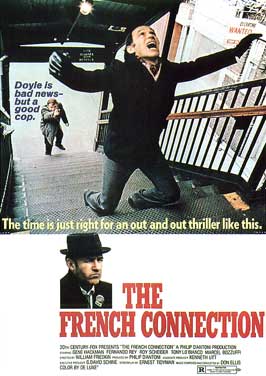
Earlier today, thanks to Netflix, I watched the 1971 best picture winner, The French Connection.

Based on a true incident, The French Connection is the story of two NYPD detectives, the reasonable and serious Buddy Russo (Roy Scheider) and his far more hyperactive partner, Popeye Doyle (Gene Hackman).  When we first see them, Doyle is dressed as Santa Claus and they’re both chasing a drug dealer through the streets of New York.  When they eventually catch up with the dealer, Russo plays good cop while Doyle plays batshit insane cop.  That’s a pattern that plays out repeatedly over the course of the film.  Russo suggests caution.  Doyle blindly fires his gun into the shadows.  Russo is sober.  Doyle is frequently drunk.  Russo is careful with his words.  Doyle is a casual racist who never seems to stop talking.  The one thing that Russo and Doyle seem to have in common is that they’re both obsessed with catching criminals.

The French Connection is also the story of Alain Charnier (Fernando Rey), a suave and always impeccably dressed French businessman.  Charnier has a plan to smuggle several millions of dollars of heroin into the United States by hiding it in a car that will be driven by an unsuspecting (and rather vacuous) French actor named Henri Devereaux (Frederic de Pasquale).  Working with Charnier is a low-level mafia associate named Sal Boca (Tony Lo Bianco) and a lawyer named Joel Weinstock (Harold Gray).

(Incidentally, Weinstock’s chemist is played by an actor named Patrick McDermott, who also played Susan Sarandon’s abusive hippie boyfriend in Joe.  The French Connection was McDermott’s third film and also his last.  I point this out because McDermott totally steals his one scene in The French Connection.  When one considers both his performance here and his work in Joe, it’s strange and unfortunate that McDermott’s cinematic career ended after just three films.  According to a comment left on the imdb, he later ran a health food store in Nebraska.)

When Doyle and Russo just happen to spy Sal hanging out with a group of mobsters at a local club, they decide (mostly on a whim) to investigate what Sal’s up to.  They notice that Sal drives a car that he shouldn’t be able to afford.  Will they discover how Sal is making his money and will they be able to stop Charnier from smuggling his heroin into the United States?

Well…let’s just say that The French Connection was made in 1971.  That’s right, this is one of those films where everything is ambiguous.  Neither Russo nor Doyle are traditional heroes.  Neither one of them is foolish enough to believe that their actions will make a difference.  Instead, they seem to view it all as a game, with Doyle and Russo as the win-at-any-cost good guys and the French as the bad guys.  And, indeed, it’s interesting to note that, when the police do make their move against Charnier, it’s the people who work for him who suffer the worst punishments.

I have to admit that, as a civil libertarian, Doyle is the type of cop who should make my skin crawl.  He’s an obsessive bigot, the type who runs into the shadows with his gun drawn and blindly firing.  When I watched The French Connection, a part of me wanted to get offended and say, “It’s none of your business why Sal has an expensive car!”  But I didn’t.  In fact, I was rooting for Doyle the whole time.  The French Connection is probably one of the best cast films of all time.  Hackman gives such a good performance that, while you can’t overlook Doyle’s flaws, you can accept them.  Meanwhile, Rey is so sleazy and smug in the role of Charnier that you really don’t care about his rights.  You just want to see him taken down.

(That said, if I ever got hold of a time machine and went back to New York in 1971, I’d rather be arrested by Russo than Doyle.  Doyle seems like he’d be the type to grope while frisking.)

Seen today, it’s a bit odd to think of The French Connection as being a best picture winner.  It has nothing to do with the film’s quality.  The film’s performances remain strong.  William Friedkin’s documentary-style direction is still compelling and he makes the decay of 1970s New York oddly beautiful.  Instead, it’s the fact that The French Connection essentially tells a very simple story that, when seen today, feels very familiar.  It’s a cop film and it includes every single cliché that we’ve come to associate with cop films.  (Russo and Doyle even have a supervisor who yells at them for not doing things by the book.)  But, what you have to realize is that the majority of those clichés were invented by The French Connection. If imitation is the sincerest form of flattery, then The French Connection is probably one of the most flattered film ever made.

And what better way to end this review than by sharing The French Connection‘s most influential scene?  In the scene below, Doyle chases a commuter train that happens to be carrying one of Charnier’s associates.

Apprecier le film!

Shattered Politics #72: Welcome to Mooseport (dir by Donald Petrie)


Welcome_To_Mooseport

The 2004 film comedy Welcome to Mooseport would probably be totally forgotten if not for one thing.  This is the film that was supposedly so bad that co-star Gene Hackman looked at the final cut and then probably looked over at the Oscars he won for The French Connection and Unforgiven and then probably looked back at the final cut and then announced, “I quit!”  There’s a reason why Hackman now spends his time writing novels and, according to most accounts, Welcome to Mooseport is that reason.

In Welcome to Mooseport, Gene Hackman plays Monroe “Eagle” Cole, the former President of the United States.  From the minute we first hear the President’s name, we know exactly what type of film Welcome to Mooseport is going to be.  It’s not enough to give Hackman’s a character a totally over-the-top name like Monroe Cole.  He also has to have a cutesy nickname.  The entire time I watched the film, I found myself wondering if Monroe Cole was listed on the presidential ballots as being Monroe “Eagle” Cole.  Personally, I always find it funny when people feel the need to include their nickname in the credits.  Is it really important for every William out there to let everyone know that some people call him Billy?

Anyway, Eagle is apparently the most popular president ever.  However, he’s also recently divorced and his ex-wife (Christine Baranski, playing the same role that she played in Bulworth) wants all of his property.  Eagle is forced to retire to one of the few residences that he has left, his vacation home in Mooseport, Maine.  In order to keep his wife from claiming that home, Eagle decides to run for mayor of Mooseport…

Now, right here, we’ve got a huge issue.  Eagle’s only motivation for running for mayor is because he doesn’t want to have to give over his vacation home to his wife.  But that could be anyone’s motivation.  One does not have to be President to want to keep the house in a divorce.  It would have been more interesting if Eagle, now out of office and struggling to adjust to no longer being the most powerful man in the world, ran for mayor because he really wanted the job.

But anyway, Eagle is not the only person running for mayor.  Hardware store owner Hardy Harrison (Ray Romano) is also running.  At first, Hardy wants to withdraw but then he sees Eagle flirting with Hardy’s longtime girlfriend (Maura Tierney) and Hardy suddenly decides that he’s going to run and he’s going to win.

I actually like Ray Romano as an actor and he doesn’t give a bad performance here.  But, at the same time, it’s obvious that his scenes were written to capitalize on his TV persona.  It’s easy to imagine stumbling across a rerun of Everybody Loves Raymond where Ray runs for mayor and has a panic attack when he loses.  The difference, of course, is that Ray Barone would not have been running against Gene Hackman (much less a former President).

Needless to say, Welcome to Mooseport has a sitcom feel to it.  After every line, you find yourself waiting for a laugh track.  Gene Hackman feels incredibly out-of-place in the film and there’s a discomfort to his performance.  Watching him in this film, you can see the wheels turning in his brain.  You can literally see Gene Hackman thinking, “I’m too old for this shit.”

And I guess he was because, in the 11 years since Welcome to Mooseport was first released, Gene Hackman has not appeared in another film.  Which is bad news for everyone waiting for Welcome to Mooseport Part II

Shattered Politics #60: Absolute Power (dir by Clint Eastwood)


Absolute_power

The main reason that I enjoyed the 1997 Clint Eastwood film Absolute Power was because it features a murderer who also happens to be the President.  As someone who dislike the idea of any one person having absolute power, I always get annoyed by the attitude that authority is something that has to be automatically respected.  Instead, I’ve always felt that all authority should be distrusted and continually questioned.

Just take President Alan Richmond (Gene Hackman) for example.  At the start of Absolute Power, he’s a popular President.  He’s quick with a smile.  He’s quick with a memorable line.  I imagine that excerpts from his State of the Union speech would probably be very popular on YouTube.  However, at the start of the film, elderly burglar Luther Whitney (Clint Eastwood) witnesses President Richmond getting violent with Jan Levinson-Gould.  When Jan resists him, two Secret Service agents (Scott Glenn and Dennis Haysbert) run into the room and shoot her.

Okay, technically, the victim was not really The Office‘s Jan Levinson-Gould.  (They both just happen to be played by Melora Hardin.)  Instead, her name was Christy Sullivan and she was also the wife of one of Richmond’s top financial supporters, Walter Sullivan (E.G. Marshall).  After the murder, President Richmond and his chief-of-staff, Gloria Russell (Judy Davis), attempt to frame Luther for the crime.

Absolute Power is pretty much your typical Clint Eastwood action picture.  In the role of Luther, Eastwood snarls his way through the film and never dispatches a bad guy without providing a ruthless quip.  (When one bad guy begs for mercy, Luther replies that he’s “fresh out.”)  Luther has an estranged daughter, a lawyer named Kate (Laura Linney) and, despite the fact that she’s helping the homicide detective (Ed Harris) who is trying to capture him, Luther still pops up to look out for her.  In the end, Luther’s not only try to prove that the President is a murderer but he’s trying to be a better father as well!  Awwwwwww!

Again, it’s all pretty predictable but the film is worth seeing just for the chance to witness Gene Hackman play one of the most evil Presidents ever.  As far as soulless chief executives are concerned, Alan Richmond makes Woodrow Wilson look like a humanitarian!  And Hackman does a good job embodying the affable type of evil that could conceivably translate into an electoral landslide.

Absolute Power may not be a great film but it’s a good one to watch whenever you need an excuse to be cynical about the absolute power of the government.

Review: A Bridge Too Far (dir. by Sir Richard Attenborough)


1977 a bridge too far

“Well, as you know, I always felt we tried to go a bridge too far” — Lt. Gen. Frederick Browning

With the recent passing of Sir Richard Attenborough I decided to bring up one of the films which first brought his name to my attention. I was quite the young lad when I first saw Attenborough’s epic war film A Bridge Too Far. I would say that it was one of my earlier memories of watching a film with my father who was a major fan of war films. One could say that I got my appreciation and love for the genre from him.

A Bridge Too Far was adapted from the Cornelius Ryan book of the same name which depicted from start to finish the disastrous World War II battle known as Operation Market Garden. The film states that the Allied landings at Normandy, France in the summer of 1944 had the German forces reeling and on the verge of collapse. With Eisenhower having to choose between competing plans to chase Hitler’s forces right into Berlin from his two best generals in George S. Patton and Bernard Montgomery, the film already lays down something that’s become synonymous with military disasters throughout history. Political expediency and pressure on Eisenhower led to an operation that was never attempted in military history and one which required every aspect of the operation to go according to plan for it to work. As the film would show this was not meant to be.

The film begins with the operation’s early days as Allied commanders rush to put Montgomery’s plan to drop 35,000 paratroopers behind German lines in occupied-Netherlands in order to capture and hold key bridges until Allied armored forces arrived to reinforce them. It’s a daring plan that the Attenborough films with a obvious confidence and enthusiasm, but also one that already showed some nagging doubts from field commanders who would be in the thick of the fighting if intelligence reports were inaccurate. One could almost say that Attenborough was making the film a sort of anti-war message which was a rarity when it came to Hollywood and and film industry depicting the events of World War II at the time.

While the film does explore that very anti-war theme throughout it’s really a by-product of how the battle itself unfolds and shown to the viewers that might give one such an idea. Yet, in the end A Bridge Too Far was a much more complicated film to just be labeled as an anti-war film. Yes, the battle itself was a disaster for the Allied forces of American, British and Polish soldiers involved, but despite the political bumbling and military arrogance of those who command from behind a desk, the film actually does a great job of showing that bond soldiers earn when confronted with the horrors of battle.

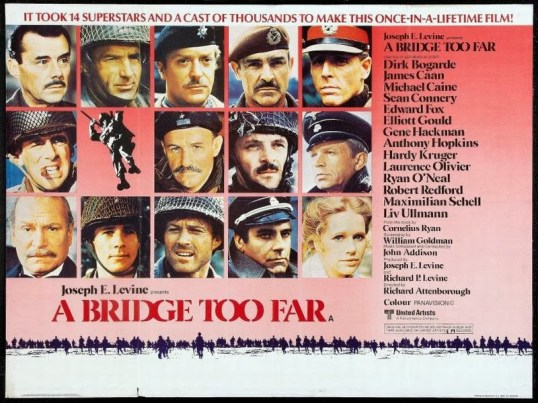
Attenborough and producer Joseph E. Levine pulls together an all-star cast for the film with names such as Sean Connery, Edward Fox, Robert Redford, Michael Caine and Laurence Olivier just to name a few. Films such as A Bridge Too Far rarely get made anymore in this day and age. The cast itself is part of the reason why the film still holds up to scrutiny decades after it’s release. While all-star casts such as this seemed to have been common place before the 1980’s it still looked like a daunting task for Attenborough to manage so many Hollywood stars and veteran British actors. Every character from Hopkin’s Col. Frost, Connery’s Gen. Urquhart and Redford’s Maj. Cook get to shine in their sections of the film as their individual stories about the battle all tie-in together to show just how complicated the events that they were filming truly turned out to be.

At times, one almost could feel overwhelmed by the amount of recognizable names and faces that come across the screen, yet Attenborough and producer Levine were able to juggle not just the logistics of the film’s screenplay, but the egos and reputation of the very stars who would become the backbone of the film.I think in a lesser filmmaker A Bridge Too Far could easily have turned into the very Operation Market Garden it was trying to depict.

It’s a film that never celebrates the concept of war itself, but actually shows that war remains a bloody and chaotic affair that relies not just on planning and execution but on the whims of lady luck. While Attenborough’s film never reached the sort of iconic status that another Cornelius Ryan adapted film has attained in The Longest Day, it does remain the more powerful of the two as it doesn’t just explore the historical event as a sort of academic exercise, but as an exploration of that old military adage of “No plan survives contact with the enemy”.

So, in the end I recommend that those looking to watch and experience the earlier directorial works of Sir Richard Attenborough should check out A Bridge Too Far. It remains to this day one of his more underappreciated films especially when compared to his later more acclaimed films like Gandhi, Chaplin and Shadowlands.

A Quickie With Lisa Marie: The Conversation (dir. by Francis Ford Coppola)


As a result of my continuing effort to see every single film ever nominated for best picture, I’ve been lucky enough to both discover and rediscover a handful of excellent films that, for whatever reason, have ended up forgotten and neglected in the years since they scored their nominations.  One of the more recent of these films was Francis Ford Coppola’s masterpiece of a paranoia, the 1974 Best Picture nominee The Conversation.*

The Conversation tells the story of Harry Caul (played by Gene Hackman), a surveillance expert who, along with his colleague Stan (played by the great John Cazale), is hired by a businessman (Robert Duvall) to bug a conversation between Duvall’s much younger wife (played by Cindy Williams) and a man who might be her lover (played by Fredric Forrest).  Harry, we quickly discover, is a man who values his privacy and who manages to find a balance between his unsavory job and his devout religious faith by maintaining an impenetrable shield of detachment from the rest of humanity.  He is a man who hides from the world inside of his apartment, only allowing himself to show the slightest hint of emotion when playing his saxophone.  In one of the film’s best scenes, Harry finds himself awkwardly socializing with a far more sleazy acquaintance (played by Alan Garfield, one of the great character actors of the 70s) and it becomes apparent that Harry may be the best in the business but he’s still the ultimate outsider.

However, Harry is forced to confront the contradictions of his own lifestyle when he listens to the conversation between Forrest and Williams and believes that he might have found evidence that both Forrest and Williams are in fear for their lives.  With Duvall’s operatives demanding the surveillance tapes, Harry Caul soon finds himself becoming more and more paranoid and unstable as he finds it more and more difficult to justify his detachment.  Harry finds himself obsessively listening to the conversation over and over again, going over every possible nuance and emphasis to try to figure out what’s actually being said.  Of course, by the end of the film, it’s obvious to both Harry and the audience that nothing is as simple as it sounds. 

Compared to the Godfather films and Apocalypse Now, the Conversation is a surprisingly low-key and rather muted film.  A lot of this is because, as opposed to the Corleones and Martin Sheen’s Captain Willard, Gene Hackman’s Harry Caul is a complete and total introvert, a man who makes his living by observing a world that he refuses to be a part of.  Though the film works quite well as a thriller, it works best when viewed as a sympathetic character study of a paranoid and anti-social human being.  Hackman full inhabits the role, bringing Harry — with all of his frustrating contradictions and conflicted actions — to oddly vibrant life.  The film ultimately serves as a sad-eyed look at how a good person can justify doing bad things and how the inevitable consequences of those bad things can only be delayed for so long.

On a final note, an impossibly young Harrison Ford shows up here as Duvall’s sinister assistant.  He plays the role with just the right amount of prissy arrogance and he has a great scene where he asks Harry is he wants to try a homemade cookie.  “They’re good,” Ford assures him.

So is The Conversation.

—–

* Of course, another Coppola film — The Godfather, Part II — beat the Conversation for best picture.  However, The Conversation did win the Palme D’Or at Cannes that year.  It was a good year to be Francis Ford Coppola.

A Quickie With Lisa Marie: I Knew It Was You: Rediscovering John Cazale (dir. by Richard Shepard)


Despite only appearing in 5 films and dying 8 years before I was born, John Cazale is one of my favorite actors.  You might not recognize his name but, if you love the films of the 70s, you know who John Cazale is because he appeared in some of the most iconic films of the decade.  Though he’s probably best known for playing poor Fredo in first two Godfather films, Cazale also appeared in The Conversation, Dog Day Afternoon, and The Deer Hunter.  All five of his films were Oscar-nominated for best picture and three of them won.  All five are, in their own individual ways, classics of modern cinema and, though he was never more than a supporting player, Cazale gave performances of such unexpected emotional depth that he elevated each of these films just by his very presence.  Tragically, Cazale died at the age of 42 of lung cancer.  At the time, he had just finished filming The Deer Hunter and he was engaged to marry an up-and-coming actress named Meryl Streep.

I Knew It Was You is a documentary that both attempts to tell the story of Cazale’s life as well as pay tribute to him an actor.  While it fails somewhat to do the former, it succeeds flawlessly as a tribute.  The film is filled with footage of Cazale’s legendary performances and watching these clips, you’re struck by not only Cazale’s talent but his courage as well.  As more than one person comments during the documentary, it takes a lot of guts to so completely inhabit a role like The Godfather’s Fredo Corleone.  While other actors might be tempted to overplay a character like Fredo (essentially winking at the audience as if to say, “I’m not a weakling like this guy,”) Cazale was willing to completely inhabit his characters, brining to life both the good and the bad of their personalities.  Watching the clips, you realize that Cazale, as an actor, really was becoming stronger and stronger with each performance.  On a sadder note, this documentary make it  painfully obvious just how sick Cazale was in The Deer Hunter.  The contrast between the nervous, lumbering Cazale of Dog Day Hunter and his gaunt, unbearably sad appearance in The Deer Hunter is simply heart breaking.

The documentary is full of interviews with actors and directors who either worked with or were inspired by John Cazale and you’re immediately struck by the affection that they all still obviously feel for him even 30 years after his death.  Among those interviewed are Steve Buscemi, Al Pacino, Meryl Streep, Robert De Niro, Francis Ford Coppola, Sidney Lumet, Sam Rockwell, and Richard Dreyfuss.  (I thought I knew every bit of Godfather trivia but I learned something new from this film when I found out that Richard Dreyfuss came close to being Fredo before Coppola saw Cazale in a play.)   Perhaps most interesting are the interviews where actors like Pacino, De Niro, and Gene Hackman talk about how acting opposite John Cazale caused them to give better performances than they might have otherwise.  If nothing else, it’s a good reminder that a classic film is, more often than not, a collaborative effort.

Where this documentary drops the ball is in detailing who Cazale was as a person.  Though everyone’s affection for him is obvious, we learn little about what drove the man who was so sad and tragic as Fredo Corleone.  Cazale’s upbringing is covered in about 2 minutes of flashy graphics and his untimely death (and his struggle to complete his Deer Hunter role) is also covered a bit too quickly.  There’s a fascinating and inspiring story there but this documentary only hints at it.  For reasons I still can’t figure out, this thing only lasts 40 minutes.  Even just an extra 15 minutes would have been helpful.

Hollywood director Brett Ratner is also interviewed and I imagine this probably has something to do with the fact that Ratner co-produced this documentary.  So, I guess Ratner is a Cazale fan and good for him but it’s still kinda jarring to see him there with directors like Lumet and actors like Pacino and De Niro.  Ratner, to be honest, is the only one of the people interviewed who actually comes across as having nothing of value to say.  Which isn’t all that surprising when you consider that Ratner is pretty much the golden child of bland, mainstream filmmaking right now.

Still, even if it never reaches the heights of Werner’s Herzog’s My Best Fiend, I still have to recommend I Knew It Was You as a touching tribute to a truly great actor.  As a bonus, the DVD contains two short films featuring a very young and intense John Cazale.  Watching him, you can’t help but mourn that he wasn’t in more movies but you’re so thankful for the legendary performances that he was able to give us.