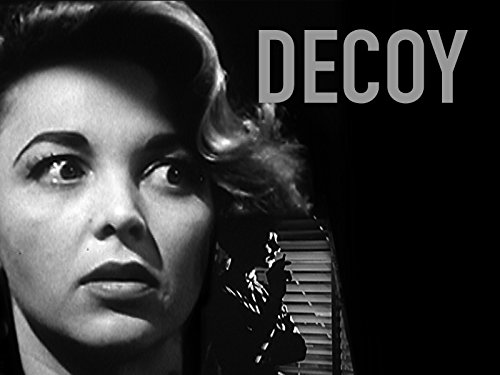
Welcome to Retro Television Reviews, a feature where we review some of our favorite and least favorite shows of the past! On Thursdays, I will be reviewing Decoy, which aired in Syndication in 1957 and 1958. The show can be viewed on Tubi!
This week, Casey gets involved with gun smugglers!
Episode 1.20 “Across the World”
(Dir by Teddy Sills, originally aired on February 24th, 1958)
Andrew Garcia (Frank Silvera), Herbert Carson (Arthur Batanides), and Carl Walton (Nicholas Colasanto) are using an import/export business to smuggle guns to the communists. (Booo!) When the owner of the company finds out, they murder her in a hit-and-run. Because of the suspicious nature of the woman’s death, Casey is sent undercover to investigate. She shows up at the company, claiming to be the woman’s only heir. Her cover is blown early, leading to her getting knocked around by the bad guys. Fortunately, for her, the bad guys end up turning on each other and eventually, the rest of the police force arrives and puts an end to the smuggling once and for all.
This episode didn’t feature much of Beverly Garland. Instead, the majority of it focused on the three smugglers arguing amongst themselves and then plotting various double crosses. Unfortunately, the smugglers weren’t particularly interesting. Sometimes, bad guys can be compelling to watch but these dopes were obviously doomed from the minute that they first appeared. Though it’s never specifically said to whom they were smuggling the weapons, I’m going to assume that it was probably Castro and his forces. In 1958, there were a lot of Americans who actually thought that Castro would be more willing to work with America than Batista was. Needless to say, they turned out to be incorrect. Casey could have warned them if anyone had bothered to listen!
This was a lesser episode of Decoy but the episode did feature some location shots of New York City. The actors where shivering so I can only assume it was very cold when they filmed this episode.
By most accounts, Che Guevara epitomized the excesses and the hypocrisies of the extreme Left. He spoke of the class struggle while remaining an elitist himself. He oversaw thousands of executions and advocated for authoritarian rule. In his writings, he frequently revealed himself to be a racist and a misogynist. By arguing that the Russians should be allowed to bring nuclear missiles to Cuba, he brought the world to the brink of destruction. However, he also died relatively young and he looked good on a t-shirt. Decades after he was executed by the Bolivian Army in 1967 (or was it the CIA?), he remains an icon for college students and champagne socialists everywhere.
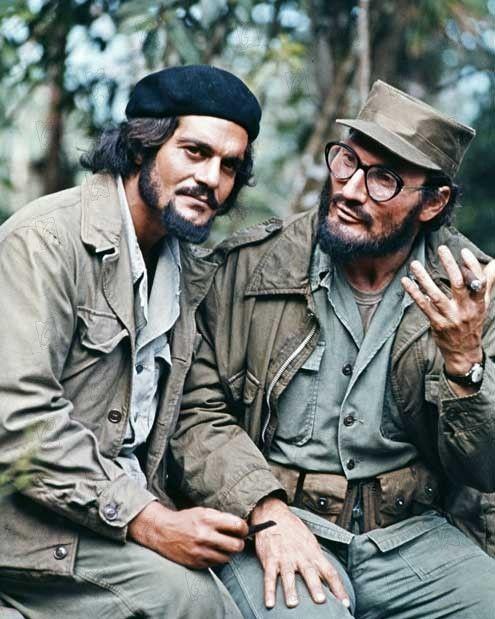
The film about Che! was released in 1969, two years after his death. Starring the Egyptian actor Omar Sharif as Che Guevara, Che! opens with Guevara already a martyr and then quickly gives way to flashbacks. Various actors pretending to be Cuban appear and speak directly to the audience, debating Che Guevara’s legacy. Some describe him as being a violent thug who killed anyone who displeased him. Others describe him as a visionary doctor who sacrificed his comfortable existence for the people. It’s a rather conventional opening and one that hints that Che! is going to try to have it both ways as far as Che’s legacy is concerned. But it’s still effective enough. A montage of soldiers and rebels creates the proper feeling of a society on the verge of collapse.
And then Jack Palance shows up.
Palance first appears creeping his way through the Cuban jungle with a group of soldiers behind him. Palance is chomping on a cigar and he wears the intense look of a man on a mission. My initial reaction was that Palance was playing one of the CIA agents who sent to Cuba to try to assassinate Fidel Castro or to set up the Bay of Pigs invasion. I kept waiting for him to look at the camera and launch into a monologue about why, for the safety of America, he had been dispatched the topple Cuba’s communist government. Imagine my shock when Omar Sharif called Palance, “Fidel.”
Yes, that’s right. Jack Palance plays Fidel Castro! As miscast as the suave Omar Sharif is as Che Guevara, nothing can prepare one for seeing Jack Palance playing Fidel Castro. Needless to say, there is nothing remotely Cuban or even Spanish about Jack Palance. He delivers his lines in his trademark terse Jack Palance voice, without even bothering to try any sort of accent. (And, needless to say, both he and Sharif speak English through the entire film.) Anyone who has ever seen a picture of a young Fidel Castro knows that, while he shared a family resemblance with Justin Trudeau, he looked nothing like Jack Palance. Eventually, Palance puts on a fake beard that makes him look even less like Castro. When one of our narrators mentions that Castro was a great speaker, the film cuts to a scene of Palance spitting out communist slogans with a noted lack of enthusiasm. When Castro takes control of Cuba, Palance looks slightly amused with himself. When Che accused Castro of selling out the revolution, Palance looks bored. It’s a remarkably bad piece of casting. Seeing Palance as Castro feels like seeing John Wayne as Genghis Khan. Thank goodness Hollywood never tried anything that silly, right? Anyway….
As for the rest of the film, it hits all the expected notes. The film was made in the very political year of 1969, a time when the New Left was ascendant and many considered Che Guevara to be a hero. However, since this was a studio production, Che! tries to appeal to both college radicals and their parents by taking a “both sides” approach to Che Guevara. Here’s Che teaching an illiterate farmer how to read. Here’s Che overseeing a bunch of dissidents being executed. Here’s Che getting angry at Castro for not being properly enthusiastic about housing Russian nuclear missiles. Here’s Che talking about a moral revolution. Here’s Che trying to start an unwanted war in Bolivia. Here’s Che talking to Sid Haig — hey, Sid Haig’s in this film!
Like so many mainstream political films of the 60s and today, Che! tries to be political without actually taking any firm positions. One is tempted to say that is the film’s downfall. Of course, the film’s real downfall is casting Jack Palance as Fidel Castro.
Based on a western short story from the great Elmore Leonard, Valdez is Coming takes place in a small town on the border between the U.S. and Mexico. Wealthy Frank Tanner (Jon Cypher, who later played Chief Fletcher Daniels on Hill Street Blues) claims that he’s spotted the man who murdered a friend of his. Tanner and his gunmen have the man and his wife pinned down in a cabin. The man is African-American while his wife is Native American and Tanner’s use of racial slurs quickly confirms that there’s more to his animosity towards the couple than just a desire to see justice done for his dead friend.
Because the sheriff is out of town, Mexican constable Bob Valdez (Burt Lancaster) is summoned to the scene of the stand-off. Saying that he needs to see proof that the man is who Tanner claims he is, Valdez goes down to the cabin and manages to calm the man and his wife down. However, one of Tanner’s gunmen, R.L. Davis (Richard Jordan), opens fire on the cabin while Valdez is talking. Thinking that he’s been betrayed, the man opens fire on Valdez and Valdez is forced to kill the man in self-defense.
Feeling guilty about the man’s death (and also suspecting that the man was innocent of the crimes for which Tanner accused him), Valdez starts a collection for the dead man’s widow. When he asks Tanner to donate $100, Tanner responds by having Valdez tied to a wooden cross (symbolism alert!) and sent into the desert. Valdez nearly dies before he’s set free by a conscience-stricken Davis.
Still determined to get justice for the man that he killed, Valdez sets out after Tanner and his men. Valdez kidnaps Tanner’s young bride, Gay Erin (Susan Clark), and lets Tanner know that he can either pay the $100 or he can die like a coward.
An American attempt to capture the feel of a Spaghetti western, Valdez is Coming has an interesting plot. I liked the fact that, even after nearly being crucified, Valdez was still more concerned with making Tanner pay his fair share and getting justice for the people Tanner had hurt than with getting any sort of personal revenge. The supporting characters also have more depth than is typical for a film like this. Gay Erin is not as innocent as she first appears to be and R.L. Davis may work for Tanner but he’s still has enough personal integrity not to leave Valdez to die in the desert.
Unfortunately, the movie itself is slow and ponderous. A big problem is that Burt Lancaster is miscast as Bob Valdez. Valdez is a Mexican constable who has served in the U.S. Calvary. Because he’s Mexican, the man in the shed is willing to briefly trust him. Tanner continually underestimates and refuses to negotiate with Valdez because Valdez is a quiet and reserved Mexican. Almost everything that happens in the film is in some way connected to Tanner’s refusal to negotiate with Valdez because Vadez is a Mexican. Burt Lancaster is in absolutely no way Mexican and the unfortunate decision to have him wear brownface makeup only serves as a reminder of how miscast he is in the lead role. The movie also concludes with the type of ambiguous ending that was very popular in the 70s but which is frustrating to watch today. After 90 minutes of Valdez demanding that Tanner either die like a coward or pay $100, it’s frustrating that the film leaves it as an open question as to what eventually happened.
Valdez is Coming had the potential to be a western classic but it was done in by miscasting and questionable directing. It’ll best be appreciated by western completists.
On February 14th, 1929, seven men were murdered in a garage in Chicago, Illinois. Five of the seven men were known to be associates of gangster George “Bugs” Moran. The other two men were considered to be innocent bystanders, a mechanic and a dry cleaner who just happened to enjoy hanging out with gangsters. Though no one was ever convicted of the crime, it was well-known that the murders were carried out on the orders of Al Capone.
In many ways, the St. Valentine’s Day Massacre was a turning point in America’s relationship with organized crime. Before the massacre, Capone had become a bit of a folk hero. He knew how to talk to the press and he was viewed as merely breaking a law (in this case, prohibition) that most people opposed in the first place. However, after the murders, public opinion soured on Capone.
Some of it was the brutality of the crime. It’s been said that over five hundred bullets were fired in that garage, all to kill seven defenseless men who were lined up against a wall. Grisly pictures of the victims were released to the press. Perhaps if the seven men had been carrying weapons and had been involved in a shootout with their murderers, the public’s reaction would have been different. But this was a cold-blooded execution.
Personally, I think the fact that the killers disguised themselves as cops also played a role in the public’s outrage. It was a very calculated move on the part of the killers and it highlighted just how much planning went into the St. Valentine’s Day Massacre. As well, it undoubtedly made people paranoid. If a bunch of killer could dress up like cops, who knew who else they could dress up as?
Finally, I think that Capone’s biggest mistake was carrying out the crime on Valentine’s Day. You don’t murder people on a holiday. Anyone should know that. If Capone had waited until February 20th, he probably could have gotten away with it.
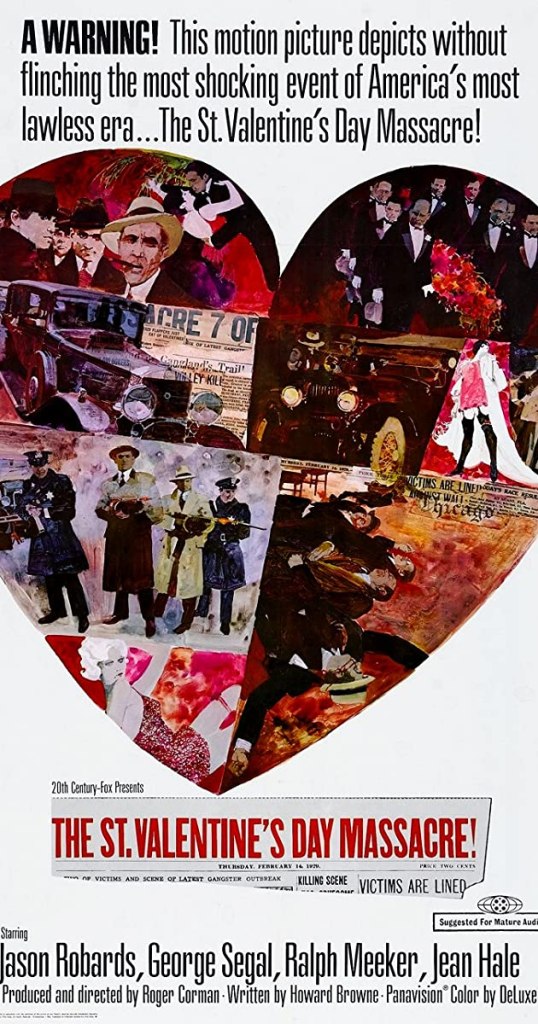
The 1967 film, The St. Valentine’s Day Massacre, details the rivalry between Capone and Moran, starting with them fighting for control over the Chicago rackets and ending with the title event. Moran is played by Ralph Meeker while Jason Robards plays Capone.
Now I know what you’re probably thinking. Perennial WASP Jason Robards as Al Capone? That may sound like odd casting and, let’s just be honest here, it is. However, it actually kind of works. Robards may not be convincingly Italian but he is convincingly ruthless. Add to that, one of the major subplots of the St. Valentine’s Day Massacre is that, even as the head of the Chicago Outfit, Capone still feels like an outsider in the world of organized crime because, while he is Italian, he isn’t Sicilian. Capone feels as if Lucky Luciano and all of the major New York crime bosses look down on him and one reason why he’s so ruthless about taking over Chicago is that wants to show Luciano that he can be just as effective a crime lord as any Sicilian. Capone feeling out of place in the Mafia is reflected by Robards initially seeming to be out of place in a gangster film. By the end of the movie, of course, Capone has proven himself and so has Jason Robards.
Robards isn’t the only familiar face to be found in The St. Valentine’s Day Massacre. Though this film was released by 20th Century Fox, it was directed by Roger Corman and Corman fills the production with members of his stock company. Dick Miller, Jonathan Haze, and Jack Nicholson all have small roles as gunmen. Bruce Dern plays the unlucky mechanic who enjoys hanging out with gangsters. Buck Taylor, Leo Gordon, and Joe Turkel all have small roles. John Agar plays Dion O’Bannon and is gunned down in his flower store. Though not members of the Corman stock company, George Segal and David Canary plays brothers who work for Moran. There’s a lot of characters wandering through this film but Corman makes sure that everyone gets a chance to make an impression.
It’s a good gangster film. Though he was working with a larger budget than usual, Corman still brought his exploitation film aesthetic to the material and the end result is a violent, melodramatic gangster film that looks really impressive. The film’s recreation of 1920s Chicago is a visual delight and looking at the well-dressed and stylish gangsters walking and driving down the vibrant city streets, you can understand why organized crime would have such a draw for some people.
The St. Valentine’s Day Massacre is a classic gangster film and a classic Corman film. It’s an offer you can’t refuse.

 Through the Shattered Lens