Horror Film Review: Dracula (dir by John Badham)


I have to admit that, when I first sat down to watch the 1979 version of Dracula, I wasn’t expecting much.  I hadn’t even heard of the film until I came across it on Encore and, when I considered that it was made in 1979, I immediately assumed it would be a disco Dracula film.

And, let’s be honest — a disco Dracula film sounds kinda fun.  But still, it’s Halloween.  Dracula is an icon of horror.  And somehow, the idea of watching disco Dracula just was not appealing.  It would be appealing in November or September.  BUT THIS IS OCTOBER!

Well, despite my misgivings, I watched the film and I quickly discovered that it wasn’t a disco Dracula at all.  This Dracula takes place in 1913 and there’s actually very little about it that would lead you to suspect that it had been made in the 1970s.  Instead, it feels more like a tribute to the colorful and lushly erotic Dracula films that Hammer produced in the 60s.  Except, oddly, the Hammer films were far more bloody than the 1979 version.  Oh, don’t get me wrong.  There’s a few gory scenes in 1979’s Dracula.  Towards the end of the film, there’s a rather bloody impaling.  Dracula graphically breaks another character’s neck as we watch.  But, even with those scenes in mind, the 1979 Dracula feels oddly restrained at times.

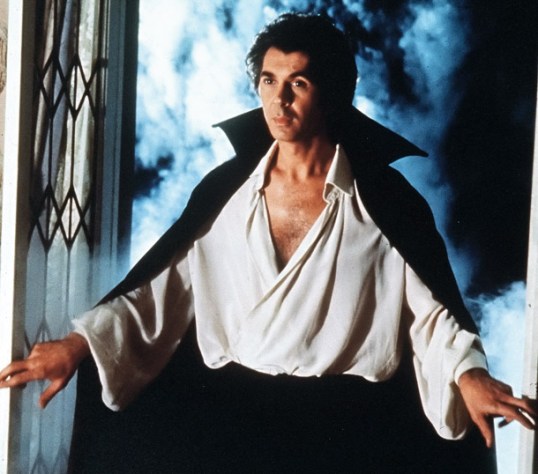
In this version of Dracula, the title character is played by a youngish Frank Langella.  I have to admit that it was a bit odd to see Langella playing someone other than a corrupt authority figure.  Dare I say it, Langella is almost sexy in this film and his somewhat feral features are perfect for a character who considers wolves to be “the children of the night.”  Langella’s performance falls between the haughty charm of Bela Lugosi and the animalistic fury of Christopher Lee.  And while Langella’s performance never quite reaches the heights of those two actors, he’s still effectively cast.

As for the film itself, it starts with a shipwreck near a local asylum.  One of the passengers on that ship is the charming but mysterious Count Dracula.  Dracula introduces himself to the head of the asylum, Dr. Jack Seward (Donald Pleasence, stealing almost every scene in which he appears).  There’s an immediate attraction between Dracula and Seward’s daughter, Lucy (Kate Nelligan).  That does not amuse Lucy’s fiancee, Jonathan Harker (Trevor Eve, who is perhaps the whiniest Harker in film history).

Meanwhile, Lucy’s best friend, Mina (Jan Francis), has been taken ill and it might have something to do with the two puncture marks on her neck.  After Mina dies, her father (played by Laurence Olivier) comes to investigate.  Her father’s name?  Abraham Van Helsing.

As I said, I was not expecting much from this version of Dracula so I was actually pleasantly surprised during the first hour of the film.  This version gets off to a nice start, with director John Badham giving us a mix of lush romanticism and gothic moodiness.  I’ve already talked about Langella’s performance but  Donald Pleasence and Laurence Olivier also distinguish themselves.  It’s obvious that these veteran performers enjoyed playing opposite each other and there’s a lot of pleasure to be found from watching Pleasence and Olivier compete to see who can steal the most scenes.

Unfortunately, after that strong first hour, Dracula slows down.  Once Seward and Van Helsing know that Dracula is a vampire, the whole movie becomes about finding excuses for them to not do anything about it.  The final 40 minutes feel almost like filler and, at one point, you’re required to believe that an elderly man, who has been seriously wounded, could still find the strength to swing a hook into a much stronger person’s back.

In the end, the 1979 Dracula is more of an intriguing oddity than a definitive version.
So, I Finally Watched Grace of Monaco…


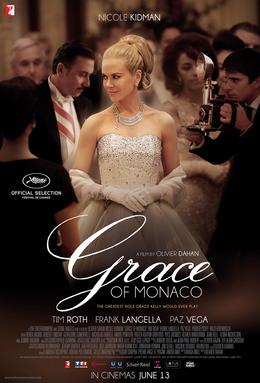
Grace_of_Monaco_PosterWell, I finally saw Grace of Monaco and…

Oh God.

Seriously, I am sitting here right now and I am just thinking to myself, “Oh God, do I really have to try to think up something interesting to say about this movie?”  Grace of Monaco is not a good movie but, at the same time, it’s bad in the worst way possible.  It’s not so bad-that-its-entertaining.  Instead, it’s just a dull misfire.

In fact, probably the only really interesting thing about Grace of Monaco is that it is the first film to go from opening Cannes to premiering on Lifetime.  Though it may seem impossible to believe now, there was a time in 2013 when everyone was expecting Grace of Monaco to be a major Oscar contender.  It seemed like everyone was saying that Nicole Kidman was a lock for a best actress nomination and maybe more!

Then the film’s American release date was moved from November of 2013 to June of 2014.  Rumor had it that the infamous Harvey Weinstein was chopping up the film and destroying the vision of director Olivier Dahan.  “Bad Harvey!” we all said.  (Of course, having now seen the film, I can understand why Harvey may have had some concerns…)

Okay, we told ourselves, Grace of Monaco probably won’t be a best picture contender.  But surely Nicole Kidman can get a nomination.  Surely the costumes and the production design will be honored…

And then the film played opening night at the Cannes Film Festival and it was greeted with less than appreciate reviews.  In fact, the reaction to the film was so negative that it has since become somewhat legendary.

And so, the American premiere was canceled.  The film opened in Europe, where it made little money and received scathing reviews.  But it was destined to never play in an American theater.  Instead, Grace of Monaco was sold to the Lifetime network.

And, after all of the drama and the waiting, I finally got to see Grace of Monaco tonight and … well, bleh.

Don’t get me wrong.  It’s a pretty movie.  I loved looking at what everyone was wearing.  I enjoyed looking at the ornate settings.  Whenever Grace Kelly stopped to look out at the view from the palace, I appreciated it because it was a beautiful view.  If I had hit mute and simply enjoyed the film as a look at beautiful people wearing beautiful clothes and living in beautiful houses, I probably would have enjoyed it a lot more.

But, unfortunately, Grace of Monaco has a plot that gets in the way.  The evil French, led by Charles De Gualle (played by Andre Penvern, who gives a performance that would probably be more appropriate for a James Bond film), want to take over Monaco because the citizens of Monaco don’t pay any income tax.  (I was totally Team Monaco as far as this was concerned.  Everyone should stop paying their taxes.  If we all do it, we’ll be fine.  They can’t prosecute all of us!)  Only Princess Grace Kelly can stop them but first, she has to convince her headstrong husband, Prince Rainier (Tim Roth), to listen to her opinions.  She has to convince her subjects that she’s more than just an opinionated American.

But Grace doesn’t just want to keep the French out of Monaco!  She also wants to return to her film career.  Alfred Hitchcock (Roger Ashton-Griffiths) wants her to star in Marnie.  (Hitchcock is always filmed as being slightly out-of-focus.)  Rainier doesn’t want her to return to acting.  And neither does a priest played by Frank Langella…

What was Frank Langella doing in this movie?  I have no idea.  He was some sort of advisor.  I understand that he’s based on a historical figure but honestly, the film was so boring that I can’t even bring myself to go on Wikipedia to find out who exactly he was.

But really, the main issue with Grace of Monaco is that it tells us absolutely nothing about Grace Kelly.  The film doesn’t seem to know who she was or what it wants to say about her.  And Nicole Kidman is a good actress and I hope that I look as good as she does when I’m 47 and after I’ve given birth to two children but seriously, she seems to be totally lost in this film.  Olivier Dahan fills the film with close-ups of Kidman’s face but for what reason?  Never for a minute do we believe we’re looking at the face of the star of High Noon, Rear Window, or To Catch A Thief.  Instead, we’re always aware that we’re looking at Nicole Kidman and she doesn’t seem to be sure just what exactly she’s supposed to be doing.  We learn nothing about Grace, Monaco, France, royalty, or movies.

And it’s a shame really.  Because the story of Grace Kelly would make a great film.  But Grace of Monaco doesn’t really tell you anything about her life.

It’s just boring and a film about an actress like Grace Kelly has absolutely no right to be boring.

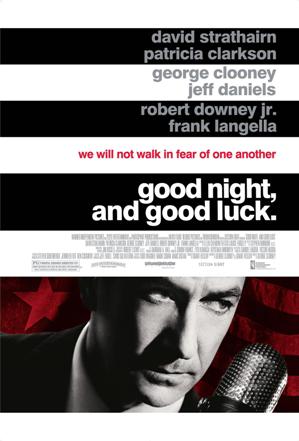
Shattered Politics #76: Good Night, and Good Luck (dir by George Clooney)


Goodnight_posterOne of my favorite episodes of South Park is called Smug Alert!  As you may remember, this is the episode where the citizens of South Park all buy hybrid cars and end up getting so self-satisfied that a dangerous cloud of smug forms over the town.  At the same time, another smug storm is racing across the United States.  This smug storm was created by the speech that George Clooney gave when he won the Oscar for Syriana.  When those two clouds of smug meet, it’s the perfect storm.  It also ends up destroying San Francisco.

The same year that Clooney was named Best Supporting Actor for Syriana, he was also nominated for directing the 2005 best picture nominee, Good Night, and Good Luck.  In his speech, Clooney specifically said that he felt he was winning supporting actor to make up for not winning director and proceeded to give the speech that he would have given if he had won director.

And looking back, I think that we do have to admit that it was a very smug speech.

Fortunately, Good Night, and Good Luck has aged better than Clooney’s speech.

I do have to admit that, when I recently rewatched Good Night and Good Luck, I was a little concerned.  I always manage to forget that the film starts on a really bad note.  The year is 1958 and news anchorman Edward R. Murrow (played by David Strathairn) is receiving an award.  As Murrow stands behind the podium, he proceeds to give a long and self-righteous speech about how television should be used not to entertain but to educate as well.  And, quite frankly, he comes across like such a pompous blowhard that I was dreading the idea of having to spend the next 90 or so minutes with him.

But then, fortunately, the film entered into flashback mode and, until the final few minutes of the film, we didn’t have to listen to anymore of Murrow’s speech.  The majority of Good Night and Good Luck takes place in 1953.  U.S. Sen. Joseph McCarthy (who appears in archival footage throughout the film) has declared that he has the names of communists who hold important positions in both the government and the media.  Murrow and his producer, Fred Friendly (George Clooney) defy the corporate overlords of CBS and bravely investigate and challenge McCarthy’s claims.  McCarthy and his henchmen respond by trying to smear both Murrow and one of his reporters (Robert Downey, Jr.) as a communists.  As always seems to happen in films about McCarthyism, another supporting character reacts to the change of communism by committing suicide.  And, in this particular vision of the fight against Joseph McCarthy, Edward R. Murrow and the media save America.

Of course, if you actually make the effort to learn history, you’ll discover that it wasn’t just Edward R. Murrow who stood up to McCarthy.  In fact, you’ll discover that Murrow stood up to McCarthy after several other prominent people — on both sides of the political divide — had already done so.  If anything, the real-life Murrow seems to have more in common with pompous scold seen at the beginning and end of the film, as opposed to the one that we see standing up to McCarthy.

One can very legitimately debate whether or not Murrow deserves all of the credit that he’s given in this film.  Still, the film does make a larger and very important point.  We, as Americans, have to always be on guard against witch hunts and against demagogues and the forces of fear and paranoia that are always trying to shape our politics.  And, whether or not Murrow was a hero or just a bystander, one cannot deny that the larger message of Goodnight, and Good Luck remains as relevant today as when the film was originally released.

Judging from some of his other films — The Monuments Men and the Ides of March — I don’t particularly feel that George Clooney is that good of a director.  But he does do a good job with Good Night and Good Luck.  (In fact, he does such a good job that you can’t help but feel that it’s the exception to the rule as far as Clooney the director is concerned.)  Filmed in wonderful black-and-white and full of good performances, Good Night, and Good Luck remains surprisingly watchable.

Just avoid any George Clooney Oscar speeches while watching it.  San Francisco has never recovered.

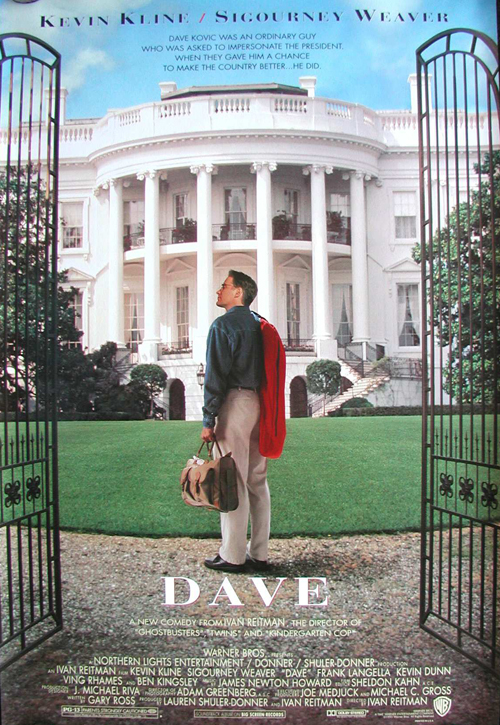
Shattered Politics #54: Dave (dir by Ivan Reitman)


Dave Poster

Way back in 1919, the terrible U.S. President and tyrannical dictator Woodrow Wilson* suffered a stroke that left him semi-paralyzed and unable to perform his duties.  By all standards, Wilson should have been removed from office, if just temporarily.  However, in those pre-Internet days, it was a lot easier to hide the truth about Wilson’s physical and mental condition.  While Wilson spent his days locked away in his bedroom, his wife Edith would forge his signature on bills.  Whenever anyone asked for the President’s opinion, Edith would give her opinion and then assure everyone that it was actually the President’s.

(And really, as long as you were promoting eugenics and white supremacy, it probably was not difficult to imitate Wilson’s opinions.)

Of course, back then, people were used to the idea of never seeing their President in public.  Hence, it was very easy for Wilson to remain sequestered in the White House.  If a similar situation happened today, it’s doubtful that anyone could successfully keep the public from finding out.  When we don’t see the President every day, we wonder why.  How, in this day and age, could a Presidential incapacitation be covered up?

The 1993 film Dave offers up one possible solution.

Dave is the story of two men who happen to look exactly like Kevin Kline.  One of them is named Bill Mitchell and he’s the arrogant and corrupt President of the United States.  The other is named Dave Kovic.  He’s a nice guy who runs a temp agency and who has a nice side job going as a professional Bill Mitchell imitator.

So, when Bill has a stroke while having sex with a white house staffer (Laura Linney), it only makes sense to recruit Dave Kovic to pretend to the President.  White House Chief of Staff Bob Alexander (played by Frank Langella, so you know he’s evil) tells Dave that Vice President Nance (Ben Kingsley) is insane and corrupt.  Dave agrees to imitate the President.  Of course, Alexander’s main plan is to convince Nance to resign and then get Dave to appoint him as Vice President.  Once Alexander is Vice President, it will be announced that Mitchell has had another stroke and then Alexander will move into the Oval Office.

However, what Alexander did not take into account was just how much Dave would enjoy being President.  From the moment that he joyfully shouts, “God Bless, America!,” Dave’s enthusiasm starts to win the public over.  Suddenly, people are realizing that President Mitchell isn’t such a bad President after all.  Even more importantly, Dave wins over the first lady (Sigourney Weaver) who, previously, had little use for her philandering husband.  When Alexander claims that there’s no money in the budget to continue funding a program for the homeless, Dave calls in his best friend, an accountant named Murray (Charles Grodin), and has him rewrite the budget…

And you know what?

Dave is one of those films that tempts me to be all cynical and snarky but, ultimately, the film itself is so likable and earnest that I can even accept the idea that one accountant could balance the budget through common sense alone.  I’ll even accept the idea that Dave could come up with a program that would guarantee everyone employment without, at the same time, bankrupting the country.  Kevin Kline is so enthusiastic in the lead role and the film itself is so good-natured that it almost feels wrong to criticize it for being totally implausible.

Sometimes, you just have to appreciate a film for being likable.

Dave—–

* For those of you keeping count, that’s the third time in two weeks that I’ve referred to Woodrow Wilson as being  a dictator.  Before anyone points out that some historians rank Wilson as being in the top ten of President, allow me to say that I don’t care.  I DO WHAT I WANT!

So, was Noah good or not?


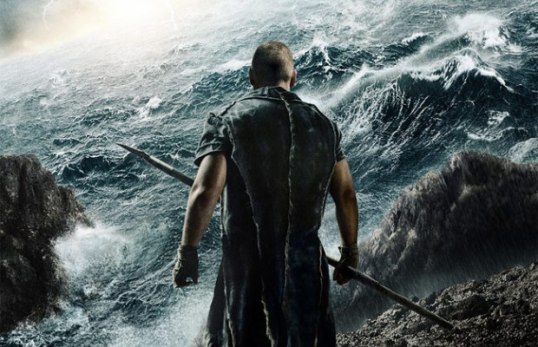
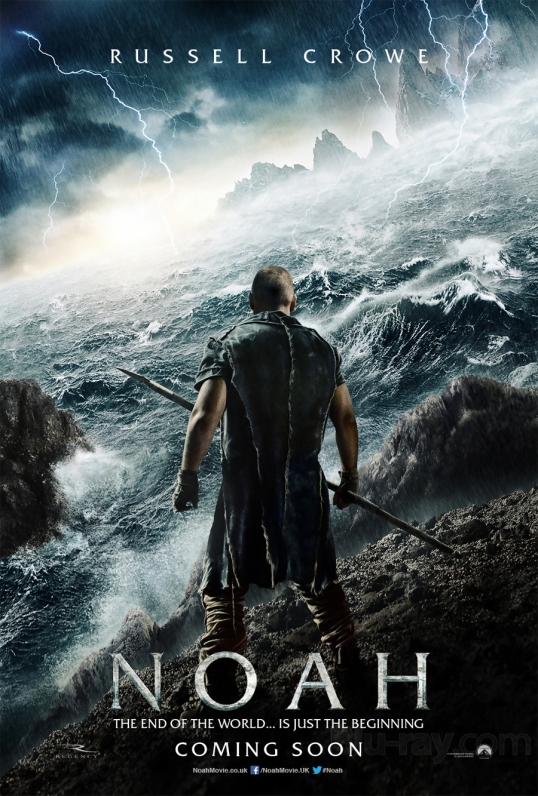
Poster-Noah-Aronofsky

Was Noah a good movie or not?

That’s a question that was first asked way back in March.  At the time, the answer depended on who you asked.  For instance, Noah is one of Arleigh’s favorite films of the year.  My reaction, however, was far more mixed.  Noah was one of those movies that I thought I would review as soon as I watched it but that proved to be a lot more difficult than I expected.  As I found myself wondering what I should say in my review, it became very apparent to me that I wasn’t sure whether I liked the film or not.

By the time that I finally decided that I was, overall, disappointed by Darren Aronofsky’s controversial and spiritual-but-not-quite-biblical version of the Deluge, over a month had passed and we had all moved on to different movies.

And so that review remained unwritten.  And, at first, I thought it wouldn’t matter.  As much as I try to review every single movie that I see, I know that the world is not going to end if I miss a film or two.  After all, I’ve never specifically written down just how much I hated the latest Transformers movie and the world has yet to plunge into the sun…

And yet, for all of its flaws and the fact that it left me feeling underwhelmed, Noah has stuck in my mind in a way that many of the films that I saw this year have not.  It would be a struggle for me to remember much of anything about Dracula Untold but Noah Noah has stayed with me.

Thinking back, it’s easy for me to say what did not work about Noah.

As opposed to Aronofsky’s best films (Requiem for A Dream, The Wrestler, and my beloved Black Swan), Noah felt oddly paced with certain scenes ending too quickly while other scenes seemed to drag on forever.

The film’s environmental message was delivered with such a heavy hand that it ultimately did not make much of a difference whether you agreed or not.  For a film that went out of its way to establish itself as not being a traditional biblical film, Noah was certainly preachy.

While the film deserves credit for not flinching in its portrait of a surly and self-righteous Noah, it still doesn’t change the fact that the movie was essentially 138 minutes spent with a very unlikable character.

Anthony Hopkins gave perhaps the worst performance of his career as Methuselah.  In the role of Tubal-Cain, Ray Winstone was such a one-dimensional villain that I half expected him to invent trains just so he could tie Emma Watson to the tracks.

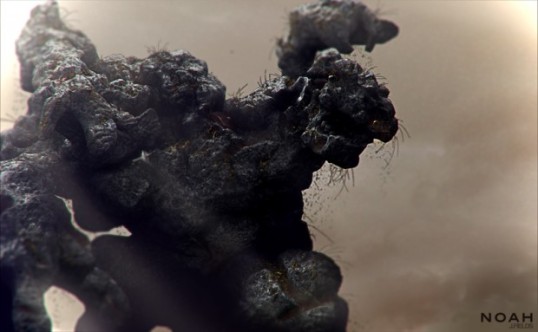
And, of course, there were the Watchers — fallen angels who had been turned into sentient piles of stone by a vengeful God.  I know that some people loved the Watchers but to me, they looked ludicrous…

NoahWatchers

And yet, that’s the reason why we love Darren Aronofsky, isn’t it?

Obviously, it was a risk to portray the fallen angels as being a bunch of talking rocks.  It was also a risk to take a character who is mentioned only once in the book of Genesis — in this case, Tubal-Cain — and then use that character as a representation of everything that’s wrong with the human race.  It was a risk to make a “biblical” film that openly questioned both the existence and wisdom of God.  We expect and demand that directors take risks but, at the same time, we also want to ridicule and judge when those risks don’t work out.  That’s the issue that we, as film lovers, often face.  Do we celebrate and perhaps excuse a director for his intentions or do we solely judge him based on the results?

And the thing with Noah is that, as much as the movie did not work for me, it also did work for me.  For all of those flaws that I listed above, Noah is full of images that are so beautiful and so memorable that I can still visualize them as if I saw them yesterday:

Noah and his sons walk across a gray and blasted landscape, stopping just long enough to stare at a foreboding city in the distance.

Noah walks through a decadent settlement and briefly, this somber film is so full of bright colors and flamboyant characters that the viewer is almost as overwhelmed as Noah.

That Ark, looking small and isolated, floating across an endless blue ocean.

And finally, Noah talking about the horrors of humanity and briefly, we see that the shadows that he’s visualizing are dressed in modern clothing.

For all of my issues with Noah, it’s such a visually impressive film and takes so many risks that I can’t help but respect it.  I don’t consider it to be a great film but, after all this time, I can say that it’s a film that only a true artist could make.

And, considering the current state of American film, that’s one of the best compliments that one can give.

noah-banner222

Super Bowl Trailer: Noah


5204

Noah is Darren Aronofsky’s follow-up to his critically-acclaimed film Black Swan (which was reviewed by Lisa Marie Bowman herself) and he looks to tell the tale of Noah’s Ark from the Book of Genesis.

When news first came out that Aronofsky would follow-up Black Swan with a biblical epic that retold the Flood and Noah’s role in saving those not corrupted according to Heaven was a sort of headscratcher. The teasers and trailers that has come out about the film hasn’t really fired up the masses. Some think it as another sword-and-sandals epic that’s late to that particular subgenre’s resurgence. Some think too much fantasy elements has been added.

One thing I’m sure of is that Aronofsky will not make an uninteresting film.

Noah is set for a March 28, 2014 release date.

Two Post Presidents Day Reviews: Frost/Nixon (dir. by Ron Howard) and All The President’s Men (dir. by Alan J. Pakula)


“Now Watergate doesn’t bother me/does your conscience bother you?” — Lynard Skynard, Sweet Home Alabama

As part of my continuing quest to see and review every film ever nominated for best picture, I want to devote my first post Presidents Day post to two films: 2008’s Frost/Nixon and 1976’s All The President’s Men.

During my sophomore year of college, I had a political science professor who, every day of class, would sit on his desk and ramble on and on and on about his past as a political activist.  He protested Viet Nam, he hung out with revolutionaries, he loved Hugo Chavez, and I assume he probably had a Che Guevara poster hanging in his office.  Whenever he wanted to criticize George W. Bush, he would compare him to Richard Nixon and then pause as if he was waiting for the class to all start hissing in unison.  He always seemed to be so bitterly disappointed that we didn’t.  What he, and a whole lot of other people his age, didn’t seem to understand was that Richard Nixon was his boogeyman.  The rest of us could hardly care less.

That was the same problem that faced the 2008 best picture nominee Frost/Nixon

Directed rather flatly by Ron Howard, Frost/Nixon tells the true story about how a light-weight English journalist named David Frost (played by Michael Sheen) managed to score the first televised interview with former President Richard Nixon (Frank Langella).  Both Frost and Nixon see the interviews as a chance to score their own individual redemptions while Frost’s assistants (played by Oliver Platt and Sam Rockwell) see the interview as a chance to put Richard Nixon on trial for Watergate, the Viet Nam War, and every thing else under the sun.  That may not sound like a very exciting movie but it does sound like a sure Oscar contender, doesn’t it?

I’ve always secretly been a big history nerd so I was really looking forward to seeing Frost/Nixon when it was first released in 2008.  When I first saw it, I was vaguely disappointed but I told myself that maybe I just didn’t know enough about Richard Nixon or Watergate to really “get” the film.  So, when the film later showed up on cable, I gave it another chance.  And then I gave it a chance after that because I really wanted to like this film.  Afterall, it was a best picture nominee.  It was critically acclaimed.  The word appeared to be insisting that this was a great film.  And the more I watched it, the more I realized that the world was wrong.  (If nothing else, my reaction to Frost/Nixon made it easier for me to reject the similarly acclaimed Avatar a year later.)  Frost/Nixon is well-acted and slickly produced but it’s not a great film.  In fact, Frost/Nixon is epitome of the type of best picture nominee that inspires people to be cynical about the Academy Awards.

Before I get into why Frost/Nixon didn’t work for me, I want to acknowledge that this was a very well-acted film.  By that, I mean that the cast (Frank Langella, Michael Sheen, Kevin Bacon, Sam Rockwell, and Oliver Platt) all gave very watchable and entertaining performances.  At the same time, none of them brought much depth to their characters.  Much like the film itself, nobody seems to have much going on underneath the surface.  Frank Langella may be playing a historic figure but, ultimately, his Oscar-nominated performance feels like just a typically grouchy Frank Langella performance.  Michael Sheen actually gives a far more interesting performance as David Frost but, at the same time, the character might as well have just been identified as “the English guy.”  In fact, a better title for this film would have been The Grouchy, the English, and the Superfluous.

For all the time that the film devotes to Rockwell and Platt blathering on about how they’re going to be giving Richard Nixon “the trial he never had,” this film is ultimately less about politics and more about show business.  Ron Howard devotes almost as much time to the rather boring details of how the interviews were set up and sold into syndication as he does to the issues that the interview brings up.  Unfortunately, for a movie about show business to succeed, the audience has to believe that the show is one that they would actually enjoy watching,  This, ultimately, is why Frost/Nixon fails.  While the filmmakers continually tell us that the Frost/Nixon interviews were an important moment in American history, they never show us.  Yes, everyone has hideous hair and wide lapels but, otherwise, the film never recreates the period or the atmosphere of the film’s setting and, as a result, its hard not to feel detached from the action happening on-screen.  For all the self-congratulatory claims made at the end of the film, it never convinces us that the Frost/Nixon interviews were really worth all the trouble.  Much like my old poli sci professor, Frost/Nixon never gives us a reason to care. 

For a far more interesting and entertaining look at the Watergate scandal, I would recommend the 1976 best picture nominee All The President’s Men.  Recreating the story of how two Washington Post reporters (played by Robert Redford and Dustin Hoffman) exposed the Watergate scandal that eventually led to Nixon’s resignation, All The President’s Men is the movie that Frost/Nixon wishes it could be.  Despite being made only two years after Watergate, All The President’s Men doesn’t take the audience’s interest for granted.  Instead, director Pakula earns our interest by crafting his story as an exciting thriller.  Pakula directs the film like an old school film noir, filling the screen with menacing shadows and always keeping the camera slightly off-center.   Like Frost/Nixon, All The President’s Men is a well-acted film with a bunch of wonderful 70s character actors — performers like Ned Beatty, Jason Robards, Jack Warden, Martin Balsam, and Robert Walden, and Jane Alexander — all giving effectively low-key and realistic performances.   The end result is a film that manages to be exciting and fascinating to those of us who really don’t have any reason to care about Richard Nixon or Watergate.

Both of these two films were nominated for best picture.  Frost/Nixon quite rightly lost to Slumdog MillionaireAll The President’s Men, on the other hand, lost to Rocky.

Lisa Marie Discovers All Good Things (dir. by Andrew Jarecki)


I’ll admit right now that I’m a true crime junkie.  Maybe it’s because I work for a lawyer or maybe I’m just morbid-minded but, for whatever reason, I am fascinated by this stuff.  And while we all love to watch a good mystery and see if we can solve it before everyone else, it’s the mysteries without a solution that hold a special grip on my imagination.  That’s why I was really looking forward to seeing the film All Good Things.  Directed by Andrew Jarecki and starring Ryan Gosling, All Good Things is based on not one true crime case but three!  (And two of those crimes remain unsolved to this day.)

All Good Things is based on the life of Andrew Durst, who was born into a wealthy New York family just to eventually find himself accused — at one time or another — of two murders and actually put on trial for a third.  Oh, and did I mention that in-between being accused of killing people, Durst also found the time to drop out of high New York society and, despite being a very wealthy man, wandering around the country like a homeless transient?  And, would you also believe that when Durst eventually ended up moving down to Galveston, Texas, he apparently also became a transvestite?  And once Durst was in Galveston, he ended up living in a run-down boarding house with another transient who Durst eventually ended up decapitating?  Of course, all of this happened long after the mysterious disappearance of his first wife and the execution-style shooting his best friend (who also happened to be the daughter of a Las Vegas mob boss).  Durst, it should be noted, has only been put on trial once and, in that case, was acquitted.  (For a better account of the various unproven allegations against Robert Durst, click here.)

Yes, Robert Durst is a man who has found himself at the middle of several very intriguing mysteries and All Good Things pretty much sticks to the facts of the case, recreating all the scenes that we Durst watchers are familiar with while leaving the ultimate question of Durst’s guilt or innocence ambiguous.  For legal reasons, the names are changed but that’s about it.  The film even begins with a title card telling us that the film is based on the Durst case even if Ryan Gosling is technically playing a character named David Marks.  We watch as David meets and romances sweet but lower class Katie (Kirsten Dunst) despite the disapproval of his wealthy father.  (David’s father is a real estate mogul who owes his fortunes to the peep shows and grindhouses on 42nd Street.)  Once David and Katie have married, we watch the marriage turn into a nightmare as David grows increasingly abusive and Katie starts to abuse drugs.  We meet all the familiar characters that we know about from reading about the case, especially David’s devoted friend Deborah (Lilly Rabe).  We see the way that Deborah fanatically defends David after Katie mysteriously vanishes and eventually, we see David in Galveston, a blank-faced recluse who has lost the ability (if he ever had it) to exist in reality.   Yes, it’s an interesting story but does the film do it justice? 

Frustratingly, the answer is yes and no.

There’s a great movie to be found in the life of Robert Durst and unfortunately, director Andew Jarecki doesn’t find that great movie with All Good Things.  Despite telling a fictionalized version of a true story, Jarecki still approaches the material as if he’s making another documentary.  By simply concentrating on the public record of the Durst case (and, for the most part, declining to engage in any poetic license while telling the story), he keeps his distance from the characters and their world and, as a result, you watch fascinated because the story is so bizarre but not because you have any emotional investment in anything happening onscreen.   Like a good documentarian, Jarecki concentrates on providing the evidence and leaving the ultimate verdict to the audience.  If this film was a documentary about Robert Durst, this would be commendable.  However, All Good Things is a movie about a vaguely sinister guy named David Marks who remains a cipher throughout the entire film.

However, this is not the fault of the cast who manage to redeem this movie with several carefully conceived character turns.  In a frustrating and vague role, Ryan Gosling gives a far better performance than anyone would really have the right to expect.  He plays the role with a vague sense of blank desperation, creating a portrait of a man who wants to fit in with reality but just doesn’t know how to do it.  When we first meet see David wandering around 42nd street and struggling to maintain a facade of normalcy, it’s hard not to feel sorry for him.  He looks like a lot child and your natural reaction is to want to protect him and help him find his place in the world.  Add that vulnerability to the fact that he looks like Ryan Gosling and you can believe that Kirsten Dunst’s character would find him attractive and would eventually marry him, despite his quirks.  Its only once David is married (and, in theory, no longer has to worry about losing Dunst) that he starts to show his true face.  Any woman who has ever been in an abusive relationship will know the type of person that David Marks is.  As played by Gosling, he becomes every boyfriend or husband who has ever transformed into a different person once we’ve made the mistake of falling in love with him.  He’s every man we’ve ever been happy to have out of our life even as we wondered if we were to blame for whatever went wrong.  Gosling’s strongest moments come when David simply stares at his own reflection, the look on his face indicating that he’s just as confused by himself as we are.  Kirsten Dunst is sympathetic as his wife and there’s excellent character turns from Frank Langella, Philip Baker Hall, Diane Venora, and Lilly Rabe.

So, what I recommend All Good Things?  I would.  It makes for a good introduction to the Durst case and, if nothing else, it’s worth seeing for Gosling’s performance.  The definitive version of Durst’s case hasn’t been told yet but All Good Things is, at the very least, a start.

Review: Unknown (dir. by Jaume Collet-Serra)


In 2009 Liam Neeson began a new phase of his career as an actor. Before 2009 he was always put into roles as the father figure and mentor to a younger protagonist. He did quite well in handling these roles. Most of the time he was the only good thing about the films he was in and it was due to how he handled the supporting role given to him. But 2009 changed everything as Liam Neeson arrived on the film scene as a bonafide action hero in his role as a former CIA Special Activities Division operative in the action-thriller, Taken. That film surprised many and Neeson’s badass portrayal of a father out to save his daughter opened the eyes of many filmgoers who always saw him as the calm, wise elder. He has taken on the mantle of older, action-hero characters from Harrison Ford who lived off and became rich doing roles such as the one in Taken.

Two years later we have another film where we get to see Liam Neeson in another role which cements his place in the action-hero pantheon. Also like Pierre Morel’s film, this one takes place in Europe and directed by another European filmmaker trying to make a name for himself in Hollywood, Jaume Collet-Serra. It would be disingenious to say that Collet-Serra had it in him to direct a film as tight and fast-moving as Unknown. His two Hollywood productions were the remake of the classic horror film, House of Wax, and the underappreciated horror film from 2009, Orphan. With this new action-thriller, Unknown, Collet-Serra and Neeson create a film which owes much of its film dna to Hitchcock and his mistaken-man classic, North by Northwest. I would also say that this film also owes much of its action and characters to one of the early 1990’s best sci-fi action films, Paul Verhoeven’s Total Recall.

The film begins with Neeson’s character, Dr. Martin Harris, and his wife Liz (played by Mad Men‘s January Jones) arriving in Berlin to attend a biomedical conference. Right from the start Neeson makes us believe in Harris being an everyman. The good professor doesn’t seem the alpha male-type. But after certain seemingly random circumstances and events puts Harris in a coma for four days we begin to see signs and glimpses that Neeson’s character may have more to him than meets the eye.

It’s when Harris’ awakens from his coma that the meat of the film’s story begins. We know going in that Neeson’s character knows he’s not crazy and that someone out there has made things appear as if he is becoming insane. Maybe the accident in the beginning of the film have given us a false perspective on the film. What we might be seeing could be a manifestation of Harris’ mental breakdown from the accident and subsequent coma. But little clues in the film’s dialogue keeps things vague, but not so much that our initial stance that Harris’ is being manipulated won’t be the final endgame.

It is the endgame in the film which may make or break the whole production for some people. The screenplay by Oliver Butcher and Stephen Cromwell is not the strongest out there and it tries to be too complex with its red herrings when trying to keep it simple would’ve sufficed. One could almost sense that the two writers were trying to be too Hitchcock that they lost sight of how Hitchcock’s films were simple affairs which only appeared to be complex. Yet, despite some necessary leaps of logic that audiences needed to make to continue believing in the film, Unknown manages to keep the core story moving forward to it’s inevitable conclusion.

The performances by everyone involved is what keeps this film from spiralling out of Collet-Serra’s capable hands. One would almost certainly point out the strong work by Neeson as the Harris. January Jones’ Liz Harris, at first, seemed like an extension of her Betty Draper character from Mad Men, but as the story moves forward we get to see more layers of personalities in her character to make her interesting beyond the dutiful and supportive wife. But the standout performance outside of Neeson has to go to Diane Kruger as Gina, the taxi driver who was involved in Neeson’s character getting in his accident in the beginning of the film.

Kruger arguably is one of Hollywood’s classic beauty, but she has an ability to actually keep that beauty in check with her acting that we believe her to be the “everywoman” in some of the roles she plays. Beauty doesn’t come into the Gina character’s personality. Kruger does a great job of playing the pawn in a much larger game being played on Neeson’s character. Her reluctance to help him gradually crumbles as she soon realizes that her own safety and survival is now inextricably linked to unraveling the mystery of who Martin Harris really is.

Unknown is one of those films that actually has an advantage being released in the so-called dead season which runs from January and into March. It’s a film season when studios put out films they have no faith in being a major blockbuster which means summer and Holiday season release are out. It’s not prestigious enough to be put out in the Fall and early Winter. But as a piece os well-done escapist fare it’s perfect for this so-called dead season. Jaume Collet-Serra has shown that even when working from an average screenplay he knows how to get the best out of his cast to sell the film to the audience. He also has a firm grasped on pacing and how to handle action sequences.

In the end, the film still loves or dies by how the audience reacts to Liam Neeson’s character. While his Martin Harris is not the Bryan Mills from Taken, by the time the final scene fades to black we begin to see how similar the two characters really are and how much they share. Until the big name films start dropping in beginning in March (blockbuster season seem to come earlier and earlier with each passing year), Unknown is one of those films that should help make this early months of the film season more entertaining than it usually is in year’s past.

As an aside, for those who know their films would understand why I say that, in addition to this film having aspirations of being Hitchcockian, Unknown definitely borrows or has been influenced by some of the story and character developments of Verhoeven’s Total Recall. I almost half-expected for a half-mutant seer named Kuato to make an appearance to explain it all to Neeson’s ccharacter.

A Quickie with Lisa Marie: Wall Street: Money Never Sleeps (Dir. by Oliver Stone)


Sometimes, words escape even me. 

I’ve been trying for about three days now to figure out how to explain why Wall Street: Money Never Sleeps is one of the most disappointing films of 2010.  Notice I didn’t use the term “worst film.”  There’s enough in the movie that works (Michael Douglas is fun to watch as Gordon Gekko and there’s a handful of scenes that perfectly capture the modern atmosphere of financial panic) to keep it from being a truly awful movie.  But just because the movie isn’t awful, that  doesn’t necessarily mean that it’s any good.

Oh, Wall Street — how did you fail?  Let me count the ways.

1) Michael Douglas gives a great performance but he actually has less screen time here than he did in the original Wall Street.  Yes, it’s fun to watch Gekko claw his way back up to the top but, once you take those scenes out of the equation, you still have about 1oo minutes of non-Gekko material to slog through.

2) Instead most of the screen time goes to Shia LeBouf.  Let me repeat that — most of the screen time goes to Shia LeBouf.  In this film, Shia plays a cocky young financial genius.  Let me repeat that.  In this film, Shia LeBouf plays a genius.  Back before Shia became the human face of the Transformers franchise, I’ll admit that I thought he was kinda cute in his geeky, awkward way.  However, in Wall Street, his character isn’t supposed to be geeky or awkward.  He’s supposed to be some sort of financial genius.

3) We’re also supposed to automatically sympathize with Shia LeBouf’s character because, while he’s a part of the system that created the recession, he’s also dedicated to funding some sort of green energy project.  Much like James Cameron in Avatar, Oliver Stone trots out a simplistic environmental theme here and expects to be praised just for mentioning it.  The message is: “Love my film or Mother Earth gets it.”

4) The film’s plot: Shia LeBouf’s mentor and boss — played by Frank Langella — commits suicide after being run out of business by evil millionaire Josh Brolin.  So, Shia takes a job working with Brolin.  Meanwhile, Shia is also engaged to the daughter of Gordon Gekko.  This leads to him taking Gekko on as a mentor.  Shia apparently wants to take Brolin down.  Or does he?  Unfortunately, LeBouf doesn’t seem to know for sure and that comes across in his performance.  As a result, the majority of the film is about as exciting as watching anyone else go to work.

5) Josh Brolin’s the villain here.  We know he’s a villain because everyone else in the film keeps insisting he’s the villain and Brolin plays the role as if he’s auditioning for a role in the next James Cameron film.  Which is to say, Brolin gives a dull and lifeless performance.

6) The little guy who is creating this alternate source of energy that Shia is so obsessed with?  The little guy is played by Austin Pendleton who, I swear to God, is one of the most annoying character actors ever.  Seriously, Pendleton, stop fucking smiling all the time! 

7) Having seen both this and the original Wall Street, I can now say that I have no idea how the stock market works and I really don’t care to learn.  I just want everyone to stop yelling and throwing paper all over the place.  Seriously, Stone tries to make the “market” scenes exciting here but, once you get over the fact that Stone knows how to use a zoom lens, they’re pretty dull.  Lucio Fulci and Jean Rollin — they would have found a cool way to film those scenes.  Stone just resorts to the same old tricks.

8) That little smiley face looks so cute with his sunglasses on.

9) As with the original Wall Street, this is yet another film about little boys and their daddy issues.  Which father figure will Shia choose?  Meanwhile, Shia’s mother (a grating performance from Susan Sarandon) and his girlfriend (Carey Mulligan) are portrayed as total fools.  Mulligan, after her performance in An Education, especially deserve better than to be stuck playing some sexist fantasy of a human being.  Sarandon is blamed for the housing collapse while Mulligan’s character is cheated out of a fortune towards the end of the film.  The message here, I guess, is don’t let women have money because we’ll just fuck everything up.  I love how I can always count on “progressive” filmmakers to prove themselves to be a bunch of pigs at heart.

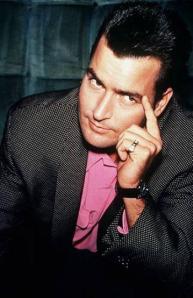
10) Charlie Sheen shows up for a really awkward cameo.  He’s supposed to be playing his Bud Fox character from the original film but, watching his performance, you get the feeling that Charlie doesn’t remember being in the original film.  Showing up at a charity dinner with a separate date on either ar, Bud Fox is presented as being just as corrupt as Gordon Gekko.  Michael Douglas, quite frankly, looked somewhat embarrassed by the whole scene.  However, as awkward as the scene was, it did manage to perfectly capture the theme of this movie:

Eventually, even Bud Fox will grow up to be Charlie Sheen.