Lisa Marie’s Take On Escape From New York (dir by John Carpenter)


I was a bit shocked to realize that I hadn’t reviewed Escape from New York for this site.  Leonard’s reviewed it.  Jeff’s reviewed it.  I’ve reviewed quite a few Italian films that were inspired by Escape from New York.  Last year, I devoted an entire day to how much I love Kurt Russell.  I’ve shared John Carpenter’s theme music, more than once.  I’ve reacted to Mamdani’s election by telling my friends that it’s time to escape from New York.  I’ve lost track of the number of times that I’ve told Leonard that it is “Time to leave the Bronx,” even though he doesn’t live in the Bronx.  (What do I know?  I live in Texas.)  But I’ve never actually reviewed Escape From New York.

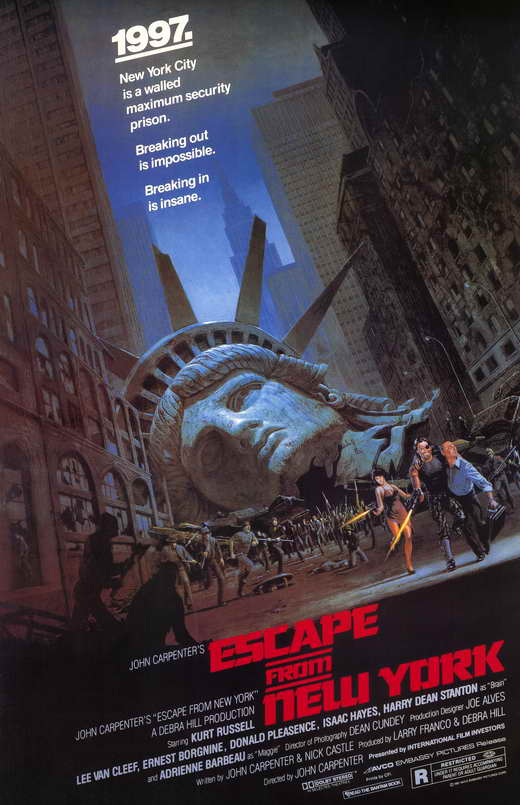
I love Escape from New York but I have to say that the film itself can’t live up the brilliant poster art.  The first time I watched Escape from New York, I was really disappointed that the Statue of Liberty’s head never appeared in the middle of a street in Manhattan.  If the film were made today, one imagines that the filmmakers would be able to do all sorts of things with the Statue of Liberty.  But Escape from New York was made in 1981, in the days before rampant CGI.  Escape from New York was made at a time when directors had to be somewhat clever and that definitely works to the film’s advantage.  The lack of big time special effects meant that Carpenter had to emphasize character and atmosphere.  Escape From New York might not feature the Statue of Liberty’s head but it does feature an amazing cast and a host of unforgettable characters.  When you manage to get Kurt Russell, Ernest Borgnine, Donald Pleasence, Harry Dean Stanton, Adrienne Barbeau, Lee Van Cleef, and Isaac Hayes all in the same film, there’s no way it isn’t going to be memorable.

We all know the plot.  Kurt Russell plays career criminal Snake Plissken.  (Everyone thought Snake was dead.)  When the President (Donald Pleasence) finds himself trapped on the prison island of Manhattan, Snake is the man who is sent to rescue him.  The fate of the world depends on rescuing the President.  If the President isn’t rescued, it could lead to nuclear war.  Snake doesn’t really care about the fate of the world.  He does care about the fate of himself, however.  He’s been injected with a poison that will kill him unless he receives the antidote in 24 hours.

(The doctor who gives Snake the poison is named Dr. Cronenberg.  Meanwhile, Frank Doubleday appears as a thug named Romero.  Lee Van Cleef’s police commissioner is named Hauk, as in Howard Hawks.  Tom Atkins plays Captain Rehme, as in producer Bob Rehme.  The film may be about the collapse and possible end of the world but John Carpenter’s having fun.  And, of course, so are we.)

The President has been captured by the Duke of New York (Isaac Hayes).  It doesn’t take Snake long to track down the Duke.  But rescuing the President and making it back to safety turns out to be far more difficult and violent than anyone was anticipating.  Snake gets some help, from characters like Cabbie (Ernest Borgnine), Brain (Harry Dean Stanton), and Maggie (Adrienne Barbeau).  Of course, that help is largely due to everyone’s self-interest.  The recurring theme is that no one really cares that much about whether or not the President or even Snake lives or dies.  Maggie loves Brain but, otherwise, there’s not much individual loyalty to be found in this film.  Instead, everyone just cares about getting the Hell out of New York.  In the end, even the President turns out to be a bit of a jerk.

(I do have to say that I absolutely love Donald Pleasence’s performance in Escape from New York.  The “You’re the Duke!  You’re the Duke!  A Number One!” scene?  That was Pleasence at his most brilliant.)

It’s a wonderfully acted and directed film, one that is often darkly humorous.  (While Kurt Russell delivers his lines with a endearing self-awareness, Carpenter has a lot of fun imagining the type of criminal society that would emerge on an isolated Manhattan.)  It’s also a film that understands the power of New York City.  Depending on who you ask, New York either represents the worst or the best of America.  That’s true today and, watching Escape from New York, it’s easy to guess that was probably true in 1981 as well.  There’s a power to the “New York” name and it’s why this film wouldn’t have worked if it had been called Escape From Houston or Escape From Spokane.  (One reason why Escape From LA failed was because the cartoonishness of Los Angeles couldn’t compete with the grit of New York.)  We all know the saying — “New York, New York: If you can make it there, you can make it anywhere.”  This film reminds us that it’s also true that if you can escape from there, you can escape from anywhere.  Escape from New York brilliantly captures the way that most of the rest of country view New York but, by limiting the action to Manhattan, it also presents a story that can be enjoyed by people in Brooklyn, the Bronx, Queens, and Staten Island.  I imagine the film is especially popular on Staten Island.

Escape From New York is a brilliant work of the pulp imagination.  It’s a film that will probably outlive the city.
Film Review: Assault on Precinct 13 (dir by John Carpenter)


Legend has it that, when John Carpenter originally offered the role of Dr. Sam Loomis to Donald Pleasence, Pleasence was reluctant to accept it.  To Pleasence, Halloween sounded like it would just be another forgettable horror film.

However, when Donald mentioned to his daughter, actress Angela Pleasence, that he had been offered a role in a film by a young director named John Carpenter, Angela immediately told him to accept.  She assured him that it would turn out to be a great film.  When Donald asked her why she was so sure about this, Angela replied that she had seen Assault on Precinct 13 at the Cannes Film Festival.

1976’s Assault on Precinct 13 was John Carpenter’s second feature film.  (The first was Dark Star, which started out as a student film and, even after being extended to feature length, still ended up feeling very much like a student film.)  The film takes place in Los Angeles, at an isolated police precinct house that is scheduled to be abandonedd.  When the father (Martin Lawson) of a girl (Kim Richards) who was murdered earlier in the day seeks refuge at the precinct, a Che Guevara-influenced street gang launches a relentless late night attack on the building.  (Frank Doubleday, who later played Romero in Escape From New York, appears as a member of the gang.)  Lt. Ethan Bishop (Austin Stoker) is forced to work with criminal Napoleon Wilson (Darwin Joston) to defeat the gang.

Assault on Precinct 13 (1976, dir by John Carpenter. DP: Douglas Knapp)

John Carpenter later said that Assault of Precinct 13 was his attempt to make a Howard Hawks-style western and, despite taking place in the modern era, it is very much a western.  Ethan Bishop is the strong and moral lawman who refuses to allow the untamed land around him to change who he is and what he believes.  Napoleon Wilson is the outlaw who finds redemption.  In most westerns, the attackers would represent the last gasp of the lawless frontier fighting against encroaching civilization.  In the case of Assault on Precinct 13, the opposite is true.  The attackers represent the collapse of society and the people in the precinct find themselves fighting not only for their lives but also the ideals of modern civilization.  With their relentless drive to attack, the members of the street gang resemble the zombies from George Romero’s Night of the Living Dead.  They’re so nihilistic and destructive that even a hardened criminal like Napoleon Wilson knows that they have to be stopped.  The film’s ultimate message seems to be that, even if Bishop and Wilson and Leigh (Laurie Zimmer) survive the night, the assault on Precinct 13 will never truly end.  In a way, we’re all trapped in that abandoned precinct house.

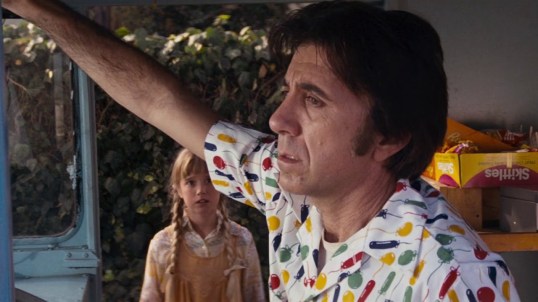
Wow, that sounds pretty grim!  And really, it is a grim film.  This, after all, is the film in which little Kim Richards is graphically shot in the chest while trying to buy ice cream.  (From the start, Carpenter understood the importance of shocking the audience.)  That said, there are unexpected moments of dark humor to be found in the film.  (Even Kim Richards’s indignation over being given the wrong flavor ice cream is rather humorous, up until she asks for a replacement and gets shot as a result.)  Both Bishop and Wilson make for compelling heroes.  As Angela Pleasence realized when she saw the movie at Cannes, John Carpenter was and is a natural-born storyteller.  Assault on Precinct 13 is a film that wastes no time in getting started and is relentless in both its suspense and its action.

Assault on Precinct 13 has been overshadowed by Carpenter’s subsequent successes but it’s still one of Carpenter’s best films.  Without Assault on Precinct 13, we would never have gotten Donald Pleasence as Dr. Sam Loomis.  That alone is reason enough to celebrate the film.

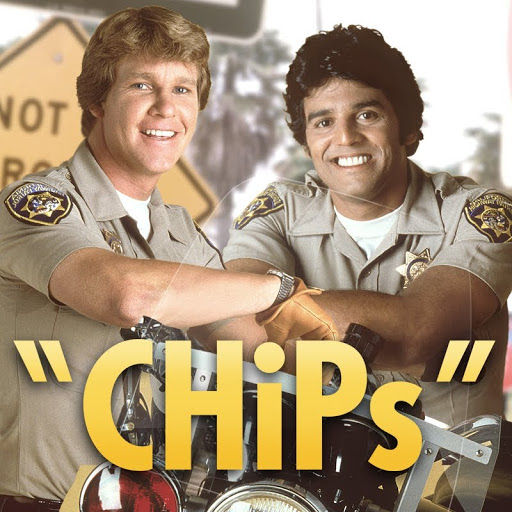
Late Night Retro Television Review: CHiPs 4.11 “11-99: Officer Needs Help”


Welcome to Late Night Retro Television Reviews, a feature where we review some of our favorite and least favorite shows of the past!  On Mondays, I will be reviewing CHiPs, which ran on NBC from 1977 to 1983.  The entire show is currently streaming on Prime!

This week, Ponch fixes everything.

Episode 4.11 “11-99: Officer Need Help”

(Dir by Phil Bondelli, originally aired on January 18th, 1981)

Three criminals are stealing trucks from a trucking company.  One of the criminals works for the company but he gets fired, not for his thievery but because he accidentally put a cate of corrosive chemicals on the wrong truck.  Now, the highway patrol has to track down the chemicals and also stop the criminals.

It’s a typical episode of CHiPs.  A man loses his job after he’s wrongly accused of being the thief.  The man’s son (Greg Bradford) helps Jon and Ponch catch the real criminals.  There’s a subplot about all of the members of the high patrol carrying a new device that sends out of a signal whenever an officer’s down.  Grossman accidentally pushes the button while chasing a lost dog.  The emphasis here is on everyone working together and the Highway Patrol going out of their way to always have the best equipment to do their job.  In the end, this is such a typical episode that the whole thing is kind of boring.

Really, for me, the only interesting thing about this episode is that it featured a subplot about a new police dispatcher who spoke with a stammer and who had trouble sending out instructions over the radio.  I had a lot of sympathy for Kathie Lark (Katherine Moffat) because I had a pretty pronounced stammer up until I was about twelve years old.  (It now only comes out if I’m extremely tired or stressed.)  That said, considering just how important the dispatchers are when it comes to the Highway Patrol, I was a bit surprised that Kathie got the job in the first place.  Kathie mentioned that she had previously been a dispatcher in a small town and again, I wondered how she got that job.  To me, it seemed like the Highway Patrol was basically setting Kathie up for failure.

The good thing is that eventually someone gives Kathie some advice that helps her to overcome her nervousness and become an excellent dispatcher.  Do you want to guess who gave her the advice?  Seriously, I dare you to guess who, out of the show’s cast of characters, magically knew exactly the right thing to say to help Kathie out.  If you’re thinking that Ponch was responsible for Kathie becoming a badass on the airwaves, you are exactly right!  Is there no problem that Ponch can’t solve?  Ponch’s advice, by the way, was that Kathie should always imagine that she was speaking directly to him.  The next time that I find myself tripping over a word that starts with B, I’ll try the same thing.

It’s the Ponch Show!  Seriously, there’s nothing that Ponch can’t do!  Beyond that, this was a boring episode.  The California scenery was nice to look at but otherwise, this episode felt like CHiPs on autopilot.

The TSL Grindhouse: Nomads (dir by John McTiernan)


1986’s Nomads opens with anthropologist Jean-Charles Pommier being rushed into an emergency room, badly beaten and struggling for his life.  Despite the best efforts of Dr. Eileen Flax (Lesley-Anne Down), Pommier dies in the ER.  Flax is shocked by Pommier’s death and, naturally, she’s upset that she couldn’t save him.  But, at the same time, people die in hospitals.  It happens to the best of doctors.

Except soon, Flax is seeing flashes of the events that led to Pommier’s death.  Pommier has somehow entered her mind and soon, she’s reliving his investigation into the origins of a group of destructive, urban nomads that Pommier witnessed causing havoc throughout Los Angeles.  Pommier often felt like he was the only person who was capable of seeing the nomads and he grew to be tortured by his fear that they were specifically stalking him.  We soon learn that there was reason for that….

Now, based on his name, you’re probably assuming that Pommier is meant to be French.  And he is!  He’s from France, though he considers himself to be a citizen of the world.  He’s traveled everywhere, taking pictures of different cultural rituals across the globe.  However, in Nomads, the very French Jean-Charles Pommier is played by Pierce Brosnan.  Pierce Brosnan is, needless to say, not French.  He’s Irish, even though a lot of people seem to be shocked when they first learn that.  Brosnan normally speaks with an accent that could best be described as a mix of posh London and mid-Atlantic American.  Everything about him screams the UK.  In short, Pierce Brosnan is one of the least convincing French people ever seen on film and he delivers his lines in an accent that sounds like every accent other than the French accent.  Watching this film, I found myself thinking about the Monty Python skit where Terry Jones and Carol Cleveland starred in a French movie.  (“I see you have a cabbage.”  “Oui.”)  Brosnan is not a bad actor and it’s entertaining to watch him overact in Nomads.  But there’s nothing French about him and every time that someone referred to him as being French, it totally took me out of the movie.

Which is a shame because Nomads may be narratively incoherent but it’s got some memorably surreal visuals and it does a good job of generating a properly ominous atmosphere.  Director John McTiernan (who later went on to do Predator, Die Hard, and The Hunt For Red October) makes smart use of slow motion and a handheld camera to keep the audience off-balance.  At its best, Nomads achieves a dream-like intensity that makes up for the fact that the story doesn’t make the least bit of sense.  The nomads themselves are a memorable and creepy.  While Adam Ant plays their leader (and the scene where he smiles as Brosnan attempts to throw him off a building is truly disturbing), the most frightening of the nomads is Mary Woronov as Dancing Mary.  Seriously, after I watched this film, I checked all the locks in the house.  No urban nomads were going to interrupt me in my sleep!

My suggestion to everyone is to do a Nomads/Nomadland double feature.  You’ll never get in another van.

Escape From New York (dir. by John Carpenter)


escape-from-new-york-movie-poster-1981-1020189511Before you start, note that Escape From New York was recently showcased in Jeff’s 4 Shots from 4 Films post to celebrate Kurt Russell’s birthday. For another take on the film, check out Jeff’s review. Please check that out, and then double back here, if you want. 
When I was little, my Aunt would sometimes take my older brother and I with her into Manhattan. In a little movie theatre near 82nd Street, she’d get us a set of tickets for a film, help us get seated with snacks and then either stay for the movie or leave to perform housekeeping duties for someone nearby if she had work and we weren’t allowed to hang out on site. John Carpenter’s Escape From New York wasn’t a film she stayed for (she loved Raiders of the Lost Ark), but it was okay. I was introduced to Snake Plissken, who ended up being cooler than Han Solo to my six year old eyes. Instead of being the hero, here was a criminal being asked to a mission. It showed me that even the bad guys could be heroes, now and then (or better yet, not every hero is cookie cutter clean). The film became an instant favorite for me. As I also do with Jaws and The Fog, I try not to let a year go by without watching Escape From New York at least once. It was my first Carpenter film.

The cultural impact of Escape From New York is pretty grand, in my opinion. It had a major influence on Hideo Kojima’s Metal Gear video games and also spawned a few comics with Plissken, complete with Jack Burton crossovers with Carpenter’s Big Trouble in Little China.

Carpenter brought in most of the same crew he worked with in his previous movies. The film was the third collaboration between Carpenter and Debra Hill, who previously worked with him in 1978’s Halloween and 1980’s The Fog. Though Hill didn’t write this one, she was still the producer, along with Larry Franco. There’s also a bit of speculation on whether Hill performed the opening vocals describing New York or Jamie Lee Curtis handled that. Cinematographer Dean Cundey (who worked on most of Carpenter’s early films) returned to help give the movie it’s gritty look, which is helpful considering how much of it takes place either at night or in darkened rooms. Another interesting part of the production is James Cameron, who was the Director of Photography when it came to the effects and matte work. One of the best effects shots in the film has Plissken gliding over Manhattan, which was designed by Effects member John C. Wash. The shot on his plane’s dashboard of the city was made from miniature mock up with reflective tape that made it appear as if it were digital, which was pretty cool given that they weren’t on an Industrial Light and Magic budget. There’s a fantastic article on We Are The Mutants and on the Escape From New York/LA Fan Page that focus on Wash’s technical contributions to the film.

For Carpenter’s career, Escape From New York marked the start of a great working relationship with Alan Howarth. Howarth, who also worked on the sound in the film, assisted Carpenter with the soundtrack. I’ve always felt this brought a new level to Carpenter’s music overall. You can easily hear the difference when Howarth was involved. Where Carpenter excelled at general synth sound, Howarth’s touch added some bass and depth. Together, they’d work on Christine, Big Trouble in Little China, Halloween III: Season of the Witch, Prince of Darkness and They Live together. On his own, Howarth was also responsible for both Halloween 2, 4 and 5.

For the writing, Carpenter worked with Nick Castle, who played Michael Myers for him in the original Halloween. Escape From New York’s story is simple. In 1988, the crime rate for the United States rises 400 percent. As a result, someone had the notion to turn Manhattan into a prison for an entire country, setting up walls around the borough and mines in the waterways. When Airforce One crashes in the borough nearly a decade later, the recently arrested war hero / fugitive Snake Plissken (Kurt Russell) is given a mission. Go in, rescue the President and/or the tape he’s carrying in 22 hours, and Plissken receives a pardon for all his crimes. To ensure that he follows through, he’s injected with nano-explosives that will kill him when the deadline hits. What seems like a simple mission becomes a little complicated when Snake discovers the President was captured by The Duke of New York, played by Issac Hayes (I’m Gonna Git You Sucka). Given that I’ve commuted to Manhattan more times than I can count, the film holds a special place in my heart.  The concept of the entire borough being a prison was mind blowing as a kid. The concept still holds up for me as an adult.

For a film about New York, there were only two days of filming actually spent on location there, according to Carpenter’s commentary. Most of that was used for the opening shot at the Statue of Liberty. The bulk of the film was made in Los Angeles, Atlanta and St. Louis. At the time, there was a major fire in St. Louis. The damage made for a great backdrop for both the crash site and the city at night. The film does take some liberties with locations, though. For example, as far as I know, we don’t have a 69th Street Bridge in Manhattan, but as a kid, it didn’t matter much. From an action standpoint, it might not feel as intense as other films. Even when compared to other films in 1981 – like Raiders of the Lost Ark (released a month earlier) – Escape From New York doesn’t have a whole lot, though I still enjoy what it does provide.

escape_from_new_york

Snake Plissken (Kurt Russell) has 22 hours to save the President in John Carpenter’s Escape from New York.

Casting seemed to come easy for the film. Hill, Castle and Carpenter reached out to some friends.  Kurt Russell and Carpenter worked together on Elvis, that was easy enough. Russell’s work with Carpenter would continue on in The Thing, Big Trouble in Little China and Escape from L.A.  From Halloween, Donald Pleasance was brought on to play the President, along with Charles Cyphers and Nancy Stephens as one pissed off flight attendant. From The Fog, we have Tom Atkins as Nick and Adrienne Barbeau as Maggie, who happened to be married to Carpenter at the time. According to Carpenter on the film’s commentary track, the sequence for Maggie’s exit needed to be reshot and extended. The scene with her body on the ground was filmed in Carpenter’s garage and added to the film.

Ernest Borgnine’s (The Poseidon Adventure) Cabbie was a favorite character of mine. Like most cabbies, he knew the city well. He even prepared for some of its challenges with molotov cocktails. Harry Dean Stanton (Alien, Christine) played Brain, the smartest individual in the room and the supplier for gas for the Duke. If you look close, you’ll also catch Assault on Precinct 13’s Frank Doubleday as Romero, which his crazy looking teeth. To round it all out, Lee Van Cleef (The Good, The Bad & The Ugly) plays Hauk, who puts Snake on his mission. And of course, it wouldn’t be a Carpenter film without a George ‘Buck’ Flower cameo. Buck was kind of Carpenter’s lucky charm in the way Dick Miller was for Joe Dante’s films. Good Ol’ Buck plays an inmate who sings Hail to the Chief.

Overall, Escape From New York is a classic Carpenter film that’s worth the watch. Whether you do so while wearing an eyepatch or not, that’s on you. We all have our preferences.