Back to School Part II #53: Stalked By My Doctor: The Return (dir by Doug Campbell)


For the past three weeks, Lisa Marie has been in the process of reviewing 56 back to school films!  She’s promised the rest of the TSL staff that this project will finally wrap up by the end of today, so that she can devote her time to helping to prepare the site for its annual October horrorthon!  Will she make it or will she fail, lose her administrator privileges, and end up writing listicles for Buzzfeed?  Keep reading the site to find out!)

eric-roberts

Oh Hell yeah!

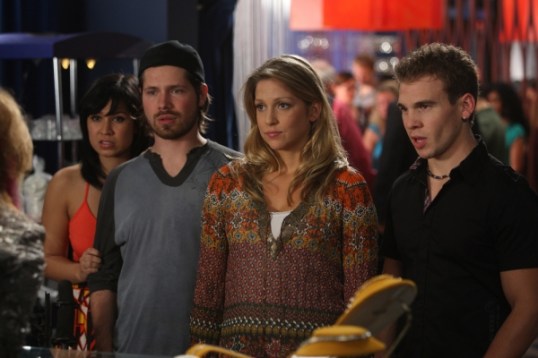
Eric Roberts is back as Dr. Beck and, once again, he’s obsessed with a teenage girl!  Believe it or not, this is a good thing because this obsession leads to Dr. Beck spending a lot of time sitting in a car that’s parked in front of Amy’s (Claire Backwelder) high school.  By doing so, Dr. Beck justifies my decision to include the 2016 Lifetime film Stalked By My Doctor: The Return in my series of Back to School reviews.

Thank you, Dr. Beck!

As you may remember from last year’s Stalked By My Doctor, Dr. Beck is a neurotic doctor who has an unfortunate tendency to get obsessed with his patients.  At the end of the first movie, the good doctor narrowly escaped the police and was last seen flashing a somewhat nervous smile.

At the start of The Return, we find Dr. Beck now living in Mexico.  He’s done a pretty good job of avoiding arrest and has a successful career going as a beach bum but he has yet to find true love.  However, it seems like that might change when, one day, he spots a teenage girl drowning in the ocean.  Dr. Beck not only saves Amy from drowning but he also literally brings her back to life.  Seriously, my wonderful readers, be sure to learn CPR.

(Then again, I’m not sure that I’ve ever learned CPR.  I guess I should.  We can’t always depend on a crazy fugitive doctor to be around.)

Both Amy and her overprotective mom, Linda (Hilary Greer), are thankful and now, Dr. Beck is now obsessed all over again.  In fact, he’s so obsessed that he even risks capture by returning to the United States.  Under the pretense of merely wanting to check up on his patient, Beck starts to stalk Amy.  Taking a lesson from Nabokov’s Lolita, Beck starts to go out with the neurotic Linda.  By marrying Linda, Dr. Beck hopes that he can get to Amy.

All together now: Ewwwwwww!  Bad doctor!

Amy and her boyfriend (Mark Grossman) eventually grow suspicious of Dr. Beck.  They even recruit Amy’s Uncle Roger (Christopher Crabb) to investigate the good doctor.  However, Linda refuses to hear a word against him.  That’s not surprising, considering that she’s just agreed to marry him…

Stalked By My Doctor: The Return is a deliberately over-the-top melodrama, one that has more in common with the snarky satire of A Deadly Adoption than the previous Stalked By My Doctor.  Sprinkled throughout the film are several scenes in which Dr. Beck has conversations with the voices in his head and, as you can probably guess, Eric Roberts plays the Hell out of these scenes.  In fact, Roberts is a force of nature in this film, keeping a straight face while ripping through his overwrought dialogue and only stopping occasionally to wink at the camera, almost as if Dr. Beck realizes that he’s just a character in a Lifetime movie.  Roberts is obviously having a blast in the role and his demented joy is somewhat infectious.  After imagining that he’s killed a dining companion, a blood-covered Roberts says, “Check please,” and his delivery of that one-liner is absolutely brilliant.

Stalked By My Doctor: The Return is a blast of over the top, Eric Roberts-inspired lunacy.
 

Back to School Part II #52: Nerve (dir by Henry Joost and Ariel Schulman)


For the past three weeks, Lisa Marie has been in the process of reviewing 56 back to school films!  She’s promised the rest of the TSL staff that this project will finally wrap up by the end of today, so that she can devote her time to helping to prepare the site for its annual October horrorthon!  Will she make it or will she fail, lose her administrator privileges, and end up writing listicles for Buzzfeed?  Keep reading the site to find out!)

nerve_2016_poster

Recently, I came across someone on twitter wondering if Emma Roberts is ever actually going to play an adult role.  Personally, I think the question is a bit unfair (just because you’re playing a teenager, that doesn’t mean that you’re not dealing with “adult” issues) but I understand the logic behind it.  Emma Roberts is a Hollywood veteran who made her film debut 15 years ago.  She’s currently 25 years old but, more often that not, she’s still cast as a high school student.  (At the most, she might occasionally get to be a college student.)  Going solely by her film and television roles, Emma Roberts has been a high school student for 12 years now.

But you know what?

I say more power to Emma Roberts.  Being a teenager is a lot more fun than being an adult and she should stay in high school for as long as she can pull it off!

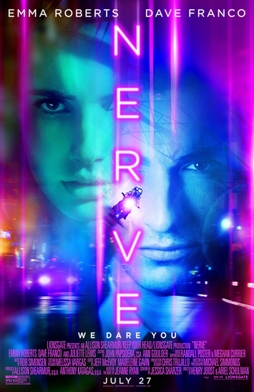
Anyway, this year’s Emma-Roberts-In-High-School film was a thriller called Nerve.  Actually, very little of the film takes place in high school though a running theme through the film is the desire of a senior named Vee (short for Venus and played by Roberts) to attend the California Institute of the Arts after she graduates.  Unfortunately, it costs money to go to a good school and Vee’s mother (Juliette Lewis) doesn’t have any.  As well, both Vee and her mother are still struggling to accept the recent death of Vee’s brother.

However, there may be a way for Vee to raise the money.  Vee learns that her friend, Sydney (Emily Meade), has become an online star by playing Nerve.  Nerve is a game where you can either volunteer to be a player or you can pay to be a viewer.  (There’s a third role that you can play in Nerve but it’s not a good role and we don’t learn about it until later in the film.)  The watchers dare the players to do something.  If the players do it, they win money.  If the players fail … well, there are consequences for everything.

Though initially reluctant, Vee agrees to be a player.  At first, it’s a lot of fun.  The normally cautious Vee gets to experience the exhilaration of taking a risk.  She even meets another Nerve player, Ian (Dave Franco) and soon the two of them are a team, partners and perhaps something more.  But, as the game progresses, the dares become more dangerous and the stakes get higher.  And, of course, Ian has a secret of his own..

The great thing about Nerve is that it tells a story about what’s is pretty much happening right now.  It’s easy to imagine a real-life version of Nerve going on right now.  As I watched Vee and Ian play Nerve, I was actually reminded of how much fun twitter used to be.  And then, just as happens in Nerve, more and more people got involved and things quickly went downhill.  The more popular both twitter and Nerve became, the less pleasant the experience.  The same is true for just about everything that’s ever happened online.  It always starts out as fun until the trolls arrive.  (And trolls, of course, have the magic ability to use their mere presence to transform former non-trolls into trolls as well.)  Nerve answers the age-old question of why we can’t have nice things.

Beyond that, it’s an entertaining film.  Emma Roberts and Dave Franco make for an exceptionally likable couple, the film is quickly paced, and Michael Simmonds’s cinematography gives the film an appealing and slickly flamboyant look.  Nerve didn’t really get as much attention as it deserved when it was originally released but I have a feeling that it is a film that will be rediscovered and appreciated by viewers in the future.


Back to School Part II #51: Killer Coach (dir by Lee Friedlander)


For the past three weeks, Lisa Marie has been in the process of reviewing 56 back to school films!  She’s promised the rest of the TSL staff that this project will finally wrap up by the end of today, so that she can devote her time to helping to prepare the site for its annual October horrorthon!  Will she make it or will she fail, lose her administrator privileges, and end up writing listicles for Buzzfeed?  Keep reading the site to find out!)

killer_coach_2016_9699857

The 2016 film Killer Coach premiered on Lifetime on July 30th.  At the time, I suspected that it was probably being released specifically to capitalize on all of the attention that was being paid to the Summer Olympics in general and Michael Phelps in specific.  After all, Killer Coach is a film about a swimmer in trouble and, as you might guess from the title, a lot of that trouble has to do with her coach.

Now, I have to admit that I kinda ignored the Olympics this year.  I’m as shocked as anyone by that but, quite frankly, I just wasn’t feeling it.  2016 has sapped the enjoyment out of a lot of events that you could previously depend upon.  Hopefully, I’ll regain my excitement in 2018 because I’d hate to miss the curling.  Along with not being into the Olympics this year, I also have an intense fear of drowning and movies that feature people trapped underwater tend to give me nightmares.  With all that in mind, I was worried that Killer Coach might not be for me.  However, I still watched it because it was on Lifetime.  You know how that goes.

Well, I shouldn’t have worried.  Killer Coach was pure Lifetime goodness, even if it never quite reached the wonderful heights of The Perfect Teacher or Babysitter’s Black Book.  Though the film may have been advertised to exploit all the attention being given to the Olympics, it was not necessary to be a swim fan to appreciate it.  As for the drowning scenes — well, there were a few but they didn’t traumatize me.  In the best Lifetime tradition, Killer Coach is pure entertainment.  No need to worry about trauma.

As for the film, it’s about Samantha (Javicia Leslie).  Sam is a smart and popular high school student.  She also has the potential to be one of the best swimmers in the country and is looking forward to going to college on a swim scholarship.  Who knows?  Olympics medals may be in her future!  As for Sam, she’s mostly just looking forward to a future with her boyfriend (Cameron Jebo).

Sam’s coach, Gina (Keesha Sharp), puts her under constant pressure.  Nothing is ever good enough for Gina.  That’s what a coach is supposed to do, right?  The only problem is that Gina is also Sam’s mother and it’s obvious that she’s reliving her own past as a championship swimmer through her daughter.  Gina is so intense that Sam is happy that the new assistant coach appears to be so laid back.  Even better, Bryce (Tom Maden) is hot!

Of course, he’s also kind of crazy.  After a one night stand, he grows obsessed with Sam and starts stalking her.  It’s actually kind of a nice reverse on the typical Lifetime storyline.  Usually, it’s a student stalking a teacher.

Anyway, there’s more to the story than just that.  Bryce is fueled by more than just obsession and Gina has secrets in her own past.  I didn’t really care about any of that and I could have done without it.  The film is far more interesting when it just focuses on Bryce as a crazed authority figure.

Killer Coach is well-filmed by veteran Lifetime director Lee Friedlander and he keeps the story moving along quickly.  Leslie is sympathetic as Samantha and Maden is memorably unhinged as her stalker.  Killer Coach is an above average Lifetime film and definitely an entertaining way to spend two hours.

Back to School Part II #50: Paper Towns (dir by Jake Schreier)


(For the past three weeks, Lisa Marie has been in the process of reviewing 56 back to school films!  She’s promised the rest of the TSL staff that this project will finally wrap up by the end of Monday, so that she can devote her time to helping to prepare the site for its annual October horror month!  Will she make it or will she fail, lose her administrator privileges, and end up writing listicles for Buzzfeed?  Keep reading the site to find out!)

paper-towns

Looking at the film poster above, you could be forgiven for immediately thinking of The Fault In Our Stars.  Of course, some of that is because it says, “From the author of The Fault In Our Stars” and because it features half of Nat Wolff’s face.  (Wolff had a key supporting role in Fault.)  Beyond that, though, the poster feels as if it could have just as easily been used for The Fault In Our Stars.  Check out the intensity of the stares.  Though we may only see half of their faces, both of the pictured characters appear to be daring the viewer to dismiss their concerns as being mere “teen drama.”

When Paper Towns was released in 2015, it was repeatedly advertised as being the next Fault In Our Stars.  Paper Towns does share Fault‘s unapologetic earnestness and, in a few scenes, its sense of inescapable melancholy.  (As people get older, they tend to sentimentalize the years that came before and, as a result, they often forget how coming-of-age and intense regret often go hand-in-hand.)  But ultimately, though they’re both based on novels by John Green and feature Nat Wolff, Paper Towns tells a very different story from The Fault In Our Stars.

Nat Wolff stars as Quintin, who is better known as Q.  Quintin is a student at Jefferson Park High School in Orlando.  He’s the epitome of a good kid.  He’s shy, he’s polite, and, somewhat inevitably when you consider what is currently valued in American society, he’s not particularly popular at school.  He spends most of his time hanging out with his friends, Ben (Austin Abrams) and Radar (Justice Smith).  And when he’s not hanging out with them, he’s pining for the most popular girl in school, Margo (Cara Delivingne).

Margo and Quintin have been neighbors since they were children.  When Margo’s family first moved in, she and Quintin became close friends but that friendship ended after they came across the body of a man who had committed suicide.  Traumatized, Margo drifted away from Quintin.  Now, nine years later, they are both seniors in high school.  Quintin silently loves Margo.  Margo rarely acknowledges his existence…

Or, that is, she doesn’t until the night that she suddenly climbs through Quintin’s bedroom window.  She explains that her boyfriend has been cheating on her.  She wants revenge on him and all of her friends, none of whom bothered to tell her what was going on.  A night of gleeful vandalism follows, ending with a romantic dance.

The next morning, Margo is gone.  She’s vanished and no one knows where she has gone.  However, Quintin is determined to find her and he is also convinced that she has left him a trail of clues that will lead him to her.  When he concludes that she’s gone to upstate New York, he recruits his friends (and one of Margo’s former friends) to go on a road trip with him.  Quintin is convinced that Margo will be waiting for him but, as always, the truth is a bit more complex…

While the plot description might make Paper Towns sound like a YA version of Gone Girl, it’s actually an achingly sincere and incredibly likable little film.  The entire cast has a good chemistry and their dialogue is clever without sounding artificial.  The best thing about Paper Towns is that it serves as a wonderful showcase for Nat Wolff, who is one of the best and most underrated young actors working today.  If you watch this film directly after watching Wolff convincingly play a self-destructive sociopath in Palo Alto, you’ll get a hint of Wolff’s range.

Paper Towns won’t make you cry like The Fault In Our Stars did but it’s still a pretty decent film.

Back to School Part II #49: Degrassi: Don’t Look Back (dir by Phil Earnshaw)


(For the past three weeks, Lisa Marie has been in the process of reviewing 56 back to school films!  She’s promised the rest of the TSL staff that this project will finally wrap up by the end of Monday, so that she can devote her time to helping to prepare the site for its annual October horror month!  Will she make it or will she fail, lose her administrator privileges, and end up writing listicles for Buzzfeed?  Keep reading the site to find out!)

ddlb

Much as in the case of my reviews of School’s Out, Degrassi Goes Hollywood, and Degrassi Takes Manhattan, this review of 2015’s Degrassi: Don’t Look Back is probably not going to make much sense to you if you’re not a huge fan of Degrassi.  Then again, it’s possible that it won’t make sense even if you’ve seen every episode of Degrassi. 

Among the Degrassi fandom, there’s actually a very passionate debate as to whether or not Don’t Look Back should even be considered canonical.  It premiered at the end of season 14, following the graduation episode.  Season 14 was also the last season of Degrassi to be broadcast on TeenNick.  (The series has subsquently moved to Netflix).  Some people don’t consider Netflix Degrassi to be the same as TeenNick Degrassi and since Don’t Look Back is mostly concerned with laying the foundation for Netflix Degrassi, there’s a tendency among some to treat Don’t Look Back as almost being fan fiction.

Admittedly, Don’t Look Back does definitely feel different from the other Degrassi films.  It’s much more light-hearted, with a good deal of the film’s 87 minute running time devoted to parodying different horror films.  (It’s almost as if Don’t Look Back, which premiered in August, was actually conceived with an October premiere in mind.)

The film, which takes place during the summer, follows five storylines, four of which are pretty typical of what you’d expect to see on Degrassi.  Rich girl Frankie Hollingsworth (Sara Waisglass) gets an internship at Toronto’s city hall and has to prove to her coworkers that she’s not just a spoiled brat while, at the same time, resisting the temptation to cheat on her boyfriend, Winston (Andre Kim).  Zoe (Ana Golja) attends summer school and finds herself attracted to her classmate, the acerbic Grace (Nikki Gould).  (As fans of Netflix Degrassi know, Zoe would eventually accept that she was a lesbian while Grace shocked everyone by revealing that she was both straight and seriously ill.)  Tristan Milligan (Lyle Lettau) obsesses over both his dreams of internet stardom and his former boyfriend, Miles.  Maya (Olivia Scriven) gets a job as a nanny for a rock star (Sonia Dhillon Tully) and Zig (Ricardo Hoyos) gets mad because he feels neglected.

But then, there’s the fifth subplot and here’s where things get controversial.  A minor Degrassi character, Gloria Chin (Nicole Samantha Huff), vanishes and soon, everyone in Canada is searching for her.  Fortunately, Grade 10 students of Degrassi Community School are able to use their amazing computer skills and deductive reasoning to figure out where Grace is being held.  It’s one of those weird things that you expect to see in an episode of something like CSI or NCIS or some other show with initials for a title.  It’s not really something you would expect to see on Degrassi.  It feels definitely out-of-place as a part of a franchise that has always prided itself on realistically and honestly exploring teen issues.

But then again, after 14 seasons (and that’s not even including the two series that came before Degrassi: The Next Generation), both the format and tone of Degrassi have changed several times.  That’s the way it’s always been.  Seasons 1  & 2 of Degrassi have a completely different feel from seasons 3 & 4.  And, ultimately, I guess the idea of a bunch of tenners solving a crime is not any stranger than Kevin Smith shooting Jay and Silent Bob Go Canadian, Eh? at the school.

Anyway, if you’re a Degrassi fan, Don’t Look Back is entertaining enough.  And yes, it is canonical.  Even if they’ve never mentioned since that they solved the Canadian crime of the century (and does seem like something that would occasionally come up in conversation), apparently that’s what the students at Degrassi did during their summer vacation.

Good for them!


Back to School Part II #47: The Diary of a Teenage Girl (dir by Marielle Heller)


thediaryofateenagegirl_newtheatricalposter

Sometimes, the best way to defend a controversial film is to take a look at some of the people who have criticized it.  That’s certainly the case with 2015’s The Diary of a Teenage Girl.

First off, you have so-called critic and professional troll Jeff Wells, who landed in some hot water when he complained that the star of the film, Bel Powley, wasn’t attractive enough for him.  Never mind that he thought the rest of the film was intriguing, he simply could not get over the fact that Powley was not conventionally attractive.  Never mind, of course, that Powley (who was 23 at the time) was supposed to be playing a 15 year-old and that she gave one of the best and most honest performances of the year or that the film itself was about much more than just sex.  Jeff Wells wasn’t turned on and therefore, by his logic, the film failed.

And then you have Sasha Stone, the editor of Awards Daily.  Sasha claims to be a feminist and uses her site to regularly scold any actress who she thinks isn’t living up to Sasha’s idea of what a feminist should be.  Sasha is the same blogger who announced that her life mission was to “educate” Shailene Woodley and who threatened to never again report on any of Susan Sarandon’s movies because Sarandon was critical of Hillary Clinton.  Oddly enough, Sasha is also the online film community’s number one enabler of Jeff Wells, regularly providing cover for him whenever he makes one of his patented misogynistic remarks.

Anyway, Sasha absolutely hated The Diary of a Teenage Girl.  In fact, she hated it to such an extent that she’s probably still cursing about it on twitter.  Oddly enough, Sasha has never really stated why she hates Diary with such a passion.  I mean, here we have an honest film about coming-of-age, one that ends on a note of empowerment.  It’s a film that was both written and directed by a woman and it’s based on a graphic novel by Phoebe Gloeckner.  This is an important film.  As far as I can tell, it appears that Sasha’s hatred was linked to the fact that apparently, she saw the film in a theater that was full of men and she felt that this film was specifically designed to appeal to “dirty old men.”

Which is bullshit.

Don’t get me wrong.  I’m sure there are dirty old men who went to see The Diary of a Teenage Girl.  That’s just a fact of life.  When you have a film about a sexually active 15 year-old, it is going to attract certain people.  That, however, is not the film’s fault.  In fact, the film’s straight-forward approach to sexuality was probably the exact opposite of what most of those pervs were looking for.

The film’s protagonist is Minnie Goetze (played, as previously stated, by Bel Powley).  In 1976, she is 15 years old and living in San Francisco with her irresponsible (and, as becomes apparent as the film plays out, rather unstable) mother (Kristin Wiig).  Minnie is an aspiring cartoonist, an independent and intelligent teenager who often feels as if she’s separated from the rest of the world.  (The film makes good use of animation to visualize Minnie’s isolation.)  After losing her virginity to him, Minnie ends up having an affair with her mother’s handsome loser of a boyfriend (played by Alexander Skarsgard)….

When The Diary of a Teenage Girl was first released, so much attention was paid to the fact that 15 year-old Minnie was sexually active and frequently seen using drugs that many reviewers missed the fact that the film ultimately celebrates Minnie’s intelligence, independence, and her imagination.  Speaking for myself, after sitting through a countless number of teen films which either idealized virginity or insisted on punishing any sexually active teen with either pregnancy or an STD, The Diary of a Teenage Girl was actually a welcome change of pace.

Unfortunately, many critics have made the mistake of assuming that just because The Diary of a Teenage Girl does not judge, it therefore supports all of Minnie’s decisions.  Despite what some critics claim, Diary of a Teenage Girl does not glamorize anything that Minnie does.  (Many of the film’s sex scenes are deliberately filmed to be as unerotic as possible.)  At the same time, the film doesn’t feel the need to dispense out any sort of karmic punishment, either.  Instead, it’s a film that suggests that Minnie, like everyone else, is exploring and trying to discover what’s right for her.  In the end, the message of this film is that the most important thing is to love yourself and to find your own happiness.  And there’s absolutely nothing wrong with that.

The Diary of a Teenage Girl is an engrossing and well-made coming-of-age story.  I can’t wait to see what director Marielle Heller does next.


Back to School Part II #46: Dog Pound (dir by Kim Chapiron)


dog_pound

The 2010 film Dog Pound is a disturbing and rather sad film but that really shouldn’t be a surprise, since it deals with the American justice system.  Even more specifically, it deals with the juvenile justice system and portrays, in exacting detail, how a mere juvenile delinquent can be transformed into a hardened criminal.

The film opens with three teenagers being either sentenced or transferred to the (fictional) Enola Vale Juvenile Detention Center in Montana.  Enola Vale is the type of place where the walls are covered with inspiring but ultimately empty-headed slogans.  It’s the type of place that claims to teach young offenders the importance of self-respect and respecting authority but ultimately, all it does is teach them how to be better criminals.  The staff is largely portrayed as being well-meaning but ineffectual.  Not only are they incapable of controlling their prisoners but they also remain oblivious to much of what is going on inside the prison.  The real power is held by the prisoners who have managed to reach the rank of trustee.  If you stay out of trouble long enough, you can become a trustee.  And then, of course, you can do whatever you want to whomever you want…

The three newest prisoners are a mixed bunch.  One can take one look at 15 year-old Angel (Mateo Morales) and 16 year-old Davis (Shane Kippel, best known for playing Spinner Mason on Degrassi) and tell immediately that neither one of them is tough enough to survive inside.  Angel is a non-violent car thief.  Davis is a drug dealer and something of a momma’s boy.

And then there’s Butch (Adam Butcher).  Butch is 17 years-old and he’s been transferred to Enola Vale from another facility.  Butch attacked an officer at the previous facility, gouging out the man’s eyes.  The angry Butch may be dangerous but he’s also the best friend that Angel and Davis could hope for.  When the three of them find themselves being targeted by a sadistic trustee named Banks (Taylor Poulin), Butch is the one who eventually ends up beating Banks nearly to death.  With Butch now the most feared prisoner at Enola Vale, Davis and Angel are safe.

Or, at least, they are until Butch witnesses a frustrated guard kill a prisoner.  While the death is being investigated, Butch is put into solitary confinement, leaving his friends at the mercy of the other prisoners…

Dog Pound is a dark and harrowing look at the juvenile justice system, one that challenges the popular belief that incarceration is always the best (and only) solution.  In fact, Dog Pound makes the argument that maybe — just maybe — automatically tossing non-violent offenders in with violent offenders may not be the ideal way to deal with delinquency.  That may sound like simple common sense but this is America and we love the idea of “lockin’ people up and throwin’ away the key.”  If the film’s plot occasionally seems to wander without any clear direction, that’s because these are characters who literally have nowhere to go.  They may only be teenagers but their lives are pretty much over.  The film’s episodic nature captures the pitiless randomness of their own existence.  The few scenes in which they actually get to behave like regular teenagers are poignant precisely because they are so rare.

Dog Pound is a well-directed and acted film, featuring especially strong work from Adam Butcher and Shane Kippel.  Reportedly, many of the smaller roles were played by actual inmates and they add a disturbing and, at times, heart-breaking authenticity to this film.  Show Dog Pound to anyone who is fond of saying that “bad kids” need to be “scared straight” and taught to “respect authority.”  At a time when many people seem to be increasingly comfortable with the idea of a police state, Dog Pound is a film that needs to be seen.

Back to School Part II #45: The Final (dir by Joey Stewart)


the_final

As we continue with this series of Back to School reviews (only 11 left to go!), we now go from Degrassi to something much, much darker.  A horror thriller from 2010, The Final takes a look at what happens when a bunch of teenage outcasts decide to get revenge on the students who have spent the past few years tormenting them.

And let’s just say that revenge is not pretty.

One day, a bunch of affluent high school students all receive an invitation to a costume party that will be held at an isolated and long-deserted mansion.  These students are your typical collection of jocks and cheerleaders.  They’re popular but they’re not exactly smart, which may explain why they all show up for the party and drink from a punch bowl that’s been laced with a drug.  Everyone falls unconscious and, when they wake up, they discover that they have all been chained together.

Among the prisoners is one uninvited guest.  Kurtis (Jascha Washington) is one of the popular kids but he wasn’t invited to the party.  Why?  Well, as we see at the beginning of the film, Kurtis is literally the only nice guy at the entire school.  He’s the only popular kid who is willing to treat the school’s “outcasts” with kindness.

And, as you’ve probably guessed already, the outcasts are the ones who set up the party.  As they announce to their prisoners, they are going to spend the rest of the night torturing them.  They’re not planning on killing anyone.  Instead, they just want to ruin everyone’s perfect future.  They didn’t want to torture Kurtis but then he decided to come to the party.

Seriously, what can you do?

The rest of the film is basically a combination of nonstop torture and talk.  The prisoners spend a lot of time begging and screaming.  Significantly, they don’t do much apologizing.  In fact, a few of them continue to try to act like bullies even though they’re in chains.  As for the outcasts, their leader proves to be surprisingly talkative.  In fact, there were a few times when I really wanted him to shut up.  Why are movie torturers always so verbose?

That said, it quickly becomes obvious that some of the outcasts are more enthusiastic than others.  And their leader, Dane, is quickly revealed to be so crazy that he’s just as willing to kill his friends as he is to torture his bullies.  Dane is played by an actor named Marc Donato.  Interestingly enough, before making The Final, Donato was best known for playing a bully on Degrassi.  And before getting his role on Degrassi, Donato had a tiny but important role as a bullied child in a terrible film called Pay It Forward.  So, when it comes cinematic bullying, Donato has seen every possible angle.

The Final is really an unpleasant film, though I imagine it was meant to make the audience uncomfortable.  I love horror films but I tend to get bored pretty quickly with films where the majority of the running time is taken up with people being tortured.  There’s only so many times you can listen to someone scream in pain before you tune out.  That said, The Final is also a well-made and atmospherically creepy film and all the popular kids are so unlikable that you really don’t mind seeing them lose limbs and get disfigured.  Considering that we’re still hearing daily stories about children being bullied to the point of suicide, maybe The Final should be required viewing in certain classrooms.

Back to School Part II #44: Degrassi Takes Manhattan (dir by Stefan Brogren)


Cassie Steele, Mike Lobel, Miriam McDonald, and Shane Kippel in Degrassi Takes Manhattan

Cassie Steele, Mike Lobel, Miriam McDonald, and Shane Kippel in Degrassi Takes Manhattan

(Much as with my previous post, this review probably will not much sense to you unless you’re a longtime Degrassi fan like me.  Sorry!)

One year after Degrassi Goes Hollywoodthe third Degrassi movie was released.  Degrassi Takes Manhattan was broadcast on July 9th, 2010 and, ratings-wise, it was a huge success.  Not only did it bring TeenNick its highest ratings ever, it was the number one show viewed by teens that summer.

Why was it such a huge success?

Largely, it was because Degrassi Takes Manhattan served as not only the conclusion to season 9 but it was also the finale of Degrassi: The Next Generation.  By the end of Degrassi Takes Manhattan, all of the original Degrassi: TNG plotlines had been resolved.  Emma Nelson, who was the show’s main character for 6 seasons, married Spinner Mason.  When the series returned for season 10, it would drop The Next Generation from its title and it would simply be known as Degrassi.  All of the original characters would be gone, replaced with new students.  Degrassi Takes Manhattan was a chance to celebrate what had been and a chance to say goodbye.

And yet, Degrassi Takes Manhattan remains very controversial among the Degrassi fandom.  To be honest, a lot of people can’t stand it.  My feelings on it are mixed, though I tend to like it more than some.

One of the big problems with Degrassi Takes Manhattan is that none of the original characters actually go to Manhattan.  Emma, Manny, Spinner, and Jay all remain in Canada.  Instead, the Manhattan portion of the film features Holly J. Sinclair (Charlotte Arnold), Fiona Coyne (Annie Clark), Jane (Paul Brancati), and Fiona’s creepy twin brother, Declan (Landon Liboiron).   The New York portion of the film deals with Fiona, Holly J, Declan, and Jane all staying in a Manhattan penthouse and having various adventures in New York.  As seems to happen to at least one Degrassi student ever semester, Jane launches a singing career.  Holly J interns and falls in love with Declan.  Fiona get jealous.  It’s nothing all that interesting though it does feature the classic line, “This is New York Holly J, bitch!”

(Say what you will about the character she was playing, Charlotte Arnold was always great at delivering angry one-liners.)

Instead, the part of the film that everyone remembers is Emma (Miriam McDonald) falling in love with Spinner (Shane Kippel) and drunkenly marrying him at Niagara Falls.  After Spinner and Emma first look into getting an annulment, they suddenly realize that they really do want to spend the rest of their lives together and they have a recommitment ceremony at the beach!

And it’s actually a pretty sweet scene.  As someone who has watched every season of Degrassi, I liked the scene at the beach.  It provided closures for a lot of characters.  But, that doesn’t change the fact that it didn’t make any sense!  In the 9 seasons that led up to Degrassi Takes Manhattan, Spinner and Emma interacted with each other a few times during the first season but, otherwise, they never had much to do with each other.  The two of them falling in love came out of nowhere and, at the risk of being dramatic, it almost felt like a betrayal.  Anyone who has ever watched Degrassi (and those would be the only people who would really have a reason to watch Manhattan), knows that Emma’s soul mate was Sean Cameron.  As for Spinner — well, he dated pretty much everyone on the show at some point, with the notable exception of his future wife, Emma.  I always thought he and Darcy made a good couple but, by the time Manhattan went into production, Shenae Grimes was starring on 90210 and presumably wasn’t available to return so that Darcy could get married.

(One thing I did like about the ceremony is that it was conducted by Jay Hogart — played, of course, by Mike Lobel.  Jay, of course, was once responsible for Emma getting gonorrhea so it’s nice to see that she’s so forgiving.  That said, Jay did look pretty hot all dressed up…)

In the years since this movie aired, snarky fans like me have been joking about how Spinner and Emma probably got divorced a week after the beach ceremony.  But, as we all learned from watching the recent reunion episode on Netflix, Spinner and Emma are apparently still married!  Well, good for them.

Anyway, controversy aside, I still liked Degrassi Takes Manhattan but, then again, I like anything related to Degrassi.  As opposed to School’s Out and Degrassi Goes Hollywood, Degrassi Takes Manhattan is for hardcore Degrassi fans only.