Earlier today, Leonard shared the trailer for Uncharted. At the same time that the Unchartered trailer was dropping, the trailer for Red Notice was being released as well. To be honest, I kind of suspect that they’re both the exact same film. Maybe Red Notice is the European edit….
No, actually, they’re both separate films. But judging from the trailer, they both appear to take place in the same cinematic universe. Anyway, Red Notice stars Ryan Reynolds and Gal Gadot as rival things who end up woring for an FBI profiler who is, of course, played by Dwayne Johnson. It’s always interesting to me that whenever you real life FBI agents, they’re always these kind of nebbish accountant types but whenever they show up in a movie, they’re always played Dwayne Johnson. Dwayne Johnson’s never had to keep track of his money because, if he ever did run out of cash, the people of the world would come together to send him as much extra money as they could. Everyone understands that the world would be a much worse place without Dwayne Johnson.
I guess Red Notice is a wacky comedy time and Netflix has a pretty uneven history when it comes to wacky comedy but I do like all three of the stars so who knows?
Today’s horror scene that I love comes from 1935’s The Bride of Frankenstein. In this wonderfully acted scene, the Bride (Elsa Lanchester) meets the Monster (Boris Karloff) for the first time. Both of their reactions reveal them to be far more human than the people who created them.
Since today is Boris Karloff’s birthday, I thought I would devote this edition to everyone’s favorite reanimated corpse, Frankenstein’s Monster! Over the years, there’s been a lot of movies about the Monster. Here are the trailers for six of them!
The Curse of Frankenstein (1957)
Believe it or not, there was a time when it was felt that the story of Frankenstein and his Monster has been played out. With the Universal films bringing in less and less money, many felt that the Monster’s days were behind it. Then, Hammer, Peter Cushing, and Christopher Lee came along and said, “No! This is what Frankenstein is all about!”
At least, I assume that’s what they said. I hope they did.
2. Jesse James Meets Frankenstein’s Daughter (1965)
You can’t keep a good Frankenstein down as Jesse James discovered in this 1965 western.
3. Lady Frankenstein (1971)
In this Italian film, the Baron’s daughter continues her father’s scientific experiments! I guess Jesse James wasn’t the only one to meet Frankenstein’s Daughter!
4. Flesh for Frankenstein (a.k.a. Andy Warhol’s Frankenstein) (1973)
Udo Kier is the Baron and Andy Warhol may have been the producer of this film. Or he may have just lended his name out for the money. It depends on who you ask.
5. Blackenstein (1973)
Of course, following the success of Blacula, there was a blaxploitation take on Frankenstein.
6. Frankenhooker (1990)
And, of course, who can forget Frankenhooker?
I hope that your Halloween is full of the type of creativity and scientific curiosity that made the Frankenstein family legendary!
4 Shots From 4 Films is just what it says it is, 4 shots from 4 of our favorite films. As opposed to the reviews and recaps that we usually post, 4 Shots From 4 Films lets the visuals do the talking.
Since we yesterday paid our respects to the great Bela Lugosi, it only seems right that today, we should honor Boris Karloff. By all account, Boris Karloff was a remarkably gentle and friendly man. Perhaps that’s why he could find the soul in almost any character, even the ones who didn’t have one.
It’s time for….
4 Shots From 4 Boris Karloff Films
Frankenstein (1931, dir by James Whale, DP: Arthur Edeson)
Bride of Frankenstein (1935, dir James Whale, DP: John J. Mescall)
Black Sabbath (1963, dir by Mario Bava, DP:Ubaldo Terzano and Mario Bava)
Targets (1968, dir by Peter Bogdanovich, DP: Laszlo Kovacs)
1957’s I Was A Teenage Werewolf combines two genres that were very popular in the late 50s.
On the one hand, it’s a film about a teenage rebel. Tony Rivers (Michael Landon) is a teenager that means well but he keeps losing his temper. If he can’t learn to control his anger, he could very well be looking at a life behind bars.
On the other hand, it’s also a horror film. When Tony visits a hypnotist (Whit Bissell), the end result is Tony turning into a werewolf and going on a rampage, all while still wearing his letterman jacket.
Wow, there certainly are a lot of vampires in New Mexico!
Well, I guess I can understand the logic behind it. My family used to visit New Mexico frequently. We even lived there for a few months when I was a kid. If you’re looking for a place to hide out, New Mexico is a good place to do it. You can drive for hours without seeing another car or another person. Add to that, New Mexico is state where people respect your privacy. No one’s going to show up at your house demanding to know why you only come out at night.
Of course, if I was a vampire, I might avoid New Mexico because of the bright sunlight. Seriously, if you’re trying to escape being touched by the sun, the New Mexico desert might not be the ideal place to hide out. I don’t know, though. I’ve never been a vampire.
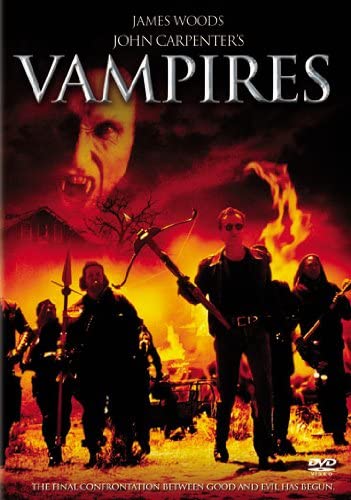
In John Carpenter’s 1998 film, Vampires (actually, John Carpenter’s Vampires because everyone know the power that the Carpenter name holds for horror fans), Jan Valek (Thomas Ian Griffith) is the world’s oldest vampire and he’s looking to perform a ceremony that will take care of that whole sunlight issue. If he can perform the ceremony, he’ll be the most powerful creature in the world.
Fortunately, the Vatican has put together a team of ruthless vampire exterminators. Led by Jack Crow (James Woods), these guys have no problem tracking down vampires and riddling their undead bodies with bullets that have probably been dipped in holy water. Unfortunately, with the exception of Jack and his second-in-command, Tony (Daniel Baldwin), the vampires hunters aren’t too smart because Valek gets the drop on them while they’re partying at a hotel with a bunch of prostitutes. The only survivors are Tony, Jack, and Katrina (Sheryl Lee), a prostitute who was previously bitten by Valek.
After teaming up with an enthusiastic but inexperienced priest named Father Guiteau (Tim Guinee), Jack tries to find a way to stop Valek. Meanwhile, Tony finds himself falling for Katrina despite the fact that Katrina will soon be transforming into a vampire and he and Jack have pledged to destroy every vampire that they come across. It leads to several chases, several bloody shootouts, and a lot of panoramic shots of the New Mexico desert.
The first time I ever watched Vampires, I thought it had its moments of demented fun and I thought that James Woods gave a wonderfully frantic performance as Jack Crow but overall, I got a little bit bored with the film’s constant violence. There’s only so many times that you can watch people die in slow motion before you get tired of it. The second time I watched the movie, I was able to better appreciate the film’s self-awareness. As directed by John Carpenter, it’s intentionally over-the-top in just about every regard and it’s definitely not meat to be taken seriously. It’s a mix of a western and a vampire film and Carpenter is basically saying, “If we’re going to do this, let’s go crazy with it.” The film still has its flaws, of course. Daniel Baldwin seems lost in the role of Tony and the film is oddly paced, It ends awkwardly, with the promise of a direct sequel that was never made. (There were sequels, don’t get me wrong. But Jon Bon Jovi is no substitute for James Woods at his most nervy.) But the important thing is that, on a second viewing, those flaws were overshadowed by John Carpenter’s kinetic direction and the performances of James Woods, Sheryl Lee, and Thomas Ian Griffith.
The first time I watched the film, I thought it was just another movie about modern-day vampires killing people while being hunted by unconventional extrerminators. However, the second time that I watched it, I found myself considering that Vampires is actually a movie about Catholics kicking ass! Yay! The lesson here is to always do a second viewing. Flaws and all, Vampires was far better than I remembered.
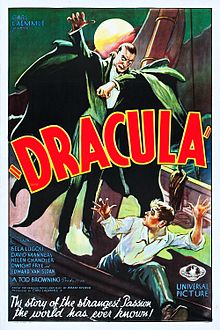
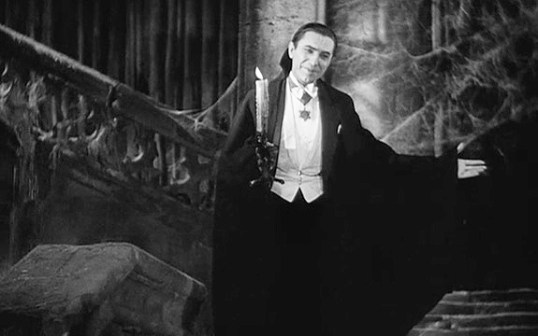
Seeing as how today is Bela Lugosi’ birthday, it only seems appropriate that today’s scene that I love should honor him. This is one Bela’s best scenes from 1931’s Dracula. Because his performance has been so widely imitated (and Bela himself appeared in a few films that poked fun at it), it’s often forgotten just how could Lugosi was in the role.
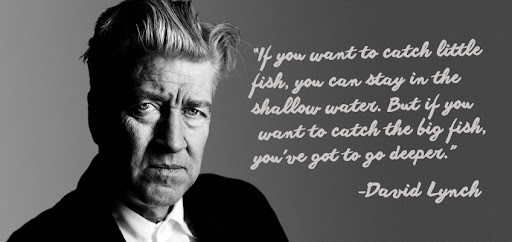
First published in 2007, Catching The Big Fish is a 177-book full of very short chapters in which David Lynch writes things that feel very David Lynchian.
The back of the book describes Catching The Big Fish as being the story of where David Lynch gets his ideas from. And it is true that, in a few chapters, Lynch does describe how a certain sight or sound inspired some of the scenes in his films. (For instance, he describes how he came to cast Frank Silva as KILLER BOB in Twin Peaks. It’s a story that you’ve probably heard before but, as with most things, it’s more charming when you read it in Lynch’s words.) Lynch describes capturing an idea as being like catching a big fish. It’s not easy and it requires you to heard for what Lynch calls the “deeper water” but you feel proud of yourself when you do it. (Or, at least, I assume that’s the case. I don’t actually fish myself.) Along with discussing his ideas, Lynch mentions the pain of Dune’s failure, his love of the French, his fascination with textures and Bob’s Big Boy, and the importance of not doing anything that could possibly compromise one’s creativity, whether it be therapy or drugs.
That said, the majority of the book is Lynch discussing meditation. Lynch is a notably apolitical filmmaker but he’s always been outspoken in his support of meditation to find peace and inspiration so it’s not surprising that a book about where he gets his ideas would center on meditation. Most of Lynch’s big ideas seem to come from catching details that others are too busy to spot and Lynch credits meditation with giving him the peace of mind and the insight necessary to do that.
So, it would seem that Lynch’s main lesson here would be that it’s a good idea to pay attention to what’s going on around you and to always take a closer look at things than the people around you. To be honest, it’s kind of an obvious lesson but again, the book is written by Lynch and the most obvious of things are more charming when Lynch points them out. As you might expect, Lynch comes across as being in his own world but he also seems like he genuinely hopes that you get something worthwhile out of the book. In the final chapter, he wishes you “peace” and you have no doubt that he means it.
To be honest, I’m not really into meditation. It works for some but it usually just makes me more anxious. But I do really like David Lynch and, if you’re a Lynch fan, you’ll find this book interesting. It’s enigmatic but earnest, much like Lynch’s best films.
This 1982 Spanish-produced slasher film was advertised, at least in the United States, with the brilliant tag line: “You don’t have to go to Texas for a chainsaw massacre.” And indeed, Pieces takes place in Boston, Massachusetts. And yet, it’s a Boston that has little relation to the Boston of the real world. (Some of that may be because, while a few scenes were filmed in Boston, the majority of the film was shot in Spain.) Indeed, one can argue that Pieces takes place in an alternate reality, one that was created with bits of giallo suspense, slasher gore, and scenes randomly borrowed from every other exploitation film ever made.
In the 1950s, a little boy wears a bowtie and plays with a pornographic jigsaw puzzle. His mother takes the puzzle away from him, which he doesn’t appreciate at all. It leads, as things usually do, to an axe murder.
In the 1980s, a college student tries to roller skate down a sidewalk, just to suddenly lose control. As she helplessly rolls down the street, two workman carrying a sheet of glass just happen to step out in front of her. Pieces of blood-stained glass fly everywhere. As is typical of Pieces, this actually has nothing to do with the larger plot of the film. We never learn the girl’s name. We never hear learn if she survived nor do we hear much else about the accident. Instead, it’s just a random incident, tossed in to illustrate that the world is going mad.
On campus, a chainsaw killer is killing students and teachers. He’s the boy with the bowtie, all grown up. He takes body parts home with him so that he can stitch them together, recreating the jigsaw puzzle that was stolen from him years before. Oddly enough, he never makes much of an effort to hide his chainsaw. He casually gets on an elevator with one of his victims. She notices that he’s carrying a chainsaw but she doesn’t say anything about it until he actually turns it on.
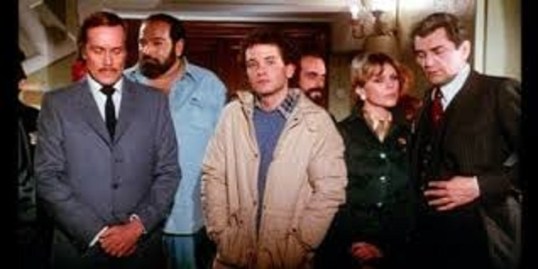
Dean Foley (played by Eurohorror veteran Edmund Purdom) is upset that students keep getting dismembered on campus, as well he should be. Lt. Bracken (Christopher George, barking out his lines with the same annoyed energy that he brought to Graduation Day) is also upset because he’s supposed to arrest criminals and stuff. Unfortunately, all of Bracken’s cops are incredibly incompetent. Bracken is forced to rely on the help of Kendall James (Ian Sera). Despite being kind of scrawny and unappealing, Kendall is the most popular student on campus. Kendall also knows every victim and discovers the majority of them. You would think that Kendall would be the obvious suspect but instead, Kendall somehow ends up directing the entire investigation. Kendall’s not a cop but he’s soon ordering around the veteran detectives and everyone’s okay with that. (One detective even mentions that Kendall might as well be a part of the force.)
Lt. Backen decides that the best way to solve the case is to send in Mary Riggs (Linda Day George), who is not only an undercover cop but also a top-ranked tennis player! There’s a lot of tennis in Pieces, as Mary works on her game in between working with Kendall to solve the murders. Kendall and Mary aren’t very effective though. After discovering that one victim was chopped in half in the showers while Kendall and Mary were trying to find the source of some loud marching band music, Mary lets the killer know exactly what she thinks of him.
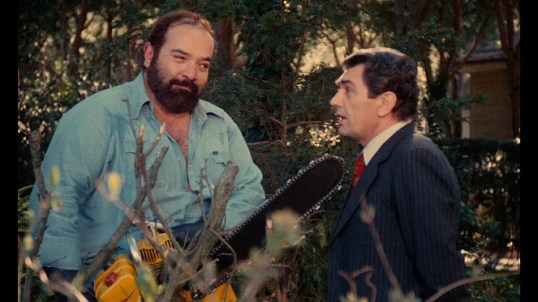
But who is the killer? Because Pieces was as inspired by the giallo genre as the slasher genre, there are several suspects. Kendall seems like the obvious one but, for whatever reason, no one makes that connection. Instead, we’re left to wonder if maybe it could be the Dean. Or how about Prof. Brown (Jack Taylor), the somewhat odd professor who seems to be a bit repressed? Or maybe it’s the handyman, Willard (Paul L. Smith)? Willard is creepy and he works with a chainsaw! There are a lot of suspects and helpfully, after a murder at the pool, every single one of them shows up at the scene of the crime. At one point, they all even gather in the same corner and look straight at the camera. You half expect Kendall to announce, “Well, I can’t possibly solve this one! Can you?”
But that’s not all! When Kendall and Mary aren’t solving murders, they’re having to deal with all of the other weird things that happen on campus. At one point, Mary is randomly attacked by the school’s karate instructor. After Kendall shows up and explains who the man in, they all laugh it off as being the result of “bad chop suey.” Later, Kendall walks Mary back to her place and, after she rejects his attempts at romance, Kendall turns around to be confronted by another student who taunts him by yelling, “Casanova!” Meanwhile, other students are still walking around campus in the middle of the night and making plans to meet up in a room that contain the height of campus luxury, a waterbed!
(Yes, a murder does occur on the waterbed. Yes, water goes everywhere. It’s Chekhov’s waterbed. You can’t introduce it without including a scene where it gets punctured.)
Many things happen, none of which make sense. The entire film is so over-the-top in its combination of gore, overacting, and general absurdity that it becomes strangely fascinating. From today’s perspective, it’s easy to imagine that the film was actually meant to be a parody but director J. Piquer Simon has said that it was meant to be viewed as a serious thriller, regardless of how the film was subsequently advertised in the United States. Even the film’s ending, in which someone who is not the killer is randomly castrated just because, was meant to be taken seriously. Every weird moment was included to give the audience what they wanted. Audiences loved Bruce Lee so, of course, a random karate fight was tossed in. People love chainsaws so, of course …. well, you get the idea.
On the one hand, Pieces is a really heavy-handed and mean-spirited film, one in which the victims are almost exclusively women and where sex and violence are too often connected. Mary may be an absurd character but you’re happy when she shows up because she’s the one woman in the film not presented as being a passive victim. On the other hand, Pieces is just so over-the-top and absurd that it’s hard not to watch the film all the way through. Perhaps the only thing that keeps the film from being incredibly offensive is that, regardless of what the director has claimed, it is so obviously not meant to be taking place in the real world. When that plate glass was shattered, it obviously opened a vortex that sucked the campus into a world where every slasher and giallo trope has been adapted to the point of absurdity. This is one of those films that just gets more and more strange with each passing minute. You watch it and you find yourself continually thinking, “This movie can’t get any weirder” and then it manages to do just that. Watching the movie is like stepping through a portal into some sort of strange alternate reality. Just try to look away.
4 Shots From 4 Films is just what it says it is, 4 shots from 4 of our favorite films. As opposed to the reviews and recaps that we usually post, 4 Shots From 4 Films lets the visuals do the talking.
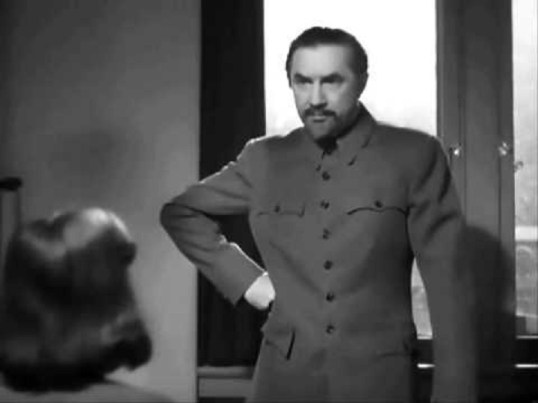
139 years ago on this date, Bela Lugosi was born in Hungary. Today, we honor his memory with….
4 Shots From 4 Bela Lugosi Films
Dracula (1931, dir by Tod Browning, DP; Karl Freund)
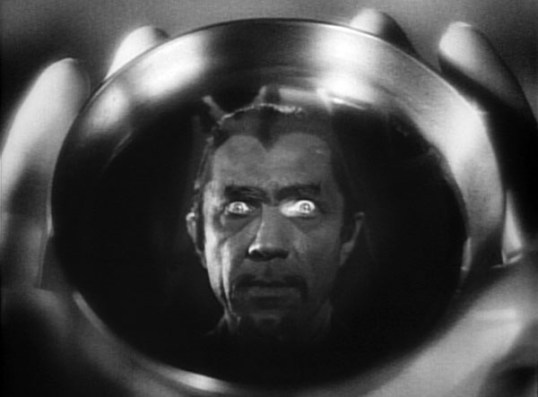
White Zombie (1932, dir by Vincent Halperin, DP: Arthur Martinelli)
Ninotchka (1939, dir by Ernst Lubitsch, DP: William H. Daniels)
Bride of The Monster (1955, dir by Ed Wood, DP: Ted Allan and William H. Thompson)




 Through the Shattered Lens