Film Review: Tammy and the T-Rex (1994, dir. Stewart Raffill)


Title Screen

You read the name and you know it sucks. Then that title screen pops up. Oh, my God! It looks like a 2nd grader made that, but it’s oh so perfect. You know why? Because this movie is as childish as that screen implies. The only thing wrong with it is that the title is too short. It should have been called Tammy, the T-Rex, and the African Queen. No, not because it has anything to do with the Hepburn movie, but because of this.

This!

This!

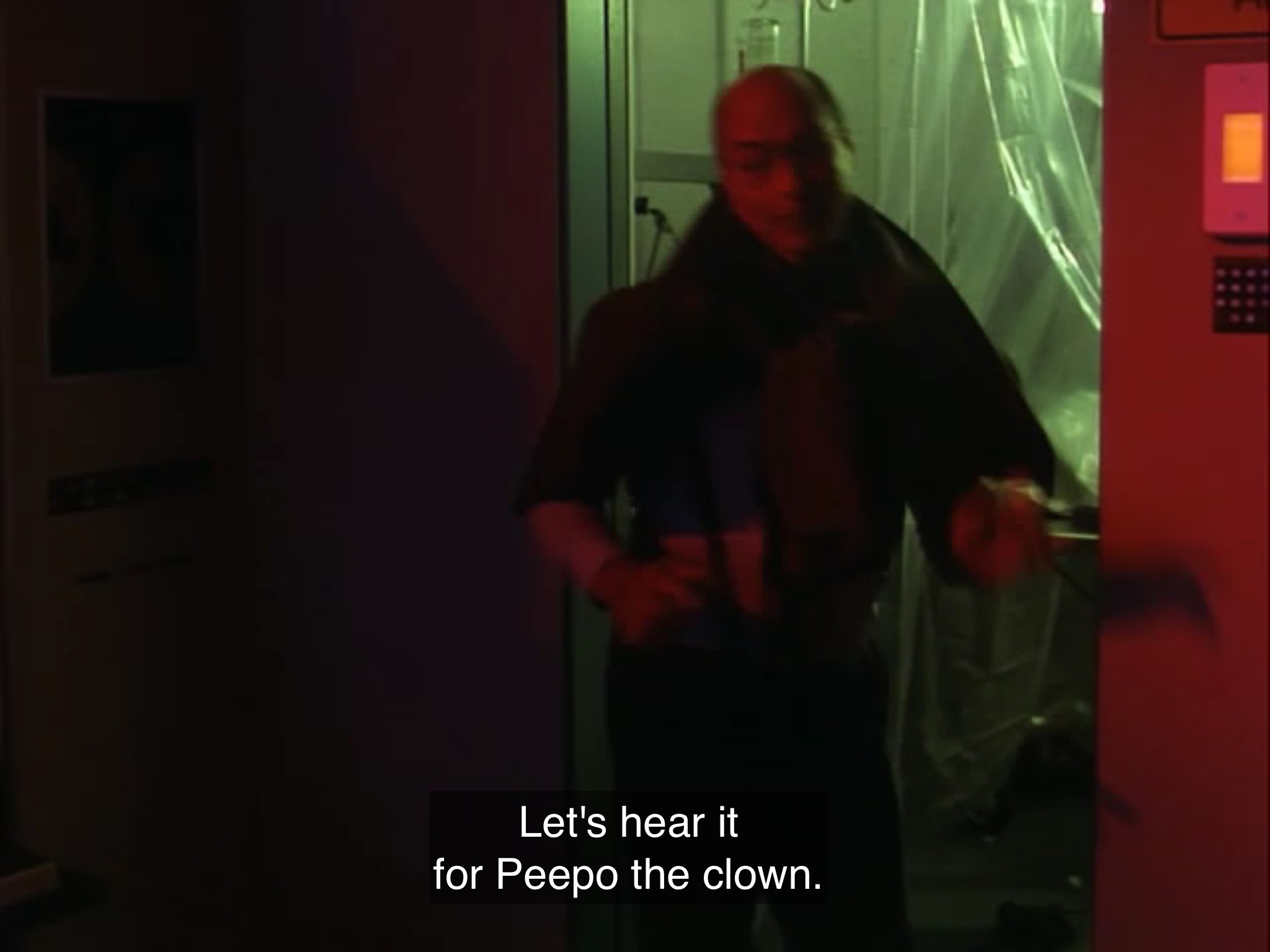
It’s two for the price of one! Not only do we get a gay stereotype, but one that is also a black stereotype. But what do you expect? The movie is made by the same guy who directed Mannequin: On The Move, which had a similar character. He also wrote and directed Mac and Me. The character’s name is Byron (Theo Forsett). So, what happens in this movie when Byron isn’t passing out or someone is saying not to bend over near him?

Testicular Standoff

Testicular Standoff

I’m not making that up! One of the two cops who shows up actually calls it that. Those are two high school guys trying to crush each other’s genitals with their bare hands. Wanna know something else? That’s Paul Walker on the right. Yep, that Paul Walker. Need it to be even dumber, since the fact that this carries on for several minutes isn’t enough. It turns out Walker, I mean Michael, is faking it because he’s actually wearing a cup. If you can’t tell whether you are holding male genitals or a piece of plastic then you are in real trouble. Why are they doing this? Well, of course for the heart of Denise Richards who plays Tammy! It’s everyone’s dream to have two men fight over them this way. Oh, and that shot of Byron above is from this scene. He seems to be turned on by it. Oh, this movie. Now comes the T-Rex.

The T-Rex

I know this is a lousy VHS print of the movie, but I can’t imagine how much worse this must look in HD. The plot goes like this. Michael shows up at Tammy’s place for a little action. Poppy Montgomery, in clearly her finest performance, sees Michael climbing up to Tammy’s room and calls in the other guy who fought with Michael earlier at school. Just as Tammy is finally gonna get a little something, in comes the bad guy with his friends in a scene reminiscent of A Clockwork Orange. They take Michael away to the Wild Animal Park. They couldn’t come up with a better name. Michael is left to get mauled by a lion. What happens next is right up there with the vagina snake scene at the beginning of Lady Terminator.

A mad scientist and his girl show up at the hospital, pretend Michael is dead, then steal his body out from under the nose of Tammy, Byron, both of which pass out on the floor, and the one member of Michael’s family who also happens to drink like a fish. Then they cut open Michael’s head and put his brain into a T-Rex. Yep, that’s how it happens. What follows is Michael the T-Rex seeking revenge on all the people who have wronged him.

The Got Milk? Guy

The Got Milk? Guy

The funniest death is easily when the guy from the original Got Milk? commercial gets killed after peeing on the T-Rex. Oh, and Michael the T-Rex also makes a phone call.

He actually tries to leave a message for Tammy!

He actually tries to leave a message for Tammy!

What follows are stupid deaths, stupid gay jokes, and one of the fakest things I have seen in a long time. Feast your eyes!

This will move you to tears.

This will move you to tears.

The ending is so absurd that I won’t even…who am I kidding? No one is going to seek this out. It ends like this.

An American Werewolf In London death

An American Werewolf In London death

Denise Richards does a sexy dance

Denise Richards does a sexy dance

And Paul Walker's brain sparks with excitement.

And Paul Walker’s brain sparks with excitement.

After unsuccessfully trying to find Michael’s body, they simple put his brain in Tammy’s room, attach it to a camera, and she dances for him. It’s amazing these movies exist. I don’t know how we made it out of the 1990’s. There’s an Italian R-rated version of this movie with a few deleted scenes. I watched them. Let’s end this review with one of them.

Like a compass

Like a compass

Val’s Movie Roundup #1


I wanted to write about two gems today, but I don’t feel well. Today is as good a day as any to start this series of posts. I watch a lot of movies and I just can’t write full posts about each and every one. Instead, I am going to do little roundups like this from time to time. Here we go.

Talking Skateboard

The Skateboard Kid (1993) – When I was a kid, a piece of wood on wheels could make you cool. Studios knew this, so many stupid skateboarding movies were made. This was one of them. But this one has a twist. Ready for this? The skateboard talks! And it flies! To make matters worse, Dom DeLuise voices the skateboard. Stay away! Watch the Francis movies instead.

Another Talking Skateboard

The Skateboard Kid II (1995) – What do you do when a bad movie about a talking flying skateboard comes out? Make a sequel of course! But this one has two things different about it. One, the skateboard becomes possessed by Turhan Bey. Don’t recognize the name? He actually dated Lana Turner back in the day. Also, the movie was executively produced by Jim Wynorski. He made Chopping Mall back in the 80’s and the softcore porn film Sexually Bugged! in 2014. Haven’t seen the first one yet, but the second one stinks to high heaven. No wonder he directed it under the name Sam Pepperman. This Skateboard Kid is actually better than the first if you can believe that.

Time Barbarians

Time Barbarians (1990) – The movie starts in olden times. There’s a stupid warrior, a stupid amulet, stupid bad guys, and it takes an hour or so for all three to wind up in Los Angeles. It’s like waiting for Godzilla to appear in the 2014 version. Once they get there it gets as dumb as you think. He not only can block bullets with his sword, but bullets fired from an automatic weapon. That’s some fine work! Can you believe this actually came out before The Beastmaster did the same thing with it’s sequel?

Howard The Duck

Howard The Duck (1986) – Yeah, I finally watched this movie. I don’t know why it has the reputation it does. Maybe people were not familiar with what a bad movie truly was at the time or they made the mistake of worshipping a director. I’m leaning more towards the second since you see people spend years trying to find ways to defend bad movies made by otherwise good directors. It’s not good, but it’s stupid campy fun. Harmless. The major issue with the film is that they tried to make it like E.T. in that it’s almost all about getting Howard back home. I think audiences would have preferred more of the wisecracking fun and much less of the child friendly material. Still, I enjoyed it more than Iron Man 2 & 3 so it’s a better Marvel movie than those and they have received praise.

Film Review: Lady Terminator (1989, dir. H. Tjut Djalil as Jalil Jackson)


Lady Terminator (Barbara Anne Constable)

Lady Terminator (Barbara Anne Constable)

It’s all here. She hunts down and kills innocent people on her way to her target. She rams a car into a police station in order to get to her target. She drives after the protector and her target while having a shootout. She appears as the Lady Terminator naked. She takes two guys to the back of a car where a snake comes out of her vagina and bites off their dicks, killing them so she can take their clothes.

What? Arnold didn’t bite off any dicks? Well, that’s because this isn’t The Terminator. This is Lady Terminator. Here, if a dick isn’t shot off, then it’s bit off by what we will refer to as the vagina snake.
The movie begins in the past where an evil queen takes a man to bed and kills him during sex. Then another man is brought in, but this time it goes differently. She gets into position, a snake slithers out of her vagina, he grabs it, it turns into a knife, and she’s banished. By banished, I mean she swears she’ll have her vengeance on his great-granddaughter in 100 years, appears outside on the beach, and walks into the ocean to join forces with evil. Isn’t that one of the most absurd openings to a movie you’ve ever heard of?

We jump to the future and meet Tania. She’s not a lady, she’s an anthropology student, as she reminds the sea captain. You see, she’s going to investigate the legend of the South Sea Queen. The lady who liked biting off dicks. She visits a library to have an encounter with a ridiculous character who knows exactly what she’s talking about, warns her, but gives her what she’s looking for anyways. You know, standard stuff.

She gets a boat, goes underwater, winds up on a bed, and the snake goes up her vagina. Makes perfect sense, doesn’t it? At this point I think we need to stop and notice that we have learned an important lesson. Fifty Shades Of Grey taught us that if you are a female English major then you’ll end up negotiating the use of butt plugs. But Lady Terminator teaches us that if you are a female Anthropology major then a snake will go up your vagina and turn you into a killing machine. Maybe major in Computer Science instead. Just saying.

See, I wasn't kidding. That's why we call it the vagina snake.

See, I wasn’t kidding. That’s why we call it the vagina snake.

Anyway, once the we really were inspired by the legend of the South Sea Queen and not The Terminator portion is over, the fun begins. And by fun, I mean almost a scene for scene copy of The Terminator, but with some differences to keep it exciting while doing those scenes well.

Emerging From The Water Naked

Emerging From The Water Naked

Lady Terminator Vision

Lady Terminator Vision

Shootout In A Club. Complete with getting shot to the ground, then popping back up.

Shootout In A Club. Complete with getting shot to the ground, then popping back up.

The Car Chase

The Car Chase

Crashing The Car Into The Police Station

Crashing The Car Into The Police Station

Cutting Out The Eyeball

Cutting Out The Eyeball

They even have somebody say Arnold’s name and the Kyle Reese character says, “Come with me if you want to live”. They also have the love scene together. I wish there was more to say, but telling you every added element would be spoiling it.

With all that out of the way. The question is whether this is worth seeing. You see the title. You know it’s a ripoff. You think of the Turks. You wonder is it worth your time.

Hell, yeah! It’s a lot of fun. It’s not as good as the real thing, but they did a damn fine job. I just wish they had made more of these movies with Barbara Anne Constable: Lady Rambo, Lady Die Hard, Lady Under Siege. Considering there is a new, legitimate, Terminator movie out, then this is a perfect way to take a trip back to the original, but with a fun twist.

Carry A Big Gun

Carry A Big Gun

Film Review: Battling Amazons (1987) (dir. Steve Antoniou)


Battling Amazons Title Screen

“Where’s Mercury? Mercury, it’s God. Listen, I need you to take a message to Odin and Zeus. And don’t forget Moses. Tell the boys to send their strongest, ablest, most beautiful women to Earth to punch it out. I wanna see some real knockouts. Tell ’em to call it: Battling Amazons. Do it!”

Thus begins one of dumbest and greatest things ever made. You might be asking yourself: Why Moses? Well, Delilah of course! We all know what she did to Victor Mature’s hair so she clearly can handle herself in the ring. So, the call goes out and numerous women are sent to battle.

Thesbian, The Viking Queen

Thesbian, The Viking Queen

Peelar, The Tiger Woman

Peelar, The Tiger Woman

Athena

Athena

Wanda, The Iron Mistress

Wanda, The Iron Mistress

Sandra, The Prophet

Sandra, The Prophet

Lazar, The Woman Of The Future

Lazar, The Woman Of The Future

Delilah

Delilah

Deidre, The Brazilian Bombshell

Deidra, The Brazilian Bombshell

We are then introduced to Georgia and Peter Willis who are two of the three people who guide us through the fights. I would be shocked if their lines were written in advance because it really sounds like they are improvising. Especially Peter. Sometimes it’s like he can’t think of something to say.

At first glance this looks like something exploitative, but it’s not really. You want that, then the movie called Trashy Ladies Wrestling that they advertise at the end of the copy I watched is for you. This is pure parody. The ladies get out there and lay it on as thick as possible. Even Holly the “round girl” comes out and does her best impersonation of those girls who are only there for eye candy.

But just as professional wrestling doesn’t all take place in the ring, neither does Amazon boxing. As the ladies arrive, Dan Dugen interviews them. They come up to him and act all tough to a remarkably small audience waiting for them. The best part of these interviews is the size of the guy doing them. The only people this guy is bigger than are Peter Dinklage and the lead singer of The Outfield. It really adds to the impression that these ladies are sent by the Gods. They tower over him.

Interview

The other people who are of note are Issie, the manager of Delilah, and Wanda, The Iron Mistress.

Issie

Issie

Wanda is one of the last of the ladies to show up, but they cut several times to show that she is on her way. My favorite is when they show her running across some grass next to a parking lot. There’s a trash can in her way and she just knocks it out of her way while holding some weapon in her hand. Other times she just runs like a mad woman holding something. These parts always had me laughing.

Wanda is on her way!

Wanda is on her way!

In wrestling backstage drama is all part of the experience and that is brought to Amazon boxing as well. During the battle between Thesbian and Delilah, Issie plays a horn. It distracts Thesbian and causes Delilah to win the fight. Then comes the controversy that takes us into a flashback where we see that Delilah told Issie to sneak into Delilah’s training area to find her weakness. After realizing that the brush in her bag will do him no good, he finds the horn.

Finding The Horn

Finding The Horn

As for the fighting itself. It’s pretty ridiculous, but they actually appear to be fighting. It’s not like the kind of thing where you’d expect every move, punch, or grab to be of a sexual nature. It’s just weak sauce moves. Still, it’s fun to watch.

I just can’t do this thing justice with words or a few screenshots. It must be seen. It’s only an hour long and it’s on YouTube at the time of writing this. Otherwise, it’s available through Amazon on VHS. Check it out!

Icarus Files No. 1: Cloud Atlas (dir. by The Wachowskis and Tom Tykwer)


CloudAtlas

“My life amounts to no more than one drop in a limitless ocean. Yet, what is any ocean, but a multitude of drops?” — David Mitchell

Let me tell you about Icarus. He took flight with wings of feather and wax. Warned not to fly too low so as not to have the sea’s dampness clog his wings or to climb too high to have the sun melt the wax. Icarus heeded not the latter and tried to fly as close to the sun. Just as his father had warned him the wax in his wings melted as he flew too close to the sun and soon fell back to earth and into the sea.

A tale from Greek mythology that taught has taught us about ambition reaching so high that it’s bound to fail. One such ambitious failure of recent times has been the epic science fiction film Cloud Atlas directed by The Wachowskis and Tom Tykwer.

The film was adapted from the novel of the same name by author David Mitchell which looked to take six stories set in 19th-century South Pacific and right up to a distant, post-apocalyptic future. Each story’s characters and actions would connect with each other through the six different time and space. The film attempts to do what Mitchell’s novel did through several hundred dense and detailed pages.

CLOUD ATLAS

Just like Icarus The Wachowski and Tom Tykwer’s attempt to connect the lives and actions of all six stories amounts for what admirers and detractors can only agree on as an admirable and ambitious failure.

The film boasts a large ensemble cast led by Tom Hanks, Halle Berry, Jim Broadbent, Hugh Grant and Hugo Weaving. More than one of the actors in the cast would perform characters in each and every six interconnecting stories in the film which added a sense of rhythmic continuity to the whole affair, but also made for some very awkward and uncomfortable scenes of what could only amount to as “yellowface”. This was most evident in the story set in 22nd-century Neo Seoul, South Korea where actors such as James D’Arcy, Jim Sturgess, Keith David and Hugo Weaving have been heavily made-up to look Asian.

Cloud Atlas was and is a sprawling film that attempts to explore the theme that everything and everyone is connected through time and space. It’s how the action of one could ripple through time to have a profound effect on others which in turn would create more ripples going forward through time. The film both succeeds and fails in portraying this theme.

cloud_atlas_hd_movie_trailer_stills_cinemavine_144.png.scaled1000

It’s the film’s narrative style to tell the six stories not in a linear fashion from 19th-century to the post-apocalyptic future, but instead allow all six tales to weave in and out of each other. At times this weaving style and how it would seamlessly go from one time location to another without missing a beat made for some very powerful and emotional moments. But then it would also make these transitions in such a clunky manner that it brings one out of the very magical tale the three directors were attempting to weave and tell.

Yet, even through some of it’s many faults and failings the film does succeed in some way due to the performances of the ensemble cast. Even despite the awkwardness of the “yellowface” of the Neo Seoul sequence the actors in the scenes perform their roles such admirable fashion. One would think that someone like Tom Hanks who has become such a recognizable presence in every film he appears in wouldn’t be able to blend into each tale being shown and told, but he does so in Cloud Atlas and so does everyone else.

It helps that the film was held up from a very hard landing after reaching so high with an exquisite and beautiful symphonic score composed by Tom Tykwer, Reinhold Heil and Johnny Klimek. It’s a score that manages to accentuate the film’s exploration of emotions and actions rippling through time without ever becoming too maudlin and pandering to the audiences emotions.

o0800045112460141324

Cloud Atlas was hyped as the next epic science fiction film from The Wachowskis and Tom Tykwer leading up to it’s release. This hype was further built-up with thundering standing ovation during it’s screening at the 37th Toronto International Film Festival. But once the film finally was released and more critics and the general public were able to see it for themselves the reaction have been divisive. This was a film that brooked no middle-ground. One either loved it flaws and all or hated it despite what it did succeed in accomplishing amongst the failures.

Just like Icarus, Cloud Atlas and it’s three directors had high ambitions for the film. It was a goal that not many filmmakers seem to want to put themselves out on the limb for nowadays because of how monumental the failure can be if their ambitions are just too high. It’s been the reputation of The Wachowskis since they burst into the scene with their Matrix trilogy. Their eclectic and, somewhat esoteric, storytelling style have made all their films an exercise in high-risk, high reward affairs that makes no apologies whether they succeed or fail. Each of their films have a unique vision that they want to share with the world and they make no compromises in how this vision is achieved.

One could call Cloud Atlas an ambitious failure. It could also be pop, New Age psychobabble wrapped up in so-called high-art. Yet, what the two siblings and Tom Tykwer were able to achieve with the film has been nothing less by brave and daring. If more filmmakers were willing to allow their inner Icarus to fly then complaints of Hollywood and the film industry not having anymore fresh new ideas would fade.

Review: Fury (dir. by David Ayer)


“Ideals are peaceful. History is violent.”

You know that feeling when a war movie tries so hard to be gritty that it forgets to be anything else? Fury, directed by David Ayer, flirts with that problem but mostly stays on the right side of the line. Released in 2014, this WWII drama follows a five-man American tank crew as they push deeper into Nazi Germany in April 1945. The war is almost over, but as the film constantly reminds us, that only makes the fighting more desperate and meaningless. Ayer, who wrote Training Day and directed End of Watch, clearly wanted to make a grimy, claustrophobic, and visceral experience—not a clean, heroic adventure. And for the most part, he succeeds. But the movie is also uneven, sometimes brilliant, and occasionally frustrating. One thing becomes clear early on: Ayer is not just making a war movie. He is trying to out-war the war movie that changed everything. Saving Private Ryan raised the bar for realistic combat violence in 1998, and ever since, directors have been chasing that opening Omaha Beach sequence. Fury spends its entire runtime trying to shove that bar even higher, especially in its final act, where the violence tips over from realistic into something almost performative—as if Ayer is daring you to look away.

The plot is simple. We meet Don “Wardaddy” Collier, played by Brad Pitt, as the seasoned commander of a Sherman tank nicknamed “Fury.” His crew includes Boyd “Bible” Swan (Shia LaBeouf), the religious gunner; Coon-Ass (Jon Bernthal), the volatile loader; and Grady (also Bernthal, though the character is actually Grady “Coon-Ass” Travis; the movie gives everyone a nickname). The crew loses their assistant driver in the opening scene, and they get a replacement: Norman Ellison (Logan Lerman), a young typist who has never fired a gun and has no intention of killing anyone. The rest of the film is basically a crash course in how war turns gentle men into monsters—or at least into effective killers.

What works best in Fury is the sense of being trapped inside a steel coffin. Ayer films almost everything from inside the tank or right next to it. You hear every shell clank, every engine strain, every bullet ping off the hull. The sound design is incredible—it’s the kind of movie where you feel the bass in your chest during combat scenes. And the tank battles are brutally realistic. There’s no slick choreography here. When a German Tiger tank shows up, the fight becomes static, clumsy, and terrifying. The Sherman isn’t some superhero; it’s outgunned and out-armored, and the crew wins only because they’re desperate and lucky. That sequence alone is worth the price of admission. You can feel Ayer’s respect for Saving Private Ryan in those moments—the same handheld cameras, the same sudden death, the same sense that no one is safe. But then the film goes further.

Brad Pitt gives one of his tougher, quieter performances. Wardaddy isn’t a philosopher or a hero. He’s a tired man who has seen too much and made too many compromises. He forces Norman to execute a German prisoner, not out of cruelty but out of a cold, broken logic: if Norman can’t kill, he’ll get the whole crew killed. Pitt sells the weight of that decision without grand speeches. Shia LaBeouf is surprisingly restrained as Bible, a character who prays before each battle but never preaches. The real surprise is Logan Lerman. He starts as a scared kid who vomits at the sight of corpses and ends the film doing things that would ruin anyone’s soul. His transformation is uncomfortable to watch, but that’s the point.

However, the movie has some clunky moments. One extended scene has Wardaddy and Norman sharing a meal with two German women in an abandoned apartment. It’s supposed to show a brief flash of normal life—eggs, music, a soft bed—but it feels oddly staged. The women are just props. They have no real personality except to be gentle and then get killed offscreen. It’s a rare moment where Ayer’s macho instincts flatten the story instead of deepening it. But the real problem is the final act. The crew holds a crossroads against an entire SS battalion of about 200 men, doing it with a broken-down tank that cannot move. Realistically, they’d be dead in minutes. But Ayer turns it into a grim last stand that feels more like a Western than a WWII movie. The Germans attack in waves like idiots, running straight into machine-gun fire. And here is where you sense Ayer’s real intention: he is not trying to be realistic anymore. He is trying to one-up Saving Private Ryan by making the violence not just brutal but excessive, almost numbing. Limbs fly. Faces get torn open. The camera lingers on wounds long past the point of necessary storytelling. It feels like Ayer is saying, “You thought Spielberg was intense? Watch this.” But instead of adding emotional weight, the violence starts to feel like a dare. The movie becomes less about these five men and more about proving it can stomach more than any other war film.

Thematically, Fury is about how institutions crush individuality. Norman was a decent person who typed letters and likely never hurt anyone. By the end, he is sitting in the commander’s seat, pulling triggers without hesitation. The movie doesn’t celebrate this—it presents it as a tragedy. But the final act undercuts that tragedy because it becomes so cartoonishly violent that you stop feeling for the characters and just wait for the bloodshed to end. Unlike Saving Private Ryan, which uses its famous opening sequence to establish horror and then pulls back for character moments, Fury seems to think that more gore equals more truth. It doesn’t. It just equals more gore.

If you’re looking for a clean story with clear good guys and bad guys, this isn’t it. The Germans are offscreen most of the time, and the real enemy is the war itself. Wardaddy even says, “The only thing that separates us from them is this uniform.” That’s a heavy line, and the film never really resolves it. It just lets it hang there. Some critics called Fury shallow because it raises moral questions without answering them. I’d argue that’s the point. War doesn’t come with footnotes. You just survive or you don’t. But the film’s desperate need to prove it is tougher than its predecessors does make it feel, at times, like a younger brother showing off.

On a technical level, the cinematography by Roman Vasyanov is beautiful in a grim way. Colors are desaturated—browns, grays, washed-out greens. Mud and blood look the same. The camera shakes when it needs to, but it’s not the hyperactive Bourne style. It’s controlled chaos. And the final shot, where the camera slowly pulls back from the dead tank, is haunting. It stays with you.

So, final verdict? Fury is a solid, often great war film that trips over its own ambitions in the last thirty minutes. It wants to be a small, character-driven horror show, then pivots to a heroic last stand that feels like it belongs in a different movie—one that cares more about shocking you than moving you. The comparison to Saving Private Ryan is unavoidable, and Fury clearly wants to be mentioned in the same breath. But where Spielberg used violence as a doorway into human cost, Ayer sometimes uses it as a blunt instrument. The performances are strong, the tank combat is second to none, and the atmosphere is suffocating in the best way. It’s not Come and See, but it’s also not Pearl Harbor. If you can handle the tonal whiplash and the occasional macho posturing, you’ll find a movie that respects its audience enough to leave them feeling dirty. Just don’t expect a clean exit—and don’t expect it to earn every drop of blood it spills.

Horror Review: All Souls Day (dir. by Jeremy Kasten)


AllSoulsDay

All Souls Day was part of the wave of zombie films that continues to flood the direct-to-video (and at times straight to cable) market. This particular zombie movie was written by Mark A. Altman who also wrote the campy and very B-movie-like House of the Dead 2. This was a  zombie flick which actually improved on Uwe Boll’s own House of the Dead that doesn’t really come as a surprise. All Souls Day was Altman’s second try at another zombie movie and while this second attempt wasn’t as fun as his previous one it still managed to be a watchable and interesting zombie movie.

The film’s set in a dusty Mexican town that hides a dark secret from its past. A young couple (played by Marisa Ramirez and Travis Wester) happen upon what seems like an abandoned town. They soon come across a funeral procession and when they inadvertently interrupt the ritual all hell literally breaks loose. It doesn’t help the couple that the only person who seems to be real in this town was the sheriff whose own past ties in with the secret of the town. It was very good to see genre veteran David Keith in the role of the town sheriff. His limited time in the movie was pretty good.

When the town’s people (who by now have shown themselves to be zombies) begin to lay siege on the young couple in the town’s only hotel the rest of the movie gradually shows more of what made this particular Mexican town a death trap for any passerby who happen to come across it on All Souls Day. Soon enough help comes in the form of the young couple’s two friends who arrive in town only to get themselves stuck in the same dire situation the original couple find themselves in.

The resolution of the movie was handled well and it brought a nice supernatural origin and reason as to why the town’s population has turned into flesh-eating zombies. The performances in the film could be seen as being mixed. The more veteran performers like Jeffrey Combs, David Keith, Danny Trejo (as the town’s manipulative patriarch) and Laura Herring perform their roles well without being too over-the-top. The actors playing the pair of young couples on the other hand go from very good to awful in the span of moments in some of the scenes. It’s really this mixed bag in the cast’s performance which keeps All Souls Day from turning into one of those hidden gems in a hill of crap that most zombie flicks turn out to be.

The gore effects in this film was pretty good in the small amount of sequences where the zombies end up doing what they do best once they get a hold of someone. While I was hoping for more of the grue in this particular zombie movie I wasn’t too surprised why it didn’t have more. Other than the pair of young couple there really wasn’t much living people for these zombies to munch on. The film itself show’s it’s low-budget origins in that it looks like something one would see premiere on a random Saturday night on the SyFy Channel. The film actually did premiere on that channel when it was still called SciFi. It’s a look that says TV instead of film, but despite that little nitpick it doesn’t distract much from the experience.

Now, most zombie films of the low-budget variety tend to just have badly done make-up effects. With All Souls Day the filmmakers seem to have done an end-around that budgetary problem by taking a page out of the classic Italian zombie flicks of the 1980’s by making these undead dry, decayed creatures. It’s something that worked well for the Fulci zombies and here it works as well.

All Souls Day was not a great zombie film by any stretch of the imagination, but it had enough entertaining moments and some genuine scary sequences to make it an enjoyable hour and a half of horror viewing on any October night.

Guilty Pleasure No. 21: Hawk the Slayer (dir. by Terry Marcel)


HawktheSlayer

Tonight was the season finale of Game of Thrones season 4. It was another great piece of storytelling that managed to juggle several subplots and giving each one their own time to shine.

The latest “Guilty Pleasure” is the 1980 epically mind-numbing fantasy film Hawk the Slayer starring the great Jack Palance in the the villainous role of Voltan the evil elder brother to the film’s title character, Hawk the Slayer. This film is in the other side of the quality spectrum of tonight’s Game of Thrones season finale.

Hawk the Slayer was part of the 80’s flood of sword and sorcery films that included such titles as Conan the Barbarian, Beastmaster and Ladyhawke. To say that this film was bad would be an understatement. Yet, I’m quite drawn to it whenever I see it on TV. In fact, it was on syndication that I first saw this when I was just a wee lad. I might have been around 9 or 10 when I came across it halfway through.

Maybe it was the fact that I was just discovering Advanced Dungeons & Dragons, but this film  spoke to me. It had that timeless story of brother against brother. The evil tyrant with legions of evil ne’er do wells against a small band of class-specific heroes and rogues. I mean this had it all. We had the hero of the film who I would probably place in the swordsman class. Then we had Ranulf with his repeating crossbow that would be the band’s rogue. Of course, there’s Gort the giant with his mighty hammer and Baldin the dwarf skilled in the art of the whip. But the one character that really shouted RPG for me throughout this film was Crow the Elf who could fire his bow as fast as any machine gun I’ve ever seen.

I think it’s very awfulness is why I keep returning to it whenever I see it on TV. The acting is atrocious with special effects that even in 1980 would be seen as laughable. The characters themselves were so one-note that one wonders if the person who wrote the screenplay was actually a trained monkey. Yet, the film was fun for all those reasons. It’s one of those titles that one would express as being so bad it’s good. Even now, with childhood several decades past, I still enjoy watching Hawk the Slayer and always wonder when they plan to get the sequel set-up and made.

Oh, the synth-heavy disco-fantasy-western soundtrack was also something to behold.

  1. Half-Baked
  2. Save The Last Dance
  3. Every Rose Has Its Thorns
  4. The Jeremy Kyle Show
  5. Invasion USA
  6. The Golden Child
  7. Final Destination 2
  8. Paparazzi
  9. The Principal
  10. The Substitute
  11. Terror In The Family
  12. Pandorum
  13. Lambada
  14. Fear
  15. Cocktail
  16. Keep Off The Grass
  17. Girls, Girls, Girls
  18. Class
  19. Tart
  20. King Kong vs. Godzilla

Guilty Pleasure No. 20: King Kong vs. Godzilla (dir. by Ishirō Honda)


KingKongvGodzilla

With the release of the new American reboot/remake/sequel of the classic 1954 Godzilla by Ishirō Honda, I thought it was high time I shared one of my guiltiest of all film pleasures growing up.

Godzilla and everything kaiju I ate up as a wee lad growing up during the 80’s. There really wasn’t anything on Saturday morning and afternoon tv other than reruns of badly dubbed Japanese monsters flicks and anime. One such film was Ishirō Honda’s very own King Kong vs. Godzilla. Yes, you read that correctly. The King of All Monsters fought the Eight Wonder of the World to decide once and for all who was the greatest giant monster of all-time.

The film itself wasn’t that great when I look back on it. Hell, even I had a sort of understanding even as an 8-year old kid that King Kong vs. Godzilla was a pretty bad film, but I still had a blast watching it. The film lacked in coherent storyline and important themes of man vs. nature and the psychological impact of the two atomic bombings of the US on Japan to end World War II wasn’t at all evident in this monster mash-up.

What the film had was King Kong fighting Godzilla. It was like watching two of the greatest icons of youths of my generation duking it out for our pleasure. It didn’t need to have a story or worry about whether it’s depiction of the natives on King Kong’s island was even remotely racist (it was so racist). All it needed to do was show everyone the very fight they’ve been waiting for. Fans of both monster wouldn’t have to wait forever to see the fight happen. This wasn’t going to be a dream fight never to happen like Mayweather vs. Pacquiao.

So, while King Kong vs. Godzilla was never one of the good entries in the Godzilla filmography (I think it was probably the worst) it more than made up for being one of the most campiest and entertaining entries in the Big Guy’s decades long history.

If there ever was a film from my youth that needs to be remade it would be King Kong vs. Godzilla and only Guillermo Del Toro should be chosen to direct it.

  1. Half-Baked
  2. Save The Last Dance
  3. Every Rose Has Its Thorns
  4. The Jeremy Kyle Show
  5. Invasion USA
  6. The Golden Child
  7. Final Destination 2
  8. Paparazzi
  9. The Principal
  10. The Substitute
  11. Terror In The Family
  12. Pandorum
  13. Lambada
  14. Fear
  15. Cocktail
  16. Keep Off The Grass
  17. Girls, Girls, Girls
  18. Class
  19. Tart

Robocop 2014


robocopposter

Boom.

So, I did, in fact, see Robocop 2014. It was suggested that some of our readers might have heard about this one. I will tell you right now that my own take on the film is… largely unbiased. The original Robocop never entrenched itself in my lexicon as an ‘essential’ film. I generally considered it to be a fun film, very watchable, fairly standard 80’s action fare… and, really, with the fingerprints of noted Dutch filmmaker Paul Verhoeven all over it. I definitely remember it fondly, but I’m by no means a Robocop purist. The puzzling direction the series took after the original (Robocop 2, in particular, strikes me as one of the worst films I can recall seeing, and 3 is somehow less memorable. I’m sure that does not mean good things). One thing probably anyone would tell you about the original film is that it was violent. Controversially so. Or perhaps that it is infested with foul language? To the point where the f-bombs seem to become their own point. Well, to start with, 2014’s Robocop went for the path of least creativity, and stuck itself in a PG-13 body that is actually pretty teen-friendly. More on that in a minute. But between the absence of Verhoeven’s style, the infusion of 201X’s powerful visual effects, the over the top violence and language, and the absence of any 80s camp, this film bears very little resemblance to the original.

If you wish to appreciate this film at all, you will be forced to do so on its own merits. Looking at it through the prism of the original film will probably not satisfy you, though I may be mistaken. I suppose it depends on how much you loved the first iteration.

2014’s incarnation of Robocop is directed by José Padilha, directing his first English language film. He is best known for his work on the Elite Squad films. His background is in action, and his style is not one that we’ve been down that road before with. I suspect that if this film had been helmed by a Michael Bay, it might have been disastrous. Instead, the result is surprisingly gritty at times, especially during an early shootout between Detroit police detectives and a hit squad sent to eliminate them to cut off their investigation of a local gunrunner. Obviously, the film has plenty of antiseptically clean sets, and the sophisticated visual effects involved give us lots of clean lines and gleaming, metallic surfaces… so it was, in a way, grounding to see some sequences in an experienced hand. Sadly, this style does not hold true through the entire picture, which features some predictably infuriating shaky cam work where our ability to understand and process the action is limited by the way in which it is shot. Some would probably argue this is realistic, and that if I were actually in a gun battle, I could only understand a tiny part of it even afterward… but as an action film viewer, it turns me off like few other things do.

The ED-209 has certainly never looked better.

The ED-209 has certainly never looked better.

The plot is a significant variation on the 1987 original, though it does have some pieces of the framework still intact. The year is 2028, and the United States is now projecting its power worldwide through the use of formidable robotic drones provided by Omnicorp (a division, we learn, of the original film’s OCP. Unlike the original film, in which the ED-209 is clearly the shoddy work of a corporation trying to make money by sending to the lowest bidder, it seems that the ED-209 is an extremely efficient and deadly enforcer and peacekeeper. Its primary flaw, that it cannot reason like a human, and does not know right from wrong, is central to the questions that the film posits. To the extent that it posits anything, that is. As with the original 1987 film, 2014 is introduced to us by a nationwide news broadcast… except, this time, instead of a simple evening news program, we’re treated to an extremely high production news opinion show (something like The O’Reilly Factor, perhaps) starring Pat Novak, a highly opinionated right-wing security lobbyist (a well cast Samuel L. Jackson delivers an energetic performance). Pat Novak wants to know why these drones aren’t keeping America’s streets safe, too.

The answer, of course, is that Americans want their protectors to have a soul. The film does make it clear, incidentally, that the United States has not asked other parts of the world if they’d prefer this same consideration… and this is where the film’s satire lies… in pumping up world peacekeeper thinking until it explodes.

With the realization that public opinion has to change or Omnicorp will never be able to deploy its products to the American market, the company’s executives, Marketing Director Tom Pope (Jay Baruchel) and, Legal Department Chair Liz Kline (Jennifer Ehle) and the CEO Raymond Sellers (Michael Keaton) decide to try and create exactly what their market wants: a man inside of a machine. Using the revolutionary cybernetics developed by Dr. Dennett Norton (Gary Oldman, in a very wistful, emotional role) they scour the country’s cops debilitated in the line of duty in search of the perfect candidate – an emotionally balanced cop with the reason and the desire to get back in the game.

Enter Alex Murphy (Joel Kinaman, from AMC’s “The Killing”), grievously injured, with wife Clara (Abbie Cornish) and son David (John Paul Ruttan) desperate not to let him go. Using Dr. Norton’s technology, Omnicorp rebuilds him into the ultimate crime fighting machine… where things go from there is, frankly, fairly predictable. Throughout the narrative, Pat Novak’s show continues to break in, stitching the narrative exposition together with both more of Novak’s bluster and with interviews with other major players like CEO Sellers and the Senator who is leading the opposition to Omnicorp’s technology, Hubert Dreyfuss (Zach Grenier). You will no doubt anticipate the conclusion of the film well before it reaches those final moments, and so aside from a couple of exceptionally well crafted sequences, this film does not exactly break new ground.

What does stand out, and I apologize for stuffing those last couple paragraphs full of as many names as possible (and I still missed plenty!), is the casting, and the acting, that are on display in this film. Everyone involved stands more or less head and shoulders above what’s being asked of them. I particularly enjoyed Michael Keaton in the role of the film’s villainous CEO, who gives a very reserved performance. There is very little evil mania from Keaton, who instead comes off exactly as coldly off-putting as I would expect from a sociopath in his position, going from decision to decision with an eye for the company’s financial future. The more scenery chewing villainy is left up to Jackie Earl Haley as Omnicorp’s in-house military QC, Rick Mattox, and from some villains scattered about the mean streets of 2028’s Detroit.

The original Robocop had a kind of wry humour to it that is entirely absent this reproduction. Curiously, the film is also almost entirely without meaningful visual violence, and almost totally absent of profanity (the traditional single use of ‘fuck’ for a PG-13 film is, in fact, bleeped, since it’s delivered by Pat Novak on his live TV show), and instead feels more like playing a modern Call of Duty or Battlefield video game in its depiction of Robocop battling his foes. This film coasts by absolutely safely at a PG-13 level (seriously, this is not the film you need to be worried about protecting your kids from).

While elements of the film are certainly a visual feast, these sumptuous visuals are actually mostly confined to the laboratory in which Robocop is built and maintained, and in the sophisticated battle armor that the titular supercop wears. The sequences on the ground, so to speak, feel a little more real. I suppose it’s the same faint sense of grittiness that the director’s hand gives this movie, which only rarely becomes a victim of its own visual effects. This is largely a good thing, as I think we’ve all developed a little bit of special effects fatigue over several heaping courses of Michael Bay’s “Transformers”, “Star Wars” prequel films, and other overblown projects. This film struck a fair balance, I felt, between taking advantage of the visual effects available, and trying to substitute them for any kind of substance. There is something going on at the core of this film. Unfortunately, I ultimately felt that it was not enough to satisfy, but plenty to entertain. Your own mileage will, of course, vary.

For those purists out there who are decrying the necessity of this remake (there was none) and the wisdom of doing so anyway… in perfect honesty, this is a film that simply wouldn’t have been made this way in 1987. In saying that, please, let’s admit that the 1987 film would also never have been made that way today. People’s outlook has changed. They look for, fear, and hope for, different things out of the world. Robocop 2014 is by no means a perfect – or even great – film… but it is a much better film for the post 9/11 world than the original one is. It fits its era. Between that, and a slew of excellent performances, you may just find this film to be above your expectations. It certainly surpassed my own.