Review: The Dead (dir. by The Ford Brothers)


Zombies.

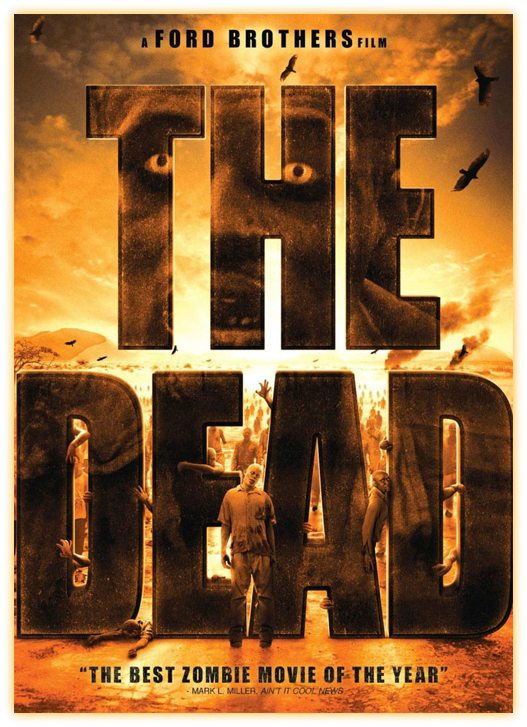
I’ve heard the collective groans from many who have achieved zombie oversaturation. For some reason the renaissance of the zombie subgenre which began during the early 2000’s continues unabated. One just has to look at the huge popularity of Robert Kirkman’s long-running horror comic book The Walking Dead right up to the even more popular tv adaptation of the comic book which now enters it’s 3rd season on AMC TV. Yet, not everything zombie-related in entertainment could be considered scary or even entertaining. If one looks at the dozens of direct-to-video which seems to come out month in and month out that barely rises above amateur production and execution one does have to feel that the subgenre should just die and go away. Then something like The Dead by the British sibling filmmakers The Ford Brothers comes along and breathes some fresh blood into the scene.

An indie film shot pretty much in northwest Africa (Burkina Faso and Ghana), The Deadis a throwback to the classic Romero zombie films before the new millennium and, even moreso, the Italian zombie films of Lucio Fulci with emphasis on Zombie. The Ford Brothers pretty much shot the film in some of the worst conditions a film crew could find itself in. It doesn’t matter whether it was the baking mid-day heat in the open plains and desert right up to the very real armed conflict which continues in the region to this very day. These two British siblings definitely took some guerilla filmmaking lessons from their hero Romero in how to stretch their tiny budget and still come out with a very good production.

The Deadis a pretty straightforward zombie film and acts more like a road film than your typical zombie story which tend to focus heavily on the siege aspect of the genre. We don’t get sieges in this film. The openness of the African plains and desert made for an interesting change of pace to the typical urban and/or countryside locales past zombie films ended up using. The film also spent so much of it’s running time in broad daylight which also made it stand out from it’s zombie film brethren which used night time as a prop to create dread and mounting terror. The Ford Brothers were able to use that very brutal heat and searing African midday sun to give the film a beautiful look but also one that highlighted it’s apocalyptic and hopeless situation. The light showed zombies shambling along from every direction, slow as they may be, in that steady, silent pace that was as inevitable as Death itself.

The story of the film is quite bare bones with the opening sequences pretty much introducing the two storylines that would intersect very early and combine to become one. There’s the lone survivor of a military evacuation flight out of the area and back to America (at least Europe) in Lt. Brian Murphy (played by Rob Freeman) whose role as a flight engineer in the doomed flight gives him the necessary technical skills to fix an abandoned vehicle he finds, but who is not what one would call a hardened soldier unlike Sgt. Daniel Dembele (played Ghana actor by Prince David Oseia) whose role as a soldier gives him the skills to protect Murphy. The two become traveling companions who must traverse the post-apocalyptic West African landscape that always have zombies, silent and sure slowly and patiently finding their way to the two no matter how fast and far they go.

Murphy wants to get back to his wife and daughter back in the States though he doesn’t know if they’re still alive or not. Daniel wants to find his son who was rescued by soldiers in the beginning of the film as their home village succumb to an attack of the dead. These similar goals become the very thing which helps the two bond together despite their cultural and ideological differences.

The film doesn’t go too heavy with the themes and ideas of Africa and zombies, but they’re there and the Ford Brothers don’t try to avoid them either. Throughout the film one could see that the film could easily be a metaphor for the birthplace of mankind also becoming the beginning of its end. There’s also the shadow of the crimes of Western colonialism and interference in a land whose people have been exploited and used like chess pieces on the grand world stage. Like some of the best zombie films, The Deaduses the apocalyptic setting and the danger of the zombies as a way to explore serious themes and ideas but do so without being too obvious or heavy-handed. In fact, the Ford Brothers actually were quite subtle with their handling of these ideas throughout the film. This made for a much more streamlined story, but also kept the film from heading into epic territory.

Freeman spends almost the whole time on the screen which stretched his performance somewhat. At times his dialogue came out natural and then on another sequence he would come off stilted. It’s not surprise that some of the best scenes Freeman’s Murphy had was when in the presence of Oseia’s Sgt. Daniel Dembele. Hiss presence on screen almost overshadows Freeman at times and one could almost wonder how much the better the film would’ve been if it was just Daniel searching for his son and no Murphy character to distract things. Oseia’s performance becomes the moral center of the film and as the story unfolded one felt like rooting for the man to find his son even though the odds on him succeeding rises with each passing minute.

The Dead is not a perfect film and one could say that it’s very straightforward nature becomes too generic and evident at certain times during the film. Yet, the rough and raw way the Ford Brothers wrote and shot the film with some very good performances from it’s cast made up for any shortcomings the film had. Even the gore effects wasn’t hampered by the minuscule budget. This film should satisfy gorehounds and story aficionados both. That’s something that most indie zombie films can’t boast about that this film can. The film’s ending leaves things somewhat open for a sequel (something the brothers are open to exploring as a future project) with the final shot evoking a “Lone Wolf and Cub” vibe before the fade to black.

The Ford Brothers’ The Dead saw a very limited release in 2010 and 2011 but has now seen a wide DVD/Blu-Ray release for 2012. For some it would be a buy and a keeper, but at the very least it deserves a rental to see what all the hoopla was about.

Review: The Amazing Spider-Man (dir. by Marc Webb)


It was in the summer of 2002 that the superhero film genre finally entered it’s Golden Age (or Silver Age for some). X-Men had come out two years before to positive acclaim and, most importantly, in the box-office. It wasn’t until Sam Raimi released the first in what would be his trilogy in the Spider-Man film franchise that superhero comic book films became the power in Hollywood it remains to this day. The first film from Raimi easily captured the pulp and campy sensibilities of the source material and for an origin story film it was done quite well in that it introduced the titular character and what made him tick. In 2004, Raimi and company released what many consider the best comic book film with Spider-Man 2. The film brought a level of Greek tragedy to the fun of the first film and it definitely brought one of the best realized comic book villains on film with Alfred Molina as Dr. Octopus. Then the franchise hit a major bump in 2007 with Raimi third entry in the franchise with the bloated Spider-Man 3.

Sony Pictures, who owned the film rights to the Spider-Man franchise, were so quick to churn out a fourth film, but in doing so lost the filmmaker and cast that made the trilogy happen. In the studios’ thinking they needed to get a fourth film up and running in order to keep the rights to the film from reverting back to Marvel and Disney. So, out goes Sam Raimi, Tobey Maguire and Kirsten Dunst and in comes Marc Webb, Andrew Garfield and Emma Stone. Instead of getting Spider-Man 4 we get The Amazing Spider-Man which doesn’t continue what Raimi had established with the first three films, but reboots the franchise all the way to the beginning.

Marc Webb takes the screenplay worked on by a trio of screenwriters (James Vanderbilt, Alvin Sargent, Steve Kloves) and reboots the origin story of Peter Parker’s transformation into Spider-Man. We find Peter Parker back in high school as a student and still getting bullied by Flash Thompson while remaining awkward around girls (especially one Gwen Stacy played by Emma Stone). yet, before we even get to this part of the film we get an introductory coda where we find a preadolescent Peter Parker playing hide and seek with his scientist father. These early scenes show hints that the enhanced spider thatwill bite and give eter his abilities may have had his father’s research and work written all over it.

This intro influences much of the storyline and leaves a huge impact on the character of Peter Parker which the previous three films never explored. The rest of the film has Peter investigating the circumstances of his parent’s disappearance and his adjustment to having been given the superhuman abilities by the spider that his father may or may not have been responsible in breeding.

First off, the film does a good job in re-establishing Peter Parker as a high school student. The original film spent some time in this part of Peter Parker’s life but never truly explored it. We see Peter not just the class genius, but also one who also shows an affinity for photography (something that the original trilogy never really explained other than he needed the job and money). There’s also some added layers to the character as this version of Peter Parker is more than willing to stand up to the bullies picking on the weaker students other than himself. It’s a huge departure from the meek and geeky Peter Parker of the past. We still get a geeky and smart Peter, but one who is also a sort of a well-intentioned slacker. We also get a proper introduction for Gwen Stacy (something the third film criminally mishandled)

The film introduces once again many of the characters the first film in the series had already done. From Uncle Ben (played by Martin Sheen this time around) and Aunt May (Sally Field) right up to the robber who runs into Uncle Ben and changes Peter Parker’s outlook on his role as a hero forever. Again these were character that had already been explored by the first three films and they’re scenes that had an air of familiarity to them though Sheen performance as Uncle Ben added more layers to the character who becomes Peter Parker’s moral center.

Another thing that the film did a good job with was the design of the film. It has been ten years since the first film and the technology in CGI-effects has leapfrogged exponentially since. The look of the OsCorp Tower was a beautiful piece of architectural design. The building loomed over New York City like something dark with a hint of malice. There were changes to the suit Peter wears that really harkens back to the McFarlane years of the Spider-Man comics. Even the return of the web-shooters was a nice surprise that I had some reservations when first hearing about it.

A third good thing about the film was the extended montage when Peter Parker realizes he has gained new abilities and begins to test them out. It’s familiar territory from the first film, but Marc Webb and Andrew Garfield adds a new level of youthful exuberance to the proceedings. Even the use of parkour by Peter Parker to show his growing abilities didn’t come off as silly. Garfield’s performance as Peter Parker in this montage was pretty great. One could believe at how much fun he was having at discovering each new level of abilities. Even some of the growing pains he goes through after getting bit were some of the more hilarious moments in the film that ultimately lacked much of it in the end.

Which brings us to what made this entertaining film end up becoming a failure in the end.

I admit that the film entertained me in the end, but there were things aboutThe Amazing Spider-Manwhich nagged at me throughout and afterwards. While the film was entertaining the story self and most of the characters were inconsistently written. Once one looked past the action and some of the witty dialogue in the beginning the film’s many plot-holes and head-scratching moments become too glaring to ignore.

The character of Peter Parker does get some new layers of characterization in the beginning, but as the film played out the more the Peter Parker of this film began to stray away from not just what Raimi had created and guided through the first three films but also most of the character’s decade’s long growth in the comics. Yes, we see Peter Parker as the science-genius and even moreso than the one portrayed by Tobey Maguire, but we also don’t get the awkward teen who grows into his abilities, but most importantly, one who learns through tragedy that he has a responsibility to the people around him to protect them even if it means sacrificing his wants and dreams to do so. We don’t just see Peter Parker saving people, but also one who seemed to relish beating up and abusing those who used to do the same to him and/or others. Spider-Man in this film acts more like a bully than a reluctant hero by film’s end. Even the events that should’ve taught him the lessons of self-sacrifice and heeding the needs of the many fail to make much of an impact on the teen superhero. All one has to look at as the perfect example of this darker and more selfish turn to the character was Peter’s whisper to Gwen about promises not being kept being the best ones.

Other characters get inconsistencies in how they’re written. The other big one being Dr. Curt Connors who begins the film as a scientist so intent of not just curing his disability but also helping the world. It’s a character similar in tone to Alfred Molina as Dr. Octopus, yet where that villain remained a tragic one throughout the film and we could see the path which led him to become a villain with Dr. Connors in this fourth film there’s such a huge turnabout in the character’s motivations that whatever sympathy we may have had for Connors was squandered.

Not every character fails to impress. Martin Sheen and Denis Leary as Uncle Ben and Capt. Stacy respectively were fully realized characters who become Peter Parker’s moral centers and voice of reason. In fact, both Sheen and Leary helped anchor the scenes they appeared in and thus made their characters’ fate have the sort of emotional impact that a growing hero needs to move from being reluctant to accepting of his lot in life. It’s a shame that the writers failed to capitalize on the performances of these two character actors to help make Peter Parker more a hero and less a teenager more in love with what he can do instead of realizing that he has more to offer those who are weakest.

This is not to say that the performances by the cast was bad. From Garfield and Stone right up to Ifans, Sheen, Leary and Field, the cast did a great job with an uneven and inconsistent script that was too full of themes and ideas but no focus on any one of them. It’s a wasted opportunity to build on what the previous cast of the three films had created. Even the third film which many would agree as being a huge, bloated mess actually had a singular focus. It was a story that tried to explore Peter Parker’s darker side andhow his life as a superhero negatively impacts everyone around him he cares for. With this Marc Webb production we get a Peter Parker who at times was compassionate when it came to others being bullied and then we get one who relished on doing the same to those he now sees deserving of payback. Even Parker’s hunt for his uncle’s killer which the film spent a considerable time following just got dropped without any sort of resolution. One of the most significant events in Peter’s life gets dumped to the wayside to concentrate on finally pitting Spider-Man against the film’s Lizard.

Did The Amazing Spider-Man need to have gotten made? The answer to that would be a yes.

Did Marc Webb, the three writers in Vanderbilt, Sargent and Kloves and the new cast get the reboot correctly? I would say no.

This was a film that spent too much time reintroducing characters both comic book and film fans already knew intimately. The storyline itself shared many similarities to the second film in the series yet none of the cohesiveness which made that first sequel such an instant classic the moment it premiered in 2004. The Amazing Spider-Man spent so much time trying to come off as a grittier and edgier version of the character (I call this the Christopher Nolan-effect) that what should’ve been coming off as a fun-loving, albeit self-sacrificing hero, came off as a dick once he finally got the full costume on. The people in charge of this reboot sacrificed what was fun about the film franchise for realism that the character and his universe were never steeped in to begin with.

Gritty, edgy and realism may work for Nolan’s take on the Batman film franchise, but for Spidey it fails and just turns what could’ve been a fresh new take on the franchise into another entertaining, but ultimately forgettable entry in the series. Maybe it’s time Sony just realize that it’s just pushing this franchise downhill and let the rights revert back to Marvel who seem to have found a balance between pulpy camp and serious realism.

Quickie Review: Running Scared (dir. by Wayne Kramer)


Director Wayne Kramer’s follow-up to his directorial debut (The Cooler) shows that he has a flair for drama and suspense that borders the line between reality and surrealism. Running Scared has such a gritty, washed out look right from the get-go that one starts to think it’s a film lifted right out of the 70’s. But that is only part of what Kramer does in creating a look and feel for Running Scared. Kramer actually uses every kind of trick in a director’s book to give his film such an over-the-top sense that the audience really doesn’t know what to expect just around the next dark corner.

Running Scared‘s first ten minutes sets up what the rest of the next two hours are going to be like. Kramer direct’s this ten minutes like a man possessed. The direction and editing is frantic and frenetic. Some have said that it’s all been done before by Tarantino, Woo and a dozen other action-stylists out of Hong Kong, but I disagree. Kramer’s style owes alot more to the grandfather of excessive film violence and that’s Sam Peckinpah. I’m not comparing Running Scared to Peckinpah’s seminal classic The Wild Bunch, but the pace and look of the chaotic shoot-out in the tiny apartment to start the film brings to mind the opening and closing shoot-outs of Peckinpah’s film.

Kramer knows he’s not making a social statement or even an intellectually relevant film. What he does know is that he wants to tell a fairy tale of one man’s hectic day and all the craziness he has to go through during that day. And this is what Running Scared really has turned out to be. A fairy tale set in an modern, dank, urban landscape where our hero (though anti-hero is more like it) and the two kids in his life must travel a surreal place filled with mack-daddy pimps, hooker with a heart of gold, corrupt cops and even a pair of child pedophiles who also turn out to be husband and wife. Running Scared is a like Grimms fairy tale as seen and told in a modern setting.

The cast of actors Kramer has assembled all do a good job in populating this violent, profane modern fairy tale. I’d be the last to think that Paul Walker was an actor who had any talent, but his performance in this film has given me pause to think that maybe its not him, but the projects he’s been doing that’s given him a bad reputation as an actor (which continues to this day as he continues to put himself in bad projects). Gone is the California surfer dude persona he seems to saddle himself with in most of his roles. He actually inhabits the low-level mobster soldier he plays as Joey Gazelle. This film may not be his breakout performance but it will open up some eyes. The boy’s got some skill he’s never been able to show before. The other actor who makes a standout performance is one Cameron Bright who plays Oleg. The neighbor kid whose theft of a mob gun Joey is suppose to make disappear turns Joey’s life upside down. Cameron’s almost like Pinocchio in that its through him that we see all the crazy characters he runs across. It’s a testament to Kramer’s direction that he’s able to get such good performances from Walker, Bright and the rest of the cast in a film that’s as confusing, complicated and surreal as this film turned out to be.

Running Scared was a wonderful surprise of a film for 2006. It’s an unabashed fun, thrilling urban fairy tale that goes for broke in everything it does. Wayne Kramer’s direction shows that his very good work in filming The Cooler wasn’t a fluke and one-time deal. He’s no Tarantino and surely not in the same league as Sam Peckinpah whose films this one owes alot to in style and feel, but he’s slowly making a name for himself as one who can do good work. Oh, Paul Walker does a good job in it as well.

A Quickie With Lisa Marie: Wall Street (dir. by Oliver Stone)


Yesterday, me and my friend Jeff were planning on seeing Wall Street: Money Never Sleeps.  However, there was one problem — I’d never seen the original Wall Street.  Though I owned the movie on DVD, I’d never actually bothered to sit down to watch it.  Don’t get me wrong, I knew that this was the movie that won Michael Douglas an Oscar.  I knew that Douglas played a character named Gordon Gekko who, at one point in the film, delivered the line, “Greed is good.”  Who hasn’t seen that clip?

So, yesterday, before leaving to see the sequel (which I’ll be reviewing in the near future), I sat down and watched the original. I discovered that there’s a reason why everyone remembers Gordon Gekko’s little “Greed is good” speech.  It’s literally the only memorable part of the entire movie.

Wall Street tells the tale of Bud Fox (Charlie Sheen), a young stock broker who becomes a protegé to an intense and amoral businessman named Gordon Gekko (Michael Douglas).   Gekko specializes in taking over other companies and putting people out of work.  He wants to take over an airline that employs Bud’s father.  Bud’s father is played by Martin Sheen and he’s such a self-righteous, judgmental, blue-collar asshole that you find yourself hoping that Gekko does put him out of work.  Anyway, Bud engages in insider trading (which is apparently a crime though I’m not sure as the film seems to assume that everyone already understands how the stock market works) yet then finds his conscience awakened when Gekko’s greed threatens his dad’s job.  Yes, this is yet another one of those laughably masculine films in which an overage boy has to pick a father figure.  

I guess we’re supposed to care about whether or not he picks the right father but seriously, Bud Fox is such a dull character and Charlie Sheen is so miscast that I found myself wondering when the film’s real hero was going to show up.  I had some hope when James Spader popped up in a supporting role but no, the lead character here is Bud Fox and he’s played by Charlie Sheen.

Not surprisingly, this is pretty much a male-dominated film.  There’s only two notable female characters in the film.  Darryl Hannah plays a ditz and Sean Young plays a bitch and neither one gets a chance to even have fun with the stereotypes.  However, we all know that this film is really just about Gordon Gekko plunking his twanger over money and Bud Fox jackin’ the beanstalk to Gekko.

However, once you see Michael Douglas’s performance as Gordon Gekko, it’s a bit easier to understand why he causes Bud to walk Willie the One-Eyed Wonder Worm.  Douglas truly is amazing in this role.  In fact, Douglas is so charismatic in the role that it actually hurts the movie.  It’s hard to take much pleasure in listening to Martin Sheen talk about how much he loves his union when you realize that all he’s doing is taking up time that could have been devoted to Michael Douglas fucking over poor people.  I don’t know if a bad film can ever be truly redeemed by just one good performance but Douglas definitely makes Wall Street — with all of its awkward moralizing and sexist (and sexual) confusion — worth seeing.

As little as I thought of Wall Street, I still found myself excited about seeing the sequel.  Why?  Because I knew Michael Douglas was coming back and Martin Sheen wasn’t.  Perhaps, I thought, this sequel will simply focus on Gekko being an over-the-top, charming viper instead of forcing us to sit through a repeat of the first film’s heavy-handed moralizing and simplistic political posturing.  Of course, I was wrong but that’s another review for another day.

Oh, one last note: Oliver Stone’s direction is far better than his script.  I once read an old review from Pauline Kael in which she said that Oliver Stone directed “as if someone held a gun to his head and shouted, ‘Go!'”  and this is certainly the case with Wall Street.  That said, I still find it hard to stay interested in any scene that features stock brokers screaming at each other and tossing around little bits of paper.  Seriously, how does the Stock Market work?  Whenever I see any footage from the New York stock exchange, it just looks incredibly silly.

Review: Lifeforce (dir. by Tobe Hooper)


“I mean, in a sense we’re all vampires. We drain energy from other life forms. The difference is one of degree. That girl was no girl. She’s totally alien to this planet and our life form… and totally dangerous.” — Dr. Hans Fallada

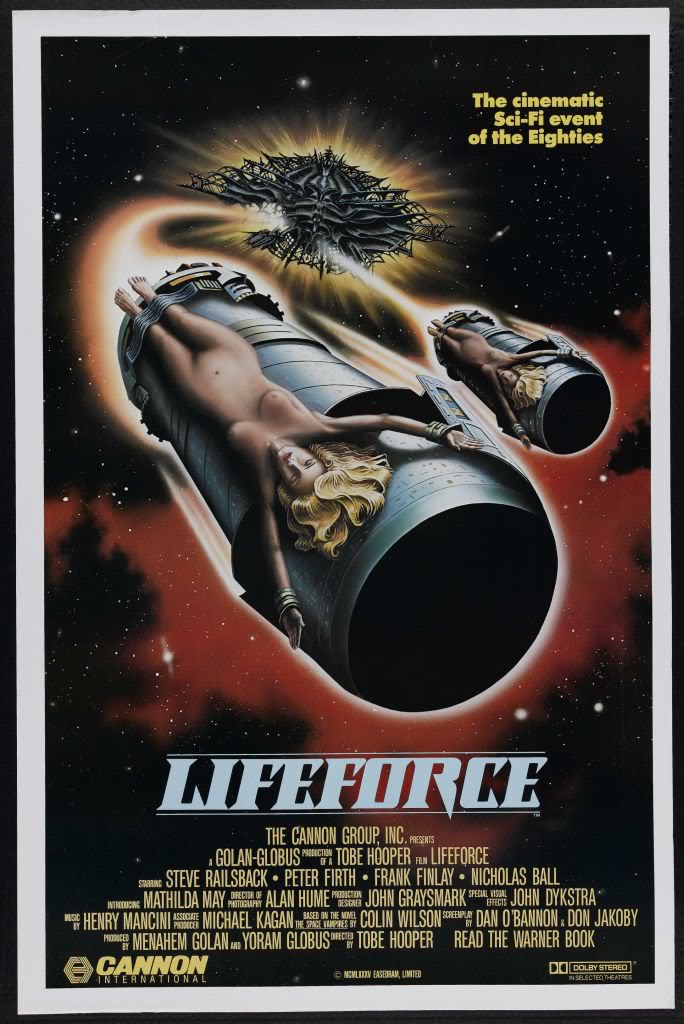
1985’s Lifeforce, directed by Tobe Hooper, was critically panned and barely registered at the box office. Yet in the decades since its release, something curious has happened: the film has gathered a loyal cult following among fans of science fiction and horror. Hooper’s film fuses so many genre conventions that it resists classification—too strange for pure sci-fi, too grandiose for standard horror. The result is a striking and eccentric reinvention of the vampire myth, a lavish but uncanny blockbuster that feels imported from an alternate cinematic timeline.

The film begins squarely in the realm of science fiction. Conceived during the public fascination with Halley’s Comet ahead of its 1986 return, Lifeforce rode the wave of comet-themed media flooding the decade. Most were cheap cash-ins. Hooper’s film stood out for its ambition and its visual scale.

Coming off Poltergeist, Hooper received an unusually large budget—a far cry from the lean, feral energy of The Texas Chainsaw Massacre. The story follows the crew of the shuttle Churchill as they discover a massive alien spacecraft hidden in the comet’s tail. Inside, frozen in suspended animation, are three humanoid figures. The ship’s dignified name feels ironic, even doomed; considering what’s to come, Demeter might have been more fitting. Like the sailors of Stoker’s novel, these astronauts inadvertently ferry an ancient predatory force home—yet this time, the threat arrives from the stars.

The horror unfolds once the crew retrieves its mysterious “specimens.” Members die in gruesome succession until only one survivor, Colonel Tom Carlsen (Steve Railsback), escapes in a pod back to Earth. Railsback’s performance is an intriguing mix of unhinged emotion and grim conviction. His intensity suits a film that constantly walks the line between pulp spectacle and cosmic tragedy.

When the story shifts to London, Lifeforce transforms into a supernatural thriller with procedural undertones. Peter Firth’s Colonel Colin Caine becomes the viewer’s compass: calm, authoritative, and determined to impose order on mounting chaos. As London succumbs to panic and outbreak, his steady professionalism anchors the outlandish events. His partnership with Railsback’s haunted, psychic Carlsen gives the middle act its volatile energy.

Among the supporting cast, Frank Finlay leaves one of the strongest impressions as Dr. Hans Fallada, a scientist fascinated by death and metaphysical energy. He serves as both philosopher and investigator, treating the vampiric invasion as a riddle of life itself. His restrained curiosity lends weight to scenes that might otherwise descend into absurdity. While the city collapses, Fallada studies the phenomenon with eerie calm, treating catastrophe as an experiment in cosmic entropy.

Patrick Stewart also makes a memorable, if brief, appearance as Dr. Armstrong, the head of a psychiatric hospital linked to the Space Girl’s psychic presence. His role builds to the film’s most grotesque and bizarre sequence: an exchange of minds, sudden possession, and an unnervingly intimate kiss with Railsback. The moment condenses everything Lifeforce represents—erotic, macabre, and unconcerned with boundaries. Stewart brings a gravitas that makes the absurd strangely compelling, a counterweight to Railsback’s volatility and Mathilda May’s silent allure.

May, as the unnamed Space Girl, says little but dominates the film through presence alone. She embodies an alien ideal of beauty and destruction, gliding through scenes with a composure that’s both sensual and predatory. Her nudity, much debated at the time, plays less as exploitation and more as elemental symbolism—the human body as an expression of both creation and death, desire and annihilation.

Supporting figures from the British military and government round out the ensemble, emphasizing the film’s descent into bureaucratic chaos. Michael Gothard’s Kane, a Ministry of Defence officer struggling to reconcile logic with the inexplicable, captures the helplessness of institutional order collapsing under cosmic threat. His pragmatic exchanges with Firth highlight competing instincts between reason and survival.

As the infection spreads, Lifeforce expands into a vision of urban apocalypse that fuses British science fiction and American spectacle. London becomes a nightmare tableau—crowds of shriveled corpses feed on energy while arcs of blue plasma swirl through the sky. The city’s fall evokes both George A. Romero’s zombie apocalypse and the metaphysical unease of Nigel Kneale’s Quatermass stories. Amid the insanity, Finlay and Firth remain the emotional touchstones, keeping the audience oriented as narrative logic begins to dissolve.

For all its ambition, however, Lifeforce suffers from erratic pacing and tonal whiplash. The first act unfolds with deliberate, moody wonder, then abruptly veers into frenzied exposition and psychic melodrama once the story reaches Earth. The balance between unsettling mystery and outright spectacle often collapses under its own weight. Scenes that should evoke cosmic terror sometimes tip into unintended camp, particularly in the dialogue-heavy middle stretch. Hooper’s direction, though visually imaginative, occasionally struggles to maintain coherence amid the script’s shifting identities—part creature feature, part disaster epic, part metaphysical drama. The editing, especially in the theatrical cut, undercuts tension with rushed transitions that leave emotional beats hanging. Railsback’s manic performance, while strangely compelling, can also verge on excess, blurring the line between conviction and chaos.

Tonally, the film wavers between awe and amusement. For some viewers, its earnest delivery will read as self-parody; for others, its collision of erotic horror and science fiction grandeur gives it a singular vitality. Lifeforce’s flaws are inseparable from its daring. It dares to fail boldly, and in that failure finds a kind of messy transcendence—larger than reason, too strange to fade.

In the end, Lifeforce lingers as one of the strangest hybrids of its era: part gothic fable, part erotic horror, part apocalyptic science fiction. It was too eccentric to find mainstream success, yet its sincerity and scope give it lasting resonance. The ensemble performances and tonal daring hold the film together, transforming potential chaos into something mythic—a story about possession, contagion, and humanity’s fatal pull toward the unknown.

Beneath its spectacle, the film engages in a deeper dialogue between gothic and cosmic horror traditions. Its characters represent a spectrum of responses to the incomprehensible: Fallada’s intellectual curiosity, Firth’s stoic resolve, Railsback’s frenzy, and May’s serene seduction. Together they form a portrait of human fragility in confrontation with the infinite. Where gothic horror finds fear in the collapse of reason, cosmic horror finds it in the vast indifference of the universe.

By fusing these lineages, Lifeforce becomes a mythic apocalypse that feels both intimate and vast—an encounter between flesh and void, terror and temptation. Its fusion of genres, ideas, and performances ensures its peculiar power endures, a reminder that some of the strangest failures of 1980s cinema are also its most visionary.

Review: A Dog Called Vengeance (dir. by Antonio Isasi)


I’ve always felt that a truly good movie should inspire the viewer to seek to confess something about themselves.  So here’s my confession.  When I was a toddler, I was mauled by a stray dog.  I don’t remember it, of course but I still have the small scars on my left arm as proof.  As a result, I’m scared of dogs and I always have been.  I jump when I hear one barking and the sound of one growling can easily set off a panic attack.  Whenever I see one nearby, regardless of whether it’s on a leash or not, my heart starts to race.  

For that reason, I suppose it was inevitable that a movie like the 1976 Spanish production A Dog Called Vengeance would get to me.

The film opens in an unnamed South American country.  Political prisoner Jason Miller escapes from a jungle prison.  As he flees, Miller runs into a tracker and the tracker’s dog, a German Shepard named King.  Miller kills the tracker and then continues to run.  King, after a few rather sad scenes in which he tries to revive his dead master, gives chase.

And that, in short, is pretty much the entire 108-minute film.  Miller runs and King chases.  Whenever Miller thinks that he’s safe (whether he’s taking a bath in a river or making love to a woman who has agreed to hide him), that relentless dog shows up and tries to kill him.   I have to admit that this movie did little to alleviate my fear of dogs because King is truly viscous.  The scenes were attacks both Miller and other assorted humans left me cringing and I don’t think it’s just a coincidence that Miller looks to be truly scared during some of the attack scenes.  King easily dominates the 1st half of this movie.

The 2nd half of the movie feels like a totally different movie from the first.  Jason Miller, having reached the city, is reunited with his comrades in the revolution.  Whereas the first half of the movie was almost wordless, the movie suddenly become a lot more talky as Miller and his associated debate the merits and morality of revolution.  Personally, I prefer the second half if just because a nice element of moral ambiguity is introduced here as it becomes pretty obvious that the “revolutionaries” are just as corrupt as the country’s dictator.  In the city, Miller finds himself still being pursued by his enemies but now his friends want him dead as well.  And, of course, that dog shows up again as well…

Anatonio Isasi’s direction is, for the most part, strong and Jason Miller (best known as Father Karras in the Exorcist) gives a good, low-key performance as the film’s lead.  But, of course, the real star of the movie is that damn dog and, despite not being a doglover, I have to admit that it did a pretty good job.  Not only did I believe that dog wanted to kill Miller but I believed that he easily could as well.  However, at the same time, it hard not to feel a little bit of admiration for King.  He was just so compellingly relentless in his pursuit.  It’s probably one of best unacknowledged canine performances in film history.

A Dog Called Vengeance is the epitome of the type of flawed yet oddly compelling film that could only have been made outside of the Hollywood system.  By refusing to shy away from showing either the full savagery of the dog’s attacks or in man’s response to those attacks, director Isasi manages to craft a political allegory that also works as a simple thriller.  By refusing to paint either Miller or the dog in purely black-and-white terms, he introduces a moral ambiguity that most Hollywood studios would never have the guts to even attempt.  Tellingly, the most shocking and disturbing scene in the film is not one of King’s many attacks on Miller.  Instead, it’s a scene in which our paranoid “hero” guns down an innocent dog while its 10 year-old owner watches in horror.

Unfortunately, A Dog Called Vengeance isn’t an easy film to find.  I saw it as part of the Grindhouse 2 DVD compilation and the transfer — taken straight from a VHS release — was terrible with frequently blurry images and terrible sound.  To a certain extent, this did give an authentic “grindhouse” feel to the experience of watching the movie but it doesn’t change the fact that it took a while to get used to just how bad the movie looked.  Luckily, the transfer seemed to improve as the film went on and, by the end of the movie, was no longer an issue.

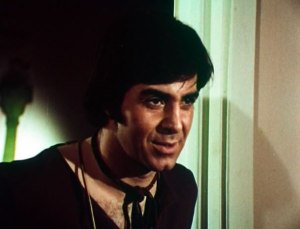
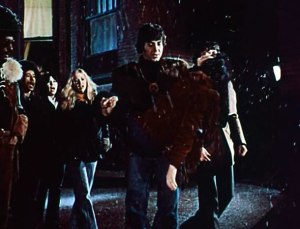
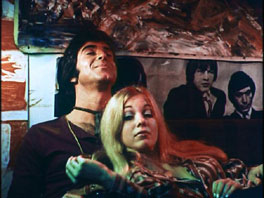
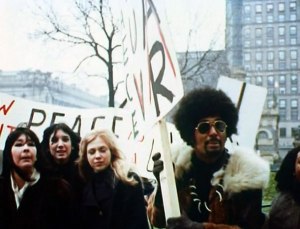
Review: Ghetto Freaks (dir. by Robert J. Emery)


During my freshman year of college, my roommate Kim often used to tell me that we were born several decades too late.  If only, she often lamented, we could have grown up in the 1960s and been part of that legendary counter-culture.  Her logic was that we both considered ourselves to be anti-establishment, we both felt society needed to be changed, and we both liked to get high on occasion.

I can see her point but honestly, I would never had made it as a hippy or, for that matter, even as a quasi-hippy.  For one thing, I hate being outdoors.  I’ve got too many allergies and crickets freak me out.  While I support free love, I don’t support practicing it with people who don’t shower on a regular basis.  I’m not going to argue with any woman who feels the need to burn her bra but quite frankly, I don’t want to wake up one day and discover that I can touch my boobs with my big toe.  Actually, that whole idea of running around day after day without any underwear on is just gross.  I don’t even want to think about it.

So, no, I could never have been a member of the 60s counter-culture.  But that doesn’t mean that I can’t watch the hundreds of films — some well-known but most incredibly dated and obscure — that have been made about and during that era.  Indeed, whatever knowledge I have the 1960s pretty much comes from my movie collection and movies like Ghetto Freaks.

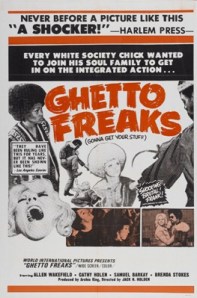
The production history of Ghetto Freaks is rather obscure.  Just to judge from the clothes and the dated lingo, it was originally filmed in 1969 or 1970.  The film, which is nearly plotless, was shot in Cleveland, Ohio.  I’ve never been to Cleveland (or Ohio, for that matter) and Ghetto Freaks — with its cold and gray urban landscape — hardly makes it look inviting.  Still, the fact that it was shot on location and that no attempt was made to hide the decay there, does bring an unexpected rawness to the movie.  Whether it was by intention or just the result of a low budget, director Robert Emery does manages to make the film’s ugliness oddly compelling.

The movie opens up with a bunch of hippies talking to a bunch of older people.  If you’ve seen any of the protest films of the 60s or 70s then you’ve already seen this scene a hundred times.  The hippies are told to get haircuts.  The hippies make the standard response about Jesus having long hair.  Fortunately, the cops arrive before the scene turns into the 2nd act of Bye Bye Birdie

This is the 1st of many awkward, predictable scenes in Ghetto Freaks.  Fortunately, this movie was smart enough to follow its bad scenes with good ones.  So, once the pigs have released him, the head of the hippies (a ruggedly handsome former drug dealer named Sonny) spends his night hanging out at a rather dingy club.  

How to describe the Club Sequence?  Well, you really have to see it to understand why I can’t get it out of my head but it all comes down to the a rather hyperactive singer who performs at the club.  This singer performs two songs.  The first features the immortal lyrics “My name is Mousey and I feel lousy.”  The second is an odd cover of the MC 5’s seminal “Kick Out The Jams,” (though, in the film, the song is kicked off by the singer shouting “Kick out the jams, brothers and sisters!” as opposed to the actual “Kick out the jams, motherfucker!”)  The two musical performances are energetic and — as opposed to the earlier “protest” scene — entertaining to watch and the singer’s flamboyance contrasts interestingly with the club’s drabness.

Of course, there’s more going on in the bar than just the music.  Sonny talks to the other members of his hippy commune.  He also turns down a chance to return to his old career of dealing drugs on the street.  These conversations have a rather nice, breezy air to them.  For the most part, the actors all give surprisingly natural performances and the dialogue — no longer full of platitudes — is occasionally even memorable.

One other important thing happens at the bar.  Sonny spots a pretty young woman named Diane who is fighting with her obviously upper class parents.  Sonny finds the time to invite her to drop by the old commune before she is dragged away by mom and dad.

Later that night, Diane makes her way to the hippie pad currently occupied by Sonny and 14 other hippies.  She and Sonny have a long talk about why Sonny and friends live the way that they do.  And I do mean long.  The conversation seems to drag on forever and it doesn’t help that everything Sonny says is a platitude along the lines of “War is bad for children and other living things.”  Fortunately, this scene is made barely tolerable by the fact that Sonny and Diane are both played by likable performers.  Sonny’s has a rugged charisma about him and Diane comes across as sincerely nice.  I haven’t ever seen either one of these actors (or for that matter, anyone in Ghetto Freaks) in any other movies and that’s a shame because the movie does boast some memorable performances.

Anyway, even as Sonny explains his world view to her, Diane is dropping acid for the first time.  Naturally this leads to a huge orgy in which the members of the commune dance around naked while Sonny and Diane make love on the floor.

(I have to admit I got a little bit jealous of Diane here because, back when I used to do that sort of thing, I never had a trip that resulted in an orgy.  I saw my face melting occasionally but never an orgy.  It makes me wish I had a “I Dropped Acid and All I Got Was A Lousy Flashback” t-shirt.)

As you might guess, the Ghetto Freaks orgy is the film’s best known scene.  Along with all the nude hippies dancing (and, credit to the film, all the hippies are seen nude and not just the females), we also get a lot of dark blue lighting and psychedelic music playing the background.  While undeniably erotic, there’s also something rather disturbing about the whole scene.  First off, with all the weird camera angles and nude onlookers, the scene immediately made me think about the Satanic “dream” sequence from Rosemary’s Baby.  Secondly, seen today, it’s painfully obvious that the film’s hero is essentially taking the virginity of a girl who has been drugged. 

Oh, there’s one other interesting thing about the orgy sequence.  Are you wondering yet why this movie about a bunch of white hippies is called Ghetto Freaks?  Well, it’s because of what happens towards the end of the orgy.  Suddenly, we’re no longer watching Sonny rape Diane while a bunch of nude hippies dance.  Instead, we’re confronted with the image of a tall, glowering black man who handles a knife while several women we’ve never seen before parade past him.  I don’t know how to explain just how odd and jarring this two-minute sequence is.  Beyond the fact that we’ve never seen any of these characters before (and we won’t see them after), the scene itself is obviously shot on completely different film stock from the rest of the movie.  The only thing that connects it to anything we’ve seen before is that droning orgy music which continues to play (albeit in rather muted form) in the background.  Yes, this sequence was inserted into the movie after it had already been filmed.  The producers, obviously wondering how they’d ever make their money back, inserted this scene featuring this unnamed black man so that they could then market this nearly entirely white film as a blaxploitation film.  That man and his “followers” are the Ghetto Freaks of the title and they’re in the film for all of two minutes.

Following the orgy, we are treated to a day in the life of a hippy commune.  Diane accompanies Sonny, Mousey, and the whole gang on a day full of passing out an underground newspaper, panhandling, and getting harassed by the pigs.   Meanwhile, the neighborhood drug dealers, angry that Sonny won’t agree to push their drugs, are plotting their own revenge on our counter-culture Adonis.  If you think all of this eventually leads to a tragedy you can see coming from miles away, you’re right.

Even though it’s hard (actually impossible) to top a drug-induced orgy sequence, the second part of the film does feature two memorable scenes.  The 1st one features the members of the commune (what should one call them?  Communers, maybe?  Communists?) standing out in the street, trying to convince people to give them money for copies of a free, underground paper.  Shot in a documentary,cinéma vérité -style, this scene is appears to unscripted and features the cast interacting with actual human beings.  As such, the reactions (most negative but some surprisingly positive) are authentic as opposed to idealized.  The cast themselves turn out to be surprisingly skilled at improvisation and this sequence features the film’s best dialogue (which could be considered back-handed praise when you consider that the scene was unscripted).  It helps that the scene was obviously shot on a very cold day and the cast was obviously suffering for their “art.” (Diane, in a surprisingly endearing moment, keeps asking people to look at how blue her frozen hands are.)  I’m not a big fan of panhandlers in general but this film does succeed in making it look like very hard work.

The 2nd sequence occurs at the end of the film, even as the end credits are rolling.  If the panhandling sequence represents the best of Ghetto Freaks, this 2nd sequence represents, perhaps, the worst.  Following the film’s sudden violence of the movie’s “tragic” conclusion, the actors suddenly go from grim-faced to smiling like a bunch of Broadway understudies who have just learned that the entire cast of the latest Grease revival was aboard a plane that crashed while landing.  They start hugging each other (except, of course, for the character who dies at the end of the film.  She just keeps lying there on the sidewalk) and giving each other high fives as the camera pulls back to reveal — yes, you guessed it! — the movie’s director and his crew.  There’s a forced whimsy to this and it’s hard not to imagine the director smirking as he talks about how much he loves Jean-Luc Godard.  Reminding the audience that they’re actively watching a movie (as opposed to reality) was, of course, one of the French New Wave’s major contributions to the language of cinema.  Unfortunately, in Ghetto Freaks, it just feels like a forced attempt at trendiness.  (If Ghetto Freaks was made today, it would be in 3-D.)

As I stated previously, my entire knowledge of the 60s counter-culture pretty much comes from how it was depicted in the movies of the era.  One of the things that I’ve always found interesting about these movies is that, regardless of whether the movie is a classic like Easy Rider or a big budget misfire like Getting Straight or even a Roger Corman B-movie like Psych-Out, they are all essentially so middle class in their attitude towards women.  Again and again, the message of many of these films seems to be that everyone should be allowed to “do their own thing” as long as they don’t have a vagina.  However, those of us who do were continually portrayed in much the same way that we were portrayed in almost every film released before and after 1967.  To be female means that you can either be worshipped or you can be punished but never dare to be an individual.  (For the most obvious example of this, check out Getting Straight, a film in which activist Elliott Gould pretty much spends two hours screaming at Candice Bergen for daring to have opinions of her own.)

This is a trend that continues in Ghetto Freaks.  For all the talk about how Sonny and his commune are all about freedom and allowing people to be themselves, it doesn’t change the fact that the female members are pretty much there to be pretty and sexually available to whoever wants them for the night.  Diane is accepted into the group not because she rejected the values of society but because she has sex with Sonny.  Add to this a scene earlier in the film in which our hero Sonny jokes about how his best friends “big-titted” sister was raped by a black man (“She was asking for it,” Sonny assures her brother who eventually agrees) and you end up with a very contradictory message.  I don’t necessarily have problem with the characters themselves being sexists.  To be honest, I prefer an honest sexist to a liberated liar.  What’s annoying is that this movie, like a lot of other so-called “counter-culture” films, does not seem to be aware of the double standard.

In true exploitation film-tradition, Ghetto Freaks was released and re-released under several different names.  Seeing as how much of the film plays out like a community theater production of Hair, the film originally had the much more appropriate title of The Age of Aquarius.  When that title didn’t exactly work wonders, the film was retitled The Love Commune.  Again, this was an appropriate (if rather banal) title that failed to attract an audience.  Finally, the film’s producers spliced that footage into the middle of the orgy scene and, hoping to appeal to the blaxploitation audience, renamed the movie Ghetto Freaks.

And it worked.

When it comes to exploitation, freaks will beat lovers any day.

Ghetto Freaks was released on DVD by one of my favorite companies, Something Weird Video.  As is typical with SWV, the DVD is actually a double feature.  The second movie is an earlier, drug-centered movie called Way Out.  Technically, it’s a far better movie than Ghetto Freaks but it’s also a lot less fun.

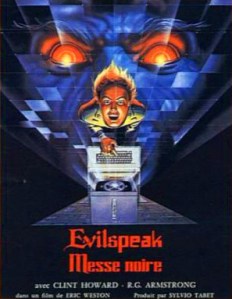
Review: Evilspeak (dir. by Eric Weston)


I first came across Evilspeak a few months ago when I was browsing through the selection of used DVDs at the Movie Trading Company in Plano, Texas.  Why did I feel so compelled to buy this movie that I had previously never heard of?  Of course, a lot of it was due to the fact that Evilspeak was a horror movie.  I have to admit that the vagueness of the title intrigued me.  I’ve long been planning on writing the ultimate slasher film and giving it the similarly vague title of Deathurge.  It also helped that the Evilspeak DVD was released by Anchor Bay and that it only cost $1.99.

A few nights ago, I sat down and watched Evilspeak for the first time.    It turned out to be, in many ways, typical of the horror films that were released in the early 80s.  (Evilspeak came out in 1981.)  However, thanks to a strong lead performance from Clint Howard and a few surprisingly dark touches on the part of director Eric Weston, Evilspeak turns out to be an oddly compelling little horror film.

Evilspeak opens with a lengthy prologue in which we see a Satanist named Esteban beheaded, along with several of his followers, by the Spanish Inquisition.  Jump forward several hundred years to a soccer game being played by teams representing two separate military academies.  The players are all typical jocks except for one pudgy, awkward fellow named Stanley Coopersmith (played by a very young Clint Howard).  Coopersmith manages to lose the game for his team.  The team’s angry response establishes that 1) this is not the 1st game that Coopersmith has lost and 2) all of his teammates are apparently psychotic.  His fellow players complain to their coach about Coopersmith’s lack of ability.  The coach replies that school policy requires that Coopersmith be allowed to play but if Coopersmith were to suffer some sort of injury (hint, hint) then they wouldn’t have to worry about school policy.  Seriously, has anything good ever come from soccer?

In many ways, Stanley Coopersmith might seem typical of the horror movie pariahs who always seem to end up asking Satan to kill their peers.  However, there are a few things that set Stanley apart.

First of all, he has one of the best last names in film history.  Coopersmith.  Just say it five times straight and see if it doesn’t get stuck in your head.  I’ve known plenty of Coopers and more than a few Smiths but I’ve never known a Coopersmith.  At first, I thought that maybe Stanley had one of those really cool hyphenated names and I was instantly jealous.  I’ve always wished my mom had done that when she got married so I could introduce myself as “Lisa Marie Marchi-Bowman.”  Of course, it’s probably for the best that she didn’t because if she had, I would have become obsessed with finding a mate with a hyphenated last name of his own just to see how long I could eventually make my last name.  But I digress.  Even though the film clearly establishes that there is not hyphen in Coopersmith, it’s still a great name.  When Stanley’s classmates insist on calling him “Cooperdick,” it just makes them all the more loathsome because not only are the insulting Stanley but they’re failing to recognize the beauty of a good name.

The other thing that sets Stanley apart from other movie outcasts is that he actually looks like an outcast.  He’s not a teen idol wearing a bad wig and prop glasses.  This is largely because Stanley Coopersmith is played by Clint Howard (as opposed to Ron Howard).  Pudgy with visible acne and a somewhat whiny voice, Clint Howard transforms Stanley Coopersmith into every kid that you ever felt sorry for but never dared to befriend.  Watching the movie, you feel sorry for Stanley but you never quite like him.  You’re on his side because every other character in the movie appears to be subhuman.

The film follows Stanley as he is continually attacked and humiliated by basically everyone else in the entire movie.  Now, as someone who did time at more than one Catholic school, I have personally experienced the fact that private schools really are a world of their own.  That said, however, Evilspeak’s military academy appears to be less a school and more some sort of elaborate and sadistic sociological experiment.  Seriously, is there anyone at this school who isn’t obsessed with tormenting Stanley?  (Actually, Stanley does have one friend but he’s kinda useless.)

Of course, one of the school’s problems might be that it has apparently been built on land that was once owned by — you guessed it — Esteban!  As the film opens, Coopersmith has found himself assigned to clean up the school’s chapel as part of a “punishment detail.”  While doing this, Coopersmith happens to stumble upon Esteban’s tomb and, in that tomb, he finds a lot of candles, what appears to be a fetus in a jar, and a black book that happens to have a Satanic symbol on the cover.  Intrigued, Coopersmith steals the book despite the fact that it’s written in Latin.

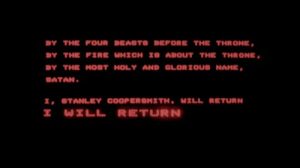
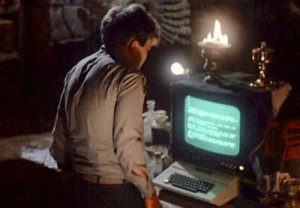
Luckily, this school has a computer!  Admittedly, Evilspeak came out four years before I was born so perhaps I’m not capable of understanding what the world was like in the early 80s.  Still, I’m always amazed to see the awe that computers were apparently regarded with back then.  Apparently, at the time, a personal computer was the ultimate elite status symbol.  All one needed to rule the world apparently was one bulky computer.  Fortunately, Coopersmith doesn’t want to rule the world.  He just wants to read his book.  He does this by typing the latin phrases into the computer and magically getting an English translation in response.  Thanks to his magic computer, Coopersmith discovers that the book was written by Esteban and  that Esteban worshipped Satan.

Coopersmith, of course, is amazed to discover this but we, the viewers are not.  After all, we’ve already sat through the entire prologue.  Unfortunately, it takes Coopersmith almost the entire movie to catch up to where we are from the beginning.  Fortunately, Clint Howard gives a good enough performance to keep the movie vaguely interesting even when it starts to drag.

Fortunately, after Coopersmith gets his translation, the action starts to pick up a bit.  For one thing, the book is stolen by the headmaster’s secretary (who, in an amusingly odd moment, smiles to herself as she listens to the headmaster paddling Coopersmith in his office).  For another thing, Coopersmith decides to get back at his enemies by conducting a black mass.  He does this by turning on his computer (which has now somehow been moved down to the tomb) and asking what he needs for a black mass.  Naturally enough, the computer tells him because it’s a computer and it knows everything.

But before Coopersmith can perform his black mass, he still has to be humiliated a few hundred more times by his classmates.  He also has to deal with a drunk janitor (played by R.G. Armstrong).  On top of that, he adopts a puppy.  Unfortunately, since Coopersmith is the school outcast, that also means that the puppy is fair game too.  After one night of heavy drinking, Coopersmith’s classmates (led by a kid named Bubba, so you know he’s evil) find his hideaway in the tomb and, for reasons that don’t quite make sense, they sacrifice his puppy.

(At this point, I was wondering if maybe it would turn out that the military academy was actually an insane asylum.  I mean, seriously —  on which level of Hell is this place located?)

Meanwhile, you remember that sadistic secretary that stole Coopersmith’s book?  Well, for whatever reason, she is obsessed with trying to pry that Satanic symbol off the cover.  Unfortunately, since she’s the only prominent female in an early 80s horror movie, this can only mean that she’s destined to meet a bloody end while taking a shower.  Which, in this movie’s best known scene, is exactly what happens.  However, she doesn’t meet her end at the hands of a knife-wielding psycho.  Instead, she’s attacked and ripped to pieces by a bunch of rampaging pigs.  And yes, the whole thing is faintly ludicrous and yes, the low-budget gore effects are undeniably crude, but it’s still an undeniably effective sequence.  Perhaps its due to the fact that pigs, in general, are filthy.  Don’t even get me started on pigs.  However, it must also be admitted that, though his direction is often time uninspired, Eric Weston shows an undeniable talent for capturing chaos.  I am not ashamed to admit that I had pig-related nightmares after seeing this movie.

Following the death of the secretary, the book mysteriously reappears in Esteban’s tomb.  Coopersmith finds it the next morning along with the corpse of his puppy.  Obviously, this is all it takes for Coopersmith (with the help of his computer) to carry out his black mass and to finally take his revenge.

Of course, the whole point of a Nerd-With-Powers movie is the finale where that nerd takes vengeance on his tormentors.  If this scene is pulled off with even the slightest amount of panache, it can make up for almost everything that’s come before it.  The prom inferno from Carrie pretty much set the standard by which all others are judged.  Personally, it’s hard for me to think of any movie that could improve on the final house party massacre in The Rage: Carrie 2.  After all, how can you top a blinded Rachel Blanchard accidentally shooting the oldest Home Improvement kid in the balls with a spear gun?

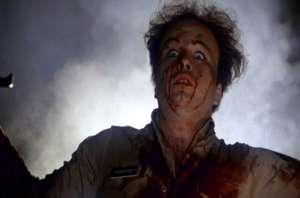
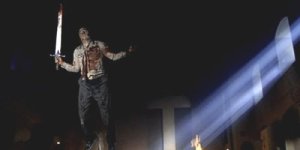
Evilspeak doesn’t quite reach those heights in its finale but it’s still pretty effective.  If nothing else, the sight of Clint Howard wielding a sword while flying above his tormentors is a lot more effective than you might think.  Over the next few minutes, spikes are drilled into foreheads, heads are chopped off, hearts are ripped out of chests, and those pigs show up again.  The gore effects here are undeniably crude but oddly effective.  This sequence (along with the previous pig shower attack) actually inspired a few nightmares the night after I saw Evilspeak.

In the end, Evilspeak is an odd little movie.  While the plot should be familiar to anyone who has ever seen a horror film, there’s a real nastiness at the core of Evilspeak that distinguishes it from other genre offerings that came out during the same period.  At times, Evilspeak almost feels like an Italian film which is probably why I found it to be so oddly compelling.

The Evilspeak DVD features a commentary track featuring both Clint Howard and the film’s director.  I always feel some trepidation before listening to a commentary track.  Too often, the track turns out to just be some jerk explaining how he financed the film for two hours while commenting not at all on the action on-screen.  (For the most part, if a commentary track features any anecdote that begins with, “We had the same lawyer…” you know you’re in trouble.)  However, the Evilspeak track is surprisingly enjoyable.  Clint Howard comes across as a surprisingly likable, levelheaded guy and its interesting to contrast his odd wholesomeness with the action onscreen.

In the end, Evilspeak may be a piece of junk but it’s an enjoyable piece of junk.

A Second Review of The Losers (dir. by Sylvain White)


Usually, I’m not a big fan of action movies.  If you see me in the audience of an action movie, it means that I’m either 1) on a date with a guy who really doesn’t care if I’m bored out of my skull, 2) the movie is actually a film with action as opposed to an action film, or 3) there’s absolutely nothing else playing.  It was because of that third reason that yesterday afternoon, I could be found at the Regal Keystone, watching The Losers.

Surprisingly enough, however, I ended up enjoying The Losers.

Why?

Six words: Idris Elba, Jason Patric, and teddy bear.

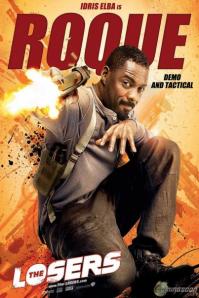
Idris Elba.  Oh God, where to start?  I think Idris Elba may be one of the best actors working today.  If you’ve seen him in The Wire then you’ve seen him as an intimidator.  (And, admit it, The Wire was never as good after Stringer Bell got killed.)  If you’ve seen him on The Office than you know that Elba can also be unexpectedly funny.  In the Losers, Elba gets to be both scary and funny at the same time.  (And incredibly sexy though I doubt that’s going to be a big selling point for this film’s target audience.)  Idris Elba manages to look convincing while both blowing things up and, during one of the film’s many postmodern moments, commenting, “Wow, this is sleazy.”

Elba plays Rocque, the second-in-command of a paramilitary group known as the Losers.  Much like the A-Team and the Expendables (both of which will be coming along later this year), the Losers are betrayed by their government and wrong declared dead.  They — a glowering Elba included — find themselves stranded in Bolivia where they pass the time working in a doll factory, betting on cockfights, and plotting vengeance against Max.

Who is Max?  This question is at the center of The Losers and it’s never really answered (perhaps it will be in the sequel).  It’s insinuated throughout the film that he’s involved with the CIA, that he’s a terrorist, or that he’s just a patriotic businessman.  Of course, the answer is that Max is actually Jason Patric (a.k.a. the son of Father Damien Karras). 

I have to admit that, in  the past, Patric has never really impressed me much as an actor.  In the past, he’s always seemed a bit stiff and humorless.  Patric plays Max as a man who is not only a comic book villain but who is totally aware of it as well.  You can tell that Max is having a lot of fun being evil and that Patric is having fun playing evil.  Patric’s over-the-top but compelling villainy let’s the audience know that this movie has no pretensions beyond entertainment.  It makes both Patric and the film enjoyable to watch.

And this leads us to the teddy bear.

At the start of the movie, the Losers are rescuing a bunch of children who are being held hostage by some random bad guy in Bolivia.  As they load the thankful children into a waiting helicopter, an angelic little boy attempts to hand over his teddy bear as a thank you gift.

“No,” Col. Clay (Jeffrey Dean Morgan) replies, “you keep it.  It will bring you luck.”

The angelic child smiles and clutching his teddy bear, he goes into the helicopter.  The helicopter then lifts up into the air and promptly explodes.  As the Losers stare at the burning wreckage, the camera zooms in on the only thing that apparently wasn’t incinerated in the explosion. 

Yes, it’s the teddy bear.

And as soon as I saw that, I knew that the Losers was going to work.  I soon as I saw that teddy bear, I knew that this was a film that felt no shame at being a work of pure pulp fiction.  In this age when every studio film is trying to feel independent and when most filmmakers would be too self-consciously hip to actually do something as shameless as show that little bear among the wreckage, the Losers went for it.  The Losers said, “We don’t care if it’s an obvious move and thoroughly illogical for a teddy bear to survive — with just a few burns — an explosion that so totally incinerated 25 people that not a single body part is seen among the wreckage.  We’re showing the damn bear!”

That’s when the Losers won me over.

A few more random thoughts on The Losers:

1) As Arleigh pointed out in his review, one of the film’s biggest strengths is the chemistry of the Losers themselves.  As opposed to most ensemble action films, all of the Losers are given clearly definable personalities, all of them are given something important to do, and most importantly, you believe that these guys would actually choose to hang out together.  When one of the Losers is eventually revealed to be a traitor, you feel the entire group’s shock and pain.  This adds an extra layer to the film that, for whatever reason, I suspect we won’t be seeing with The A-Team.

2) The Losers is yet another film that demonstrates the importance of not only walking in slow motion but having something to throw to the side while doing so.  It just looks incredibly cool on-screen though people tend to get annoyed when you attempt to do the same thing in real life.

3) Throughout the movie, we are continually told that The Losers are waging war on the CIA and the American establishment in general.  The audience I was with loved this.  Once again, this validates my theory that the best reflection of the times can usually be found in contemporary pulp.

4) Zoe Saldana is in this film too as a mysterious woman who helps the Losers track down Max.  In the style of Carrie-Ann Moss and the Girl with the dragon tattoo, she gets a chance to kick a lot of ass and I have to admit that I found this so inspiring that, once I got home, I stripped down to my undies, stood in front of my bedroom mirror, and attempted to execute a few flying kicks of my own.  The lesson I learned from this is that I’m not Zoe Saldana.  That and, regardless of how soft the carpet is, it still hurts when you end up falling flat on your ass.

In the end, The Loser is the perfect definition of stupid fun.  I’ll take stupidly fun over funny stupidity any day.

10 Reasons Why I Hated Avatar


(The opinions in this review are mine and mine alone.  They reflect the feelings of Lisa Marie Bowman and not the feelings of any other editor on this site.  To prove that the opinions below are solely mine, check out this very positive review of Avatar that was posted on this very site last December.)

In case you didn’t already know this from my previous reviews, I’m going to confess something here.  I hated Avatar.  It was probably my least favorite film of 2009.  How much did I hate Avatar?  Well, I didn’t care much for The Hurt Locker either but I still cheered when it won best picture because it meant that Avatar didn’t. 

Most of my friends and family loved Avatar and, I’m proud to say, that none of them have allowed our difference of opinion to effect our relationship.  Indeed, most Avatar fans have been very tolerant of my dissenting views.  However, there’s always an exception.  From the 1st time I ever openly admitted to disliking Avatar, I have had to deal with a small but vocal group of people who not only disagree but apparently feel that I’ve committed a crime against humanity.  So, why bring it up now?  Because on Thursday, Avatar is going to be released on DVD and Blu-ray.  In honor of that event, here are 10 reason why I personally hated Avatar

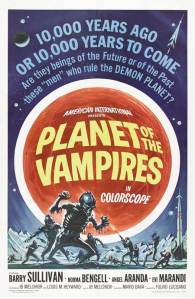
1) Ironically enough, most people who love Avatar will probably agree with the majority of my criticisms.  They’ll argue that yes, the story is predictable and yes, James Cameron is heavy-handed as both a writer and a director but none of that matters because of all the brilliant visual effects.  They’ll argue that Cameron made a whole different world, Pandora, come to life.  To a certain extent, they’re right.  Cameron does manage to make Pandora believable and wow, Pandora certainly turns out to be a boring planet.  Seriously, does that jungle cover the entire freaking planet?  However, regardless of my personal feelings about Pandora, James Cameron is hardly the 1st director to make an alien world believable.  Peter Jackson did it with his Lord of the Rings trilogy and the same can, arguably, be said of the Narnia films.  Even earlier, Mario Bava did it with Planet of the Vampires and he did it with a lot less money.  Of course, none of these films were in 3-D but so what?  Just because the mundane appears to be inches in front of your nose doesn’t make it any less mundane.
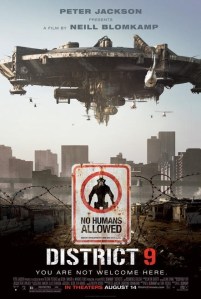
2) Speaking of mundane, wouldn’t you be let down if, when you first met the members of a totally alien race, they all turned out to be a bunch of movie stereotypes?  The Na’vi appear to have developed their entire culture as the result of a steady diet of Hollywood westerns, New Age self-help books, and some 16 year-old’s half-assed understanding of what it means to be a Pagan.  I remember when I first saw Avatar, it was impossible for me not to compare it unfavorably with District 9, a film that addressed many of the same themes and issues as Avatar but did it with a much lower budget and a much more intelligent script.  This was especially evident when one compares Avatar’s Na’vi with District 9’s prawns.  While the prawns were believable as both individual characters and as representatives of a totally alien race, the Na’vi are essentially the reflections of James Cameron’s sophomoric noble savage fantasies.

3) District 9 wasn’t the only great science fiction film to come out in 2009.  There was also Moon, which featured a great performance by Sam Rockwell and excellent direction from Duncan Jones.  When /Film asked Jones for his opinion of Avatar, Jones replied, “…at which point in the film did you have any doubt what was going to happen next?”  It’s a good question. 

In all honesty, I’m a horror girl.  I haven’t seen much science fiction and therefore, I’m not as well acquainted with the genre’s clichés as I am with horror.  However, I can still say that, at no point, did anything that happened in Avatar take me by surprise.

Of course, some of my favorite movies were (and are) very predictable.  Georges Polti argued that there were really only 36 basic plots available to use in fiction so its understandable that you’re going to come across the same one used several times.  However, a predictable plot can be forgiven if maybe that plot features at least a few interesting characters or maybe an occasional unexpected line of dialogue.  Avatar, however, can’t even manage this.  Our hero is an impulsive man of action.  The villains are all evil because … well, they just are.  In the manner of most oppressed races in American film, the Na’vi are noble savages who require a white guy to come save them.  The only lines of dialogue that I remember are the ones that made me roll my eyes.  I’m talking about stuff like a bunch of 22nd century marines being greeted with “You’re not in Kansas anymore.”  Well, that and “I see you,” which was apparently included in the script so that it could serve as the title of a syrupy theme song.

4) Strangely enough, even though the movie took absolutely no narrative risks, it was still full of plot holes and things that just didn’t make much sense. 

For instance, why does Quaritich promise to give Jake back his legs (“your real ones”)?  I mean, does Quaritich have them sitting in a freezer somewhere? 

As part of his deal with Quaritich, Jake agrees to make videos about the Na’vi.  Oddly enough, it appears that he’s still making the videos even after he turns against Quaritich and you have to wonder exactly why.  Also, Jake records many of these videos in an isolated, apparently one-room outpost occupied by him and two other scientists yet the scientists are later shocked and outraged when told that Jake was making the videos.  Okay, what did they think he was doing all that time?  Were they just not listening to what he was saying? 

What exactly was the backstory of Sigourney Weaver’s character and when exactly did she join Sully in the Na’vi camp?   And why were the Na’vi willing to let her into their tribe when they would only grudgingly accepted Sully even after the Goddess selected him?  I mean, if Weaver already had such a great relationship with the Na’vi, it seems like she could have saved a lot of time by just taking Sully straight to them.  (Editor’s Note: According to the comments below, this issue actually was addressed in the film. — LMB)

Sully, after the final battle, decides to stay on Pandora and he might as well since the Tree of Souls (good God!) transferred his soul into his Na’vi body.  But what’s in it for Max and Norm?  We seem them at the end (though really, Norm should be dead) standing there pointing guns at all the humans that are leaving.  Norm, at least, could still probably hang out in his avatar but what about Max?  Why is Max, who has had nothing to do with Na’vi, so quick to join the revolution?

I’m sure a lot of this is because scenes were edited out and I know that Cameron has a reputation for reinserting those scenes once his movies come out on DVD and blu-ray.  Well, more power to him.

5) The film suffers from a really bad case of the white man’s burden disease.  This is another one of those films where a caucasian character befriends an oppressed minority and, with remarkably little dissent, manages to appoint himself as the leader of that minority.  It’s a fantasy, one in which members of the bourgeoisie (like James Cameron) can live out their childhood fantasies of being outlaws without having to worry about  (unlike actual “outlaws,”) being punished for taking their stand.

Once again, it’s hard not to compare Avatar with District 9.  Both of them feature lead characters who are transformed into aliens.  The difference is that, with the exception of one brief scene, Jake Sully accomplishes the transformation rather easily and quickly becomes the best Na’vi there is while in District 9, poor Sharlto Copley is terrified by the process and, even though it does lead to him understanding the prawns (and ironically, learning how to show a little humanity), the movie never pretends that Copley isn’t losing his own individuality in the process of transforming.
6) The lead character is named Jake Sully.  Did James Cameron get frustrated and just use a Random Generic Movie Hero Name Generator to come up with that?  I wonder if Nick Sully was Cameron’s 2nd choice.  It’s not that there’s anything wrong with either name.  It’s just that it feels so generic.  Of course, the leader character is going to be named Jake and, of course, he’s not going to be an intellectual and, of course, Sigourney Weaver’s going to spend the whole movie making sarcastic comments about how stupid he is.  Speaking of which…

7) Sigourney plays Dr. Grace Augustine.  Her character and her performance are typical of a rather annoying Hollywood tradition, that of portraying any “strong” female as a total and complete bitch.  If you want the audience to know they’re supposed to take a woman seriously, have that woman spend the entire movie pissed off about something, as if the only way a woman can be strong is by sacrificing anything that might make her unique.  Now, there’s a lot I could say about why, from a cultural perspective, American movies often seem to be so conflicted about how to portray any woman who is neither an Eve nor a Lillith.  But in the case of Avatar, its hard not to feel that it comes down to screenwriter Cameron’s inability to make any of his characters interesting unless something nearby is exploding.

8 ) And while we’re on the subject of misunderstood women…okay, let’s say you discover a planet and this planet is a lush, beautiful paradise.  Why the Hell would you then call it Pandora?  Yes, I understand that newly discovered planets are usually named after mythological figures.  But there’s still usually some sort of vague logic behind the names.  For instance, Mars was named after the God of War because of its red hue.  Venus was often considered to be the most beautiful star in the sky.  Mercury has the fastest orbit.  Jupiter’s the biggest planet.  Pluto (before it got downgraded) was considered the darkest and coldest of the planets.  Pandora, however, was the woman who opened up the jar that released everything terrible, evil, and destructive into the world.  Why would anyone name a planet after her?  It’s possible, of course, that all the good names were taken.  Of course, it’s also possible that this is just another example of how thuddingly obvious Avatar is in its symbolism and subtext.

9) Speaking of obvious, what about the villain played by Stephen Lang?  More specifically, what about that accent?  It’s true that Cameron doesn’t exactly encourage his villains to be subtle.  Just check out Billy Zane in Titanic.  Zane, however, at least appeared to be having a little fun at his director’s expense.  He, alone among the cast, seemed to realize that Titanic was a silly melodrama and so he gave something of a silly performance.  It’s no great secret that it’s often more important to have a good villain than to have a good hero.  A good villain usually has some sort of motivation beyond just being the villain.  This is something that Cameron has never seemed to be able to grasp.  Whenever I see a military figure show up in a James Cameron movie, I get the same feeling that I get whenever a preacher shows up in a Stephen King novel.  Automatically I know that they’re going to turn out to be evil and I find myself dreading having to even waste the time with the “shocking” discovery of that evil. 

10) Perhaps most importantly, this is a movie that wants to preach peace but celebrate war.  Avatar contains all the trendy environmental messages that you’d expect from a Hollywood film but — even though director Cameron seems to be in a state of denial about it — the film’s heart is with its villanous soldiers.  Much as how Titanic, for all the rhetoric about the passengers in third class, was really only interested in portraying the lives (and deaths) of those in first class, Avatar spends a lot of time talking about trees but is much more interested in blowing them up with the destruction of the Home Tree serving as the money shot.

To be honest, I don’t mind a little hypocrisy when it comes to movies.  Most exploitation films celebrate hypocrisy.  The filmmakers knew it and, for the most part, the audiences knew it.  The fact that a movie like Child Bride could be advertised as “an important movie every parent must see!” became something of a shared joke between the filmmaker and his audience.  Rather than being hypocritical, the exploitation filmmaker is simply inviting his audience to join in a conspiracy against the forces of dullness.
Unfortunately, Avatar is not an exploitation film.  If Avatar was simply a B-movie, none of the my previous complaints would matter.  They would add to the film’s rogue charm.  Avatar, however, is too expensive to be considered an exploitation film.  And James Cameron, as he proved when he went ballistic over Kenneth Turan’s negative review of Titanic and as he has continued to prove with his recent comments regarding global warming, does not have the sensibility of a B-movie maker.  Arguably, he once did.  This is a man who, after all, did the special effects for Galaxy of Terror and made his directorial debut with Piranha IIThe Terminator was a great B-movie, right down to the accusations of plagiarism from Harlan Ellison.  However, as he’s become the most financially succesful director in history, Cameron has lost that B-movie sensibility. 

In other words, James Cameron takes himself seriously now and that, ultimately, is the main reason I hated Avatar.  It just takes itself too damn seriously.

Yes, I’ve read quite a few favorable reviews that have argued that Avatar‘s sole purpose is to entertain and that people like me who occasionally expect unique characters and an interesting story should just lie back and enjoy it.  I’ve seen the term “popcorn epic” used in quite a few reviews. 

I’m sorry but I’m not buying it.  If Avatar was truly setting out to be a “popcorn epic,” than I’d be a lot more willing to cut it some slack.  However, when the script contains lines about how on Earth, humans have “destroyed all the green,” and when the villains are accused of launching a “shock and awe” campaign, it’s ludicrous to then argue that Avatar isn’t setting itself up to be judged by a higher standard. 

It becomes hard to escape the fact that Cameron, regardless of how well he handles the special effects, has essentially made a stupid movie about deep issues.

As I said before, the majority of the people I know love Avatar.  I don’t hold it against them or think any less of them because, ultimately, movies are a subjective experience.  Whether or not a movie is good has less to do with the actual movie and more to do with the person watching it.

It would be nice to have the same courtesy extended to me .  Since I first revealed my opinion of Avatar on a non-Avatar related message board, I have found myself frequently attacked by little fanboys who apparently cannot handle the fact that one human being didn’t enjoy Avatar.  I’ve been told that, as a female, I can’t be expected to understand Avatar.  I’ve been accused of being “unimaginative,” “a snob,” “a bitch,” and my personal favorite “the type of cunt who cried at the end of the Blind Side.” 

I realize the risk I’m taking by openly admitting my dislike of Avatar but then again, movies are supposed to inspire conversation and not just pavlovian agreement.  So, in conclusion, I’ll just admit that yes, I am female and yes, I did cry at the end of The Blind Side, and yes, I hated Avatar.